
Autobiographical Reflections
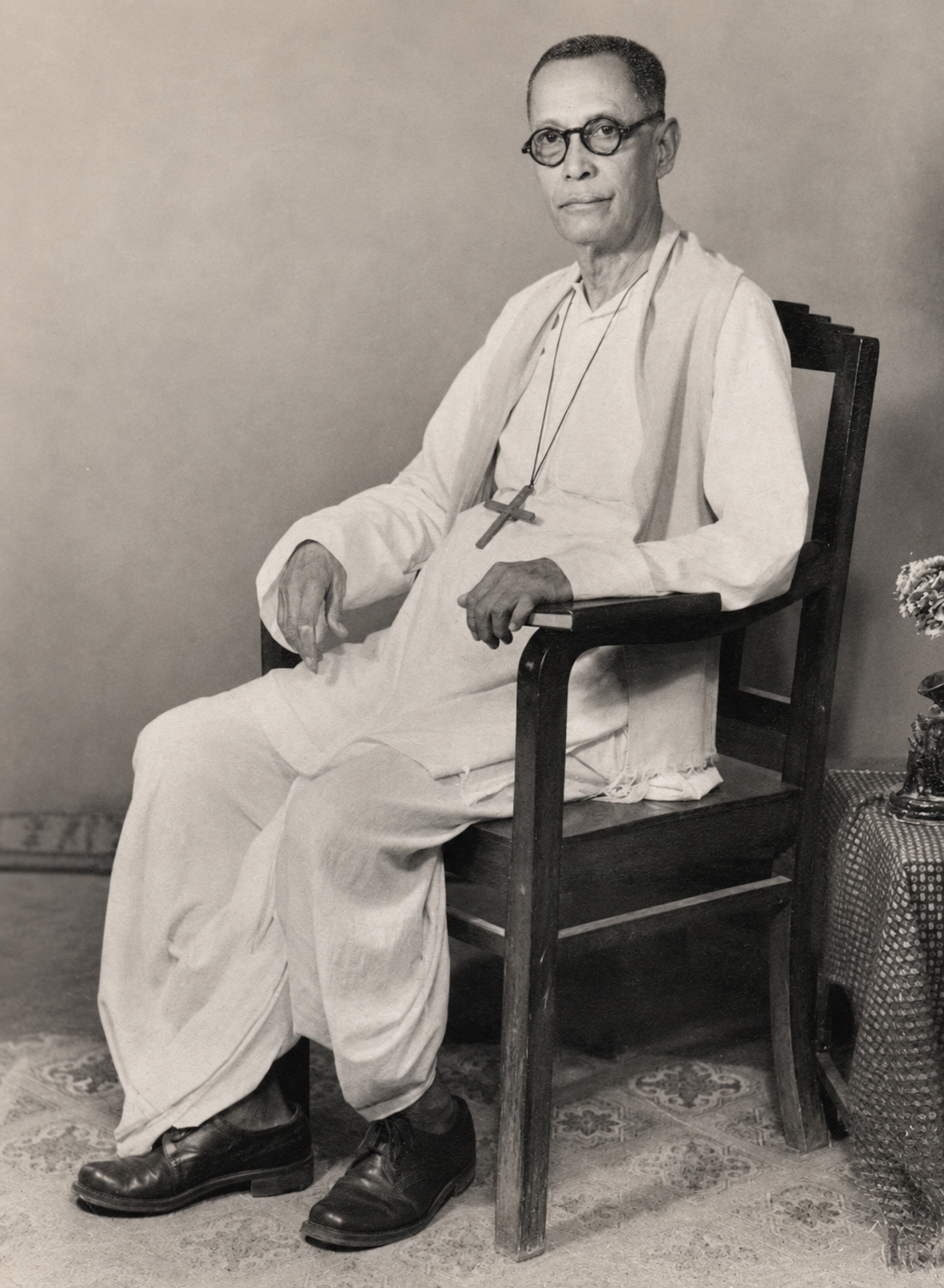
Dedicated
To those who are in darkness of sin, superstition, and evil custom and all forms of bondage all power of evil
In the name of Jesus Christ who is the Way, the Truth and the Life - the Eternal the Son of God and the Saviour and Lord of all men.
To be had at:
Khristpanthi Ashram
129 Dashashwamedh Road
Varanasi, (Uttar Pradesh)
India
Acharya Rajendra Chandra Das, B.A. Hons. (Sanskrit and Philosophy), M.A. (Philosophy), Shastri (Calcutta Pandit Gosthi), Vidyaratna (Nadia Pandit Mandal), Vidyaranjan (Bharat Dharm Mahamandal, Varanasi)
Formerly Professor of Sanskrit and Philosophy (St. Paul’s College, Calcutta, 1913-1918 and St. John’s College, Agra, 1918-1922), C.M.S. missionary (Kustia-Nadia, 1922-24), Church of God Mission (Kurigram-Rungpur, 1924-30), organising evangelist Benares United City Mission (1930-47), Acharya Khristpanthi Ashram (1930-to date) (Also, former member of N.C.C. and U.P.C.C., of C.M.S. Commission, Hon. Missionary and member of all India council of N.M.S., Executive Secretary and Palak Pramukh -Bharat Khrist Sangh)
Books by the author:
- Khrista Sangit (Bengali hymnbook)
- Ishwaropasana (a manual of worship and prayer and meditation in Bengali)
- How to Present Christ to a Hindu (a pamphlet in English and Hindi) published by Allahabad Tract Society
- Convictions of an Indian Disciple - published by the Christian Institute for the Study of Religion and Society
- God’s redemptive Acts and Creative Dealings (English)
- Whither Christian (Bengali)
- Editor - Did Jesus come to India (Bengali)
Editor - The Seeker, The Seeker and Pilgrim, and The Church of Christ, 1947 to date
Chapter 1
In the Dream Land
(On the lap of nature)
My Infancy and Boyhood
Infancy is an age of Mystery. Every thing is strange, wonderful, beautiful and fearsome too, both inside and outside in the home and out in the nature. It is also a time, of wishfulness and unanswered questioning. Boyhood is a stage of wondering, imagination, idealism and bold adventure and of acts popularly known as boyish “pranks”. At this time crude attempts were made to unravel what looks mysteriously secret and often fearful. So freedom and bravery, even licence and boldness mark this period. As I look back and study my early life this is found true.
I saw for the first, time the light of this world in 1887 in a hamlet called Shyampur, the city of the Blue one, Srikrishna, the supreme Avatar of God in Hinduism. This small village is about 3 miles From my home and 12 miles distant from Dacca, the second city of the then, united Bengal, later Capital of East Pakistan, and now of free Bangla Desh. This village Was the home of my maternal grandmother my mother’s aunt who brought her up after she had lost her mother, and married her to my father who lived at Amarpur 3 miles away from Shyampur (Amarpur means the immortal city or the city of the immortals). So it is clear that I was not born in my Father’s house, But was, after birth, brought up THere. It is a common custom in Bengal that the birth of a child is arranged to take place among the folks of its mother. None could imagine that my mother was, soon to pass away, when I was three-years old. I still Have a faint impression of mother’s great affection and her beautiful face. From all who knew her I learnt later that she was indeed a beautiful daughter of the village. She died suddenly from an attack of Cholera. I can see now the will of God in it so that I might grow in life through hardship, difficulty, and struggle.
This village of Shyampur, my birthplace has always remained a romantic place for me. It consisted of a dozen homes, houses of my grandparents, uncles and cousins possessing extensive lands and gardens, a mali or malakar (a gardener who rears flowers), a bhuinmali (village scavenger), one or two ironsmiths and goldsmiths, a few fishermen and carpenters, a grocer and a rich and large family of Sahas (technically untouchable though very clean and religious, of Vaishnava persuasion) and one solitary family of priests (Brahmins).
The Saha family carried on trade and commerce and acted as bankers of the village. There were some Muslims in the neighbourhood. I did not, in those early days, know much about them, except that they were Yavans (untouchable), ate forbidden food (cow and fowl) and were enemies of Hindus. I still remember with some happy feeling and admiration how beautifully the girls of the malakar family made garlands of sweet smelling flowers of various hues and sizes and went about to the Krishna temple in the Saha family and to other families especially on auspicious occasions such as marriages and other domestic and social festivals and Pujas (worship of Gods and Goddesses). They did not so much expect cash for their artistic and lovely creations as clothes, grains and other presents on these occasions. The Bhuinmali in the same way served the homes during marriages and Shradha (funeral ceremonies and solemn obsequies performed in honour, and for the peace of the manes of deceased ancestors) and kept the village paths clean. He received in kind what he needed for his family. Craftsmen and artisans who supplied the village with implements and other necessaries of life also lived in the same way. The Sahas and other rich men in the villages (goldsmiths) lent money on reasonable interest, and sometime without interest, to the poor. From times, immemorial the village economy of India was simple, cooperative, self-contained, self-supporting and self-sufficient. These units were known as the village republics of ancient India, to Which Mahatma Gandhi drew pointed attention of Congressmen and the Rulers of India.
The natural scenery in and around my home was satisfying to the heart and imagination, health and delightful to the eyes. Prosperous crops of various kinds all through the year in the ups and downs of the fields. The fruit trees - mangoes, plantains, watermelons, jack fruits and plums. The huge Bat and Pippal or Ashwattha (the banyan pair). The dates and Palmyras. The profuse flowers grown both in the homesteads and wild in the jungles. The bamboo clumps, the various birds, bees and crickets singing different tunes in different seasons and in different hours of the day and night. All these and many other things such as large herds of cattle leisurely grazing in the wilds and marshes: the cultivators busy ploughing or harvesting: rows of women and children with their earthen pitchers rested on their lion sides going to the nearby river often infested with crocodiles and tortoises and big fishes and to the village pond studded with blue and red lotuses and filled with smaller fishes; swarms of ducks and geese playing and swimming in the water in course, of search of their daily food: all these indicated peace and prosperity, contentment and happiness. Where has it gone now from the village life, this beauty and bounty of nature and the natural freedom and joy of social life? We have had the domination of machine civilisation over a period of nearly two hundred years during the British occupation of India and the spell of this industrialist, and materialistic power still continues and grows.
Shyampur with its towering “Math” (a tapering masonry structure over the tomb of a noted ancestor) visible from a distance was not my father’s home village as I have already mentioned. I was born there, but was mainly brought up at Amarpur where my father had his home. But my mother spent a couple of months every year in her aunt’s place along with me during my infancy and I grew up in an atmosphere of great love of the relations of my grandma especially in the fondling affections of my senior cousins. There was an incident about this time when I was just able to stand up. Over Which my grandma was seriously upset and naturally unhappy and apprehensive. This I came to learn from my father after I became a Christian. It is said that one year when for the worship of Lakshmi (goddess of wealth and prosperity) the miniature image of the goddess was set up in the house with all paraphernalia and just at the start of the worship, I, an infant of two years, stood close to, and in front of the image and inundated it with my urine. Everybody and especially grandma was shocked. The Puja was stopped, and the room was cleared and cleaned of nice and good things. All interpreted this happening as very inauspicious and as an evil omen. Almost immediately after, my mother suddenly died leaving, me a child of less than 3 years, an orphan, but not quite, I fell in the strong and loving arms of my father. They could not hold me responsible as I was an ignorant innocent child but after my conversion they recalled the incident as a prophetic pointer to the fact, that I would reject my ancestral religion.
Though I grew up under the direct and fostering care of my affectionate father, I could not forget Shyampur its rustic beauty and charm and never my grandma who lavished her love and all good things on me so long as she lived.
I soon entered the village Pathshala (primary school) at Amarpur and as soon as the summer holiday would come, I would automatically, and sometimes unnoticed, walk over the three miles to grandma’s home. I would spend the entire holiday a month or so every year in the fruit season in most pleasant surroundings. I do not remember if I at any time missed my mother. Though feelings of filial affection have come later in life through reflection. Grandmother possessed a grove of mangoes and several other fruits. I would enjoy these fruits fresh from the trees several times a day particularly the delicious dish of mango, milk, rice gur (molasses) and sugar. For this dish of food many, both children and elders in my time would go to relative’s houses in the summer. Especially son’s-in-law and daughters with grand children would be invited by the parents and grandparents. Fruit in a great variety and large quantity, and cheap too, was a feature of summer life in Bengal. Birds, monkeys, even snakes, squirrels, jackals, pigs, dogs and cattle would be happy over it. Almost on every alternate day I would be invited for a meal, with milk and mango by a relative or a neighbour. Just as food products were genuine in those days and no admixture in anything eatable, so were men’s hearts and minds sincere, generous, friendly and honest. And their behaviour and treatment were affectionate and considerate. Thus, I grew up in an environment of love and plenty. And mind You, my relatives and neighbours were ordinary village people, many of them uneducated, and not rich in any sense.
I was born of humble parents, humble in every sense, in the goods of this world, in education, in social status and supremely in spirit. My community though numerous (around three millions) was the progeny of fallen Brahmin ancestors. Historians say about the origin of this caste that their ancestors were the victims of the rage and curse of social authorities and Kings like Ballal and Lakshman Sen because of some impertinence and disobedience or social law fault based possibly on a keen sense of justice and self-respect. In those earlier centuries of Hindu Rule in India, society was strictly disciplined. My ancestor’s social rights and privileges as Brahmins were snatched away, and they were condemned and degraded as “chandals” an original caste who used to keep dogs and burn the dead. Soon they were being treated as untouchables. So this community of Kashyapa Gotra (of the dynasty of Kashyap muni, the famous sage or Rishi of ancient India) very wisely took to agriculture as their main profession. They have since then constituted the sturdy peasantry of Bengal, supplied food not only to the province but beyond its borders too, supplied fine soldiers to the Hindu Kings and Muslim nawabs of Bengal. In modern times under British rule during the two world wars they specially supplied soldiers and labour corps. This is the only Hindu community that has been a rival to the Muslim mass and has acted as a bulwark against Muslim oppression and conversion of Hindu higher castes. These people, three million strong were healthy, not too poor nor too rich, clean, industrious, brave and freedom loving. At one time they embraced Buddhism to be free from the social ostracism and persecution by higher caste Hindus. But when Shri Chaitanya appeared they turned back to Hinduism in his religious movement and became followers of Shri Krishna. Because this new religious revival was originally free from caste rules and provided a simpler and more natural faith than the strict Vedic religion. They worship Vishnu - the God of love and grace in his different forms or Avatars such as Ram and Krishna. They have also supplied the bulk of converts to Christianity in Eastern and mid-Bengal. Out of these converts have arisen in the Church of Bengal many great evangelists, missionaries, pastors and ministers, musicians, poets of no mean order, revivalists, prophets, sadhus, sanyasis and saints and laymen of character and ability in public life. Besides cultivation, they have followed other professions also to a considerable extent such as trade and commerce especially on rice, cloth and jute, boat making, carpentry, fishing, smithy (iron, silver, gold), priesthood, teaching, medicine, masonry etc. During British rule they got and utilised, after struggle, fairly large opportunities in education and service with their caste to retrieve their lost position and influence. They have successfully competed with Brahmins and other higher castes and entered into all positions under Government and into independent professions such as those of magistrates, judges, teachers, professors, engineers, legislators, doctors, lawyers and ministers. As a scheduled caste under terms of the constitution they have been entitled to many special privileges and provisions in public service and life. It is interesting that this is the only non-Brahmin caste in Bengal that has kept up Brahminic (Vedic) rites and ceremonies in their domestic and social religious life. They have experimentally proved in various ways in different spheres that they possess as much, if not more, the quality of head and heart as the highest among Brahmins. There are other examples of cruel and unjust Brahminic and Royal suppression and persecution of men. In Bengal such victims are the Rajbanshis in the north, and Pods around Calcutta (Paun-dra-kshatriyas) who were originally royal fighting and ruling classes. In Uttar Pradesh the Lalbegi sweepers (latrine cleaners), originally a fine race of Aryan blood, were condemned to dirt and servitude.
Only a few of these groups of able-bodied and brainy people have been reclaimed and redeemed by Christian missions, the Muslim Brotherhood and the Arya Samaj. “Namasudras”, as my community is normally known, are so-called because they were “namasya” (salutable, respectable, as Brahmins) though formally condemned as Shudras and even worse. They were popularly abused and despised as “chandals” (untouchables and fallen) though in their professions, life, behaviour and character they can never be compared to the chandals of Hindu social and religious history, who used to keep dogs and pigs, burn the dead, eat carrion and human flesh, and whose humble homesteads used to be near burning ghats or on the fringes of jungles outside the proper village or town. This name “chandal” of sheer hate and contempt now has long been withdrawn from usage on account of the community opposition and pressure of enlightened public opinion both from public records and social parlour. Though in the past there has always been keen mutual recrimination and bad blood between the Namasudras and the Brahmins, the rigid and unpleasant attitude is now much softened and mellowed. The community is now respected on account of good and faithful public service and their intellectual and spiritual talents. Many of the modern educated among them have intermarried with higher castes. Interdining and cultural contacts are now common among the English educated and western influenced intelligentsia of all castes and creeds in India.
When I was young the conditions and relationships were not congenial or favourable. There were open conflicts between the Namasudras and Brahmins. I took my lessons rapidly in the Pathshala of the Guru Mahashya (the village teacher in the primary school). I remember I was initiated into the life of a student (shishya, Brahmachari or Chhatra) by writing on the dust of the ground my right hand and forefinger being tightly held and pressed by the Guru. Worship and prayers were held and Brahmins fed. What a contrast, to the present day secular practice, no reverence, no seriousness and no prayers even in Christian families. Yes, in my initiation into the life of a disciple, there was reality and spirituality. I became intimate with the sacred soil of the earth and the soul of India - Dhartee Mata (mother Earth and mother India).
I learnt quickly and well. Though a cane, and a heavy one at that, was the main instrument of discipline, I do not remember ever to have received a stroke. Some of my class fellows and playmates used to bleed, cry, and limp on the way home. My smartness soon got recognition and appreciation, and my father was very much encouraged. I had double promotions one in the primary and later in the middle vernacular and English school at Sabhar a mile off from my village. I got Government stipends twice at the primary and again at the M. V. final examinations together with the book prizes given voluntarily by the secretaries of the schools. More about my educational career later on, I will now describe briefly the physical, social, moral and religious conditions of the village in the which I passed my boyhood days.
Amarpur, divided into half a dozen hamlets, had a population of about 35 families, our own hamlet having only six families. These homes were of different castes who followed various avocations such as priests, fisherman, cultivators, woodcutters, straw and grass cutters, minor landlords, carts-man, day-labourers, smiths, doctors (of Hindu and Muslim medicine), boat makers, milkman, moneylenders, sweet meat makers and small vendors of ordinary commodities, etc. My community was the majority in the population. There were some mussulmans - living on one side of the village Mostly cultivators and traders. Our village was situated on the East bank of a river called Bangshi (Krishna - the flute bearer) and a narrow tributary stream passed right along our homestead. Within a mile was a big confluence of this river with a much broader one known as Dhaleshwari (the white goddess or white waters). At this wide confluence of roaring wavy waters stood a great commercial centre (Ganj) and market, a small town, a small port accessible by many routes on water and by land mainly inhabited by Sahas another untouchable caste but very rich merchants dealing chiefly in rice, jute, cloth, ironwares, groceries etc. They were pious Vaishnavas (followers of the way of Bhakti) with many of whom my father kept fellowship. This little but important town is Sabhar with a Post Office, a police station and a middle English and vernacular school. Sabhar has been famous for its physicians of the Ayurvedic school of medicine. Rows of boats with patients would anchor and stay at the confluence breathe fresh of life-giving breezes until they would be treated to health and strength by Kaviraj Durgacharan. “Shakti oushadhalaya” has been the main and pioneering channel of distribution of the products of its great factory in Dacca, founded by Sri Mathura Nath Chakravarty near Sabhar - my assistant headmaster later on in Dacca. When I finished my village instruction under the Guru I walked daily to and from the school at Sabhar one mile each day. My father owned and conducted a shop of ironwares in the big market of Sabhar and I used to help him, in selling the goods as much as I could along with my school lessons.
The topography of this little town and my village is sheer fascination a real beauty spot from an artistic standpoint. Two rivers are flowing jointly on the west side dividing vast tracts of cultivable land. On the eastern side the land rises slowly and is full of ups and downs covered with gardens and heavy forests. As you approach this place on the steamer route by river, from a distance you notice a high bank red as vermilion. This red bank represents the soil of the upland on the slopes of which my village stands. This is the original land of East Bengal. It extends through Tangail of Bhawal Raj and Madhupur forest through the Mymensingh district up to the Garo and Khasi hills in Assam. To the west and south of Sabhar lay an enormous expanse of low land rich with crops are trending down to the bank of Bhagirathi (the Hooghly river of Calcutta) and to the Bay of Bengal all risen and made out of the sea by the silt deposits from the mighty Brahmputra (or Yamuna) and the broad Ganga or Padma through the many centuries of the history of Bengal. So my home stood between the old and new geological phenomena. The jungles were full of fruit trees - mango, jack, date, Palmyra, custard apple, plum etc. The wild wood provided plenty of timber, fuel, straw for thatching, grass for cattle. These jungles, just at the back of our village were infested with panthers, jackals, wild buffaloes and boars. The rivers, their small tributaries, and low-lying watery paddy fields were great reservoirs of fish of many varieties and crocodiles lived in the deeper waters. We never bought fish except on rare occasions of guest feedings or festivals. Walking on the short low-lying paddy or bathing in the smaller streams you could just handle and collect them in an earthen pot or bamboo basket. As a youth I used several devices for catching fish. (1) a small net or thin cloth spread by bamboo pieces into a triangular pouch. With this I would catch small varieties of fish or collect schools of the young ones of a big fish. (2) a small pike is a stick with narrow sharp iron head with which to pierce middle size fishes that live in or on mud underwater i.e. eels and several other varieties. (3) a three-pronged sharp fork attached to a longish bamboo stick thrown violently and striking the big fishes that roam in the water filled paddy fields and indicate their presence on a particular spot by gentle shaking of the paddy plants coming up above the water. (4) I would often sink, in a stream, a small boat after filling it in with tree branches and weeds or grass and after a night or two draw it gently but quickly up on land and capture the fishes that would have come and made their nests in the belly of the boat. Needless to say that some of the more sensitive, clever and bigger ones would jump out into the water in the process. (5) short strong three-pronged forks at the head of a long bamboo stick would be thrown suddenly and violently on the backs of tortoises that would come up on the surface of the river. This was actually done by a skilled priest and I used to help him by plying his small boat. A few of these tortoises would make a good meal for a whole hamlet.
Though born in a Vaishnava family who are not expected to eat meat or fish according to scriptural injunctions Neither I nor my father had any compunction in catching and eating fish. We never ate any animal meat. We all ate a lot of fish in the family. In fact throughout Bengal, especially in the East, the masses of nominal Vaishnavas all eat fish though some devout ones would not touch any animal flesh. By the way, the majority of eastern Bengali Brahmins enjoy all kinds of meat and fish and bird (except fowl, beef and pork) and they even eat “Kachchhap” (a flat tortoise) found in plenty in the waters of east and south Bengal. In later years when I grew into maturity after my conversion I felt the impropriety of the cruelty and violence involved in catching fish and tortoise, though I continued fish eating and slowly took to mutton in company with Christians. A fine piece of inconsistency or hypocrisy never felt strongly by a good many Hindus who profess Ahimsa (non-violence).
Chapter 2
Reflection and Disillusionment
All that glitters is not gold
(Some anecdotes, incidents, and happenings of young age)
1. Natural Phenomena
Rushing black clouds in the sky, sharp storms breaking trees and felling houses, heavy rains and hail, great devastating floods sometimes very sudden, earthquakes rolling men, animals and rocking houses sometimes for minutes, epidemics of cholera and pox and animal diseases with consequent death and destruction, sudden changes of seasons etc. used to make me reflect, and wonder and frighten me beyond measure.
The sky has been clear in the spring and summer and even in the rainy season, all on a sudden a gushing cool wind blows over and carries fast and over our heads and almost touching us dark huge volumes of smoke (clouds). In east Bengal clouds fly very low, and I could never believe or understand how they contained and poured water in great abundance. I used to muse over it. Where do they come from, and where do they go and why? None could answer. Elders said God sends them for our need - for bathing and drinking water, to help grow crops etc. Who is God? Storms and hail were a terrifying experience to me. The sky that holds the sun and the moon also produces destructive storms and hurls down hailstones hitting roofs, men and animals sometimes killing them! Why such a contradiction? The floods, though often beautiful and grand to behold, were also horrifying and very destructive. Where do such great volumes of water rushing headlong in all directions submerging crops and many a hamlet come from with such terrific speed and rising so high often inundating the courtyards of many homes! As to earthquakes, I experienced two, one of them was awful. I was caught in the field away from home alone. Only our cows, about 20, were near me. I fell into a circular hole of about 10 yards in diameter. The earth rocked so heavily and sharply that I was thoroughly shaken in my whole body and in my brain so that I felt dizzy and as I tried to stand on my feet I was rolled on the ground hither and thither and badly bruised. The cows sprang up on their feet with raised tails but could not run to the house, they danced and fell again and again on the ground and moved in a circle. We were dumb, could not raise a cry or a call and the home was out of sound. It must have been quite a few minutes. As I did not know a watch or a clock I cannot say how long it lasted nor could I know anything what happened elsewhere as I did not have a newspaper. But it was really a shaking experience in one afternoon when I was about 6 or 7 years old. I thought I was going to be killed. Later when I was calmed I could not reconcile it to other aspects of nature and of my Dream Land which were peaceful and benevolent. A thorough somersault of otherwise good Mother earth. Is it reliable where we stand, sit or sleep?
Epidemics of cholera and pox appeared after every few years and carried off a heavy toll. We would tremble in anxiety. Some would specially worship with sacrificing of goats to goddess Kali to ward off cholera as they believed it was the result of her displeasure. They would also make offerings to Mother goddess Sitala for the same reason and in the same belief. Somehow it never appealed to me. I used to see some people receiving vaccination against pox arranged by Government. But it was rather painful in those days I was told I was given one in my infancy. It was however very effective compared to the result obtained from pacification of the goddesses anger.
Changes of season were rather remarkable. After a severely cold winter suddenly came the softening Spring with its bird songs, colours, new leaves and blossom. I was particularly interested how some birds (like the tailor birds) made their unique nests so skilfully, laid their eggs and raised their young ones. Some wicked boys would interfere with the nests, destroy the eggs and kill the young ones. As a junior boy I could not successfully intervene as it would inevitably lead to a riotous children’s quarrel. With pain in my heart I would stop with a mild protest.
Death was a mystifying and fearsome experience. I saw just a few men but many cattle die. The struggle for life and the pain involved in many cases was so agonising to me that I felt that some powerful unseen devil was snatching it away forcibly. It remained a mystery and an awful event until I received light from Christ.
2. Ferocious Wild Animals and Poisonous Creeping Beings
They played a great part in forming my life. I saw one clear morning a huge wild buffalo with bleeding wounds on its legs running for its life that strayed into the villages in the night being hotly chased by hundreds of men with spears, thick sticks and other weapons in their hands. Near my house the animal jumped into a stream raising a splash and a terrific noise and went up into a ripe paddy field on the slopes of high jungle land and after a look behind towards its enemies on the other side went on eating up the paddy with great satisfaction.
Crocodiles used to come near our homestead floating on the high flood water and with their raised eyes on the head looking around for a victim either a man bathing or a cow grazing near the water edge. The river on the bank of which our village was situated and the bigger river into which it falls were infested with crocodiles and alligators one of which one day floated in front of our little boat (in which my father and I were going back home from the market) and splashed it almost to drowning. Wild boars and jackals roamed about our home in the dry season, the pigs eating up roots by furrowing the fields and the jackals scratching the soft earth discovering delicious tortoise eggs. I have faint memory of a wild boar swimming on the flood and coming to our village and killing the senior old priest by thrusting its sharp long teeth into his abdomen as the man refused to take shelter inside his room. Snakes of all kinds and sizes some of them coming from the nearby jungles were numerous. Scorpions and centipedes were a great nuisance. A little girl - sister of my playmate next door to us, died almost instantaneously, after an agonising cry, being bitten by a house snake! House snake? Why are men indifferent and some even worship them! I saw in many homes snakes and frogs crawling on the floors and thatches! I had an instinct of being angry with snakes as soon as sighted. And I would not rest until I finished them with long sticks. One early morning in the autumn when the flood subsided halfway I noticed something swirling on the water rather long and slowly coming towards the shore. I stood steady with a long bamboo and beat it down to death as soon as it touched land and looked at me. What a huge long snake with beautiful and multicoloured stripes. They rebuked me saying that “This is ‘Shankhine’ very poisonous but would not bite as we worship her”. I buried the carcass of their goddess and said “nonsense”! Next year after the flood I dug up and lo what a beautiful garland of skeleton bones knit together. The people cherished it, but I had a loathsome feeling. Another late morning I found from a small boat in which I was bathing from flood water a long thick black cobra swimming towards our village evidently from the forest yonder. I stood firm with my long bamboo. When it saw me and the bamboo it turned back and vanished. Another fine morning in St. Paul’s College, Calcutta, as I was going down to class, behold a three footer was crawling up the stairs to go into our bedroom when my wife was resting. Pulling myself up I had to crush its head under my shoes while it coiled round my foot for a minute. This kind of snake threat followed me later to Agra and Varanasi. In Agra again I had to face a house snake hanging down with its head out from the eves of our thatched Bungalow. As I was stepping out to go to College, had I not noticed it, it would have bitten me to instant death, I just gave a tight stroke with my umbrella and finished it. We waited long for its partner to appear in revenge (as they believe) but it did not. We lived in fear and with some carefulness for some time. In Varanasi to reclaim my would-be Ashram - a small building surrounded by some trees and jungle - in the process of clearing it not less than fifteen poisonous snakes were killed by my children and I. Why snakes, why poisonous insects and worms, why vermin and bacteria? The role of poison and virus has been ever a theme of my philosophical reflection. Confronting and defeating them grew a lot of courage and confidence in me. It was incidentally a serious opposition to Hindu non-violence to all living creatures.
Jungles to the east and north of our few villages for many miles reaching up to Madhupur, and Mymensingh district in the north were full of timber but also notoriously infested with panthers. They lived on killing cows, calves, goats, buffaloes, dogs and when possible, human beings. I heard many stories of the depredations of these beasts upon herds of cattle when grazing near the jungles or in cattle sheds: and also stories of courage and skill in avoiding or meeting these ferocious beings. My great-grandfather was a well-to-do farmer possessing much land and cattle. He had forty ploughs to ply on his fields. One day when the shepherds took out the cattle to graze on the slopes of the high land in the late morning a big panther got scent of it and was slowly crawling towards the big herd of cows, calves, bulls and bullocks. When it came on the edge of the jungle the cows got its odour and became restive. They all stood in a complete circle with their heads outwards and all the calves inside the barricade. The chief bullock - captain of the herd - tall, thick, and strong - with his terrifying pair of long sharp horns - together with the shepherds - began patrolling round the circle keeping an ever vigilant eye on the prowling beast. As the panther appeared out in the open he noticed a heavy barrage and started walking round the circle at the safe distance seeking a weak point in chain of the defence. He realised it would be tough business to pounce upon a member of this formidable army. True to its instinct for the right moment and the strategy the captain bull took a sudden leap and fell upon the tiger and so did the shepherds with their strong and heavy sticks and lethal wood cutter delivered heavy blows while the bull kept the beast under control with his horns and hooves. The captain was naturally mangled, but the tiger got tired and right at that moment the bull felled the tiger on his back and thrust his horns into the chest of the enemy. The beast succumbed. The bull with a sharp jerk pulled the tiger up and poised it on his broad shoulders and stood triumphant and proud. The cows and the calves and the shepherds shed their fear and began to dance with joy. Neighbours in their hundreds streamed in and were amazed at the great achievement. The bull then started walking towards home at the head of the herd and my great grand pa patted him on the back, men and children brought garlands, flowers and leaves and decorated the bull. Women and girls brought vermilion and painted his forehead and did arati (worship) to him with lamps in their hands. This joyous festival over the bull with the beast on his shoulder was led to the Thana (Police Station) a mile away and there the beast was thrown on the ground before the sub Inspector of Police - head of the Station. He was amazed and glad and gave my great-grandfather Rs. 500/- as a reward, and they all returned home with great joy.
Another little incident when I saw a live tiger from a distance of a hundred yards. One afternoon I was sitting under a bel (custard apple) tree and reading my text books in front of our shop in the market situated on a little hillock. In the horizon before my eyes lay the ancient walls of the fort of a Chandal (untouchable) king who had become a Buddhist. The walls over 50 feet high were covered with closely grown thickets. A stray dog was eating something unsavoury at the foot of a wall down below. Suddenly, I noticed with a trembling heart that a tiger sprang upon the dog and caught hold of its neck and jumped up in a moment and disappeared. The painful groaning of the dog was drowned in silence in a minute. They said quite several pairs of panthers lived inside the thick jungle of the court of the Fort. But they did not do any harm to human beings.
On another evening, our shop closed rather late–about 9 P.M.– which was unusual because the neighbours had already become quiet. But we had to go back home, and the path lay along and between the side of one wall of the fort and the bank of our village river. By that late hour tigers would come down to quench their day-long thirst. My father whispered into my ears “walk fast after me and do not look about”. I did, and my father said “look behind and on the left”. I saw two panthers (must be a couple) were drinking rapaciously fully intent on the water. I ran home before my father breathless and tired. At dead of night one day we were awakened from deep sleep by a terrific commotion at a distance of half a mile towards the house of a Muslim neighbour who lived on the edge of the higher land jungle. It was like a heavy thudding noise of splashing water. It was actually so. We felt concerned but did not venture out lest in the blinding darkness evil should befall us though we heard some muffled human howling. We remained prudent. At early dawn, we ran and joined the crowd gathered there. What was the centre of interest and fear? A long and stout panther - a ten footer with black stripes on its body lay prostrate on the ground - lifeless but fearful to look at. With my father on my side I fully enjoyed the sight of the ferocious wild beast though with some inner trembling. How did it all happen? A rather intriguing little story. The beast left its jungle hole with the cubs in, and with its spouse - both hungry and restless for food came out on a hunting bid. They normally pounce upon calves, goats, cows, and relish dogs if they can catch them. They are usually afraid of men and try to avoid them. On this fateful night for the beast, a dog was chased just outside the house. The dog knew the whereabouts well and skilfully managed its escape. The panther rather blindly followed the dog and ran fast into the courtyard and lo, it dropped into the big deep well there. It made a terrific noise jumping up and down to save itself. But to no purpose. The householders were stricken with fear and kept quiet. But the beast could not struggle for long. Towards dawn, it succumbed to its inevitable fate. Its belly became bloated with water. The inmates carefully watched about and had a look into the well. The beast was half floating on water and with great difficulty and by the help of strong rope some brave men dragged the beast out of the well. Scenting danger its partner has run back in terror to its lair as soon as she heard the loud thud.
In the bright noon of autumn season a boat full of strong healthy men with scythe and sickle in their hands plied their long raft into the thick jungle through the narrow creaks still high with flood water in order to cut and bring back bundles of green straw used for thatches and poor people. Some villagers earn a good deal of money by selling this straw during the dull rainy season. They went deep into the forest to get better flourishing stuff. They normally make a shouting noise or sing loudly as they go about their business in order to drive out of harm’s way any prowling beasts that maybe there in front. They all keep together for protection but unfortunately a middle-aged man (father of my playmates - Kongoli - a poor lad) of a poor family - went aside and a little too forward noticing some very good bush and suddenly a tiger, roused from sleep and hungry angry, jumped upon him; broke his chest and drank the blood and quickly fled away. The rest of the company hearing his groans and the roaring of the beast ran and found him in a miserable gory condition and badly mauled. They bound his wounds and quickly returned home carrying the wounded man. It was a ghastly look as I saw the man in agony - half conscious and groaning. It made an impression of evil in the world on my boyish heart. They made a stretcher of bamboo and placing him on a tiny little dingi (boat) rowed fast on high flood down stream to reach the only hospital in the big town of Dacca. They hardly went a mile when the man breathed his last and threw his body midstream, came back home sad and worn out. And my humble playmate was left an orphan. What an evil world this is!
My final and blood-less encounter with a huge panther was most exciting and breathtaking. It was a close, though harmless, meeting with a powerful beast through sight. It was a full-moon night. It was daylight all around. By ten o’clock the labour-weary village was fast asleep after a hurried simple dinner with tired children. My stepmother having gone for a holiday to her folks 3 miles away with her two small children, my father and I were alone in the house. Father went into a deep sleep as he was always a busy and hardworking man. I was studying silently my text books under a village lamp stand burning mildly as my examination was near. The door was shut but through the crevices you could see through and look out. I was tired and heaved a sigh and took a look towards the courtyard - neat and clean and bright with a dazzling moon at about 11 P.M. I saw a most horrifying sight. I looked because a moment before I heard the mild sound as of a cow or a man walking in, and it was perfect silence the next moment. What did I see? A huge panther sitting comfortably on his buttocks and two hind legs with his big tail wagging right and left, his front paws resting on the ground and his head held high and looking at and evidently enjoying the full moon almost overhead and at the same times slightly moving it sideways to the left and to the right. At times, it looked straight in front toward the cow shed where no less than 20 cows, bulls and calves were herded together for the night with heavy smoke inside to drive away mosquitoes. For a few moments I gazed at this frightening sight, motionless and almost frozen with fear, yet collecting sufficient presence of mind I awakened my father by gently touching his head and whispering into his ears - “Daddy! A panther!” He quickly got up and patting me on the back whispered “Be quiet.” Then looking out like me through the crevices all of a sudden he gave loud sharp clap with his hands and the beast taking fright and with a quick glance towards our door ran away! What a miracle! He obviously came to force open into the cow shed and carry away one of our calves. My father said that was the first time in his knowledge that a tiger came right into the village from the jungle a mile away for a Shikar.
Why such mixtures of men, and tigers, men and snakes, nectar and poison, love and hate? Hinduism teaches that creation was made by an intermingling of Gunas (fundamental qualities) - Satwa, Rajas and Tamas - light or truth, energy, darkness or ignorance. It also teaches that when the ocean was churned by the gods, Vasuki - the legendary snake - was used as a rope. Suras (gods) held the tail and Asuras (the devils) held the head, and then they pulled to and fro and the churning started. It went on furiously, Basuki was done for and vomited poison which got mixed up with the nectar. Then Shiva had to come to the rescue and drank the poison to save the gods. Here you have an inexplicable combination of nectar and poison, good and evil. I reflected on this ever since throughout my life and got final satisfaction in the Christian conception of God through Jesus Christ.
3. Participation in Field Work
My father possessed 22 bighas (8 acres) of paddy and jute lands, and a mango and jackfruit garden of 7 bighas. He was busy in his shop of iron wares in the market. And being a man of God he also spent a considerable time in religious association. So he had little time to supervise the fields which were practically in the hands of day labourers. I naturally took interest and liked the fields, roaming about and directing them according to father’s instructions. I soon learnt everything about tilling the ground, sowing seeds and harvesting the crops. I used to take pleasure in cutting jute stalks with a sharp sickle by diving under flood water in spite of my father’s warning against fever. To cut beautifully ripe paddy and bind them into bundles was a real joy. I specially enjoyed going out with shepherds to graze our cattle in the nearby jungle edge and play with them. There was always an insidious fear of a wolf or tiger appearing. But it never happened in my time. We used to grow some lowland paddy when water would stand even in dry winter and summer. The rice from this paddy was sweet smelling and made a tasty sweet dish cooked with milk, sugar (from kasi) raisins and nuts. This dish was particularly appropriate to offer to goddess mother earth, and to feed a Brahmin (priest). Another very fine and tiny rice was grown on uplands near the forest - rather an expensive delicacy. We did not buy any vegetables from the bazaar. Almost everything except potato was grown round about our homestead. Vegetables were damned cheap. As for instance a gourd would sell for 2 paise (3 n. p.) which now fetches Rs. 5/-. Karela which is now Rs. 3/- K.G. would sell 2 K.G.’s for a paise (1 1/2 n. p.). We had 2 to 3 milch cows all the year round that would give 10 to 12 K.G. milk A day. We would keep for ourselves - two brothers, two sisters and parents about 5 Kilograms and sell the rest for 2 n.p. a kilogram. The flood season paddy (Kharif) the best quality rice would grow 25 feet high stalk. With the increase of flood water the paddy grows rapidly with its head well above the surface of water. I loved a catch of prawns in a bamboo cage with a brick-load and filled with bright vegetable flowers and drowned on the ground underwater and tied with a string to the paddy on top. During the night the cage would be filled with these tasty creatures full of eggs. When we used to buy fish we never spent more than a paise or 2 for 2/3 K.G. of different fishes.
This full sharing in the rural life: its hard labour, difficulty and danger, its joys and sorrows, particularly its poverty gave a tough toning up to my personal life and produced courage and self-confidence which stood me in good stead in my future ministry.
4. In the Family
I have already mentioned that I lost my mother when I was very young, and my father did not marry until I was about eight. During five or six years I was alone with my father at home in the village and at the shop in the market. I was carried on his shoulders in the beginning whenever he went out. But slowly I began to take interest in everything he did. I fetched water from the river, helped father in cooking, buying things from bazaar, helping in sales in the shop, and incidentally I learnt a bit of iron smithy. This I continued along with my studies in the M.E. school until finally I left for Dacca for secondary education. I became a fairly good cook and did it alone - which gave father much relief. Father was very selective in forming friendship and social mixing. He took me to his friends homes where I would be entertained with a variety of delicacies. When I was a child he compelled me to learn how to keep my body and clothes clean. I learnt to clean my teeth with a bitter twig, and kept up the habit until very recently when I took to modern brushing but with Neem paste. A number of times in the year my father would visit pilgrim centres to go round with me to his sisters homes, my uncles homes for social visits and festivities. We were not on good terms with our first cousins who lived quite near us as they did not like my father’s righteousness and religious interests themselves being rather evil minded and ill doing. I was regarded as a good boy - simple, straightforward, truthful and quiet and well-behaved. I was nowhere near to “Naughty”. Yet I indulged in a few childish pranks along with other companions such as playing games in and underwater - which was rather dangerous and often gave me high fever. So one day I was punished by father, beaten by cow’s leather, and stopped the practice. Another practice was climbing up trees and plucking fruits which he did not quite discourage but Asked me to take good care and do it slow. I played a number of village games along with about 25 children especially on holidays and moonlit nights after supper. All my friends loved me. I was very popular. One day something extraordinary and unbelievable happened. A senior friend, younger brother of the priest, persuaded me to go to a nearby jungle with the proposal that we would have a “forest feast” (Vana Bhojan) cooking and eating together. He arranged rice and other eatables. To my surprise I found a small hen which he killed and dressed up and cooked. With much effort he enticed me to eat it. The smell was good, though I hated cocks and hens which only Mussulman’s eat. As soon as I finished eating I vomited the whole thing out of my stomach, and felt sorry to have been tempted to do a wrong thing. But it left a taste on my tongue. The priest boy relished it. All my class friends and schoolmates with whom I came in contact, were attached to me for my loving nature and helpfulness. I helped them in their lessons particularly by solving mathematical and geometrical problems in which subjects I was quite strong. Often after school in the afternoon they would follow me to my home a mile away from the school at Sabhar. They would meet mother who would offer them some eatables and water. They loved our plums, guavas and cucumber. On the way we would climb trees and pluck some fruits from gardens which nobody particularly owned.
My parents and we children were regarded as a good religious and righteous family. My stepmother was the leader of sun worship in the winter. At dawn before the sun was actually visible only the dim crimson spread on the eastern horizon, before we hardly woke up from sleep, she would go out to the fields with the other grown up girls and young mothers a lamp on left-hand and an incense pot on the right waving and wafting in a rhythmic manner with their eyes to the east singing songs of praise and prayer to the slowly rising sun and welcoming him as he was very much needed in the cold. Later in life I learnt it was the legacy of the sun worship of the ancient Aryans; strangely enough I did not see it in practice anywhere else around our villages. We worshipped in the family home all the gods and goddesses both local and ancient except Kali and Durga whose worship was invariably corporate as it was expensive. Mother observed many domestic ceremonies and festivals. One of them was Shastipuja. There was some feast, and fun connected with it. She would make small dry cakes out of soft sweet rice and my brother and sisters would sit in front of her. She would offer the cakes to some goddess - Nati (dancer). Then she would place half a dozen of the hot cakes in four big bitter leaves for four of us. We would each take up on our palm one leaf and run round the house six times and then come on the courtyard and enjoy the cakes restfully. She would also make several kinds of ‘laddus’ - balls of sweet meat - mainly out of rice in different forms and oil seeds (til) and ‘gur’ (country molasses) and serve these to us and to visiting relatives and visitors on various holy and feast days. We would also fast and half fast on several occasions in the year. I was specially interested in the worship of Saraswati (goddess of learning and fine arts) and Bhumi or Dharitree (Mother Earth) as its offered purer joy. I was so devoted to Debi Saraswati that (later on) I would run home on foot 15 miles from Dacca as soon as school would close for the Puja. I also liked the worship of Durga Debi (goddess of strength, power and energy and motherly affection and mercy) and would spend whole nights listening to music, drama, and poetic competitions in the house of the revenue collector of our Zamindar (landlord) on the occasion of her Puja and that of her daughter Lakshmi. I was so earnest and sincere that going to school and coming back home I would salute the wall of Durga mandir in the little town of Sabhar, and sometimes I would bang my head on it.
My parents believed in divine grace, and miraculous healings. When I used to get cold or fever, mother would seat all of us brothers and sisters in front of the Tulasi plant (in the middle of the courtyard tended by them daily with water after bath) and made us chant the name of Hari (the saviour God) and prostrate and roll my body before it and lo I would be well. He also believed in Totka (ridiculous practice and trick and home remedy). I remember vividly that one day when I had rather high fever (possibly malarial) he invited the Mussulman Hakim (doctor) who practiced the Unani system of medicine. The Fakir, as he was called, asked for an old broom and broken earthen pots and placed them on the eves of the main house and asked me to stand below it. Then he poured water on those holy symbols and it came down upon my head suddenly. I got a shock, but the fever was gone, and I was happy. My father had bile trouble. One day the Fakir prescribed some white powder to be bandaged upon his thigh and kept warm under a rejai (quilt). After an hour or so he started vomiting out clots of bile to the tune of a kilo or so. And he improved in health.
Belief in evil spirits (Bhuts) - agents of the Devil is a universal phenomenon. It is more prevalent in countries like India where most people have remained uneducated for centuries and where scientific studies have not made enough progress yet. I shared the belief in the existence and harmful exploits of various kinds evil spirits. One day our elderly priest was returning home about three miles away after performing Bhumi Puja (worship of mother earth) on our fields and finishing midday meal and a short nap. He had to pass by a marshy place a few furlongs off our home. The sun was just setting. Light was dim. The path lay lengthwise along the edge of the water. He had gone hardly a few yards and a huge shadow figure appeared before him all on a sudden and gave him a heavy slap on the check. He fell down into a swoon. Passers-by found him in an unconscious state. They recognised him and carried him home. He developed high fever and delirium. Next day he came to consciousness for a while when he narrated his awful experience to his near and dear ones. He fell back into a coma again and passed away in the night. This event left an indelible mark on my mind and ever afterwards during my whole life I pondered over the subject of evil spirits. In this world which is so full of good things provided by God there were destructive natural upheavals. On top of it these unseen evil ones were filling the atmosphere of the earth. How good was the world and how dangerous and bad!
Father taught me in those young days of mine many moral and spiritual lessons by word and example of his own life. He was very loving and accommodating and patient but at the same time very strict, righteous and uncompromising in certain matters. He warned me against bad company such as boys who abuse others or tell lies or quarrel or are angry; he asked me to call all girls sisters and all women mothers. One day when in my innocence I asked where my mother was he said “don’t you see you have so many mothers in the villages they all love you as their son?” I felt happy. He warned me against thieves and enemies and ordered me not to take away anything without permission from a home or shop. He also warned me against going near a particular part of our little town and big marketplace. I did not understand the reason nor did he tell me why. I realised long afterwards in life. He also warned me against unscrupulous men and liars - particularly against a shop-keeper who used to deceive customers by selling at under weights. One day I observed the man was outwardly a devoted Vaishnava - having tilaks (religious marks) on his face and arms. When he weighs things he cleverly tilts the balance against the buyers. Father had found out that he also kept false weights. I was shocked to see a “religious” man doing such wrong things. Both father and I had a strong and clear conscience.
5. Section End
This section will end with the description of a very poignant and sad experience both for me and father. It has already been maintained that I was sharp at learning. My handwriting was very good and clear - an example to others. My teacher often held up my slate before the other pupils and say “Look at the pearls on the slate.” When the Inspector of schools used to come I correctly answered all his questions. Soon I became a marked student. Everybody praised and loved me especially because I came from an ignorant village and a comparatively poor family. The parents of my class friends would invite and feed me. We used to deeply respect our teachers - three of them - who were as affectionate to us as our own parents. I carried off many prizes on the examination respectively. I secured government stipends for the Lower, Primary, Upper Primary, and the Middle Vernacular examinations. By this time I was 15 and ready for the high school. I was never punished for any bad conduct. On one day, if I remember correctly I could not do a lesson. The teacher was very displeased and asked me to stretch out my hand and open my palm. I did. He took up the cane and gave several strokes but not on my palm but in the air!
There was no High school in Sabhar. To enjoy the government scholarship I must join one. My father consulted friends. He decided to admit me to the High school at Rowail a few miles across the river. This school was owned and conducted by our Zamindars - Landlords - a high class Brahmin family. Father had great hopes for not only my admission to the school but also for provision for me to live in the boarding house. He thought that we being their Praja (subjects) they would have special interest and sympathy for me particularly in view of good results. So one clear morning we started for the place hoping to be fed there too at noon. We arrived there before the school started, met the Headmaster. He was bare-bodied with the sacred thread hanging across his broad chest. We duly made our obeisance and were about to touch his feet when he sharply shifted them away. He could not allow himself to be polluted by the touch of the fallen shudras (low caste people created by God with Tamoguna - the quality of darkness). Simultaneously came forth from his shouting mouth many filthy abuses and the remark -“Don’t you know this school is reserved only for Brahmacharis and Brahmin boys. Be off!” We were kicked away (of course metaphorically!). We ran off for life and self-respect. We could never think of such insult being hurled against us in our own home area from any man be he so high and mighty. We felt thoroughly dejected and broken-hearted. It took us time to recover from the effects of such a shock. The incident made me pensive. Why has God created us so low as to deserve such cruel and contemptuous treatment?
Chapter 3
Some More Episodes
(In the village and in Dacca)
(A) Suggestions and Proposals of Marriage
In my home village a farmer family had a tiny handsome girl whose parents wanted to capture me as a son-in-law. Father laughed it out as we were far too young.
In need of support for my high school education in Dacca, father found a rich and respectable business family who were ready to accept me for their beautiful healthy girl. But I ignored and it fizzled out.
One of my patrons during my school career in Dacca, a well-to-do medical practitioner, a dwarfish black man had a similar daughter of ugly features. When it came to my ears that he would see through my education on condition that I would marry her daughter, I quietly refused his monthly help.
When father came to know that I was drawn to Brahmoism and Christianity he dropped his share of support to me and instead proposed a marriage in a family who would support me. In desperation, I reluctantly agreed. As I was ready to proceed to the bride’s home for wedding at night with a small bridegroom’s party, lo, there comes a messenger with a note saying that the bride’s uncle was attacked with cholera and the wedding was postponed. I was relieved and released and took it as the will of God. I quickly returned to my studies in Dacca.
These were some obstacles and temptations in the way of a poor student’s education.
(B) Divine Intervention and Help
Menace of a robber. Of the 7 years of my stay in Dacca, every year I used to go home for the Saraswati Puja on foot - a distance of 15 miles starting early in the morning at 4 A.M. One year when I had just passed the boundary of the city and came to a wilderness through which my path lay, lo, I noticed a man following me from behind at a distance of 2 furlongs or so. I became apprehensive and began to walk fast. I noticed he did the same and was slowly nearing me. So I almost half ran. He did the same. I was bare foot. I raced, so did he and showed me a big knife. I was overwhelmed with feelings of fear and automatically took the name of Jesus on my lips again and again. It was fairly light by then and as I looked on my left I saw about half a mile off a few men with their bulls and ploughs on the fields. I was inspired to suddenly take a left-hand turn and run through the rough and thorny bushes with bleeding feet up to the cultivators and briefly related to them what had happened. And as I looked back to see the rogue of a man I noticed he brandished his big knife in despair. The peasants asked me to take the village path up to a point and I did. I reached home tired and all were thankful that I escaped without injury.
One year during my stay in Dacca when I had some spontaneous faith in Jesus as a helper, and deliverer I came home during the Dusserah holidays - the time of the great Puja of mother Durga and Lakshmi. On the day of Dashami i.e. the immersion ceremony of the idols of Durga there was as usual a big mela (fair) at the confluence of the rivers in front of our commercial little town of Sabhar about 3/4 mile away from my village home. I came along with other villagers and my playmates to witness the great event. There were many attractive sports and plays and magical performances and gambling for money and many sweetmeat shops, and it was a huge crowd. I enjoyed myself in various ways and roamed about the whole place and occasionally joined in the cries of Victory for Mother Durga as the images were lowered into the water one after another late in the evening. There were blazing lights around, and I was absorbed into various things to observe. I did not realise it was nearly midnight and the crowd had thinned out. All of a sudden I woke up as if from a stupor and searched for my companions to go home. I found none, and they had all gone possibly thinking I had gone already. Finding no alternative I started homewards alone at dead of night, but there was some light from the setting moon. Immediately I had to pass along a high wall of an old fort full of dense jungle and infested with tigers. With the name of Jesus in my heart and on my lips I passed through that strip of two furlongs of dangerous path. As I came nearer home on the path along the marshy place I was suddenly reminded of Daityas and Danavas - the giant spirits of evil one of whom had killed our beloved old priest. So I had cold feet, but I could not retrace my steps and walked faster with the name of Jesus uttered loudly and came through trembling but unscathed. My family who had concluded that I was with my friends, was surprised to hear that I came alone in safety. My faith in Jesus being a companion was getting established.
While in the hostel in Dacca one day at sunset, I had to go to the latrine in the back courtyard and under a tall tree. As soon as I finished coming out I felt a suffocating pressure all over my body and in fear I called out “O Jesus save me” “O Jesus save me”. At once, I felt loosened, and I came out. My hostel mates overheard me and asked “Have you become a Christian?” They noted the incident.
One morning I was passing along the river bank in Dacca, and came to a place where there were many bullock carts loading and being unloaded. When bullocks are loosened the hind part of the cart comes down suddenly. I was passing under the back when suddenly it was coming heavily upon my head when I just lisped “Oh! Jesus!” Lo, it turned a bit to the left and fell with a thud on the ground, and I was just saved and sighed a heavy sigh of relief, but I could not understand how it turned to the left in a moment just a bit to save me except an angel of Jesus came unseen and intervened.
(C) Hostility and Small Persecutions**
When I came to Dacca I originally took lodgings in the only students mess of my community situated in the midst of the houses of Hindu weavers in a narrow lane of stinking drains. A senior student became friendly and helpful to me. I found there a few students who were studying English in high schools. The majority were learning Bengali and Sanskrit and being trained as vernacular teachers and a few were learning primary medicine. The superintendent was an elderly man - a Vaishnava with religious marks on his face, chest and hands. He and his younger assistant were both teachers of Bengali and Sanskrit - Pundits - in the Government Zila High School. I soon discovered that they were conservative and reactionary in their ideas and daily practices of life. My senior friend and I were young men of ambition and progressive ideas. The younger students of English soon took to us as both the Superintendent and his assistant discouraged our learning English and asked us to take the vernacular line and be religious Hindus forsaking the way of the Jabans and Mlecchas - the untouchable and fallen English Christians. Bharat Chandra Sircar and I planned to put our ideas into practice. We did not believe in the caste rules, and we broke them and ate and drank from people who were lower in the social grades. They came to know of it and scolded us severely. We believed in the rightness of widow remarriage and inter caste and even interreligious marriages. This irritated the reactionary members, of the mess. A trifling thing. During meals, we used to hold the glass when drinking by our left-hand instead of the traditional custom of holding it by the eating right hand. The junior students of English High School started to imitate us. This made the authorities of the hostel bitter against us and complained that we were out to break the morals of Sanatan Dharma (eternal religion of Hindus). They suspected us to be hobnobbing with the Brahmo Samajists and Christians. They ordered our trunks and boxes to be opened and examined them. They found only in my trunk some incriminating (!?) literature - some Christian gospels and tracts - which were burnt. They began to watch two of us who always moved together. They threatened that my financial support as a student given by my father and some leaders of our community would be withdrawn. But we ignored these threats and felt confident. In fact my father and the leaders were informed of our trends, but they continued their help. And we carried on our free religious association and enquiry into truth. One Sunday when we were just beginning our midday meal a leader of our community appeared and together with the superintendent scolded us so bitterly abusing us with filthy language that we felt badly insulted and so much hurt in our feelings that could not eat there any more, so we rose in a body - all the students of English schools - leaving our food on the plate, took out our small luggage on the streets and within a few hours rented a small house where we settled down with our freedom of thinking, expression and action, and we all heaved a sigh of great relief from repression and reaction.
In the course of a year or two we changed several houses in different areas as there were some inconveniences. In the midst of these troubles we however carried on our studies all right because we felt free to live in our own way and learn modern ways and things. We had inner peace, joy and happiness. We at last found a good house - spacious and breezy on the bank of the river (Buriganga) close to a steamer station (Badamtoli Ghat). It was while living here that I became a Christian. We were about 20 boys - most of them younger to me in age and studying English in High schools. They had full confidence in me as a young man of character and never questioned my ability and right to leadership. They loved me deeply. In the midst of this happy atmosphere I was baptised and continued to live in the hostel without a whisper of criticism. I was pleasantly surprised to notice their liberal spirit and large heartedness. Young and immature though they were in many matters, they gave me the freedom to follow my conscience. But one day a bitter and unpleasant incident disturbed (but never destroyed) our happy relationship. One day a respected and respectable leader of my caste - whose large family home was just across the river - Ram Krishna Mistry (Carpenter) who used to build and deal in the famous houseboats of Dacca came to visit the hostel with one or two other friends to see how we were getting on - severely scolded the hostellers and in particular Bharat Chandra Sarkar (who was my serious friend and open leader of this rebellious group of students) pointing out that by keeping me a Christian in the hostel they violated the Sanatan Dharma of the Hindus. He did not refer to me at all. All the strong and filthy abuse and insult were poured upon the Hindu members of the mess. I felt very bad that for my sake my friends were insulted and criticised. So I went over to Rev. J.D. Morris who lived adjacent to us to tell my story of woe. He saw through, was sympathetic and offered me a cosy corner in his three roomed lodgings and asked me to leave the hostel. He also made arrangements with his cook to give me meals. This was ideal solution. I had the closest fellowship with the saint, easy association with my hostel friends, privacy and independence. The main thing was that my old hostel friends were free from criticism and condemnation from society after having me apparently expelled and excommunicated.
My baptism upset my father very much. He was deeply wounded, and became very sad. I was the motherless child whom he brought up to youth with care and interest, the first son in the family, with two sisters and one brother by his second wife. He loved me too much to do any harm to me - to scold me, or show any violence or excommunicate me. He began to lose his health through deep sorrow. He could not understand why his eldest and intelligent son should have left his ancestral religion in which he was brought up and happy. Within a month of my baptism in Dacca I went to my village home during the Puja holiday to remove misunderstanding and wrong ideas about the Christian religion and to give my folks some consolation. I informed them of my coming - my arrival, dates etc. They knew the almost exact hour of the day. As soon as I set foot on land from a boat at one end of the village and started towards our home along the village path, from every home men, women and children came out to have look at me. Their faces were down and sad. I noticed tears on a few faces as if I was lost and dead. I inquired of their welfare, but they did not speak. The whole scene was a heavy burden for me to bear. When I came near my home at the other end of village about 3 furlongs of way, I heard loud weeping and wailing. I reached the door of the outer house and sat on the threshold. The grief and sorrow I saw and heard pierced my soul, and I was almost broken down. So I kept quiet and praying in my heart for quite a half hour. Then my father slowly came toward me sobbing and wiping his tears and in a moving voice said - you are as good as dead to us. If this is not persecution of the bitterest kind I wonder what is. A flash of light came, and I felt it was a rare opportunity to show Christian love and humility. They did not make any enquiries, about my studies or health nor answered my few simple questions about the home and their welfare. They continued sobbing. My father went back and brought me a pot of water for washing. I did wash and felt refreshed. Then he brought plantain leaves and placed them on the way to the courtyard just outside the house. Mother brought rice, curry and other eatables and I ate. At the end she brought more water and some cow dung and I understood. I threw the leaves with morsels of food on the wayside and washed and cleaned the placed with the dung. I felt uplifted in spirit. All this time, my brother and sisters watched me and saw that I did not show any dislike or disapproval of their treatment of me. I took it all in humility and love. After meal, I had a restful nap. It looked they could not eat that noon through the pressure of grief. When I got up they gave me some tiffin to eat. I asked them inquiring whether they had their meal. They did not answer, so I started singing and reading from the N. T. and praying. This attracted the children, but my parents stood a little far behind them but listened attentively. They also joined me in the evening prayer after dinner. The next day I took leave of them allowing them to reflect. It was a silent dialogue of love in spirit.
It was a partially consoled but still a sad father who came to town to see how I was getting on. I was in St. Morris’ quarters. He was staying, somewhere among his caste people. He used to come and sit on the steps and weep for a while and then speak a few words and would be gone. Even after repeated and earnest request by me and Mr. Morris he would not come in and sit in the room. Sometimes he would go to my old Hostel and talk with the young students. One day he came with some anxiety in his face and gave me a serious warning that some leaders of our caste who felt insulted and irritated over my baptism conceived of a diabolical plan of taking my life. They were arranging a nice boat trip in which they would invite all my old Hostel friends including myself on the last day of the Bengali year - an auspicious and festive day. While going along the swift fresh currents of the river for some picnic point, someone would accidentally push me on some pretext and drop me into the deep waters. My elimination from society was their objective. Someone who knew the inner conspiracy against my life gave this terrible confidential news to my father. He strictly warned me not to accept any invitation for any excursion like that nor any invitation to meal in any Hindu home. They might poison me to death, so I owe protection of my life from possible fatal injury to my grieving and loving father. The terrible possibility of such a thing happening was confirmed when a young matriculate of my community whom I knew and encouraged to seek truth and accept it was poisoned to death by his mother after his baptism in the Australian Baptist Mission in Mymensingh district.
Though I became a little circumspect against possible and further persecution from society in general I never lost confidence in my father, family members, my hostel friends and the majority of the leaders of my community who showed towards me a great liberal spirit of toleration, appreciation and even love. I repeated my visits to my home and village, visits to the homes of my hostel friends and of some leaders. Every time I visited home the treatment of my parents and brothers and sisters towards me showed slow but sure improvement. The villagers began to come to ask me about what Christianity was. They used to hear me sing, pray and read. My mother especially got attracted and took me inside the courtyard and fed me inside the room of the big house, give me plates instead of plantain leaves and wash my plates herself. But I myself took care never to enter the kitchen as that would involve the family in social squabbles. Though I received some minor insults and scoldings in some quarters, I steadily grew in their estimation and appreciation of my talents amongst my community people.
It might be stated even now that I was the third graduate and first M.A. in my community. Growing in their confidence I was being looked upon as a growing leader of the community in political, social and educational matters. During any spare time I used to go out in different centres in united Bengal to address big meetings and counsel small groups of leaders everywhere. Thus, by the time I left for the Metropolis in 1910 to finish my education I become fully rehabilitated in my society and home in the love and confidence of all. This was a great inspiration and encouragement to my progressive and aspiring mind.
(D) An Intriguing and Instructional Situation
Certain things happened around and at my baptism that provide insights into The attitude and position of both Hindu society and Christian Mission church in relation to the question of conversion of men from one religion to another. When my baptism was certain and the matter was known in certain quarters that were interested in me, I did not meet any opposition, surprise or shock or regret. These were educated reasonable men. They rather expressed satisfaction at my courage of conviction. My chief Acharya Gurudas Chakravarty in the Sadharan Brahmo Samaj said “Rajen, if you have seen the light go ahead, God bless you.” Another looking Acharya Bhakta Amritel Gupta smilingly said “oh! The Christians have snatched him away from us!” The students who knew me were deeply interested and expectantly awaited the event. The leaders and workers in the Ramkrishna Mission and Arya Samaj listlessly looked forward to the occasion. On the day following the baptism early in the morning came Prashanta Kumar Ray - my class friend in the Dacca Government College calling me to his uncle and my beloved Acharya of the New Dispensation Church of Keshub Ch. Sen - Bhai Banga Chandra Roy - editor, “East Bengal Times” and member of an aristocratic Hindu family who was one of the 40 outstanding converts initiated in one day’s meeting of Keshub into the Brahmo Samaj. My friend called out from the ground floor that Rajendra was coming. Immediately the octogenarian saint with a stick in hand started to come down to welcome me stepping on a rather precarious wooden staircase. With some difficulty and with strong but loving words I succeeded in making him wait upstairs. I was pleasantly shocked to see his child like delight and enthusiasm to run down to meet me at sight. When I went up slowly and carefully and bowed on his feet he stretched out his loving hand and shook it strong with mine and affectionately embraced me saying “From today you are my Brother”. I was like his son - his nephew’s age, but I understood what he meant - Brother in Jesus Christ.
When my baptism was fixed on a Sunday at 10 a.m. in the month of August, I went from the hostel over to the Mission on the previous evening to have the fellowship and prayer with the missionaries to be worthily prepared to accept the grace of the Lord through the holy rite and to confess before the public to the truth and new life I found in Jesus Christ. The news spread in the town, and slowly crowds began to gather near the outer gate of the large compound and around the walls. It was a strategic centre. The river with a beautiful mile long embankment was just about 5 minutes slow walk. The Divisional Commissioner’s house was across the junction of the 4 roads. The Brahmo Samaj, Arya Samaj and R.K. Mission were all situated in a row at the end of one road. Huge crowds passed to and fro especially to take a stroll along the riverside in the pleasant evening. Some of them had their curiosity aroused and waited near the gate. Plenty of traffic constables and security police were there near the Commissioner’s Bungalow. They quietly controlled the crowds who were wonderfully disciplined unlike those of today.
I finished my evening meal and prayers and was about to go to bed. It was about 9 p.m. The Rev. J.N. Rawson a good scholar in science and scriptures in whose room I was to sleep was tying my mosquito net. Ever since then I regarded him as my big brother. The other missionaries were also there looking on. We heard some banging by the crowd At the gate door and a tired crying voice calling by my name ‘Rajendra’. I realised it was my father. And Rev. Peter Noble the superintending missionary who knew my father well also recognised the voice. He ran to the gate asking me to stay in. With difficulty, he got my father in. The crowd seemed excited, but the Police had control. As soon as father stepped up into the anteroom he had hardly a look at me when he fainted and fell down unconscious at the foot of the staircase. All of us were alarmed. My hostel friends knowing beforehand that I was going to be baptised had done their duty by sending a wire to father. He started for Dacca on foot as the steamer was not available at the time. He actually ran the 15 miles of road and was exhausted in body and mind when he reached the mission house. We nursed him back to consciousness in an hour. He looked at me for a moment and said in a painful tone “Rajendra, let us go back”. It was a shock to the missionaries when I said “I am going with father.” They took me aside in a room for a few minutes and said that I was in the midst of great temptation. But I did not feel that there was any evil or danger anywhere. It was quite natural and right for a father to come and see his eldest son and understand the situation and try and dissuade him from accepting another religion and in this case a foreign religion and a religion of the ruling power. I wanted to console him back to peace, which he needed very badly at that moment in his physical exhaustion and mental worry. The average Hindu had absurd and wrong ideas of conversion to Christianity such as eating of beef at the baptismal ceremony, using English dress, marrying a foreign woman, drinking wines, in fact becoming a foreigner in every way adopting western civilization. I wanted to disabuse his mind of these misunderstandings and assuring him of my continued love and regard for him and the family. In so many words I told the missionaries so. When they saw that I was firm in my mind to go with him to the hostel, they went apart a bit and conferred among themselves for a minute or two and told me that they proposed to baptise me before I left the mission house. I was astounded and asked simply - how is it possible? At 10.30 P.M. at night, without a congregation in church, and without a tankful of water for immersion? They said they would sprinkle me, and the ladies of the close by Zenana Mission and they themselves would form the congregation in that very room. That would be all right. I was stunned by surprise and replied - Have you not taught me that immersion is the right and biblical form of baptism and sprinkling or affusion was wrong, and have I not learnt from the Lord himself that I should confess my faith before the public and baptism was the best and appropriate way of confessing before men? How could baptism through sprinkling in a private room in the absence of non-Christian friends in the nighttime - almost midnight - be a true and effective confession? You have explained to me that the word “baptism” means bathing, sprinkling cannot be bathing and moreover it is also taught that the Lord himself was immersed (baptised) in the river Jordan by John the Baptist, his forerunner. My conscience and reason are against such a procedure.
The senior missionary whom I learnt to respect as a strict Baptist, Peter Noble, said that I was under a severe test by Satan, and might slip back into betrayal of my faith. I replied firmly that I could never lose my faith based on experience, baptism might, of course, be delayed. I no longer waited for their strange inconsistent arguments but lifted my father and we both walked out together. When near the river bank I looked back and saw Mr. Noble following us. I did not say anything. But I heard him murmuring something now and then. It was nearly 3/4 mile of beautiful walk along the river in the cool breeze blowing from the waters. When halfway, he came near us and whispered into my years “Rajan, you see this is the magistrates house, after dinner they are dancing, I will go and ask for a couple of constables so that they in the hostel may not do you any harm and keep you back forcibly”. I said “nothing of the sort. Do you think I should protect myself from my father and friends on the basis of some imaginary fear of violence, and be baptised under police escort? No, never. You please go back. We reached the hostel within minutes and Mr. Noble followed us and came in. He quietly watched us. My father finished his meal, and we had some conversation, and it was time for us to go to bed. Mr. Noble intervened and asked me to go back with him to the mission. I suggested that the baptism be postponed as it would not be a nice thing and a peaceful ceremony having my father here in the present condition of his mind that I should be with him for a while, send him back home assured and comforted. Then I will come and be baptised. Mr. Noble by now was fully unbalanced and cursed me by saying”Satan, has got you, Rajan” and with a sad face turned towards his home. I was in my father’s fellowship the whole of Sunday covering the evening. He wanted me to promise that I would never become a Christian. This I refused to do by explaining that a man was free to follow any religion which is an inner matter of his heart and conscience. I assured him that whatever I am by religion I shall always remain his loving and loved son and even a better son as a Christian. He went away on Monday morning. I informed Mr. Morris who apprised the mission house that Rajendra was now free to accept the baptism. On the Tuesday next morning at 10.00 A.M. I was baptised in the presence of the small Christian congregation, my hostel friends and some Hindu young men and teachers. As soon as I came out of the church wearing new clothes Peter Noble met me with a smile, shook my hands heartily and embraced me lovingly. He then presented me with a good Bengali edition of the Holy Bible with his greetings and blessing inserted within. I then looked around expecting to be met by others present. But what did I find and how did I feel when the Christians went apart as if to boycott me and stood silent and restful along the hedge of the compound looking askance at me as if I was a peculiar animal from the zoo. My Hindu friends naturally waited on one side expecting me to join them to walk to the hostel. No Bengali Christians came near me or greeted me except the missionaries. I felt very cold and disheartened when suddenly a tall and respectable looking man came up to me greeting and shaking hands with me. I felt the warmth of friendship. He invited me to lunch at his home close by. So I dismissed my Hindu friends saying I would be returning to the hostel in the evening. I had a hearty welcome and tasty lunch at the home of this Mussulman convert. I was happy and on returning to the mission house I had a restful sleep and towards 4 p.m. after having some tea I felt an inner urge to go out and heard an inner voice “You will bear my message to your own people”. I listlessly walked to the river bank and entered the park on the left and standing at the edge of the central platform beckoned to the people who were sitting around on the grass or walking about. Some people came and gathered round me and as I opened my mouth more of them came - a motley crowd of more than a hundred.
I told them that some of them knew me as a student of religion and as a Congress volunteer. I explained in about 20 minutes how I found the satisfaction of my spiritual aspirations for truth, love and new life in Jesus Christ. They listened with attention and in a serious mood. At the end came forward to me from the audience a bulky reverend looking man and warmly congratulated me. He gave his name as the Rev. B.C. Sircar (M.A.) - a general secretary of the Y.M.C.A. He said he knew me as he examined my paper on “The Acts of the Apostles” in the Bengal Bible Prizes Examination. He regretted that he did not know about my baptism or else he would have certainly attended the ceremony. He was staying in a hotel and was there on the Y.M.C.A. business. I went back to hostel and was living there as usual until I left on the hostellers being insulted by a leader for my sake. Ever afterwards until my appointment by the C.M.S. (Church Missionary Society) as a full evangelist in 1922, I used my spare time and holidays by preaching the Gospel of Christ and giving my personal testimony to the truth of the new birth through the Holy Spirit.
The behaviour of the missionaries around my baptism affected my growing mind very deeply. Is it after all true, as Hindus generally allege, that Christian missionaries want to convert people by hook or by crook in order to get rewards from their employers? How can religious people be prepared to forego cherished principles to achieve seemingly prudential ends? Convinced evangelicals like Baptists being ready to resort to sprinkling to grab a convert from Hindu religion, how can there be such inconsistency among educated persons who teach truths and morals to people of other religions and societies? What is their true attitude to other religious and groups? Use of governmental help in spiritual matters, is this appropriate? Ignoring my relation to my family, community and country in the process of conversion, is this good or right? One’s position as to these points must have far-reaching repercussions. The future revealed and confirmed many of my thoughts and misgivings that arose in my mind at this time.
(E) A Bad Example That Pained Me
After worship every Sunday evening a Christian drunken man would come out of the church, stand at the gate of the mission compound and aiming at the crowds passing on the street he would shout and utter all manner of filthy abuses and curses. This he would do steadily, with short intervals of silence, in great patience for quite a long hour. Why was such a man permitted to do this as if he was representing the church and Mission as an ambassador of Christ! Shameful conduct. Why was such a man permitted to participate in church worship? Is there no discipline in the church?
(F) Pilgrimage to Gopalganj
This small town is a subdivisional H.Q. in the ‘back’ area (Marshy Swamp) of the Faridpur district in lower and mind Bengal. After my baptism I heard from Christians that at Gopalganj there was a highly educated and saintly Bengali evangelist who carried on preaching work independently of foreign mission connection and direction on his own on indigenous lines and that his first convert was a leper who was healed through his prayer and nursing. This latter information struck me and I at once planned to visit this leper convert and the saint. I took the flat big type steamer from Dacca and along the great Padma and then via Laujung and Madaripur reached Gopalganj in about 24 hours Time. Mr. D.C. Bose a Christian teacher in the Mathura Nath High School (after the name of the saint evangelist) was my host by previous arrangement. A little incident made me happy and encouraged me very much. When I reached Mr. Bose’s home I did not have any change to pay 25 p. to the coolie and was tossing the rupee on my hand. The coolie, who looked so poor in his loin cloth, wanted the rupee to go and get the change from some shop. I said - how could I trust you? He with a loud angry voice said - “a Christian does not tell a lie, I will come back in a moment”. This impressed me. He did not run away he returned with the change. He got the truth in him. He acted out the truth. It has remained indelible in my memory ever since.
Mr. and Mrs. Bose and their children were very kind and courteous. I had good rest after dinner that night as I was rather tired by the long journey. As soon as I got up and washed I suggested to my host that immediately after some breakfast I should like firstly to visit, the leper convert of Mathura Nath Bose. The saint died in 1902. The healed live wire leper Christian was a standing monument to his glorious ministry in the name of Jesus Christ. The convert lived in his village home about 3 miles away. I was helped to reach the place by an escort. What did I see? Indeed, a leper with his fingers and toes all off but perfectly healed, joyous and very much alive. I gave him a big Namaskar, and he very politely asked me to have a seat. Then he inquired about the purpose of my visit to Gopalganj and my antecedents. He was overjoyed to learn that I was a new convert from his own caste and community and that I had heard about his miraculous healing and conversion and desired very much to see him face to face. He gave me some message from the Word of God and prayed and sang. I saw a horse tied to a pole and asked who used it. He laughingly said - this unworthy servant of the Lord goes about trotting and preaching the gospel. Then I saw a strange black thing - long and boxlike. When asked about it, he replied - that is my chariot to go to heaven - and he explained. Before that I had not seen a coffin. I carried away very pleasant and inspiring impressions as a new convert.
I came back to my hosts who introduced me to the Christians to whom I gave my testimony. They told me the romantic story of the evangelistic enterprise of Mathura Nath, and the foundation of the church of Gopalganj. M.N. Basu was a Professor teaching in the Scottish Churches College in Calcutta and also practicing law in the High Court. Thus, he had a good position in society and earned good money. At this time one day the Magistrate of Faridpur had an appeal published in the daily statesman to the effect that the people of Gopalganj Police Station regarded as ‘Chandals’ (untouchables) were a rebellions people who did not recognise the authority of the Government officials and police officers some of whom were beaten back. Government would be happy if some missionary went to this centre and tried to moralise these uncivilised tribe of men. Now, no foreign missionary responded to the call. Mr. Bose who had seen this appeal felt concerned that men of our own blood, brethren in God were so unruly and despised by high caste Hindus. They must be redeemed by the love of Christ. He decided to leave his comfortable life in Calcutta and go to Gopalganj. What about his support? Even bare necessities of life? One Mr. Mukerjee, a timber merchant came forward and promised him Rs. 50/- a month. So one day this servant of God with his wife sailed in a country boat in great faith not knowing what would befall him. After a month they arrived. He anchored in midstream of Madhumati river in front of the town. People saw and thought it was another Government official come to harass them. The devoted couple would sit in the open front of the boat morning and evening sing pray and read the Bible in perfect peace. When the people saw this rather unusual behaviour of the men in the boat they beckoned and asked them to come to the bank. Mathura Nath feeling assured in his heart came. They asked him who he was. He replied that he was an ambassador of the king of kings, the Prince of peace, and the Incarnation of love. They took interest, gave him land to build his residential hut, start a small dispensary and a Primary School. These were rapidly developed. The saint went about to different homes, villages, bazaar and hat (village marked) and preached the gospel in his persuasive way. He was a poet and sang beautifully. A leper one day came and said he had heard the gospel story that Jesus went about doing good by healing diverse diseases and even lepers were healed. Could he, a miserable looking man, in great pain, looked down upon even by relatives - could he be healed of his horrible disease? The saint said “Yes, if he could believe in the living Lord”. Then he brought him home and fenced out a portion of his verandah for him to stay. Mathura Nath would wash his wounds daily, put oil on them and pray for his healing. He was whole in a short time and baptised in the name of Jesus. This created a deep and fearful impression among the people. Some poor fishermen and day labourers and cultivators of the Namasudra (Chandal) caste were also baptised. Though the leading people did not make any open objection they became inwardly unhappy as people of their own caste who believed in gods and goddesses were being weaned away to another way of life in which they did not follow the traditions of their fathers. But they also realised that they were receiving benefits of education and medical treatment, good counsels and loving treatment from the saintly preacher of the gospel of Christ. One morning people of Gopalganj noticed that the strong current of the river was striking the bank and eroding it. The mission house of Mathura Nath was near the bank. So the crowd became intrigued into thinking that it was the anger of the gods to drive away the Christians who were converting the Hindus. The saintly couple started praying on the bank morn and eve against the current. The crowd became curious and some laughed and made jokes. After a few days one morning to their great surprise (shocking to the unsympathetic Hindus and pleasant to the Christians) that the course of the river had changed, and the current was flowing away from the bank. So the town and the mission house were saved. Most people were again more deeply impressed and said - even the river listens to his prayer! He is a great magician - a man of supernatural power !
Sometime later a school boy was baptised. A wildfire of anger was raging all over the community. Thousands of men with all sorts of weapons is their hands - such as spears, scythes, choppers, lathis etc. - marched from directions towards the town to destroy the houses of Christians and kill them. They raised a battle cry. Some good and faithful friends confided the matter to the saint. He prepared himself through prayer and asked all Christian women and children to flee and cover themselves in the jungles and straw fields. He made ready with dharis, mats and benches and chairs in the front of the house as if he was going to hold a meeting. He sang and prayed. On this critical occasion he composed a lyric - the first line of which runs as follows - why so much worry and anxiety, O my soul, anxiety about what? Dost thou not know that the Father has control over all things? He was quite ready to meet this rushing hostile crowd whose warlike voices were now clearly heard. As soon as the rowdies came near enough they looked and saw the saint kneeling in prayer. They gave unfriendly shouts and the saint was aroused. He stood up and with outstretched hands warmly welcomed them to come and sit. They were taken aback and halted like the priests and Pharisees led by Judas who came to arrest Jesus in Gethsemane garden fell back who said “I am he whom ye seek”. A few minutes before there was a slender speck of a cloud in the sky. As the two parties stood face to face in a matter of a few moments all found the sky was covered with heavy black clouds rushing with heavy gusts of wind and there was terrific thunder, storm, rain and hail that so suddenly sprung upon them like a Bengal tiger pouncing upon its prey that the crusaders who came fully armed to rescue the young convert ran for life helter-skelter as they were being swept away by the terrific currents of winds and pounded by heavy balls of snow. In a short while calm was restored and all people heaved a sigh of relief. Next day some friends (or repenting enemies?) came and said - we now understand you must be a god! Since then there was hardly any opposition to conversion. Hundreds of people were baptised in the villages outside the town and in 1902 when this great evangelist died he left in the town a solid church of 500 believers. With a thankful heart and many ideas in my mind I left Gopalganj in a few days. Who could ever imagine at that time that 8-years afterwards I was destined to marry a girl from a family of that church?
(G) A Trip to Agra (U.P.) via Calcutta
Immediately after baptism I was accepted a member of the Christian Endeavour Society connected with the local church. In the following year the Dacca congregation elected me a delegate to the World Christian Endeavour Convention to be held in Agra during Christmas in 1960. I started for Calcutta. This is the first time I sat on a Railway train at Dacca for Narayangang. It looked odd to me how box like rooms made of wood with base held by iron works moved on iron rails and made a terrific noise. After going up stream on the Padma in about 6 hours I reached Goalando and boarded the Calcutta train. Early in the morning we arrived at Sealdah. I was met by someone who would take me to the Rev. B.C. Sircar of the Y.M.C.A. at 86 College Street. When we came out of the station I looked out and saw a very strange object. Two boat like big coaches were being drawn by what I did not understand at the time on iron rails along the road and made the loud sound of “Ding Dong Bell”. This was the Tram Car hauled by electric energy. We arrived soon at the Y.M.C.A. in a Bandhgari drawn by horses with which I was familiar in Dacca. I was welcomed very warmly by Mr. Sircar who lived in big rooms by himself on the top floor. He has arranged my travel to Agra in the company of Lal Behari Shah of revered memory and some others who were also delegates to the Conference. I was duly introduced to Mr. Shah as one interested in the welfare of the blind who subsequently founded the blind school. A Muslim convert he looked severe but very sincere and affectionate at heart. We soon made friends. The mail train was so overcrowded that all night I had to sit on the high heaped luggage. It was so cold, though I armed myself with a warm coat and an improvised turban for the head I felt its severity. We reached Agra fort at 1 A.M. in the dead of night. I was met by the Rev. L. Bevan Jones, who was the superintendent of the hostel at Wari in Dacca and who later on founded the school of Islamics. He escorted me to the Baptist Mission house and refreshed me with hot coffee and cakes. Then I lay down under the weight of thick rugs. I slept well and got up about 9 A.M. After wash and some breakfast Mr. Jones took me to the Conference Camp. Lo, it was a mile long town of tent between the Moghal Fort and the famous Taj. I was registered as a member of the conference and meal tickets. The whole thing impressed me so much that I was overwhelmed by its sheer size number and colourfulness. There were five thousand delegates from all over the world - 52 countries and nearly sixty languages. There were confusing diversities of race in complexion - red, yellow, dark, black, wheat colour, white. The huge auditorium was beautifully decorated. The dining room was not only big but very orderly, neat and clean. The living room and the baths in modern style left nothing to be desired. The hygienic arrangements were perfect. I was told that the beautiful tents were lent by the Viceroy. The meetings were solemn but joyful at the same time with plenty of songs and shouts of praise. Practically all denominations of Christians were represented. The subjects for addresses were mostly spiritual and moral. Different language groups were asked to sing a song, or pray or read some scripture portion during Roll Call on the first morning. We found we were nearly 30 from Bengal. For a new convert this was a soul stirring experience and a most inspiring sight of unity and peace and fellowship. I could never imagine it before I saw it. I carried away very many exhilarating memories. The conference lasted nearly 4-days and after seeing the famous Taj, the Fort, Sicundra (Akbar’s tomb), Fatehpur Sikri - Akbar’s capital, etc. I returned home to Dacca after a few days stay in Calcutta. During this recess I met some famous converts and notable evangelists - Rev. B.A. Nag, 29, Harrison Road, Father Mondol (Monohar Mondol - seller of harmoniums in Bow Bazar), Lal Behari Shah (Lower Circular Road), Allauddin Khan - the great Revivalist etc. I was very much encouraged by the stories of their conversion and their zeal for preaching the Gospel. I gave an inspiring message in report to the Dacca congregation who were very happy to hear everything.
(H) A Boat Trip to Barisal
I came to realise the high order of culture amongst my caste people from the physical features, conduct and character, general level of intelligence amongst the Namasudras who came to Dacca for the study and from the few leaders who followed different avocations in life, I was convinced of our Brahminic origin, though the Brahmins of that time condemned and despised our caste, this trip and people who composed the party and the people I met at our destination and I got these impressions. A marriage was arranged between the eldest son of Ramkristo Mistry (who lived with his big and respectable family on the other bank of Buriganga) and a young lady of the famous family of doctors of Chandsi. The bridegroom’s party hired a steamer which travelled for at least 8 hours with at least 50 men, women and children. It was a very pleasant and enjoyable journey during the summer.
What struck me at Chandsi is the very high culture of the doctor family as well as of the invited relatives and local guests. Their physical features were Aryan obviously - evident in their fair complexion, tall figure, facial features, their courtesy and cleanliness. Their conversations were sober and happy and showed their intelligence and common sense. The delicacy of the food preparation, the serving style as well as the reverence, and the artistic simplicity in the performance of the Vedic ceremony of marriage - all proved their Brahminic purity and Aryan nobility. In the many domestic rites and festivities decency marked even their jokes and frivolities. It was a pleasant and happy little incident in my youth before baptism.
(I) Excursions and Visit
Rev. Peter Noble was very happy over my baptism that he would often visit my father and encourage him by giving him counsel and praying for him and the family. He with his party would also be entertained to meals in the family. Thus, a friendship between them grew slowly. He would also preach the gospel and distribute literature in our village and in the bazaar of Sabhar - the commercial centre. He would often take evangelistic tours far out into the villages for a period of a week or two going among the Namasudras and other poor depressed classes in his nice little steam boat with a British flag and the cross flying in the breeze on the forehead. The boat was equipped for two people for eating and sleeping. Provisions and a cook would accompany. He took me along a few times with him, and we enjoyed the preaching and the travel on the water and the life in the villages. The kind-hearted and polite villagers would give us fruits, vegetables, rice, dal and fish.
Similarly, during holidays, we used to go to nearby villages for preaching either on foot or bicycles. Once Noble and I went on cycles one early morning in the summer 8 miles to the east of Dacca to the well-to-do home of one of the member’s of the Namasudra Hostel in Wari. As soon as we arrived we were given a quiet warm welcome - water to wash. Then came one basket full of muri (puffed rice) and another basket of sweet delicious mangoes. We ate and ate up to the throat - Akantha Bhojan and so satisfied and thankful we were. We counted the seeds and found to our horror that each of us finished nearly 50 mangoes!
Another pleasant feature of my life in Dacca was a visit sometimes to the home of a member of the Mission Hostel for Namasudra boys. Their parents and the villagers would be so glad and listen to the words of Jesus with reverence and in humility. Their hospitality was generous and warm-hearted.
(J) Believe It or Not
This timid boy (before baptism as he was) took a prominent part in a dramatic performance of Rabindranath Thakur’s ‘Visarjan’ (the Immersion) on our hostel premises. Boys and young men of the high caste hostel (in which I lived) and the Namasudra Hostel played different parts and I acted the part of Raja Govinda Manikya and my close friend in weal and woe - Bharat Chandra Sircar - was my Captain. The moral of the story is that the royal priest slowly got fed up with the worship of Goddess Kali as the Raja felt the wrong and superstition of animal sacrifices and began to shudder to the sight of the blood of innocent goats. So one day the priest took hold of the idol and threw it off and away. This was the belief of the Brahmo Samaj acted out.
The Namasudra boys did well in their studies and some rose high in life, but none of them, though of liberal and tolerant spirit, sought truth and spiritual life and none of them became a Christian. But the Baptist Mission did a noble work in uplifting them. They were ready to do more, built a much bigger hostel - their own property in the Mission compound at Sadarghat. But the boys were afraid to come in, and take advantage of the great and promising opportunity. They were ill-advised and misled by their so-called leaders and well-wishers. This hostel was then thrown open to high caste Hindu students. They grabbed the offer on condition that no caste rules would be observed in the hostel life that it would be open to all without any distinction. But a Christian medical student - Shanti Kumar Ghosh entered the dining hall. The high caste stalwarts in a body left the hall in protest leaving their food behind, and so they were all expelled by the Missionary superintendent and the hostel was filled with Mussulmans! After a few years the high castes repented, came back and began to eat with Mussulmans! Such was the inconsistency and hypocrisy of Hindus of those days. And nemesis overtook them justifying Christian principles and ideals!
Chapter 4
In Dacca
In Dacca - The second but much older than Calcutta - the city of the Nawabs - a great seat of ancient Hindu-Muslim culture and a centre of modern religious, social and political revolutions. The Nawabs were good popular rulers. The late father of the currently ruling Nawab gave to Dacca its electrified roads the waterworks and the beautiful embankment along Buriganga on the bank of which Dacca is situated as well as its distribution system of pure drinking water. Like the Princes of Rajputana the Nawabs owned much of the land of the district. They loved their subjects and did good work for them irrespective of caste, creed, or custom. I remember vividly how a Nawab during his annual tour of his territory used to course in his steam launch to our ganj (commercial centre) and village. He would call one and all - especially the poor, the widows and the children. He would distribute with his own hands sweets, cloths, and brand new silver coins - rupees, eight anna, four anna and two anna pieces. We the youngsters used to cherish these bright little prizes.
The Hindus who had full liberty as regards religious profession and practice used to observe their feasts and fasts, ceremonies and rites without fear or let. One of the big festivals was the “Krishna Janmashtami” - the Birth Day of Sri Krishna on the 8th day of the lunar month in August. As a very ancient custom they would make high chowkis or manchas - towers of wood - the tapering top going up to 50 feet or more and beautifully decorated with rich tapestry with gold and silver works of great value. They would also bring out their fine ornaments, gold and silver treasures, relics of different varieties. Elephants and horses and carriages would be decorated with rich cloth and jewels. The images of Bala Krishna (infant Krishna) and Radha Krishna and other gods and goddesses would be installed on the chowkis, profusely dressed in gold and silver. This gorgeously artistic pageant and procession would move slowly along main roads. Roadsides and housetops would be lined by heavy crowds of spectators and foreign visitors. None ever heard of any row, any theft or forcible seizer of any treasures, jewels, or souvenirs highly valuable though they were and in spite of them being some gundas in certain poor and crowded areas of the city. We never heard of Hindu-Muslim riots. There was perfect peace and order in society which was one - consisting of Hindus, Mussulmans, Christians, Buddhists, rich and poor, High caste and low castes or untouchables. The Muslim population fully joined in this great and joyous festival without any prejudice though they were against idolatry and polytheism. They never expressed any fanaticism but were tolerant and respectful. Mussulmans and Hindus equally made a lot of money by plying different trades and arranging various amusements on the occasion. Mussulmans were owners and drivers of horse carriages. It was a model of democratic co-operation on the social and cultural level.
Dacca has been a centre, from ancient times, of certain industries, craft and manufactures. In particular, the weaving industry has been very famous. The Hindu Tantis or Tanubayas (weavers) were noted for both ordinary and fine cloth. The celebrated “muslin” cloth that found its way to the royal families of the Middle East and of Europe was made here. It is said that the ‘muslin’ was so nice and fine (Sukshma) that if you spread it on grass in the night and came to examine it in the morning you could not see it having been mingled in the dew. You could only touch and rescue it by your fingers. It was substantially so little that a whole “sari” (women’s wear) could be contained in the hollow of your palm. The next in importance was the manufacture of conch shell ornaments and art pieces. This industry also was cultivated by a Hindu tribe of great experts. Like the weaver caste, these ‘Shankaris’ (artists of Shankha - conch shell) lived very crowded in a small area on just one street of some small lanes. Both the castes, especially the ‘Shankaris’ married close in their tiny community on this or other side of the street or lane. This close marriage and their being almost always in the shadow must have been responsible for their peculiar whitish and anaemic bodies. But they were very hardworking. Conch shells were in abundance from the sea coasts of India. In their narrow and small shops along the street the workers would be seen slaving away with bent head and back hardly looking up or aside cutting the shells and refining the pieces and converting them into beautiful bangles, earrings, finger rings, neck chains etc. pure white and regarded as authentic, orthodox and auspicious ornaments for marriage. These were used all over Bengal only by Hindus. It was in the beginning of the century - in the early teens that Akshay Kumar Nandy - a noted pioneer industrialist and social reformer - who afterwards became a Christian but stayed in his Hindu house and society - had the brain wave to fix thin pieces of gold in the shell ornaments adding beauty and lustre to them. He was an original thinker and inventor of quite a few things and a businessman by caste dealing in brass and bell metal utensils and crockery. He took his Calcutta shop of conch shell ornaments in gold to the first Wembly Exhibition in London and made a debut. Both he as a personality and his wares become popular. He was a respected personal friend of mine.
Then the milk products and sweet meats of Dacca were unique in quality and taste and were regularly exported to Calcutta along with a large amount of big fish and tasty fruit every day. The cream products of patkhir (Paratha or Chapati like flat pieces kept within plantain leaves), Shani Khir (dry cream), and Jhola Khir (soft cream), the last two preserved in earthen pots - used to be packed very carefully and daily sent to Calcutta bazaars for the consumption of the rich and the aristocrats. This was Dacca - a prosperous happy city.
My Spiritual Pilgrimage
(The story - how I found Jesus and why I accepted him as my Saviour, Lord and God; Written and distributed privately in 1911 two years after my conversion and baptism. Published in the National Christian Council Review in 1949 and subsequently in the C.I.S.R.S. quarterly “Religion and Society” and some other Christian journals).
I was born of humble parents, Shyampur (city of Krishna) was my actual birthplace in the home of my granny but Amarpur (city of the immortals) a hamlet on the outskirts of Sabhar was the cradle of my social and religious nurture in my infancy and boyhood. Sabhar was an important Bandar or Ganj - a prosperous commercial and trading centre 15 miles N. W. of Dacca. Sabhar was beautifully situated at the confluence of two rivers - Dhaleshwari and Bangshi. Its high and red banks were a landmark from a distance and its Kavirajes or Vaids (Doctors of Hindu medical science - Ayurveda) were famous. Little did I realise at the time that the name of my home village was a symbol of the kingdom of everlasting life - the Kingdom of God or Heaven. My father Dukhinath - a religious and righteous man was head of a lower middle class family owing about 25 head of cattle and 10 acres of cropland, a garden of jackfruit and mango as also a small shop in the market of Sabhar. I hardly understood then that my father’s name was a silent pointer to the Lord of the sorrowing and the poor. Nor could I imagine that my own name - Rajendra Chandra - had similarity with the name of Jesus - the King of kings and the prince of peace - to whom I was at last to come as a disciple. Chandra (money) was a symbol of peace.
As they thought I was smart in studies they put me in several schools and I carried off Government scholarships and prizes at every step. When I finished my middle vernacular examination I was sent to Dacca for higher secondary education. I do not remember having been ever punished for indiscipline or bad conduct or for neglect of studies. My handwriting on slate and later on paper would be held up before the class by the teacher and praised as sparkling pearls. I also gave a good account of my self, my teachers, and the school before the Inspector of schools whenever he would visit us.
My father was a Vaishnava - a follower and devotee of Vishnu and Krishna. His strong moral character left a mark on my life. I also imbibed his faith and devotion. He was a popular and loved companion among the rich ‘Saha’ tradesmen who were devoted Krishna Bhaktas and I became known to them as a young devotee and as a good student.
When I came to town at the age of 15 I joined the Kishorilal Jubilee School - the best private school among the Higher Secondary Institutions in Dacca. It matched the Government Zila school in educational standard, and cultural quality. The world-famous scientist (astrophysicist) - Dr. Meghnath Saha - was brought to my school from the zila school by offering him a school stipend to compete with me. I used to defeat him in all subjects in all classes and was helpful to my classmates in assisting them in their lessons without a question whenever they approached me. So I was respected and loved by students and teachers alike. I lived in a hostel of boys of my own caste who had aspirations to learn English and rise in life. A senior roommate interested in religion and morals introduced me to religious meetings and lectures going in the city especially to the modern and dynamic organisations like the Brahmo Samaj, Arya Samaj, and the Ram Krishna mission. Vital contacts with the leaders of these movements and their almost revolutionary activities and a study of their literature not only confused me, but I was driven this side and that side in my thinking being thrown in the strong currents and whirlpools of their contradictory doctrines and practices. For the first time I realised that Hinduism was not one harmonious peaceful religion but that it had inconsistent creeds and cultures demanding different loyalties and thus splitting your personality. As a consequence I lost my simple single and earnest faith in popular religion - polytheism, idolatry, caste, pilgrimages, infallibility of Shastras and Gurus (Scriptures and spiritual teachers), Incarnations, blood sacrifices, Ahimsa, theory of Karma and maya etc. in fact everything that comprised the Sanatan Dharma (eternal religion). I also strongly resented the malpractices, superstitions, evil customs in Hindu religion, society and families. Soon a reformist urge grew in me. The Brahmo Samaj settled me in the faith of one God and brotherhood of man for the time being, and I was somewhat satisfied and remained attached to them. The first phase in the conversion of my life was realised during worship one Sunday evening by hearing a hymn sung with the booming of the organ by a young devotee. I felt convinced, after the spiritual and intellectual vacuum created by the Arya Samaj, of the reality of one supreme God and tears flowed from my eyes.
So long as I lived in the village Sri Krishna, Sri Ram, and Sri Chaitanya, great personalities, were the chief objects of my devotion and worship. As I had a strong imagination the other gods and goddesses of Hinduism except Saraswati (goddess of learning and fine arts) had a secondary place in my heart because of their unsatisfactory character and violent life. Though I had and passionate love for and a deep faith in Sri Krishna doubts often arose in my mind whether Hindus were justified in worshipping Krishna’s physical image. Krishna to me was rather an ideal, and with that I was for the time being satisfied. I remember having heard from time to time Christian preachers selling books in the bazar. But no impression was made upon me.
I bought a few books from them - probably the psalms and the story of Joseph and his brethren. These books appealed to my impressionable heart, but I did not hear clearly about Jesus Christ and his great religion while I was at home.
Bharat Chandra Sircar, my hostel friend in Dacca also introduced me the Christian missionaries of the English Baptist mission. I because acquainted with the Rev. J.D. Morris, Rev. J.N. Rawson, Rev. W.S. Page, Rev. Peter Noble, and Rev. L Bevan Jones, Rev. Angus, etc. Mr. Morris’s pious life and noble character led me to revere him. I became a regular weekly visitor (on Sunday noon) to his house. He did not live in the mission compound in the comfortable rooms with rich missionaries. He had a rented house in the midst of Hindu and Muslim populations. Except during storms he always kept his doors and windows open and people could see when and how he was eating, reading and writing and praying on his knees. He was an Anglo-Indian and related to the family of Colonel Stracey of I.N.A. fame of Shahjahanpur (U.P.). I liked him more than the other missionaries because he was a sadhu - a saint - a simple but staunch believer. He arranged a Bible study class for both of us, Bharat and I. We used to hear attentively the simple story of Jesus Christ in wonderful words of life giving spirit. I found them so real, consoling and inspiring that they began to take root in my heart. Simultaneously I joined a Bible class in the Mission House conducted in a scholarly way by the Rev. J.N. Rawson and the Rev. C.B. Young. Meghnath Saha also joined the class. This was in connection with the All Bengal Bible Prizes Examination. We carefully studied the Gospel of St. Mark and the Acts of the Apostles. Meghnath beat me by 1/2 mark and carried off the first prize and the second fell to my lot. The prizes of money and some books were given away in a public function in the Regents Park Hall when Rev. Peter Noble the superintending missionary made the remark that it was evident in the answer books that Rajendra had a true spirit of inquiry into truth rather than mere curiosity for knowledge and information and the temptation for a prize.
However, I used to visit regularly the Brahmo Samaj also, attend their Sunday worship services, hear their occasional public lectures and their religious conversations. I particularly sought personal and private contracts with Acharya Gurudas Chakravarty (a retired Headmaster and Minister in charge of the E. Bengal Sadharan Brahmo Samaj), with Bhakta Amrit Lal Gupta bubbling with joy, and above all with Bhai Banga Chandra Roy minister in charge of the New Dispensation church of Keshub Chandra Sen founded after the great division of the Samaj. He was an old saintly man with depth of learning and spirituality and produced a deep impression upon me. I liked his sermons and prayers very much and devoured them eagerly. I was surprised to see that though a Hindu (Brahmo) he was fond of speaking about Jesus more than Buddha, Chaitanya or Mohammed and drew his texts from the New Testament more than from any other scriptures.
A significant point is that before I had known the Christian missionaries and came into close contact with Bhai Banga Chandra Roy I discovered and read in the Sadharan Brahmo Samaj Library a unique and attractive book called The Oriental Christ written by Pratap Chandra Majumdar - one of the twelve special followers and colleagues of Keshub - who, I understood later, specialised in Christian studies. It touched my heart and prodded my mind to inquire into who and what Christ was more deeply and intensively. My Acharyas especially Gurudas often read to me from the Bible kept in Library and verbally taught me about Christ. I have been grateful to them for this help ever since.
As a regular and active member of the East Bengal Students Association (affiliated to the Brahmo Samaj) I had the opportunity of reading a good deal of valuable literature on biography, character building, religion, morals, criticisms, history, poetry and so forth. I was a passionate lover of books especially those bearing on religion and morals. I hardly played any games in the school but devoted the time to study. This lack of physical exercise and the hard work I had to do in the hostel kitchen and as an assistant in the Mission Hall Library were responsible for my thin physical constitution during my whole life. So I had to be very careful about my habits and diet. One of the boons I received during my association with fellow students of the Brahmo Samaj is that I was able to give up my conservative notions about womanhood and attained a respect for all women and girls and stood for healthy freedom equality of sex in all spheres of life. Later on, coming into the church I found to my sorrow that Indian Christian women, though educated, were behind the Brahmo women in all respects especially in culture.
The Brahmo form of congregational worship on Sundays, and the Sunday school for the young boys and girls, along with songs, meditation, prayer and sermons appealed to me very strongly. Study of Brahmo literature, constant attendance at their meetings and private personal inquiry resulted in a gradual collapse of my faith in Hinduism. Idolatry was abominable for me. Krishna became an imaginary unhistorical and inglorious personality enveloped in mythical mist. Nevertheless, Brahmoism had not given me anything very tangible on which I could lay a firm hold. It gave me a vague idea of a spiritual Being - loving, beautiful, father-like and father, good and sublime, pervasive and almighty. To him, I was taught, every human being was individually responsible for right living and from him alone one was to draw all inspiration and guidance in life. Buddha, Chaitanya, Christ, Mahommed and other great prophets had a greater knowledge of divine things than ordinary mortals. They were our ideals and guides in so far as their teachings and actions tallied with reason, conscience and intuition. I tried to realise the presence of this God and to pray and worship him in spirit and in truth. My original touch with the reality of this God during the early part of my associating with the Brahmo Samaj slowly melted away as, I think, it was too emotional and not based on deeper truths and convictions. To remove the uneasiness, questionings, and vacuum created by the destructive criticism of the Brahmos and of the Arya Samaj I did not find any means of immediate remedy. While Brahmoism was the best form of Hinduism - the acme, essence, crown, the end of the Vedas - Vedanta based on the Upanishads and on respect and toleration of other faiths and other spiritual figures and I accepted it as a working philosophy of life - its rationalism - entire dependence on intellectual reasoning and personal judgement failed to answer the deeper questions of life. How can sin be met? How can one be permanently satisfied about the reality of God? What was God like? I have already mentioned my acquaintance with the leaders and monks of the Arya Samaj and the Ram Krishna Mission. To pacify my restless spirit I began to inquire of their faith by reading and personal interview. Thus, I read a good deal of most fascinating but unsound literature on neo-Hinduism. The founder of the Arya Samaj - Swami Dayanand Saraswati - through his notorious book, Satyarth Prakas, successfully slashed men’s faith in popular Hinduism. My later studies and experience showed that their new ways of interpretation of Hinduism and of the Vedas were neither conclusive nor justifiable. The Arya Samaj gave tactical interpretations of many vital truths revealed in the Vedas and spiritualised them thus emptying them of all vitality and dynamism which the vast body of Sanatani Hindus believed and accepted as inherent in the Brahma Vakya. Such as the ideas of sin and sacrifice, concepts of Brahma as personal and ethical. Moreover, they rejected the whole system of popular modern Hinduism like the Brahmo Samaj. The Ram Krishna Mission though having a rare natural saint and a learned courageous Vivekananda accepted without discrimination the whole of Hinduism declaring that all religious paths sincerely followed lead to God. The latter’s serious point of the sameness or equality or similarity of all religions was not personally acceptable to my reason or conscience nor generally to the Brahmo and Arya Samajes. However, my contacts with these modern denominations of Hinduism left some permanent impressions and ideas which were later on useful to me in understanding some of the deeper aspects of both Hinduism and Christianity.
Gradually I discovered that my friend who was almost always my companion was somewhat shallow, and superficial in the deeper aspects of religion and life. He sought information about religion to satisfy his intellectual curiosity and not the truths of religion to satisfy moral and spiritual needs and longings. He tried to know for the sake of knowing, not for applying the knowledge to life. Knowledge and not sincere action was his motive in inquiring into religious truth. Slowly I came to ignore him and avoid him whenever I could. I felt that as a man I must act according to the light that I was receiving. My friend also became suspicious of me. And henceforth our natural intimacy became loose, and we remained friends only in appearance.
My student friends also noticed my movements and tested my attitude to religion. It became known to all very soon that I had no longer any real faith in Hinduism though I conformed to some of its regulations and customs - e.g. bowing before temples, observance of the rules of caste etc. But I did this only avoid social disturbance. I broke caste secretly long ago. My relatives and friends devised means to prevent me from breaking with Hinduism. But secretly and carefully I got on well though sometimes I met with opposition and troubles. Both my Brahmo and Christian friends encouraged me and gave me timely advice. My father and interested benefactors tried to entangle me in matrimonial alliances so that my religious fervour might be curbed. (For details and examples see chapter on “anecdotes and episodes in Dacca and in the village”) But they were not successful because of my reasoned and persuading explanations against marriage in early age and student career.
All through the restlessness of spirit and heart I was getting on well with my studies and political work (Vide chapter on episodes and anecdotes). I became independent of financial help from my father, and benefactors who had ulterior motives and were afraid of my religious tendencies. I had Government scholarship, stipends from school and secured help from other sources, such as subscriptions (one and two annas per head) from classmates who were attached to me for my brain, good conduct and helpfulness. For a period I received food free of cost in the hostel as I helped in the kitchen by cooking and dressing fish and vegetables. This independence of the means of my support in education enabled me to get on without much inconvenience or serious disturbance.
I became attached to Brahmoism, and to Christianity, (a little later though), almost simultaneously though during the earlier part of my residence in Dacca I was inclined more towards Brahmoism than to Christianity. Had I not kept up this connection with Christianity (for which I thank God) perhaps I could not have become what I am today - a humble disciple of Jesus trying to follow his way. There was sufficient reason for my partiality to Brahmoism at that time. First, it was indigenous in every way; so naturally appealed to the heart and pride of a nationalist. Secondly, it possessed excellent literature in the vernacular and music of a high standard which, I believe, is the most effective instrument to attract men to religion and spirituality and to change their traditional views. Thirdly it offered a reconciliation of the conflicting and competitive religions of the world. Though I discovered the fallacy of its eclecticism before long. Brahmoism believed and claimed that on the basis of reason and intuition one could cull together the essence of all religions and organise these essences into one universal religion. Now, obviously this would be an individualistic effort. No two men (however great their minds) would agree on the essence of a particular religion. Moreover, it is only the behaviour and follower of a particular religion who has the right to say what is the essence of his religion. An outsider could never understand nor claim that. When different religionists would give their respective religious essences in doctrine and experience, it would be a veritable jungle of differences and conflicts without any substantial bond of unity or order. Lastly, the Brahmo community was highly developed in respect of education (equally for men and women), culture, morals and religion and in women’s emancipation from many harmful customs and ideas, in social reform and in balanced political life. Moreover, it was a pleasant halfway house between Hinduism and Christianity. All these drew my attention and interest. I hardly found any good Bengali Christian literature and scarcely frequented the Christian church. I remember having gone to the Bengali service once or twice, but it gave me little satisfaction. The whole thing appeared to be a got up show arranged by the foreign missionaries. The service was dry and formal, no Bhakti (devotional spirit) was seen among the few people. It was words and words and sound and sound. No spontaneous spirit of worship that I saw in the Brahma Mandir. Every thing, even the very atmosphere, seemed foreign and alien to my taste. There was nothing that could meet my spiritual hunger and thirst.
But it must be noted that I never broke my connection with Mr. Morris. I made considerable progress in the devotional and spiritual study and understanding of the Bible. We prayed together after the meditation on the word of God. This was exerting a secret influence upon my soul. Brahmoism stirred the depths of my whole being because it was intellectually more critical (and reconstructive too) requiring much mental exertion without the reward of consolation and peace; whereas in the Bible I found a sure steady and lasting comforter, guide and inspirer whenever I read of the gentle and strong Jesus. I felt there was something real and living behind the simple words of the Gospel. Gradually, the personality and character of Jesus Christ began to capture my imagination. I realised that the words of the gospels were not mere dead letters written on paper but full of inspiration and power above all soothing and life giving - and this is what my tired and restless soul needed most. As days went on a dignified, peaceful yet most glorious and dazzling ideal appeared above my mental horizon. I was experiencing the power and winning influence of Jesus - the person - Purushottama of Hindu idealism. The Gospel message gave me gladness and hope and provided an example to imitate. But if it had ceased there I could not have accepted Jesus in a personal way.
The living word of God warned me of a serious fact in my life. The life and death of Jesus and the teaching in the O.T. (the psalms, prophets, and the Law) convinced me that God is not only loving, beautiful and almighty and easily pleased and forgiving with our tears (as Brahmoism taught) but that He is also holy and rightness and just. This incidentally referred me back to the Vedas and its teaching on sin and sacrifice in relation to the righteous Varuna - the chief god. The character that has been revealed through the gospel pages sinless, spotless, bright, transcendental brought out my own character in its true colour not as painted by public opinion or my own limited imagination. It told me plainly that I was a miserable sinner unworthy of the Heavenly Father’s love and affection, not to speak of his forgiveness.
But what was my sin? What did I do? Or omitted doing? I was naturally good from my boyhood. I was on good terms with my neighbour, I told the truth and hated a lie, I never abused anyone, I was not disobedient to elders. I did not steal, did not commit adultery, did never covet etc. Like the young lawyer who came to Jesus longing for life and like St. Paul (may God forgive my presumption) I could almost say I perfectly kept the law. But then what happened? My involvement in politics - in the Boycott Movement as a volunteer benumbed my conscience and weakened my moral fibre. Hatred and violence, though in a good cause, soiled my good and humble conduct. This was caused by wrong one-sided teaching of the Gita and overemphasis on the importance of political freedom. Vide “Episodes and anecdotes”.
I felt condemned for my wrong deeds perpetrated though in a noble cause. My sins were deeper than those raw ones of the flesh. My sins flowed from the Devil himself and from the world. I was too much devoted to my enslaved mother India and tried my little bit to unshackle her even by unfair means. I was born with a spontaneous hatred and spirit of contemptuousness against the followers of Islam. Coming into close contact with them in my volunteer’s work and in the classroom and school and in playing games and also the teachings of the Brahma Samaj on humanity and brotherhood of man had a softening effect on my unfair attitude. I acquired, through politics and due to undue patriotic fervour, a spirit of keen hatred against the British and all western and so-called Christian colonialists and imperialists. This hatred attendant with violence and untruth was like wild and burning fire. My sins were rather spiritual and intellectual.
The moral character of Jesus in its bright purity and light shed a scrutinising ray of truth into my inner soul and heart and mind and gave me a realisation of these wrong attitudes. It especially revealed my moral complacence and self-righteousness that I was a good young man above the average. The opinions of my teachers, my student friends, and the public with whom I came in contact including my Acharyas and the missionaries confirmed this subtle pharisaism. Coming face to face with Jesus in moral grandeur and utter humility and self giving love I broke down and was humbled.
My whole life became gloomy. I was most unhappy not knowing how to relieve my pain. Sometimes I cut my classes and one day in Dacca College while Prof. Ramsbothain of History wanted me to answer a question too difficult for the class, lo, I was not found in the room, though minutes ago he saw me, I had slipped away to the roof in intense tension to be alone with God.
I had not yet clearly understood the meaning of the death of Christ, the real significance of sacrifice as propitiation of sin - Biblical or Vedic. And so I turned to Brahmoism for the last time for relief of my anguish and peace of mind. I thought that through sorrow for sin and repentance (as taught by it) I would be able to wash away the stain on my soul and secure God’s forgiveness. So I decided to accept Brahmoism as my shelter and hope - not knowing definitely or clearly or certainly how and why, only thinking that thereby I would be able to quell the storm that had arisen in my moral life. This period of my life - about a year - was the most unhappy time for me. I tried but could not become a Brahmo. Not that any external hindrance or human force kept me back. I was free and independent in mind and of circumstance. I was master of myself. But I felt that a supernatural power was working mysteriously within my soul, heart, mind and spirit. It was somewhat later that I became clearly conscious that it was the ever living Jesus of Nazareth who was inwardly controlling my life.
All through this period of tension I felt that I must be sincere and honest with and to myself. True to conviction, I must try my best to follow the light and the truth as for as I know it. All through my inquiry into religious truth, I used to pray and meditate for light and truth. True to the rationalistic principles of Brahmoism I could not take Christ or any other great man as my sole spiritual guide and idea. This position of Brahmo Samajists goes contrary to the teaching of Sri Krishna in Gita regarding the necessity and inevitability of the Incarnation of the Infinite God and his teaching on the legitimacy of any sincere approach to God.
But I was now finding myself unable resist the influence of the Son of God become the son of man to save man. In this Christward movement of my spirit I was rather reinforced by the teaching of the Vedas on Brahma Vakya, sacrifice and infallibility of Shruti (inspired scriptures) and of the Gita on incarnation Purushottam (perfect man), jeevan mukta (born again and released child of God on earth), emphasis on the importance of personal surrender (through faith, love and devotion) to a Person rather than on Religion (system of doctrines and ritual etc.). Realising this surprising support by essential and orthodox Hindu scriptures of my position vis a vis Jesus Christ, I was inwardly encouraged to go forward to Christ. Often did I utter unintentionally the simple name ‘Jesus’ silently after a solemn and earnest prayer. Mr. Morris has often spoken about Jesus love and man’s sin, but he never persuaded me to become a Christian. He would advise me both verbally and through letters rather to follow the right and shun the wrong and the false when I knew it. Often did I write to him almost unwillingly about my faith in and love for Jesus. He would say “do not care, go ahead, everything will come out right at proper moment”. Very soon I came to find in Jesus my personal friend, my guide, my saviour and my goal. I believed because I could not stop believing. In this conviction and experience I was helped by Dr. Frank Lenwood (World Secretary of the London Missionary Society) who at this time was on a lecture tour in India and visited us for a week in Dacca. His main theme was - man’s sin and God’s Redemption. He spoke on Purity for 5 days - purity of the body sincerity or honesty of the mind, light and obedience of the spirit and their opposites - fleshly sins and diseases, mental hypocrisy and errors, soul’s darkness and disobedience. In fact, it was a thorough analysis of sin enveloping body, mind and soul. His emphasis on total holiness of life and how to attain it through the grace of the Lord Jesus impressed me most deeply and convicted me fully.
Now came another conflict in my soul between Brahmoism and Christianity. The former taught me to be critical. I felt I must not take Christ that easy. My faith in Jesus may be the product of a charm (as was the case of Narendra Nath with Ramkrishna) or just an emotional outburst not necessarily an intelligent response to truth. I must question and test him. This was a period of intellectual doubt, conflict and struggle. The supernatural in Christianity, the most overriding and prominent feature was a great stumbling block to me until through the agency of both human and divine help, I was led to see that all true religion as such, and especially Biblical Revelation, is inseparable from supernaturalism. The possibility of a special revelation was a knotty problem, but soon I was convinced that for a perfect, adequate and vital religion, revelation was a necessity. I believed quite sincerely that truth is its own defence and witness and must triumph in the long run (Satyameva Jayate - Veda Vani). So I applied this knife of rational criticism to Christianity and Brahmoism alike. Under this critical pressure my faith in Brahmoism went to pieces. I found that Brahmoism was a mental abstraction and philosophic speculation having little reality behind its teachings and there was no organised unity among its principles. More solid was the experience of a Ramprasad, Chaitanya and Ramkrishna. I had already discovered the unsoundness of its eclecticism. I realised Brahmoism was largely, and ethically, Christianity divorced from the dynamism of the Divine and supernatural personality of Jesus Christ and my surprise know no bounds. Brahmoism taught me that God is loving and good, but it overlooked very largely that God is also holy and righteous and just and hates sin, is angry with injustice and unrighteousness - truths that I learned from the Bible at the feet of Jesus. Brahmoism talked loudly but thought loosely of the Fatherhood of God and Brotherhood of man. But this is imaginary and meaningless without the revelation of the sonship of Jesus through his incarnation. Brahmoism stirred me to restlessness but gave me no adequate consolation or peace. It told me to repent and turn to God, but I was unable to work out sincere and full repentance through shedding tears until I saw the son of God (who became son of man for me) suffer for my sins and the sins of the world on the cursed tree - the holy healing but awful cross. My continued association with the Samaj only increased my restlessness and dryness of heart. I chased the shadowy ghost of the God of Brahmoism in vain while on the contrary without my wishing it or being even conscious of it the reality of the presence of God in Christ followed me, upheld me and even got hold of me. It was, it seemed to me, at least a feeble realisation in my very humble and obscure life of the truth of the cat school of philosophy in Vaishnavism - the kitten being compulsorily moved and rescued by mother cat. The Brahmo God though true in theory eluded my grasp and in worship I had to create a God in my heart. But I was not to be satisfied with this God of theory and imagination. I wanted reality which would at once satisfy both my heart and intellect. Brahmoism hardly told me or even could recognise anything of the stain and impurity which blackened and weakened my soul and conscience, and dimmed my vision of God and defiled his image in me. Brahmoism scarcely offered me an adequate means of salvation except inadequate and hypocritical repentance to be worked out at that by self effort. It told man to go to God but did not say fully and clearly how to remove the barrier between. Nor did it teach that God comes to man first and works out with his Holy Spirit a true repentance making his heart fit to receive salvation through grace. Reason and intuition are the ultimate criteria of truth and judgement, according to Brahmoism. Revelation of God’s righteousness and love on the cross producing sincere and adequate repentance in the human heart is an absurd idea and an impossibility in practice. Well did my whole natural revolt against such teaching when I arrived fully at the age of discretion and maturity in thinking. I found Christianity to be the most rational religion that satisfied the intellectual demands of consistency, harmony, clarity, synthesis, wholeness of truth etc. At the same time it is a faith that satisfies the deepest needs of the human soul and heart - longing for salvation and freedom, desire for unity and fellowship with God, demands for love and brotherhood, the reality and concreteness of God and their authoritative verification, etc. I tested Christ both theoretically and practically by believing in him and I found him rationally true and experimentally living and strong. In him, I found my highest ethical ideal through his teachings realised in his actual historical life and conduct. Through his straight words and the kind of life he lived in close identification with God I found authentic assurances of a Divine Reality who is our loving and just heavenly Father. The necessity and purpose of the death of Christ at Calvary became clear to me. In the cross of Christ, “Justice and mercy met and kissed each other.” God fulfilled the demands of Law and Justice by punishing his only-begotten son for human sin who made it his own. Thus propitiating for sin God made available to man free salvation and forgiveness once and for all thus satisfying the constraint of his love and mercy. There was true and lasting reconciliation between holy God and sinful man through his eternal love for his creation. As I linked myself to him as dying through faith, my sin for his love and righteousness through trust and surrendered my will to his, I found myself electrified with his spirit, my sense of guilt removed, my burden of sin fallen, the black stain washed away by the sacred blood of the Lamb of God, my restless spirit cooled by the crimson stream from the cross. The heavens were opened as it were and a new vision of life crossed my mind. I got a new life through a new birth in God through the operation of the Spirit.
I decided to accept and confess Christ publicly as my Saviour and Lord through baptism. I had already told my father before about my religious belief and the possibility of a change of faith. He became sad and wept and apparently did not oppose. My hostel mates, teachers and other friends and acquaintances (except the Acharyas of the Brahmo Samaj) became alarmed and tried to prevent my baptism. They offered me many strong temptations. But Christ would not let me go astray as I was a votary of Truth and needed and longed for peace. He raised me up in my weak moments because I looked up to him even when I was falling. At last, through the weeping and sorrowing of my family and friends I was led nearest to my Saviour and was baptised by immersion in 1908 at the age of 21 in the English Baptist Mission, Dacca by the Rev. Peter Noble - the Superintending missionary (vide chapter on episodes and anecdotes in Dacca).
“Come unto me all ye that labour, and are heavy laden, I will give you rest. Take my yoke upon you, and learn of me. For I am meek and lowly in heart, and you shall find rest unto your souls. For my yoke in easy and my burden is light.” Matthew 11:28-30. That gracious tender call of Jesus, the like of which I had never heard from anyone else, arrested my attention and captivated my soul. The whole process of my conversion was completed when I became convinced of the legitimacy, authority and force of the unique claim of Christ when he says “I am the Way, the Truth, and the Life, no man cometh to the Father but by me.” John 14:6
Before I was baptised I had no definite idea as to what work I should do in my life. My only anxiety then was to find a moral ideal and a spiritual position. And once I found that, I thought, every thing else would come out well with me. And I thought rightly. In taking baptism I took a jump into the dark in faith. In lonely prayer before the throne of God, I discovered his will and purpose for my life. I heard the small still voice of the Lord that I was chosen by him to bear his message to my own people. On the basis of this supernatural direction and in the light of the whole process of enquiry and conversion I found the final solution with regard to my life work after cool deliberation under God’s guidance. I felt my humble life, wherever and whatever my field of work, my energy and ability, must be used for the glory of my Master to whom I owe everything here and hereafter.
In spite of my pre-baptismal restlessness and uncertainty with a peculiar feeling of jumping into darkness, I carried on my studies fairly satisfactorily and passed my examinations with credit. As stated before I used to defeat my brainy friend - Meghnath in every subject in the High school including mathematics in and through which he carried on his researches and which I gave up in preference to Logic, psychology, philosophy in the college course. Meghnath was very selfish, would not help his classmates in their lessons and would always keep to himself. He was intensely jealous of me and could not bear being beaten by me in the monthly, quarterly, and annual tests. Here is an example of his bitterness both against me and the teachers - which of course also shows his high ambition and dogged determination. When one day our revered head pundit (Sanskrit teacher) gave back to the class valued and marked monthly test papers, Meghnath accepted his and noted the marks he obtained. Then swiftly he came over to me snatched my paper and found that I got 3/4 marks more (nearly the full marks). He became very much agitated, leapt to the dais and asked the pundit in a challenging tone - Sir, why have you given me less than Rajendra? The lovely old pundit naturally became indignant and give him a tight slap. Meghnath with an insulted spirit and loud cry came back to his seat. Incidentally this wise man - Rajani Kanta Amin - with a bent back and serious mood used to regale us, profitably, with stories out of vast Sanskrit learning. He was an expert in the languages of birds and occasionally used to tell us what ‘Kakatali’ meant - the language of the crows and the wonderful interpretations. Some of these meanings have been verified later on in my experience.
Meghnath, and I with some others joined the Dacca Government College (later the Dacca University) for further studies - having taken Science and Arts respectively. He at last defeated me in the final examination of the University. Out of 160 marks, full marks in maths, he secured all, and I lost by 13 marks as I did not have time to solve an easy algebraic problem for which I got a slap from Satish Chandra Mukerji - our much respected and clever teacher. In totality Meghnath stood third in the University and I stood first in the Dacca Division and securing second-highest marks in English. Meghnath grabbed a general scholarship of R 20/- a month out of 10 such and the University Gold Medal for maths. I carried off the reward of R 15/- a month out of 5 such Divisional scholarships. I heard that our maths teacher expected me to stand first in maths or at least be bracketed with Meghnath. Three more of my class friends secured the district scholarship of R 10/-. One has to remember that the competition in the Presidency of Bengal was acute regard being hard to the fact that Bikrampur the southern Tehsil (subdivision of Dacca district) was celebrated as the highest and most educated piece of land in the whole of India (an honour which Kerala now enjoys). One of these districts scholars Snehamay Datta, M.Sc., hailing from my place, Sabhar, rose to be the Director of Public Instruction, Bengal. Another, Bhupen Chatterji became a high Executive officer. Another, a B.Sc. Demonstrator became a faithful disciple of Sri Ram Krishna and one of my fast friends - Hari Prasanna Chakravarty, who hated me as an untouchable during the school days.
The Superintendent of Dacca English Baptist Mission - the Rev. Peter Noble, who baptised me by immersion in their church was a zealous evangelist who used to go on tours in the villages far out of Dacca town in his small motorboat carrying clean water and foodstuff for a week or so. During my holidays I would join him and give my testimony to my own community people. I found that Mussulmans took keen interest in me and expressed gratification at my conversion from the Kafirs (unbelievers) i.e. Hindus. Mr. Noble had a sociable nature. He would mix with the common people, smoke tobacco in the ‘hukka’ (Hubble-bubble), sit on the ground and eat ‘panta bhat’ (soaked rice) with curries or a burnt red chilly. Thus, he became very popular and acceptable. He could also preach in Bengali, and sing lyrics mightily in his peculiar accents over which children would laugh and cut jokes.
One fine morning in the summer he and I planned to visit the home of one of the Namasudra caste students of our mission hostel about 8 miles to the east of the town. So we cycled off very early and reached just after sunrise. We were very enthusiastically received by the other student, his family members and the villagers. We were given water and towel to wash and a fine breakfast of fresh ‘muri’ (puffed rice), milk and ‘gur’ (molasses) made out of date juice and one basket full of ripe juicy mangoes. After having some pudding of ‘muri,’ milk, and ‘gur’ we tackled the mangoes. One by one we finished them and counting the stones we found that each of us ate nearly fifty mangoes. We then had some singing and prayer, and preached the gospel. We came back safe and happy.
In this connection I might also mention that I also used to hear, both before and after my baptism, the gospel preaching done by two saintly men in different centres of the town. Rev. J.D. Morris and Rev. Amrita Lal Sircar both were very humble and simple believers and behaved themselves very well among Hindus and Muslims. Mr. Morris would often accept invitations to meals in Hindu - Muslim homes. They revered and loved this innocent saint. Mr. Sircar, though a family man, who lost his wife due to T. B. caused by malnutrition was simple in his habits of living near my hostel and near the Zenana Mission. He was so fair that he looked like an Anglo-Indian. He preached the gospel, without any proud assertions, simply and lovingly in humility. The non-Christians appreciated and respected him too. His position was that of an assistant missionary. He subsequently went to Serampore college for further studies, and eventually became an M.A. in Hebrew and taught the subject in the Theological Department Unfortunately he was absorbed and overwhelmed by Higher Criticism and condemned by Calcutta Christians as a liberal and modernist. I did not know while at Dacca that after some years I would marry his brother’s sister-in-law in Gopalganj.
Miscellany: Some important decisions and steps were taken by the Baptist Mission in relation to the Namasudra Community who numbered 3 million at the time in the whole of Bengal. The missionaries asked me to write out in English my spiritual experiences as to how and why I became a Christian. In answering my question they said your story would be a testimony to educated men generally and to the Namasudra students. It would also bring some funds if distributed in England. This fund could be used for the social and educational welfare of the community. I was pleased with the idea. I wrote the testimony which is now known as “My Spiritual Pilgrimage” which has been published and used in some Christian magazines and among inquirers, converts, Evangelists and other friends.
After some years, I learnt from reliable sources, that the mission collected a deal of money, but the missionaries never undertook any projects for the promotion of education, health or any economic reconstruction of my community in the villages of Bengal. Seizing this opportunity of a gap created by the indifference of the Christians, the Brahmo Samaj captured the field. A Hindu convert to Brahmoism who was dedicated to social service for the depressed and oppressed people, was chosen as the leading sevak of the Depressed Classes Improvement Society under the presidentship of Lord Sinha. When I asked Hari Narain Sen the executive - a simple straight forward young man - how he got interested in social amelioration work his reply, was a pleasant surprise to me. He said he happened to have a picture of Christ’s crucifixion in his room on which he used to meditate especially on the words printed below - “This have I done for thee, what hast thou done for me?” He was inspired to consecrate his life for the service of the poor, weak and despised. I was glad that the default of the Christians was partially made up by the Brahmo Samaj. Hari Narain remained a sincere and intimate friend through life. This development took place after I had left Dacca.
But the missionaries of Dacca had done something for the students of my caste even while I was still there. They hired a big house in Wari - the park like area to the north-east, and on the outskirts of the city. To this were transferred all the students of my former hostel and a few new ones also came. Their number came near 30. They had to pay no rent and arranged their own messing. Adjacent to it, was another hostel rented by the mission for 10 high caste Hindu students. Rev. J.N. Rawson was superintendent of both the hostel and lived amongst the students on the upper flat. There was a Brahmo Samajist student in this hostel, and I was also temporarily lodged here. So Munindra Nath Ray and I sat together for meals separately as the Brahmins and Kayasthas and Vaidyas would not have us to eat with them. Munindra and I walked together to Dacca Government College and thus our intimacy grew. He admired Christ and slowly became a believer in heart and later on married a Christian Bible woman. The marriage was and remained a happy one until his wife died. The man became a headmaster, but after a few years took to law practice in Calcutta. Mr. Rawson was soon transferred to Serampore College as Vice Principal and Rev. L. Bevan Jones took his place. Members of the two hostels - belonging to different denominations lived happily and peacefully together. Some of the students of the Namasudra hostel after finishing their education became magistrates, doctors, pleaders and leaders of society.
I soon left Dacca, and came to Calcutta to continue my higher studies. Mr. Noble wanted me to join the medical school and became a doctor, and take charge of Chandpur hospital, but it did not appeal to me. Mr. Rawson also encouraged me to study in the general line as I was smart in studies and carried off Government scholarships. About this time the Baptist Mission had a big plan to build a large hostel of their own in the mission compound itself. It would be for the Namasudra students, for high castes, even for Muslims and Christians all living together, eating in the same room without observing untouchability. Rules of discipline were printed and distributed widely. The missionaries miscalculated. The time for a venture like that had not come yet. The Namasudras refused to come as they also would not eat with Christians and Muslims. High caste Hindus came with the evil motive of capturing the hostel only for themselves. A lone Christian - a medical student - Shanti Kumar Ghosh, was admitted. On the first evening as he entered the eating hall, all the high class students left their meals and came out. After some difficulty these students were ousted from the hostel, and it was filled partly by Muslims as their number was small. After a year or two the hostel was thrown open again but only for high caste students. I was grieved that my caste students did not take advantage of this great opportunity. The hostel was really built for them. They were afraid of losing caste and being excommunicated. Caste is an evil genius that has invaded the high and the low equally.
Bharat Chandra Sircar - a senior student and my fellow hosteller in Dacca led me to the religious enquiries and associations ending in my conversion. He remained a Hindu adherent of the Brahmo Samaj. He took to social reform of his community - my former caste. He also dabbled in politics and finally was nominated a member of the Legislative Council under the Lieutenant Governor of East Bengal. He tried his best to understand Christianity, but he could not pay single attention to his spiritual life. All this marred his educational life. He could not pass even the I.A. When I started teaching in St. Paul’s College, Calcutta in 1914 he offered to come to us, start his studies over again and at the same time seriously consider the claims of Christ on life. He failed. Due to too much dose of rationalism from the Brahmo Samaj and lack of courageous independent thinking he could not understand and accept the cross of Christ - a stumbling block to many an intellectual unaware of or unable to understand, the deeper significance of Vedic prophetic light.
(K) Political Agitation - Boycott of British Goods
As soon as I was admitted to class five of the High school in 1905 at the age of 15, a significant action was taken by the British Government to break the edge of the agitation for political power carried on by the Indian National Congress which was founded in the eighties of the last century by the elite leadership of the country consisting of Hindu, Muslim and Christian educated men including some Europeans and I.C.S. men who became politically conscious and concerned about the consequences of imperialistic and colonial rule. The British adopted the policy of ‘Divide and Rule’. Now East Bengal naturally divided from West Bengal by big rivers was also dominantly Muslim in population. It was easy for them to separate E.B. and thus drive a wedge between Hindu and Muslim Bengalis. The seed of Pakistan was sown. They constituted a Lieutenant Governorship cutting off E.B. from Bengal Presidency. This decision at once sparked off a sharp, strong, and wide and united struggle against the Government to undo the harmful action they took. Great leaders like Surendra Nath Banerji, Bipin Chandra Pal and many others organised resistance groups in all big and small towns and even in many village centres. They devised the instrument of boycotting British goods from the markets in the country. British manufactured such as Manchester cloth, Aden salt were the main targets of assault. But many other luxury goods also were included - such as biscuits, condensed milk, shoes, corrugated iron sheets, iron wares, chocolates, soaps, scents and perfumes etc.
To implement the boycott decision, to actually carry out the programme, besides hurricane propaganda to incite people they wanted well knit groups of young volunteers not only to do propaganda but actually to prevent people from buying British goods, and to punish them who dared to do so by all means fair and foul - by hook and by crook. So an organisation of one of the first volunteers groups was completed with fifteen of us young students offering our services enthusiastically. We were taken to a lonely and deserted Shiva Mandir (temple of god Shiva) on the outskirts of the city and there bowing before the lingam (the phallic symbol) we took pledges and promised to obey our leaders and captains absolutely. We were given regular instructions, allegedly from the Gita, as I did not know the Gita teachings well and accurately in those early days. We were told that in the service of the motherland to free her from slavery one could do anything, adopt any means - falsehood, cheating, telling lies, exercising violence, theft, murder, arson, dacoity, etc. I beat many people with lathis - Hindus and Muslims - villagers - who would dare to come to town, purchase foreign cloth, salt, and other goods. I burnt much cloth and drowned quintals of salt into the river, violently obstructed shops having British goods. We were normally four, sometimes more of us, working together. Our normal instrument was bamboo lathi (stick) but some of us and sometimes in certain localities we used to carry knives and pistols. All people were in mortal fear of us as we were backed by great leaders and were educated young men - sons of respectable families. One day the governor come into his beautiful big steam launch with the British flag fluttering majestically with the rushing winds. He anchored midstream and found a huge gathering of lakhs (hundreds of thousands) of educated men listening to the roaring lion of Bengal (Surendra Nath) and loud, but sonorous out bursts of the Black Tiger - Bipin Chandra - with rapt attention and beating the air and rending the sky with terrific applause. Neither the speaker nor the audience cared a straw for the presence of His Highness - Mr. Within a few years the volunteers ranks were swollen to hundreds of trained fighters for freedom and peace in the country. We were impatient - against the repression by the police and the army and the law courts who all lost their respectability, dignity and terror for us. Many in our midst took to very violent means for the struggle not only against government officials, who were foreign, but their Indian stooges also. To get funds for the agitational work some committed dacoity in rich homes in broad daylight with big guns in their hands gliding along the currents of rivers or going upstream with the help of sails unafraid sitting on the roofs of boats with thousands following them with all sorts of village weapons to catch them, but they would escape the vigilance of police and evade the capture by the angry populace in the deepening darkness after sunset. One such incident happened near my home. I clearly felt a bloody revolution was imminent. The violence and other unethical means adopted freely meant much suffering and financial loss to the public. Along with this political service for the country I carried on my studies and enquiries into religious truth and spiritual life. My growing moral and spiritual convictions convicted me and I gave up political connections by 1908 after 3/4 years of twilight activities of doubtful good. Then early in 1911, one day I started for the Metropolis for higher and further studies and training.
Chapter 5
In Calcutta Metropolis of India and Premier of Asia 1911-18
Student Life
If my memory serves me well, on a bright June morning, though rather unusual, I came to the city of palaces and went straight to the Duff Hostel on the Beadon St. where I was given a single room on the ground floor in an exclusively Christian Hostel of the Scottish Churches College. For my B.A. studies I was admitted to the said college and took up English, Sanskrit and Philosophy as my subjects. Having been an inquirer into truth and a student of religion and morals I was especially interested in Philosophy - in Metaphysics and Ethics. With a Hindu background I had a natural aptitude for Sanskrit. English - though a foreign tongue - fascinated me and by now I learnt it well. My Principal and Professors - all Scotch Missionaries - were good learned men and soon took interest in me. Among my class friends were Naba Kumar Bose (who learnt Engineering in Birmingham England, who retired as Chief Mechanical Engineer of the then E.I. Rly) Nirmal Kumar Siddhanta (who rose to be Vice Chancellor of Lucknow University) and other brilliant students. Dr. Watt, the Principal and Scientist was a simple practical Christian man whose prayers and conduct impressed me. Professor W.S. Urquhart who taught me psychology was a devout family man. I always called Mrs. Urquhart Guruma (wife of teacher) who wrote a nice readable little book in Bengali on “The Women of Bengal”. His sermons in the Duff church were not only inspirational but deeply spiritual. Henry Stephen - a layman - a metaphysician, mathematician and Astrologer - was a beloved teacher of Metaphysics and Ethics. His innocent pure and celibate life and character, his simple behaviour and loving nature made him most popular and endearing amongst students. I was particularly drawn to this natural philosopher.
In his depth of insight, and simplicity of verbal expression he often reminded me of Socrates and Jesus, and of Ramkrishna Paramahansa. He made a deep mark on my mind, heart and conscience. It was sad that this man because of lack of the traditional missionary zeal, was later rejected by the official religious hierarchy, and he had to join the university as a teacher (where he was very popular and respected for his learning) and live in the great Eastern Hotel. But the student body saw more of Christ in him than in others. The elite of Calcutta teachers and taught felt very much hurt. Other Professors who taught English and Scriptures were all good Scots as far as I was concerned. At the admission my college fees were remitted as a poor but smart student and as a new convert Christian. For my other expenses the Baptist Missionary Society H.Q. in Calcutta granted me a monthly stipend of Rs. 30/- at the intervention of my missionary friends in Dacca. This was sufficient for all legitimate expenses of a student in those days. As I went about and made friends among Christians I heard criticisms against many mission policies and their motives. They try and exploit to their advantage to those whom they help. The benefactors become the lords of the lives of the beneficiaries and freedom of conscience and mind get reduced gradually. I was warned and resolved in my mind not to be dependent again on others in future - particularly upon any church or mission organisations.
Naba Kumar and I as President and secretary respectively at once formed a Christian Union in the college under which we used to have a weekly Bible study class and prayer meeting. We all - Christian students and Professors undertook to do personal work (prayer, spiritual conversation etc. to present Christ) among students. This was the basis and beginning of a real and deep friendship between me and older Naba who was the youngest brother in a respectable educated and well known Christian family who lived nearby. I also came to respect and confide in the Rev. Lakshmi Prasad Choudhury - Pastor of the Duff Church - a fine and genuine convert from a Brahmin family, a man of gracious and dignified character. He also came to love me and take interest in my life.
There was one thing in the college that surprised me and shocked my moral consciousness. In the office there regular corrupt practice was going on publicly. A bribe of Rs. 50/- or more would be accepted for irregular or difficult admission of students and raising marks for plucked boys and percentage of lectures attended by students to enable them to sit for university examinations. The Secretary head of the office - Mr. Mitra’s name was notorious amongst the students and the guardians. The sad thing was that for certain irregularities a low grade clerk was punished by dismissal and the drinking Secretary who had the lions share of the black money went merrily on, till retirement. Isn’t that the perennial habit of high authorities!
Over another personal matter I grew unhappy. That matter was the life of the students in Duff Hostel. These came from different parts - Burma, Lushai Hills, Khasi Hills, Garo Hills, Darjeeling, Ranchi and so forth. There were very few Bengalis and only one Hindu. So their racial, cultural and social backgrounds were different and obviously conflicting. They were rather easy going pleasure-loving youngsters some of whom were after girls. At times, they were rowdy in the dining hall. The food was not suitable for a young Hindu convert. Most of them ate all kinds of flesh and meat. Their pickles and chutneys (sour - sweet - hot preparations to excite the liver) were very pungent. The Burmese ate a kind of preserved insects the stink of which was too much for me to bear. So I sought for other accommodation. A class friend - Dhirendra Nath Mondol - introduced me to his warden the principal of St. Paul’s College the Rev. Canon W.E.S. Holland and recommended me for a room in one of their hostels. Mr. Holland took to me at the very first meeting and heard my complaints about the Duff hostel and kindly agreed to give me a room at the usual rate of rent. I came over in July at the beginning of the session of my 4th year B.A. final. But I left behind a sad Harihar Das - Assistant Superintendent and a humble servant of God and man who looked after our meals.
But before I left the Duff Hostel I had to do something which was significant to me and my former community. Three students (whom I had met a little beforehand) of my former caste were studying in Calcutta staying in lodgings in the midst of high caste Hindus. They had to keep their caste a secret passing as one of the high castes. So great was the prejudice of Brahmins and others against some lower castes that they would not tolerate low caste presence even in one street. One day their neighbours found our their real caste and challenged their residence in their midst. There was a serious row with the landlord who asked these three brothers to leave their lane at once. Looking anxious and restless they Mukunda, Atul and Nerod (Mullik) came to me one day suddenly at sunset and related their woeful story of helplessness. They sought shelter and protection. I saw the Superintendent - a kindhearted missionary Professor - who took pity on them. I gave up my room for them and was myself lodged in another room with a Hindu friend. They heaved a sigh of relief and at once brought their luggage and began to live there happily amongst Christians spiritual nominals, but they got a pleasant company and quiet place for study, without inhibitions for which they remained ever grateful. They did not mind, and avoided the unhealthy features of the hostel life and faithfully carried on their studies. These three brothers belong to the Mullik family of Khulna district - Bagerhat - near the home village of Acharya Prafulla Chandra Ray - the well known professor and Researcher of Hindu Chemistry. They were Joledars - small landlords. Looking at their fair complexion and Aryan features and observing their living habits and behaviour, nobody could or would say that they were not Brahmins. After my baptism this family of six brothers and widowed mother showed generosity to me and encouraged and accepted me into the family by saying to their mother as I touched her feet - mother, from now we are seven brothers. I smelt heaven and love around me as they felt later a haven of security and freedom in the Duff Hostel.
I started my life in the Rev. Jani Ali hostel of St. Paul’s College with much joy, and freedom under helpful circumstances. Dhiren Mondol came close to me in friendly intimacy. This friendship continued unbroken later during our working together in St. Paul’s and afterwards until he died of insanity. He remained a celibate and was a man of upright conduct. Students and teachers soon took interest in me and I formed the Christian Union of the College under the name St. Paul’s Christian Fraternity, with Aurobindo Mukerji as secretary and myself as chairman. Mr. Mukerji after graduation became a teacher and worked at Bhagalpur Agra and Delhi. At this last place he was ordained priest and rose to be principal of St. Stephen’s High school of the Cambridge Brotherhood, and then he was consecrated Bishop of Delhi and finally appointed Bishop of Calcutta and Metropolitan of India. I was meanwhile taken as a member of the Executive Committee of the Student Christian Movement of India. As such I got opportunities of visiting distant places like Poona, Bombay, Bangalore, Madras and Nagpur. While in the army H.Q. at Poona in 1914, the whole Executive Committee of S.C.M. about 15 of us took a day off to visit the famous Ashram - the Mukti Mission - of Pandita Ramabai Saraswati about whom I had read a book and heard from friends. Her life story appeared to me as a romantic adventure in religious life - in patient search and conversion and wonderful work of social and spiritual upliftment.
When we arrived at Kedgaon (Khedugram) a small Railway station 14 miles away from Poona, Pandita was standing at the door of a big building to welcome us in. I had never seen before such a holy face beaming with joy and kindness. Women Assistants showed us our individual rooms one for each for midday rest. There was simple beauty in the native architecture of the building. Each room was simply but tidily decorated with articles of indigenous manufacture. The beds tables and chairs, the beddings, curtains, the plates and glasses and cups for meals and tea sets, were all made in the different sections of the building by young window technician inmates. I particularly noticed the departments of weaving, carpets, brass smithy, even black smithy. There was nothing foreign even in the bathroom and latrines. I was delighted to see indigenousness in perfection. Then we saw the girls clad in coarse but clean clothes coming up in a row with plates in their hands to receive their meals. They were all in their full-grown youth around twenty in age - all widows from high castes among Hindus. We were told there were eleven hundred such widows gathered from different parts of Maharashtra. Besides, there were two hundred more young girls and women who had gone astray in their moral life. They were kept and cared for separately. All the girls were taught to work hard and learn some craft or other so that they may be self-supporting afterwards if not remarried.
There was deep compassion, and concern in the heart of Ramabai which was shared by her assistants Missionaries both Indian and foreign. Born in a Brahmin family and educated in Sanskrit, having lost her parents due to starvation during a famine while she was quite young, she and her brother determined to leave Maharashtra in utter destitution in search of food and better conditions of life. While walking through the desert of Rajasthan her brother died of sheer exhaustion. On one night all by herself alone she dug a deep hole in sand to cover her body with sand keeping her nose out to breathe as she did not have enough clothes to save herself from bitter cold. She reached North India and slowly and finally arrived in Calcutta. Here she joined the Brahmo Samaj and married a lawyer of Sylhet in East Bengal. When she lost her husband, she came back to Calcutta as a widow. One day she heard a speech given by Keshub Chandra Sen in which he quoted words from somewhere. These words struck Ramabai who asked to see the sources of the quotations. It was the significant little book of Raja Ram Mohan Roy - “The Precepts of Jesus - a guide to peace and happiness”. Down below in the book in the fly page it was written:- “of all the faiths that have come to my knowledge, Christianity is most conducive to the moral and spiritual advancement of mankind”. This started Pandita’s search for Christ and was finally baptised in England. Her own sufferings in young life and the painful conditions of widowhood healed by the love of Jesus naturally led her to the remembrance of the suffering and deprivations of hundreds of widows and others in her own country, and she dedicated her life to the amelioration of their sad lot.
While still living in the Duff Hostel I came in contact with a student - a year junior to me - Bilas Chandra Mukerji. He impressed me a man of social amiability and culture - one with some potentiality and creative talent, though a little restless, among the Christians in the hostels. Son of Rev. Sat Saran Mukerji of the Baptist Mission, he became a Professor working at Gorakhpur and Serampore. Finally, he was accepted as a Sangha Missionary of the Bengal Baptist Union and was placed in charge of the Students Hall in College Square Calcutta. He was a man of literary qualifications and did good work for Adult Literature under the auspices of the Government. He was one of the Christian leaders for whom I had some respect.
The Bengal Christian Conference offered two medals (one of gold and one of silver) for the best and second essay in Bengali on the supremacy of Christianity over other religions of the world - a comparative study. I was awarded the first prize and Miss Lilavati Ghosh - a fellow College student - got the second. This was one of the many ways I became known in Christian circles.
While a student of S.C. College I began to like the educated congregation and the worship in the Duff church. So I became a regular adherent, though as a convinced Baptist I retained my membership with the Entally Church and made communion every month there. Of the several pastors of the Duff Church I became attached to Rev. Lakshmi Prasad Choudhury, and to Rev. Nritya Gopal Banerji (a son of the famous Kalicharan Banerji - Registrar of Calcutta University) in the Baptist Church. Mr. Banerji’s elder brother was a member of the Duff Church. I liked them both for their culture and background unfortunately I sensed some superiority complex and consequent snobbishness having descended from Brahmin ancestry. Rev. L.M. Dutt - a poet - another pastor of the Scottish Mission Church also appreciated and loved me. I was grateful for these good contacts.
I attached myself to the College Branch Y.M.C.A. at 86, College Street and came in contact with helpful American and other secretaries. The Rev. B.C. Sircar, m. a. was an inspiring personality. This man as a Hindu had been a roving sanyasi and while in America became a Christian. They sent him out to India after ordination in a Baptist church as one of the four General Secretaries of the Y.M.C.A. of India, Burma and Ceylon. He was in charge of Evangelism and lived on the top flat in the College Street building. I have already referred to him in connection with the all Bengal Bible prizes examination. He gave me 98/100 marks on my paper on the Acts of the Apostles. He arranged my trip to Agra in 1909. I met a blind Swedish secretary - Steinthal - of whom more later on. I also joined services in other churches when ever I found some opportunity and thus became acquainted with the activities of other denominations besides my own - the Baptist. I became a member of the
Christian Organisations
Indian Christian Association Bengal Branch which was a body interested in the all round welfare of the Christian community and independent of the influence of the Foreign Missions and the church hierarchies. As a member of the Indian National Congress struggling for national freedom, I liked the views and work of this institution. They took particular interest in, and struggle for, saving mission and church properties including schools, hospitals etc. when they were offered by foreign missions to other - for transfer - hands or purchase by the highest bidder. During my 8 years stay in Calcutta I saw several churches and other places gone to other hands while a few could be retained. Sometimes the fight between Indian Christians and foreign missions was bitter and created permanent bad feelings. The I.C.A. also tried to secure jobs for Christian youth and positions in Government and political life for Christian leaders. There was a good deal of competition and rivalry nepotism and favouritism where Hindus were in ascendancy.
I also joined the paid membership of the Bengal Christian Conference. This body looked after the spiritual religious and moral as well as social and cultural welfare of the entire Christian community. Both this body and the I.C.A. disapproved of denominational barriers and so had my hearty approval. The conference conduced a Scripture Union under which the study of the Bible by Christian children, and for encouragement, prizes were offered on examinations held. Music both vocal and instruments especially sankirtans were encouraged by holding competitive demonstrations and offer of prizes. In order to discourage Christian young boys and girls from indulging in Hindu puja festivals, the conference arranged during the puja holidays large evangelical and instructional meetings of religious and moral interest. In some of these meetings I gladly participated as a listener and often a speaker. My contribution to religious inspiration and spiritual illumination was soon recognised and appreciated. The conference promoted Christian unity and fellowship and ended their annual meetings with a live feast. Though Calcutta was the centre of their main activities, representatives came from various parts of the then one Bengal even from Chittagong Hill tracts. There is no doubt that the stress on unity and the non-denominational character of the conference and the I.C.A. and B.C.C. invisibly inspired the emergence of the Church Union Movement later on.
The Christian Tract and Book Society was another institution intended for the production of small leaflets and booklets with an evangelical message mainly for Hindus and Muslims and bigger books for the enlightenment of the Christian community. Generally speaking the literary value of the Bengali products was of a low order. It was in the style of what was known among Hindus as “Khristani Bangla” - savouring of English idiom and ideology far from chaste indigenous idiomatic language of good quality and standard. I was known to possess some literary qualifications especially in my mother tongue. I discovered that such Christian Bengali of inferior quality instead of manifesting Christ to Hindus rather covered him from their sight. I realised with sadness that such a God-fearing and civilised race as the Bengalis were deprived of the true vision of a glorious sinless and mighty Saviour and incarnation as Jesus because of linguistic faults. I found out that unworthy and unqualified people were occupying the executive committee and positions of office. e.g. Simply because a churchman is high up in the Y.M.C.A. but devoid of any literary judgement or evangelical concern is chosen as chairman. Similarly, a clergyman who is good-natured and honest or soft but innocent of any interest in literature is appointed as Secretary. Or a clever man of administrative ability without reference to his character and antecedents is selected as Treasurer. So on and so forth. All committee members must be selected from within the boundaries of the orthodox church. Whether the men have any literary qualifications or not the question does not arise. No new convert from Hinduism nor any litterateur born within the church but having his name and fame more among Hindus through his literary pursuits has any chance of entering the holy precincts of the society. I know quite a few Christians with good knowledge of Sanskrit and Bengali literature appreciated by Hindus who could produce sound Christian Bengali books etc. and encourage others would not be accepted as office bearers or even as workers and writers. Thus, the society deprived itself of the service of indigenous Christian men of genius - poets, critics, prose writers, story writers, play writers, biographers, original thinkers. The committee was filled with men devoid of impartial judgement. Favouritism and nepotism were rampant. Everybody wanted to please the missionaries. Another fact was that these men would cling to their positions and get reelected again and again by their own clique. It came to be known to the public gradually that there was corruption among the members especially the Treasurers big funds being involved. Very few, if any, good books have been produced over the decades. Such barrenness, inefficiency and bungling of funds continued, and increased rather than lessened until today it is reduced to a lifeless skeleton and is in a moribund condition. An institution for the good of the community in general at the instance of well-intentioned missionaries with ample funds collected has had a shameful career of over half a century telling loudly that the Bengal church is a worthless product of missionary societies.
The Y.M.C.A. and the Y.W.C.A. were useful institutions based on Christian principles and controlled by Christian policies. Men and women of good character and deep Christian conviction were often secretaries and leaders in the social, cultural, literary and religious activities of the Associations. In my time many conversions took place through their ministry. Not only the physical health of the young people was promoted through games and sports, but many poor young people were helped in being trained in technical work for a livelihood. Secretaries held helpful Bible study classes for inquirers into religious truths. I was impressed by Steinthal who had helped me while in Dacca as an inquirer by his very inspiring and convincing little paper - the Inquirer - a monthly if I remember right - through which he resolved many of my intellectual questions. When earlier in Calcutta on the occasion of my visit to Agra I stopped at the College Branch and went in to see Steinthal. I had not known before that he was blind. He looked all right but was a bit unnatural in his movement. He fervently shook hands with me and seated me close to him at a table before us. He congratulated me on my conversion and I expressed my gratitude to him for his spiritual help. After a brief conversation he offered to pray before we parted. I noticed after kneeling down he put forward his right hand to grasp something kept on the table. I saw it was a marble piece - a figure of Christ on the cross. With both hands he held the small figure near his bosom and prayed earnestly with great emotion, groaning, and wet eyes. I realised once again that all serious men who would sincerely feel the need of the nearness and reality of the Lord Incarnate would require the help of something tangible and visible for a deep devotional experience and a realistic grasp of the invisible God. This confirmed my own faith, and view of idolatry’s place in helping all - intellectual and illiterate - to understand, and realise the presence of God who would otherwise remain hazy. Our Lord Jesus was the Exact Image of Godhood - his nature, person and substance (Vide Hebrews ch.1). I came away uplifted and satisfied.
There was an American “Quaker” (Friend) - Mr. Slack in the College Branch. Very good man - a true Christian. I was also acquainted with the General Secretary - Head of the Y.M.C.A.’s of India, Burma and Ceylon - Mr. Carter - a very wise far seeing man. Later on when I started teaching in St. Paul’s, the College Branch invited me to serve on their Managing Committee. From before that I had been taking their Sunday evening evangelistic meetings, Bible classes etc. I man called Nalin Chandra Ganguli (son of Bhudeb Ganguli - famous novel writer of Hazra Road) came on the staff of the Branch. While a Hindu Headmaster of Gopalganj Mathuranath Institute, I had known him to be interested in Christianity. He had an almirah full of books on Christian theology and mysticism. He could not accept water baptism; so finally, found his niche among the Friends of Heshangabad and confessed Christ in their non-ritualistic way. Then, came another convert - P.A.N. Sen - a descendant of Keshub Chandra Sen’s family - Premananda Anath Nath Sen full of love and zeal for the gospel. There were incidents in connection with their lives and service to be related later on. I had a good impression of the Y.M.C.A. and Y.W.C.A. as effective Christian institutions - inter denominational and supported by all churches and by the vast non-Christian communities who supplied the largest percentage of membership and finance. So they were fairly on the way to self-reliance and indigenousness.
Preaching group and social service union in St. Paul’s College and hostels and in the Collegiate school. In the school there was a small group of teachers, and some boys who used to visit hospitals with tracts and gospels in their hands and once a week stood at the Sealdah crossing and preach to a motley crowd. It was preaching more in the air than to men’s hearts. I used to join sometimes but dissatisfied with the emptiness of the showy enterprise I organised a group in the college with a few students and some professors. This group slowly grew in effectiveness, and we also organised a small social service band who started a night school in a nearby bustee (slum). We also tried to comfort and help the patients in hospitals. This also grew in popularity slowly. My own personal interest was in meeting young men in the squares (such as Cornwallis, College Square etc.) and on the roads and even visit the homes of some of them. I was welcomed by their parents and brothers in the homes. I normally carried some leaflets and gospels in my pockets and distributed them to those who showed a better life. In this way many young men were drawn to me and even visited me in the hostel. I also visited Christian homes especially converts and those who were reported to possess some interest in religious, moral, literary, social or cultural subjects. I used to attend activities in other Churches and those of progressive Hindu, Buddhist organisations. Thus, I was becoming well-known rather rapidly and respected in many circles of the general Calcutta community such as the University Institute, the Buddhist centre the Brahmo Samaj in the two branches, the Ram Krishna Mission and their various institutions in north Calcutta, The Arya Samaj, Kalighat area, various Ashrams and Mathas, Vaishnava Kirtan Centres. I thus made many contacts and friends. They felt keen interest as they did not know of other Christians visiting then on the social, cultural and political levels. I made fairly close contacts will great leaders in different fields - such as Surendra Nath Banerji, Bipin Chandra Pal, Krishna Kumar Maitra (editor - Sanjibani), Asvini Kumar Datta, Rash Behari Bose etc. (in politics); Heramba Chandra Maitra, Ashutosh Mukerji, Jnana Ranjan Banerji, W.S. Urquhart, J.N. Farquhar, Dr. Howells, Lal Behari Shah etc. (in the educational sphere); B.C. Sircar, Bishop Lefroy, M.C. Chakravarty, Sitanath Talwabhusand, Father Douglas, Father Brown, Father Shore, Father Mondol, Bimalananda Nag, Allauddin Khan, Acharyas in the Sadharan and Navabidhan Samajes, etc. (in religious life and theology); and other leaders like Sir Gurudas Banerji, Dr. Moitra (Bengal Social Service League), Rabindranath Tagore, Deenabandhu C.F. Andrews, K.T. Paul, Bishop Chitambar (first Indian Bishop), Madhusudan Das (Cuttack), etc.
As a pioneer worker in the Student Movement in Bengal I was responsible as secretary for organising three annual student camps at Dacca, Krishnagar and Balasore. I was also privileged to preside over the first All India Conference of S.C.M. held at Serampore.
During the two years of my B.A. study I came in close contact will the Founder-superintendent of the Blind School - Lal Behari Shah. Though he took me to Agra for the World Conference of the Christian Endeavour Society in 1909 and his personality impressed me, I did not have an opportunity of knowing him at close quarters. The man was tough and brusque in his behaviour but straight forward and devoted to truth. He was very zealous in his evangelical views and testimony and had a practical turn of mind. He spoke few words but very emphatically. Behind his rough exterior he had a kindly spirit concealed in his heart. When I visited him in his lower Circular Road School and home near Bishop’s College he told me how he came to start the school. In going to and fro from office he used to see the misery of the blind beggars walking slowly or sitting or sleeping on the pavements. He took pity on them and brought a few of them to the verandah of the house where he was living. One day his boss in office heard about his interest in the blind. This man, a European, knew the Braille system. So he offered Lal Behari his help. Before this, Lal Behari had already attempted to teach the blind some music with the harmonium and some basket making with cane and bamboo. Now he grew very enthusiastic to teach them the three R’s. He made Bengali and English Braille alphabet with wood and slowly made a successful advance. One of the strange things I did not understand at the time, was that such persons were unpopular among Missionaries and even among Christians; but very much respected and well known among the Hindu members of the public. I used to find him, whenever in the evening I used to repair to his place slowly on foot, engaged in his work of teaching them lessons or practical work. To all visitors he used to witness to the truth in Jesus Christ but very briefly and to give some literature to read. He was a radical Christian unlike others and always made an impression unlike the catechists in Mission work. I was glad to have made my acquaintance with such a man of independent spirit and courage of conviction.
Another man with a distinctive genius for practical work was Mullik (I forget his initials) of Baranagar. He was a mere infant when his widowed mother came to the Zenana Mission (C.E.Z.M.) of the C.M.S. and became a Christian. He was the founder-superintendent of the mechanical engineering centre where Christian boys were trained in technology. After his death it was carried on at Cassipore as an Industrial Ashram for a time by an English man. It is a real pity that such institutions of social, economic and cultural value to the church do not last long after foundation, or they go under non-Christian control. It is essentially due to a theological defect from which missionaries suffered who taught the Indian Christians too much of another worldly Christianity. They failed to reconcile the demands of this life and the hereafter. There was another distinctive school of general education at Srinagar which I visited later on and which was founded by a peculiar man - Tindale Biscoe of the C.M.S. These three schools were described in a book called “Schools with a message”.
The Rev. Canon W.E.S. Holland, M.A. principal of St. Paul’s was a C.M.S. missionary but an Anglo-Catholic in his views and devotional life more attuned to the spirit of the Oxford Mission and Cambridge Brotherhood. His Christianity appealed to my Hindu mind and heart. He came to Allahabad and founded and nursed the famous Holland Hall in the University. He was a personal worker and had a tremendous influence over the lives of students both Hindu and Christian. He came to Calcutta with the same spirit to reorganise, and raise the standard of the former C.M.S. Intermediate College to a first grade institution with two hostels and a stipulated number of three hundred and odd students all resident in the campus. There were good games and sports, science laboratories, a hall, a library and a unique chapel on indigenous lines. There were three messes for meals managed by students themselves - two orthodox Hindu messes and one common mess in which all could eat together - non caste Hindus, untouchables, Buddhists, Muslims and Christians. The missionary members of the staff had breakfast in the Hall immediately before Assembly. There was a Dhobi student (washer man caste) studying for his B.A. who soon showed sings of insanity and died soon after. My diagnosis was that his heredity was too weak to bear the stress of modern education. There were roughly twenty students of my own caste who were readily admitted at my request and on explanation of their peculiar difficulties and needs as to admission to college and social life. These and the Dhobi were very welcome members of the common mess as they were not admitted into the Hindu messes. The common mess powerfully demonstrated the Christian principles of brotherhood, fellowship, equality of man and the dignity of the human individual. They were very happy and grateful among Christians. Christian students were very few. Most of them received mission help to defray their educational expenses. But it struck me as strange that they were not very grateful to the mission rather indifferent to religion and church though they attended chapel services, and Bible instruction classes, and Sunday worship in church for a show rather than out of real spiritual desire and because these were more or less compulsory for Christians to do. Another habit of the Christian students was to keep by themselves and not to mix with Hindus or Muslims naturally or freely. This communalism in attitude and behaviour was thoroughly against the spirit of a religion that taught human brotherhood and universal fellowship.
Calcutta of my student days was a big town of only 7 lakhs of people bounded on the West by the Ganga and by the Circular Road on the three other sides. I visited and enjoyed all the important sights of Calcutta - e.g. The Botanical Garden, The Docks, The Zoo, The Museum, The Temples of Kalighat, Dakshineshwar and Paresh Nath, The Cathedral and some other big churches and masjids. On a Sunday or a holiday afternoon, some of us at a party used to visit the jungles of Dum Dum and Ballyganj on foot and bring away the twigs of a bitter plant to rinse our teeth. There were only two or three tea shops round about College Square and nowhere else, only one shop of pan and Lassi (Sharbat made of dahi - frozen milk) at the crossing of Amherst St. and Harrison Road. The owner of the shop in time became fabulously rich. Horse carriages (Bandh gharry), Tram Car offered the main transport facilities to the public. Cars and bicycles were few and far between. The town-roads were lighted by gas. Few houses possessed electric facilities. Buses were unknown. Cinema pictures were still, and only gradually moving and finally talking which created great astonishment among us. It indicated to us the wonderful possibilities of science. We did not see any aeroplane in the sky. But we could imagine a man flying in the air with two biggish wings attached to his arms. We did not know of any street accident. We walked on the street peacefully and happily. The only two crowded places were Burrabazar and Murgihatta. The elite crowd mainly of foreigners in the New Market was perfectly disciplined. The Eden Gardens were exclusive preserved (especially the Bandstand walks) of Europeans and Anglo-Indians. So also was the Cathedral more or less. I felt resentful and unhappy over this racial discrimination. I saw several instances of police molestations of Indians in these places and in the Government House and Fort Areas. And my resolve to free our country from the British control grew stronger.
In Serampore for Theology
It was arranged by my missionary friends that after graduation I go to learn some theology and be trained for service in the mission church system. But after I sat for the B.A. and when waiting for the result, I felt rather exhausted. I was naturally of thin constitution and never grew robust because I did not play any good games and enough of it due to my preoccupation with books - both texts and extracurricular. Canon Holland who grew to be my spiritual friend And well-wisher arranged the mission Doctor (an English man) to check me up. The Doctor said - nothing to be anxious of. But take a month’s holiday preferably on a hill station. So I arranged to go to Darjeeling, with my Brahmo Samajist friend of Dacca hostel. When I applied for some financial help to the principal of Serampore College - Dr. Howells, he said an Indian does not need a holiday on the hills though the hills were in the country of the Indians! And my other missionary friends (including Mr. Rawson) were also unsympathetic. So I felt rather let down and sold my gold medal (won for an essay in Bengali on comparative religion) and found the necessary money. In Darjeeling, we stayed in the Lowe’s Jubilee Sanatorium on a daily concessional rate of Rs. 1/-. This place was run under the Brahmo Samaj auspices for poorer people who were medically recommended for a change of climate. It was a regrettable matter that while a Hindu place accepted me without discrimination and financially helped me my missionary friends who wanted to train me as a minister of the Gospel were indifferent to my health. Any way, Munindra Nath and I had a happy and profitable visit. I still have a graphic memory of the wonderful and sublime scenery of the Himalayas. On arrival, we had lunch and a short map. On awakening, I looked to the north-east through the window and lo, it was a most glorious and inexplicable sight - a high and massive structure was all gold glistening in the bright but mellow evening sun. Wonderstruck I asked what that majestic thing was. My friend joined me and said possibly that was the second peak of the Himalayas - the Kanchan-Jangha and friends confirmed. Kanchan-Jangha means a mountain peak the thigh of which is golden. One morning we went out for a walk keeping our window open. On return, we found all our luggage and bedding and clothes wet and heavy smoke passing freely through. Our fellow intimates laughed and said it was not smoke but a cloud. In Calcutta airborne clouds were quite high over head. But Darjeeling being more than 7000 feet in altitude some clouds touched the hill sides and went forward and higher. The almost vertical very high steeps and the deep valleys looked just terrible. But the circular Mall Road was an enjoyable walk under the sun. We returned to the metropolis bucked up and feeling much stronger and better both in body and spirit to continue the rummaging of books and pen pushing.
I was duly admitted to the Theological Department of Serampore College and joined the first band of 15 students after the reorganisation of the College. For my support I was given a College Scholarship of Rs. 60/- per month in return for some tutorial work done for students of English. So I felt quite free, and happy. Serampore was carrying on Bengali and lower grade English theological studies before this. A remarkable scholar, and a man with Indian sympathies and understandings, learned in metaphysics and comparative religion, in the person of Dr. Howells was appointed as principal by the B.M.S. who owned the college to overhaul the institution and raises it to the B.D. grade. We went with high hopes of making a good study of theology - a subject dear to my heart. In our batch were some students who attained eminence is later life. Devasahayam of Nagercoil - a graduate and a fundamentalist - zealous and full of spirit and fervent in prayer. He never joined any church or mission formally but preached the Gospel independently especially organising church congregations of converts in the hills where his family possessed large estates of tea gardens, and he helped in the trade also. Surendra Nath Moitra M.Sc. - a fresh convert baptised by the Rev. B.A. Nag of the Baptist Music Student Hall in College Square East. He was a fundamentalist like his guru - Mr. Nag - full of evangelical earnestness. He was son of a lawyer of Pabna and Nephew of Principal Heramba Ch. Moitra Principal of City College. For his conversion he was bitterly persecuted - confined, starved and flogged by his father himself. But this only intensified his zeal and strengthened his faith. He was ultimately a Professor of Maths in Judson College, Rangoon. Aryan Williams - son of an Anglican priest of Jafna (Ceylon) - only a matriculated, young and immature both in age and understanding. Studying for L.Th., left after sometime, went over to Shantiniketan and become a disciple of Tagore who made him his private secretary during his world tour. He changed his name to Aryanayakam, was an ardent nationalist in politics and culture. He hated the church as an institution and Christianity as a dogmatic and aggressive religion. As to his attitude to God, he was an agnostic. He had regard for Christ as a noble and high personality. When Rabindranath Thakur was refused entry to Canada from U.S.A., Arya Nayakam shared the bitter reaction of his Guru against British. Rabindranath returned his imperial humour of knighthood in indignant and dignified protest. Aryanayakam later became principal of Shantiniketan Ashram. At this time he was unhappy over his religious life verses Jesus Christ. He called me as an old friend and believer to go and help him by prayer and counselling. I spent about two weeks with him. He was very generous and respectful to me. I found him a hard-hearted and tough headed rationalist having no capacity to exercise faith. I could not convince him of the truth of the cross. When Gandhiji appeared on the horizon of Indian politics Aryanayakam became his devoted disciple and remained faithful until death. He had married Asha - daughter of Prof. Bhattacharya - Head of the Department of Philosophy at the Banaras Hindu University, and succeeded Mahatma as the head of Sevagram Ashram at Wardha (M.P.). There was a Maharashtrian lady student amongst us for the B.D. course from a high caste Christian family. Amongst the teaching staff the most striking personality was Father Geevergese of the orthodox (Jacobite) Syrian Church (Kerala). His peculiar sparkling garb of a priest was a thing to behold. A tall stately figure with a smiling face he drew respect and homage from every one. He came as a teacher of Syriac to Keralian theologians. The next figure was the principal - Rev. Dr. Howells - a tough Baptist. But he was a learned scholar and very sympathetic to India and Indians. Rev. W.S. Page was a heavy strong man teaching us Greek with realistic Greek accents which sounded like Sanskrit. Prof. Robinson - a slender and extra tall man - taught good Hebrew. Prof. S.C. Mukerjee, M.A.B. L., Vice Principal - a reputed lawyer and political-social leader of the Bengali Christian Community - attempted to teach us History of Christianity and its mission though apparently he did not know the subject. He was an important man in that he helped the Principal in reorganising the college. Serampore as a University possessed an original Royal Charter from king of Denmark. Mr. Mukerji - well known in the Calcutta University circles was able to have the B.D. degree recognised by Calcutta. This man was outwardly sympathetic to me - very polite and affectionate too. But there was proof that he was inwardly jealous of me. There was another interesting man - a middle-aged Bengali with French cut beard - very amiable and humble by nature of soft speech and tenor voice - a teacher of theology in the Bengali Department. He taught perfect western theology copying English books almost verbatim in faultless “Christian” Bengali. A few commentaries he wrote excelled in this qualification. This was Mr. Ghosh for whom we had some regard. But he amused us not a little by marrying Miss Buchanan - an Anglo-Indian with a goat like face and thin chin - in his advancing years!
Dissatisfaction and Complaints
Our studies especially the textual exegesis included an overdose of emphasis on, the importance of Higher Criticism of the Bible in the 18th and 19th centuries in western countries. Of course, these liberal interpretations of Christianity based on research, reason and history naturally affected simple traditional faith and many of our group of 15 were perturbed. Esp. Aryanayakam (who had no deep religious roots and was brought up in a shallow traditional belief in doctrine and practice); Devasahayam, Surendra Moitra - both fundamentalists - all three without any training in Logic, psychology, and philosophy - were particularly shocked and Aryanayakam lost his fragile faith and openly assaulted Christian doctrines - e.g. Inspiration, Virgin Birth, corporal Resurrection etc. The other students also many of whom had a good background in pious homes, general education and intelligence also showed restlessness. Personally I felt perfectly natural in dealing with and meeting unreasonable superficial Higher Critical methods because of my Vedic background and higher studies in philosophy. But I could understand the reasons why the others were dissatisfied and felt that none except a strong graduate (preferably with higher training) could tackle a course like that.
The Jute Mill adjacent to the College, which was originally its own land, is constantly emitting smoke and noise is not conducive to quiet student life. Moreover, the contamination of the atmosphere by the coal soot delivered by the mill’s chimneys is a hazard to health. Any newcomer will sense the heavy smelling air he will breathe. Why the mission authorities did not seek for a suitable new centre for accommodation and classes of theological students say, on the Barrackpore side or the newly acquired plots to the east of the college for the purpose and use the land around the main building for extension of the science and arts departments, offices and laboratories - exhibits a sad lack of creative imagination and a lack of knowledge and understanding of the Indian type of education and religion in the Ashram ideal of life.
There was a church an uninviting building caught within the Jute Mills though situated on the bank of the river Bhagirathi (Hooghly or Ganga). They used to conduct an English service for the college congregation here. But both the Church and type of worship utterly failed to remind one of the greatness of the founder of Serampore - William Carey (and his colleagues) a man of varied and versatile genius - Missionary, Scholar and Philanthropist.
With all Christian and missionary staff and for all the Christian students to be trained as pastors, evangelists, teachers and leaders of the Church, there no chapel or prayer room in the campus for daily prayers, meditation or quiet time. Not to speak of concern, there was no thought of the necessity of deepening the spiritual life of the young in age and experience especially of those that were weak in faith or were not born again or did not have adequate knowledge of scriptures. This was rather strange to some of us who were thoughtful. We had to pray morning and evening with some scripture reading sitting on chairs round the dining table after meals. Some of us who would be kneeling down on the ground our knees would be pasted with grains of rice or our duties and pants and pajamas painted with drops of gravy from fish or meat curry. To a Hindu convert like myself or Suren Moitra this was abominable. To others, it was at least unpleasant. How could one have real (not feigned) Bhakti (spirit of devotion - faith, love, surrender) and not Bhukti (enjoyment) under the circumstances? A spirit of disgust was inevitable. We were not yet mature enough in spiritual transcendence from the real world! How many like that are there in any religion?
Horrible lavatories. In one corner, on the ground floor of the rectangular hostel of which in the first floor we lived in single rooms, and dined in the central hall, and adjacent which (the lavatory room) the Vice Principal (Mr. Mukerji) lived with family in his quarters getting the awful smell of human excreta, there were set a dozen wooden boxes, euphemistically called commodes, containers of the dung of 15 young men. Sometimes some students carelessly left the vessels uncovered, and often the sweepers would not clean them properly or not regularly or punctually. Can you imagine the effect?
These were built by an English supervisor - Rev. J.H. Rawson B.Sc., B.D. - a scientist and a spiritual man at that! Did he know the Indian climate and the atmospheric condition of West Bengal? Any Indian tyro would have suggested a few Indian style latrines just outside and near enough the hostel with a rainproof and sunproof access to them. That would have been hygienic from a scientific point of view and would have saved the hostel from pollution and bad odour and given it a pure and congenial atmosphere for our studying, eating and praying! A mere student at the time when the building was coming up who walked over the constructions with Mr. Rawson, I could have made, if asked, the obvious suggestions. But an Englishman with an imperialistic strain knows every thing or his egotism does not allow him to learn anything from others - especially inferior and slave Indians. This missionary gentleman who put me up in his own room in Dacca on the night before my fixed Baptism date made up my bed with a mosquito net and whom I came to regard as my elder brother had accommodated me in an empty and narrow bathroom in his residence in Serampore at the Christian boys hostel when I was still a B.A. student in Calcutta and went to Mr. Rawson in the summer for a holiday at his invitation. The bathroom had a low masonry partition over which a bed was placed. There was not much room to move about. The hostel, a large building, had large room and wide verandahs, where the boys lived comfortably and Mr. Rawson had a big room with an attached bath. I would have been happy in the verandah or in a corner with the boys. But possibly this preacher of the gospel of peace, love and justice thought that coming from a village and a poor low caste Hindu family I did not deserve more. Were the so-called born Christian boys, many of them orphans, of dubious legitimacy without any background of culture or religion, more worthy of missionary care and love? This discrimination and mean treatment stuck in my mind.
Are lavatories and urinals in Christians Schools, Colleges, student hostel and even in hospitals, houses and orphanages more decent and kept more clean today? Are they not of the same order and condition as are found at Railway stations in Waiting and Retiring Rooms and on the public streets in Calcutta and Bombay? With such condition nobody would believe that Railways, Municipal Corporations, and Christian Institutions have such a large contingent of sweepers on their payroll? What and where is the Christian witness in this situation?
Curricula and life in the College. Greek, Hebrew, Old and New Testament Exegesis, Systematic Theology, History of Christianity and Missions or Church History - all very important but largely irrelevant and unrealistic to India. Every B.D. student was expected to take up one of the classical languages, like Sanskrit, Arabic, Syriac, Hebrew. This was good but the way of the stepmother it was treated rendered it useless. Similarly, no justice was done to History of Religion or Comparative Religion. In the interest of the Christian enterprise, pastoral nurture of congregations, and evangelical purpose and success of the general deepening of Christian life and ripening of Christian experience, less attention ought to have been paid to Theology proper and western and critical studies and more attention and practical treatment ought to have been given to a spiritual and devotional study of the inspired Word of God in the Bible, Vedas and Koran; to regional languages like Bengali, Hindi, Marathi, Malayalam, Telegu, Tamil etc.; to the cultivation of Indian and regional music; thorough study of Hindu Muslim essential religious literature. Though the essential fundamental and dominant culture and faith of India is Hindu, no or little interest has been taken in it. Only a marginal treatment was accorded to Hinduism by teachers. Right from the beginning the vast and deep scholarship and experience of Hindu teachers and devotees ought to have been utilised in and for Christian institutions. The “touch me not” attitude of Christians towards Hinduism has been responsible for this lack. The emphasis has been laid on academic attainment, scholarly excellence, intellectual understanding rather than on spiritual experience moral apprehension, practical realisation and devotion. Even this intellectual and scholarly interpretation has been in and through western categories.
The consequence has been serious and harmful for the church, country and religion itself. After the reorganisation of Serampore on a higher grade and standard and the gradual process of affiliation to Serampore Senate of other theological school seminaries and colleges in the country belonging to different denominations and also to united bodies, a regular renaissance has taken place in Theological studies in India but all in western style. The Bible schools - mostly started by some modern evangelical bodies - are exact transplantations of institutions in Europe and America. Their thinking is either English, or German, or Latin but especially American. When expressed in India in spoken or written language it sounds and appears unintelligent and cadaverous. The living habits of both staff and students are almost fully western especially in Evangelical Bible Schools recently established. Young Indian Christian boys and girls are initiated into the tempting ways and expensive standards of life to their spiritual ineffectiveness and social and cultural worthlessness in the Indian context. Money and organisation are the manifest power in the mission church system and adaptation of western style is the inevitable passport, to success and influence.
All this has happened because Serampore being the norm-setter in educational ideals and living forms failed to take precaution against intellectualism and for spirituality, against theory and for practical life, against foreign imitation and for natural indigenous evolution.
The end of theological training and its realisation. What is the purpose of this training? Not to prepare mere scholars, at least not in the beginning. But to make efficient pastors, priests and ministers, successful zealous and fruitful evangelists and preachers, catechists and colporteurs, to produce able and earnest teachers and sincere committed patriotic leaders of society. The aim is more practical than theoretical. Of course, it is important for the church to have its pundits, Jnanins, scholars and intellectuals. But they come naturally where the church in its process of life development is mature in its spiritual, intellectual and moral life. It is necessary for the church to guard its intellectual front against assault of untruth, atheism, heresy and agnosticism and for witness to, and sharing of, positive verities and values of all true religion amongst and with the world at large.
Serampore as well as many other seminaries have failed to emphasise and fulfil the more practical but essential and immediate purpose of theological education (not narrow instruction) and character building and personality development.
On these and several other smaller matters all of us - fifteen inmates and disciples - Vidyarthis and Shishyas - felt more or less dissatisfied and even disgruntled. At least half the number were deeply moved by anxiety and apprehension as to our present and future. Devasahayam was our articulate and even vociferous leader. I was a more quiet and sober thinker and guide. Surendra Moitra was an unhappy nodder and ready emotional follower. We three were most immediately concerned about our fate after passing the examinations. We even questioned whether it was right, or fair to ourselves, to allow ourselves to be trained in the way we were and under the circumstances in which we were placed. Individually and in groups and on many occasions we presented our problems, difficulties, and complaints to the Principal. He treated our grievances rather frivolously and often laughed us out as if we were mere children and did not understand. There was no effort to understand the matters that were serious to us. We also noticed gradual sadness appearing on the face of Father Geeverghese, the Syrian church representative. Possibly, he sensed and shared some of our troubles. The man ultimately left the college for reasons of disagreement and misunderstanding. One example of Dr. Howells’ strange frivolity was when we presented to him our demand for a chapel and said that we could not pray with any sense of sanctity around a dining table. On hearing this he laughed a loud and hilarious laughter (nearly a ribald) and remarked - a spiritual man can pray anywhere because God is present everywhere. Though I appreciate the great man’s humour and his Vedanta he exceeded the limit. It does not apply here. On that basis why should not we pray, say, in a bathroom or an opium den? Or in a worse place? He also said a believing Christian should leave his future to the future or some such words. English men are known to plan everything beforehand - business matters even church and mission affairs. Even this college was organised on a previous plan. Faith is not belief in fate or laissez-faire. Reasonable foresight and advance thinking are not sings of disbelief in God. The Baptist Mission gave me no idea as to what would be my scope of service after the degree attained and what was the preparation for the particular type of work. A mere B.D. - academic and theoretical? The college was ridden by Baptist influence. In numerical majority they had the authority also. Apart from their evangelical zeal - a fine qualification, they were rather tough in their doctrines and ideological positions such as congregationalism and baptism by immersion and H.C. Their angularities were rather sharp. They failed to appreciate others standpoints.
Advised by some friends we wanted to interview the General Secretary of the B.M.S. in India resident in Calcutta. He was known to be more a politician than a missionary - very intelligent and able as an administrator. Some others derided our idea by saying that we should be careful in speaking to an astute lawyer! Herbert Anderson received us cordially and entertained us. We briefly set before him all our troubles and problems. This time we were accompanied by another student - Prionath Bairagi - who was preparing for the L.Th. course and being a man born in the Baptist church knew certain things better than some of us. We soon realised from Mr. Anderson’s laconic replies to our questions that he was a clever statesman and manipulator of mundane matters. And it was true of his dealing in religious affairs. He vaguely assured us of our future and said we should not bother. We had reasons for our insistence to be clear on this subject. We knew some cases of qualified and respectable workers in the church and mission service being treated as slaves disallowed to use their talents and initiative; other cases of utter neglect and indifference to the actual economic and financial needs of workers. Generally, they were provided with very poor quarters to live in. And there was discrimination against those who had a mind of their own. Those who were flattering and obedient personally to the missionaries fared a little better. Merit and genius were neither recognised nor respected. There was hardly a well-educated worker in the service. This was responsible for much bad blood, quarrelling, intrigue, hatred and wrong competition among the Indians. Jealously was rampant. Missionaries ruled absolutely over this motley crowd of workers by the principle of ‘Divide and Rule’. The situation revealed to us was rather disgusting. So we wanted to be fairly assured that men of education, self-respect and of patriotism would be treated well. In a cryptic symbol he assured us that he was a good kite player and every kite (worker or policy or Rule!) was safe in his hands! We were inwardly warned and not being assured of any high principles or ideals or any progressive plans, we returned to our hostel rather sad and disillusioned than enlightened and inspired about our ministry. He talked like a lawyer, businessman, and a diplomat.
It was 1913. The political atmosphere of India was thick with suspicion, fear, and the smell of terrorism. The Government were determinately repressive and hateful as the Indian strugglers were. It could not but colour our thinking and intensify our feeling against the British however indirectly. Non co-operation, desertion, and rebelliousness were the order of the day. We saw a parallel between the Indian Christians on the one hand and the foreign missions and churches planted by them on the other. Moreover, we found the church as such very inert and inactive. Only some Hindu Muslim converts were carrying on, either inside or outside the mission church system, voluntary evangelical ministry, educational or medical work or orphanages etc. with any sincerity and faithfulness. Workers born in the church were selfish, out for jobs, making money and looking after their families. Hardly any had any ideals or progressive outlook. On the contrary all of us in Serampore were fired with enthusiasm, forward look and hope. We had certain principles to guide our lives and work. It was a select group from all over India. Suren Moitra, Devasahayam were bubbling with earnestness for a new age of evangelism. Aryanayakam, though rather immature was sincerely shot through and through with patriotic fervour, service of India through Christ and indigenous spirit. While Prionath the Maharashtrian lady and I were imbued with the spirit of discipline in thinking and feeling, stood for new interpretations and applications of Christian truth and new experiments on evangelism though our nationalism was no less ardent. Some of us, with liberal understanding, intense but clear imagination, and high idealism felt convinced that it would not be right or paying for us to linger in Serampore any longer wasting our time and energy in futile unsuitable and inadequate training and always carrying a disgruntled spirit within us. So three of us - Devasahayam, Surendra and myself finally decided to leave advising others not to take the extreme step, but to continue and finish their course, as they had some difficulty or other to contend with. Warned and told the Principal. We were at the end of the second year. Back I came straight to Calcutta to my spiritual friend - Canon Holland in St. Paul’s and apprised him of every thing that happened. It surprised him painfully and made him pensive. I asked for some advice as to how I can carry on some study of law to become a pleader so that I can be independent in my life work; by doing some tuition or some other work to defray absolutely necessary expenses? He asked me to stay in the hostel and think and pray as he himself would do and consult Howells of Serampore before giving me any counsel. After Holland had seen Howells the former took me into his confidence and gave me his frank advice. He told me that as far as he knew my nature and life, my ideals and thinking (and he knew well) I would not be happy or successful in any secular line except in spiritual work. So they thought of giving me some work to do in the college and an allowance to enable me to study for my M.A. in philosophy privately and when qualified, I would be appointed on the Philosophy staff of St. Paul’s. At this time throughout India you would hardly come across an M.A. in Philosophy among Indian Christians. Christian Colleges were staffed for Philosophy with Europeans or Hindus. This proposal sounded reasonable and attractive. I was instinctively happy. Philosophy was my favourite subject. So I started my work - teaching of English texts, poetry and prose, to the first year class of 60 boys. English composition for the Fourth year class, some Tutorial classes for Intermediate students, Scripture class for about 50 Christian boys, comparative treatment of Hinduism and Christianity, some participation in leading chapel prayers, chairman of three mess-committees, superintendent of games, charge of library with two assisting clerks, can you reasonably imagine that a young man with no robust health would have any time or energy left for M.A. studies after doing all these multifarious duties? Yet, I was gratefully trying to do all this as far as in me lay. Besides these duties I had my extracurricular interests such as the preaching Band, editorship of a Bengali monthly called “Abohan” (Call) on behalf of the Bengal Evangelistic Campaign led by Mr. P.A.N. Sen of the Y.M.C.A., social service Union, membership of the Calcutta Missionary Union (at the suggestion of my Missionary friends), the Bengal Christian Conference, the I.C.A., the S.C.M. (Student Movement), the Y.M.C.A., (they put me on the managing committee), personal evangelism and visiting homes with Christian literature etc. In these connections I had to do some speaking or reading papers on various subjects like education, spiritual life, character building, national life, the Indian and indigenous church the role of the Ashram in development of Christian life and in preaching Christ to Hindus, Foreign missions - their aims and objects - their policies and methods - Their success and failure - Their need of readjustment under Indian conditions; utter need of good indigenous music in church worship, and the utter lack of chaste Christian literature including Bible translation for evangelism and for intellectual and cultural progress of the Christians in the different languages of India, the spirit and objective of Evangelism especially among Hindus, the need of the Christian community for integration into Indian cultural life and requirement of Christian Missionaries and their Indian Assistants to be conversant with the faith and practice of the Indians in the correct way. I also used to attend some political meetings and light activities from time to time as a member of the Indian National Congress, Hindu cultural and religious activities and conferences especially in the Brahmo Samajes and the Ram Krishna Mission. Once I was asked by my missionary friends to speak to the Missionary Union on an educational subject. I read a paper on the ancient Indian ideals of education and their relevance to Christian education. It made some spur. The article was published in the Y.M.C.A. monthly paper - “The Young Men of India” and elicited some enquiries from India and abroad. My views on the church - mission in system, emphasis on the need of national outlook and indigenisation of the entire missionary and Christian enterprise and life were not acceptable to the majority of missionaries and there was no Indian Christian appreciation at all except by some converts and Hindu leaders. I spoke in conferences and councils committees and seminars and wrote in magazines rather widely and with an unbiased and independent spirit. So it all created a lot of immature criticism and I became very unpopular but remained respected and wanted. But my missionary friends including Bishop Lefroy Metropolitan of India as well as the Secretary of the C.M.S. were sympathetic and interested. Also, Indian men like Prof. J.R. Banerji (Vice Principal at the time of Ishwar Chandra Vidya Sagar College), my own Prof. of psychology Rev. Dr. W.S. Urquhart, philosopher-mathematician-Astronomer-mystic Henry Stephen, Fathers Douglas and Shore of the Oxford Mission, Lal Behari Shah, Father Mundle (founder of the Church of God), famous Bhakta and Preacher Allauddin Khan, Fr. M.C. Chakravarty and Rev. Aghore Nath Banerji of the S.P.G., Y.M.C.A. Secretaries (Carter, K.T. Paul, S.K. Dutta, Slack etc.) Howells - Principal of Serampore, Mr. S.C. Mukerji, Lawyer and leader in the community, Rev. L.B. Dutt, Rev. Lakshmi Prasad Choudhury, Canon A.W. Davis Principal St. John’s College of Agra, Pelly and Garfield of Gorakhpur, Hon. Madhusudan Das of Cuttack, N.C.C. Secretaries, the leaders of the Madras Christo Samaj - Chakkarai (Mayor of Madras) P. Chenchiah - Lawyer and Judge and thinker, Bishop A.J. Appasamy and others appreciated and encouraged me. The Rev. B.A. Nag of 29, Harrison Road, and later of the Student Hall founder and superintendent in College Square - the fiery and successful evangelist of Calcutta (originally of Dacca Brahmo Samaj and of the English Baptist Mission) was a tough hard heated fundamentalist, did not lose an opportunity of warning me of impending danger to my Christian position because of my philosophy and progressive liberal thinking. Once he said to me “you are sitting on a fence, you many fall on this or that side of faith. He did not know my deeper faith and convictions supported fully by my reason and the word of God. He was afraid of my learning. And possibly he thought I was a cheap and easy convert from a village community having some ulterior mundane motive. Of course, I used to argue against his bigoted fundamentalism which was not acceptable to me as being anti-biblical and irrational. The Bible gives an honourable place to knowledge and reason in human life. Faith is not irrational or unnatural or against known facts laws of science. It, of course, goes beyond knowledge and rational categories and grasps and assimilates truth. Mr. Nag was the only man who was concerned about my faith. Christian faith is fundamental in its depth because it is supernatural and supra-rational, but it is unfortunate that fundamentalism has based itself on ignorance, and imagination flying in the face of facts. It is usually less educated men who have not the mental power of reconciling faith and reason who deny any light or truth outside the biblical revelation, and are usually overcritical of and unfair to the other great religions of the world. Fortunately, I got a training in the use of my intellect, reason and common sense while attached to the Sadharan Brahmo Samaj in Dacca in my early youth (vide”My Spiritual Pilgrimage”). The few converts of Mr. Nag with whom I became acquainted were prejudiced, narrow-minded, quarrelsome, argumentative and very sentimental. Some of his children grew like that and lacked sobriety and depth of spiritual experience. Lal Behari Shah and Father Monohar Mundle (father-in-law of Allauddin Khan) though fundamental and firm in personal faith and conviction were men of few words, and though zealous they were fair-minded and sober. So was Allauddin Khan. Of two men whom I liked most one was Father Douglas of Behala Oxford Mission and the other was the Rev. B.C. Sircar, m. a. General Secretary of the Y.M.C.A. of India, Burma and Ceylon in charge of evangelism. Mr. Sircar had been a Hindu sanyasi hailing from a respectable Kayastha family of Barisal (E.B.). He happened to go to America and became a Christian and was ordained and sent out to India. He had a sanyasi brother living in Puri during his last days. His two sons - Mahendra and Satindra were influenced by B.C. They were baptised and held good positions as professors in the S.C. College. Satindra was a dear student of mine in St. Paul’s. B.C. Sircar because of his liberal views, nationalism and broad sympathies were able to draw the two brothers his nephews to Jesus Christ. No fanatic zealot, however sincere and correct in belief, could have ever won them. B.C. was misunderstood by the educated Christians as not possessing the true Christian faith particularly because he associated himself with the Brahmo Samaj like myself. He was in demand to conduct their divine services. Mr. Sircar was the founder of the “Ishapanthi Ashram” in Puri, in 1922. It is evident that though many of the official leaders of the church and foreign missions did not like my views and activities and my fast-growing influence in important Hindu Christian circles, there were other worthy men, as mentioned above, who were sincerely interested in my life and activity as a teacher and preacher.
During one of my summer holidays in Ranchi I met a very young simple Adibasi boy playing with a few other children under the shade of big trees in a quiet area. I asked him what that big and beautiful building was. He promptly replied “that is our church - The Gossner Memorial (Lutheran Mission) church”. Are you Christian? “Yes, there are many Christian here - we are mostly Adivasis - Oraons and Mundas in the town and more in the jungles and hills around.” Are you a stranger here? Yes, I have come from Calcutta for a holiday and this is my first visit to your town. I asked him what he was doing. He appeared in the Matriculation (High School) examination and has just heard of having passed with good results. I asked him where he would go to College. He said he comes from a poor Oraon family who lived many miles away from Ranchi and there was no chance for him to prosecute his studies further. I offered to take him to Calcutta to my College and assured him of a stipend adequate to cover his expenses. He readily agreed. It was then arranged to admit him to St. Paul’s. This is Joel Lakra whom I taught for four years. He was the best student in conduct, lessons, multifarious Christian activities. He was of a group of the better type of the Christian young men - fifty or so in the College. He learnt well. In fact, we made him fit for what he was later in life. He got his M.A.B.D. S.T.M., became the first Indian Secretary of his Church of one lakh and eighty thousand. He became its President (when ordained) which was equal to a bishop’s position, Principal of their theological school and later on joined politics as a member of Upper House at Patna. Rev. Joel Lakra in his youth was my well-beloved student and always addressed me as Guruji and bowed in the Indian fashion. He co-operated with me in all my religious activities particularly in evangelistic work among Hindus. He was very popular with the Hindu students of the College but not so with all the Christians.
Another student whom I loved and encouraged was Kiron Banerji a short statured fair complexioned young boy with a good innocent face. He was one of the two youngest boys in our college. His father an orthodox Brahmin and a magistrate brought him one day to the college and in my presence said to the Principal “Sir, this boy from now will be yours. I hand him over to your kind care. His life, his future, religion and character are in your custody. Please accept him.” Kiron was fairly good at lessons and passed easily. His conduct was exemplary. Right from the beginning he took interest in some of us of the missionary group, joined chapel prayers and our small social service work in the slums and hospitals. We used to conduct a night school for poor illiterate children and adults for a couple of hours daily by batches of student teachers. Joel was a leader in this and in various kinds of helpfulness to patients. Kiron also learnt the life and work of Jesus Christ in the daily Bible class - the source of his love and concern for the poor, the sick and the untouchables. Kiron thoroughly imbibed the spirit of service and immediately after graduation joined the Ram Krishna Mission and gradually became as a monk one of its leaders in India and America who was instrumental in finding finance for the erection of the famous Belur Muth - a rare piece of Indian art representing the synthetic culture of India. While he was on a return visit to India from America I found on the Dashwamedh Road in Kashi one lonely morn a short figure of a pilgrim wrapped in a rug trudging his way towards the Ganga for a bath. I was walking in the opposite direction. When the figure, rather mystical in the twilight, came near me, he fell down at my feet. I asked who he was. He to my pleasant superior replied “I am Kiron - your disciple. You are my Guruji from the days of St. Paul’s.” I recognised him with great delight as he removed the rug from his half covered face. We had a brief pleasant conversation standing as other bathers stood by with great interest. Kiron Banerji (now Swami Asheshananda) was not a proud Brahman but a humble true man - yes, indeed a real Brahman now according to the Shastras.
Yet, another student - a Christian - whom I loved and about whose future potentiality I often thought was an amiable humble lovely little boy - Amiya Kumar Bose - son of a great Padri of dubious reputation in the S.P.G. church - the Rev. Bindumadhab Bose. It was said openly in the Christian circles that the Bishop connived at his many faults, and failures in his life as a man and as a priest. “Once a priest forever a priest in the Anglican Church” men said. But in spite of his father, I got attached to this boy and wished his well-being in the future. He was strong in English and intellectually brilliant and very well-behaved. He passed out well. On the readily available recommendation of the ‘Lord’ Bishop of Calcutta he was appointed an Income Tax Officer - at a rather immature age and with little experience of this evil world! I used to hear of his wasteful exploits destructive of his body and soul. Up to middle age he did not marry, and I do not know if he ever married or whether he is alive today. What a contrast to Kiron and Joel his college friends!
Another Christian student - Nirmal Guin rather young, well-behaved and intellectual, also learnt good English. He passed well and subsequently got appointed as Lecturer in English. While on the staff and as a member of the Y.M.C.A. Managing Committee he brought charges of embezzlement of money against the Secretary - Mr. Hemanta Kumar Mukerji who was finally removed from the Y.M.C.A. Cases of corruption and immorality in a small community like that of Christians gave a bad odour to my nostrils. I could not understand these matters.
There were about 50 Christian students in the college of whom full half came from Kerala. I liked the lot. They were open-hearted and cheerful and industrious in their studies. Some were quite brainy and smart. Good churchmen they were devoid of any evangelistic spirit. I liked their meals - though some of the dishes lacked sufficient nutriment. I experimented on their food for 6 months and did not fare badly. In the beginning I did not take meat, but ate eggs instead, but the students looked askance at me and made remarks and cut jokes which I thought improper. I was not used to meat food but gradually learnt to take it. I took classes wearing dhoti and shirt (or coat) and a chaddar shawl around my neck like the very nice and humble Hindu teacher of mathematics. Other Indians - all Hindus - wore European dresses. Probably thereby they wanted to please and flatter the English missionaries and bosses - to me a ridiculous and wrong notion. The Hindu students liked my Indian ways of living.
I have referred to our humble efforts at some social service. One year there was a great flood in Eastern Bengal killing hundreds of people, cattle and birds and making a thousand homeless. Huge properties were swept away. There was a cry for relief. Our Principal, with a few students bravely went forth, waded through waist deep currents of water and mud, collected data and gave an objective report which was horrible. It drew the attention of the Government and the public to the necessity of immediate relief. This happened to be the occasion for the inauguration of the Bengal League of social service with the superintendent of Mayo hospitals as secretary and Lord Sinha as the president. Mr. Holland became very popular and respected in the country as a true missionary.
Personal work among students in the hostels and in the playing fields. A few of us who were missionary minded - Holland, Johnston, Robertson, Barrow (these two being short service men) Joel and myself - we went about among the students at any opportunity mixing with them informally and in a friendly spirit after a game of ‘Fives’ or ‘Tennis’ in which the staff and students played together or during the evening hours in their respective rooms. We used to ask about their welfare, these difficulties, if any, in their studies, their parents and home and native places, their opinion about the prevailing conditions in the country. With some we could become very intimate and speak about their moral and spiritual life. We prayed with many of them. Some of them were amazingly frank with me and shared their moral problems. I was horrified to learn that one young student only in the first year class - a son of a Brahmin Magistrate again - used to scale the wall of the Campus and visit evil houses almost every night. He could not help it, he said. There was another senior student of a very bold nature who Used to do the same thing off and on and subsequently one day when coming in to his room at dead of night he was caught by the spikes over the wall near my residence. There were of course numerous cases of self-abuse, masturbation and homosexual relation. When I revealed these conditions in the hostels and shared my confidences with the missionary staff they because very concerned and arranged for special counselling and prayer. Many of the boys were helped and improved. But for the first mentioned young boy we could not do much. In our anxiety Holland and I thought of taking him to some Hindu saint - and pious man. At first, we went and consulted Babu Krishna Kumar Mitra - a convinced and faithful Brahmo Samajist - an ardent social reformer and strong in his moral stand - a man who edited the renowned reformist Bengali weekly - the Sanjibani (life giving or vitalising). This bearded revered great leader of Bengal surprised Holland (but not me so such as I knew) by his remark - “Can you not take him and pray for him in your chapel? Hinduism has no remedy for such surgical cases!” When the two missionary teachers in our collegiate High School heard about this matter they requested me to give similar help to their boys. I gladly agreed and for more than a year I moved among the tender young boys with more confidence and hope. To my horror I found several of these boys were doing the same thing as the college young man - scale the wall and visit towns-women and nobody knew anything about it. Many of them were helped and more easily because of their Christian backgrounds. This humble service I was able to render over a period and the English missionaries were grateful. But I did not know if after my departure from Calcutta anyone else continued it. This informal Christian helpfulness and interest shown on the part of the staff in the total welfare of the student life made a great impact on the students and there were over a dozen quite advanced inquirers who would have been baptised after a little more care and help, could Holland and I continue in college a little longer.
Our college in those days in Bengal and after the new regulations as regards curricula and examinations were introduced in the High schools and colleges by the then Vice Chancellor - Sir Ashutosh Mukerji - a Puign Judge of the High Court of Calcutta was regarded as an ideal educational institution. We restricted the numbers to a little over 300 so that most of them could reside in the hostels where discipline was sound and Christian in spirit. It was the first residential college with staff and students living close to one another in the same campus. There was evident love, fellowship and understanding among them and plenty of mutual helpfulness.
Holland probably discovered some originality, freedom, self-respect, integrity and sincerity in me along with some peculiar talents and initiative. So he used to consult with me and confide in me in some matters related to college and hostel administration. Especially the Chapel in the college was made and prayers were held in an indigenous way. Some of the Hindu students were attracted and attended. The Scripture classes, the hostel and college common mess, personal work, the Reading Room and the close relations between the Guardians and the college were similarly arranged in a more informal and human ways. So there was some evident influence I seemed to exert on running of the different departments of life. And some naughty students Nicknamed me “Principal” to tease me and Holland. But we remained dignified and followed our daily avocations.
I duly passed my M.A. in Philosophy after 3 years of chequered private study in the midst of other heavy duties, and appointed to teach the subject in 1916. In the same year I was confirmed into the Anglican Communion by the saintly bishop Lefroy and blessed as a Missionary evangelist. I owe to the public some explanation justifying this transfer of church loyalty personal though the matter be. I have already mentioned my unhappiness over the divisions of the church of Christ into numerous denominations and sects - not so much over the different groups themselves as over the feeling of estrangement and lack of fellowship and even the existence of wrong ideas and the spirit of hostility and unhelpfulness among the groups. I made a fairly good practical and theoretical study of the motives and implications of separatism. While I found some reason for difference in the system of church government and methods of worship and observance of the Sacraments and for a variety of emphasis on some doctrines due to racial, national, and cultural background and because of normal freedom of the human mind, I could not justify the narrowness of mind, actual social and religious separation and consequent lack of brotherliness, and even mutual recriminations prevailing in the denominations particularly among the smaller sects. As a believer in the Kingdom of God and its partial and imperfect realisation on earth through the universal church and backed by Vedic heritage of broad humanity and world idea and also driven and buffeted by the caste system, my mind was holding the ideal of the Holy Catholic Church apart from and transcending and even in spite of sectarianism. I discovered that the Church of England was occupying a more or less middle position between Roman Catholic and other uniform and authoritarian and non-evangelical churches on the one hand and the ultra protestant groups like Baptist and Pentecostals on the other. The Anglican church maintained the concept of the Catholic Church and possessed and practiced enough of the evangelical principles. Though I kept up my fellowship for long eight-years with the Baptist church and took the trouble of travelling several miles to the Entally Baptist church to make my communion and though I liked the life and conduct of the then Pastor - Mr. Banerji - the youngest son of the famous leader Kali Charan Banerji - Registrar of the University, I could not reconcile myself to their fanatic adherence to what is known as Congregationalism prevalent both among Baptists and London Mission Churches as also among Scotch Presbyterian Churches in north India. This congregational independence and individuality was fatal to the unity and fellowship of the church. I felt it strongly even while the idea of church union was being feebly talked about. It was curious to my mind that the Pastor of the Entally Baptist church was one day ‘ordained’ by the Principal of Serampore College - Dr. Howells in a publicly notified meeting held in the church after years of his ministry there. I had never known he was unordained and yet was carrying on full Presbyter’s duties over the years - conducting Sunday worship, celebrating the Lord’s Supper (Holy Communion), marrying and burying the dead etc. Was it not a farce to ordain him in this way after he had been accepted as a full priest for many years, I asked myself and others. No answer came from others. It was plain self inconsistency of congregationalism.
Life in College at Full Swing and at Its Zenith
When I finished my M.A. my missionary friends especially the Principal suggested that I should continue teaching for some time Though I was ordained as a preacher of the Gospel. I was young, and could wait for a while until I started my whole time evangelistic work. There were many English missionaries who were teaching and preaching during spare hours and holidays or witnessing among students and educated men. Why should not I? Though an Indian on the mission staff? The idea of young people pretending to teach religious and moral truths was not appreciated in India. Then Holland also said that Christian Institutions in Indian badly needed Christian men on the philosophy staff - especially Indians, and they were rare. So the suggestion was acceptable to me. I gave up the teaching of English and started on philosophy.
Now even before this the idea of celibacy came to my mind and I thought I should live as a Sadhu, and preach the Gospel. The life story of Sadhu Sunder Singh gripped me. Apart from that Tyaga in India (renunciation) was the highest ideal of life, and it was part of my spiritual conviction. Jesus Christ and most of his disciples were celibates. I saw a Guru (a Hindu Sanyasi) and sought his advice. I wanted to learn and practice Yoga. When he examined me he said I had better marry and live a simple life as far as possible. Celibacy and Yoga would not suit my physical condition. I obeyed him and thought of marriage. I communicated my mind to my missionary friends and they were happy. They offered me very simple married quarters attached to St. David’s Hostel. So far I was sub-warden of Rev. Jani Ali Hostel. They also increased my allowances to Rs. 150/- a month on marriage. So far I had been receiving Rs. 75/- and I started on Rs. 50/-.
Even before I thought of and decided to marry some of my Indian friends especially Rev. Lakshmi Narayan Choudhury Pastor of the Duff church asked me questions on the subject. Mr. Choudhury - himself a Brahmin convert - apprised me that in some family circles in Calcutta the feeling and practice of caste still persisted. Christians of higher caste extraction desired to keep their children’s marriages restricted within their caste wall. Mr. Choudhury imbued with a reformist spirit wanted to break this barrier. He suggested that he would try to find a partner for me in a higher caste family. He tried about half a dozen families of Brahmin and Kayastha origin and even Nabashaka caste. Each one refused on account of my caste though they appreciated me as a man of character and ability and spiritual life. He was a disillusioned man. I was most surprised. Neither of us could think that after conversion to Christianity and among members of the church caste bias was so strong. But fortunately this circle of caste ridden Christians was not a very large or influential one.
Rev. L.M. Dutt - a poet of merit - himself a high caste man - offered his niece to me. This was Miss Mitra daughter to late Mr. Mitra - the office-head of the Scottish Churches College to whom some unpleasant reference has been made before. I was introduced to the family. The widow’s mother, the girl and her younger brother - all of them and the family of Mr. Dutt liked me and appreciated my life and conduct. The girl’s elder brother - a barrister-at-law - in Gorakhpur wrote letters of hearty approval. The girl’s old uncle - a professor of note In a Madyabharat royal family who happened to know me, wrote encouragingly. The girl was a student in Bethune the Government run and only college for girls. The two daughters of Rev. B.A. Nag, a future student of mine - Miss Dasgupta and Miss Mitra - none could imagine that my future wife was with and among them. Everything was settled about my marriage with Miss Mitra when their near relatives - the Dutts of Rambogan, and Baithak Khana raised objections to my previous caste which I thought was nullified by my Christian faith. As the opposition was strong and from influential families the poor widow hesitated. So in disgust I gave up the idea. But Rev. Dutt was really sad. This girl was later married to a Magistrate of dubious morals who remained a bachelor up to middle age. The girl’s life was most unhappy, and she suffered grievously at the hands of her husband and in-laws. She was driven out from the house after a forced and accidental delivery and lived a lonely life of sorrow and pain with her younger brother until death. People were heard to make the remark that she was cursed and suffered for the sins of her close relatives! What a grievous thought!
After a little while I got scent of one girl whom I was destined to marry. She came from a village-town - 150 miles east of Calcutta - Gopalganj in the district of Faridpur - mid lower Bengal. Sarojini Sircar was studying in Bethune College along with Bijoli Mitra, and the Miss Nags. Gopalganj, as I have mentioned before was a pilgrim centre for Christians hallowed by the memory of Mathura Nath Bose and his colleague - Madhusudan Sircar. Sarojini was a granddaughter of Madhusudan - being the youngest child of his eldest daughter. So she came from a well known family. Her maternal uncle - Rev. Prabhat Kumar Sikdar - an Assistant Missionary of the Baptist Missionary Society and associate of Rev. B.A. Nag in his “Student Hall”, College Square - brought the marriage proposal direct to me on hearing that some other proposals had previously fizzled out. Mr. Sikdar was a sincere and pious preacher of the Gospel. He arranged in his house in the C.M.S. Compound for me to meet Miss Sircar. I liked her appearance health and general demeanour. Rev. Lakshminarain Choudhury also warmly approved of the idea and soon arranged for a good public engagement ceremony in the Duff Church chapel during the Puja holidays. Over a hundred persons, all well known and important leaders of the Christian community, both lay and clerical, attended the ceremony. It was done in a big way as the wedding would happen in a faraway place with scarce possibility of any number of Calcutta friends joining it. I gave my fiancee a Dacca made sari and a wedding ring and bore the expenses of the entertainment. Friends congratulated both of us enthusiastically. After six months in the month of May 1917, the marriage ceremony was arranged at Gopalganj. My widowed mother-in-law gave silk made Bengali dresses and I gave her daughter wedding dresses and a few pieces of ornament. Gold in those days was Rs. 19/- a tola. Some of my Calcutta friends expected me and requested me to wear an English suit for the wedding, but I refused. I had a very good friend in Sri Debendra Nath Biswas - a Muslim convert of Nadia and a teacher in the S.C. collegiate school. Curiously, though older than myself, he was one of my students in St. Paul’s. Though a Mussulman he looked like an Aryan Brahmin - tall and fair. I took him as my only friend at the marriage. We comfortably journeyed to Gopalganj and were given a warm reception by my would be relatives and towns people. The marriage was performed by the Rev. Shashi Bhusan Basu - a devout Christian and a faithful pastor of simple great faith in the Sadhu Mathura Nath Church. I was very happy to be surrounded by rural people, soon because acquainted with the Hindu Headmaster - Girish Chandra De - and his staff members in the Mathura Nath Institution - a High School in those days when my brother-in-law - Jitendra Lal Sircar was also a teacher. Under Pakistan regime later on this school slowly assumed the proportion of a small University where Sheikh Mujibur Rehman (late Prime Minister of Bangladesh) was educated as a boy and learnt the Bible also from my brother-in-law. It is now known as Mujibur Mahavidyalaya. Entirely Bengali customs were observed during the marriage time. Rural eastern Bengali musical band played very joyful tunes - especially the Sanai and drummer performed skilful tricks. Hundreds of the population of the small town were fed sumptuously batch by batch sitting on the floor in the courtyards and even on the street. The custom of “Malabadal” (exchange of garlands of sweet flowers between the bride and bridegroom) was gone through after the wedding ceremony. Being a nationalist I liked this. The happiest persons were we the married two and my friend - Debendra Nath. It was a worthwhile excursion on a marriage project and a renewed experience of everything good in Bengal countryside. We three duly took leave of our relatives and temporary friends. Large crowds came up to the steamer station. When we slowly steamed out and standing in the upper foredeck of the boat and with our mother and other relations standing on shore and wiping their faces, I noticed pearls dropping out of the eyes of my dear wife and I too felt choked and soon invisibility enveloped us, and we were comforted in our cabins. We had a most enjoyable journey back by steam boat and Railway train to College in Calcutta. This is my second and permanent contact with Gopalganj which I visited for the first time in 1909 while still in Dacca, and as a new convert for a meet with the leper who was Christian no. 1 and for me Gopalganj became holy spot since then. It was also, I found, a health resort for many Bengali Christians who were tired in the office work of Calcutta and spent a period of time there relaxing their nerves. It was easy of access and not very expensive. It was an attractive rural centre with plenty of fish and milk and genuine ghee and fruit.
My teaching method in classes was a matter of comment among teachers and students. Somehow I did not like the orthodox and hackneyed way of lecturing from the platform, and letting the students take ‘notes’: some of these notes of Professors of Calcutta used to get printed and many students who wanted to shirk work would commit these to memory a short time before the examination and vomit them out on answer papers. It was an easy way of passing exams. Because they came to know who among the teachers would be the examiners. They possess the notes of these examiners who make incidentally some profit and give good marks to those students who reproduce their words. In this way the young people get a passport to posts and jobs but learn little and their thinking power is not awakened. I did not do well in one paper - that on Greek Philosophy - in my M.A. My student friends asked me whether I did not read the notes of Prof. J.R. Banerjee Vice - Principal of Vidyasagar College, who was the examiner and I answered in the negative and added that I did not quite understand what they meant. Then they explained. But I emphasised that I read the real original books on the subject though for lack of time and energy I did not do enough of it. But they said that I acted foolishly. If I had followed his notes I would have scored very high. I reflected but could not reconcile myself to the idea. I got disgusted with the idea of giving notes to students to make it easy for them to pass their exams. Before this when I was teaching some English, I followed somewhat different methods. Instead of being on the professor’s dais, in the chair or standing, I would prefer walking through the aisle and the sides of the classroom amongst the students to talk to or converse with them. It prevented them from feeling cosy and falling into slumber, and they learnt more through the method of questions and answers. It was somewhat like the way Socrates used to teach in his peripatetic Ashram or the way our Lord Jesus taught in close contact with the people. This method created good interest in lessons amongst many of the pupils, but the majority did not quite like it as it did not allow them to lean comfortably and have a nap, rather kept them alert. Though I acquired some Unpopularity I went on in my way. Mr. Johnston, Vice Principal, a good scholar of English literature liked my way. There were two other things which helped to convince the students. I asked the students to make good use of the Library. A few books were recommended, and they were set questions to find answers from the books, or essays were suggested to be written on the basis of book consultation. These tasks had liberal times tags. Then we had a fully worked out Tutorial system to help students individually six in a class for one hour of mostly writing work - composition. These are the students generally appreciated. There was one unfortunate factor in both teaching and learning English. As from 1910, the Calcutta University began to be governed by some new regulations under the dynamic leadership of its worthy Vice Chancellor Sir Ashutosh Mukerji. One of the Regulations of this new system was to abolish selected English texts from authors for the High School and recommend instead a half a dozen books at least for students to freely use. Questions at the final University examination - renamed matriculation. It is obvious no teacher could tackle all these books nor could the students make any head or tails of this business though the latter felt somewhat amused and free to nibble at the books here and there. But they actually could learn no English. We learnt the style and spirit of every important author of English literature through the careful selections and mastered the language under the old system of the Entrance Examination. As soon as I started taking classes in 1914 I found out that the class as a whole failed to understand my English speech through which medium I was to impart instruction. Neither they understood my accents nor did I follow them in their short broken English. When they wrote something on paper there were ten mistakes on one page. It was a very uneasy state of things. They learnt no English in High Schools. How could they follow lectures and benefit themselves in Colleges? I went out of my way to reduce my fluency and over simplify my accents to be grasped by them. When we were in school we wrote flawless English without a single grammatical mistake or syntactical defect. We learnt and practised elocution to be able to speak clear and fluent. Our reading of Texts in class or at home was clear and running easy. We tried to follow our respected great leader and orators like Surendra Nath Banerjee and Bipin Chandra Pal. But what a degradation of English within a few years of so-called Reforms. Probably there were some improvements in the administrative structure of the university and some easing and freedom in the light British system. But it actually resulted in desultory academic behaviour and lowering of the standards of learning.
Incidents, Episodes and Anecdotes
(during my eight-year stay in Calcutta)
These reveal a horizon of twilight and patches of darkness in the church mission system, in the Christian community as well as in the country. Few indicate light or direction to life. Though there were some men of character and insight and honest zeal both among Christians and outsiders generally speaking there was uncertainty, hesitation, lack of moral courage, deterioration of social and moral standards, darkening of spiritual vision and perversion of cultural ideals. The deepening political crisis - stiffening of the British attitude, spread of terrorism, rising tempo of hatred and hostility among Hindus and Muslims, the revengeful awakening of the Depressed Classes of society against the oppressive and power holding Brahmins, feeble talks and movements for reform in the social, religious and political spheres - these and many other questions marked the second decade of the twentieth century.
I was very fond of honest and authoritative daily newspapers and important periodical magazines - such as the Daily Bengali, Statesman, the Bengali Weekly Reformer paper - the Sanjivini, the Prabase, Bengali Monthly the Indian Social Reformer of Bombay, the Christians Patriot of Madras, Bangabasi and Basumati (Bengalis monthlies), the Young Men of India (Y.M.C.A.), The Epiphany (Oxford mission), The Inquirer (College Branch Y.M.C.A.), The World Review of Missions, The Harvest Field, The N.C.C. Review, The Indian Messenger (Sadharan Brahmo Samaj), Prabhuddha Bharat (Ram Krishna Mission) Tatwa Kaumudi -Bengali (Brahmo Samaj), The Review of Reviews (London: Editor William Stead): there was hardly any decent and important Christian Bengali magazine. One or two there were only reported parochial news. I sometimes read articles, essays on the welfare of the deprived and depressed castes. I was the first and a Christian at that to edit and publish a small Bengali magazine to awaken my old community.
I came into vital contact with the following society, religious, cultural and political institutions - The Indian National Congress, the Brahmo Samaj, The Ramkrishna Mission, the Servants of India Society (Poona), the Christo Samaj (Madras), Kalighat Temple, The Calcutta Missionary Conference, the Christian Ashram (Rev. B.C. Sircar; College Branch Y.M.C.A.) Shantiniketan Ashram of Rabindranath (Bolpur), Jagannath Temple (Puri), Dakshineshwar Temple, Bengal Christian Conference, I.C.A., the Indian Association (founded by S.N. Banerji).
I know personally or had fellowship with or know by reputation the following great men of character, vision and heroism:- Krishna Kumar Mitra (Editor Sanjvani), Heramba Chandra Moitra (Principal - City College), Sita Nath Datta - Tatwabhusan (Doyen of Brahmo Samaj Theology), Surendra Nath Banerji (unsurpassed political leader), Bipin Chandra Pal, Asvini Kumar Datta (Barisal), Brojendra Nath Seal (great philosopher) Sir Ashutosh Mukerji, Rabindranath Thakur, C.F. Andrews, Bishop A.J. Appasamy, Chakkarai and Chenchiah (all three of Madras), Principal Gee of Bishop’s College, Fathers Douglas and Shore of Oxford Mission, Satish Chandra Mukerjee, Rev. J. Hickson (Divine Healer), Bishop Pakenham Walsh (Divine Healer), Dr. Zwemer (Arabic Scholar and Missionary to Mecca who personally taught me some Islam), Chunilal Mukerjee (Bengali literature worker under B.C.C.) Drs. Mott and Eddy (American Christian Statesmen and Revivalists).
These journals, these institutions, these men, these associations and fellowships helped and contributed to the moulding of my life in its formative stage in and around Calcutta. They gave inspiration, moral dynamism, high ideal, light and guidance a wide horizon, a liberal outlook on life and world, an exhilarating and variegated experience apart from the Bible, Hindu Shastras, the fellowship of saints and direct Divine intervention.
Jnan Chandra Ghosh was a Hindu Zamindar who became a Christian. He emphasised the importance of love, charity, fellowship in Christian life. I was soon attracted to him and loved his company and quiet conversation. I used to observe that a great many indigent Christians pressed by some pecuniary need used to visit him and implored assistance. To some he made outright money gifts for travel to a T. B. hospital or sanitarium, or for ransoming some from the clutches of the Kabuli moneylenders, he also helped poor students for text books school fees, widows and orphans for their daily bread, writers and authors for printing expenses etc. This was his personal and private charity. He lived his Christian life of devotion and meditation as well as practical love in the midst of a thick Hindu population in no. 3 Simla Street. He made large public charities. One lakh of rupees he gave to the Calcutta University to create a chair which would prove that love is the supreme Religion. The University has been faithfully carrying out this his wish and will. This is known as Nirmalenda lectureship after the name of his only and very young son in the 10th class who died in an accident. In his name he also gave to St. Paul’s College a Library-Reading Room costing Rs. 50000/-. Rs. one lakh was given to the Oxford Mission for the rescue and rehabilitation of young women who were tempted to live an evil life for whom he had a compassionate heart. But the public up to now does not know what work has been done by that Mission as no report is published either in the Epiphany or confidentially for interested people. He also gave Rs. 50000/- to the C.M.S. to start a small hospital for T. B. patients among Christian women at a good centre like Jashi (Santalia - Bihar East) where he himself possessed some properties. Nothing came out of this and the money seems to have sunk into the deep bottom pockets of some corrupt personnel in the Mission. One day in my presence when I was visiting him he mentioned this with a sorrowing heart and wept.
This great man with a great loving heart and liberal mind had Rs. 7 or 8 lakhs as his personal money. Besides this he had his share in the joint property and zamindari which had still to be divided between the brothers. He was a widower and passionately loved his little son who grew in our presence. I was personally acquainted with him. A boy of his nature and conduct - a student in the S.C. Collegiate school was rare even in these days - very smart in studies and extremely well-behaved, humble and loving like his father. It was stunning grief for all who knew him to hear of his accidental unexplainable death. But the father - a true spiritual man - did not nurse the sorrow. He did what he could to perpetuate his example for generations to follows. The man was wonderful. When the family property was being divided, his brothers went to the High Court and deposed that their Christian brother should not get any share of it as he was a renegade and separated himself thereby from the family. Jnan Chandra went up and replied that “he did not understand why his brothers came to the court, he never claimed any share. Let them have it.” It made a deep impression on the court. Probably the brothers did not know that in law conversion to Christianity did not deprive a person of his share of property in a joint family. The conduct of G.C. Ghose was exemplary and a triumphant witness to the truth and grace of Christ.
He was a man of multifarious interests in good causes. He edited an independent Bengali monthly on his own called “Sanmilani” (Fellowship) which stood for unity, brotherhood, indigenous expression of Christianity etc. I used to contribute articles to it as long as it lasted. He saw Christians ate too much fish and flesh. He would encourage vegetarianism amongst them. In order to prove the goodness and quality of vegetarian food, he gave a public dinner for about a hundred invitees every year. Up to fifty dishes of vegetables of different kinds, rice and dahi would be prepared by expert cooks. Some of these dishes would be as tasty as fish or meat. Except individuals the generality of Christians did not appreciate it. In order to promote the feeling of brotherliness amongst Christians and discourage denominational differences, he used to arrange an annual conference in some centre at his own expense. Suitable and relevant subjects would be discussed after papers were read or lectures were given by leaders from different branches of the church.
This man slowly became unpopular among Christians especially among the priests, pastors, preachers and the missionaries who thought he was too liberal as he mixed freely among all people, and because he stressed so much the importance of Christian brotherhood between high and low, rich and poor, educated and uneducated and because of his holding up of the ideal of nationalism and vegetarianism. Only those now began to resort his place who needed any pecuniary help. His friendly circle of educated leaders gradually dwindled. The elderly saint had his weaknesses. He was a simple-hearted believing man easily pliable. He showed extraordinary favouritism to some who knew the art of flattery. In one case, he donated a whole house in the city to one whom he liked for his intimate loyalty to him. But the greatness of his heart was more evident than his temperamental weakness. His unpopularity was rather a more real barometer of the narrowness and westernised imitative life of the Christian community. On one occasion I had the experience of the greatness of his soul and his moral courage. One year he arranged his annual conference at Gopalganj, and I was there in my mother-in-law’s house during the summer holidays. Mr. Ghosh was very glad to find me there and asked me to read a paper on the problems of the church in India. I readily accepted and produced a writing of 25 pages full foolscap size. My mother and Mr. Ghosh were surprised at this quick work. Surrounded by a few leading men Mr. Ghosh was heard praising me as a young man of great talent and genius. This wounded the pride of Mr. Mahendra Ch. Bose, the eldest son of the late Saint of Gopalganj. He was enraged and made some rude and uncomplimentary remarks referring to my caste - “O, how far can a son of a chandal go?” ‘Chandal’ is a small caste of untouchables who keep dogs, eat human flesh and live near burning ghats. This matter of unspeakable abuse against me and my caste was conveyed to me and my mother-in-law. She was grieved but would not stir as a close neighbour obliging to the Bose family in various ways. But how could I, a respectable and educated man whom the least in the community and in the country have come to regard and appreciate, how could I, and should I, stomach this brazen open insult? I wrote and informed Mr. Ghose that I was deeply wounded by the words of Mr. Bose and would not attend the meeting. He called for me in the open conference and I had to go. He stood up, kissed and embraced me before all men, and it was a fitting Christian reply to Mr. Bose’s shameful rudeness. There was applause in meeting. When I touched Mr. Ghose’s feet and returned a Namaskar (salute) of thanks to the conference there was further and loud applause. The face of Mr. Bose grew small at this acceptance. This poor man Mahendra Bose though son of a great saint who welcomed a leper to his home and healed him by faith and prayer did not know what Christianity was. Nor did he remember that most of the members of his father’s congregation were my caste men. He also forgot that 95% of the current conference consisted of members of my community - both Christian and Hindu.
Through various circumstances and incidents among the Christians Mr. Ghose’s interest in them also grew dim, and he began to live a life of retirement and meditation. A twilight came over his Christian life, and understanding. It was during this period later on when I was in Agra that he turned attention to Buddhism and wrote a large book which showed how his sympathies got mixed up. And he died unrecognised and unhonoured by the Christian church. But I have reasons to believe that his inner personal faith in Christ as his Lord was intact. What a commentary on the hollowness of Christian professions and the barrenness of formal official Christianity which had a tight grip over the lay people!
Rev. B.C. Sircar, M.A. was a convert and appointed as one of the four General Secretaries of the Council of the Y.M.C.A.’s of India, Burma and Ceylon in charge of the Evangelistic portfolio, and as such he had to travel far and wide. When back to the Headquarters in Calcutta he used live in the uppermost rooms of the College Branch at the crossing of the Harrison Road and College St. a coveted centre of work among young men. He practically lived alone by himself under the canopy of the blue sky. I have made some reference to him earlier. It is said he was a roving sanyasi before he became a Christian. He still had the aura of an unattached man whose mind was set on high. He had a soft deep voice, a sweet smiling face. He never wore a proper American or English dress. He went about putting on a choga and chapkan and a cap on his head and sometimes when preaching in a church he would wear a clerical collar. But he looked very indigenous and a fine specimen of an Indian with deep Christian convictions and liberal views on affairs. He was a personal worker true to the tradition of the Y.M.C.A. Though he would sometimes address a public meeting he preferred to work quietly among educated young men and religious and spiritual men of the Hindu community. He had a heart full of love and sympathy for every one he came in contact with. He won by his winsome manner, persuasive rational arguments and appeal to heart and conscience - many who came to the saving knowledge of Christ up and down the country. He was in fact the Indian forerunner of the kind of ministry, followed by men, later on, like Stanley Jones, Eddy and Mott. The spirit of sanyasi never left him. He thought, as a retired man, he would not be happy except in an Ashram. His wife, though baptised, was of orthodox Hindu spirit and habit. She was practically living the life of a Vanaprasthee in Giridih (Santantia) though Mr. Sircar visited her whenever he came near her in Calcutta. So Mr. Sircar decided for a rehearsal of a Christian Ashram and founded a ‘Sat Sang’ - a fellowship of good men - in his spacious rooms. For members, he invited the educated religious men of Calcutta and soon there were fifteen to twenty regularly attending disciples while he acted as the guru - all squatting on the floor. Every Saturday at sunset we would gather for two hours. Someone would be asked to give a talk or a short paper on a religious or spiritual topic or on some theological and philosophical point. Sometimes we would touch on education, society and culture but never politics. There would follow quiet discussion without any recrimination, bias or bigotry which were wisely banned. One would speak softly in a friendly spirit with persuasion, sweet reasonableness; questions would be asked with politeness and courtesy, answers were given in humility and without bravado. In 1916 Dr. Sarbapalli Radhakrishnan, having been trained in London, was sent out to India by the Government under the Indian Educational service to teach philosophy in the Presidency College, Calcutta. It was a coincidence that he and I started work at about the same time he in a government institution and I in a Mission College in the same city. A few days later we were introduced to each other in Mr. Sircar’s Ashram one evening. He also joined it. My readers will pardon me and permit me to mention something personal connected with our mutual acquaintance which slowly deepened later into deep friendship and understanding. In the course of discussion many knotty questions were raised by members or often by Dr. Radhakrishnan himself. These problems revealed a large broad brain, a keen intellectual acumen. Radhakrishnan had a command over English, and the gift of easy fluency and facile expression. I lacked this. My style of speaking was halting and hesitant, but my thought was penetrating. Some of the metaphysical, Ethical and theological questions nobody could answer when at last it came from me in a slow thinking motion and the group would quietly approve and appreciate. Similarly, when I posed any problem none could answer, and I had to explain in a humble suggestive way. Dr. Radhakrishnan marked this depth of thought in me while I was gripped by his presentation and explanation in clear liberal language which removed many cobwebs and much mist in the mental atmosphere. Our mutual appreciation grew to which references will be made later in our life.
The Ashram life and activity were not merely unrelieved mental exercises or intellectual treats. There were sometimes enjoyable rural music, Sankirton, or Ektara, and simple tasty refreshments to cater to the less fine aspects of our existence. “Madhuren Sanapayet (Finish with sweet) though Tiktena Arabhet (Begun with bitter)” - this wise policy was invariably followed, and our total fellowship was the more tangibly appreciated. Thus, a few intellectuals of Calcutta used to enjoy one another’s company, men like Rev. Dr. W.S. Urquhart Vice Principal of S.C. College, a noted Psychologist who taught me, who later on became Principal, and Hon. Vice Chancellor of Calcutta University. He has left an erudite book on the “Upanishads and Christianity”. Dr. Barna Head of the Department of Philosophy in the Presidency College - a fine spirit. Some Monks of Oxford Mission to Calcutta, Rev. Fr. Mahendra Chandra Chakravarty (a true convert from a high Brahmin family of Dacca, a genuine Sadhu and a quiet listener and an absorptive personality), Dr. Radhakrishnan and myself etc.
It was significant that not a single church leader as such - priest, evangelical missionary - joined the Ashram. It however served its purpose. It was a good preparation for B.C. to start his Ishapanthi Ashram in 1922 in Puri. It was by the way a boon for me to develop further and more and fruitful friendship and association with Dr. Radhakrishnan in future in Varanasi.
Allauddin Khan, Monohar Mondal, Moses, Abraham Khan, Purna Mandal, Banehkaran Sahn, Lal Mohan Patnaik etc. and the Church of God. Monohar Mondal of Ban Houghly - Baranagar was a noted convert from the untouchable caste known as Ponds (now renamed Paundra Kshatriyas). He was only a vernacular educated man knowing little English but had learnt a craft to his credit. He could make musical instruments known as harmoniums (small organs), and had a shop in Bow Bazaar. Sales were good as he was an honest tradesman. The peculiar thing to note about him is that he did not learn from any missionary, was self-taught in the Bible and in very sincere natural prayer life. He used to preach and sell gospels to all customers who came to his shop, and they listened to him with respect. Thus, he gained many inquirers some of whom were baptised. He held evangelical views like those of the Baptists. But unlike them, he denounced denominational differences and divisions and by preaching among Christians of different sects on the unity of the church of God he formed a group of believes under that name. They believed in (and practised) Divine Healing and the reality and working of the Holy Spirit. They were truly Pentecostal in those days when as yet no Pentecostal mission came to Calcutta from America. Allauddin Khan a young student (a member of the Zamindar family of Dhala - Mymensingh district - East Bengal) in the Bhowanipur L.M.S. College and Majiuddin (a Muslim family of Pabna - East Bengal) in the same College had come under the influence of their teacher J.N. Farquhar (the noted scholar of Hinduism) and become Christian. They came into close association with Father Mondol (as he was afterwards known) and they formed a strong movement in behalf of the Church of God ideals, principles and practices. Their influence spread rapidly and many Christians who were nominal or mistaken about true Christianity were converted.Amongst Christians their evangelical preaching took the form of Pentecostal Revival meetings. Allauddin went to U.S.A. and there at Anderson (Indiana) H.Q. of American Church of God he gained in experience and zeal and came back as their sole Missionary-Secretary-Treasurer-President all in one. He married Fr. Mondal’s daughter and the leaders, workers and believers in the church of God began to preach all over Bengal, Assam and Orissa and built new separated churches. This great evangelistic fervour produced hope, faith, new life and great enthusiasm among many Christians: the idea of independence and economic self-reliance gripped them. But it also created suspicion, hesitation, opposition and criticism among others - especially the missionaries, and the hierarchy of priests and preachers and catechists. But the movement was genuine, it stood for apostolic Christianity and emphasised vital Christian truths - the Cross, the New Life, the Holy Spirit. So it spread like wildfire. The main thing the generality of Christians in the established churches objected to was the separatism of the renewed Christians and forming another church under a new name. But to the zealous workers it seemed inevitable. When I came to Calcutta in 1911, the movement was at its zenith of its power and success. It naturally drew my attention and interest. I gradually began to associate with them - especially with Fr. Mondol and Allauddin Khan. From time to time I attended their Sunday worship service and also some of their evangelistic meetings. I imbibed much of their spirit and truth. Up to date in my estimation the Church of God has been the greatest spiritual movement for revival and conversion in the church in India. Where is it today and why? Of this more later on. An unfortunate factor in the life of Allauddin was his very young son (only 16) who was sent to Cambridge after his High School in Calcutta against strong objection from his father-in-law - Fr. Mondol. Allauddin must have seen some of the beauty and strength of Christian life and education in America and heard about the fame of the noted Universities of England. He must have had a good motive and purpose in giving his son the best education. But he got his life’s greatest shock when this young boy within a short time of his stay in Edinburgh wrote to his believer father that there was no God. This atheistic son did well in his studies and training and qualified himself for the Indian Civil Service, returned to India and was appointed a Magistrate. He soon rose to higher positions and was one of the big high ups in the Government service in Calcutta and still living. His father did not live to see his son’s mundane success and glory. He died a premature death at the age of 42. This must have been a thorn in the flesh of the father’s spiritual life. His wife, mother of Auralius David, had died meanwhile. He married again and this time and beautiful Oriya lady. They had a number of children - specially girls some of whom were well-educated and held good positions later on. They lived in a western style. Mr. Khan always dressed himself as an American. He was trusted by the American Mission authorities as an able leader and administrator and a forceful persuasive preacher of the Gospel. But his style of living in a better home was not a mark of brotherhood or equality or the faith principles on which they pretended to live. The other workers who were also quite able and sincere believers - some of whom were very pious and were carrying the main burden of the actual evangelistic work - felt this superiority and aloofness of the Khan family. With the concurrence of the general body of believers Allauddin in collaboration with Rev. Nichols Ray (Shillong) and Brother Philip of Chengannur (Kerala) organised some business in the economic interest of their community. They started a Company to manage an orange grove in Assam. But in a few years it proved a flop. The shareholders hardly got any dividends and shares money disappeared gradually where the others did not know. The Nichols Rays built a good house in Shillong and Phillip in Chengannur. Allauddin also carried on the business of horse carriages in Calcutta as a private personal affair. They professed to believe in and live on faith lines. Whatever moneys (local church tithes and collections and personal gifts and tithes and large grants from U.S.A.) were available were supposed to be distributed according to the principle of need among all workers including leaders. But other workers slowly lost their confidence in the Khans and the Nichols-Rays, and they knew little of what happened in Travancore. They complained that there was no equitable distribution of the resources pooled together that some even suffered from starvation and inadequacy of clothes. They started living and behaving as a Fellowship, as an Ashram, as a Brotherhood and ended as professionals and even as rivals. They used to “brother” one another a little too much and too often. It sounded odd and unnatural to me. They were also rather proud of the principles and truths of their movement. No doubt these were sound and very important. But they beat their own trumpet a little too loud. Much ado do nothing as the saying goes. “Bahwarambha Laghu Kria.” If you begin in a big way the resulting action will be light.
So immediately after the death of Allauddin the American authorities sent a missionary of their own race as Treasurer-Secretary. Soon the confidence and enthusiasm of the ordinary members of the church came back. But the leading few became resentful and hostile in their attitude and spirit. Unfortunately these indigenous irregularities and misbehaviour (and other reasons and causes to be explained later) started the beginning of the end of a fine piece of spiritual upbuilding of the Church in Bengal and adjacent provinces.
There was another man called Singh - an Oriya who had the gift of prophetic ministry - power of the tongue gift of healing and zeal. He was a man of quieter nature who came in touch with the Church of God, and almost simultaneously began to preach the Gospel among Christians of Eastern and middle Bengal. The church groups began to be revived, and his fame spread all over the rural area. I came in touch with him at Gopalganj. I found he was making some mistakes e.g. Holding long fasts, carrying the meeting with men, women and children over the midnight until early morning hours. The result was spiritual saturation, intellectual and physical indolence and social and moral laxity. I gave him some points so that he might change his methods to make his work sound and healthy. I was particularly interested as the man was obviously devoted and gifted and could do good service to the church in East Bengal where the Church of God did not touch. He had a beautiful, young wife and a host of children who were accepted by an uncle in law of mine and taken care of by my mother-in-law so that Singh could carry on his ministry without family anxiety. But Singh did not follow my hints and counsel. Slowly some indiscreet acts on his part revealed that he loved an Oriya young woman - a graduate teacher in Cuttack and secretly visited her. In time, she became pregnant and both of them fled to Rangoon and the woman after some time gave out in the papers that Singh died. This woman after a long time returned to Cuttack, bitterly repented her slip both before God and men. She was thoroughly changed and reborn. Later she helped the Oriya church with the example of her devotional life and writings. How many Christian and Hindu saints on the anvil of sex-discipline breakdown and in the fire of sex passion are burnt up, and the community loses tremendous spiritual wealth in their custody given by God!
St. Paul’s Cathedral: On one shining winter afternoon I happened to go to the great and beautiful Calcutta Maidan filled with beautiful green trees and vegetation and a few well-kept roads with the equally great Fort William unlike Today when the sprawling fields and the heart of the largest city in Asia has been gradually converted into a horrendous rendezvous of all sorts of clubs, army settlements, Police pickets, exhibitions, buildings and bazaars. It no more possesses the attraction to lead astray or a tired man, or a worried soul. It came close to evening when I found myself near the Cathedral Church to catch a tram car back to college. The trams were standing still due to some defect on the line. So I took occasion to go into the Church compound and have a close appreciative look into the fine architecture of the building. As I was slowly going round it, a rough and rude call came to me to halt. An Englishman on uncertain feet yelled - “Hey! Bloody Fool, what are you doing here. I replied calmly - I am enjoying the beauty of my Cathedral. Your Cathedral! No black natives are allowed here.” I disclosed my identity that I was a Christian and a teacher of St. Paul’s (this Cathedral mission) College. “Be off! To the gate and out.” In anger and with some terror I went out of the gate on the footpath and said, “May I stand here and wait for a tram car? Yes, certainly and freeze!” I came back rather sad and shaken and reported to the Principal. Willie said he would see the bishop about it. He did and on behalf of the bishop explained that the man concerned was the Cathedral chaplain who was drunk at the time and unfortunately misbehaved. A forthright reply came on my lips - why are such persons accepted in religious work? According to Hindu ethical code drunkenness was a cardinal vice and a man must first conquer it as a preparation for the cultivation of the religious life. And such men were eating the salt of India! Holland kept mum! Many Indians do not know (and Christians have never cared or liked to know) that the salaries of bishops and chaplains (R. 4000/- and 2000/- respectively) in their hundreds and other sumptuous allowance were paid from the Indian exchequer - which was almost cent percent Hindu Muslim money. It needs no further comment - this sort of Christianity or rather the politico-economic instrument and handmaid of exploitation and a perverted religious civilization of the imperialistic and colonial powers of the West has no place in India.
Douglas of Behala. I had a very high regards for this Christian Rishi of the Oxford Mission. This man of saintliness and devotion lived in a hut of thatch with walls of wire netting so that you could see him with your naked eyes always except when he used his closed bathroom. People watched his religious exercises, his prayers, and meditation, his study of books and writing work. He influenced by his Christian love and character many people - particularly young men - some of whom became Christians. He was instrumental in opening a school for orphans - almost all of them subsequently became Christians. This school has been supplying to many homes and institutions intelligent help in the shape of manual labour. Most of the Fathers and Brothers of the Oxford Mission lived in their Headquarters in Cornwallis street. Douglas, like Indian Sadhus and Sanyasis, generally lived a solitary life and his compound was a genuine rural Ashram easily accessible to all kinds of people. I had a particular liking for his small chapel (or church) made of a straw thatch, and walls of split bamboo. The inside was simply decorated with an altar on which there would be flowers, light and incense. During evening worship the incense container would be waived, and it spread the sweet smoke and aroma among the congregation. There would be a helpful typical Indian atmosphere of devotion inducing Bhakti (faith) Shraddha (Reverence). This was the only church of its kind in the city and suburbs.
With a short time of my stay in St. Paul’s a number of students began seeking truth and God as a result of our intensive personal work among them. Most advanced was Suresh Chakravarty who was studying for his M.A. in English literature at the University and allowed to stay in our hostel. He would have been baptised soon but for a most unfortunate rebuff from the great Christian - Douglas. Very strange! One Sunday I thought (and rightly) that Suresh would be encouraged and helped in his spiritual progress by attending the beautiful service in Behala Chapel. I took him there in the evening. We were very warmly welcome by the Rishi whose personality and appearance evidently impressed Suresh very much indeed. Douglas asked me whether he was baptised. On my replying in the negative, Douglas pushed me to go to the front seats and separated Suresh from me and put him inside a small open enclosure of bamboos right at the back in the corner, which I had never noticed before. I was very much hurt because I wanted to help Suresh in following the order of worship. I felt it as an insult to me and especially to Suresh. It was something like what householders do in a cow shed. They have an enclosure like that in which they confine the calves to prevent them from free feeding during the night. Was it the same idea of depriving Suresh from the spiritual Milk of the church - the mother - which is reserved selfishly for the initiated superiors by cunning. I understood the meaning of the practice and belief behind it which is simple exclusiveness and selfishness in the spiritual sphere practised also by the Brahmins of India. To my knowledge there was not another church practicing such a moral and religious apartheid! How was the great saint affected by this unchristian behaviour unsupported by the New Testament?
Worship over, Suresh and I left the chapel suddenly without seeing and saying good night to Douglas. I found Suresh very sad his voice being heavy. We spoke quietly on the way. I expressed my ignorance of the existence of such a thing in the church and my deep sorrow for what had happened. But Suresh was an honest and clear thinker. He said he would not be baptised and join a church like that! Would I have been baptised in 1908 had I similar insult done to me? Think deep and see what a harm a trivial practice and a non-essential tiny doctrine all innocently done and held, can do to true religion and to sincere men! We lost Suresh!
Fort William. Bishweshwar Choudhury was a convert from my community. He belonged to Orakandi (Faridpur District) in the centre of Bengal - a middle-aged bearded religious man devoted to the study of the Bhagavad Gita. He was about the only educated and much respected man in the village. At Orakandi the main and influential family was that of the revered Haricharan Thakur who was the religious and social head of almost the entire Namasudra community in Bengal. When the fierce anti-British Swadeshi movement started in Bengal, the Namasudras (3 million of them) were against it and abstained from it as they were poignantly conscious of the oppression and suppression by the high caste Hindus from which they had been suffering for centuries and the leaders of the anti-British agitation were all high caste. British regime provided them justice and opportunities for improving their social, economic and cultural status. They sent a cable to the Secretary of State for India disassociating themselves from the movement and supporting the British rule and praying for its continuance. This was done in the name of the generally acknowledged leader (Hari Charan Thakur) on behalf of the entire Namasudra community. Incidentally, two boys of this great family - Bhagwati and Pramatha were educated in St. Paul’s College.
Now, when the news of my conversion spread throughout the community and in Mission circles, many missionaries got interested in these people, among them Dr. C.S. Mead an Australian Missionary who had his centre of work at the headquarters town of Faridpur, transferred his whole Mission, bag and baggage to this waterlogged village in the marshy area of the district at the earnest invitation of the leader. Namasudras in many parts of Bengal felt at the time that the Christian Missions were their truest friends. Dr. Mead naturally expected that many in the village would become Christians. Incidentally, he also invited me to leave Calcutta and be the Headmaster of the Mission High School of Orakandi. By that time I had my views on the average Missionary attitude to an educated Indian colleague. This is my apprehension was confirmed when he sent me an urgent prepaid telegram in which he asked me to subscribe my reply as “Black”! I declined with thanks by signing as “Das”.
Bishweshwar Choudhury was the only substantial gain to the Mission. The people of the area especially those others than the Namasudras were shockingly surprised that such a wise, and learned Hindu should accept the Christian faith. But Choudhury was a genuine convert as he was a genuine seeker of truth. He soon contacted me and asked me to see him. I went over to his home. He was a cloth merchant and very popular and influential among the people for his honesty and righteousness. Even as a Christian he was trusted to settle disputes among themselves. I found that due to the conversion of the husband the wife was persuaded by her folks to leave him and go and be amongst them. But the children did not leave the father. Choudhury proposed that I take away his eldest son - a young school boy - and instruct him. This responsibility I gladly undertook. I put him, after a stay with me, in our collegiate school boarding house. He began his studies and was instructed in the Bible. Soon he was baptised in the Holy Trinity Church on the Amherst street. One day I heard he was not to be seen anywhere within the Campus. Enquiries and searches were made, and it was revealed that he, along with other boys was recruited for the army as the first world war was on at the time. He was not quite a major (18 years) and went without his father’s permission. Until he could be released. I persuaded my Principal to take me to the Fort. On arrival, we found that he had just left for an unknown destination. We were disappointed. However, Holland took occasion to take me on the taxi round the parts open to the public and showed the tough British soldiers armed cap-a-pie and the many fearful arms - guns and cannons explaining that the underground cells were secret, where ammunitions and reserve armoury were located. It was a sombre atmosphere and I felt fearful within myself at the sight (though very partial) of Great British might. But my nationalist spirit was hurt when Willie made the remark with some pride in his voice “Rajen, look, this is how we keep India!” Was it a rejoinder to my desire for a free India?
Acharya Bimalananda Nag: (Rev. B.A. Nag) was a figure to count in Mission circles and among the public. He was a distinctive personality - short of stature, his head being more prominent than his legs - always in respectable English dress with a clerical collar and a sola hat. When in public and meeting people even at home. He was living not far from my College and very close to the crossing of Amherst Street with Harrison Road - 29, Harrison which became famous because of his constant invitation to his audiences at the end of every preaching meeting to see him at 29, Harrison Road repeated several times. As I had heard of him in Dacca I went and met him at his home soon after I came to Calcutta in 1911. It would be interesting and encouraging to know who this man was.
He hailed from a respectable Kayastha family in Bikrampur - the south-eastern tip of land in Dacca district between the great Padma and mighty Meghna rivers - noted as the most enlightened part of India with men and women graduates in every home - the homeland of Barrister Chittranjan Das of the Swaraj Party fame - an area which gets inundated during the rainy season and men and women enjoy angling Koi fish sitting on branches of trees! While an Intermediate student in Dacca BimalAnand came under the influence of the Brahmo Samaj, and joined after initiation the Keshab Sen branch of the Samaj - the Nava Bidhan. He was not apparently very satisfied in his spiritual life when he came in contact with a Baptist Missionary of fundamentalist conviction with the name of Lewis Stuart if my memory serves me well. He was soon reconverted to Christianity and was baptised in the English Baptist Church where I was also baptised a few years later. We were the two educated young man in these days who found Christ as their Saviour and Lord in Dacca. Nag’s conversion to Christianity made a stir in the Brahmo Samaj naturally, but they had respect for his religious views and experience. He was soon ordained and came to Calcutta as Missionary for his ministry of evangelism. He was of an emotional type and very earnest and enthusiastic in his testimony. Though not a graduate he had a good command of English and spoke simply and directly and his audience would be impressed by his sincerity. He preached the gospel among the educated young men, students and Hindu householders. He had connections with many Brahmo families. All respected him and listened to his messages. I do not think I have known an evangelist so earnest and sincere who worked very hard and won many converts. Very soon the Baptist Mission gave him money to build the student Hall in College Square East where he carried on his ministry very successfully for a long period. The Hall had a Hostel for young Intermediate boys who used to attend prayers daily, a Bible class weekly, and his Sunday evangelistic meetings. He lived with his fairly large family of half a dozen children on top of the building. Unlike many other evangelists with whom I came in contact he was always accessible to the public who called on him. Whenever I went over to his place he would treat me very affectionately, entertain me with tea, and sometimes he would invite me for lunch. Though westernised in dress and often in speech, he was a true Bengali in his food habits and had strong nationalist feelings which were imbibed by his children. I will give two instances. One day as I called at their Harrison Road home in a rented building, Acharya Nag was busy with someone and I had to wait. Here sprang forth his eldest boy, quite young them, Ashanand and started rummaging the books in the shelves and asked me suddenly whether I knew Sanskrit. I said ‘yes’, lo he brings Carey’s Sanskrit Testament and asked me to read in order to test my knowledge. I read, and he was very pleased and had a bright smile on his face. This young boy gradually learnt up and became a good scholar in Sanskrit and of Hinduism - particularly the Vedas and the Gita. Years later, he thought a little eccentric in his behaviour helped me in the school of Hinduism in Varanasi and Landour over the years (1939-60). He could hold conversation in Sanskrit with the Jnanins and saints of the Holy City and gave series of lectures on the Gita in the Benares Hindu University which impressed the Sanskrit community. Another son went to London for studies in the Regents Park Baptist College. One day an English Professor made a derogatory remark about India. The boy deeply hurt and enraged gave a tight slap on his face. The professor remained dignified but arranged for the return of the boy to India. If the English man realised his wrong he would not have destroyed the boy’s educational chances. The English man nurses the wrong quietly and takes revenge. This will be proved by various incidents.
Mr. Nag’s emotional but quietened patriotism enabled him to mingle with a limited number of moderate politicians. He took me, a newcomer to the city, to the Indian Association founded by Surendra Nath Banerji and had me enrolled in a member. This gave me the privilege of being selected a delegate to the annual Congress Session. The I. A. was a body of academic and elite political thinkers nowhere near the dynamic and virile workers many of whom were in jail. But their political thinking and discussion of problems had their influence on the Government and public mind.
Though my visits to Mr. Nag were fairly frequent, and we discussed various matters like church, evangelism and Christianity, our mutual relations began to be a little sour, and bitter whenever we touched on Christian doctrines and the nature of the church. His fundamentalist views of the Bible and of the life of Christ jarred on my liberal and rational interpretations. He believed in the verbal inspiration of the Bible like as Mussulmans regard the Koran and Hindus accept the Vedic texts - a sort of magical and unnatural view of religion. My own use of reason and the teaching of the Brahmoism gave me a balanced view of Reason and Faith. Faith is not blind and wayward. It is shot through and through with Reason’s light and discrimination while on the other hand Reason is not proud or dogmatic knowing its own limit. A true interpretation and harmony would be to say that Reason enlightens and judges and stops short at a point in awe and reverence and Faith walking hand in hand with Reason quite far now takes its own unique path and goes forward in hope into the great beyond. Reason affirms Faith grasps, Reason offers a possibility Faith gives certainty. Reason is a look from a distance Faith is an embrace in close contact with truth. Mr. Nag had no intellectual understanding of Christian truth. He was dogmatic and even fanatic at times without giving any reasons for his strong and emphatic self assertions. Sometimes he would lose his temper. A man of emotion untempered by reason often does. One day in such an agitated state of mind he said that my faith was shaky, and I was sitting on the fence. He did not and could not understand that my faith was cool tested by the rationalism of the Brahmo Samaj. He did not seem to have benefited at all by his initiation into Brahmoism. Without initiation with my close contact with and understanding of the Brahmo position I get many blessings from my association with the Samaj for which I have always remained grateful. My testimony (My Spiritual Pilgrimage) included herein would indicate why I could not accept Brahmoism for my life. One of Mr. Nag’s converts imbibed and inherited his emotional dogmatism. Surendra Nath Moitra - a young M.Sc. - nephew of Heramba Chandra Moitra - principal of City College and a great righteous leader of Bengal’s public life - a Brahmo Samajist - and son of a lawyer at Pabna in North Bengal. He was with me in Serampore for B.D. studies and as a rebel came out from the College prematurely along with me. He became a Professor of Mathematics in Judson College, Rangoon. He was full of jitteries and whenever he would discuss with anyone the subjects of Inspiration or the Holy Spirit he would go into hysteria. Though married in the family of the late famous leader - Kali Charan Banerji - his married life was not a happy one, it was gloomy and under separation he passed lonely days in the midst of his Hindu relatives.
But one must praise the earnestness and sincerity of the evangelistic zeal in Mr. Nag and his great Christian ministry in Calcutta. Unfortunately after his retirement and subsequent death his great ministry was not continued as he did not have left any trained successors. A few who succeeded him - though degree holders - have proved to have been selfish money grabbers and comfort seeking partisan men. Favouritism, corruption and faction fighting unworthy men of no clear Christian faith and love - have degraded a coveted centre of evangelism sacred to the proud memory of Acharya Bimalanda Nag to whom I give my final salute. It is a shame for the Christian churches and Missions of Calcutta.
My continued relations with my former community. My caste men never discarded me from their fellowship on account of my Christian faith. A few leaders - specially of the Chandsi (Barisal) doctor family - Mohini Mohan Das and his elder brother and then Ramkrishna Mistri (Roy) - the great boat maker of Shubhadda across Buriganga of Dacca where the pioneer scientist of India Sir J.C. Bose was born, a prejudiced uneducated but influential leader of the notorious immoral sect of Vaishnavas - the Karta Bhaja and Kishori Bhajan - these few men were somewhat prejudiced against me though they respected me.
The head and eldest brother of the Mullik family of (Khulna) where the second great scientist and Hindu chemist - Acharya Prafulla Chandra Roy was born - Kumud Behari Mullik was Magistrate of Faridpur. After my baptism I used to spend my summer holidays with him. This is the eldest brother of the Mullik young men whom I had a little opportunity of helping in their difficulty when I was staying in the Duff Hostel. I think the primary reason of my being respected by my community was that I happened to be the third graduate of my community in the whole of Bengal and obtained good results in exams with government scholarship. And I also happened to be the first M.A. and that in Philosophy from a low caste. Were not Brahmins the monopolists of learning and spirituality in India for thousands of years?! The three Mullik brothers who stayed in the Duff Hostel for some time and got out and rented rooms in another area where they were not molested. One day they took me to their home and introduced me to their widowed mother by saying “Mother! We were six brothers, from today we are seven. I bowed and touched her feet and she affectionately blessed me and fed me with nice things afterwards. The mother looked better than a Brahmin, and of course the sons too. One of these was my classmate in the college and in time was elected to the Legislative Council but died prematurely. The second brother became an advocate of the High Court and later on minister of the Bengal Government for three terms before Independence. He resumed practicing law at which he was doing till his death in 1975. The third brother was a judge and died. The fourth my college friend died. The fifth brother also was a magistrate like the eldest. The sixth and youngest became a lawyer. He also was a minister for a term ; he died of an accident in 1974. Any impartial man would regard this family as Brahmin. I have been very happy in my association with them all along.
Since I left the village and came to Dacca I noticed that there was a general desire among my caste men to rise in all departments of life - especially in education and economics also in politics and even in religion. So there was always a stir in the entire community. Mass meetings, and conferences would be held everywhere to awaken and enlighten the people to go forward. I was in demand to speak and give advice. In this way I addressed assemblies of thousands in the districts of Dacca, Faridpur, Pabna, Jessore etc.
Some of the leaders of the community proposed that I should marry a girl from a good family of the community and thus in fact remain in the society. They would not interfere or say anything about our religious belief and practice. I bowed my head and said “not yet” the thought of marriage. Then again others more responsible suggested that I go to England at their expense and qualify myself as an Engineer or preferably as Barrister and then become their leader in social, educational and political life and promote their interests in every way. I replied in the negative with thanks saying “that way did not lie the course of my life, I feel”. I assured them wherever I was and whatever I did I would try to be of any service to my people of which I was capable.
While in Calcutta as a student, I started a small magazine in Bengali entitled “The Namasudra” to agitate for the legitimate and all-round rights of my community and to rouse a sense of responsibility and obligation of the Government and the educated rich higher castes to this benighted community. As a result within a few years a fairly large hostel for Namasudra students on the Amherst street was built because considered untouchable in those days they were not admitted to the ordinary hostels. Education among the Namasudra young soon spread and many were getting posts in Government service. Within half a century the Namasudra community has made great strides in all stages of life. They have successfully competed with the higher castes and have risen high in the estimation of the public. They are at present not only equals to high castes but in many cases superior to them. In the ministry (State and Centre) in Parliament Legislative Assemblies, in the political parties of the country in trade and commerce, in professions such as medicine, educational service, engineering, law, in the fields of scientific and technological production etc., they have risen high. There is hardly any sense of untouchability against them among higher castes. Many inter-caste marriages have taken place. They no longer abuse them as ‘Chandals’. Among the scheduled castes, the Namasudras one of the few largest, have been in the vanguard of progress. Apart from their own struggle, the sympathy of the British Government and the socialistic outlook of the Congress regime, as well as the sympathy and actual help of the different foreign missionary societies have been responsible for their rapid and phenomenal improvement in secular life. The only exception, which applies also to other castes, communities and groups, is in the field of morals and spirituality. They are still engrossed in idolatry, polytheism and many other Hindu religious and social superstitions and evil practices. Though a few have joined the Brahmo Samaj, the Christian church and the Muslim Community, by and large, they are in darkness and lack truth and righteous. And they are as fully irresponsible, unconcerned, selfish and corrupt as the hundred and one groups of educated people in government or among the public. All need to pay attention to the Rishi Vakya in Ved Vani - “Satyameva Jayate Nanritam” and the word of God in the Bible - Righteousness exalteth a nation.
Christian Bengali Literature: “Khristya Bandhale” (The Christian friend) - A Bengali monthly edited by the Rev. Mathuranath - an Assistant Missionary preacher of the Baptist Mission. This was the most widely read influential paper for the Church in Bengal and Bengali Christians living outside of Bengal. It was heavily subsidised by the Mission, so the reader’s subscription was small. It dealt with merely Mission Church news and reports, some biblical expositions, some articles on the spiritual and moral life - hardly anything about India - politics, culture or religion of the Hindus. As to the style of writing and the language the paper was poor compared to Hindu journals current in those days - Duchar Bangabasi, Vasumati, Prabasi etc. It was a peculiar Christian and European style full of grammatical and syntactical mistakes - not reading easy and distasteful. The Christian community was fed with such stuff and no wonder that not even up-to-date real literary genius has not appeared in the church. And their communal and exclusive spirit prevented them from studying high class Hindu literature and thus getting some inspiration. The few converts from Hinduism felt rather disgusted as they did not get any worthy Christian books either, though there was a high-sounding producer company called Christian Literature Society with ample funds but no true literateurs to guide it. The Christians did well in English through the S.P.C.K.(Society for the Propagation of Christian Knowledge) and the Y.M.C.A. Publishing House (5 Russell Street). The C.L.S. of Madras also distributed. Many biographical and devotional books and books on the spiritual life and also interpreting important Christian verities have been more helpful to me in my spiritual pilgrimage and building up of my Christian faith and understanding rather than any Bengali Christian literature. Important converts in the pioneering days of Carey and Duff possessed literary talents, but their abilities were allowed to dry up because these worthy men (e.g. Rev. Lal Behari De, Kali Charan Banerji, Brahma Bandhab Upadhyaya) were used in other fields of service like prophetic ministry, practical verbal preaching, oral controversy, administrative work, and the lack of missionary sympathy for deeper cultivation of Bengali literature. Hostility of Catholic hierarchy compelled Upadhyaya to turn to politics and edit a virile daily Bengali - Sandhya - which inspired thousands of young Bengalis like myself for the service of the country in the Anti-British struggle.
Rev. Nath was a quiet loving personality and a good personal worker. I went to his home in Khulna during an evangelistic trip. My association with him gave me peace and steadiness during the formative days of my Christian life full of restless thinking and ceaseless work. The thing that disappointed me is that in the literary firmament of Bengal there were no Christian stars. The thing that would have encouraged is something like what the Christian Literature Centre (65 A, Mahatma Gandhi Road, Calcutta-9) has attempted in these latter days. It started with a loud beat of drum - undesirable in literary enterprises - it has already had a setback. One hopes that it will recoup itself and continue to render even better service for the all round Christian cause.
Rabindranath Thakur, C.F. Andrews, Kuruvilla Zachariah. Kuruvilla was a brilliant student and easily came out first in Oxford Tripos. Like Radhakrishnan he was also chosen by the Secretary of State for India in the Indian Educational Service for Presidency College. If I remember right he taught history. He came to live with us in the College as a guest. He was of short stature - a Malayali - jocular man of fine humour, and speaking with Oxonian accents, who kept us amused and in good humour at the dining table and in the lounge. We were all proud of his presence amongst us. He soon rose in eminence - Principal, Director of Education and finally member of Central Public Service Commission. He met with a smile every one who would come on his way, mingled freely with the staff and students of the College and School on the playing field and personally. So with him the Missionary staff formed a sort of Ashram like life for informal discussion and fellowship, and we used to have visitors dropping in constantly. This gave me a young convert a wide contact with different types of men.
One such constant visitor was Andrews (C.F. - Christ’s, Faithful Apostle - a name given by Hindus). Charlie, as he was affectionately called came over from Bolpur almost every weekend and spent a day or two with us and visiting friends and leaders in Calcutta. As is well known he came to India as Missionary Principal of St. Andrew’s College in Delhi conducted by the Cambridge Brotherhood. As soon as he set foot on the Indian soil he felt many things were not right. There were injustice and wrong everywhere - in the relationships bet Indians and British, between Missionaries and Indian Christian, between employers and employees, between high castes and low castes (untouchables), between the rich and the poor, between the foreign business concerns (such as Tea Gardens) and the exploited coolies etc. He found on the spot in his college that Sushil Kumar Rudra who was on the staff ought to have been Principal and not he - a stranger. Soon he gave up his position, installed Rudra instead, and remained as Vice Principal for a while. On being further disturbed and frustrated he returned his clerical garb and his priest’s licence to the Bishop. He took to ordinary dress. He felt he ought to learn from India and about India rather than teach and preach. He took to Dhoti, Kamij and Chaddar like the average Bengali and came to Shantiniketan as a disciple of the poet-Guru in order to learn. Their close fellowship and intimate relationship lasted till the mystic passed away. It was during his days in Bolpur that he loved to meet his old friend - Holland. Willie and Charlie were great friends. And he picked up friendship with all of us. He was particularly drawn to me. Very often after midday lunch he would come to my room and rest on the hard wooden bed without a rajai and pillow. We would spend some time in quietly discussing the implications of Christian life, politics, and social problems. His wide service to downtrodden humanity in India, Fiji and in many other parts of the world are well known. He led a life of struggle and hardship.
At the beginning of the World War No. I in 1914, he came to the College at lunchtime. He was red and appeared very much agitated. One should know that he had a deep emotional nature, when he cooled down after a little rest under the fan and some little lunch with us, we asked what was bothering Charlie. With a deep voice and evident indignation he Said he had been to see the Bishop on an urgent and important errand. He conveyed Tagore’s and his own message to the bishop. “Let the bishop as the highest leader of the church and a respected official of the Government in India send a wire to the Archbishop and Prime Minister of England that this country has no desire to enter into war with Germany, that they will lay down her arms before the German hosts if they chose to devastate England.” The bishop was moved, hesitated and replied “As a bishop I should like to do as you say but as Government official and a British citizen I cannot do it.” A split personality! Is that Christian? Said Charlie who was very much hurt and disheartened. We nodded an affirmation on his side. You are right, I said, but we live in an imperfect world and even with an imperfect Christianity and an imperfect church. We cannot impose on helpless masses standards of moral and spiritual behaviour which are hardly understood by them and cannot apply it to barbarians who live below the normal ethical level. There was reticent assent to my view except from C.F. who stood clear and adamant.
One of these days when Rabindranath Thakur was in his ancestral home at Jorasanko, Calcutta and was invited by the Principal to our College. He paid a long hour visit to us, and we all enjoyed his gracious presence and were thankful. There was leisurely and delightful conversation on various topics between the staff and the poet in the Professors’ Room. The eager interested students were thronging at the door and overlooking from the windows. Guruji was hale and hearty. Holland asked about his thoughts and feelings regarding his late revered father - the Maharishi. Immediately came from the great son a natural humble but certain reply - I always see him and feel his near presence. This affirms the age long Hindu and Christian faith in the blissful existence of the enlightened and redeemed soul in a dynamic spiritual world not far from here.
Immediately after I came to the metropolis in the middle of 1911 for B.A. studies, I took occasion to visit the poet in Shantiniketan Ashram. I vividly remember how warmly I was received at the station and welcomed at the Ashram. A large bullock cart took me to the Ashram along a rough muddy road through a jungle. The Ashram was also rather full of rural jungle. It was a true atmosphere for an Ashram. I was shown my place and after lunch and some rest I met the great personality on a fine afternoon. After a proper obeisance I introduced myself. A few minutes brief talk made a lasting impression on me to the effect that ancient Bharat of the Aryan Rishis and Munis was still real and living. Someone showed me round. The greatest thing, apart from the personality of the poet, that remained deep grained in my memory was the ‘Chhatini’ tree under which the father of the poet - the Maharishi Debendra Nath Thakur used to meditate and attained his spiritual realisation. Verily the Ashram had a proper foundation on that spiritual fact. During my 8 years stay in Calcutta I paid several visits to Bolpur and attended some of the Sunday worship services and cultural functions of the Ashram school. During the period the constant visits of Andrews to Calcutta which gave us and others much inspiration and illumination on many matters. A few students at Shantiniketan who inquired into Christianity of Andrews were recommended to us - one of then later on became Christian. According to the tradition of the Ashram no propagandist religion could be preached or scriptures of any particular religion publicly taught. Andrews introduced, and taught the principles of social service among the boys. The striking thing he performed was the cleaning of the latrines with the students as their leader with a bucket and broom in hand. Later he partly abolished the latrine system and taught the boys to go to the jungle and fields, make small pits with a cutter, and after evacuation cover the stool with earth - a custom which the Jews followed in ancient times. The whole life of C.F. A. with various activities and movements was a warning lesson to the church as well as to the country.
Evangelism - inquirers - converts. During long holidays - especially in the summer I used to go to a missionary such as John Reid and J.D. Morris in Jessore, Peter Noble in Dacca and Khulna, T.C. Kelly in Serajganj not only for a holiday of rest but to participate in their evangelistic excursions in the villages especially among the Namasudras. Thousands of them would gather in some centres and listened to my testimony and Gospel preaching with attention and interest. Many of them wondered and pondered over the reasons I gave for my faith and having accepted Christianity publicly. I heard about some conversions that took place afterwards. I took note of certain things. These missionaries travelled in big country boats houseboats on navigable and flooded areas or motorboats that moved faster. There were arrangements for sleeping, cooking and toilet. They spent a lot for themselves and their assistant workers who went with them. They carried in big jars pure boiled water. But they had their own European food especially tinned stuff and we Bengalis had our own meals of rice dal and curry and local water. They travelled in second class (which has been for years First class) and we went third or Inter - when a train journey had to be taken. This was excessive expense to my mind - apparently contrary to our Lord’s teachings. And I think these distinctions which they observed marred in the minds of the people the message of love, equality, justice and brotherhood which we preached to them along with the message of the Cross. I went to villages around Calcutta with men like Allauddin, Douglas and Mathura Nath and Englishmen like Hickenbotham in Nadia district. Our relations with men were more natural and I felt happy. I felt best and could serve best when I would be invited by my community members to lead in or preside over their social, educational and cultural functions or attend marriage parties. One little incident in my own district of Dacca will show what a strong hold caste and untouchability have even on those who are exploited by and victims of caste. With my friend Bharat Chandra Sircar, I was walking through fields and villages several miles under the midday sun to join a big wedding feast. We got tired and thirsty, so we sat under a tree in the yard of a small house of Namasudra cultivators. The women folks and children took some interest in us. After a little rest we asked for some water to quench our thirst. Surprised the woman of the house replied “Being Bhadraloks (gentlemen - educated - high caste) how can you drink our water and how can we (Chashas and chhota loks - agricultural labourers and low people - abusive terms) give you?” I replied - woman! You are misunderstanding. We are neither Bhadralok nor high caste, I am a Jaban Christian and my friend is of your caste. Nowadays even Bhadraloks do not observe these rules of caste.” But the woman remained adamant saying that if she gave us water it would be ‘adharma’ (irreligion)! Think of the topsy-turvy interpretation of religion. We had to walk another 1/2 mile to reach our destination and quench our thirst. Such wrong belief is still strong in the villages all over India. Did our Lord not meet a similar difficulty in Samaria two thousand years ago. How strong and well entrenched is evil in the world.
Coming to the scene of Calcutta and suburbs. It has already been mentioned that some of us professor and students of the college with a few outsiders organised a regular preaching band. Gyan Chandra Ghose gave us a middle-sized good harmonium and the tract society supplied us free tracts and leaflets and the Bible Society gospels and N.T.’s at a discount. Incidentally this harmonium came with me to Agra in 1918 and then back to Bengal at Kushtia and Kurigram and back again to U.P. in Varanasi. Everywhere it has been used at evangelistic meetings and Christian worship. It has now been gifted to a poor man interested in music. This band of workers regularly visited each Sunday afternoon and evening one of the four squares in n. Calcutta (open enclosed space large for a tank of water or small playing fields and grass lawns and benches for squatters and paths around for pedestrians). We started on Beadon Square in the extreme west. There was a beautiful seat erected to the respected memory of Kali Charan Banerji - the great Christian leader and Registrar of the University by his friends and admirers both Hindu and Christian. It was a semicircle or like half moon having a cemented floor surrounded by masonry seatings - with backs. Very suitable for quiet evangelistic meetings with music and books displayed on the floor. All sitting and many standing in front and around would listen to music and suitable verses from scripture read out with brief explanations, prayers and praise and meditation. At intervals there would be conversations questions and answers and selling of gospels and New Testaments and free distribution of Bengali and English tracts and leaflets. In this way many became interested and some serious inquirers. We would also lend a selected and limited number of devotional and biographical books.
If I remember right Sushil Kumar Roy of Khulna district came to me first and lived in my room. When he was baptised in Holy Trinity his wife (Hindu) also came, and joined him. He took up the work of clerk in the C.M.S. Mission Office. Then came Daymay Choudhury when he returned from war service he joined the Kidderpore Docks and married. The third was a young man - Tarkeshwar Mukerji who lived with me in my room. Besides our prayers and Bible studies, he was also being helped spiritually by Mr. P.A.N. Sen, Assistant Secretary of the Y.M.C.A. who was getting him trained in Typewriting and stenography. He was soon baptised. He was one of the best among the converts. He afterwards became an Evangelist and married but died rather prematurely after a hernia operation. While still with me in St. Paul’s one day Tarkeshwar spoke to me very feelingly about his two brothers (very young) who were given away to an Ashram in Baranagar by their poor widowed mother who lived at Dhakuria - a south suburban area. Tarkeshwar had one brother - a Sanyasi at Varanasi and another at Lucknow in a good position, but they were indifferent to the family including the mother. Tarkeshwar earnestly expressed his longing and desire that his two given-up brothers might be rescued. I consulted Holland who promised to give me Rs. 100/-. Armed with money and a letter from the mother one fine morning I want forth to the Acharya of the Ashram. Swamiji was very courteous and good. In a few minutes the work was done, and I was happy to have released the tender lads - Rameshwar and Vaikunteshwar aged about 7 and 5. They were put in the Boarding House of St. Paul’s School. Rev. R.F. Pearce and the Secretary of the C.M.S. Mission – Canon Sandys - kindly accepted their full financial responsibility. They were slowly educated quite high in the scale. The elder brother was a student of mine. He passed his M.A.B.D. was ordained and rose to be Canon and Archdeacon of the Calcutta Diocese and for a while he held the position of Principal of the Bengali Theological School at Behala. Vaikuntha passed his B.A.B.T. and worked as Headmaster of the Mission School at Krishnagar. He was ordained after some time. Johiruddin Khan - a straight forward outspoken Muslim youth came to us in the College from the extreme south-eastern tip of India - Cox’s Bazar. He was baptised and sent to a drier climate in St. John’s College Agra. The forefathers of Abdus Subhan were in Varanasi and belonged to the weaver class of Muslims who make beautiful silk saris and brocades of fine embroidered silks. They migrated and settled down in Calcutta. They were followers of Sufism in Islam. Out of this family came a young smiling lad who was in the final class in the High School. In our association and our instructions he was also baptised and given the Christian name of John. Again in this case also for health reasons he was admitted to St. John’s Agra. Rev. B.C. Sircar of the Y.M.C.A. had effective Christian influence on his Hindu home and persuaded his younger Sanyasi brother to allow his two sons - Mahendra and Satindra - to come away with their Christian uncle. The two brothers continued to be students - Mahendra was my contemporary, and we passed the M.A. the same year. Satindra was junior and studied in my classes. I have already mentioned their conversion and later life of education. Both of them were quite good Christians and faithful members of the church. Mahendra remained to the last day a true friend very helpful to the Ashram in Varanasi and to many converts in their need. Bharat Chandra Sircar who was a friend and guide in my days of enquiry and conversion in Dacca was very much upset later on. He was not clever in studies and failed in his intermediate. He was always confronted with the claims of Christ but on account of his current Brahmo Samaj views of religion could not decide for Christianity and was always hesitating. He offered to come to me in St. Paul’s to see if he could succeed in his studies and make a decision for his spiritual life. The poor man tried his best. He joined the Christian (common) mess against the wishes of high caste Hindu students and was even photographed with a Christian group of professors and students. He continued his worship with us and Bible study with me. His sole difficulty was his inability to understand the true significance of the Cross - the meaning and nature of the Atonement. This is a hurdle for all rationalists and Unitarians. He went back without success either in his educational career or in his religious life. He remained until death a dissatisfied agnostic. I helped financially a bright Namasudra poor student for his B.A. studies in Serampore. He was deeply interested in the growth of spiritual life and attracted to Christianity through the Gospel and by my testimony. But he saw too much of the dark side of church life and without power of discrimination and proper outlook he slid back to worldliness. I lost contact with him later on. This was Bipin Bihari Huldar, who, I heard a rumour, did fairly well in secular life.
The news of the conversion of a prominent man came as an encouragement to us in college. One of these was Mullik a saintly member of the Brahmo Samaj - an elderly person - who was Superintendent in charge of their Girls’ Orphanage in Dacca. One day he went wrong with one of the inmates and was severely convicted by his clear conscience which under temptation became dumb temporarily. He could not bear the pangs. He telegraphed to Rev. B.A. Nag to come and baptise him. Mr. Nag had been intimately associated with him while in Dacca and maintained his fellowship. This is an instance of surgical moral cases treated by Christianity. I am reminded of the significant remark of Krishna Kumar Mitra that Hinduism has no remedy for such cases.
Section 2
Calcutta - More Incidents and Their Morals
While a student in S.C. College Calcutta and living in St. Paul’s College Hostel as a guest I was interested in the Students Christian Movement founded by Dr. J.R. Mott - a layman Secretary of its World Federation. I was responsible in starting the three Christian Unions in S.C. College, Serampore and St. Paul’s, and held positions of chairman and secretary. I was also able, as leader and secretary of the Annual Student Camp, to arrange for three Conferences in three centres - Balasore, Krishnagar and Dacca. Dacca was the best camp of those days. For Krishnagar we invited Rev. B.A. Nag to be president for a week’s conference. According to constitutional rules the Students’ Committee was the final authority in all matters. Under my leadership all Christian students agreed that until Intercommunion became the accepted practice in churches there would be no official celebration of it at the camp nor would notices of separated celebrations of sectarian churches would be allowed to be given to the Camp, officially. In Dacca there were Anglican and nonconformist separate celebrations in two churches from which my Anglican friend Sushil Kumar Mullik in tearful sympathy with me a baptist refrained from his Anglican celebration and this identification made a deep impression on me.
Mr. Nag who was a bigoted Baptist Minister and was proud of nonconformity and separation had rather curiously a soft corner for the Anglican bishop whom he was will not always to address as ‘My Lord’ was anxious to please an English priest of Krishnagar. We never knew him to be an advocate of church Union. He proposed a Communion service for the Camp officiated by the Anglican priest. I as secretary of the Committee politely refused, as it would be against our convention. His temper was frayed as he felt rebuffed. He began to argue with me asserting his authority as President. I replied that his position was honorific not authoritarian. The president is not elected to any permanent post but only chosen for the occasion by the student body who have the final say. He felt so unhappy that he left in a huff. It was good for he might have caused other incidents. We managed our camp without a President for the whole session by choosing a chairman for every meeting on the spot.
In the Dacca camp this small incident was like a straw showing which way the winds of youthful thinking were blowing. The local Anglican church was having a celebration of H. C. and the Anglican members in the Camp - both Professors and students - arranged to attend - of course privately which they had every right to do. I was yet a Baptist at that time and so would not be allowed to participate, I stayed back. After a little I discovered that my very good friend - Sushil Mullik - an Anglican student also stayed behind and was weeping. When asked, he replied “how could I go without you?” He was later on reproved by his teacher for breaking discipline! He indeed broke an Anglican rule but not Christian fellowship which is of greater spiritual value than a doctrine or an outward observance.
I noticed that in these annual camps and other student conferences, new English and American missionaries (usually short service men) fell ill or even died of Dysentery after eating hot and spiced Bengali curries. e.g. My professor of English - Kidd - of S.C. College died of Dysentery after Serampore Camp. I felt it very strongly and proposed to the Student committee that we should not invite any non-Indian without making proper and special arrangements for their meals. They agreed. I managed three camps on that basis. To this humanitarian consideration also Mr. Nag took strong exception saying that it broke the principal of equality and brotherhood. Which is greater? Life or an abstract principal? The humanitarian consideration was a truer form of equality.
Lord Islington and the Namasudras. The Under Secretary of State for India became our guest one year. At the common breakfast table in the College mess at 9 a.m. Lord Islington was seated on the right of the Principal, and I was on his left. The brief conversation turned on politics and the movement of boycott of British goods since 1905. Incidentally he said that it was interesting to the British Government that as soon as the Boycott started a Hindu caste called Namasudra (numbering three millions in Bengal) telegraphed to them that they were loyal subjects of the British and wished continuance of British role of India and were completely against the movement carried on by Brahmins like Surendra Nath Banerji. They are said to be a depressed class people untouchables and called “Chandals” and despised by high caste Hindus. Do you know anything about them? He asked Holland who immediately replied, Here is Mr. Das on my left who is on our staff and is a true and notable and fine convert from the Namasudra community and there are about 20 students of the same caste and still Hindu and who are eating with us now. Then the Principal asked all the Namasudra student to rise from their seats for a moment for his Lordship to have a look at them. The Undersecretary had a close watch on them and sat down and said - Sir, we in England thought that the Namasudras were an uncivilised weird-looking, grotesque class of people black and ugly in features, but no, I see they are a fine specimen of humanity quite handsome, clean and intelligent. Yes, your lordship said Holland, they have good brains and are sharp in studies. Lord Islington said then why and how are they untouchables, and why so despised? Yes, why? Other Hindus have no answer.
Ill manner and pettyfoggism.
There was an English Professor with an extra tall figure and sprawling hands - nicknamed - vulture. He had to bend low to enter the classroom. I was told he taught well, but his manner was brusque. He lived in the College house on way to the outer gate to the public road. He would often shout against students who would pass by in batches making some noise. I had not realised it was so bad until one day I was talking to a boy, and going out passing his house on the right. Abruptly came out a deep loud voice - you bloody fools! Do not disturb me. We were speaking very low, and his house was about fifty yards in front of a Badminton lawn. I did not understand why he would shout so loud that abuse against us. So I said we are far enough from you, and we are not making a noise, this is a road we have a right to walk on, and we have to as there is no other way. You better shut yourself in. He went in. We passed commenting that the man must be badly eccentric.
Dr. P.D. Bose was a famous good Christian physician who charged rather high fees even in those cheap times Rs. 16/- in the day and Rs. 32/- in the night. He was our college doctor, and used to pay a daily visit. One morning when I had some fever for the past few days I called him to my room. A visitor, an M.A. student had come to see me. We gave the doctor a good morning. He sat and felt my pulse and otherwise questioned and examined me. Mukundada as I called my visitor in all politeness asked the doctor “Sir, is it malaria?” He flared up and said who are you, and who are you? Are you a doctor? What business have you to ask me? Be off. Mukundada cowed down. The doctor suggested that I should go to the Medical College Hospital as he suspected something serious and gave me a chit. It was the first fortnight of the summer holiday and there was nobody to look after me in the College. So Mukundada arranged my admission to the hospital. I was put in a ward reserved and donated for Christians. Very good arrangements and very wholesome food. It was typhoid I was suffering from. An English nurse used to look after me. I was really most pleasantly surprised how carefully and affectionately she cleaned my face every morning and how soft-spoken she was. It took nine days for me to get well again. Mukundada used to visit me and observe the fine conduct of the nurses. He one day asked me - why was Dr. Bose, your College physician, so rough and ill-mannered? I have heard he is a Christian? Later on I learnt that he was a drunkard! A habitual one at that!
One Sunday morning Mr. Johnston - Vice Principal who also lived in the College house near the gate noticed that a coolie was carrying a mound of coal (cooking fuel) inside the College. So he caught him as it was Christian Sabbath and found out it was meant for one of the two Hindu messes. Johnston turned the Coolie back and reported to me as chairman of the mess Committees. On enquiry, I found that the mess manager had not noticed the previous day that coal was short. Such error is only too human especially when the manager was a student engrossed in studies. But Mr. Johnston did not accept my explanation and plea for excuse. A fine was imposed on the manager! Now, I was taught in the Bible that Sabbath was a Jewish institution and Sunday for Christians was not a day of abstinence but rather of rejoicing! Because of Christ’s Resurrection - rise from the dead - a defeat of sin and misery.
I was once invited to Krishnagar to conduct some meetings. I arrived on Saturday evening. The meetings continued till the early evening of Sunday. My train was around 9 p.m. So I proposed to leave the same evening as I had classes at 10 a.m. Monday morning. This surprised the Christian friends who said you must not travel on a Sunday. But I did not budge and left. This irritated them - what a sanctimonious piety! It was barely three hours at the tail of sacred Sabbath!
Comments: Now think of these four rather petty occasions. On the one side are Missionaries and Christians and on the other hand Hindus and a young convert. Christians are ill-behaved, and what an obsession with discipline and technicalities! Whereas Hindus and converts attach importance to moral and spiritual values - and humanism! My Hindu visitor - Mukundada - also noted a difference between professionals, priests and preachers on the one hand and lay Christians on the other. He and his two younger brothers highly appreciated the sympathy and practical help shown to them by the Scotch Superintendent of Duff Hostel, the mess-manager - Harihar Das, and a Hindu hosteller who gave them his room. He also saw true Christianity in the nurses of the hospital. Such daily failures of formal Christianity and emphasis on rules, discipline, doctrine are responsible for the disgust Hindus have acquired against the church.
Christians and beef. In those days the average Christian family was averse to beef eating. But in big towns and cities there were some westernised families, and individual educated bachelors who were fond of the meat. Specially on occasions of marriage or birthdays they enjoyed it along with drinks. But hardly any Hindus or new converts could imagine that beef was a regular item in the menu of Christian boarding schools. My friend - Bisheshwar Choudury of Orakandi - a sincere convert - came to me one day looking sad with the complaint that his daughter - Saraswati - aged 13 who had been put in a Mission Girls’ school on the advice of Dr. Mead was bitterly grousing against beef being served in her mess. She suffered as she did not take it nor was given an alternative item and also had to bear the taunt and stricture of teachers and fellow hostellers. This was the then famous and good High school for girls on the Dharamtala St. run by the Women’s Missionary Society - an evangelical group now non-existent. I saw some leading Christians and explained and argued the case against beef in schools where Hindu students were admitted. They saw my point, and it seems some of them represented the matter to the school authority, and I was assured that beef would henceforth be withdrawn as an item of food in the Boarding Hostel. But I felt there should an agitation publicly against this custom as there were many other such institutions where also perhaps beef was current. I argued the case reasonably and dispassionately, but I could not say that the obnoxious thing was discontinued in all places. I wrote in English and Bengali magazines. I have never been a bigot about such matters ever since I began to think reasonable, freely and dispassionately - I never held that eating beef or any item of food is sinful. But considerations of habit, personal taste, custom and culture are important. Especially when Hindus generally have high regard for the cow and believe that Christians eat its flesh, our evangelistic work among them met a setback unless we can prove satisfactorily that by far the great majority of Christians especially Indian Christians abstain from it and follow the custom of the country.
A Y.M.C.A. Function. There was a social evening only for Christians. As I was entering, the younger man in immaculate American dress halted me and remarked “we do not expect guests here in your dress”. Of course, as always and everywhere I was wont to wear my Bengali dress. I never thought of making a European suit. And I was on the staff of a College and a member of the Managing Committee of 86 College St. Y.M.C.A. I felt offended but overcame it and pitied the lackey. I took a sharp look at him and went in and to my horror and surprise I saw all male guests in western dress only a few women wore saris.
I have also noted up to date a serious defect in Bengali Christian social life. I have attended scores of mixed gatherings and tea parties and socials at the Y.M.C.A., Y.W.C.A., schools and colleges. The women folks always sit by themselves and hardly mix with men folks except a relative and well known friend. The social life of women of the Bengali church has remained unsocial. It is not so in other parts of the country. It is the Christian women who received the highest western culture for the first time in India. They fell into the narrow Christian groove and within the church into the Zenana. Even the young educated girls of today are shy and corner-loving.
A trip to Dacca via the Sundarbans. After the closer of the College for the summer one year, I conceived the idea of going home to see father who was always sorrowing because of my conversion. I needed a little rest, and holidays too, so arranged to board a Despatch from Jagannath Ghat. These large heavy and flat steamers used to carry Goods - merchandise of all kinds for centres in the coastal districts, East Bengal and Assam. Sundarbans in my imagination was a thrilling hunting ground for tigers and crocodiles in the jungles and creeks. I thought I might be able to see some of these ferocious animals. I obtained a missionary’s concession in fare which came down to almost the third class fare on the ordinary steamboats plying in the riverine routes. So to be comfortable I travelled first and got a Return Journey ticket. The cabins were nice, the dining hall fine and the lounge on deck in front was very comfortable with the cool breeze blowing gently right against your face. There were a few third class passengers on the deck below. I was the only passenger on top. The butler who cooks and serves you was very helpful, and I tasted his well cooked meals of rice, chicken, vegetable and dal. He told me many stories of tigers (Royal Bengal Tigers) roaring and walking about unafraid of the approaching and hissing steamer in the thinner forests on the banks. I saw none at this time but noticed a few huge crocodiles floating and diving in front of us. Except this disappointment in not being able to look at a free Royal Tiger it was a very pleasant and restful time. I slept much of the time and gazed when awake on the gorgeous and healthful green of the deep forests and the calm blue waters of the creeks and river mouths. I was feeling a real change of body and mind after a toilsome session of college routine. I realised afresh the importance of the advice given to me when going to Darjeeling in 1912 for a change by the C.M.S. Mission doctor - an Englishman - that I should take a month off from work every year. I determined to follow this advice in spite of my straight financial condition. Since then, I have all my life gone for at least a month annually to hill stations, seaside, and other centres with a good climate. Part of my consistent good health and longevity is due to this habit.
Wherever I went I always used to carry some gospels and leaflets for sale and free distribution among the people. Wherever the Despatch halted at big stations like Khulna, Barisal, Chandpur, Narayanganj for an hour or much longer for delivery and receipt of goods, depending on large or small quantity, I would, after taking Serang’s (captain of the ship) permission go ashore and speak to the people about the Lord Jesus and distribute literature. I would, of course, do the same with all people aboard the steamer including the crew. Some of them would take much interest and come to me for questions and further talks. It took me 4 days and nights to reach Dacca. The only lack I felt during the journey was of that of intellectual and spiritual fellowship as I was the only educated and Christian passenger.
After due salutations to my Missionary Gurus at the Baptist Mission at Sadar Ghat crossing and a night’s stay at the students Hostel I took steamer early morning - a very much smaller one this time - at Badamtoli and started out for Sabhar - my home. It was 5 hours journey along Buriganga and Dhaleshwari. After settling down and some tea and refreshments I went about among the hundreds of deck passengers distributing literature and sometimes preaching to a group sitting amongst them. My gospels and tracts would be nearly finished by the time I would reach home. The scenery on the way was soothing to the eyes - the green of the crop fields and jute and slightly muddy blue of the river waters. From off a mile from the station you would notice a high red bank - that is my destination. The steamer would halt for nearly an hour’s exchange of goods and passengers and for people eating their midday meal. What do you think they ate - rice, dal, fish? No. They preferred Chida (beaten dry rice), dahi (frozen milk with cream), banana and tasty Varanasi Sugar (Kasi Chini - not available now). This is the most wholesome meal during a journey. This meal would be available anywhere in the Dacca district. But they make it fine at Sabhar. The steamer would go forward to its destination to Manikganj - a subdivisional H.Q. of the district - where Mr. Auralius David Khan - son of the late famous evangelist - Rev. Allauddin Khan - was first posted as Magistrate. Across the river on the other side is a patch of land - ‘Kala Kopa’ - where have lived hundreds of Roman Catholics for a long time. Out of this community have come a number of educated men including Barrister Gomes from Calcutta. By the time the steamer touched its terminus, I would be settled at home - a mile off from the ganj (big market of Sabhar) in a small village with wide expanse of land and very peaceful environment of paddy crop, and jungle on the eastern side. Father expected me as I had written in advance and letters would come quick and delivered punctually in those British times unlike our miserable days. One of the special things they would prepare at home for my consumption was thick boiled genuine milk of our own cows and thick cream to be eaten mixed and smashed with Kasi Chini and Maldai Aam (Mangoes - famous for sweetness and taste - from Malda district in North Behar and N. Bengal). And of course fish of different varieties big and small. The area is also famous for sweet and tasty Kathal (Jack fruit with big juicy pulps). On usual, and mutual enquiries of prosperity and welfare I noticed that my father’s body had become much emaciated almost to the skin and bone and general health almost to the breaking point, and he had for the first time in his life some religious marks (tilak phote) of the Vaishnavic practice. On enquiry, he told me that driven by restlessness and sorrow after my conversion he had gone hither and thither, to this saint or that, and at last to Nabadwip North of Calcutta to secure peace in mind. He met there not only hundreds of fellow bhaktas (devotees) but prominent Vaishnava saints and religious heads who prescribed quite an arduous routine of daily religious exercises - prayer, posture, external signs - lines and spots of white holy mud to be painted on the body, Japamala - garland of beads and above all vegetarian diet. He practised all this for a few years with faithfulness. But with no intellectual or spiritual understanding attached to them these outward empty forms became an end to themselves, and soon turned laborious and painful. Vegetarian food is a good thing but one must test whether it suits one’s constitution and to start it in elderly age is not very wise. In Bengal Brahmans and other high castes together with the lower masses of the population all eat fish and many take goat flesh, and eggs and birds. In our family only fish was a regular item for generations but no meat. So for father vegetarian food was an abrupt stoppage of adequate nutrition, and he broke down. The religious exercises became burdensome. I explained the rationale of such discipline that it was not suitable for everybody’s mind and body. It was far better to be natural and personally devoted to God through faith and love as we are taught by Jesus Christ. Formality in religion does not pay much dividend nor external forms lead to peace except to a careful and understanding disciple. My father was not a fit subject for discipline. He was a natural man with power of direct perception of moral and spiritual matters. A guru like Jesus was his suitable worthy guide. I think my words sank into his heart and I left him at that.
I returned to Dacca and took a Calcutta bound Despatch. By sunset, we were on the broadest part of the combined waters of the Padma (lower Ganges), Brahmaputra (through Assam), Dhaleshwari - a branch of Brahmputra flowing through Dacca district, and the Meghna (the turbulent voluminous river of middle and southern Assam), in front of the port and rail terminus of Chandpur. Just as we left the port within a few minutes we were on placid waters studded with some weak eddies or whirlpools here and there. The evening was calm and somewhat sombre. The two banks on the east in Tripura, Noakhali districts and on the west in Barisal district were not visible. I was told that the deep river there were ten miles in breadth. I was on deck seriously beholding the somewhat terrifying scenery all round with distant mysterious horizons. The sun was only a few yards up on the line - a large ball of mild greyish red light impelling many strange thoughts in my mind. I had an odd ominous feeling though it was perfectly calm on all sides - no noise - absolutely none - among the crew and the few odd passengers down below on deck, and I was the only passenger on top with the captain and his assistant operating the wheel in front deck. Though the boat was gliding peacefully down the subdued currents why such eerie feeling!?
Within seconds, I felt a sudden blast coming from the right side and my eyes were choked with cooling steam. It was darkening. A storm with fury assaulted the boat sideways. It began to reel. I started but noticed the captain (Serang) - a Muslim with long beard a strong robust man - just in front of me - holding the wheel light and strong, and trying to turn the boat to the right to face the storm straight ahead. It gave me a momentary confidence. But he was failing. The storm attacked us on the right side with terrific force of heavy lashing rain. The boat was being compelled to capsize on the left. Unattached articles of furniture and goods packages were turned upside down and some were thrown down into the river. The butler with great difficulty saved his meat safe almirah. As the fury increased in a matter of moments the Muslim sailors cried out ‘Alla’ ‘Alla’ and were holding fast to the parts of the steamer to save themselves from being thrown out into the deep water. O, there was wailing! The butler thoughtfully gave me a life belt and hanging it on my left shoulder I was ready to jump out when the boat would sink. I had already stripped myself keeping only my short pant round the loins. The wonderful thing was - the Serang - a brave soul was still holding his wheel strong. If he let it go the boat would at once turn turtle and go upside down into the water. All this happened within seconds. Much more (ten times) quickly then I have taken to write this note.
As I was standing holding the railing of the deck and ready to meet my doom, strangely, I was not frightened to my wits. It suddenly flashed in me that I had said no prayer. I ran into my cabin and knelt in ankle deep water before my bed and whispered “O Lord! If thou hast any use for thy servant save him and the boat and everybody in it”. Quick I came out and lo, what did I see? Behold! There was a sudden calm in the twinkling of an eye! I felt a relief from the shock and heaved a sigh of Thanksgiving to the almighty God. There was a joyous cry of ‘Alla’, ‘Alla’ throughout the boat. The crew got to work at once cleared the water and replaced things in order. All praise for bravery and sincere heartfelt thanks must go to the master of the ship for his presence of mind, wisdom and dogged tenacity though he failed to put the boat in the proper position. We would have sunk in another moment in spite of the skill and faithfulness of the Serang (Captain) had no God directly intervened and said to the storm “Be still”. It at once reminded me of what happened to the disciples on the sea of Galilee.
When my cabin dried up, I went in and had a change and then sat down opening the chapter in the Bible containing the incident on the Galilean sea. I meditated and prayed. I felt exalted and uplifted and rededicated myself to the Lord’s service. I realised God was indeed true and faithful and very nigh unto salvation for them that fear him and call upon his holy name in times of distress and peril. Prayer over, I took up the pen and wrote to Willie (Rev. W.E.S. Holland - my Principal) a very personal letter describing every detail of this fearful at the same time very wonderful incident and experience. He was then in England on a short furlough. I said it was a real test of my faith. Later on, he sent a reply expressing his mixed feelings of shock and joy - his concern and pleasant surprise. When in the usual course of my life I related this story to my select friends in a confidential way they expressed utter surprise though they believed me. Yes, divine revelations and mysteries, God’s actions and miracles are hard to believe. Did not our Lord complain of unbelief and hardness of heart not only among the public but even among his close disciples in spite of the fact that they saw him and heard his open teaching and beheld his works? “Blessed are they who, though they have not seen, yet, have believed.”
A racial conflict. After this buffeting but solid spiritual experience and in and through it, we touched Barisal - the southern big town of alluvial mid. Bengal at late evening and afterward we proceeded towards Khulna arriving there on a shining humming morning. As soon as the steamer touched the wharf in came a horde of English men women and children and slowly occupied the whole of First class accommodation and the lounge in front, but a few of them did not get a cabin. They were hesitating and looking around and saw me occupying a cabin. It was Easter time and these people came on a shooting excursion and going back to Calcutta. It was yet a night and 2 days journey before us. After some discussion among themselves they sent the butler and the booking clerk one after the other to me. They proposed that I vacate the cabin and go into a tent to be set-up behind the First Class with bathroom and toilet fitted on. I at once sensed the trick. After being driven from the cabin I would have to be content with the open deck and go down to the sailor’s latrine for toilet purposes. I refused to give up my right to the cabin particularly on the ground that I was a long journey passenger and was not in the best of my health. Then a white man himself came with a sullen face and made the same suggestion to which I made a polite but the same and a strong reply, but I readily offered the second bunk in my cabin to a single man among them and said that I had absolutely no objection but would rather be glad of his company. He went back crest fallen. They managed somehow with the limited available accommodation. The British imperialists could not reconcile themselves to the idea of sharing a room and specially the toilet with a black Negro! And I was a congressman and a nationalist - a hard nut for them to crack. But I was in a solitary minority. They could have used force against me - which was quite common in those days, but I suppose they were afraid of a court trial.
They adopted a sullen mood and angry face against whenever I would naturally go to the Dining Saloon and the resting Lounge in front deck. They soon discovered that I was an educated man with books and magazines and must have imagined me to be a man of some position. So they remained quiet but very dissatisfied.
Now, whenever I would go to the deck, the small children - a girl of about 2 years of age in particular - would be attracted by my presence. They would look and watch intently on me. I was the only black passenger amongst them. My dress and appearance were different. The little one was gradually approaching me, but would hesitate to come near me. But one day she did come quite close to me and babbled something. I gave a hearty smiling good morning to her. She was very cheerful, and I fondled her a bit. The parents had been watching and came up to me and said good morning and asked me where I was going and who I was. I gave my credentials. We had a brief conversation and I learnt that the man was the Manager of the Alliance Bank of Simla in Calcutta (long defunct). They said they took occasion of the Easter holiday and came on a short hunting trip, but we did not get any game. From now onward others also started saying ‘good morning’ or ‘good afternoon’ or ‘good evening’ and I gladly returned whenever we passed by one another. It seemed the Manager of the Bank was the leader of the party. When they saw the change in him in his attitude to me, they also changed. Without much fuss there was a friendly atmosphere created and prevailing. And the child was the real creator of it. I was at once reminded of our Lord’s words in scriptures “suffer the little children to come unto me. Forbid them not For of such is the Kingdom of heaven.” “Unless you become as a little child ye shall in no wise enter into heaven.” Luke 18:18-19. When the disciples were having a controversy amongst themselves as to who was great and superior amongst them Jesus took a child and set him in the midst and then took him on his lap and said “whoever accepts this child in my name, accepts me” Mark 9:33-37. How true is the prophetic vision and word of Isaiah! “The wolf shall dwell with the lamb, and the leopard shall lie down with the kid; and the calf and the young lion and the fatling together; and a little child shall lead them” Isaiah 11:6 and onwards.
When we came near Calcutta the Manager and his good wife (whose names I forget) proposed that I should get down at Princep’s ghat and stay in their home for a day or two, and they would escort me to the College in their car. I declined their gracious invitation politely with many thanks explaining that I was a busy man, and much work was awaiting me in the College. Thus, ended an unhappy episode with a sweet trail. “All’s well that ends well.” The orthodox Hindu diet begins with bitter and ends with sweet - salt, hot and sour intervening. There is a proverb in Bengali that the Englishman is terror to a weak man, but devotee of the strong. Though this was proved in this case the supremely important thing was not the vanquishment of the proud Englishman but the happy reconciliation through a little child. God came down as a Babe to the earth to reconcile man with God and man with man. Blessed are the peacemakers for they shall be called the children of God” Matthew 5:9. Many professionally religious people seriously offended me in life, but they never came forward for reconciliation, but these lay people did! And they did it better in action and attitude than in mere words!
The Baptist Missionary Society. When I joined St. Paul’s College as a teacher, my Baptist friends - especially some missionaries - like Rev. J.N. Rawson, Rev. J.D. Morris, Rev. Peter Noble, Rev. B.A. Nag, Rev. Amrita Lal Sircar, who had taken interest in my conversion became apprehensive that I would in due course give up the Baptist Church, and became an Anglican - a fear that was natural enough. They thought of connecting me in some way with the Baptist Mission. So in spite of my rebellious role in Serampore College they consulted other friends - Rev. John Reid in particular who was the Secretary of the B.M.S. at the time. So Messrs. Rawson and Nag approached me with an idea. They asked whether I would be ready to give up my present work and connection and be ready to accept the position of Missionary under the B.M.S. I said readily that all I was mainly and centrally interested in was a sphere and an opportunity in which I could preach the Gospel to my people. They were happy over my position and at my attitude. They asked and helped me to draft an application to the Secretary of the B.M.S. which would be considered in the annual conference of the Bengal Baptist Mission. I did as they desired. They assured me that many members would be naturally in my favour, and they would canvas support among those who did not know me and might oppose. After the Conference was duly over I was informed by Rawson that the result was negative, and a majority rejected my application. He was cut to the quick in sorrow and disappointment. But he confessed to one important thing. Those who outwardly praised me - my qualifications and character went against me at the time of voting and even Mr. Nag who was so keen apparently, absented himself deliberately at the voting time from the meeting. Mr. Rawson sarcastically said “your own countrymen were mostly against you”. I could understand it easily and told him that probably they were afraid that my entry into the mission field would add to the competition for the loaves and fishes of mission service. In this, of course, they were unfortunately mistaken. But there was another more serious factor of fear. They knew me to be an independent-minded man, a man of dispassionate views and a votary of truth. They probably thought that my very presence in their midst would expose many things in their lives and in the system which they regarded as a Kalpataru or a Kamadhenu (a tree which gave whatever fruit you desired or a cow who would yield milk always in the same way). This was possible and might have happened. Poor creatures - Indian slaves of foreign mission service!
There was a more potent reason behind it all and why my application was not accepted. None else but three persons knew it - Rev. J. Reid, Rev. B.C. Sircar, and I. Mr. Sircar was deeply interested in my joining the Baptist Mission, but he was not a member of the Conference - nor would it have made any difference even if he were. Some time before Mr. Reid became B. M. S. secretary, I had occasion to write to him a strong letter supporting the small beginnings of freedom movement in the African Continent. I made certain remarks to the effect that the so-called Christian nations of English culture out of sheer selfish motives exploited the uncivilised nations and races of Africa. Each nation had one or more colonies in the continent, fleeced the people of their raw material wealth and subjected them to political and social slavery. Hundreds and thousands of Negroes were forcibly captured and sent shiploads of them across the Atlantic to U.S.A. and use them as slave labour on their prosperous sugarcane fields. The Imperialistic powers of Europe followed the policy of “divide and rule”. And the surprising and shameful thing was that missionaries accompanied and followed the guns with their charities, drinking bottle and the Bible. These innocent people, of course, thought that as heathens and barbarians they were being civilized, moralised and spiritualised. So they embraced Christianity - the religion of the superior nations en-masse. This conduct of Europe was not, I opined, good nor Christian. It degraded Christianity as it condemned the European nations who were stronger and more intelligent due to their wealth and military power and progress of science. These views I had to express in protest against the prevailing missionary views about India. It was in fact a conflict between nationalism, self-respect, freedom on the one hand and imperialism, slavery and selfishness on the other. Mr. Sircar confided in me that he met Mr. Reid at Jessore when he was district superintended of the Mission and that Mr. Reid was full of bitterness against me and hung as it were my letter on his neck and cherished it as if it were a garland of (poisonous?) flowers. The Englishman never forgets a conflict, an insult, or a defeat. He entertains it in his heart and seeks revenge when he gets an opportunity. It is he who influenced the missionaries and at least some of the Indians who voted against me. He was then, as Secretary of B.M.S, the all powerful man - Ma-Bap (father mother) - patronage distributor of all the workers. This is an instance where political differences or cultural dissimilarities are allowed to influence one’s decision even in religious matters in the wrong way. The rejection of my application did not make me sorry or disappointed in any way as I had already set my course of life in another field. But the incident taught me some lessons.
The Bengal Christian Council and the conduct of some Bengalis. According to the rules all travelling members were paid Second class (First class until very recently) fare. Quite a number of delegates from the countryside would travel third but charge second and pocket the balance. This to me looked not only odd but very wrong for Christians to do. It was simple corruption. I raised the point at one session and strongly condemned it. The majority sided with me and made third class the rule thereafter. If anyone should like to travel higher he, or his Mission or church would pay the balance. The Indian members were sullen against me and abused me as self-righteous! Soon after I had left Calcutta for Agra I heard that they reversed the rule and made it Inter Class! Though this saved some money to the Council, the possibility of corruption, eradication of which was my purpose, was still there.
Rev. L. Bevan Jesus and myself in mental conflict during a ride on steamer down the Padma. If you have to go to Dacca from Calcutta one has to take train late in the evening and arrive Goalando, the terminus, just before sun rise. There you have to shift to the flat houselike steamers, which are very steady though they move fairly fast. It takes just 6 hours to reach Narainganj the rail head on the Dacca side. One year in semi darkness I entered a cabin in the First Class section (as I held a Missionary concession ticket reducing the fare to half). After morning ablutions, I went to the Saloon for breakfast. The place was rather crowded with Europeans. I found a corner seat and took a glance round the huge table. I found none familiar to me - all being businessmen - but one Mr. Jones right across me at the other end. When he took my glance I nodded good morning, but he did not show any sign except that he turned his eyes down. Anyway after finishing my breakfast, and by that time it was shining in the east and the boat was moving slowly onwards, I went in search of Mr. Jones because I had seen him after a year or so and mind you I was a boarder in his hostel in Wari when I was an Intermediate student in Dacca College.
As I looked around I found him in the lounge on front deck reading some magazine. I said Good Morning, he returned rather reluctantly and in a low voice. I asked how he was and where he had been to. He did not show any interest, so I came away with a sad heart, and rather surprised. I wondered why he was so cold. The reason was not far to seek. Only the other day I was a simple poor village lad, passing all my exams well and with distinction and was now employed on the staff of a First Grade College in the metropolis and lived in very cultured good company. And my name was known far and wide in a short time. People knew my writings and heard my speeches. And only the other day I was a mere boy in his hostel, and possibly he also thought of my class. His mind may have been filled with feelings of jealously. I had not become one of the slave preachers like many in their Mission system. Moreover, I had the audacity to pass as a Missionary and travel first on an equality with Europeans! This is his proud British mind could not bear. Such persons believe in the maxim “They must keep to their place” in respect of servants, juniors, men of low caste and backward community who have risen high in social scale through their personal merit.
In Dacca, I noticed L.B. Jones was interested in Islam and Mussulmans. He used to hold a small class of evangelists who preached among Muslims. He later on founded the school of Islamics under the auspices of the N.C.C. located in stages at Aligarh, Landour, Lahore etc. with which were associated scholars like Rev. Abdul Huqq and Rev. John Abdus Subhan - later on Bishop of the Methodist Church in Hyderabad. I have had the highest regard for his personality and unique talents and still pay respects to his memory. I regret to mention the painful incident. It shows how even otherwise good and great men fail in humane virtues due to lack of cultivation of the spiritual life in terms of the example of Christ and his teaching.
Prof. Bhaswani and anti-Christian clique in the College. It should not be regarded as unnatural or unexpected nor very surprising that in any Christian College worth its name there should be some people who cannot reconcile themselves to the Christian influence exerted invisibly upon its members. Then there are certain Christian activities and movements that have their inevitable impact. Such as the Bible instruction imparted in classes and in missionaries homes, daily Christian worship in the chapel morning and evening, private talks on religion and morals between Christian and Hindu members - both students and staff, social ameliorative work for the poor and oppressed led by Christians, public preaching in church worship and in halls and in the open air, international Christian visitors in various walks of life must contribute their share of influence on the minds and hearts of the non-Christian teachers and taught.
In a college educationally and culturally ideal in its set-up and environment, St. Paul’s, under the guidance of principal Holland - a dedicated Christian and a man of renunciation along with some Christian teachers and students in fellowship together - spread a Christian spiritual atmosphere in the institution and around it, in which some members of the College felt restive and developed a sort of blind hostility. Prominent among them were professor Vaswani and a senior medical student who lived in our hostels. They whispered criticism of petty matters in college and hostel life. They slowly uttered their misgivings about our compulsory Bible teaching for all students and chapel attendance for Christians. They even suggested that the purpose of the college was not educational or humanitarian or cultural but proselytization. The admission of low caste Hindu students such as about 20 Namasudras and one Dhobi (washerman) and a few Buddhists into the Common College mess was a sore point with them. The case of Bharat Chandra Sircar in particular who came avowedly to understand and accept Christianity and incidentally to finish his studies and who refused to join the Hindu orthodox messes even on invitation and deliberately put himself into a Christian group to be photographed - roused a lot of indignation and feelings of dissatisfaction among the Hindus. The conversion of a few young men, though mostly non student outsiders, contributed to the hostility of the group led by Narendra the medic and Vaswani. Abdus Subhan, Johiruddin Khan, Abdul Wadud Munshi, Dayamay Choudhury, Tarakeshwar Mukerjee and his two little brothers (Rameshvar and Vaikuntheshwar), Sushil Kumar Roy, and my own younger sister - these all became Christians amongst us in the College and school premises with and around myself more or less as centre. Then the keen interest of some fifteen good and intelligent students headed by Suresh Chakravarty (an M.A. Student) in Bible study apart from College instruction and the rapid progress they were making in their enquiry into, and understanding, of the Christian truth and the Gospel - naturally alarmed these thinking Hindus. They also heard of conversions taking place in other centres outside of Calcutta which made them serious and pensive. In fact, they felt a slow rising onrush of the power of Christianity passing through Hindu society.
I had much sympathy and agreement with Prof. Vaswani in his feeling against compulsory Bible teaching in College Classes and attendance at Chapel services. In fact, I myself was taking these compulsory religious classes against my conscience - three classes - one special for Christians, and two general (1st and 4th years). I was rather young to be able to rationally organise my sentiments of misgiving and inner objection. But Vaswani’s bold and frank stand helped my thinking also, and I broached the whole matter to the Principal and the missionary staff. They were rather surprised at my attitude and my views on the matter. I also gave hints at possible evil consequences of our policy. But I was more surprised at their surprise. Because they, being so highly educated and widely experienced men, did not understand that Religion is caught (through personal influence of faith and experience) rather than taught and that under compulsion. Anyhow, I definitely suggested that compulsory teaching of religion be abolished. The Principal offered a partial solution and conceded that I have voluntary classes as an experimental basis for six months. I was satisfied for the time being. I started my voluntary teaching and made a fervent rational appeal to the students. Other teachers followed the traditional policy. In this I had some little support from an independent layman - Kuruvilla Zachariah, our College guest, who said “Mr. Das has a point”. But the missionaries demurred. I carried on my experiment. Practically all Christians came regularly as in the past, but Hindus’ attendance was 34% to 50% in the First year class of 60 boys. The senior boys of the Fourth year class whom I taught a little of simple Comparative Religion offered an attendance of over 50%. Attendance being voluntary the young men were more attentive and earnest listeners. And when they asked questions and during any discussion there was more respect and gravity.
When after the experimental period, reports were placed before the missionary staff they asked me how I felt about the results. I said at once “very happy”. But they raised an objection that more than half my classes loiter about and hang around the college, gossip and often make loud noise for an hour. This is indiscipline during college hours. I admitted and suggested that they could regularly attend classes on Hinduism, on morals, or civics, or social service or some aspects of natural life if organised in co-operation with the Hindu members of staff or outstanding men in the community of Calcutta. This would remove from the minds of the Hindus any doubts as to missionaries ulterior motives of proselytisation under duress. They would have more respect for missionaries and converts who would come freely. It would have a reinforcing influence on the new converts who naturally feel diffident at least in the beginning of their new life. But these reflections did not have much effect on the missionaries and though the Principal had some understanding and respect for my personal position he could not alone take a decision on the general policy. With this conflict in my mind I worked for a few years until I was transferred to Agra. Meanwhile, the missionary staff got so unhappy over the critical and hostile attitude of Vaswani spreading its unhelpful influence over the students that the Governing Body decided to ask Vaswani to resign on the grounds of indiscipline, non co-operation and cliquish activities among the students - which went against the general tradition and policy of the college marring the spirit of fellowship and co-operation in its common life. He did go leaving an evil trail behind.
I could not reconcile myself to the views and stand of the Governing Body. So I abstained from voting to avoid misunderstanding by explicit opposition. This sad thing happened and my stand for the freedom of conscience was not accepted because of fundamental ignorance and misunderstanding on the part of Christians of the true nature of Hinduism and Indian culture - the Vedic notions of the university of spiritual religion and truth, catholicity of thinking against narrowness and sectionalism, Ahimsa, humanism, essential unity of all religions etc. Hindus oppose (and rightly too from Christian standpoint) active inducement of any kind to transfer one’s religious allegiance and firmly stand for freedom of conscience. It was a sad case of Vaswani - his dismissal on religious and spiritual grounds. He was a good, amiable, friendly man of sincerity. I understood his position. He could have been changed and made co-operative if missionary position were free from certain blemishes. The authorities could not deal with him positively due to lack of experience in the fundamental and essential spirit of both Hinduism and Christianity.
As the subject of the freedom of conscience and my inner and outer struggle for it was a continuing one I may anticipate and describe here what conclusion it led to after I went to Agra. In 1918 July I was posted at Agra and soon after I raised the question of the compulsory Bible teaching in St. John’s. The Principal and Vice Principal took interest and had it discussed in Christian staff meeting. Mr. T.D. Sully - a lay missionary on the Philosophy staff (who later was ordained, appointed Canon of All Saints Cathedral of Allahabad, Vice Principal, and Archdeacon of the Diocese of Lucknow) agreed with me fully when my views were adequately explained and the Principal being sympathetic and none having any contrary opinions, a decision was taken to apprise the H.Q. of the Mission in London as to the desirability of a change of policy on Bible instruction in view of the growth of religious and political consciousness among the Indian people. The answer from the Parent Committee of the Church Missionary Society came soon enough disagreeing with any proposal for the change of the traditional policy. So the apple cart continued moving on its heavy wheels and weight undisturbed. Compulsory Bible went on its laborious journey as usual and the incubus on my conscience had to be tolerated until I was able to throw it off at the end of my three-year term with the College.
How strange it is that men who know nothing worthwhile about India especially about its religious faith and attitudes and unfortunately little of the spirit of Christianity, pretend to direct educational policies in their institutions from a distance of seven thousand miles just as the British rulers have held the reins of political and military and economic government of their Indian Empire of feudalism and colonialism. It is not for nothing that the elite and saints of India have suspected political and other ulterior motives in the foreign Christian Missions to India in their work of Gospel preaching and humanitarian service.
My marriage and Rev. Peter Noble of Dacca. It was natural and right that Noble who baptised me should take interest in my marriage and welfare. He had heard that I was going to marry Miss Mitra - only daughter of late Mr. Mitra of the S.C. College. Later he heard that proposal fell through, and I finally married a girl from Gopalganj. He grew very angry with me that I had broken an engagement and was not a reliable man. He was not correct as there was no engagement ceremony gone through, and it was the party of the girl who broke the proposal and not I. Even on my explanation he would not be satisfied. I cannot understand the psychology of his displeasure. Just before my marriage I had formally joined the Anglican church and was appointed a Missionary Evangelist in the work of the C.M.S. Noble had great expectation that I would work with the Baptists. It was not my fault. I had offered my services at their instance to the B.M.S. who did not accept me. So his displeasure had no justification. In this situation I planned to visit home with my newly married wife. Immediately after marriage in May 1917 we only two of us found ourselves rather lonely in our little home in the big Campus which was practically empty during the summer holidays. I wrote to Noble asking him kindly to put us up in the Hostel as usual in the past for a night or so. He wrote back a curt reply that he was unable to receive me without giving any valid reason. I thought he would be glad to meet my wife especially when I, a convert of the place, was going to my Hindu parents, brothers and sisters with a Christian wife. My father was all the time anxious that I should get married as he had many misgivings about the course of my Christian life. He, like the average Hindu, thought that I would marry a foreign girl, drink wine, eat beef, and go abroad across Kala Pani the sea - a great sin in the eyes of many. I thought that the presentation of my Bengali wife and a country girl withal (though educated and modernised) might start a thawing of his thick prejudice.
But the unfavourable and inexplicable reply to my request to Mr. Noble threw a cold douche on my enthusiasm and good intention. However, I got an idea. I went straight to College Square to the Rev. B. A Nag to lay bare my heart’s sorrow and my problem. He was surprised at Noble’s behaviour and showed great sympathy to me. Though we were at daggers drawn in theological matters he had respect for me and my aspirations for the future. I did not know he had a younger brother at Dacca - Jagadananda Nag - who also became a Christian in the Anglican church and married Rev. Nag’s sister-in-law who followed the independent profession of a midwife-nurse. Acharya Nag promised to wire his brother at once and let me know the reply. The reply by wire came in good time to say that I was very welcome to their home. So we started that very night. It was a pleasant trip to Dacca, up to Goalando ghat by night mail and then by mail steamer on and along the Padma. I had concession tickets for first class accommodation in which we were comfortable. The scenery around was both idyllic, mystical and romantic too - the broad long river, the still waters with strong steady and deep currents, the deep green crops fields across the banks, the wide distant horizons the birds flying over the waters and across in large swarms, the sweet southern breeze blowing gently mollifying the approaching summer heat, the crocodiles, huge and bulky and fearful, surfacing sometimes in front of you and on your right and left and then diving deep through fright from the steamer making loud hissing noise, the big black watermelons lying like boulders of stone on the banks, and the vast expanse of the blue sky over head - all dominated by the keen heat and dazzling splendour of the burning late morning sun - the most glorious crown of creation. This is why Rabindranath sat, mused and wrote many of his poems on Padma’s bank near Kustia.
In six hours about 1 p.m. we would reach Narayanganj the great outer port of Dacca and a large commercial centre when the Baptist Mission had an evangelistic centre. Rev. Joynarayan Ghose was a dynamic preacher and had a personality that drew respect from all. From Goalando we glided south-east. When we were nearing Narayanganj we were in a risky position on the water. The voluminous Meghna with its terrible currents falls into the Padma and at the point of confluence there is a fearful convulsion and conflict producing dangerous whirlpools and eddies. Our boat had to take a left turn leaving the Padma and getting into the more pacific joint waters of the Dhaleshwari and Lakkha. This is the last tip of land of South Dacca district. The steamer was being badly rocked and reeling by the cross currents. The captain had his assistant also at the wheel. The two men with great difficulty turned the boat to the north and brought it to the safe water. Every year at the beginning of the summer the cross currents of four rivers convert this point into a dangerous spot. And there is no way out of it. We soon came to Narayanganj, and leaving the boat, got into the waiting mail train for half an hour’s journey to the romantic city of Dacca. Both Mr. Nag and his niece Miss Priti Nag - eldest daughter of Rev. Nag were at the station to welcome and escort us. Incidentally, Miss Nag was in Bethune College along with my wife. We did not know before she was there with her uncle’s family for the summer holidays. A warm reception was awaiting us at home. On arrival, we gave due salutation (Pranam) to Mrs. Nag. We discovered to our utter surprise that they vacated their bedroom and reserved it for us. After bath and lunch we were chatting sitting on the verandah, when, to my great surprise appeared Rev. P. Noble steaming profusely and wearing a sad long face. After wishing and a handshake, I introduced my wife when he blessed her. He did not speak much. Evidently he was sorry for his hard attitude to me over my marriage affair and acceptance of Anglicanism. Also, he now saw that I was not cowed down and at last found a shelter and a very friendly one. After brief talk about our mutual welfare, he invited us to dinner the following day which we accepted with thanks. Since this reconciliation, our relations were smooth for a few years, when he was transferred to Khulna another very active Baptist Mission station. I said before that he was a zealous evangelist. One day he had to go to an evangelistic meeting at a distance. As he was rather late he ran on the street to catch the train. He perspired and breathed quick and heavily and being a fatty build he fell down prostrate and fainted. He was immediately helped by kind friends to a hospital where he died of double pneumonia. Thus, ended prematurely a turbulent life of good words and deeds.
The following morning we took a steamer from Badantali Ghat for Sabhar. We had to go upstream on the Buriganga and on to Dhaleshwari. We were delighted as soon as we sighted the red bank at which the steamer would touch the station. On our right was the village - Shyampur where I was born and where I spent many summers eating mangoes and Jack fruits and many other fruits and drinking genuine and thickly boiled milk. It reminded me of happy boyhood days. We landed from the steamer and were met by my younger brother who had a boat ready for us to go a mile to Amarpur - our home - instead of walking in the hot sun. As soon as we entered the village we saw children, women and even elderly males coming out of their homes greeting us with smiling faces and making inaudible remarks - probably about the appearance and demeanour of my newly married wife. We were given a very warm welcome by my parents and sister. All this was in sharp contrast to the sadness and tears and weeping and indifference with which they greeted us when I visited home in 1908 immediately after my baptism. We spent a month during which crowds came to visit us and give us their benedictions and felicitations. We used to eat and sleep at home No hesitation or objection now as before. We prayed, read and sang and all would listen. A boxful of N.T.’s, gospels and tracts were distributed to all who came from the surrounding villages.
We took rounds through the several hamlets and homes. People we were glad to see us. On the day of departure we had early lunch in order to catch the steamer back to Dacca. When we came to the boat we found to our surprise that my junior sister was hiding in the boat. When asked to get down she replied that she would accompany us to Calcutta. We were in a fix. Father rebuked her, and we tried to dissuade her, but she would not. She quickly opened the packet of rice provided for the journey and began to eat it showing that she had lost her caste. Then father started dragging her out and down. There was a fierce struggle - sister was well-built and strong. Her glass bangles broke into pieces and blood came out. I realised in a moment that her hand might be torn off, and it would be a scandal, and also we would miss the steamer. So under an inspiration I hit my fathers hand hard and he gave up. We started with the sister in, not knowing what to do. We noticed that father ran along the bank of the river and complained to the police near the steamer station that I, his eldest son but a Christian, was carrying away his young daughter against her will to make her a Christian. Realising the situation I made myself ready to answer the Police by putting on my English dress - one suit of which I kept for occasional use. Our boat was gliding down midstream purposely. But we could not evade the Police. Father identified us, and we were ordered by two constables to land. I came out of the boat and went up to the Subinspector in charge. I explained that my sister is going with me to my home in Calcutta not only of her own accord but deliberately and forcefully against our wish and advice. My father used much force to drag her out of the boat and was almost breaking her hand. He asked me about her age to which I replied she must be a major. I asked him kindly to come and see her as the girl would be shy and afraid to come out. He came and had a look at her and saw her bleeding hands and said ‘go’. My father’s face was very small and sad. He did his duty as father. Thus, ended this little (great?) episode in the life of a young inexperienced, almost raw, evangelist kidnapping his sister from father’s home for conversion! We left father in ill health with a Christian appeal to his heart and conscience.
We came to Dacca and after saying goodbye with thanks to friends launched out for Calcutta the same way as we came. It was a good trip, though not very long, as it meant new friendship, reconciliation and a physical toning up as well. In the lonely college compound again we settled to hard work now making a new home and lecturing preparation for the coming session. Pramila - my sister learnt from her Baadi and later sent to Barisal Mission School for regular education.
A friendly encounter with Professor J.R. Banerji: - M.A.B.L. (Jnan Ranjan Bandyopadhyaya - Vice Principal of an orthodox Hindu College - Metropolitan Institution - later called Vidya - Sagar College). Prof. Banerji was one of the great leaders of the church and the community, high up in the University as its senate member, law lecturer, examiner in English and philosophy. He was one of the best known scholars of English literature and a rare speaker in English interspersed with poetical quotations. He was a most popular and respected man and teacher among students and generally in educated circles. A generous benefactor of poor students he was a wanted preacher in the church and a speaker in Christian Assemblies and conferences, and chairman of the Y.M.C.A.’s in Calcutta. He was examiner of my paper on Greek Philosophy in the M.A. He had some affection and respect for me.
I went and conveyed to him the news of my having been accepted as an Evangelist with the status of a Missionary by the Church Missionary Society (C.M.S. - then the greatest and richest missionary society in the world). He asked me a flat question “what is your salary as a missionary? I said that question was never raised by either party. I am getting Rs. 150/- as a lecturer in the College, and think that will suffice for the time being. He said that I was fool not to have settled the questions of allowances. Status of a missionary without commensurate salary (many times more) as other missionaries get it meaningless. Status means money and money means status. I instinctively replied - I beg to differ from you, sir. Money does not make status. Rather money and property detract from it and make worldliness. Both in Hinduism and Christianity it is self-sacrifice, simplicity, character, ability, learning and culture that constitute the status of a man. He disagreed, and said I had made a mistake, and then wore an unhappy face. This obsession of Prof. Banerjee had in fact as its basis an unhappy incident in his personal life. When he qualified himself as a young man to teach he offered his services to the Scottish Churches College, and he was a member of the Scotch Presbyterian Church who conducted the College. He was offered the petty (not petty in those days!) sum of only Rs. 80/- a month as his salary, while the Scotch Professors were receiving allowances ten to fifteen times more. He felt Rs. 80/- would not meet even his own personal expenses and sought other avenues of employment. This unfortunate incident left its trail of bitterness in his mind caused by the invidious distinctions that foreign missionaries usually make in their treatment of Indians even in cases of equal (not to speak of superior) qualifications.
A case of favouritism and neglect in my old graduation College. The S.C. College in Cornwallis Square run by Scottish Missionaries was one of the (if not the) the best colleges in Calcutta. As usual, one year on the Annual Day-old boys and important persons especially from educational circles were invited. I went along with my friend - Mr. P.A.N. Sen - who also was accepted after me as an Evangelist Missionary in the C.M.S., and was doing Hindi work living near St. Paul’s College. After the ceremonial part was over - Principal’s Report and Presidential remarks - and inevitable clapping the time for tea came. My old principal Dr. Watt noticed us sitting together - Sen in English dress and I in normal “Bengali costume”. He took hold of Sen’s hand and led him away for tea without making any gesture to me. So I was left behind, though I was on the staff of another College and an old boy at that. It made me sad, and I came away with the thought that the dress made the difference! I also remembered that while a student I was not within the social circle of his sympathy being a nationalist with an independence spirit (a Congressman) unlike other Christians and not one praising the Missionaries all the time!
St. Paul’s School Prize Day and Sir Ashutosh Mukerjee. W. Bean was Principal (to whom I have already referred as soon as he set his foot on the soil of India but not in a very complementary way). The Annual Day was a joyous function, and triumphant occasion with festoons fluttering in the breeze and with an elite and large audience. I took my position in the middle near the aisle directly facing the platform on which were seated the Principal and the Puisne Judge of the High Court and the Vice Chancellor of the university who was presiding. After the ceremonial routine of welcome prayer, song, recitations etc. came the Report of the Principal-Secretary. It was full of descriptions of good work done, and good results obtained in the final examination. He waxed very eloquent and rather confident and proud in tone on one point when he made the remark - we missionaries who have been carrying on schools and college over the years - well-nigh for a century in India with our money and administration want now to transfer these responsibilities to capable and suitable Indian hands. But where are the men of character, efficiency and requisite qualifications who can take our place?” As he spoke, the man was so agitated that, he took up his sola hat - which he had the foolish audacity and discourtesy to have placed under the very nose of the distinguished citizen of India - (popularly and aptly named the “Bengal Tiger” for his courage, indigenous originality, nationalist loyalty sense of freedom and integrity of character) and waved it high, to and fro, before the audience in evident indignation and placed it back in the same place. He plainly ignored the august and high personality of the chief guest of the occasion. He threw a challenge to the Indian claim to autonomy and freedom and his remarks were particularly and immediately meant for my consumption. He knew that among Indian Christian I was the only man who demanded changes in mission policies in the fields of education, medicine and evangelism that missionaries should give up their love of power and position and their discreetly covered ulterior political motives in the religious sphere. Among the Missionary staff it was only Bean (along with Holland and Hickinbotham who soon left) who had reservations about decisions on urgent and important subjects. The others - some of whom were much greater personalities than Bean - were patient and considerate in the context of the national struggle for political freedom and of the demand for indigenisation of the Christian enterprise in India. As I was the vocal and public exponent of the indigenous demand and claims, Holland was the powerful leader of progressive thought and action among Missionaries. Sir Ashutosh - a perfect gentleman - gave a very dispassionate and liberal spirited speech as President, though one can well imagine he must have been inwardly irritated by the unnecessary and wrong words of the Principal. But he remained unruffled. This fact alone proves that India has men who can take over from the British.
Nalini Ganguli of the Y.M.C.A. and the question of Baptism. Nalini - son of Bhudel Ganguli - a celebrated Bengali Novelist of Hazra Road - possessed from his young age an intellectual and spiritual hunger for truth. The first I saw him, was when I visited Gopalganj (Faridpur) in 1909. He was Headmaster of the Mathura Nath Institution - the Mission High School - where my future brother-in-law - Jitendra Lal Sircar - was also a teacher. I found a big almirah full of books on religion, theology, philosophy especially on Christianity. He was an earnest inquirer - no, he seemed convinced that Christianity was the true religion which a man of discriminating mind could follow. But he failed to understand why he needed to be baptised and observe many other (to him) meaningless ceremonies. As I was a very young convert and not learned like him, I simply spoke of my new life through faith in Christ. I did not argue with him about the rightness or wrongness of the externals of a religion. I simply asserted the universality of rites and ceremonies.
After sometimes he evidently left Gopalganj and took a trip round the country. While in Calcutta, I found one day that he was accepted as a secretary of the Y.M.C.A. and was in charge of the College Branch at 86, College Street, when the American Secretary Glad left the post. He told me about his pilgrimage to different centres of Christians but nowhere he found a fellowship after his heart except when he came upon a tiny group called Quakers or Friends at Hoshangabad in Madhya Pradesh who satisfied his intellectual and spiritual position vis a vis Christianity. I did not hear before of this group of Christians who are mostly to be found in England and American. They accept only the spiritual and moral aspects of Christianity and reject all its Sacraments observed outwardly and visibly by the church. They spiritualise Baptism and Holy Communion and practice them in an intellectual way and observe them through verbal testimony, reading of scriptures and meditation. Immediately after Ganguli joined the Y.M.C.A. came an English Quaker to Calcutta, took lodgings in a first floor on the Beadon St. facing the square. He founded a weekly Journal entitled the Guardian with the object of spreading the views of Friends on War, Nonviolence, and their emphasis on the spiritual and moral truths of Christianity and the importance of loving selfless service of the poor, needy, distressed, exploited and the suppressed. So I became an eager reader of the Guardian from the very start and slowly began to contribute articles to it. I was told by important members of the Anglican Church that the Quakers in England were a much respected community.
So Ganguli continued in his work and any of his inquirers advanced towards acceptance of Christianity he introduced them either to us in the College or to the Duff Church.
Ganguli had one weakness in his life - an itching critical mind linked with sarcasm and misapplied humour. When among Christian he used to taunt them on the subject of rituals. One morning we awoke to find that he had written and circulated among Christians a small pamphlet entitled - Baptism a hydraulic operation - or something like this in which he indulged in sarcastic strictures against Baptism and Christians while at the same time magnifying the spiritual meaning and value of Baptism (initiation) into Christ. One thing should be noted in this connection that Ganguli never raised or discussed the subject with non-Christians. He was sensible and wise enough. As a Hindu convert who accepted Christ thoughtfully and freely saw one important point in Quakerism that it provided a home for some ultra spiritual and intellectual inquirers (like Ganguli) and in fact very soon I came to know of and became acquainted with quite several Hindu converts - highly educated and cultured and of high caste extraction - who had joined this fellowship of the Friends.
The publication of the ‘Hydraulic Operation’ raised a hue and cry among the missionaries and the clergy. Some members of the Committee of management of the College Branch Y.M.C.A. particularly of the Oxford Mission and my Principal - Holland, became furious and filed complaints against Ganguli and demanded his dismissal. We sat in the Committee with the record attendance of a full house. Prof. J.R. Banerjee as Chairman wore a grave face and the Missionaries showed an angry appearance. The Missionaries wanted an outright dismissal without discussion. But the chairman demanded a frank and free discussion of the matter remarking that the pamphlet in question was obviously objectionable but did it justify a dismissal, he asked. So a discussion followed in which the priests took little part; it is laymen like myself who were in easy majority who, while conceding the impropriety of the sarcastic remarks in the pamphlet and its publication raised the questions of freedom of conscience and of expression, and of racial discrimination. I pointed out that the conduct of Ganguli did not adversely affect the work and purpose of the Y.M.C.A. That some Hindu inquirers of the Y.M.C.A. were baptised in spite of him. I further referred to the fact in the long chain of the Secretaryship of the Calcutta Y.M.C.A. there have been many Quaker links in the persons of Steinthal and Glad only in the recent past. They were western - American and European. No question was raised about their suitability in Y.M.C.A. work. Ganguli was the first Indian and a Quaker. He should be warned but does not deserve a drastic action. When it became obvious that all the Indians in a great majority and including the chairman - a great personality - were all against the dismissal of Ganguli whom they knew to be an honest and hardworking man with high intellectual qualifications, the Brother from the Oxford Mission and Principal Holland resigned in apparent anger from the Committee and straightway left the place. And we did not mind either.
After sometime the Council of the Y.M.C.A.’s of India appointed him as Literature Secretary as the first Indian incumbent to hold the post and succeed Dr. J.N. Farquhar who died of Malaria. In this position Ganguli did, though not impressive, but fairly good work. Then he was called by Gurudev Rabindranath to Shanti Niketan where he took charge as Principal. Soon came the Visva Bharati, and Ganguli was asked to be Principal there too. During his time in Bolpur I visited the place at least twice, and I remember once to have heard the poet giving his message on Christmas morning to the very cultured and elite audience of the Bolpur.
Atrocities of the British on the Bengali Youth. These days were days of repression by the Government through its political department and the police of the Terrorists and their abettors and sympathisers. Son of my old Guru Mahashaya at Sabhar - Headmaster of the Middle vernacular and English school - was studying for his Intermediate at Krishnagar College in Nadia. It was alleged that the Police on a search of his room found in his reading desk an incriminating and seditious essay. The boy strongly denied the authorship of the document. But the Police would not believe it. It was common practice for the Police during this period (1908-20) and even later to produce seditious literature and through the help of the student members of the Criminal Intelligence Department (C.I.D.) to smuggle such stuff into students rooms, into homes of their parents or into the pockets of people who were known to have any patriotic sentiments. In fact in the mind and according to the interpretation, of the British Government patriotism was another name for violent sedition. Of course, it is true that the secret murders of British officials helped give such an impression. So that in between terrorism and Government repression Bengali youth were demoralised and the studies of many young people were disrupted.
As regards my teacher’s son, the Government had him rusticated from the College and his student career came to an end. In this fix and at this crisis, my teacher came to me in the College to see if his son could be reclaimed through the help of the English Principal and other Christian leaders. I felt concern for my teacher and his son. They were poor village folks and much was expected from the young man. I spoke to the Principal who understood and promised to make an effort. If the ban on his studies could be lifted he would study in St. Paul’s College under the direct guardianship of the Principal. Holland saw Stephenson the Political Secretary of the Government explained and pleaded on behalf of the young man, but the officer would not budge an inch. So a sacrifice was made among many others to the indiscriminate, widespread and whimsical persecution of the younger generation. British pride of power and authority was wounded by the activities of the Terrorists and the devastating boycott of British goods under the leadership of able and worthy men like Surendra Nath Banerji. My teacher - Babu Gopinath Saha of Dacca district had to go home with a sad face and a heavy heart but with great feelings of gratitude to us and Christians.
Another case of a different kind will show how far terrorism and the nationalistic idealism caught hold of the imagination of the younger and how far low vengeful and cruel went the policy of repression by the British just to keep their imperial and colonial power intact over India and to of fleece her wool and suck her blood as long as they could.
Veena Das, a B.A. student, living in the hostel of the Cathedral Mission (or Diocesan) College on Elgin Road under the guardianship of English Missionary Superintending ladies was caught and arrested at the University on the Convocation Day in a huge hall and in the midst of a big audience of students and educated men and women for shooting at the English Chief Secretary of the Government who was presiding. But the firing with a pistol was unsuccessful as it missed the target. The officer quickly bowed low to his side and saved himself. Unfortunately the shot injured the Indian Vice Chancellor slightly. There was an unprecedented uproar. Very soon later, another pistol was discovered under Veena’s bed in the Mission Hostel by the Police and after a quick trial she was awarded years of prison and exile in the Andamans. This girl came from a very repeatable Brahmo Samajist family of Mr. Das who was a Headmaster and close friend of the Rev. B.A. Nag and very much involved in Christianity. Veena was released after nine years.
Further Acquaintances and Contacts of Value in My Life
“Father Abraham” - The gatekeeper of the College. I forget his real name and use the nickname we gave him because he reminded one of the revered Patriarch by his grey beard stout and sedate figure, his balanced demeanour and equable temper, his simple though respectable dress. He was really an ornament to the college - a little educated, poor village Christian from the Nadia district. He was a terror to the mischievous and wicked student but a lovable person to many. His honesty, punctuality and faithfulness in work was an open lesson to me. His Christian life of prayer and Bible reading at regular hours and his disciplined life was an inspiration and example to me. And so for all this he was a special favourite of the Principal.
Jewson - The great itinerant colporteur and evangelist of Calcutta; friend of the poor, unemployed and men of all groups though a Baptist Missionary. With a bag full of gospels and tracts he used to traverse the whole area from 10 A.M. to 4 P.M. almost daily visiting Railway stations, students hostels, homes of people, the crowded streets and lanes in the heat and cold of the seasons. Often he came to us at midday and would rest a while and have a prayer. He would inevitably meet young men without a job and would take them round to different mercantile firms. The heads of these institutions, both Government and private, mostly European would often oblige him by providing jobs to these unemployed. They used to respect him sincerely. He started two hostels for inquirers and converts, one in Entally side and another on the Amherst street. I often took a prayer meeting and Bible study class in these places. As a husband he was unfortunate and unhappy. His wife was an unsocial, crack brained and jealous woman. She did not like Mr. Jewson to spend so much time out and for others. Only two of them occupied a very big house with comfortable furniture at 85-A, Elliot Road - at present the office of the Bengal Baptist Union with two Indian families living in it. She probably thought a missionary should live in ease and receive visitors who would care to see them and occasionally preach in the church. One morning I called on Mr. Jewson. We had just started our conversation in the sitting room when she appeared and quietly caught hold of his neck tie and pulled him away out the room without saying a word to me. He obeyed her without protest. He was constantly ill-treated in various ways and this made him humble and brought him nearer to the Lord. I do not know why he was particularly attached to me. I saw in him an ideal Christian husband and a true disciple of Christ and a selfless servant of God and man.
Sam Bose, B.A. of the famous well-to-do Bose family of Serampore. Son of the late Dr. B.L. Bose whom I was fortunate to see and know. His several brothers and sister were well-placed in life. He only was a school master on a petty pay of R. 100/- per month. He was proud of his caste (second in the Hindu Bengali social order) and the importance of his family. He had a lurking contempt for me due to my former low caste and very jealous of me because of my position in the college and popularity among the public. He would often taunt me though with a smiling face. Otherwise, he was outwardly polite. He seemed to be pleased with my evangelistic zeal. He himself showed much formal interest in religious activities such as joining with the school preaching party, occasionally taking a meeting in the Y.M.C.A. and helping Mr. Jewson also in the converts homes. But he never joined a students camp. I suspected that he was not ready to live the simple hard informal life in the camps. Also, he might feel unhappy in the midst of learned and deeply spiritual leaders. His religious life was formal church going and Bible reading and prayer. He did not seem to possess any intellectual or spiritual depth. He was always in a hurry and talked too much and glibly. He with the rest of his family was thoroughly westernised in habits of living at home and in dress. He spoke broken Europeanised Bengali. He was all the time grousing over his school salary that it was not enough for his tiffin and travel. He had strong feelings against the Missionaries who did not give him a better job. The Missionaries explained that they themselves were getting only Rs. 120/-, the Headmaster - Manish Ch. Biswas a senior member of the staff only Rs. 110/- and Mr. Das on the College Staff started on Rs. 50/- and was then getting only Rs. 75/-! This stopped his grumbling but a little later one day he resigned and went and joined the Customs of Calcutta as a clerk. But by sheer merit, hard and honest work he was rapidly promoted to higher positions till finally he retired as Deputy Director with a big pension. He lived a long life. He did some good work at Serampore, established a Girls’ school, and a Christian colony in Jannagore. Had he had a deep experience and humility he might have done good service in the religious field, but he could not have had the money he earned at the Customs and for which he hankered.
J.N. Farquhar - The persisting authority on Hinduism even after his demise. Farquhar - an L.M.S. Missionary and a teacher of English in the then L.M.S. College in Bhowanipur - was responsible for the conversion of Allauddin Khan and Moses who because known as leaders in the Church of God later on. This English man took to the study of Hinduism - a rather rare phenomenon. English men - a matter of fact people - a race of shopkeepers - have not shown in history much interest in philosophy, or emotional expressions of religion, or the fine arts not to speak of a study of the religion of the heathen who were moreover their subjects. The Germans and French have had some interest in Sanskrit and Oriental Culture. So it was rather surprising that this singular Englishman was ploughing a lonely furrow in the midst of amused missionaries and officials. He was very persistent, persevering, thorough and penetrating. His understanding of and insight into the meaning and spirit of Hinduism in its pervasiveness and strength and of its ancient tradition stands out clear after half a century of friendly and unfriendly criticism by other scholars and students of this most ancient culture and faith - both Indian and foreign.
I was happy in having come into contact with such a man. I helped him by my suggestions that he would do better by contacts intimate and long with practising pious and devoted Hindus and with religious institutions rather than by simply reading books - however authoritative or ancient. That it was necessary to touch living Hinduism among the masses, and the orthodox sections and recognise the importance of the views of modern educated people. He travelled extensively through India investigating and exploring avenues of knowledge and spent many days in the dark narrow lanes of Varanasi looking into and learning from archives and curios of ancient India. He spent much time in Libraries, temples, Ashrams, Muths and attending ceremonies and festivals in Hindu homes. He had wonderful energy and tenacity. Above all with all the qualifications and abilities of a scholar and student he had a clear and earnest evangelical and evangelistic spirit which endeared him to me. He gave me hope and inspiration, and I was thankful for the little fellowship and co-operation with him in his stupendous researches. He has left behind him a number of books of original scholarship worthy of serious study. By the example of his life no less than by his views and conclusions on Hinduism he directly inspired the Y.M.C.A. to open their department of literature production in which he was the first senior worker. Posterity will remain grateful for this man’s massive creation on India, on Hindu culture and faith.
Bishop Abraham. The first bishop of the Mar Thoma Syrian church of Travancore and Cochin, (Kerala) was a wonderful man. Deeply spiritual, simple in habits, selfless, of little speech, of immaculate character gave me the privilege of welcoming and entertaining him in my little house just before marriage. He used to sleep on the bare bed without pillow or rejai (gadda), eat very little, often fast and pray incessantly. His very presence was a blessing. The Mar Thoma Church, in fact the whole Church in India was fortunate in having such an inspiring leader.
Hickman Johnson and Bishop Pakenham Walsh. Hickman, a C.M.S. man, came to India visiting the schools, colleges, hospitals and other institutions of the Mission. He was a divine healer - as distinct from faith healers or psychiatrists or other charlatans in the field. He preached simple messages of healing all manner of sickness and disease directly from the Gospel and blessed patients in the name of Jesus Christ. He was sober and unassuming. So it was from him that I had my initiation into the mysteries of Christian healing in the right sense. It is Jesus Christ who directly touches the patients with his grace and heals them not that a man is healed by virtue of his own faith alone or primarily on exercise of his own will power nor by virtue of the one who prays and blesses. It is Christ who is held high and glorified in every thing. He never boasted of the number of healings. And it seemed he did not know who was or was not healed.
Pakenham Walsh came out to the south of India as an S.P.G. (Anglican) Missionary and soon found his talent for healing ministry which he started practising slowly and in the fear of God. He was appointed bishop of Assam. But he was not meant for administrative work. Both he, and his wife were saints. He bungled in the Diocesan affairs. He used to give away money on a fairly large scale to the poor and serve the coolies in their distress in the Tea Gardens. He did the work of stretcher bearer along with Mrs. Walsh in the cholera camps at Chandpur when large numbers of coolies in the Gardens came out as a protest against their exploitation by British proprietors and managers. When C.F. Andrews was carrying on his agitation against the ill-treatment of these unfortunate Indian poor by foreign masters, the bishop was carrying on his healing ministry quietly especially among Christians. He visited us in the College once or twice, and I remember a few cases of healing having taken place. Very soon out of disgust for the drudgery of the Bishop’s office he gave up his position and came to Calcutta as Principal of Bishop’s College. We used to see him constantly in our College in those days. But again very soon he was fed up with College administration, resigned, went down South and in consultation with his friends in the Orthodox (Jacobite) Syrian Church of Kerala, he managed to start an Ashram on the slopes of the Nilgiri hills just a few miles above Coimbatore - Shishyashram of Tadagaon. When in the beginning of the fifties Sadhu Sircar and I were engaged in evangelistic and healing work in the Cathedral of Coimbatore presided over by the Rt. Rev. Bishop A.J. Appasamy we had the privilege of visiting the Ashram for a whole day. There were small and simple huts on the extensive grounds, some cultivation for crops and vegetables, and some flower gardens. The old bishop was kind enough to tell us of his favourite work of healing. He opened files of cases who were being prayed for and even healed from a distance - cases even of cancer. We were exalted. Some old students of Serampore and members of the Orthodox Church were their colleagues and are now carrying on the Ashram in their absence by death. Bishop and Mrs. Pakenham-Walsh were examples of rare devotion, saintliness, renunciation and creative ministry.
Butler and Gee. Butler was a C.M.S. Missionary and an evangelist in Calcutta - Contemporary of Jewson. Like Jewson he was a home to home colporteur - but more sedate and natural. His faith and persistence were an example to me a young convert.
Gee, was a rare specimen of moral character and courage, of quiet devotional life, a perfect teacher and Divine Healer withal. He was principle of Bishop’s College finally and taught me some Greek at Serampore. He was very much on demand for Retreat and Quiet Time for the young. His invariable subject for teaching and meditation would be purity, holiness, and singleness of heart and devotion. He changed the direction in the life of many a youth. He was one of the few two workers among fallen women and misguided men. The number of prostitutes in Calcutta has always been large and of various nationalities. It being a large port with big docks ships of different countries made long halts and the sailors had a free time going about the city and enjoy their life. Mr. Gee as a guardian angel would often go and stand at the head of a particular lane in a particular area and implore the visitors of foreign nations not to go to the unhealthy and diseased houses. Some of then listened to him and went back. He distributed suitable literature on the subject of true and happy life and on the dreadful consequences of prostitution. He was a lovable and adorable person. Thank God for his gift of a sincere servant of His.
Akshaya Kumar Nandy: was a Kansari by caste, used to hawk and sell utensils and crockery made of bell metal, brass, and copper. I once saw him on the lanes of Gopalganj (Faridpur) walking and ringing a bell (to indicate that he had these wares to sell) followed by a man carrying on his head a large basket full of these articles. He was a personality - tall and stout and of few words but cheerful. He came in contact with Christians and missionaries and preachers, read the gospels which appealed to him. He met my mother-in-law - a widow, teacher and preacher in the Bengal Evangelistic Mission of Sadhu Mathura Nath Bose. She was a pious and believing woman and exerted much influence on Akshaya Kumar who called her his Didi (elder sister). He gives a fine testimony to that influence in his pamphlet “Antarjyoti” (Internal Light) written in his later life. When the Boycott Move was on (1905 - onwards) he joined and did some good social uplift work along with it. He was by nature a reformer and an inventor. In the course of this good service to poor people he had to mingle with women a lot and one day he had a fall in his moral life. Naturally an aspiring and ambitions man with some idealism, he was deeply upset, and stung by the remorse of conscience he undertook a round trip to holy places throughout India to find peace by meeting Mahatmas (great souls) and by performing suitable rites and ceremonies before the gods and goddesses. But nothing availed. He was returning unhappy to Bengal and happened to halt at Serampore on his way with a Brahmin friend of his in his home. There he remembered the gracious call of Christ to sinners and to those who got tired of religion. He went and met Principal Howells of Serampore College and within a short time of prayer, study and fellowship he was convinced of the truth of Christ as Saviour. He was one morning baptised by Howells in the waters of Ganga in front of the College. He had made two conditions before the act viz. (i) that his baptism should not be regarded as a socio-religions affair but as a personal spiritual act of dedication and surrender to Christ (ii) that he would be continued to live in Hindu society in his own home with his Hindu wife. It was a brave action on the part of both of them and Dr. Howells gladly accepted and consented. In the evening there was a tea party in this connection but Nandy was absent. He spent his time in prayer, meditation and study. And at night in his friend’s home, as was reported long afterwards, he went round his bed, sang and danced the whole time filled, as he claimed, with the Holy Spirit. He came back home and carried on his old profession for a time. I had been already introduced to him by my mother-in-law.
A man of talent and of inventive genius he took interest in the conch shell industry of Dacca which had been confined in one narrow street for centuries producing the same articles in the same pattern - Shankhas (bangles for married women), rings and earrings. Nandy thought of attaching thin gold plates on these and other articles. Thus, he produced Sonar-Shaka (gold shell) ornaments. He soon organised a small factory in North Calcutta on the Cornwalis Street and did a booming business. When the World Industrial Exhibition was held at Wembly in England in the twenties (if I remember right) he took his wares to London and with good publicity did good business. He stayed on in England after this and travelled widely in the villages of England and praised highly the genuine Christianity he found among the rural people. He wrote a Bengali book on his experiences which became a text in schools and a Prize book in Bengal.
After his return from England he continued his business in which he engaged widows and stranded women. He published a Bengali monthly magazine in which he advocated reforms of social customs and ideas. He was the first man to have agitated for reserved seating accommodation for women on the Tram Car in which he succeeded. He tackled the unemployment problem, and the question of women’s status in society. His advocacy of the Roman character for all languages was a persuasive and life-long effort. His daughter - Amala - a graduate of Calcutta University took to dancing and married the world-famous dancer - Uday Shankar. A few others of his large family adopted the same line with credit. He was an honest businessman, a noted citizen of scrupulous conduct and a man of principles and ideals. I had many occasions of coming in close contact with him in many places and on many occasions. He visited and lived in my Varanasi Ashram later on and there read a statement on his conversion to Christianity before an elite assembly of Varanasi. I had also occasioned more than once to stay in his Calcutta home, and he attended several of the annual Retreats for Bible study, prayer, and discussion of important questions in different centres. He used to read the New Testament and pray morning and evening and in the next room his loyal wife - a devotee of goddess Kali used to worship in her own way. I have seen few families where there was peace and co-operation between members recognising religion as a matter of conscience and a private personal affair. A man of strong will he stuck to his habits, ideology, and aspirations.
Hari Narayan Sen of the Sadharan Brahmo Samaj. This Hindu young man of Bikrampur (Dacca) became a Brahmo Samajist at about the same time that I became a Christian. He was a tall and serious looking figure - very polite and sincere, of a loving nature. When the Christian Missionaries were showing more eagerness for conversions from amongst the Namasudras - the largest depressed class in Bengal - and neglected their social, educational and economic interests the Brahmo Samaj organised and launched their “Depressed Classes Improvement Society” with my knowledge and tacit approval. Hari Narayan was chosen as its leading executive organiser and started doing very good work. He was a deeply religious man and soon acquired the respect and confidence of the poor and down trodden classes of Hindu society.
Once I asked him why and how he came to choose the service of the fallen and helpless as his vocation. He told me feelingly that at home he had a picture of Christ on the Cross with the inscription “These have I done for thee what has thou done for me.” He realised that a spirit of selfless service for the oppressed, and despised was born in his soul and he could fulfil it better if not only by becoming a Brahmo. He soon transferred his H.Q. from Dacca to Calcutta and I used to meet him often. Once later on, he visited me and stayed with me in the Mission house at Ram Katora (Varanasi). He was a delightful social companion and a spiritual partner. The first President of his society was Lord Sinha, and it grew strong in useful service and Mr. Sen was able to draw a few fairly educated Namasudra young men into the Brahmo Samaj out of the darkness of Hindu heathenism. His life and character was a perpetual inspiration to me in my ministry.
Krishna Kumar Mitra and Heramba Chandra Moitra. Babu K.K. Mitra was the famous editor of the well known and influential Bengali Weekly - Sanjibani - published from 6, College Square East. He was a front rank social and religious reformer liked his counterpart at Bombay - Natarajan - the Editor of the “Social Reformer”. Babu Krishna K. was also a first rank political leader - one of the nine great leaders, men of character and grit, in Bengal who were in one day put behind the bars by the Government for their support to the anti-British goods movement. He stood for one humanity - Hindu-Muslim unity and a clean Hindu society and religion shed of its evil practices and superstitions, of its idolatry, polytheism and caste system. He stood bravely for the honour and dignity of womanhood. His condemnation of atrocities on widows and young women showed his wonderful moral courage and sensitivity. Every week he would publish the reports of various oppressions and all treatment of women - especially rapes. Sometimes he would supply statistics. It would be found that Mussulmans committed 80% of rapes upon Hindu women - a blot on Islam a great religion he would say. I used to visit him often being very near my place and adjacent to the Students Hall of Acharya Nag. His fellowship gave me hope and courage in my work.
Babu Heramba Chandra Moitra was principal of City College originally situated on Mirzapur Street and removed to Amherst St. later on. This man - heavy and a towering personality - was the uncrowned king of the student world. He was a benefactor of poor students, a true educationalist, and believed and advocated character building as the true aim of education of the young. He was on of the collaborators with Dr. Howells in the selections of texts from the Bible for the University Colleges. Suren Moitra who was baptised under the influence of Acharya Nag was a nephew of Principal Moitra - son of his younger brother - a pleader in the district court of Pabna. Principal Moitra was a stern moralist. An instance to illustrate this would be delightfully intriguing to every one. Once he was travelling with his minor son for whom he bought a half ticket. But on the way after same hours he became a major, so Moitraji intervened with the Guard and asked him to stop for a minute or two until he made the payment for a full ticket for his son. One might be induced in these days of secularism to laugh out such an incident as a case of eccentricity. But no, such loyalty to truth and righteousness is the very basis of a sound and lasting social fabric and political state.
Sitanath Datta (Tatwabhusan): he was the great and honoured theologian of the Sadharan B. Samaj and a strong pillar of its “Sadhanashram” (theological, spiritual fellowship). He was the doyen of the advanced thinking of the Brahmo Samaj. I made my acquaintance with him as soon as I came to Calcutta early in 1911. He took to me very soon and treated me as a son. It almost seemed that he thought I would in time resign from my Christian position and might marry a daughter from the family. I revered him like a father but more as a thinker - Rishi of rare genius. He was President of the Brahmo Samaj when on an important Sunday he conducted worship and gave a radical sermon on the doctrine of the Holy Trinity. He made reference to Adwaita and Vishistadwaita and Hegel but concluded by categorically declaring that the Triune Christian concept of God was the most rational and satisfying spiritually, that the Brahmo position of an absolute Brahma and the other concepts current in the thinking world were defective at some point or other. In holding this view Tatwabhushan was in line with the thinking and understanding of the Founder - the great Raja Rammohan Roy that Brahmo thinking was not static nor a closed circle, that it would grow. Freedom was its essential characteristic.
Now, after the worship as soon as he came down from the pulpit I saw him surrounded by all the important members of the Samaj who complained bitterly that he let down the Samaj very badly in the eyes of the world. Very soon this misadventure on his part cost him his presidentship. He was deposed. But this was not to disturb his mental balance. He remained calm and unshaken in his faith. He continued to be until his death the silent ruler of Brahmo Samaj thinking as there was none other to equal his intellectual acumen and spiritual calibre.
Chunilal Mukerjee and S.C. (Satish Chandra) Mukerjee. The two were poles apart almost in everything. One was a typical Christian, M.A.B.L. and advocate of the High Court but unrelated to Indian culture and society. The other was a degreeless learned young man and imbued with the highest in the culture and life of the Hindu society. One was a high product of the British system of education the other was a self-made man, a seeker as a member of the Theological circle (Sadhan Ashram) of the elite and high in the Hindu community - the Brahmo Samaj. S.C. was well known as a leader of the Christian community but also acquainted with the University authorities and in the Legal circles. The other C. L. was an obscure Sadhan - an inquirer and explorer in the religious and intellectual spheres.
Chuni Lal came to know about Christianity in the Samaj and came in contact with the Oxford Mission brethren who were not far from the Brahma Mandir and centre. He accepted Christ and was baptised. Sometime afterwards he was accepted as a member (probably the first Indian) of the Brotherhood. He moved in intellectual circles, and spiritual sanctuaries and soon came to be known as a scholar and writer in Bengali. His Bengali was chaste and literary - unlike what is known and used among Christians. He soon came into my intimate friendship. When I was in Varanasi he came to me a number of times to spend his holiday, and we used to have many useful talks and much spiritual fellowship. He had attracted the notice of S.C. who was then the Chairman of the Bengal Christian Council - the representative body of churches and missions. Mr. Mukerji thought, quite rightly, that Chunilal’s talents and genius could be very well utilised for the enrichment of Christian literature especially in Bengali. So he had him appointed as the Literature Secretary of the Council under his direct Supervision. Chunilal - a creative man - began to produce small and big books especially in Bengali. The books were written in a style and language rare in beauty and elegance. The interpretations of Christian truths and facts of Christ’s life were original and contained flashes of insight. S.C. was an active Christian worker and enthusiastic, but his run was short. Being a born Christian with all the foreign legacy he did not have the idea of the nature and measure of the indigenous culture and its influence. He along with many other Christian workers of that time both Indian and foreign got somewhat disappointment and rather alarmed that Christian orthodoxy was being eroded. Not being a literary man nor a thinker and not knowing theology, comparative religion and even the Bible (well), and bereft of any nationalist emotion and even of the bare knowledge of India and her ancient faith - he did not have the proper instrument to appraise the worth and value and Chunilal’s books especially - his Introduction to the Bible - something unknown in Christian circles before. S.C. warned C. L. many a time, Chunilal stuck to his guns and said that his boss did not have qualifications to judge his products. A proud man S.C. got him dismissed from his position in anger - not that every one agreed with Mr. Mukerjee’s views and action, but he had the brute majority to deal with him. So like other times in the past, the church again lost a creative thinker’s leadership and prolific genius.
Mortified Chunilal took his refuge in the Oxford Mission but did not know what to do. When we met he used to confide in me some important and serious matters. This is how I came to know. During his residence in the Oxford Mission in the beginning and also this second time he used to see and sense racial discrimination and the spirit of British imperialism among the English members. He wisely tolerated it but a time came when he could no longer bear this inequality of outlook and spirit in a Brotherhood. He left and came to stay in the family of a friendly and sympathetic Brahmo Samajist. Even here he could not live long. He was disappointed finally not to find the much professed liberalism and universalism of the Brahmo Samaj vis a vis other communities. He was sorry to find intolerance of attitude and a lurking expectation that Chunilal would at last recant from Christianity. But Chunilal accepted Christ and his message of redemption with some intelligence and reason. He could leave the Christians and even the church but not the Christian faith. So he came out and spent his last days mostly at Canning in the St. Gabriel’s Mission of the S.P.G. and passed away unhonoured and unsung. The Indian Christian congregations gathered by foreign Missions in North India exactly according to their foreign pattern and having been implanted into their brains the alien ideologies - which are very far from the Bible truths and commands and a church unrelated to the country and the Christianity and church pattern of the apostles - have failed to recognise, appreciate, and utilise the native genius consecrated by the true faith based on the Word of God. Numerous instances of this mistake and injustice can be quoted from the annals of the Indian church and the history of the Missions. So the church today lies feeble and ineffective on the dust of India.
The Rev. Gopal Chandra Dutta - his great evangelistic instrument the Prachar - a Bengali Monthly - four paged folders. He was a convert and a genuine one. He was a Preacher under the London Mission and had his home in Bhawanipur. As soon as I came to Calcutta I naturally sought to meet him. He was an earnest evangelist. He not only appealed to men’s heart, conscience and will but also knew how to use reason arguing about the supremacy and inescapability of the Christian faith. The Prachar which was printed regularly and distributed widely was a good channel for the dissemination of Christian knowledge and proclamation of the Gospel. He was a free and frank evangelical. The man was heavy built and in appearance like Bhim, of Mahabharata fame rather frightening from a distance. But when you go near him, he is kindness and courtesy incarnate. His ministry of literature, much of it carried on through post, was fruitful of many conversions far and near.
I knew him to be the only man throughout India who interested himself in the reclamation of fallen women. Through sympathetic friends and other agencies he collected the numbers of houses, names of streets and lanes and post offices and in same cases even names of some women in Calcutta, throughout Bengal, (even from a far off city like Varanasi!). Then he would send suitable literature on moral and spiritual life, evils of prostitution and warning messages, gospels giving the call to new life of hope and happiness. He received much response and many a fallen woman of young age came out, was taught and baptised and rehabilitated in society. This was a very serious as also dangerous but noble piece of work Mr. Dutt did during the latter part of his life. It needed a brave and strong character to do it. This was a rare application of the principle of forgiveness through the love of Christ of hard and hopeless sinners, with which he started his own family life.
One day after worship in the Congregational Church in Bhowanipur he found himself in the midst of a strange and awful situation. A young unmarried woman (A born Christian or a Hindu convert) broke out in weeping in the midst of awful silence and attentive eyes at her, and crying aloud she lashed out with evident wounded pique of respectability but with the voice sincere repentance saying - will not this congregation of the worshippers of a loving and forgiving God - will not any amongst these so many people forgive me? She stood accused of adultery. Lo, out of the stern silence and sullenness of the congregation broke out a deep determined voice “I will”. Who do you think it was? The young chivalrous Dutt. The girl was redeemed and rescued from the power of the Evil One through the superior might of divine love exhibited on the cross. Their married life was consistently happy with the blessing of children. When I first heard it from a friend of Dutt I said “Sabash! Here is a man - a jewel of a man!”
Principal Mahanty and Prof. Dhiren Mondol.
Both Mahanty and Mondol were my contemporaries in educational career. Mondol was in fact my class friend in the S.C. College studying for B.A. Mahanty applied for post of Professor of History in our College vacated by the dismissal of Vaswani. While his application was being considered rather favourably I felt as a member of the Governing Body of an Anglican College I should divulge an important matter concerning Mahanty’s religious position though personally I had no serious objection. Though a Baptist and hailing from a respectable family of Berhampore in Orissa, he was not a baptised person and not member of his or any church up to that age. On hearing this the Governing Body unanimously rejected his application. A year after, he applied again giving the news that meanwhile he had been baptised and was a member in good standing in his church. This time he was appointed and did his work with credit. He was well qualified in his subject. A man of ability with a personality of his own and with deep Christian life of consecration and sociability. This was during the Principalship of Mr. E.C. Dewick. When Dewick left, Mahanty succeeded him as Principal and for 13 years he conducted the affairs of the College with ability and wisdom. After retirement from the College he was accepted as the General Secretary of the Bible Society of India with Headquarters in Bangalore. When on tour in this capacity he dropped one day and died in the Meerut district (U.P.) Thus, ended a life of useful service to the Church. While undoubtedly a leader in the narrow Christian educated circles he lacked evangelical zeal and as one known in the narrow official circles he did not possess cultural and social qualifications to be a public man - a serious and general lack in the Christian community. How came it that Mahanty was appointed as Principal without a foreign label but Das was asked to go to Oxford to qualify himself for acceptance?
Mondol also applied for a post in Philosophy, but he was not accepted. Criticism against him was that he was not adequately Christian - neither in thought nor conduct. He was closely watched by the Missionary staff while a student and living in the Rev. Jani Ali Hostel. He abstained from all Christian activities, was very irregular in Chapel worship in College though he regularly attended church services on Sundays in Holy Trinity. He was a heavy smoker and while living in the same hostel I tried my best through teaching and prayer to break the habit. But he did not succeed. It is true that he had no living Christian experience, but he confessed Christ and was loyal to the church. He was good, humble and quiet. He had an excellent moral character and remained a bachelor. On my strong recommendation that Mondol was a good Christian in his inner life he was finally accepted on the staff though the authorities expected every Christian teacher to be earnest evangelists. The main reason for his acceptance was his being the first M.A. in the Anglican Church of the district of Nadia. He was a good teacher and nothing else very much, had absolutely no spiritual influence over the students. But his friendship with me was true and steady all through. He trusted me fully and confided in me certain irregularities, both financial of moral, in the life of Babu Manik Chandra Biswas - Headmaster of our Collegiate School and younger brother of Rev. J.P.N. Biswas Pastor of Holy Trinity Church. Manik Babu was his close friend but Mondol was unhappy over his moral character. Mondol in his later life turned insane and had to resign from work and died soon after while in Bankura district.
Just a world about Rev. J.P.N. Biswas. He was a typical Anglican Padri after the heart of foreign Missionaries. Not truth or righteousness or honesty but opportunism was his motive. He was a good teacher of Latin and a narrow conservative theologian - a real proxy of an English priest. Hater of India, of Hindus and Hinduism having had a Muslim background, he was naturally and interestedly against me on every matter. Similar was the attitude of Rev. S.K. Tarafdar to me. Reasons are not far to seek. I was a young and, in their opinion, an immature Hindu convert while they were of Muslim extraction and seniors. Also, I was an eastern Bengali - an active fighter against British rule, as a Christian I did not take to English dress but kept my Bengali dress and habits of living. And not an Anglican but a Baptist. As such I was given positions of influence and power and trust in the Anglican College which they regarded as a private, parochial and exclusive preserve for themselves - their children and relatives. But Holland who reorganised and expanded the institution had broader views and nobler ideals and the authorities (St. Paul’s Cathedral Mission or C.M.S.) as well as the Missionary staff fully endorsed his policies. Then, when I was confirmed into the Anglican church and accepted as a Missionary Evangelist the hearts of these two Bengalis burned in jealousy and hatred. They used to oppose me on everything I said in a meeting - a Committee or Conference. Though interestingly oftener than not Missionaries would agree with me - especially the more educated and influential men. They even complained to London displaying their grievances that they who were much senior to me and had been serving the Mission and the church with faithfulness and hard work have not been given the status of Missionary but a youngster (maybe a crypto Hindu!) was so readily trusted and accepted. The Parent Committee in London replied that they had never raised this question of status all these years why should they do it now out of jealousy to another man?
Such is the attitude of so-called Christian leaders to new converts prevailing even today. The fundamental reason is they have no Christian experience to rejoice at conversion of men. They regard a convert as an intruder in the competition for better economic life. A few years later I went to Calcutta from Agra at the invitation of the Indian Christian Association of Bengal to address a meeting of leading Indian Christians and foreign Missionaries at the London Mission College to acquaint them fully with my views on the foreign Mission and Church system in India. Now ‘Japan’ Biswas (his nickname) met me accidentally on the street and made this uncomplimentary remark. O, Mr. Das, why such a long trip? I replied that I was to address a meeting to which I have been invited. Oh! You drive wild buffaloes eating in your own house your own food! What a bounty and generosity! I replied - they will pay my expenses!
It was to a packed house I was asked freely to ventilate my views and convictions. After I spoke for an hour and made an impassioned plea for change and reform of not only policy and method but also the spirit and motive of the Christian enterprise in India on the part of Missionaries and Indians Dr. Howells Principal of Serampore College seated in front of me stood up and bursting into tears said in a passionate manner “If this is the situation in India then we must pack bag and baggage out of India.” I said in a stronger voice “No, that is never the solution. Change your attitude and policy and continue to serve India with a Christian spirit in a different context. India needs your service. If you would not do that you would be untrue to the great Founder of your religion, to India, and your own conscience.” The packed hall dispersed in august silence.
Rev. Prionath Bairagi hailed from Gaila (Barisal, East Bengal) and belonged to an average village family. The Baptist Mission had hopes about his serving the Mission and educated him in the S.C. College, Calcutta up to the Intermediate standard. Then he joined Serampore for the L.Th. diploma the same year that some of us joined for the B.D. He was a young man of character and quiet thinking -, but not very smart intellectually. Our friendship slowly grew deeper. Senior to me, he extorted my respect for his simple faith and sincerity. He was also badly shaken in his Christian position by the high dose of Higher Critical Studies and lack of life building influences in the College. He was one of the fifteen dissatisfied ones, but he did not leave the College, as three of us did, in his own interests of the future good to the church under divine providence. He joined the Mission service as on Assistant Missionary and served as an evangelist cum pastor in many centres of Bengal. We kept up correspondence and sometimes met personally. He trusted me fully. He happened to marry an Oriya lady who was working as a woman missionary in Cuttack along with some foreign missionary ladies. They soon had some children, but their allowance was rather meagre. As has been my lifelong experience Indian women in foreign mission service - whether teacher, preacher, or nurse midwife - acquire a highbrow attitude, and fussy in many ways they forget their natural Indian situation and temper. So, in this case Prio Babu’s wife coming from a respectable Oriya family and one with a missionary status soon realised that she had married (a good man but) one who came from a lower background. Their disagreements on petty domestic matters ended in quarrels. Both sides became bitter and cherished misunderstandings. The children were neglected. It was a tragic situation. Once when I was a guest for a night in their home in Khulna on way to Gopalgunje I saw them quarrelling and Mrs. Bairagi took the name of the former caste of Prio Babu in a derogatory manner abused him by calling her husband chandal (untouchable) and forthwith in great sharp temper he gave his wife a tight slap on the face and then came and asked my pardon. He complained that she was constantly insulting him on the basis of his former and forefathers caste. These unfortunate happenings were only communicated to Mission authorities by interested persons. Missionaries had not liked Prio Babu’s independent spirit and his growing influence among the masses of East Bengal Christians. They found an opportunity of teaching him obedience and humility. A committee sat and condemned him as unworthy of religious work. The most vociferous complainant and judge in the Committee - Rev. B.A. Nag - a man who was notorious in the matter of beating his wife almost every night after a glass of wine and before going to bed. It was a bye word in Calcutta society. And the matter was known in distant parts of Bengal. The Missionaries did not touch him as he was a sycophant and flatterer of missionaries and supporter of their policies. So Prionath became a pauper with many children. His wife true to her nature returned to her mission work in Cuttack. He had to go through extraordinary sufferings, which you could just imagine but not realise. Fortunately at his home he had some paddy land and that gave him a little succour. The Roman Catholics gave him some work of translation and that brought him some income. But it was all too insufficient. Often he fasted. But he had robust faith in God. The cruel mother did not have any compunction in leaving the children behind!
In East Bengal an informal spiritual movement arose among the village Christians. Men, women and children began to sing mightily, pray freely and read and explain scriptures independently. They made vows before God for securing his blessing and prayed for the sick. They used the local indigenous musical instruments. They often on till late into midnight, were rather too free without rules of order or discipline under the influence of the Holy Spirit as they claimed. Hence, this association or fellowship began to be called by people by the name of “Pagla Samity” - an association of the mad. Prionath out of his deep spiritual experience made his distinctive contribution adding some discipline and dignity. But essentially it remained spontaneous and free. It (later on) began to be called by another name - Sevak Samity (a society of servants - of God).
While Prionath was being used by God in the spiritual service of the Church, on the other hand after some years, a thaw occurred in the hard nature of his wife. She slowly realised the wrongness of their separated condition and the heavy burden of the young children on her husband’s lone shoulders. She repented, and went straight to her husband’s poor home where she used to do - as every village wife or women was doing - thrashing the paddy stalks with the help of bulls and cows, separating the paddy grain from the straw, winnowing the paddy, boiling and drying it up in the sun and then beating it with a heavy wooden instrument to separate pure rice grain from the chaff - all very hard work, and it must have been very irksome for a lady who lived an easy life in the Mission. In addition, she had to clean up with cowdung the courtyard and the rooms, fetch water and cook for a large family. Then the responsibility of the children was grievous indeed. It was a brave decision and a Christian act on her part. God began to show light on their path and shed his benign countenance on them. He was accepted again for religious work but not in the Baptist Mission but in the Bengal Baptist Union (Bangya Baptist Sangha) - a semi indigenous and independent body organised by then. Again he was posted in different centres and finally at Serampore where he retired as Sangha Missionary. Besides a free house his allowance was only Rs. 100/- which was all too inadequate to meet the material need of a family with several children. He would often speak to me or write to me about his need, suffering, and of lack of co-operation and sympathy from Missionaries and their Bengali lackeys. I was myself in need with my rather large family with a small allowance and was not of any practical help. But he liked my spiritual fellowship and good counsel. This brave man of God died leaving behind two sons then unsettled and a sorrowing widow. The three girls being beautiful had already been married in good families, so the sons were helped forward by their relatives in finishing their study and securing some job. It is a matter of satisfaction and thankfulness to God that the eldest son has collected the hymns and songs that the father had composed and sang throughout his life of suffering. They show his clear faith in and dependence on God. This son - Nalini is now at this writing (1976 February) Professor of Theology in Bishop’s College, Calcutta. He has also revived the work of the Sevak Samiti in W. B. especially among the Baptists who came as refugees or have migrated E. Pakistan to India. A rare saint and a Bhakta (devotee) of Christ he was a sustaining inspiration to me and many others including Hindus.
Rev. Father Mahendra Chandra Chakravarty of the S.P.G. section of the Anglican Church and connected with the Oxford Mission. He was a convert from a high Brahman family of Bikrampur in Dacca which had also been the home of Acharya Bimalanand Nag. He did not marry and under the influence of the Fathers of the Mission he became a monk. When I came to Calcutta I found him installed as Vicar of St. Mary’s at Elgin Road adjacent to the Diocesan Girls College and hostel. He had a large house as Pastor. But he kept only one room for himself and kept poor Christian students in the other rooms. He got Rs. 250/- as salary. But he kept only Rs. 25/- for himself and the rest he sent to St. Andrew’s Brotherhood at Haluaghat in the Mymensingh district of E.B. bordering on the Garo Hills in the north. This was an Ashram founded by Jaynarayan Choudhury a Hindu convert of the Australian Baptist Mission. But after his death it fell into the able hands of Father Chakravarty who nourished it with rare consecration and care. He slowly got together twelve ordained men of self-sacrificing life around him and a few sisters also who with devoted labours and prayers organised this Ashram into a big institution with school, hospital and church. Many Hindus and Garos and some Mussulmans became Christians. It was thoroughly evangelical. Father Chakravarty would often visit this centre and help build up a life of Christian fellowship with prayer, worship and sacraments and encouraged others to witness personally and preach the Gospel. He would sometimes go to Barisal and teach in the Theological school. The only Indian among so many English Fathers and Brothers and the Sisters of the Epiphany in Cornwalis St., Behala and Barisal and as a Sanyasi Vicar of St. Mary’s he came into my circle of intellectual and spiritual fellowship and I came into his orbit. He was one of those few church leaders who would sometimes attend my indigenous worship improvised in my small quarters at 9 p.m. on Sundays. Sometimes he would pay me an unexpected visit in the daytime. But oftener I would go and see him in his quarters and spend enough time in quiet fellowship. The main topics of our conversation were the Church Mission system and its policies, indigenousness, Nationalism and politics, Christian literature, worship, evangelism, the nature of Christianity, future of Missionaries in India, the role of theological education, etc. And we were largely agreed in our views, convictions and emotional reaction.
Father Chakravarty was truly indigenous. His life of simplicity and Tyag (renunciation) proved it. How could he be anything else. Coming from Hinduism - a very ancient religion and culture and from a Brahmin family, it could not be otherwise. He was the first priest to dare compile a hymn book - for his congregation with most of the songs in native tunes and well-chosen in respect of literary quality entitled - ‘Khrist Sangit’ and the worshippers used it for years even after his death though for the first time in Church history the book contained some songs of the poet Rabindranath Thakur. After two centuries of Protestant Christianity in North India only during the sixties of this century there arose a revolt in the Bengal Church against any use of hymns written by non-Christians. After long protracted discussions, the wise Bengali Christian leaders of today have made a compromise by printing these objectionable hymns in an appendix at the end of a common hymnery. This is the consequence of western domination over the native church which is their child. The poison of western civilisation is still working with full force in the life of the Indian citizens called Christian.
Though the Father did not wear Gairik (coloured robe) - the typical dress for a Sanyasi - his dress was very simple and rather short. He wore a dhoti and a kurta made of coarse cloth. Sometimes he would remain bare foot. Some members of his congregation were fairly rich, sophisticated, and rather snobbish. Some of them were in the Government Secretariat in Calcutta, Simla and Delhi. These did not like the simplicity of Father’s life. They used to whisper among themselves that they did not want their minister to walk barefoot - who looked more like a beggar than a priest. Now this is the attitude of Christians whose universal Dharmaguru - Jesus Christ and his disciples were typical Sanyasis of the Indian spirit - and in a country where learning, character, saintliness, renunciation, and not wealth or high position, constitute status, authority and power. And that is India, and where are the Christians, and what are they?
There had been some talk about consecrating an Indian bishop in the Anglican Church - when in the country there was a fierce struggle for political freedom and Indianisation of the Governmental system. It was rumoured that some English bishops and Missionaries thought that Mahendra Chakravarty might be chosen. He was sounded, but his reply was that the church was too English for him to suit it or to be of any service to it in a profitable way. The reply correctly showed his personal humility and absence of ambition in him. The truth is that the current Christianity and the position of a bishop were quite different from what he understood them to be. He confided in me many of his feelings and thoughts and on the basis of this I can say that he died sad and broken-hearted, with the feeling that he was not appreciated sincerely with all his talents and good services rendered to the church and the cause of Christ in India. A few years before his death he wrote an article on his own ideas of the church and the current facts of the church - which was published in the Diocesan Magazine. This threw a stone at the hornet’s nest. How could the brethren of the Oxford Mission tolerate it - being hard-hearted imperialists and bigoted churchmen? So even the little sympathy that was left in the minds of Missionaries and their Indian followers for his self-sacrificing life of service was eroded before he passed beyond the veil. Though his death was not mourned and his life sung in a worthy manner, I cannot but pay my sincere homage to a great soul and a great hero in the religious field of Bengal who gave me much encouragement to my ideas and ways of Christian life.
Rev. P.A.N. (Premananda Anath Nath) Sen. P.A.N. came from the family of Keshub Chunder Sen - the world known third great leader of the Brahmo Samaj and Founder of the New Dispensation Church of India after the division of the Samaj. P.A.N. was a difficult young man - disobedient, mischievous, wicked and even violent. Licence marked his youthful career. He used to tear and burn the gospels when he met the Christian preachers in their presence. But in time he came in touch with the Bishop’s College and Oxford Mission when he took a new turn in his life and was baptised. After doing this and that in this or that office and after his marriage with an orphan Brahmin convert girl of Ranchi he finally appeared in Calcutta as Assistant Secretary of the College Branch Y.M.C.A. He inherited a house property in Madhupur which must have brought some income to him. The couple lived in an Anglo-Indian style. Except that, he had, with his wife, an indigenous mind and great enthusiasm for Christian personal work and even open air preaching. As a member of the Managing Committee and constant visitor to the Y.M.C.A. I soon came in intimate contact with him. I found him greatly interested in seeking and teaching inquirers. So we both by our prayer, teaching and example of life brought a number of seekers to decisions and baptism. He became very popular in Missionary circles as I too was liked by them. He had much respect for me for my education and was pleasantly surprised that being a Professor in a College I was so much interested in evangelistic work. He spoilt his general education in youth by neglecting his studies. Though he spoke the English language fairly he could not even draft a letter correctly. I had to look through his important writings. But his faith was so brilliant that people did not see or mind his Anglo-Indian style or his defective English. He was cheerful and smiling and dignified in manner having come from a good orthodox Hindu background.
Soon after I became a C.M.S. missionary in July 1916 in a formal way he also followed me and was given the same status and was placed in charge of work among Hindi-speaking people in Calcutta. As such he came to live in our compound in a house allotted to the Hindi worker. So we became closer friends and we used to constantly visit one another. When I married within a year Mrs. Sen took to my wife and came to our house often as she used to go to hers. One thing they did not like in me was my strong Nationalist politics and my criticism of the Mission system. I did not blame them as they were not conversant enough will Church Mission affairs and the political situation in the country.
In 1922, the C.M.S. sent a strong delegation, six strong and able English men to India to probe into and assess their work in India probably for the first time since the work began in the 19th century. They were prodded to do this immediately by the criticisms levelled against foreign Mission, their Missionaries, and the aim and policy of their adventure in India by many Hindu leaders but more significantly by some Indian Christian leaders and organisations of the Christo Samaj, Madras and my humble self. But I think they were also motivated from within. It is always good to take stock of your achievements and failures especially when large sums of money are involved. I was in Agra at the time, and they thought it fit to include me with the six Indian delegates they chose for the work in U.P. area first and then in Bengal.
Now while engaged in the work of Bengal something surprising intriguing and painfully unpleasant and devastating happened to the Delegation. One of the English members - Barclay - representative of C.M.S. Bankers lived with the Sens as their guest. It is interesting to Note the direction of the parent Committee in London that none of the English delegates of the Commission was to live, while in India in the Delegation work, in any missionary or English family but every one must find hospitality in an Indian home preferably the home of a layman. In the course of conversation one day Barclay asked Sen if he knew how much Mr. R.C. Das was receiving as his allowance. Mr. Sen gave a prompt reply. “We have heard it was Rs. 150/- a month from 1916 in view of his imminent marriage. Earlier he used to get Rs. 75/- and Rs. 50/- at the start.” This tallied with the Receipts in the Mission office under the Secretary for Bengal - Canon Sandys. Now Sandys was an elderly man having spent all his life as a Missionary here and had fatherly affection for me while I looked up to him for help and advice when I needed it. Barclay said “Das is a Missionary, and we have sent to the Mission office all these 7 years Missionary allowance for him which is many times more than Rs. 150/-, where has the rest of the money gone to”. He inquired but did not receive satisfactory explanation neither from the Secretary nor from the head clerk - Madan Mohan Biswas of Nadia. These revelations made Barclay more circumspect. He investigated into other matters: such as the Hindi Mission Fund (because there were no Missionaries there consecutively or continuously, there were breaks), and particularly the accounts of the C.M.S. compound - a very large landed and house property - attached to the Holy Trinity Church. There were no accounts to be found anywhere about rents from at least 50 tenants nor of any expenses incurred for repairs or extensions. On cautious enquiries made in London it was found out that Sandys had accounts in his name in three Banks for a total sum amounting to the tune of one lakh of rupees. The clerk in question must have had his share of the loot because without his co-operation the Secretary could not do it by himself safety. The Canon was quietly asked to resign and he went. Outsiders knew nothing about this most sordid affair. Will the readers be surprised or shocked it I relate a cognate story. This was when I was still in College. The house which the College took over later on for its staff members was originally the house reserved for the chairman of the chairman of the Calcutta District Church Council. At the time referred to when I had just come to St. Paul’s, a Missionary named Cannon was chairman. He was discovered by the Committee to have been embezzling a lot of money of the Church Council Fund. And he was on the way to go on furlough. Canon Sandys warned him not to return to Calcutta any more. After a year Cannon was returning against instructions. When his ship touched Colombo Sandys sent him a cablegram - “Cannon! No place for you in Calcutta.” This deterred him and he returned from there. Can one devil cast out another!?
I came to know of these things rather accidentally. Who knows what has been going on from the beginning, where and on what scale, even unto this day among Missionaries and their Indian successors. This is how Christian work is done in Hindustan! What result can you expect? Sin does not produce virtue, nor evil good. A bad tree producers bad fruit and a good tree good fruit.
Sen was later on ordained in the Anglican church and only retired in Ranchi where he built a fairly big house called “Sandhya” in the evening of their life with the sale proceeds of their house at Madhupur and with whatever savings he had. His wife became blind and died soon after. He was disheartened and morose in grief living all by himself. But God gave him the wisdom to do the right thing. He sold the property and with the proceeds he built an Ashram for women and put it under a Body of Trustees with the Bishop of Ranchi as chairman. I have lived with him in the Ashram noticing his firm character and daily sacrament as a faithful Anglican saint. He lingered in faith and died at the age of 92. He regarded me as a younger brother and I have always called him my Dada. Our correspondence was fairly regular. More than once he asked me whether I see any reason why the Lord does not call him though he had been suffering from H.B.P. and using a lot of medicines. My reply again and again was that his very sedentary life, like that of an ancient Rishi of India, was a standing witness to all the effectiveness of truth and faith of the living Christ. No, more than that, until the last day he was an earnest practical preacher of the Gospel to anyone who visited him and there were many such. He has left behind an autobiography - a hair-raising story of his youth and conversion and of consecrated service of the Lord. It can be had from the S.P.C.K. Bookshop at the house of the Bishop of Calcutta.
This brief narration of his life would remain incomplete but for the mention of another feature of his active life. He genuinely felt for the poor and distressed. He had a real love for the leper. While in Calcutta he used to beg money going from office to office especially the big mercantile houses of foreign businessmen. He found a place for the on the spot treatment of leprosy at the premises of the Maniktala cemetery. The scheme made good progress with a doctor and nurse and many patients started coming and getting relief there. He was a man of great sympathy and everything was done with heart and devotion. As he advanced in years he handed over the “Premananda Memorial Leper Asylum” to the brethren of the Oxford Mission under whose careful supervision the work is still going on as a standing monument to the great love of Jesus with which he was filled. My sincere homage to another great servant of God and saint.
Ideals and Imaginations Versus Concrete Realities
Dreams and Visions: Trials and Temptations
Soon after I joined the Anglican communion with the status of a lay Missionary-Evangelist like many of the foreign missionaries were - such as Bean, Harford, Ealand, Hickinbotham, Robertson, Burrow etc. one morning Willie Holland wanted to broach some important matter to me. This was immediately after a new College session started after the summer. All the leading Missionaries of North India serving in the church or educational institutions got together in Kashmir holidaying in the hot season. They were Canon A.W. Davis (Principal - St. John’s, Agra) Garfield Williams (Principal – Gorakhpur, St. Andrew’s College), Bishop Pelly of Rangoon, Bishop of Calcutta and Metropolitan of India, Canon Sandys - Secretary, C.M.S., Bengal; and Holland - Principal of St. Paul’s, Calcutta. It was a very strong group of men of thinking and responsibility and the occasion was a rare opportunity for spiritual fellowship and co-operative planning.
Something that concerned my life and future was in the offing. Holland said to me that after prayer and thought they had decided to invite me to the brotherhood of Anglican clergy. It meant ordination to priesthood climbing up the rungs of the ladder - Deacon, priest, bishop. He said they were convinced that India needed to begin to have Indian bishops with evangelical views. They were no longer satisfied with exclusively white hierarchy. They wanted to mix the black with the white and the supposedly inferior with the imagined superior - Indian and English and thus prove the true equality and partnership in Christ. Very high and sound thought indeed! It caught my imagination.
I asked for time to consider such an important matter to think and pray over it. Willie said - certainly, there is no urgency about it. You take your time and think clearly about it and even consult friends if you think fit. I did. One day I took time with him to open my mind about the subject. I said I have known the Anglican Church, and some worthy members of it for long enough. Moreover, I have studied its Constitution also. While I think it is a wonderful organisation and a good fellowship, and it possesses certain features, excellences, emphases and truths lacking in the other protestant sections of the church, my conclusion is that by and large I am unsuitable to the church as it is unsuitable to me. I have a sense of vocation and a call from God, a freedom, an initiative and a wider ideal - which I think cannot be fulfilled within the purview of the church which is too tight and strict in law and order. I shall be swamped in its thick atmosphere and thwarted at every step by the very tradition of the church - totally alien to India and by the very close fellowship of its members in a different climate. I can understand Christ and appreciate the Bible. I can live simple Christian life more freely in accordance with his word of instruction and with his way of life in the atmosphere and under the inspiration of Indian spiritual and moral culture than in that of Anglican and other churches of the west. These churches and constitutions and methods of worship are all right in the countries of their development but not helpful to Indian converts to Christianity. Here I am making a necessary and true distinction between the faith of Christ and the religion of Christianity, between Christian truths and morals on the one hand and their developments in life under certain climatic, social, geographical, historical and even political conditions on the other. In the Anglican Church I, a Hindu convert, as a priest shall be only one black rung in the entire white wheel of the church. What can I do for the church, and what can the church do for my life development? Holland was thawed by this answer which I made after mature consideration. He kept quiet and said nothing more about it. But he was obviously disappointed and his zeal for idealism and adventure was reduced as he could not think of a suitable and practical reply to my thought out position.
After sometime Holland revealed to me another idea which also, he said, they discussed while in Kashmir and came and a conclusion. If Rajen (my pet name) found it difficult to be ordained let him for the time being been in charge of the High school and mould the boys account to his indigenous idea of education and build up their spiritual life and moral character on the basis of Christian faith and principles but in indigenous atmosphere and national terms. The school has been since its foundation too much of an English Public School, and inevitably, because mission schools have consistently been conducted by missionaries who served according to their best lights. The time has come to change the pattern, policy and standard. There is renaissance of life in the country in all its departments - social, cultural, economic political and religious. Christian institutions will be inescapably affected. And they thought Mr. Das could and would do it.
So after a few days, Harford the Principal of the school along with Bean both missionaries came to me one day with the request that I take charge of the school and Harford would be very happy to be the Vice Principal. They made the offer in writing and in due course I accepted it with thanks also in writing. As I was a Missionary and drawing my allowance from the Mission there was no need for any discussion of financial matters.
After two days Harford came and showed me a letter written by the Headmaster - Manik Chandra Biswas for the Principal - Mr. Harford to the effect that if Mr. Das became Principal of the School he would resign. Mr. Harford appeared to be wanting my reaction, and advice. But I was led to say that it was a matter absolutely between the Missionaries and the Headmaster to settle, and I had no competence to get involved in it. So he went back and retraced his steps and retained the Headmaster. The Missionaries both in the College and in the school never raised the matter again and their faces were small.
Now, after sometime, when I left Calcutta Manik Chandra instead of Rajendra Chandra was given the charge of the school. I have already mentioned before in another connection the hints given to me by my colleague Prof. D.N. Mondal about his moral lapses. It was known in Calcutta that he had destroyed the chastity of one Miss Singh - teacher of Bethune College who with her illegitimate child had to take shelter with the Sisters of the Epiphany in Barisal for the rest of her life. It was also notorious that Manik Chandra built a big house in Park Circus. He had a small bachelor’s allowance but happened to be the Bursar of the school. To top it all an extraordinary thing happened. He normally lived in the school premises but had his room in the Mission compound adjacent to the school along with his brothers. He was a blind angry Headmaster and many guardians of boys complained to me of atrocities inflicted on their wards in the name of discipline. This man had a Catholic maid working for him. One day for something he got angry with her and gave her a tight slap and a heavy man’s heavy blow killed her on the spot. He was bewildered. He quickly put some cloth round her neck and hanged her body from the ceiling. But it could not be kept hidden. The truth came out. The Catholic Fathers brought the police and Manik Babu gave away all his cash (thousands it was rumoured) to the Police. But he was not to be saved. In the process he suddenly developed meningitis and died within 24 hours.
This was the end of a man who refused to serve God and man with a fellow Indian. And the missionaries kept quiet. But I think they laughed in their sleeves. It was shown that Indians do not agree, the Englishman must be the eternal leader and mediator. The school also was cursed after this. An old student of mine - Monoranjan De M.A.B.D. - an old Boy of the school too, became Principal. In the course of a few years he managed to steal from school funds a huge sum of Rs. 42,000/- the Governing Body discovered. He was asked to resign. The Indian Metropolitan - Bishop of Calcutta - Aurobindo Mukerjee took pity on his dismissal. He gave him a much better assignment as Railway Chaplain posted at Patna. This was the punishment! The Principalship fell vacant. There was a Christian thief on the staff of the Khatri College - the Uday Pratap College - a semi government institution at Varanasi under an I.C.S. Englishman - King - who told me about this thief - who was no less than a person Nirmal Kumar Ghosh, Vice Principal. He was socially a delightful person with a beautiful wife and fine children. We were on nice social terms when later I went to Varanasi as a worker among Hindus. To Mr. Ghosh, financial affairs were about to be looked unto when Assistant Bishop Tarafdar (to whom reference has already been made) along with Ref. R.F. Pearce, the then C.M.S. Secretary (to whom interesting references will be made later) came to Varanasi secretly and lived at the Cantonment Railway Station and discussed matters with Mr. Ghosh. Without the knowledge of anybody in Varanasi they took away Ghosh and family bag and baggage to fill up the vacancy in Calcutta. Within two years of his incumbency the man stole 6000/- from school funds which was discovered, and he was dismissed. The family went to their fine house in Darbhanga which they had built presumably with unearned money from Varanasi and spent the rest of their time in Insurance business. The school then was given to another nominal born in the church. One day as I was visiting Calcutta during Mr. Ghosh’s regime I noticed a motto hanging in front of the school - “knowledge is power” - a Greek and Hindu conception instead of a Christian motto - Righteousness is Power or Love is Power or Faith is Power or “Righteousness exalteth a nation.” This indicated a serious shift in the ideal aim and policy of the school. Such are the professional Christians and corrupt men who are deployed throughout the system of church and mission service. Do the missionaries and their Indian disciples have any noble aspirations, spiritual and cultural qualifications, moral courage and conviction, and holiness and consecration of life dynamic imagination to fulfil the obligations of the Great Commission of our Lord? These and many other questions are important for the future of Christianity in India. Do Christians have honest and correct answers?
Another trial for me at about the end of my time in Calcutta. I never knew why and how I would have to leave Calcutta. Again on another morning Holland revealed that he was asked by the Archbishop of Canterbury to do special Deputation work in England for three years in recruiting the right type of missionaries for India in those times - very different socially and politically. He accepted and was going in the beginning of 1918. He was anxious about my future in St. Paul’s. We knew that both of us were rather unpopular in certain Christian circles on account of our views and life and policies in the College. Though these circles were neither large nor influential, they could do mischief. So he thought of two things alternatively for me to do because he still cherished the hope, in spite of certain unfavourable incidents and criticisms that Rajen would remain in relation with the Anglican Diocese or in close contiguity to it. The better thing he would prefer for me was going with him to England and live in Oxford for a year or two or even for six months. I may take up some subject for study or just be in the company of Oxonian scholars of philosophy. Then on return Holland would relinquish Principalship and call me to the post. He assured me that he sincerely wanted the College to be under Indian leadership and that he would be happy to serve as Vice Principal. All our institutions he said even High Schools, all over India were under white heads. He wanted to break the chain of bad legacy. After a day or two of quiet prayer and thinking I gave my considered opinion about the suggestion over which I felt happy, though not surprised. Because that is what ought to have been done decades ago.
I said in reply “there are hundreds of school and colleges in India, most of which though within the British educational system were headed by Hindu Muslim Principals who have not gone to the west for training or experience and yet have succeeded with their native talents, and practically acquired experience. Why should a Christian go out and get trained in a foreign country for a responsible position in India. You must have seen some ability in me an Indian and a Christian which led you to make a rather revolutionary proposal. If my native qualifications are not sufficient, no amount of extraneous propping will make me better. On the contrary people would think that if my time in Oxford gave the qualification to accept some responsibility in my own country - my Indian status was not enough. Some of these Hindu Muslim Principals were too orthodox and anti-west in their ideology, and yet they were running their institutions well with success. I don’t want to be baptised in the water of the Thames to qualify myself to do something here. I am already baptised in the Jordan and the Pentecost. I could go to England or any other country freely afterwards for a pleasure trip or to acquire some special experience if I felt the need of it. The real situation is India: you basically need the Indian qualifications for it in the cultural, social, educational and political sphere. The missionaries who come here for service to India ought rather strictly be required to go through discipline and training in Hinduistics and things Indian.” Holland became grave and remained quiet for a time. Then he brought forward his last suggestion. He said while he was away I might go to St. John’s Agra as he apprehended the situation might turn unfavourable for me in Calcutta in his absence. They need a philosophy man badly there as T.D. Sully was conscripted for war service, and he is leaving very soon. It suits them well for you to join in July next. I agreed but on condition of a three-year term so that I may have the right to return to the Bengal Mission in the fourth year for evangelistic work among my own people - Bengalis and my caste-men, or to resume my work in the work of St. Paul. This was mutually endorsed and agreed upon. I was preparing for a trip to Agra - a place I already saw and somewhat knew in 1909. Before I close this section on Calcutta and Bengal, let me take a little time to record:-
Some Ideas and Convictions
My 8-year period of completing my studies and beginning of some teaching work, my association with various people and institutions created in me certain ideas and aspirations and confirmed and reinforced others. This will be a sort of resume of my growing and grown convictions.
I felt quiet sure that the foreign system of church and Mission of Christian enterprise in India needed a thorough overhaul, though not in its basic purpose, at least in its over structure. The change, a radical one, of spirit, method and policy on the part of its personnel was badly needed, if their legitimate moral and spiritual purpose is to be properly fulfilled. It was sad that the mission work of redemption of man and society through the grace of Jesus was more like a war against Hinduism and Islam. The spirit of hostility, opposition, confrontation, attack, fight has been rampant in the rank and file of preachers - Indian and foreign. The idea was that heathenism was an enemy to be killed rather than a fallen brother to be lifted. The ideas of disunity, disharmony, conflict, difference, separation, disagreement between Christianity and other religions were common among missionaries and their Indian catechists. They never cared to study their faith, culture, society of the Hindus nor their ideas, ideologies, beliefs, customs and traditions and daily practices - their philosophies, histories or literature in which there is great wisdom and truth. A few non-missionaries like Max Muller, Carey - as cobbler, De Bois, and some civilians and travellers, like Risley did give a look into the Hindu mysteries more as a curiosity than as a serious pursuit. Thousands of Missionaries have come and gone and died here. But a rare Mitchel, Johnson Thompson, Farquhar, Hogg, Urquhart or Howells touched a bit of Hinduism. Farquhar studied and wrote somewhat more extensively and Howells was appreciative of the truths and values in Hinduism and constructive in his conclusions. The others were more critical (though correctly sometimes) but negative rather than positive in their approach.
In their open air preaching in melas (religious fairs), bazaars or hats (weekly or biweekly markets in villages) or in their evangelistic meetings in halls, libraries or homes by educated preachers finding fault with Hindu scriptures or abusing their gods and goddesses were common in the earlier period. This unwise habit and useless practice is almost gone from the bigger and more organised churches. But their place has been quickly filled by a worse type of evangelists - the modern sectist evangelicals within the last 40 years or so. Their mentality is much more negative and in conflict vis a vis Hinduism than their more sober predecessors. They cannot understand that revelation or understanding of truth has been given to man in a gradual process everywhere and always and that God has never been partial to one race as his favourite. Religious history does not prove any undue interest or narrowness of mind in God. They take a clannish view of the Biblical revelation and dispensation that only through it God has revealed his truth and purpose and will and nowhere else. They are not prepared to face even like St. Paul the natural and special revelations in other cultures and climes acknowledged in the Bible. They claim a monopoly of truth for Christianity and a monopoly of revelation through Christ alone. This produces a conflict right at the outset. They do not care that Hinduism should be, and can be, met, contacted and faced without throwing a challenge and without making a compromise - quite spontaneously on the human level. It is not necessary, and rather it would be a hindrance, to introduce in the beginning of our talk, say, with an individual Hindu or in dealing with Hinduism in a general way - the uniqueness, the uncompromising nature, or the only-ness of Christ. The Hindu when confronted with exclusive claims on behalf of a particular religion, get a rebuff, recedes and shows his own mettle. We lose the man, though we may win an argument. The Hindu religious psychology is such that it assumes the presence of truth and goodness, in whatever small measure, in all religions. It appreciates it and picks it up quite naturally rather than seeking for a difference or noticing even an obvious one. So the right method with the Hindu would be to show first the humanity of Christ Jesus - his humility, affection, tenderness, peace, love, his social helpfulness, companionship, friendship and fellowship - Christ the Good Shepherd, the Good Samaritan, the children’s friend, the women’s friend, the compassionate Saviour - Christ the guide, philosopher and friend. Then slowly through appreciating His courage, firmness, truth, uncompromisingness, moral courage and strength the Hindu will understand his Lordship, his sovereignty, his supremacy his uniqueness. This will be about the last thing he will learn as he grows in knowledge and reverence more and more. Uniqueness on the surface as the main motive force of life is illogical and irrational to him. But coming in the proper order as a climax of his experience uniqueness gives him confidence, certainty and a shelter for faith and hope. It gives a temper harmonious and peaceful to his whole being. Every Hindu sect, or denomination, or god, and man’s loyalty to it in his own discipline implies uniqueness. The idea of uniqueness, theological or metaphysical, does not rule his life. Rather the ideas of harmony, synthesis, character and integrity rule his thinking and feeling and uniqueness is the fruit or goal of his experience. So a Hindu coming to desire appreciate, believe and love Jesus Christ will ultimately find his lasting and full peace in Him not in opposition to other faiths but in coexistence with them. Christ’s life and character and his teachings and personality are such that if presented properly he will replace other gods and their kingdoms very naturally. So the real problem is not uniqueness but rather the question - How to present Jesus to a Hindu. The emphasis should be on ‘How’. What of Christ is not a difficulty, it is easily recognised and assimilated by the Hindu in good time.
There has also been much misconceived motivation, not an utterly wrong but distorted purpose and diluted sense of mission in the work of evangelisation in India. Not the pure purpose of the extension of the Kingdom of God which is independent of time and space and therefore adaptable and capable of expression in indigenous terms and features - but a church which has already been established and fully developed in the west and comes here as a mix-up of western culture and eternal universal truth, as if that is the type of the Kingdom of Heaven spoken of by Jesus with an amalgam of virtue and vice, justice and injustice, race and brotherhood, militancy and non-violence. Christianity came to North India in the 18th and 19th centuries as not only a full-fledged religion but also as a complete civilization of the west - the new world to the old world - with its full complement of beer barrel and Bible. It has not been like the cooling waters of Jordan - the simple pure Gospel of the Galilean - the Evangel of the apostles that went from Jerusalem to the heathenism of the Greeks from the East to the West - to the Roman world - which received the message so eagerly. Is the hunger of the East less than that of the West? No, in fact the hunger and thirst for righteousness in the heart of the east has been more keen and persisting. But the east did not feel the cool waters of the Gospel so much as they saw its outer container - the bottle of the wine, the barrel of the gun and the binding silvern cover of the golden Bible. This language is meant to be sarcastic and hyperbolic. But there is truth in it - and a large element at that - in the history of the spread of Christianity in India. That is why the church appears to be empty, dormant and ineffective. The church of the Evangel must be dynamic and creative. But is it? This leads me to a consideration of the causes of this barren state of the church and its artificial and formal nature. Why has not the church been an overflowing fruit bearing movement issuing in conversion of souls and emancipation of men in India as it was in the Greco-Roman world?
When St. Thomas came and converted some Brahmins and other educated people under the patronage of the benign kings of Kochin and Travancore, the Christians naturally identified themselves with the higher castes of Hindus. They saw in St. Thomas an Indian Sanyasi who spoke of God in another name and followed a way of life of devotion, prayer, meditation and worship more or less intelligible to them. They did not at that time (and never even later on) see the practical implications of the faith of Christ issuing in loving service for men who are fallen and poor, and despised and persecuted. So the Christianity of the Syrian origin and polity developed in Kerala as a system of priestly hierarchy enforcing uniformity and as a religion of the educated, well-to-do and respectable classes with whom the higher caste Hindus found no difficulty in social mingling. It became slowly a formal rigid religious community and lost its evangelical values. Hence, the church as a whole, like a caste within Hinduism, remained confined in its ideology as well as in its geographical dimension. It increased mainly by natural birth for over 16 centuries. The rest of the vast country to the north remained more or less unknown to them and untouched by any evangelical effort.
The Christianity represented by modern Missionaries for the last two centuries in North India has not impressed the country for various reasons. In the first place, it has come in the wake of British colonialism and imperialism. The people could not see any difference between British Civil servants, traders and the missionaries, or the chaplains. They were actually mixed up. Then the religious life of Missionaries and Government appointed priests appeared to our countrymen very unsatisfactory high style living, drinking and snobbery. It compared very little to the gentle and lowly Jesus and his apostles about whom they read in the gospels. There was little saintliness or sacrifice in their lives. It was all enjoyment of the good things of the world - worldliness - they saw no otherworldliness or spirituality in them. Moreover, they were as violent in their temper and attitude as the military officers. Soldiers in all considerable cantonment towns went to church with their guns hanging on sides - as if they or God had to be protected from the heathens, or they had to be protected from God - God’s demands on their lives!
Christianity was a finished product, spick and span and in good trim. It was indeed a thoroughly developed pattern of the west - in church polity, method of worship and theological thinking - a transportation of the totality of faith, religious cultivation, politics and commerce and industry, civilization and culture of Europe all mixed up inextricably - quite mature and strong and suitable and effective in the home base - and artificially transplanted on the Indian (Hindu) soil and protected in glass houses against the extremes of the native climate! They never realised that this European sapling of Christianity could not grow healthy and strong in this artificial way. What Missionaries ought to have done was to sow the seeds of the faith from the Gospel in the hearts of men and when they believed, baptise them. Then the converts ought to have been asked to organise themselves on their own lines into church assemblies and councils and synods with Indian nomenclature and with apostles, priests, bishops and sevaks as Hindus have organised themselves in their various denominations.
The Missionaries ought to have left the convert groups free to organise united churches, erect church buildings according to their own architectural designs and spend as much money or as little as they could gather from their own incomes and not lure them to western money. They ought to have been encouraged to follow their own native devotional ways of worship, and fellowship in Holy Communion. The converts ought to have been encouraged and allowed to develop their own music and literature. School, Colleges, hospitals, dispensaries could have been attached to church bodies right from the beginning. No, it did not come this way. It could not. Because, missionaries came from different nationalities, and they were loyal citizens of their countries, were proud of their civilization and culture including their special brand of Christianity. They even appointed Indian evangelists with their money and direction to preach the gospel in the streets and squares of towns and bazaars and hats (markets) and Melas (religious fairs) in the villages. They paid rather low salaries to the priests and pastors of Churches. Bishops and superintendents were all of course foreigners. Teachers, professors and doctors were paid allowances not very respectable nor adequate and their institutions were almost fully subsidised from Mission funds.
So, a religious community was formed who had practically nothing to do by themselves and on their own using their talents. All their services were lent for money. They were not involved in the purpose or policymaking for the work. A community or caste of slaves thus came into being. There was no spirit of freedom in their minds and no actual freedom in their acts. They simply dittoed what missionaries thought and did. The theological schools and Colleges were exact replicas of their western originals. How could one nation live a natural life of spiritual and religious growth by the theological thinking of another nation? The thinking categories and the linguistic forms are so different. So the church has up to today remained inhibited in its original thinking of God and Christ. We have been using word for word translations of the Bible and even of many theological treatises. So there has been no creative thinking or dynamic action in the life of the church. Whatever it has done has been imitative. So we want a great release and breakthrough from this slavery of mind and will.
This release will come fresh life forces will be set in motion within the church only when her thinking, feeling and action will be related to the culture and to the main streams of national life in the country. Indigenisation is the solution. We should worship in the indigenous spirit of devotion in posture, method, attitude and approach to God as Hindus do. We do not accept Hindu gods, but we retain the same spirit of Bhakti (loving faith and surrender), of meditation and Sadhana (religious discipline including the devoted study of the scriptures). We accept the internal and external paraphernalia of worship from Hinduism and the aim of worship viz. union with God and obtaining of light and strength for the struggle of life. We need indigenisation of the structure of the temple (church building), of the organisation of the congregational life on indigenous models. A simple agile legal constitution for the stability, growth and security of the Church. We need to create scope for the use of the church for God’s glory and man’s good throughout all the days of the year. We need to abolish the paid system in the service of the church and in evangelical works, in educational (particularly theological) work. Development of Fellowships, Brotherhoods, Sisterhoods, Homes for the aged, nursing, teaching children and orphans and widows on Hindu Ashram lines is essential for the progress of the total life of the church. This will cost less in personnel, finance, time, and energy. Because everything will be done by devoted concentrated experts at the sacrificial level. Every Christian will be an evangelist under the influence of the Ashram ideals and principles. There will be no special class of clergy or evangelists with vested interests though there will be recognition, confirmation and ordination of the different types of services with the simplest ceremonies for the occasions. The disciplined life in the Ashram lived honestly will create a favourable atmosphere in which the study of the Bible will be inspiring and creative, evangelism among non-Christians and Christians will be frank, friendly and fruitful, growth of life in the Ashram and in church will be joyous and uninhibited and spontaneous revealing its moral and spiritual qualities. A disciplined life in the Ashram only can inspire and induce a deep sincere spirit of selfless service for the needy and distressed in society. The Ashram is an arm or organ of the church providing a special field for adventure, enterprise, exploration, search and experiment in the total all round life of the church promoted in a spirit of freedom but with a sense of Christian integrity, and with essential loyalty to the church.
Many missionaries and Indian Christians have been misled in thinking that the purposes of indigenisation will be served by Indianisation of the leading positions of responsibility and influence through the removal of missionary personnel from those positions. So in recent decades in all fields of Christian service, missionaries have been replaced by Indians of similar qualifications in education and administrative ability. They have not inquired if the Indians possessed the essential moral and spiritual qualities. They ignored all together whether these Indians possessed the indigenous qualifications in self-sacrifice and simplicity of life not to speak of knowledge of India - her history, literature, philosophies, faith and culture. Without these, what is the fun is setting up figureheads of counterfeit Europeans and Americans - mere puppets under distant alien control. If they have no indigenous life in themselves their black skin or Indian name or even Indian dress will not make them dynamically indigenous. It would be just falsifying the culture of India.
Indians will make the situation far worse than western missionaries would have done. Because now the struggle will be between those who uphold the ideal of indigenisation and these fake Indians who have been or are being put in posts of power and leadership. The foreigner from a distance were watching this fratricidal quarrel amongst us and condemning us. It is like the British rulers having divided the country and watching the game between Pakistan and India. The situation can be improved only when these Indian leaders of the church will accept sincerely the claims of indigenisation on Christian life in India and will earnestly and urgently implement them. I hope this will happen, probably rather slowly. Among the hundreds of Indian leaders both lay and clerical there are some who have realised the need of indigenisation. But they have to clean the Augean stables. They must have a clear mind and a robust will for the task. They have to unlearn, shed, shun, destroy a lot of things and learn, accept, assimilate a host of fresh things. Then the church will be renewed as a fit instrument for the redemption and remaking of the vast humanity of India. That must be the clear goal of the church.
For the fulfilment of this great object set before the Church by its Founder, we must remake after the indigenous pattern our schools and colleges on Ashram lines. Especially Theology must be made in Ashrams out of Indian Christian experience and an independent contemplative study of the Word of God in the Bible which is after all an oriental production. Then Christian life will be dynamically and creatively evangelical and spiritual and explosive in song, philosophy and in the service of humanity. For real indigenisation genuine Indian personnel - and not the ones trained in mission-established theological schools or trained abroad, Indian name, Indian living standard and style, Indian music and literature are essential. Use of Indian terms and categories in philosophical and theological thinking and production of apologetics is basic. To be able to achieve these students and scholars need to study original Indian scriptures, histories, philosophies, cultural ideas and patterns, beliefs, customs and practices of the people at first hand not simply through books and living contacts with Hindus. Even books should be products of Hindu saints and sages. Acceptable ideals and practices should be tested in Christian living and worship in different institutions even in Churches where a preparation has already been made.
The fifty and odd Christian Ashrams - big and small - of various types and with different aims - have been neglected, disfavoured and even resisted in places by the Church. This attitude of hostility and indifference must give place to positive encouragement and help so that they may grow in strength and number and do their God appointed work faithfully. The worship in the Churches, especially in urban areas - are utterly alien in spirit and mode. This must change into more indigenous forms and methods. And the state of separation that has existed between rural and urban Christians must be slowly bridged. And the natural process of reconciliation would be the indigenisation of the urban Christians. Look and see how Hindus and Muslims live their religious and cultural life both in villages and towns and observe social and religious customs and rites, ceremonies, and festivals in the same way.
The basic reason why the Indian Church has been so cold and sterile, indifferent and diffident, uncreative and static is the absence of genuine life. Even if they had accepted the truer and higher values of western culture, they could have been creative in a western sense. But Christians generally adopted the tinsel of western civilisation and religion and have indulged in cheap imitation. After all, how it could even spirituality grow when Christianity was presented in western terms and colour to the Indian mind and heart. Of course, the real seed - the Gospel - the Christian faith and truth could grow on any soil especially on the soil prepared and made fertile by native and ancient culture. That was the true process, but our missionary friends not only created faith in the Indian mind by preaching but also reinforced it by their own theology, philosophy, by their national and ecclesiastical constitutions and institutions, their discipline, their systems of doctrine and piety. The Indian Christian mind and life became impressed in an alien atmosphere and system. Hence, the Herculean task faces the church today to modify, change and renovate and in some cases destroy and reconstruct that Christianity so that the universal faith may have a congenial Indian soil and atmosphere to grow naturally and bless millions of people and make India strong, integrated, pure, uncorrupt, prosperous and happy knit in the spirit of brotherhood, equality and justice. This has not happened. The Church has failed in its role and mission in India. It may yet come. Better late than never. But it must be a church that will feel akin to India and India will feel its affinity to it. A Church that will be rooted in Christ but related to India. The present church is neither in the sky nor on the earth but hanging somewhere in between. Like “Trishanku” of Hindu mythology who hanged in the vacuum between heaven and earth. We have to bring down the Church on the hard soil of the earth - the grim realities of life.
Hinduism has been an absorptive force. Whenever it has confronted another culture or a powerful alien personality (e.g. Buddha, Vaishnava movement, Islam and Mahammad, Zoroaster, Akbar) it has at first hesitated from a distance, then set about analysing it, find its essence and identify the essence with its own religious substance thus breaking or blunting the sharp edge of the aggressiveness of the new faith or charisma. Hinduism successfully met Buddhism by accepting Buddha as a Vedic Rishi who was essentially an agnostic Vedantist and even as an Avatar of Vishnu to appeal to the popular mind. Hinduism obtained some success against Vaishnavism by accepting its theology as an authoritative vedic product. The Bhagavad Gita is a tremendous effort of reconciling its simple faith and philosophy with the Vedanta and other philosophic and yogic systems. So the Saivism and Saiva Siddhant of the South became the modified and diluted Vaishnavism of the North. The rigours of the caste system were mollified and the system itself entered into the Vaishnava casteless society again. To cultivate their devotional life the Vaishnas adopted in a slow process temples and idols. Thus, today there are hardly any marked external differences between Vaishnava and Shakta sects. Many Shaktas have adopted the Vaishnava way of Bhakti. Coming to more modern times Hinduism by its penetrative and absorptive power have practically broken the virile attitudes and protestant spirit of the Modern Movements like the Arya Samaj, Brahmo Samaj, Prarthana Samaj, the Islamic Sufi movement, the Bahai movement, the religion of the Parsees - fire worship (by identifying it with the ancient Aryan Practice of Havan and the present day Hindu worship of god Agni). Though less successful with Islam, Hinduism has softened the rigours of Muslim fanaticism in India. Hinduism has done the same thing with Christianity though they have found it a hard nut to crack. Hinduism has accepted in toto the ethical, spiritual and humanistic teachings of Christ and have even imitated the works of foreign missions in modified forms. The results have been large scale changes in Hindu religion and society in the emergence of the movements and denominations like the Aryans and Brahmos - who have by now almost lapsed back into the Hindu social and religious atmosphere. In the process Hindu society has been largely permeated with Christian thought and behaviour. Individuals have done the same thing in their personal life and conduct more prominently and successfully, Raja Ram Mohan Roy, Keshub Chunder Sen, Ram Krishna Paramhansa, Vivekananda, Rabindranath Tagore, Aurobindo Ghosh and Gandhiji, and many others - actually hundreds of thousands - lesser folks.
Both these new Movements and these powerful personalities under the pressure of the Spirit of Christ and the pressure of the religious and humanitarian expressions of the Christian faith and thought manifest in the foreign missions and churches - have produced a veritable pandemonium in Hindu Society, and religion today. There is no clear light, certainty, peace, conviction, commitment, loyalty anywhere. There is confusion and doubt. It is the inevitable result of the Hindus having put the new wine of Christianity into old bottles of ancient tradition. The bottles have burst, and the wine has spilled. In these doldrums and enfeeblements of Hinduism the best gift that the church can give to India is Jesus Christ - the energiser, director, and lord of life. He will reorganise sanctify harmonise Hindu social and religious fabric into a dynamic fellowship which will be automatically recognised both by Hindus and Christians as the true national Church of India. The spirit of the universal Christ has been spread abroad in the hearts and minds of the elite, the cultured, the high and the spiritual, the seekers among the different strata of Hindu society - directly by the Holy Spirit and indirectly and historically by the church especially through its educational channels. Christ will be acknowledged as the unique Saviour and Lord of total life only in the last stage of the development of Hindu Christian consciousness. Meanwhile, he is a guru, prophet, and an incarnation. The process of assimilation of fresh truth and light in the Hindu mind has been so dynamic from the beginning, that the Hindu who has been even slightly touched by Christ cannot stand still. The true national church baptises, teaches and induces experience of salvation and new life or as Evangelicals would have it the church (or rather the Apostle) and the prophet preaches the word which, like a seed, germinates in the soul and changes the man under the operation of the Holy Spirit who in fills the convert and stabilises him in the Fellowship of the Church. The Hindu spontaneously accepts the teaching, the spirituality, the truth of Christianity - the light and life - the Logos and the Antaryamin - the Holy Spirit. He experiments on the faith, grows in it and his inner life slowly affects his external conduct and his social life - purifies and changes it. In some cases this process may end in baptism. In most cases not. But it is producing in the entire body of Hinduism a new fellowship in thinking and spirit which bids fair to change the whole aspect of Hinduism in time and issue in the genuine national Church of India. It would be rash to delineate the details in the picture of this church. But there is no doubt the Christ will have the primacy and the supremacy in its life. In moulding this life the Church from the west loosely hanging in the Indian atmosphere could wisely make its contribution and in doing so it will itself find its proper place in Indian culture and the two streams might coalesce into solid fellowship in the Holy Catholic Church. This need not be an idle dream of a visionary or an enthusiast. May the dynamic and creative genius of the Holy Spirit of Christ control and direct the many streams of life in India today to their divinely destined goal.
The foreign planted church must, for its own good and in its true and lasting interest, shed many of the customs, behaviours, ideologies, loyalties they have borrowed from western civilization and take active interest in the struggles going on for the creation of an egalitarian and prosperous society in India - a truly democratic and socialistic state. With the honourable exceptions of a few individuals the Christian nationals of India, by and large, have kept themselves aloof not only from the political struggle for freedom during British regime and later for larger and more truly democratic life but also from the general social and cultural activities of the country. Though foreign Christians and their organisations have rendered notable service to India in the work of uplifting the degraded, and suppressed humanity of India and of relief and rehabilitation of sufferers from natural calamities and war devastations, the Indian church as such has done precious little to help and serve their poor and needy neighbours. It is time that Christians make their contribution to the amelioration of the conditions of the downtrodden and persecuted sections of society. They must do this in co-operation with their Hindu brethren and governmental agencies and not in a communal spirit by themselves separately. They should prove the truth and reality and love which they proclaim in their preaching by concrete acts. Preaching the Gospel in theory without verification of it in practice is futile. So the church must engage in social service - in the work of education, health, village reconstruction - taking care of the poor and helpless with the spirit of Christ in the heart without any expectation of reward or gain or with the motive of converting needy people. When they will see Christians doing selfless loving service to their fellowmen they will understand our profession and proclamation of Jesus Christ. And this identification with our country will make for good neighbourliness and sound citizenship - people living side by side in peace and goodwill toward one another thus helping the heterogenous peoples of India form themselves into a strong integrated nation. India expects and waits for this valuable contribution from the Christian church especially when the country faces a crisis of character and economic depression and social and religious confusion. God himself waits for the church offering the country a gospel of hope and a loving deed that will help lead the country towards the goal of equality, freedom, prosperity, peace and happiness. In fact India waits to be transformed into a new dynamic society on the basis of truth, justice and love. The church has the potential in Christ in moral and spiritual energy to make its own contribution towards this remaking of a vast humanity. Preach and serve, and heal and preach, should be our motive. All these include active participation by Christians in the political life of the country in which they can influence the thinking and motivation of all men by Christian principles and ideals and help implementation of sound policies and socialistic measures by Christian dynamism and sincerity of purpose.
I felt quite strongly that the desire of Missionaries and Mission boards overseas to hand over power to Indian hands was not quite sincere in all cases. Their idea was to have remote control. So they selected Indians who would not use their judgement or did not have any ability but to obey and remain grateful in a servile sense. So the partnership was not on a basis of equality. It was between the superior and the inferior. The superior controller - be he Secretary of a High School or Chairman of a College Governing Body or Treasurer of any institution or Archdeacon of a diocese or its treasurer or just a friend helping in the teaching of an institution or spiritual work of a church - would be the decisive factor. The others are just puppets. In their selection of Indians for theological studies or for any responsible posts in the ecclesiastical, educational or medical services they would carefully weed out any patriots, or highly educated persons of self-respect and of respectable families, or any persons possessing distinctive qualifications of head and heart. In this way they have tried to keep their thumb on the church policies and go on ruling it as long as they can even up to date. This is indirectly proved by their indifference to the Ashram movement and the few indigenous evangelical Missions, and the semi-religious independent associations like the I.C.A.’s of India. They have never referred to them in their committees, councils or conferences or even in their prayer meetings.
In all the foreign missions they have always appointed one or two missionaries to keep a watch over their properties. These watch dogs have sold out large properties without the knowledge, or with the willing approval of their Indian lackeys. They have surveyed and mapped out the lands and buildings and kept bare approaches to, and slender road round, church buildings and sold out lands formerly given out as belonging to church authorities. In this way many hospitals, schools, orphanages have disappeared. These arms of strength having been cut off, the church has become weak and has lost its prestige and influence with the non-Christian people of the country. Even after practically full Indianisation of Church authorities, their Indian disciples - whom they have trained after their own mind in their theological seminaries and whom they have helped in attaining their Church positions - have conspired with their colleagues and have been selling out church properties lying idle instead of exploiting them for church development. They have hardly any programme for the growth of church life. Their main objective in securing further income is to increase the emoluments of the higher echelons of church service and to finance committees, councils and synods. Good pastoral care is lacking, education needs to be encouraged and extended, practical training for life has to be provided for the unemployed youth of the community. Above all evangelistic activities have to be generated in the whole church. But even the Indian authorities are more busy with, and spend money on, committees, synods, councils, useless seminars and retreats of a theological nature, and for high travelling expense. We are reaping the evil fruit of a feudal colonial and imperialistic policy of preaching the simple and straightforward Gospel of Jesus Christ.
Theological Education. Pastoral care and religious instruction to parishes and the conduct of worship of the church is of strategic importance. The build up of church membership spiritually socially and culturally depends on the leadership in charge who are trained in Theological seminaries. On what basis or principles are our young men and women recruited for training? Are they from spiritual cultural background? Or are they chosen just because they have passed some school or college examinations and pretend to be religious and desirous of doing church or mission work. Do they inquire into their moral life and spiritual susceptibilities? Are they satisfied that they have done some voluntary work of social helpfulness or work of spiritual helpfulness to others in whatsoever limited field it may be? In brief is the new birth - conversion experience used as a criterion of admission?
There is almost entire lack of studies of Indian subjects. There are no proper arrangements for the study of Hindu faith, beliefs, doctrines, practices or culture. The only bare reference they make to Hinduism or Islam is covered by their course on the History of Religion which is very theoretical and lectures are given by teachers who possess only some book knowledge. Even that much knowledge is not acquired in the proper way by studying original texts or Hindu authors. The teachers of Hinduism are ignorant of Sanskrit and generally carry a prejudice against Hindus and Hinduism. The theology is western - either American or German or British or Latin. It is rumination of others thoughts, ideas or imaginations or heresies. Because there is no real Indian mind to make critical appraisal. All terms and categories are western. How can such sterile and imitative study help the youth of India to think independently using eastern categories? So they remain stolid uncreative and as pastors and teachers have produced a cold, unthinking and unprogressive church life. Arrangements should be made in all seminaries for deep and extensive study of Hinduistics, Buddhistics, Islamics and Indology so that real students and scholars with originality of thought and genius for experiments may arise in these departments. When such well-trained theological graduates, apart from their spiritual Christian faith and knowledge of the Bible, equipped with good knowledge of Indian literature, philosophy, devotions and Sadhanas (approaches to God), Ethics, Song and music and particularly possessed of practical experience of the popular aspects of Hinduism, will teach, lead, and build the congregations, the Church will be alive, think and act. I am sure they would then change many things. Another lack is that theological students are not brought into effective touch with the secular and material needs of men. They turn out academicians, lecturers, preachers, teachers, hierarchical overlords who with their congregations never feel any compassion for the poor and the destitute. A heavy dose of the social gospel, of which the Bible is full, followed by practical service of the sinful and sorrowing men must be given to all students. The study of systematic theology, psychology, logic and defunct classics like Hebrew, Arabic, Pali, Persian, Greek, Syriac and even Sanskrit (except for those who would specialise) should be either altogether omitted or done in a limited quantity.
The church’s renewal to spiritual life and revival to evangelism are the two dire needs of today. The theological student who is supposed to be responsible to generate this in church life is encumbered with too many and some unnecessary courses of studies. Have your goal clear and preparation simple and straight forward. When the church will be mature, abstruse scholars, mystics, saints, theoreticians, and academicians and even heretics will naturally arise.
India and the world need love, justice, equality, fraternity, peace and fellowship with economic prosperity; national cohesion and international harmony. This will give man his true status and happiness and destiny. Are the theologians so trained that they themselves and their congregations can meet this need even partially? Love account to Jesus’ teaching and example is a concrete power of fellow feeling, concern and justice. A deed, an act. How rare it is in our midst?
The total life in the Seminaries: In most cases, especially in the so-called Evangelical Bible schools - social and cultural life is thoroughly western - American in particular. They are fully supported by dollars. The members of the staff and managing committee though mostly Indian and of dark complexion speak perfect American twang and dress immaculately American. Many of the students ape them - who can afford. They have wash bowls, closed (often attached) bathrooms in which western gadgets are fixed. They eat from tables and pray and worship sitting on chairs under fans. The staff are highly paid in comparison to their non-Christian equals. The students also live economically high style lives - subsidised by dollar grants unlike their Hindu counterparts. Both staff and pupils live on a higher plane than their neighbours. Though some of these schools are situated in or near rural surroundings the inmates hardly learn or are taught, to appreciate and love the beauties and silences of nature so conducive to meditation and spiritual growth. They get cut off from their countrymen by higher economic standards and thus are deprived of the values and dynamics of national life. They remain ignorant of India and things Indian - which are theirs by birth right and acquire the spirit of little snobs. And in a condescending spirit and pitying gesture the youngsters go among the humbler folks to preach the Gospel of love and redemption who are told that salvation is not possible apart from Christ. But they do not understand. They do not see Christ and his salvation in their small pamphlets and leaflets printed with uncouth pictures and in unchaste language with Yankee imprimatur, nor in the life and conduct of the immature sophisticated spiritual gurus. Though these humble and often inquisitive people know the outward signs of salvation and religious life e.g. non-attachment, simplicity and saintly behaviour, selflessness, purity, Ahimsa, a certain otherworldliness, silence and calm, and celibacy. They do not understand an irreligious man enjoying fully the goods of this world or a man who collects money, marries, builds a home and spends an unanxious retired life. Nor do they see in the Christian evangelists any desire to uplift the downtrodden any thought for the poor. There are not enough Christians going about doing good to others? That work is confined to experts and institutions from abroad - affluent organisations. The Bible schools are highly expensive to conduct and Indian Christians making no contribution to their running do not cherish the knowledge they acquire. They mainly learn how to do some religious work to rise in life in a worldly sense. I have personally come across scores of such theological graduates. Those who take up Pastoral responsibilities give the same kind of impressions more or less to their congregations. On the whole pastoral ministry in the church in India has been a dismal failure except in the Catholic Church. The congregations have not been properly instructed in the faith and morals of Christianity. Spiritual and moral dynamics are absent. There has been a lot of routine professional teaching of doctrine and discipline. The progressive and revolutionary spirit of true Christian life is not there. Christians are nowhere in deep learning, devoted piety or service of their fellowmen except in rare cases in an official capacity. Compared to their Hindu compatriots they are far behind. Though there are Retreats, conferences, prayer meetings, worship services, revivals galore, there is little result. There are several causes for this ineffectiveness. These activities are inspired and imposed from abroad and Directed by foreigners or by foreign trained Indians with foreign money. Our Indian leaders always go to overseas countries to be trained in spiritual leadership for work in India. They never think of India as a training field except in their closed theological Islands. Then the money is, in most cases, totally provided by other countries and these activities are conducted in high style. Indian initiative, talent and originality have not produced such activities. There is one small exception to this description. The Marthoma church of Kerala has a hierarchy that has developed a simpler, indigenous spiritual and evangelical ministry. But even they are not able to appropriate into their cultural and spiritual life the values and dynamics of Indian religion and ethics, because for far too long they have been under the Syrian tradition (even financial and administrative connection in the beginning) which is also foreign not native though Asiatic and oriental. Until indigenous and local talent arises nothing strong and reproductive can grow.
Theological education and Bible training should be conducted in rural atmosphere and in the hills and jungles, on river banks and seashore. Instead, practically all the seminaries and colleges are situated in big towns and cities. The whole thing has been done not for an ideal or goal but for the worldly convenience of missionaries and their Indian followers. Bishop’s College in Calcutta has a situation and atmosphere which is Ashram like. The United Theological College and C.I.S.R.S. as well as the Ecumenical Centre in Bangalore are in a suitable situation. So is Leonard’s at Jabalpur, and United Theological College of Bareilly as well. Gurukul in Madras has the right name. But the inmates - staff and students are generally ignorant of the principles, ideals, objects and activities of Ashram life. If Christians will learn not only from books but by actual observation and experience acquired through living in Hindu and Christian Ashrams for a time a new day for the Church will arise in India. This is one way of indigenising the existing theological institutions. Some of the schools should be shifted from busy town areas, from noise and distractions, from active politics and moral temptations to a quiet, holy, inspiring, and healthy atmosphere. And these schools in that case can learn and live by the ideals of Ashram life in our country. It is not known among Christians generally that from the beginning - from the times of Vedas and the ancient Aryans, the cultivation of spirituality, philosophies, sciences, Arts, literature, Song, devotion, yoga, music, character building, education of children and youth, and what not, everything that goes to make up the culture and ethos of a people - was accomplished in the Ashrams of India. How can Christianity be understood, realised, lived, presented to others and the church life be enriched, deepened, beautiful and happy without these indigenous instruments and aloof from the throbbing life of our country. Some of the less established Bible schools may very well merge themselves into some of the suitable and existing Christian Ashrams. In the same way leaders of some Ashrams may start simpler courses of theological training for our Christian youth as late Dr. Jesudasen of Tirupattur Khristkul Ashram did rather late in his life. This work should be followed up by someone connected with the Tirupattur Ashram. These courses should be of a practical nature to prepare Pastors, teachers and evangelists. In the less inhibited atmosphere of the Ashram young folks with requisite qualifications of head and heart will have scope to think freely, interpret the Word of God in indigenous terms, cultivate music and produce literature and acquire a spirit of go and be dynamic and creative.
Chapter 6
Departure From Calcutta - To Far Off Up Country
My life is Calcutta may be regarded as the formative stage and preparation for the future.
Our first child - a son - Amarendra Kumar - was born in Calcutta at the Eden Maternity hospital of the Medical College in April 1918. His maternal grandmother - my mother-in-law - visited us on the occasion and blessed the first child - her first grandson by her younger daughter. I made arrangements for my wife and child to stay with her maternal uncle - Rev. P.K. Sikdar - in the C.M.S. compound attached to the Holy Trinity Church and me left for Agra alone in July to join my duty in St. John’s College account to the terms and conditions mentioned before, as also to make the necessary household arrangements for the family to be fetched three months later on. Agra was somewhat known to me as I visited it previously in 1909 as a delegate to the 4-day session of the World Convention of the Christian Endeavour Society. So I was confident and when I arrived I was warmly received by the Principal and the Christian staff. Rev. Canon A.W. Davies, M.A. a short thin man with practically no impressive personality at first sight married a wealthy wife who possessed properties in Honolulu. This Principal asked me to live in a thatched Bungalow built on a high patch of land very near the College and the houses of the Principal, and a few other Professors - Indian and English and the famous Queen Victoria Girl’s High School on the other side of the main artery Road of Agra. Canon Davis was a genuine Englishman and a perfect gentleman. He asked me very graciously to have all my meals in his home until my family came and not to worry.
My house, known as “Drew Kothi” after the name of a previous staff member and a philosopher who occupied it during his term, had also a popular name - “Phuswali Kothi” as it was built a very thick and heavy thatch of straw as its roof. This made the large house cool in the summer and warm in the winter. It had many rooms and I hardly used even half of it. After three months, when I was going fetch my family I spoke to the Principal very softly and offered to make a payment for my meals. He became angry and I saw he felt insulted. Rajen, you want to pay me for a few meals? I apologised humbly and said - thank you.
In Agra
A simple indigenous Bengali family confronting, and in the midst of, a thoroughly Anglicised, sophisticated and rather snobbish Christian Indian community.
While still in Calcutta a friend warned me that a Hindu convert and nationalist as I was I might have to face some social problems from the Christian community - unpopularity, exclusion and even persecution, U.P. Christians being what they were - not only western in their living style but harbouring anti-Indian and anti-Hindu prejudices and cherishing extraterritorial politics and cultural loyalties and economic and religious gratitude to the west. I thought it was horrible. To obviate at least an initial unpleasant situation, the friend suggested that I should adopt European dress. In spite of my reluctance, as a tactical gesture, I wisely accepted the advice. Why should I, under the actual circumstances allow an external thing like dress to be the cause of misunderstanding when Christians should have, and have, internal spiritual unity? So with my wife in Sari (which was rather strangely appreciated even in those days!) I appeared as a full-fledged Bara Sahib. We were given a quiet but warm reception by all - staff and students and a few leaders among the local elite.
We soon settled down in our beautiful thatched Bungalow situated on an elevated level with wide surrounding space for gardening and children’s playground. There was a water tap already laid in the middle of the open frontage besides taps in the bathrooms and kitchen. For a diversion to monotony and loneliness the Railway line passed along touching close on our compound. On the first day we had our meals in the Principal’s home. My wife and our little child were given an enthusiastic hug - Harry - a little older than Amar, and the first child and son of the Davis family - were destined to become in later months and years fast friends and chums.
Teaching Work: Student and Staff Relations
As it happened, the war having ended in 1918, T.D. Sully - Head of the Philosophy Department - just stopped short of leaving India on conscription. We were three - all Christians - in the philosophy department. Prof. Marks was a psychologist. Sully took Logic, and History of Philosophy. I was given according to my specialisation and liking Metaphysics and Ethics. The Philosophy class in the B.A. had about 50 students and in the M.A. only 8. I found the students intelligent and interested. In the M.A. class there was a lonely Christian lady - Miss Thomas a local well known family of a Police Superintendent. There was not a single other women student in the whole college! It was just the beginning of female education in India in those days. Miss Thomas had to be escorted to the class by a Professor just like Miss Dasgupta in St. Paul’s, Calcutta. The students were at first surprised and halted by my method of teaching rather unknown and unpractised. It was different from coming in and after ‘good morning’ and a Roll call starting and finishing a half hour to forty minute prepared lecture on the subject and departure. The students would take down ‘notes’ quietly and seriously. They would, before the end of the academic year, ruminate on these ‘notes’ and vomit them out on the examination paper at the college test or in university final. And they would generally obtain good marks, I would not say good results or success. I talked and conversed, questioned and answered in the class often walking slowly upon and down the aisle or around the students and would sometimes take special interest in a student’s query or answer. I would sometimes make the students write out from their own brain short (just a page or a mere half) answers to some single questions. I would take them home and correct and comment on them. Some would not or could not write. I would not mind. I would some time in view of a short holiday set them a home task and ask them to use the Library and consult suggested books and a particular topic to write upon, and they were free to discuss among themselves. I would talk or discuss the best one or two answers in the class.
This is what I had done in Calcutta (and became somewhat unpopular) because of over emphasis on the usefulness of lectures and notes and general lack of adequate knowledge of English under the new system of education introduced in the university by the then Vice-Chancellor - Sir Ashutosh Mukerji - Judge of the High Court of Judicature. The method is so natural and free from inhibition or restraint on both sides - teacher and taught. It is usually known as the Socratic method and was also followed by our Lord after 4 centuries who even improved upon it considerably. Ancient Aryan Rishis followed similar methods in their Gurukuls. It was rather irksome to the dull or idle students but was appreciated by the intelligent and alert and thinking ones. So for ill or weal I was somewhat marked out as a teacher.
Teacher-taught relations here were more happy and intimate than in Calcutta. Students would visit and talk to the Professor outside the classroom in social and cultural functions, on the playing fields, and even at the homes of the latter. Some Professors would go out during short holidays and live in the homes of their favourite students. Many students consulted the professors on their personal problems moral, intellectual, spiritual, educational and related to family life. Many of the students, unlike in Bengal were quite grown up men and married and some had children. It was a special feature in the life of St. John’s that quite over 30% of the students were Muslims. Quite a few of them came from aristocratic families and one or two of them were descendants of Badshah and Nawab (imperial and royal) families. But except the teacher of Arabic and Persian Muslims were not represented on the teaching staff. This was an indication of the backwardness of Mussulmans in modern life. The Hindu predominated in every sphere of national progress.
Many of the students co-operated with their Professors in extracurricular activities and projects - some examples will be given later on of this. There were two large hostels with single rooms and common baths with spacious grounds for gardening for the residence of students who needed it usually presided over by a resident teacher as superintendent. But practically all the affairs of the hostel life were directly managed by students themselves. This taught them discipline and self-reliance. In fact students and staff relations - educational, social and cultural were based on the principles of self-respect and freedom and equality and friendship. The result was an atmosphere of peaceful, orderly intellectual and social life in the whole campus. I may mention that it was a matter of pleasure and pride that the whole Christian staff - Davis (Principal) Steele (Vice Principal), Sully (resident superintendent of the original hostel), Baunaut (an elderly French teacher of English), Suren Banerji, Marks and I were liked and respected by the students and the public more than the worthy Hindu Professors. Though Mr. Banerjee (Hindu head of the office staff) was a very popular and friendly man. It may also be noted that while some of us Christians - in fact all of us, insisted on discipline and character building the Hindu teachers were disinterested and neglectful about these important factors of life.
Some Outstanding Students
From my personal standpoint the most outstanding student in the B.A. Class who was destined to be great, influential and useful in his ministry afterwards, was John Abdus Subhan who came here from Calcutta after his conversion. I taught him philosophy for two years. He was one of my beloved students in Agra. He had great respect for, and confidence in me. He was a sincere and genuine convert from Islam (sufi group). Earnest about the spiritual growth of his life he was dissatisfied like myself with the low level of spirituality and culture among Christians (though those living in towns and cities were, some of them at least, very highly educated in the modern sense). The church us a whole was cold and barren though foreign missionaries were generally warm, enthusiastic and sincere in their evangelistic, educational medical and humanitarian services. Another feature in church life that was disgusting and inexplicable to both of us was the horrible division among Protestants into multifarious sects and denominations. These divisions were not merely sectarian differences on the basis of church polities and doctrines, they were invidious distinctions of high and low, rich and poor, educated and uneducated actually vitiating their social and economic life. In practice, they were actual separations - one party condemning another as out of order and wrong and sometimes not recognising one another as Christian even. The worst unhappy relations subsisted between Roman Catholics and Protestants. Though they were about equal in numerical strength, the Catholics seemed to be better than Protestants in one respect at least. They were one church with no sects among them all over India and the world. This appealed to both of us. John had a strong sense of unity with his Muslim background - the unity of God - the more important and of practical value being the unity of Islamic brotherhood. I was tired of Hindu caste system and expected to see actual equality and brotherhood among Christians account to the teaching of the Bible and especially of Jesus Christ on the Fatherhood of God and the Brotherhood of man (not simply of Christian men) and as the fruit of the ideal of the Holy Catholic (universal) Church. So the unity of the Catholics both as a uniform Church organisation and as a body of people appealed to both of us. Subhan felt and cherished a hatred of the semi-caste among protestants in a more practical way and more poignantly while it was more of a subjective phenomenon of secondary importance with me. One often observed that he was pensive and sad when attending a church service or a religious or social function of Christians. One day he was found missing from the Campus. On enquiry being made, it transpired that he was in the St. Peter’s College and had joined the Roman Catholic Church. By that time he had duly passed the B.A. from St. John’s and was now doing some teaching work there. To some of us in the College especially the Principal, Prof. Sully and myself it was not a surprise knowing as we did the trend of his thinking and his disappointment over the condition of the church. I lost touch with him. But he did not stay long in the Catholic Church. The prevalence of pseudo-idolatry among Catholics was a heavier rebuff to a convert of Muslimic extraction with the sufi background. He got his life’s shock as he had not realised it before. Later on he accepted Methodism of the American Episcopal church and found his lasting home in their fellowship. It was a big church lightly organised with uniformity of doctrine and practice - a free church without much ritual - thoroughly evangelical - earnest and full of the spirit - all of which suited his temperament and ideas, and he made good use it. He was ordained after he had obtained the B.D. degree. He used to go about on revival programme especially among Christians and attained good success. He soon accepted an offer of a post of teacher in the school of Islamics founded by the Rev. L. Bevan Jones and conducted under the patronage of the National Christian Council of India. This institution was making a significant contribution towards the evangelisation of Muslims in India and Subhan found the proper scope for his ministry according to his talents. He held this post for a considerable period of time and made his specific contribution in life by giving a critical comparative knowledge of the Muslim faith to Missionaries and Indian workers among Muslims. He wrote a book of testimony - why and how he became a Christian - entitled “How a Sufi found his Lord.” In the winter months the School would function in one of the Muslim dominated towns on the plains such as Lahore (in British days), Aligarh etc. and would send out its teachers to different centres in other parts of the country on invitation. Thus, John acquired a good deal of experience of men and affairs in the country, and he never missed a chance of preaching the Gospel wherever he went. John was a fairly good correspondent and kept in touch with me, and we sometimes met in Mussoorie (Landour) where his school would function in the summer at Lal Tibba the highest point (about 8000 ft) in the sprawling station - the Queen of the hills. I used to go there annually for many years for a summer session of the Banaras school of Hinduism for lectures in the Missionary Community Centre.
As I said before John had confidence in me. Up to the end of his time with the Islamics school he used to consult me whenever he had to make any important decisions. One of these days I heard from friends that he stood as a candidate for a bishopric in his church. He never informed me probably fearing that I would not approve of it knowing as he did my ideals, and standards of Christian life. He won his place together with an American by going through 84 rounds of voting in which there were malpractices galore. He was right in thinking that I would not and could not bless him in his new career leaving a fruitful and creative ministry as a teacher, preacher and writer. In my considered judgement, his work, like that of his colleagues in the Episcopacy, was a futile struggle in drudgery for some breath of freedom within strict discipline for some structural changes in the church polity and constitution. It was too hard for him, and it took one’s life out of him. So as bishop he lived a frustrated life for the most part. Then there was a more serious aspect in his life. Bishops have generally been a snobbish class disdaining other people especially the laymen and even their clergy. The bishop belongs to a privileged group on top with an artificially high salary and emoluments and a palace to live in. The net salary excluding allowances was Rs. 4000/- per menses for an American bishop and Rs. 3500 for his Indian colleague. In the case of the Indian it is only Rs. 500/- less! Does either need so much money to live a respectable and reasonably comfortable life in India? Especially when one is Christian minister (Sevak - voluntary servant of God and man)? For Bishop Subhan it was a sharp contrast - a sheer height in economic position. Excessive money corrodes character and lowers conduct. While a Professor, living quite a respectable and useful life without undue hardship, he used to get a salary below Rs. 500/- and managed with that in simplicity and austerity - which deepens spiritual life and strengthens character and makes one a popular fellow citizen of the average educated lower middle class Hindus and Mussulmans. We have a saying that money (excessive - beyond what you need for healthy useful life) is the root of all evil. True status of a man of character and influence in India (and according to the Bible) is not made by money but by deep learning, spirituality and concrete love. In this respect the Catholic bishops and priests and the monks of Ram Krishna Matha and Mission have shown better and inspiring examples than the Protestant and evangelical religious leaders. I have always regretted that the latter and riper part of his life should have been what it was. For many years there was no contact between us. During this period also a serious misunderstanding cropped up. The bishop in an unpleasant letter challenged the rightness and justification of my association with and support of, Archbishop J.S. Williams of the Azad Hind Church (independent church of India) of Bombay and Leader of the All India Federation of National Churches. This man and his wife were mercilessly persecuted in various ways by the Anglican Bishop of Bombay (who happened to be a Sanyasi (monk) and a personal friend of mine over the years) for the simple reason that Williams declared the church to be independent of western control through money and ecclesiastical machinery and possessed the church properties on behalf of the worshipping congregation - properties which were originally acquired, and the church organised by Indian citizens and with Indian money. Bishop Subhan was naturally a friend of the Anglican bishop. But without knowing both sides of the picture, only on the representation of a fellow bishop, he wrote me a strong nasty letter to which I gave a dignified and unanswerable reply. I asked him to come in contact with Williams who, he thought in ignorance, was a rascal, depending on other peoples reports. Both of them lived in the same area but had never met one another before though the foundation of the Indian National Church created a great sensation all over the country. I suggested that Bishop Subhan invite Williams to meet him over a cup of tea then the avalanche of misunderstandings would start thawing. I do not think he ever did that. Prestige is responsible for so much evil - unfair judgement, bitterness, even hostility. So there was a dark patch of unnatural relationship between Bishop Subhan and his Guru. But I am glad to report that in recent months (1973-74) through certain circumstances the curtain of misunderstanding has been lifted and in our old age we are reconciled again and through a steady flow of correspondence we have been sharing our experiences - he in Hyderabad and me in Varanasi.
In the M.A. Philosophy there was a Hindu student named Chandrabhan, a sensible well-behaved young man and a serious and honest student who always minded his study and is remembered by me with pleasurable feelings. I guess he rose high in public life. Another student in the M.A. philosophy named Seed, a heavy-built rough and strong man, rather ill-behaved, was a bookworm - rather dull but very persevering - an admirer of Brother Sully but looking a little askance at me. He became a successful lawyer, I believe.
Johiruddin Khan - another Muslim convert of Calcutta hailing from Cox’s Bazar - the extreme south point of East Bengal in the Chittagong district. He had been in my classes in Calcutta in the Intermediate, but came for his graduate’s course to St. John’s. He was a fair-complexioned straight forward young man and was rather sceptical about my Christian life and views on things but a jolly social fellow - was a frequent visitor to our home. He loved our little child - Amar, hugged him and played with him. Not very smart in Philosophy he took his M.A. in English and rose to be Head of the Department of English in St. Andrew’s College, Gorakhpur. As the man grew up in mental stature he slowly and rather reluctantly appreciated and supported my way of the Christian ministry. He was instrumental in inviting me to St. Andrew’s many times in later years for holding Retreats or a series of lectures for the Christian staff and students. He built a good house for retirement, but the man died prematurely.
The Muslim students, as a group at least in my B.A. class - were rather backward and dull in brain. But they possessed social and cultural qualifications in abundance.
James Gobind Ram, a U.P. boy, a tall figure and a personality, was a dullard too. Like a simpleton he used to ask uninteresting and unnecessary questions in philosophy. But he managed to become a graduate all right and took up teaching work in the Farrukhabad Christian High School where in time in an upgraded College he became its Principal and retired to die soon after. I always felt sorry that Christian students born in the Church (fairly strong and large in up country) were so few in a first class Christian Institution life St. John’s. The Hindus and Muslims were enjoying all its educational, intellectual and cultural benefits. The Missionaries did not somehow consciously encourage Christian students. There were no good schools in the mass movements areas in the villages to send up meritorious students to Colleges in towns. Though towns Christians are generally educated in the ordinary secular sense and some of them have held good and high positions in the Government services and in the Mission-church system, the Christian community in upper India on the whole remains backward even today in the spheres of social, political, intellectual and cultural-spiritual life of the country.
But Miss Thomas - daughter of a local well known family in the police department - was a rare exception and in fact Christian girls were much more advanced in education and social life than Christian young men because Lady missionaries took very good care of them in good educational and other institutions. She took her M.A. in Philosophy and entered the Government Education Department and rose to be an Inspectress of schools or even higher I suppose, so the services of such persons were necessary in those days of the beginning of female education and emancipation.
Christian Religious Life
College chapel, city and civil lines churches, College Christian Union, and other religious functions. We became members of the English congregation of St. Paul’s Church in Delhi Gate area near the College as we did not learn Urdu yet to be able to follow the worship in the St. John’s Church in the city and situated in the compound of Hindustani Christians. Non-Hindustani students and teachers and students, some European and Anglo-Indian retired officers as also some English knowing U.P. families were members of St. Paul’s. We felt happy in this enlightened community. There was an English lady called Mrs. Ball, widow of a Barrister, who used to live on a hillock and was a member of St. Paul’s, she became friendly with us and used to visit us often. One day as we took our child Amar on her lap he stood up on his legs and danced so violently like a monkey holding her shoulders with his hands that she laughed and laughed loudly, and though of a strong physique she became tired. All the churches - St. Paul’s St. John’s, the Methodist and Baptist - were well attended but no where did I see any Hindus or Mussulmans taking any interest in our worship or church activities - which were strictly confined to Christians as if Christians were like a Hindu caste or a Muslim sect. The chapel in the College was underground. It was an austere and sombre looking room very helpful for quiet meditation. The daily services were led entirely by the missionary staff. Even the attendance was very much confined to the professionally religious men and women. Though it was mainly intended for Christian students, hardly more than one or two (John Abdus Subhan and Johiruddin Khan - converts) of them and no Christian lay teachers ever attended. I was marked out as an object of good humour being more religious than was expected or necessary, they thought. In fact, my religious life and activity were a reflection in their lives. There was already a Christian union organised as a constituent of, and affiliated with, the Student Christian Movement of India. As soon as I joined the College they elected me as President and John as Secretary - a very happy combination. Both of us, being converts, did some good personal work among students both Christian and other. We arranged some evangelistic meetings primarily for students. But the seed was sown on the hard and plain wayside ground and there was no actual fruit. We also tried to reconcile the leaders of the different churches removing their misunderstandings and misgivings of one another. As a missionary I used to co-operate with the other Indian clergymen of U.P. and Delhi such as Rev. J.S.C. Banerjee (who finally became a bishop) Rev. Canon Edwin, I liked them for their zeal, initiative and activity. They were all of them men of an independent nature and mind. Because of them, one unfortunate thing happened to me. Their monthly allowances were Rs. 130/- for the married and Rs. 100/- for the bachelors. My allowance in Calcutta was Rs. 150/- so on principle and to be on good terms with the U.P. clergymen, I accepted a drop of Rs. 20/-. It was rather a hardship for me to keep a big Bungalow and run a hospitable home with that sum of money. But I resigned myself to God and an ideal. The principal was well aware of my financial inadequacy and suggested my giving up the Missionary status and instead accepting a professorial position. My colleagues in the College were getting double and treble the money I got. But I did not like the idea. So I suffered. But Principal and his wife were rich people - noble minded and gracious. Sometimes, especially at the time of our going away for the summer holidays Canon Davis used to squeeze a cheque or a hundred rupee notes into my pocket. Then from College funds they used to give me a grant to meet second class (now first) travel to Gopalganj and back every year we went to my wife’s folks.
In this context I might suitably mention something rather unpleasant and rather mean. The two Indian (Bengali) Clergymen who were on top in the scale of allowances, and position in the Bengal Mission (Rev. Tarafdar of Bhagalpur High School - later on Canon and Assistant Bishop, Bishop and the Rev. (Canon later) J.P.N. Biswas of Calcutta) got jealous of my missionary position. Their grouse was that they had been in mission service for a much longer period, and I was a youngster, a dubious Hindu convert (in their opinion), not originally a member of their (Anglican) church, hailing from notorious East Bengal and not from holy Nadia - the homeland of Anglicans, nor from Calcutta, and I got the prive position for the first time in the history of the Anglican Missions (C.M.S. and S.P.G.) in India, and they were neglected in the background. So they made an appeal on their behalf and against me to the Parent Committee of the C.M.S. in London. In reply, they got the retort - why they did not ask for a different position before and for so long and why they got jealous now - which proves that they did not need, nor really want, more allowances - that their dissatisfaction was the result of pure jealousy - unworthy of Christians - of a new entrant into the ministry who deserved the higher position because of his special qualifications. So their applications were turned down and they were well served. To me this was an instance of British fair-mindedness and firmness in principles.
Extracurricular (Social and Political) Service
St. Johns’ Charity, the I.C.A. (Indian Christian Association) The Chamar Christians, and the C.M.S. Commission 1922.
My extracurricular activities were not only religious, but they also extended beyond. The Muslims in the city were generally poor. Some were so poor they did not have enough food, and their women folks no proper clothing. Realising this our college authorities organised a St. John’s Charity Association. I was elected Hon. Treasurer and a few teachers and students of suitable capacity were chosen as workers. Some thousands of rupees passed through my hands, and I was happy to find that there was no whisper in any circle about my honesty. While Hindus, Muslims, converts co-operated gladly the Indian Christians born in the church were out of it. It was a sad commentary on the church’s Christianity. John and Johiruddin were very grateful and enthusiastic about what was being done for the poor Mussulmans - their former community. They were our main stay and were particularly pleased that I being a Hindu Christian participated fully in the project. All the money came from Christian sources in England, and it made a great impression upon the non-Christian public.
The Indian Christian Association was an organisation independent of the Church and Mission system consisting of individuals some of whom were retired men from high positions in the Government, and Mission services and in public life. The objects of the Association were to secure the just rights of Indian Christians in Government service and legislatures and to struggle against and stop the sales of mission properties by foreign societies without consultation with church leaders. These indiscriminate sales were considered harmful against the progress of the church in this country. In fact the I.C.A. was working for the preservation of the social, political and religious interests of the Indian church. It was an All India effort and had branches in all provinces of the country. The constitution was quite strong. Membership was voluntary and independent. The U.P. Branch was the most useful and active in the whole country and did much successful work. Many churches and schools and lands were saved from disappearance. I became a member seeing that it had a just cause, and I was a trained fighter in the National Congress. I joined wholeheartedly in its activity. The eminent leaders were very glad of my co-operation. I was a member of the state Committee, a Treasurer for a time and chairman of the local Banaras district organisation. They liked my association with them and appreciated my counsel and leadership in everything except that they could not swallow my Nationalist spirit and indigenous outlook, and anti-British attitude, and my membership of the Indian National Congress. They were all westernised in their thinking, ways of life, in cultural and even in political loyalty. So sometimes, when I had an opportunity to speak about the desirability of India being free of economic and political slavery and imperialism of the British they resented so much and reacted so sharply that I used to be hooted out sometimes from meetings. But I was patient and persistent, with love in my heart, in my nationalist cause and ideal in which I thought the Christian community grievously erred. My persistent preaching of nationalism, self-reliance, indigenousness in social and religious life, in political loyalty to India over the years was in no small measures responsible for the present day nationalist and indigenous trends in North Indian Churches. Such great persons as Sir Harnam Singh, the young Sikh Prince who preferred Christ to the throne of Kapurthala used to honour the chair at All India conferences of the I.C.A. Other great all India leaders were - K.T. Paul and S.K. Dutta (Y.M.C.A.), Sushil Rudra (Delhi), Chakkrai (Mayor of Madras) Devadas (Christian Gandhi of U.P.), Wilson (All India Congress Committee), Ahmed Shah (Lucknow) Maharaja Singh (Ex Governor), Rajyapal H.K. Mukerji (Calcutta) etc.
The Chamar Christians
Mass movement results were numerous both in the city of Agra and in the countryside. There was a lone missionary set apart by the C.M.S. for work among these Christians. The American Methodist Mission also baptised many such Christians from the depressed classes of Hindus. The Specialist Missionary lived quite close to my Bungalow. We became familiar to each other and I learned a good deal about these poor and ignorant Christians and at one time made a trip to the district areas. I found them in miserable conditions in every way. In spite of much money spent by the C.M.S. one missionary could not do much. The established church in the city - educated and fairly prosperous - did nothing for these not even for the few hundreds of them living in the city. The Indian Christians of means were callous and unsympathetic. There was an unbridgeable gulf between the towns churches and the village congregations of untouchable castes. This hurt the feelings of John Abdus Subhan and Johiruddin Khan very much indeed. And quite naturally and understandably. Even in Islam (anti-Christian in so many ways) relations between the high and low, rich and poor, educated and ignorant were more cordial and tolerable. John with sorrow in his heart used to tell me and the Principal and other Christian professors and leaders and was anxious to start making a bridge over the gulf and break the indifference and lack of love in the Church. To begin with he suggested a common dinner for these unfortunate poor and untouchable Christians and the towns Christians of the different churches. It was enthusiastically supported by Canon Davis and the European staff of the College and the Principal and Mrs. Davis offered to bear the entire cost. Of course, I expressed my hearty approval. But the Indian Christian leaders for whom it was meant did not show much keenness. Very few of them attended. But otherwise it was a grand success. Though educated Christians who participated were only 25% they joined heartily and mixed with them freely. One ennobling example must be noted. Canon Davis after eating a little from his own plate (leaf woven) went round and indiscriminately took a morsel from many Harijan eaters. All of us were pleasantly moved by this action of the chief guest of the love feast. It showed his Christian heart. All were sumptuously fed and thoroughly satisfied and uplifted. It was a good balanced dinner too. This broke the caste feeling and every one who joined was feeling freed of inhibition. But it did not end there. We made a tentative programme for night schools, prayer meetings and Bible study classes and occasional common meals like this. But we were fated to be disappointed. John and I left the College soon and there were no leaders keen enough to implement the programme. Any way it roused the conscience and sense of responsibility of the generality of Christians in the city. We should remember that the progress of good work depends on the continuous availability of true and strong leadership.
C.M.S. Commission
The Parent Committee in London appointed a Commission of 12 members to Judge the results, standards, administration, and hope for the future of their worldwide work to begin with in India. Of the 12 members, 6 to be English men and 6 nationals - representing the Church, religious experience, administrative principles, finance and general cultural ideals. The 6 English men included the General World Secretary of the C.M.S. - Dr. Bardsley and a representative of their Barclays Bank. The Indians included Behari Lal Rallia Ram of the Lahore Y.M.C.A. - an active member of the ICA and a staunch fighter for the rights and privileges of the Indian Church. His big bulky physique was irrepressible. Others were Canon (later bishop) Banerjee, myself and three clergymen. The report taking and judging session of the Commission started in the house at Allahabad of the bishop of Lucknow. The parent committee made it a rule that the English members should not be guests of missionaries but stay in homes of Indians. But this was not possible in every centre e.g. in Calcutta only a few lived with Indians. The Bengali Christians seemed to be rather conservative in their ideas. Many cases of irregularities of administration by missionaries were revealed. Cases of domination of, and injustice to, Indians were also brought out. Cases of financial bungling were not a few both among missionaries and Indian workers. Quarrels, misunderstandings, lack of fellowship, lack of unity of purpose and sound policy and method in evangelism, education and in administration were galore. Cases of immoralities among workers were not inconsiderable. Apart from this the church was cold in spiritual life and ineffective in evangelical approach and barren of fruit in conversion. Some centres and some phases of the work were carried on simply for a show and keeping the system for personal gain without any zeal or purpose. The English members felt and noted the emergence of a sense of responsibility and eagerness for leadership in the Mission of the Church in India among the nationals. So on the basis of the findings of the Commission, in a few years after this, drastic changes were made in the administration of the C.M.S. work. The principle of gradual withdrawal of missionaries, reduction of grants in gradual phases, preference to Indians where qualifications were about equal in leadership, appreciation of Indian talents and indigenous methods, gradual attachment to church bodies of properties in lands and houses and funds essential for the growth and prestige of the church - all these principles and administrative actions were approved and gradually implemented, until the C.M.S. was the first to withdraw its missionaries and the system by the time of Indian Independence leaving the Anglican church completely free of all binding strings of the west.
Certain rather strange and scandalous things were revealed and happened during and after this Commission. When a session was held in Calcutta the Bank representative - Mr. Barclay - who stayed with Rev. and Mrs. P.A.N. Sen near the College one day in a cursory manner asked Mr. Sen, Do you know how much allowance Mr. Das has been receiving from the Mission? Mr. Sen, as he knew very well, replied straightaway Rs. 150/- since 1916 and before that he received Rs. 50/- and Rs. 75/- as a bachelor from the College. Mr. Barclay said “but Mr. Das was accepted as the first case, on a par with Missionaries and London has been sending Missionaries allowances for him which is much higher to which he is entitled including not only the emoluments of Missionaries but also their status and all other privileges. He is in the A Division in the system together with missionaries. While examining the office, I found Receipts only for Rs. 150/- but where has the rest of the money gone? Of course, Mr. Sen could not say more.
Mr. Barclay also went into the matter of the C.M.S. compound property attached to Holy Trinity and found there was no accounting for it at all. Where have the huge monthly rents gone? And accounts of expenditure for repairs, and development? When challenged, Canon Sandys, the fatherly longstanding Secretary of the C.M.S., Bengal could not give a satisfactory explanation of the situation. While the Commission was still active in Calcutta, reference was made to London, and it was discovered that moneys to the tune of Rs. 96000/- (ninety-six thousand) were deposited in the name of Canon Sandys in certain banks. His head was low in shame, and he was asked to resign and go away quietly which he did. The public did not know the cause of his final departure. Some of us happened to be privileged to know. It was a painful surprise to us that an old man - a pious Christian, very affectionate (especially to me personally) in nature and a man of wide and long experience should have done such a heinous thing. The fact is that no man can rest on his personal saintliness and righteousness and is prone to evil without the saving grace of Jesus Christ.
A return missionary of U.P. Mission - Dr. Carpenter was dismissed from the C.M.S. and sent back to his country as he was found to be untruthful and deliberately so against the Indian priests (the leading five) of U.P. Another U.P. Missionary - a cheerful, healthy, happy-go-lucky man - about whom we never knew what and how much Christian work he was doing who appeared to be a man of loose character - one day left on pretext of a furlough and never came back. The English members of the Commission must have got scent of it when in U.P. One good feature in British Character is that they do not publicly expose their countrymen but at the same time take proper action against moral turpitude.
Visits to Outside Stations for Pleasure and Experience
Lahore, Amritsar, Peshawar, Rawalpindi, Kashmir, Delhi, Tajmahal, Fatepur Sikri etc. naturally attracted my mind, and heart. In Lahore Forman Christian College, Y.M.C.A., the redoubtable Pathan and Punjabi Mussulmans and their quick activity, the comfortable high and clean - fast moving Tongas with strong healthy horses, the crisp air etc. are the impressions still fresh in memory. Rawalpindi on way to Kashmir in the summer was unusually hot, but I relished a cool delightful bottle of barley water at the station the like of which I never tasted before or elsewhere. Amritsar with the Golden Temple in the midst of a huge tank and the brave Sikhs behind it stands out like a fortress. Here at the Railway station for the first time in my life I lost something for which I felt severe bites of conscience - a miserable little needle and my shaving brush! How could I be so careless! At Peshawar, I had an awesome view of the hills around and a chilly fear when I realised that this was the frontier of British India beyond which lived rather unruly rifled Tribals - whose ancestors ruled India for a time. I came to know later that here in Peshawar used to live and witness the great Pathan Evangelist - Sultan Mahammad Paul. And also I heard of a significant incident in the Christian life of Peshawar. Dr. Holland (a brother of Principal Holland of St. Paul’s, Calcutta) went out for a pleasure trip into the Tribal areas beyond Peshawar. A Pathan who took it into his head that this man was an alien and an enemy shot him, but the wound was not serious. After this, this very man was grievously shot by a fellow Pathan, and he was brought to Holland’s hospital for treatment. When he was placed on the operation table he looked up and saw Dr. Holland and recalled with dismay that he had previously shot this white man. He screamed out in fear and begged to be allowed to go. Holland of course forgot the incident and did not realise that this was the man who once shot him and was now afraid that Holland would now kill him under pretext of treatment. Any way he was persuaded to undergo the operation which was a serious one. In due course the man was fully healed and broached the matter to Dr. Holland. He now had a fine opportunity of preaching the Gospel of love and forgiveness in Jesus to the man who soon became a Christian. A Pathan is a straight forward and honest and brave man and when he finds the truth he accepts it and implements it. I had instances of this later on in my experience. Kashmir (Bhuswarga - ‘a heaven on earth’) was indeed majestic and sublime. The glory of snow capped high peaks surrounding the valley itself being 5000 ft above sea level is a feast not only to the physical eyes but also to a thinking man’s imagination. It uplifts and exalts. I shared a car with a young Bengali Muslim couple early in the morning and arrived at Srinagar at 7 p.m. via Murree. I returned the other way via Banital pass - 10000 feet high. What impressed me in the valley was not the palace of the Hindu Maharaja or the Hindu temples and Ashrams in the midst of a dominantly Muslim population - but the utter poverty and helplessness of the Muslim common folks. Child labour was rampant. Agriculture was of a low order. These poor people wholly depended on the foreign and Indian tourists for their meagre income. They supplied coolies for the luggage of travellers, escorting them to hotels on both land boats in the river Jhelum. They also guided the tourists in sightseeing. Man women and children plied hundreds of beautiful and well furnished houseboats in which tenants could live for days and weeks having their meals either in the hotels on land or having cooking arrangements in the boats themselves. I took a room at a very moderate rate in a houseboat hotel itself. These boats would move about and anchor at different points on the river and get their electric connections from power poles on the bank. The boatmen or rather their wives and children would ply very small pretty boats called Shikaras for pleasure trips on the Dal lake. Here for the first time, and never again anywhere else, I saw and wondered at floating and moving gardens of vegetables and flowers. The people are very clever in collecting and amassing a heap of water weeds and making a platform with fertile soil on top and then growing tomatoes, potatoes, beans etc. They could be moved about by one man with a long bamboo pole. The Dal Lake is full of small moving gardens. The huge lake is also studded with large and admirable lotuses. Kashmir is known for its lotus honey. In the midst of this natural beauty and glory what pained one was the existence of the large and well laid Nishath gardens on the banks of the lake and along the slopes of the high mountains, dimly lighted and adorned with perpetual fountains - built by the erstwhile Moghul emperors who used to revel here in pleasure with wine and women at the expense of the masses of poor subjects of the empire. Later on the British did no less. So in the midst and name of art and nature there was undue waste of gold and human energy. This has been so in history and is still present in many parts of the world - the exploitation of the common man in different forms for the pleasure and enjoyment of a few who have power in their hands.
The other impressions that have lasted in memory are the fine wooden works - wood works - paper mache executed by Muslim women behind the purdah in the loneliness of their closed homes. The men also do quite extensive gardening on the rooves of houses some of which sometimes collapse under weight of a heavy snow fall. The visits to Gulmarg (way of roses) 9000 feet high with snow melting from the encircling heights and Pahlgaon some miles away by motor towards the North East at an altitude of 7000 feet were quite cool holidays. At Gulbarg one could watch polo being played with gusto by Europeans. On the way to Pahlgaon one could notice on both sides the cultivating of saffron - the precious sweet smelling herbs used in making sweat rich pink coloured dishes. I was particularly interested to see at points the culture of hill fishes (trouts) somewhat like a small variety of Rahus of the plains. To my surprise I found a shrine dedicated to the sun god - a rare remnant of Aryan culture. The only other centre of sun worship is somewhere in Rajasthan. Varanasi also claims a small temple of the sun god. But probably it does not indicate an actual lineage of Aryan practice, having been built by priests in the Middle Ages from motives of gain. Two narrow rivers meet at Pahlgaon rushing down with terrific speed from hills behind and the waters making deafening noise dashing against thousands of heavy boulders strewn all over. A sad tragedy happened one day. A Bengali youth who had just appeared in his Intermediate exam was washed away and his body badly battered. Soon came the news of his successful pass. You cannot set your foot even knee-deep without danger of a fall and unless you go to a currentless quiet pool protected by bounders. People go there for a stroll and sightseeing at the confluence. It is difficult to have a conversation due to the baffling noise. Along the left bank of the northern stream some miles away lies the famous shrine of Amarnath. It can be visited only for one day in the year - Shravani Purnamasi - the full moon day in early August. For the safety and convenience of a few hundred pilgrims the Maharaja of Kashmir used to (now the Government) make elaborate arrangements - provision of tents, rugs, medical outfit, police, guides, ponies, basket carriers, etc. In complete faith and serious eagerness they have a darshan (sight) of the white linga murti - the symbol of the great Shiva. On the day of the great occasion a big flight of doves come down from somewhere and hover around and over the temple. Whether they come expecting a feast of good food or for the wonderful sight of the procession of Mahatmas, Sadhus, Sanyasis, pilgrims from all over India and even from overseas, police and government official ponies and Dandis etc. nobody can say. People believe that it is an auspicious sign divinely provided. They also believe that the phallic symbol or linga murti is living like the God Shiva. It grows taller and goes shorter again. The truth and fact is that it is a piece of natural rock in the shape of a lingam which is perpetually covered in snow and ice. In the winter it wanes and in the summer it waxes account as the snow fall increases and decreases. But there is no doubt that it provides a spiritual discipline to the believers. In ancient times there was a fearful custom which seems to have been put down by the British rulers. The climax of Hindu spiritual search and disciple is for the Sanyasi to attain ‘Moksha’ (release of the spirit). After the Darshan at Amarnath nothing very much remains to do. So some Sanyasis take it into their head to secure ‘Moksha’ voluntarily by evading “Bhava Jantrana” (pain of being in existence in the prison of the body). On the way back from Amarnath on the left side there is a deep precipice. They throw themselves over and down and thus end their world misery. The rock “lingam” must have existed from times immemorial. Men discovered it in comparatively recent centuries and by a stroke of their holy imagination they covered and surrounded it with a rock temple or the temple like rock was there. A stroke of spiritual genius indeed for the benefit of religious aspirants over the centuries. The journey is on foot but a few use ponies or Dandis (carriers on the back or shoulders of labourers).
A significant and sombre feature of Hinduism is revealed by the above-mentioned incidents of self-immolation before the British came and took firm charge of most of the country. This and similar practices in India were put down by the British Government as criminal acts equivalent to suicide or murder. This practice of voluntary death (legally not different from suicide) has a long history in India. It is deep-rooted in Hindu ideas of life and death, of existence, and of release, salvation (Moksha). The Chaturvarna system - the fourfold discipline of life - Brahmacharya (state of learning and discipleship - training in character building and body building), Grihastha (stage of married life and life work), Banaprasth (stage of retirement ideally in a lonely place or jungle alone or with wife leaving grown up children to fend for themselves, and spending time in prayers, study and meditation as in rendering honorary service to others such as carrying on Ashrams institutions, or teaching philosophy or religion; the last of Sanyas - being absolutely alone in meditation or Yoga state in the hills or jungles, even roaming from place to place). This is preparation for departure from this world of appearance and entering into the world of pure spirit. It actually means escape from the prison of the body.
Pahlgaon nestled on the slope of a high hill and on the banks and at the confluence of the two rivers. One bright morning I had a stroll up this hill on top of which many visitors go, and have a picnic or just a view round riding on the backs of strong built ponies. As I walked I found an English young woman riding a pony down hill along with a few younger men. I thought she would recognise me and speak to me. I continued looking towards her, but she turned her face as if she has not noticed me. Who was this, can you guess? The head of the Zenana Mission (Z.B.M.) of Varanasi. After years of acquaintance in the city engaged in common Christian enterprise she did not know me in a distant hill station. Many another missionary behaves in the same way with Indians. I went past her about a furlong and a jungle breaking noise came from the left and I stood for a while to see what it was. I dimly saw the figure of a terrible beast coming out into the open road. For a moment I seemed to feel lost, but suddenly I got the inspiration to take to my heels downwards, and soon I came to a safe place and breathed an air of relief. Had I stopped there a minute more or gone up sure death would have been my fate. To be sure it was a bear!
I spent a week in a hotel at Pahlgaon and felt much rested. It is a healthy holiday resort at an altitude of 7000 feet. A month in Kashmir gave me a much-needed rest. I returned via Banipal pass. The tunnel was ten thousand feet above sea level and overhead was a high hill. As our bus had a few minutes wait at the mouth of the tunnel I went in into the tunnel a few yards out of curiosity. Oh, it was real cold, snow feeling water was dripping from above. We passed the tunnel and came down on a lower level by evening to a halt for the night. It was an awful experience cancelling the benefit you derived from the holiday. The whole atmosphere was filled with bad odour of human excreta and with mosquitoes and the charpois - the Hindustani bedsteads made of wood and ropes were replete with bugs. Without sleep, we passed the night and were relieved to hear the warning bell for starting on our journey. During 150 years of British Rule we did not learn to provide urinals and privies at halting stations on the way to one of the finest holiday resorts in the world. Passengers had to go to relieve and ease themselves anywhere in the jungles on the hill sides around the Sarai - old-fashioned waiting room that provided very poor food. We were glad to leave it behind.
I took full advantage of visiting and studying the relics of Moghal rule in India - the Taj - a dream in marble - as it has been truthfully described, the Fort with its high parapets, big-walled palace rooms, the courtyards - Dewani Am and Dewani Khas, the narrow dark lane to the horrible execution place etc., the big and high and costly Mausoleums (mosques over tombs of their Imperial Majesties and Royal Highnesses, and military marshals, Generals, and Colonels), Fatepur Sikri - Akbar’s capital in the desert - 40 kilometres from Agra where he gathered scholars, musicians, wits, and religious leaders and formed a sort of humanistic and syncretistic Fellowship with a revolving chair for himself in the centre of a circle of seats around for high dignitaries, visitors, leaders of thought, religion and art gathered from many countries and cultures, the huge and imposing Jumma Musjid (mosque for public worship on Fridays) built in memory of his beloved daughter - Jahanara - by Emperor Shahjahan, the Red fort in Delhi displaying the military might of Moghul Imperialism, the Delhi Jumma Musjid - a massive structure built in front of the Red Fort to indicate the nature of Islam Theocracy. Then Old Delhi mainly inhabited by Muslim merchants, Imams, scholars, lawyers, doctors and common craftsmen in very narrow and circuitous lanes as in Agra, finally the ancient dilapidated sites of Hindu Empires - Indraprastha of Kurus and Pandavas and almost vanished capitals of kings like Prithviraj - all these many other things display the majesty, glory, wealth, power, exploitation, luxury and debauchery of the Hindu Muslim imperialism and consequent slavery, serfdom, misery, poverty, and oppression of the common masses of the subject people - mainly Hindus. Tajmahal took 20 years to build with the finest of marble at the expense of crores of rupees (in those days) with costly skill but free and forced labour of thousands of common workers. All this was to satisfy and petrify the whim and humour of the intensity of human love essentially selfish. Conceding the value and beauty of high standard art and idealism how can one justify on ethical grounds the lavishing of so much wealth and human blood? After all it was a tomb over the grave of a beloved - though be her imperial majesty - it could be done at a less cost and on a smaller scale with more artistic effect and some impact of ethical value. The spiritual significance and moral grandeur of genuine human love have been vitiated by imperial extravagance and cruelty and oppression of man involved. The rule of the Hindu Emperors and kings, though refined and sometimes benign, was no less harsh and immoral. Have subsequent and modern governments, emperors, kings, democracies, and other rulers learnt any lessons? Is not Indian Democratic and socialistic government after Independence really more immoral, exploiting, oppressive, extravagant, indifferent, inefficient, selfish, deliberately putting down the poor, the suppressed, the destitute and the miserable than the British Raj, the Mussulman imperialism and old Hindu Raj?
Contacts With Man: Some Leaders of Up Country: Hindu, Muslim, Christian
Sushil Rudra: of St. Stephen’s College, Delhi. While in Calcutta I had heard, especially from Andrews, about him. So one day I visited him by appointment. When I arrived I found him arrayed in the fine Muslim dress of choga, and chapkan and not in coat and pant as all Christians in this part of the country used to wear. He was all gracious to me in his courtesy and generous hospitality. We had some conversation on religion, Christianity, and education. He was one of those famous student converts of Alexander Duff of Bengal who came up country to help spread the light of education and culture, health and nationalism as teachers, lawyers, doctors, missionaries and patriots in this backward area. C.F. Andrews was sent out from England by the S.P.G. (Society for the Propagation of the Gospel) to be Principal of St. Stephen’s College where Rudra was teaching. When C.F. arrived he found to his pleasant surprise in Rudra a man more worthy and qualified than himself - an inexperienced foreign youngster. So with the approval of the Mission he succeeded in installing Rudra as Principal, and he became his Vice. He could not understand why the Committee did not choose him long before this. This was a bold unique and significant piece of policy that Andrews laid down towards Indianising the Christian enterprise in India. Later on, I came to be acquainted with Sushil Rudra’s son - Professor Rudra of Allahabad University - who in middle age met his tragic end at Sat Tal Ashram by being drowned in Panna Lake.
Prof. Serajuddin of Forman Christian College, Lahore. As I was a devotee of Indian culture, friends in Agra told me to go and meet him. On communicating to him, I was cordially invited. When I arrived on a fine morning and approached his spacious sitting room what did I see? An anglicised Muslim convert with tie and collar around his neck? No, not at all. I was pleasantly surprised that he was wearing a lungi (a half loin cloth up to the ankle), a shirt, and a Fez (a Persian head dress) on his head. He was sitting on a Farash (a low raised big wooden bed covered with a white sheet) and slowly but deeply and quietly smoking away from a long pipe (at least 10 yds.) from a distantly situated Gurguri Hookah (the tall big Hubble bubble). I thought he was a typical Muslim but a Christian by faith. I was very much encouraged by his life in the matter of my interest in indigenous culture in the Indian Church. I was assured that after all there were a few Christians, mainly converts from Islam Hinduism who had not discarded their national way of living. It was a day’s visit and after thanking for his kind hospitality with richly cooked vegetarian (!) food I came away carrying a great inspiration. I took a subsequent occasion to visit Behari Lal Rallia Ram - a student movement leader and Y.M.C.A. Secretary in Lahore. He was a staunch independent-minded and spirited nationalist generally in his Punjabi dress and born in the church. I had much association with him in connection with the Student Movement camps and conferences. He was a heavy man - an unusually tall and bulky figure - an irrepressible personality indeed! And such men of talent and progressive thinking were being ignored by missionaries!
Swami Shraddhanand - a great leader of the Arya Samaj. He was head of the Gurukul Kangri situated on the slopes of the Himalaya in the jungles on the other side of Ganga a few miles off Haridwar. I came in touch with the local leaders of the Samaj at Agra - particularly a man of literary ability, and speaking qualification and ex-graduate of Gurukul - a man not of virile in nature but liberal-minded and open. From this young friend I learnt about Swamiji. I came to know much of this great Swamiji. He was a man of solid character, deep and quiet in learning, a convinced Arya yet sympathetic to other views and positions - a massive personality. I paid him two visits just to appreciate his life of sacrifice and simplicity. He was kind affectionate to me and entertained me with the simple but nourishing Ashram meals. There were several hundreds of young Brahmacharis - very healthy and cheerful living in small huts made of wood and straw. Swamiji himself and his worthy staff members lived in the same style. The only brick building was the Library. After a few years the whole institution was washed away by an unprecedented flood, and they decided to come over to the Haridwar side of Ganga. On the bank of the Ganga canal on a spacious valley in full view of the northern hills they rebuilt the Ashram which in the course of some years became the Gurukul university. I went in with a friend soon after they had settled down on the new site and stayed there for a couple of days. We appreciated the kind and liberal hospitality and fellowship extended to us. Finally, Swamiji was killed by a Muslim fanatic in his Delhi residence. Those were the days of high tension between Hindus and Muslims over the questions of Independence and division of the country.
Manilal Chhotelal Parekh of Rajkot. He was of the same caste with Gandhiji whose home also was not far - Por Bunder, and whose education was obtained in a school of Rajkot. So Manilal was within and under the direct influence of the Mahatma. Like him Manilal was also of Jain persuasion and hence a strict vegetarian. He was a Missionary of the Brahmo Samaj who represented the strongest Theistic Movement in modern times in India under the impact of Islam and Christianity. Later, Manilal became a Christian and was baptised in 1915 amongst the Maratha Mission people. He was a man of wide reputation while still in the Brahmo Samaj and his conversion story spread faster and wider still. Somewhere he got my name and address of Agra. He wrote asking me if I could put him up for a month’s holiday. I invited him cordially as I was naturally anxious to meet a man like that and have fellowship in prayer and thinking. He was a liberal type Christian unlike the narrow evangelical. He was well-educated and thoughtful. In fact, he was a revolutionary in thought, feeling and action. Thus, he came in 1919 and spent a month in my family. Both of us became mutually attached ever since. He was soon in the midst of the different denominations of the church and much in demand for speaking engagements. He was thoroughly indigenous and nationalist anxious to see, like myself, retention and spread of Indian culture amongst Christians and removal of western influences. His dress and manner of life and his vegetarianism in particular were the topics of comments amongst Christians - particularly Indians. But in spite of some misgivings in many hearts he received facilities of travel throughout India and abroad - America, Europe, Japan because missionaries were generally in his favour. In this connection a Danish Missionary Rev. Aksel J. Knudsen, in south India, became his close friend and supporter of the cause of indigenisation of Christianity. Unfortunately this missionary had to leave India on medical grounds. Had he continued in India the cause of the indigenous church would have received much inspiration and an onward move. He is still living and has been serving India and Christianity in this direction through his writings. Manilal projected as a true Hindu theist a universal Christ not an exclusive possession of the church. And he always stressed the indigenous stand. His views and style of life slowly made him unpopular with the thinking (or unthinking?) herd of the church leaders - mainly Indians, and he became bitter against the church organisation and its vested self-interest. He wrote certain books, while alone in his home in his later years, that gave vent to his sorrow and frustration and a few immature criticisms of organised Christianity. He never left his home where his Hindu wife and daughter took loving care of him as if there was no difference between them. I have always been able to maintain my friendship with him in spite of certain theological and temperamental differences. While I was visiting Bombay in the late fifties I visited his home (along with a visit to Dwarka on the western tip of India - the seat of Krishna the King). He was gracious and overwhelmed with joy as I was delighted to see his family of love and humanity. I enjoyed the delicious vegetarian food so meticulously served. He passed away some years ago unheard and unsung by the church and the country. But he was a brave soul and a reconstructive genius. Pity the church because of its own prejudice and narrowness, missed using his talents.
I will finish by relating two incidents that will give some idea of the harmful prejudice and superficial religious life of the Church then and even now - not much changed. (1) On one occasion when I was at Sat Tal Ashram of Dr. Stanley Jones with my children for about three weeks, we all walked up 11 miles to Naini Tal to spend a month there before coming down to plains. We secured own accommodation in Hindustan Hotel and on one morning Manilal appeared before me with pleasant surprise. He was staying in the Y.M.C.A. Hostel for a while in the course of a round trip of preaching. He looked worried and asked me to give him some counsel in a difficult situation. He was invited by the Pastor of the Union Church to preach at the Sunday service. He agreed and the announcement to the effect was made. But when the Pastor noted his Indian (rather Bengali type) dress he asked him whether he had an English suit. And as Parekh was not ordained he could not be given a cassock and surplice. Manilal insisted that his dress was quite respectable and would not wear any other dress. The Pastor then said the engagement must be cancelled then. He came and asked me whether he was right taking up the stand as he did. I nodded ‘yes’ and said he must not compromise in such a matter. The Pastor later had second thoughts possibly after consulting his friends and asked him to preach in his dress on as he liked. There ended the unpleasant situation. But it reveals the pettiness of mind and spirit of domination among Christians. (2) Again once we were at Wallair on the seaside of the Madras coast for the Triennial Conference of the National Christian Council (N.C.C.) for three-days. The meetings were being held in some Christian Mission building. One evening I was taking my evening stroll along the beach together with Canon (later bishop) Banerjee and Parekh and in front of us within hearing distance were a group of veteran Indian leaders who did not probably realise we were not very far from them. We heard them indulging in loud laughter and joking about Manilal who was a very humble man - “what a nuisance Parekh is with his vegetarianism, wherever he goes he must have vegetarian food! He is now a Christian, cannot he change his eating style?” Remarks to this effect - very uncomplimentary - were overheard by us and Manilal was hurt. At the dining table everybody would look askance at him. I was the only person to befriend him. Naturally he felt very bad and even wanted to leave the conference and not to cause trouble and inconvenience to other friends. Instead of expressing their appreciation that an educated convert maintained his social and family culture Christians grumbled. At the worst they might have expressed their criticism in a humorous way which might not hurt Parekh. No, they were sullen. Was it an insurmountable difficulty to prepare some suitable and acceptable meal for a sensitive soul, where thousands of rupees were spent on food and cooks and waiters were employed by the dozen? No, it is sheer shallow thinking, lack of consideration, courtesy and rule of good hospitality. How can such and so-called Christian leaders show Christ to Hindus among whom are so many sages and saints - men and women and children possessed of mature civilization, culture and high intelligence? Is there a future for real Christianity - its true spirituality and sacrificial humility - in India?
S.K. Dutta of the Foreman Christian College, Lahore, again. S.K. was a British educated, student leader in England. His intellectual, spiritual, and personal qualities helpful him to be the Secretary of the British Student Christian Movement, and he did creditable work in that capacity. Later he joined the Scotch Presbyterian College at Lahore as a Science Professor. He after some time developed disagreement of views on education and administration and was not getting on well with Dr. Luke the Principal. It was in this distressed condition of mind he visited us in the College to consult the Principal as to his future. I sensed the dissatisfaction in his mind with the conditions in Lahore. But Canon Davis could not quite see how he could be accommodated in the College service. Dutta later on was accepted in the Y.M.C.A. as one of its General Secretaries under the Council of Y.M.C.A. of India, Burma and Ceylon and there he finished his life work. It was when he was in the General Council House in Calcutta I had to go and see him for some advice over a difficulty I had with a missionary. He said in a forthright manner “Fight it out, you are obviously in the right”. The man was a typical Punjabi - a grave looking tall and towering personality - brave independent and full of spirit. Such men, easily superior or at least equal to any European or American, were not appreciated nor their great talents used in the service of the church in India.
Sadhu Sunder Singh and Alfred Zahir. Zahir - a Muslim convert was on the staff on St. Johns’ High School, Agra, and a faithful disciple of the Sadhu. He was a bachelor in charge of the Christian boys Hostel close to our College. We soon became friends. In 1919 Sunder Singh paid a visit to Agra and stayed with him in the Hostel. One morning he came to our house and over a cup of tea we had some conversation on the subject of the presentation of Christ to India. He stressed the significance of witnessing among the Sadhus and Sanyasis of India and of the importance and need of Christian workers of renunciation and saintliness. He blessed our small son Amarendra who had already been baptized in the underground college chapel. It was Zahir who introduced the Sadhu to the Christian public of India through his writings in small books about his conversion, life and preaching in the Himalayan countries including Tibet. It was the Sadhu’s alleged meeting with a Christian Sanyasi of over 300 years of age, the many miraculous happenings in his life and his reference to a secret Sanyasi Mission promoted by him that attracted the wondering attention to the Sadhu of many Christians including some Missionaries Coats, Sushil Rudra, C.F. Andrews, Mrs. Martha Yesudas Thomas of Almora and some Germans. John Abdus Subhan, our student and quite young, was naturally a friend of Zahir and was much influenced by, and attracted to, the Sadhu. This was my first personal view of the great Christian Sanyasi of India. I was inspired and assured as to the future of Christ’s hold over India.
Here in Agra I came to know a few Christian Hindu educationists - Naskar, an able Headmaster; Mukerji in the Provincial education service who ultimately rose to be Deputy Director of Education in U.P. Incidentally this Mukerjee was an orphan boy rescued with his widowed mother by the Lady Missionaries of Z.B.M., Banaras, from tragic social conditions prevailing in those days. His daughter has been Principal of Women’s Christian College Madras for many years. Aurobindo Mukerjee of Calcutta was on the staff of St. John’s School, having left Bhagalpur C.M.S. School in Bihar. But he soon went over to Delhi St. Stephen’s school where be become Principal and later ordained and soon became bishop of Delhi and finally Metropolitan of India stationed in Calcutta. Garfield, Dewick and Pelly (later Bishop of Rangoon), Miss Williams - Inspectress of schools, Professor Lall of Lahore etc. are other names with whom I came in contact. Kunzru, a personal friend of Canon Davis and a public leader of great ability and quiet influence was also known to me. He helped in the inauguration of the Agra University - a co-operative institution consisting of St. John’s College and Government College of which the first Hon. Vice Chancellor was Canon Davis of St. John’s and the Curzon Hall of St. John’s became the Senate Hall. Principal of Kanpur D.A.V. (Dayanand Anglo Vedic) College … was another great educationist. The long line of Principals of the Mission Colleges and Schools in N. India were men of vision and of large intellectual calibre and of deep spirituality and human qualities.
I took particular interest in the Christian Nationalist leaders. Mohan Joshi of Almora was editing a strong patriotic paper - “The Christian Nationalist” - even while he was graduating from the Ewing Christian College. A true Gandhian - a most faithful freedom fighter - I have known among Christians. The poor man lost his mental balance due to a heavy head blow being involved in a Police Lathi charge. When he died after some gloomy years the Hindus bestowed the greatest honours and affectionate tributes to his mortal remains. They fixed a Tricolour over his grave in the cemetery - an incident which the Christians did not like. The editor of the fiery daily of Allahabad - “The Independent” George Joseph was a staunch Lieutenant of Mahatma was soon arrested and jailed in Agra. He had been a practicing barrister who earned good money in Hyderabad courts. He gave up everything and as a follower of Gandhi was struggling to rescue India from the exploiting and repressive British Imperialists. His wife once came and stayed with us while visiting her incarcerated husband in jail. Gandhiji was particularly fond of his few very loyal Christian followers.
One or two incidents (1) Once when we were going down to Calcutta my wife and I were occupying two lower berths. On the upper bunks were lying two Europeans or Anglo-Indians - we could not make out quiet. Around 10 P.M. when we were trying to get a little sleep, these two white friends started annoying us (possibly because being black niggers as they used to call us in those days) by letting down upon our faces their ties and bed straps. When spoken to they simply grumbled but not behaved. Then I got angry and snatched their ties and kept them under my pillows and pulled their bed straps with force and warned them that if they did not stop their ill behaviour the train would be stopped and a Railway officer called. They became peaceful after. Even by this time I learnt by my own experience that the Christian principles of patience and non-violence do not apply on certain occasions if you need to obtain quick results in this evil society in the imperfect world. The age long adage in India is a better instrument - “Shathe Shathyam” - with the crook you have to be a crook. And you have to show a big stick to a bully. At least the average Englishman does not understand anything better - even among Missionaries. (2) Amar - our little son - was a peculiar boy. The only prank he used to indulge in was to take our keys and try to open almirahs, and untie a knot wherever he came across one. One day he Was missing from the house; after some search around I went out and found him walking ahead and a long way gone on the high road in front of the College. When caught and asked why he left the house his straight answer was - to search out Daddy as he was not in the house. He was of a quiet nature though not too serious. One day we went out marketing and when we returned he was sullen and said “you did not buy me an umbrella nor a stick!” You did not say anything when we passed the shops, I answered. Then he paused. On another occasion we stopped at Lucknow on our way to Bengal with a good Christian brother in Zahur Bux. When we came to the station and I went over to purchase tickets leaving my wife with the boy and luggage at a little distance. Suddenly I heard his painful cry and returning quickly I found the naughty boy entangled his forefinger in a bicycle chain, and it was rather dark. There was a crowd surrounding him and everybody wanted a try to unloose the finger by turning the wheel. I cried a halt because that would obviously have snapped his finger. I wanted some light - a torch or a lamp. But nobody cared. They all simply looked. Fortunately an English soldier appeared on the scene of trouble. He had a torch and a big knife. He set to work at once, cut the chain and rescued the child. He did not wait for us to thank him enough and properly. An iced bandage was applied, and the boy felt much relieved. This soldier acted as a true Christian. He did not hesitate or ask any philosophic or academic question but went straight to action and to the point. This is in accord with our Lord’s teaching and action. When we are face to face with any urgent need or acute suffering we are not to ask about the cause or origin of the trouble nor about ancestry or caste or any other consideration and hesitate or wait but go straight at the trouble and give relief first. Dr. Stanley Jones once related a funny story about China. In one of the big cities the sewerage system failed to function, and the city was filled with stinking dirty water. The Municipal Board met in many sessions and cogitated about the possible causes and could not arrive at any conclusion. The discussion was theoretical whereas the problem required a practical approach. Finally, an Engineering expert went round and examined every nook and corner of possible obstruction and found in one narrow joint in one place that a dead big rodent which was swollen into double the size got stuck in the drain pipe and successfully obstructed the free flow out at a strategic point. The result was that at many points the manholes were forced open by the strong underground current. Now this was a case of an elite Committee discussing all sorts of theories of obstruction and guesses and suppositions when they ought to have ordered a practical measure of exploration at their very first sitting, without wasting time, money and energy. This is how many people behave when a prompt practical treatment is necessary. So we learn a lesson even from a minor incident of a dead rat!
Then again another incident: my wife and son entered the female part of a long bogie, and I got into the male portion. A Muslim woman in burqa came in my wife’s compartment which I did not notice as I was loitering about. When I came near the compartment a few minutes before departure of the train I found my wife and child weeping as the husband of the lady got all the windows forcibly shut in spite of protest for the sake of his wife, and it was very hot in the evening. I intervened, but the Muslim man did not yield. I had to bring a Railway officer on duty who had all the shutters up again. This is our country even today. One person or family or group because of some superstition or harmful custom would inconvenience and impinge upon the rights of hundreds of others without any compunctions of conscience. They have no humanity or consideration for others. Are we cultured? Is culture only in our philosophy, spirituality, song and dance and beauty? Our little son was very querulous at home and with his parents but outside and before others very quiet and seemingly diffident. But he was furiously thoughtful and emotional which came out at times. His grandmother (maternal) visited us one year. She brought a few things from home in Gopalganj and from Calcutta for our enjoyment. They were set on a table. The boy fell down at the garden top and was crying in an angry mood and came up to her grandma and in his childish Urdu learnt from the Arya bitterly complained. But she did not understand his Urdu in the female gender and pacified him somehow and seated him near the sweets etc. He quietly got up on the table opened the box of Sandesh - the best Bengali sweet and ate up about nearly half a seer of it which alarmed us, but he managed to digest it. One day my mother-in-law was dressing up some fish sitting bare foot upon the sandy yard. She felt some pressure below her sole and started up. And a big brown snake appeared in the surface. We drove it away from the fish, and it went up a tree. We were told it was non-poisonous and travels under sand and climbs trees. So we did not kill it. In a few minutes we heard a heavy thud under the tall tree. And lo, it was a poor squirrel in the coils of the snake. It went away with its prey. On another day as I was going out for College I noticed a thin long snake sticking out of the verandah thatch. Providentially, I had my sole hat on my head and if had not noticed it I might have been bitten and died. A house snake is very poisonous. With one stroke of my stick which I normally carried I felled it to the ground. We were apprehensive of further trouble but nothing happening as we took some measures by using carbolic acid etc. All through my life - from boyhood in the village until this old age - I am a sworn enemy of snakes and have finished not less than 50 of them in different centres.
Meanwhile, a year before we left Agra for good, a second child - a boy - was born two months prematurely only 3 pounds in weight. He was very fair, and kicking, but we were not sure whether he would live. We prayed, and he did live and very strong and strenuous a life in future, Robi gladdened our heart as he was very fair and sprightly. When we travelled in trains, he was an attraction and a joy to all in the compartment. We had still another boy born - Sudhi before we actually returned to Bengal. He was a plump quiet child of good health and also of fair complexion.
About the middle of our 3 1/2 year’s stay in Agra the College authorities thought of sending a Christian member of the staff to England for further training and experience. They had a plan of Indianising the leadership of the Institution and sounded me for the purpose. I had a more legitimate status as Missionary than any other. But I had to decline as I was committed to evangelism and had a three years contract to return to the Bengal Mission for the purpose. As the time of my departure drew near, the Principal who was on furlough in England at the time, wrote asking me to postpone my going till he returned to India. Unfortunately, I could not oblige him as in that case it would be too late for Bengal to accept me and give me a place to work in. Canon Davis was a bit annoyed but all the missionary staff really respected me and appreciated my resolve to go in for evangelistic ministry. The lay Indian Christians made a joke of it and laughed. They thought I was rather stupid, superficial and emotional to spurn a good opportunity offered by the College. There was another difficulty. The College looked for a philosophy man to take my place. Indian Christians qualified in philosophy were very rare in those days. So they put the onus on me to find a man. Fortunately, I came to know of Herbert Mundle of the Mundle family of Elgin Road, Bhawanipur. He was junior to me and was still unemployed. On my approach to him, he jumped on it. Though not a specialist in any branch of the subject he professed, the College accepted him at least for the time being and relieved me.
With great joy in our hearts to be able to leave a place of extreme heat and cold and to return to “Sonar Bangla” (Golden Bengal) to its equable and sweet climate, we made preparations for our departure. We duly bade farewell to all our friends and neighbours - the students, the staff, the members of the church, and public leaders. The Principal - Canon Davis and Sully - head of the Philosophy Department were temporarily sad over it. Harry the small boy of the Davis family and a fast friend of Amar - our eldest child was particularly grieved. Harry later on joined the British Navy and rose high as an officer but was drowned to death near Singapore with the Sinking of Queen Mary by Japanese bomb. It spread a gloom over a great and noble English family.
Chapter 7
Return to Bengal - Settled at Kushtia 1922-24
As I had no proper place to stay in at Calcutta for a while with my family of wife, and three small children during my transit to an evangelistic centre somewhere in the countryside, I had written to the C.M.S. Secretary - Canon Sandys - requesting for accommodation in the mission house which was meant for the use of missionaries and to which they are entitled. But he refused on some flimsy ground that only European food was available in the house, though he knew that we were used to European food and could manage with it for a few days. But we had really planned to cook our own meals. I did not pursue the matter further as I realised that with the English missionaries it was a matter of racial and cultural prejudice. We went to the crowded rooms of the maternal uncle of my wife - Rev. P.K. Sikdar of the Baptist Mission in the C.M.S. Compound, Amherst Street through whose mediation our marriage came about. Though inconvenient to both parties they were glad to have us and showed us every kindness and courtesy, and we were extremely grateful. While staying there, I went to buy a loaf from the then Machhuabazar Street. It was sunset time. At the head of a lane, a young Muslim suddenly appeared before me and at the point of a knife demanded my money. In fact, he snatched from my pocket my C.M.S. Diary which contained Rs. 42/- and odd coins. This was the first time I was a victim to violent crime. I was dazed and saw the youth disappear in the darkness of the narrow lane. I could not raise an alarm but was thankful not to have been harmed physically. I was more sorry for the loss of the Diary than the money as it contained important information and “notes”.
In a few days I was told that the Mission Committee appointed me to Kushtia - a sub divisional H.Q. of the Nadia District - about a hundred miles N. of Calcutta. This small town was an old established evangelistic centre and even the C.I.Z.M. (church of England Zenana Mission) had some work there. But hardly any converts were baptised and there was no local Christian community there except the imported school masters and catechists (evangelist preachers). In 1908, the missionary in charge was shot allegedly by Swadeshi Wallahs (Nationalist Terrorists) but I heard later from local people that it was a woman’s affair. However, the bullet did not kill Mr. Hickinbotham as it passed through his elbow. He was withdrawn from there. Until 1922 when I joined, it was without a missionary for 14 years and remained under the nominal supervision of Babu Gyan Ch. Biswas - a senior catechist on a salary of Rs. 57/- highest grade! He was not resident at Kushtia but used to pay visits from outside. This man’s name was a great and interesting joke in Bengal especially among the younger folks. They openly said he was a hypocrite obsessed with excessive show of prayer and devotion. They alleged he was a money lover and collected thousands of rupees but how on a wage of 57/- a month they did not say but averred that he used to fast often not from any religious motive but to save money!
As there was no furniture in the small house of the missionary at Kushtia, Canon Sandys arranged to transfer some from Kanchrapora which was lying there. So one day we started for this another empty church station. I had gone a little ahead and got myself seated in an Intermediate class compartment. But arriving a little later he bought 2 second (now first) class tickets and persuaded me to come to sit with him. All missionaries were given second class expenses. I thought the old man wanted to mollify his conscience a little and make a small amends to me for his refusal to put me up in the mission house. So I did not mind. The furniture was chosen and duly booked for Kushtia.
On a bright morning we felt delighted and with expectations in our hearts we arrived at Kushtia. We were enthusiastically received by the school staff and the 2 catechists. They were apparently very pleased to see us with three bright children. On arrival at the mission house, our luggage went into our quarters, but we were led to the Middle English School which was decorated with flower and foliage and filled with young children with eager faces. After due introductions, salutations (Namaskar) and hand shaking we were seated. And Gyan Babu (whom I had met in Calcutta once or twice before) started his harangue of artificial and flattering praises of me in superlative high-flown language and I at once felt he was a hypocrite. Contrasted with this performance the few words of welcome said by the Headmaster - Riazuddin Kaviraj (about my age) were sober and to the point. I liked him at once. His son - Sukhen Kaviraj - has risen high in church service as Rev. Pastor of St. Stephen’s Church, Dum Dum and Archdeacon of Barrackpore diocese.
We took residence in our small house which was in the past meant for a bachelor. Having been used to much more spacious accommodation, and in big cities we at first felt a bit awkward, but we soon overcame our feelings and settled down peacefully - a family of five in two rooms. Very soon realising our inconvenience with rather narrow space, Canon Sandys - a man of fatherly nature, and very considerate and affectionate to me, made a voluntary grant and with that I extended our accommodation by building a thatch divided into a kitchen and a small dining room. The mission compound was quite extensive full of fruit trees mainly mango and jack and date and much of it vacant in spite of 6 houses meant for 4 teachers and two preachers and the house of the first convert from Islam. In front of us across a public road was the large playing field and large hostel and classrooms of the prosperous High School. So we enjoyed an open front before the Mission house. Besides this Mission Compound there was a C.E.Z.M. property nearly lying vacant for reasons unknown to me. There were rich fruit trees - the sale proceeds of which had to be collected, and the property looked after by the C.M.S. superintendent. Kushtia situated on the right bank of Madhumati - a branch of the great Padma (Ganga so-called from the point at which Bhagirathee or Hooghly branches off for the Bay of Bengal via Calcutta) was a fairly healthy station though malaria was not unknown. We liked the little town and its Hindu Muslim population. I came is contact with the Government servants, lawyers, local board people, staff of educational institutions and businessmen. There were leaders of the Congress movement - one of them very outstanding - editor of a local monthly paper. The town was well-connected by rail with Calcutta and Darjeeling and steam boat with Dacca and southern-middle Bengal. The soil was very productive with prosperous crops and fruit trees all over the surrounding areas. During my two years stay at this station we took our summer holidays once in Darjeeling and once at Shillong.
Right from the beginning I took all the workers into my confidence and formed a weekly Satsang or Fellowship in which we had Bible readings, song prayer and discussion on our objectives and methods of work. They were greatly interested as they found some new ideas. And Reaz - the Headmaster being intelligent and very dynamic easily became the leader of the group. We started evangelistic outings into the country and armed with music and literature and big meetings in homes and schools in which we read from the Bible and explained or gave a brief evangelical address. Stress was laid on prayer, songs and meditation. Both in town and village we met courtesy and hospitality particularly because they saw an educated Indian leading the Mission work after a long lapse of time. I used to be invited to schools and cultural institutions to speak on Christ’s life and teaching. People found that in my positive approach to man there was no reference to other religions. In those days adverse comments on Hinduism and Islam by Christian preachers were fairly common. So they appreciated my positive exclusive presentation of the Christian Gospel. And my assistant workers learnt a good many things. They saw a freshness in my contacts with men and a break with the traditional method and spirit - the iconoclastic and aggressive way - and consequent greater and deeper interest among people.
All the mission work - evangelism and junior education - of the Anglican societies, the C.M.S. and the S.P.G. and Oxford Mission, and transferred from direct control of missionaries - to the district church councils under the bishop and his synod. My station as well as the areas of several English missionaries fell within the Nadia district Church Council. The Council had no jurisdiction over the personal status of missionaries being directly under the Missionary Society with its Secretary in Calcutta. They had oversight over the work of the missionaries and their colleagues. The president of the Nadia Council was an English Missionary - Rev. R.F. Pearce - a highly educated man, a member of the Calcutta University Senate and ex Principal of C.M.S. theological school in Cassipore. But the man was rather tough and hard, unimaginative and lacking in social qualifications. This arrangement envisaged a sound policy as ultimately the Indian church ought to be responsible for the total Christian enterprise. Missionaries who were paid their allowances by the Missionary Society (a foreign agency) were put under, and lent to, the church at least theoretically. And so they were under a dual authority. But given proper understanding and with goodwill there need not be and should not be any great difficulty in the working out of the policy. I was elected the Secretary of the Council at its first meeting. I was elected unanimously by over 200 members - lay and clerical. The Bengali members who were the overwhelming majority - priests, teachers, laymen and evangelists and colporteurs - were very enthusiastic over my election. Some of them had seen me before and the rest heard about me. They knew I was a convert from Hinduism and an educated man of progressive and dynamic views. But I sensed that the few missionaries (and the chairman in particular) though voted for me, had reservations in their minds. Their faces and words of congratulation were not very happy - rather halting and lacking in sincerity.
As my contacts grew in number and depth both in town and nearly villages, I strongly felt the need of a preaching hall for educated people. My colleagues suggested that we build a church instead of a secular hall which would be welcome by the Christians of the district and the body of the church could be used for evangelistic meetings. I accepted the idea, but I explained to them my indigenous methods of worship and the conduct of the meetings for non-Christians in which they were keenly interested and gladly agreed to them. On the west of the school and alongside of the public road there was a neglected small tank of water which badly needed excavation and cleaning up. We unanimously chose the other north side of the pond as the only appropriate site of the Church to be built. But there was an outstanding difficulty in the way. The dilapidated house of the old original Mussulman convert - a man and wife with a young daughter. The man was hard-headed and somewhat cracked: the wife and girl looked rather unhappy and resentful. They had no ostensible means of livelihood. And they were nominals like hundreds of others in the country. They had lived long on charities of the C.M.S. and C.E.Z.M. But they do not last. They would not vacate and go to a different and far better spot near the road but within the compound. They were adamant. Foolish and unwise, they did not understand their own true interests nor the wider Christians interests. We promised to build them a much better house on a better site more convenient to them at our cost, but they did not trust us and stuck to the ground.
Canon Sandys - the Mission Secretary - gave eight thousand rupees and I collected nearly two thousand from my friends. The Renwick Company - English manufactures of (sugar) cane crushing machines - took interest, and promised the furnishings to the church. Everything was ready. The pond was renovated and looked fine. We were expecting baptism of converts at no distant future. But our Muslim friend would not budge an inch. So Sandys told me to evict the man legally, and he would fully and financially support me. He said it was a long-standing scandal - the family was disreputable. The previous missionaries were complacent and not courageous enough. He asked me to have a try. I engaged the Government pleader who filed a case for me on behalf of the Mission as its agent. Hardly did I know the dirty game of lawsuits. I was thoroughly innocent of any trickery that could be played against me. But one day suddenly I was summoned to the court of the S.D.O. for alleged assault and insult to the convert family in order to drive him out from his home in the Mission compound. I was thunderstruck and could not imagine that such a false and nasty accusation could be brought against anyone. I engaged a criminal lawyer who gave a sane and appropriate reply saying that Mr. Das did not need to use violence for eviction of the family in as much as a civil suit for holiday was currently going on, and he was a Christian missionary like a father to the Christians in his charge. In fact the whole small Christian community was behind the legal action for eviction not to speak of Church Missionary Society to whom the properly belongs. They want to build a place of worship on the spot concerned and went to court only after having failed to persuade him to vacate the site in a peaceful way by offering him generous compensations.
But the Magistrate was determined to go on with the criminal case against me. Upon this our lawyers and other good friends advised me to ask the district Magistrate at Krishnagar to have the case transferred and another court as the trying S.D.O. was biased against me and in favour of the concerned and sued family in his own private interests. They confided to me that the young and healthy girl in the family was being used by the S.D.O. to satisfy his carnal lust for some time on the pretext that the girl family being poor she went to his quarters in the evening sometimes to beg some help in the shape of money, clothes and even foodstuff and also on the excuse of learning some instrumental music in order to qualify herself to earn some money in future. Though her complexion was dark she was a charming woman of 19 at the time who did not get an earning husband to marry. They all said it was an open secret and talk of the town. The S.D.O. feared that my action was an intervention in the arrangements of his personal affairs. Nobody could think of doing anything about it as he was the most powerful man in the town. The man was a fairly elderly widower. There was public apathy towards the matter.
I went over to Krishnagar (district H.Q.) to contact the magistrate in the company of an English priest of the Anglican church. I had narrated the whole affair to my friend. The Magistrate who was also English was having his evening bath after his strenuous duties in the day and shouted out through the window and asked us to wait in his sitting room. He came in a short while and after usual salutation and introduction my friend broached the matter by saying “our friend, Mr. Das, is in trouble” and placed the matter before him. The Magistrate at once promised to have the case transferred to Chuadanga where there was a Bengali Christian S.D.O. - Mr. Alexander Bose of the famed Serampore family. The Magistrate jokingly made this remark “You Indians are too fond of litigation. You know what we do in England in a case like that? We just mildly hold a man like that and just put him on the street with his belongings and family. There the matter ends. We avoid law courts and settle altercations, disagreements and feuds on the spot on the basis of justice, order and decency even if the incidents may mean some violence.” I thought that was probably a better and truly a more Christian way. We thanked him and said goodbye and goodnight.
After a few days I was called to the court again. The place was crowded with members of the bench and bar and members of the public to hear a case. When the S.D.O., who was crest fallen and the face darkened with disappointment, appeared and took his seat of power, he announced with a sad tone, “you see, gentlemen the Dt. Magistrate has ordered me not to proceed with the case, it has been transferred to another court.” We were all jubilant except the anti-party and their lawyers.
The case was opened at Chuadanga. The S.D.O. called the lawyers of both parties. Then like a true Christian he said “I will not allow this case to be heard by washing dirty linen, both Hindu, and Christian, before the public. Come to terms and settle it amicably”. The settlement which was not in the interests of the lawyers and almost coerced by the S.D.O., was that the man must vacate and go out of the compound all together and receive a compensation of Rs. 200/-. I was a bit painfully surprised as we offered him much better terms, and he would have remained a friend in good society. He had to go and erect a wretched thatch on some vacant space along the Railway line and there to our shame and their degradation the family (at least nominally Christian) had to earn its livelihood through the prostitution of it youthful daughter!
The Church was duly built with a wooden cross on top. Every passerby or visitor was pleasantly surprised. Incidentally, I understand the church even after the devastation of Bangladesh war of liberation still stands. It passed through but survived the scathing ravages of iconoclastic and mad Pakistani soldiers. I took care to separate the altar from the hall of the church by a thick and wide curtain so that when there would be public meetings we could cover the chancel part. On Sunday mornings we had worship according to the Anglican liturgy and in the evening we had crowded meetings especially for non-Christians with plenty of music and an amount of meditation and silence observed. One of the catechists - Surya Kumar Biswas - though an addict to smoking Ganga and even to other narcotics, was a good musician experienced in playing the Mridanga - made of burnt clay strapped in leather, cylinder like longish drum, used by the Vaishnavas in Bengal on a wide scale. All squatted on the matted floor. The leader - called Guru (teacher) or Acharya would sit separately on a Kushasan (a small mat made of a particular straw regarded as holy by Hindus), with a small desk in front to keep the Bible and hymn book on and facing the audience. We kept a few chairs and benches at the back and alongside walls for old and weak people and for those dressed in European style who find it inconvenient to sit on the ground.
On one Sunday we would have more of Bible study and explanation than prayer or singing. On another we would emphasise meditation and silence by words from the Scriptures and one or two solos. Again, on another Sunday we would have much more of music than Scripture or preaching. Once in a month an evangelistic address would be given with a strong appeal to the heart, conscience, will and intellect. Sometimes these general meetings would be related to the lessons of national culture and patriotism. We soon got a number of educated inquirers - viz. our Muslim contractor, and Mr. Biswas - president of the local Bar, the Government Doctor etc. A Namasudra family who had heard of me before and lived just a few miles off in the village and were fairly well-to-do with large crop lands and good houses became interested. Converts started to come. The first was a Muslim married youth - a legal clerk. He lived in the Mission house for a considerable time to get a thorough knowledge of the Bible. He was a controversialist stressing mere words in scriptures overlooking moral and spiritual meanings. He was soon brought to a saner and more helpful attitude toward religion and to sense of personal moral and spiritual need through much singing and waiting on God. From a wolf like virile nature he was transformed into a humble lamb. And in due course one day he was baptised in our renovated small but nice and clean village pond beautified with lotuses and other plants and flowers on the banks. This was Syed Md. Hussain who had high regard for me as I had much affection for him. Though with Hindu and Mussulman contrary nature, we were united and harmonised in loyalty and love for Christ our common Saviour and Lord.
A Young Niece of Deshabandhu Chittranjan Das
She was aged about 19 and daughter of his elder brother who was doing the work of a Nayeb (collector of revenue) for a Zamindar (landlord) in the town of Mymensingh - north of Dacca. Her father was ill, and being nursed by his daughter who had lost her mother. The attending young doctor - a Brahmin - fell in love with her and eloped with her in the adjoining district of Pabna. The Doctor opened private practice in a village and promised to marry her. But months went and a child was born - neighbours started asking questions. The young girl was fed up and one day fled and asked people the way to a nearby Christian Mission station. So by steamer through water and land by rail she appeared at Kushtia one late morning. I was sitting in the verandah of my house engaged in reading. As I looked out I saw a young woman opening the outer gate. She seemed to have something wrapped up in cloth on her shoulder. As she came slowly before me, she laid the small burden on the floor and behold it was a newborn babe! She asked for shelter and rest after her troublesome journey, and then she said she would tell her story. We took care of her as best as possible - our small boys were very much delighted to see a little girl fair and nice. In the afternoon she told her sad story and of her disillusionment, as is disclosed above. She said that in her young age Christian women preachers used to visit their home and sing the love of Christ and preach his words of comfort and peace. In her present distress she recalled those sweet words of the Gospel and decided to forego her lover’s protection and care which were precarious and had no future, and to come to a Christian shelter. She was comforted, prayed for, taught the truth and love of Christ and finally baptised. She was later sent to a Christian Home in Calcutta where she qualified as a nurse. I lost touch with her since then.
‘Khuki’ - A Handsome Young Prostitute
Some 20 miles away from Kushtia there lived this 20 years old woman with her adopted mother in a small colony of unfortunate woman in a small town. She had a paramour in the person of a jealous Muslim youth of a Zamindar family. One day he realised that his kept mistress was hobnobbing with other lovers. So he determined to take revenge. One night he finished her mother with a knife and slashed her throat. The small 4 years old child - a daughter covered herself under the quilt through fear. The groans of ‘Khuti’ brought the neighbours who immediately made arrangements for her to be treated in the Government hospital at Kushtia. She survived the almost fatal attack. When she was convalescing the Doctor who was a man from near my country home and used to visit me often, came one day and related the above story. He said the woman has experienced the horror of hell and would not return to her home of shame. She asked for advice. The doctor frankly answered that she would have no honourable life anywhere except among Christians. She agreed. The doctor asked me to be kind enough to accept the responsibility which I readily did. So Khuki came to the Mission with a cash of one thousand rupees she carried from home and deposited with the doctor. She was so repentant of her past life of shame and misery like C.R. Das niece that she did not take long to believe fully in the Lord Jesus Christ, the Saviour. She was baptised duly and renamed Pankojini as she was actually rescued from the mud of sin and sorrow. Pankojini is a name of the lotus that grows in mud and through water into the free atmosphere and blue sky.
One day she disclosed to my wife that she had left a little daughter behind in the colony. As she has found a new life she would very much like to bring out her child from hellish conditions otherwise she would be brought up and trained for the evil life. She also said if it meant any court case against any woman who may have adopted her after the violent events, she offered her money for the expenses. We were all very interested in this unique adventure for the moral rescue of a child. I sent my most trusted catechist (with a couple of hundred rupees for the purchase of the child) on this holy crusade. But the emissary returned without any success and reported that the woman who captured the child after the murderous assault in the house of Khuki, was adamant and would on no account give the child away. So a court case had to be opened in which the mother of the child won. It was a scene to witness when a hundred rupees were paid in cash for the child by the order of the magistrate. The woman clasped the child to her bosom and would not release her. A sharp command had to be given for Khuki the mother to snatch the child and deposit the money on the ground. It was a tough battle between the nurse and the mother. As Khuki put the money on the floor, the nurse placed the child on the ground and threw herself violently down. The fact is that the woman apart from her selfish interest in the child, got attached to her as she was a lovely child as fair as her mother. Pankojini was later trained in Calcutta as a Bible woman (a female preacher among households) and worked in the area of the Nadia district church council. I soon left the place and after a few years came away to U.P. state and so contacts were slowly lost. Pankojini, like a typical Hindu woman got attached to our family especially to my mother-in-law - as she regarded me as Guru. After the child was accepted in a crowded court our criminal lawyer - an elderly and fatherly man - went up to Khuki out of a natural curiosity and asked her to show him the wound mark in her neck which she kept carefully concealed with the veil of her sari. But she refused with the remark “I am no more Khuki but Pankojini”. And the whole court was surprised and silent for a moment with the lawyer and the magistrate. It was an effective testimony to the redemptive power of Christ the Saviour.
There were other baptisms, a new Christian congregation was gathered. But only these three cases are described as they have certain distinctive features.
I have already mentions how my father came to accept Christ as his Saviour in 1919 when I was in Agra. He was drawing his lonely furrow as my mother and brother did not return home after they had left it and gone to our first cousins. He had to look after the croplands the cows and the shop by himself and cook his meals too. Under these circumstances one day my sister (the elder one) who had been married rather young appeared before father with two small kids (girls) as a widow and related her sad story. After her husbands death the in laws stripped her of all ornaments and good clothes and asked her to go to father’s house. She tracked several miles with the two young children (2 and 4). Father kept them for a while, thought about their future and wrote to me. I asked them to come over to Kushtia. After a stay father went away leaving Nayantara, Parvati and Draupadi with us. My wife took care of them and taught them the three rupees and the Bible. Nayantara started to help in the household work. Our children mingled and played together. Sometimes the younger one - Draupadi - a sullen and disgruntled child - used to kick my children who took it nicely. My father who was a village man and a smoker of hukka used to watch how we ate at a table and what and wondered why we drank something black which was called “tea”. One day he remarked that it was only an excuse and a clever device for eating a lot of sugar. He had a good company with the preachers and teachers who liked him and showed their courtesy and respect.
Just due north across the Padma stood a district town called Padma on its north bank. There lived a Hindu saint - called Anukul Thakur whom I visited more than once. I found he was one of those modern educated Hindus who posed to be something and somebody and whose teaching are of a general vague nature - a hotch-potch of Hindu-Christian-Muslim ideas. I did not find anything remarkable or distinctive about him. On the contrary there were some hushed rumours that he was collecting money and ornaments from his disciples, who were liberal in giving, in the interests of his own relatives. This Thakur in his elderly age removed himself to Vaidyanath - Jasidih in Santalia (Bihar) where he had an Ashram built in which he lived with some of his disciples and taught them and the public a liberal kind of Hinduism.
Contacts With Leaders
There were five outstanding men and inquirers with whom I came into fellowship. Just behind our Mission compound there was the house of the Sub Registrar of Kushtia. On the first day of my visit, I met the elderly father of the Subregistrar. He narrowed his eyes as he looked at me. I presented my credentials, but he did not appear to be pleased at all. In a short conversation I learnt that he himself had been a sub registrar, now retired, and that they were a Brahmo Samajist family of the New Dispensation Church (Navabidhan Samaj) section. I took some interest and told him that I was associated with the Sadharan (public or democratic) Brahmo Samaj of East Bengal in Dacca while I was a student there. I took leave of him that day as the time for a bath and lunch was nearing but left some literature for him to look into. After some time I went again this time in the afternoon. He looked happy and welcomed me cordially. The mention of my connection with the Brahmo Samaj and the literature given before did their work in his mind. He was an intellectual man. With his permission I briefly told him why and how I became a Christian, and he appeared interested. Then he took up the role of a preacher-teacher and introduced a topic to shed light on it. He asked me, Do you know that there are religions and groups of men who do not think of or bother about God. I said, yes, a little, the Buddhists do not say anything about God and there are some atheists all over the world - the Charvaks and Shunyabadis and Jains in India, for example. But do you know there are big religions and large sections of mankind who do not bother about man and his welfare, I said, difficult for me to see to say about this question. He said, look at the Vaishnavas in India majority of Hindu population. They are mad after and with God and have done nothing for man. Their love and devotion are only for God. Islam is also more or less similar. They have ruthlessly destroyed churches, temples and men for the zeal of God - one true God! You seem to be reasonable, I affirmed. Then be flung his final and unique question. But which religion or who has reconciled love of God and love of man? Very intriguing question? Though a Christian and the Gospel was fairly well understood I did not think quite in this way. He said with some apparent pride that Jesus Christ in his life and teaching reconciled the two. He was intoxicated with God - did everything to glorify him and fulfil his purposes. He was deeply concerned with man’s total good - body mind and spirit and finally gave his life for the sinful world. Historical Christianity - reflected by the church, has shown something of this harmony in its Mission of preaching salvation and peace to sinners and in its noble enterprise of alleviation of human suffering. The church also loved God through its wonderful system of devotion and worship, in its meditation and thinking (theology), in its zeal to adore and glorify God. I thought this was wonderful testimony and thanked him.
The Muslim contractor who built the church was a quiet humble seeker - an educated man who thought and felt, and would have been baptised if my stay at Kushtia were not cut short. A great Hindu Nationalist and freedom fighter who edited a Bengali monthly to teach and lead the masses of the people naturally drew my attention and interest. He was senior to me, in age, had a heavy personality, and great influence over the public being Chairman of the Local Board and Managing Director of the local Bank. He was regarded as a man of character and righteous man in whose hands the affairs of the Bank and Board were safe. In his association with me, he seemed to show silent appreciation of what I said or was. One shining afternoon, the Government Doctor - a country man and a friend, and fairly regular visitor - opened my gate and seeing me seated in the verandah burst into laughter. When seated and pacified, he said seriously - you know so-and-so - our trusted leader - is in custody. It has been detected that he has embezzled funds very heavily from the Board and the Bank. Many widows and other poor men have been deprived of their small savings. The S.D.O. caught him and put him in jail. The man, strangely enough has been begging for some opium and drink. He has been an addict but we never knew. But I am a strict doctor, you know. In the criminal cases that followed he got 6 years of Rs. I. on four courts out of six. Here is the exposure of the real character of an apparently great leader, who deliberately committed, being an intelligent man, sin and crime hidden from public view until a point of time. So are many leaders of natural reputation who are leading the country to wrack and ruin. Poor India!
Mr. Biswas, an elderly civil lawyer, President of the Bar Association at the time, met me as soon as I settled down, and became an intimate friend and inquirer. He had given up idolatry and caste and was like a Brahmo Samajist without initiation believing in one God. He has been studying the Bible by himself and for some time. He now joined me in a close study of the Word and prayer. He was being convicted of sin and of the need for salvation. Though much older than myself he called me his spiritual father. I have already referred to crowded evangelistic meetings on Sunday evening in the church. Through a brain wave I got the idea that it would be spiritually helpful both to himself and other inquirers if Mr. Biswas gave a personal testimony to his own experience of the Bible and his understanding of Christ. So one Sunday evening I asked him to give a brief statement. He spoke for 15 minutes to an eager audience who listened to him attentively and became very subdued. We sent them away in silence after an appropriate prayer.
The next day Surya Kumar Biswas, our respected musician catechist was missing from home. None could say when he could have gone. The following day he appeared before me with a letter from the Rev. R.F. Pearce - the Chairman of the District Church Council. The letter said in so many words:- Dear Mr. Das, it is reported to me that you allowed a Hindu to preach in the church in a Christian service. This is contravening the Christian principle, and practice. You are therefore suspended, and Surya Kumar will be in charge of the Mission from the time of your receiving this letter. Yours sincerely, R.F. Pearce (Chairman - D.C.C.).
I fell from the skies. To me, it was inconceivable that such a thing could happen. In the first place, it was not a Christian (Anglican) service which we have in the morning and then separate the altar from the hall by a screen. It was a meeting for the public to listen to the Gospel preaching led by myself with prayer, scripture reading and music rendered by Brother Surya Kumar and party. He did not ‘preach’ in the technical sense as an evangelist or Missionary presenting Christ as Saviour and Lord, but Mr. Biswas gave only a very humble testimony to his experience of Christ and the Bible. Moreover, I was presiding, leading and was preacher. The church book was signed by me as preacher. That this could be objected is beyond my conception. Moreover, the church building was neither consecrated by a bishop nor formally dedicated by a representative priest of the Church council. We opened the work locally by informal prayers. Because it was built not for Christian worship primarily but for evangelical purposes among and with non-Christians. We found it conveniently available to hold our Christian service at a different hour of the day - for the few of us living in the compound. The point of importance for us was that it was part of our evangelistic strategy and approach to non-Christians. If this pollutes a church building or injures Christianity, then we better not have any Mission work or preaching of the Gospel among Hindus. After some thinking and prayer I decided to resign and go back to education.
It was quite clear that Mr. Pearce - an imperialistic Englishman along with all his missionary colleagues in the district - did not like me an educated Indian who had a mind of his own. Mine was an appointment from top and he could not have interfered with it. So he had appointed a spy to watch a flaw in my life and work which he could pounce upon. Then he broke the ordinary legal procedure and, of course, the rule of courtesy. He ought to have made an enquiry before he suspended me and put a laughingstock in my place. All the other workers of the Mission were astonished beyond measure. When Mr. Biswas the Bar President and inquirer heard about it, he wept and felt he was the cause of my trouble - of course, he was not. The cause was far deeper - that most Missionaries who had vested interests in the Mission system did not want qualified Indians to come into the system and thereby disturb their selfish gain. I had already, while in Calcutta and Agra, got a scent of it in my contacts with men in different avocations. But I could not think the prejudice was so blatant as in this case. I felt it would be waste of time and energy and generation of ill feeling all round to try to break this white racism and unjust attitude of superiority on the part of foreign Missionaries quite some of whom were working in the villages of the district. I was bound to come into collision with them some time or other in some connection or other. There was a man called Didsbury stationed at Shikarpur not far from Kushtia. He came to my station a few times as I invited him for baptism of a convert or celebration of the Holy Communion as I used to ask others too. He was a heavy and tall man and had a commanding tone and patronising spirit and was not proportionately dignified. But I liked him as he was a talkative man and jolly. I would sometimes ask about the nature of his work and about his station, but the man never showed the courtesy of inviting me to his place. Though I respected him and entertained him with sincerity and was grateful to him for his help.
After this insult and high-handedness against me by Mr. Pearce I happened to be in Calcutta. I took occasion to see Dr. S.K. Dutta of the Y.M.C.A. in whom I had some, confidence, and asked him what he thought that I should do. He instinctively said Go and see the bishop and fight it out. Your Pearce is just prejudiced and oppressive. I said I had no fighting spirit me in a religious sphere in a matter that concerns the Mission of my life and the purpose of God through me. Of course, I met Canon Sandys. He expressed deep sorrow and asked me to be patient for a few days so that he might try a reconciliation. Through Babu Bidhubhusan Choudhury he arranged a meeting of four of us - Sandys, Bidhubhusan, Pearce and myself at Krishnagar in the home of the C.M.S. English priest who knew me slightly and had some respect for me. Bidhu Babu acted as a peacemaker. He was also a Hindu convert but much senior to me - a man well versed in worldly affairs and experienced in Mission church politics especially in the villages. He had no education worth the name but a zealous formal evangelist in charge of the C.M.S. work at Chuadanga. He seemed to have a large family establishment who built a big house and possessed extensive rice fields. The man seemed to have some good will and regard for me as he used to visit me from time to time but was rather of a suppressed nature and spoke little. He came to sense as a member of the Council the immediate apparent reason for Pearce’s hostility to Das. Pearce was chairman and Das Secretary for two years. During this time I travelled through practically all the important centres of work - pastorate, education and evangelism. All over the district all workers - evangelists, teachers and clergymen and lay leaders and congregations poured in with various complaints - against the Committee and particularly the Chairman - of inefficiency, indifference, favouritism, nepotism immorality, embezzlements and corruption of all kinds amongst the workers - teachers, preachers, priests. They pleaded that I, an educated and independent-minded man and having the position of Secretary do something in cleaning the mess. They had been suffering all along with no chance of redress of their grievances. Complaints also came by post to Kushtia of many serious incidents. They openly alleged that the chairman who obviously had the means for patronage favoured his party men who flattered and supported him. He was naturally powerful with his large party. Injustice was being done. I had my own experience of irregularities and high-handedness of the chairman. At the Committee meetings and in the open conference he used to speak black lies and stick to them. There was hardly anyone to challenge him and incur his displeasure. When I would place before him serious matters of grievance and money bungling he would suppress them under the paper weight saying being new to the district I did not understand the complications of these cases - they could not be considered in the committee or in the conference. I, as chairman, will dispose of them. Thus, he suppressed real grievances and truths against his party men. So, slowly some of the workers favoured by Pearce went against me even when they found that I was for even justice and fair play and if I had my way they would stand to lose. There were serious cases in my own station. When Babu Gyan Biswas handed over the Report Book of the Mission to me, I made time to go through this rather bulky volume and found to my surprise that expenditure was entered for repairs or proposed new work which were never done. When I asked the teachers and catechists there was no sign of them anywhere. Entries of income from the two big gardens were very low as shown by Gyan Babu. My own experience showed that there was at least three times the real income from the sale of fruit and wood and trees etc. Travel expense was shown to be of a higher class than he actually travelled i.e. by third class, which he always did, but he drew money for the Inter class i.e. almost double. Then I wanted the transfer of two workers on the ground of their being lazy and inefficient in a town where Hindus and Muslims were on the tiptoe watching our faithfulness and honesty. But Mr. Pearce ignored these matters as of no importance.
So you can see how he felt about me as the Conference Secretary, as a missionary as a man. Mr. Choudhury sincerely wanted that in spite of the incident I should stay. So he made a proposal which I would only call ‘crude’ instead of one-sided, and unfair. He thought in his worldly mind that I would swallow the bait, and he would be more popular with the chairman and many of the workers. He suggested that if Mr. Das would only say that such an indiscretion (allowing a Hindu to speak in a church) would not happen again all would be well. He had no idea where the shoe was pinching. Pearce did not look very happy with the prospect of my continued stay. But Sandys and the local English priest appeared to be subdued and inwardly pleased. I made a frank humble statement to the effect that I was called by the Lord himself to bear his message to my own people and that I was convinced because of my Hindu heritage and understanding of the Indian situation and the spirit of the Gospel that I should present Christ in an indigenous way by indigenous methods of approach. What was happening in Kushtia was only a small part of my strategy for the preaching of the Gospel; similar methods would repeat. I would not learn how to do this among my people from a foreign country - or a foreign missionary. I knew my country and my Lord and my job enough to be able to do it with the light that is in me. It is not nice and no good for either party to be harassed and thwarted. Under the circumstances of the prejudice and ignorance the best course is my withdrawal. Choudhury became sad and Sandys crestfallen. The Canon who had come to know something of my peculiar talents and convinced of my Christian integrity had great hopes I could show an example through my ministry to the churches of Nadia and Calcutta which were spiritually cold and indifferent, morally and educationally backward and culturally cut off from the streams of national life. But it was not to be.
Sandys took me aside and with tearful eyes wanted to know what I would do as the C.M.S. Mission had no place vacant in the educational or evangelistic field. I told him that God would take care of me and my family and that I had already been contacting some colleges for a sphere or work. He assured me that the Mission would not let me down but would gladly continue giving my allowances until I got work in some other place at least for the next six months. I felt happy and thanked him sincerely. I said I am asking Pearce to come over to Kushtia tomorrow and take over. Pearce came early in the morning, had some tea and then lunch when we bade farewell to each other without any sense of recrimination. He was an educated man. But his imperialistic spirit and pride of superiority of race were being wrongly exploited instead of being corrected by unfavourable conditions and bad guides among Indian Christians. Pity on the poor man rich in knowledge!
I had already prepared for departure to Gopalganj by river - to my wife’s folks. So the following day with our light luggage and a few pieces of small furniture that was my own, we started in the morning gliding down a calm river we reached Gopalganj well before sunset. Our kinsmen and friends expected us and gave us a quiet welcome. Thus, ended a two-year ministry blessed with fruit by God but cursed with disturbance by Satan.
Before finishing this section, I should like to mention a few reflections that troubled me at the time.
Can religious truth be propagated by a paid system - foreign inspired, foreign financed and foreign manned? The Indian personnel are trained in foreign theology and alien methods. Those who accept the religion necessarily form a community or a religious caste in a caste ridden country devoid of any relations with the general society of men and women. And that is the church. How can a church communicate the Christian faith to Hindu heart and mind without natural media that appeal to t
How can we expect Hindus and Muslims with their distinctive cultures to join a church and be happy - a church whose polity is Latin or Western democratic, whose worship-forms are foreign and harmful to the growth of spiritual life, whose social life is full of foreign customs and eating and drinking habits are repulsive? Or at best not suitable?
Within Hindu society religious thinking and practice are natural and free whereas there is strict discipline through uniformity exercised over thinking and ideology and devotion by western denominational standards in church worship and in theological instructions in seminaries. This restriction on natural thought and practice hampers the growth of progressive Indian Christian life which is merely imitative and barren.
Such an uncreative church cannot attract the talented Hindus. So it has collected some idiotic masses of people in the rural areas and among the Adivasis and hill tribes. The few conscious Christians and missionaries have been facing many social, economic and educational problems. It is a drag and a pull behind. Ameliorative work has not been strong enough - neither financially nor quantitatively nor morally - to lift the dead weight of ignorance, superstition, poverty bondage and social degradation. So many a Hindu inquirer into a purer and stronger religion and seeker of peace and fellowship has been disappointed.
A creation of missionaries during the period of a century and a half, the church in N. India has been looking to the west for everything with the spirit of abject slavery and false gratitude. When supplies of money and missionaries have been reduced for any reason, the Indian beggars have felt and grumbled. There is no other group of people in India whose social, religious, and economic responsibilities have been accepted by a foreign organised system. Consequences in terms of life have been very serious - all round dependence on others and slavery, alien civilisation, extraterritorial loyalty. Though the Christian community has not outwardly indulged in political agitationalism or in antigovernment disturbances it is missionaries, foreign diplomats and Indian Christian leaders who have sown the seeds of political secessionist. These seeds have germinated and grown into small plants of independence movement (called local autonomy by courtesy) in various parts of the country even in greater India. This is part of the reason why Christians are disliked as undesirable elements in the national life. Instead of utilising our sincere political loyalty and cultural participation in the interests of the extension of Christian influence and leadership in the country the church and mission system has lost a golden opportunity of identification with Hindus in political social and economic life and thus become not a strong solvent but instead a bad liability in the national life. Many individual Christians, alien and native, have been held in high esteem by national leaders - like Raja Ram Mohan Roy, Mahatma Gandhi and Jawaharlal Nehru to name only a few typical ones. But the church has not sufficiently recognised nor appreciated nor exploited the fund of good will among educated Hindus. Very few Christians in the whole country actually joined in the struggle for freedom. They suffered from inhibitions both internal and externally. The evangelical sections of the church were openly anti-national. Many young congress Christians were excommunicated. Such a situation in the church created a very bad impression in Hindu minds. Why cannot a Christian love his country? The cause is not Christianity but the vast political and economic interests of so-called Christian nations that modified the loyalty and patriotic spirit of the Indian church. And this was a tragedy and indeed the situation is not very different today (1975) 28 years after Independence. One thought that the discriminative and purer nationalism of the Christian (as distinct from the blind and superstitious adoration of the country - my country: right or wrong) and his full identification with his compatriots in the service of the motherland in the fields of economics, social reforms education and health programmes would raise his status and stature among men to enable him to have the confidence and regard of Hindus which would be a helpful climate and a cool atmosphere in which to present the claims of Christ upon human life without distinction of creed, colour and caste. This is where the church had been failing.
They had been trying to be established in India a hostile church, alien civilisation and a narrow religion by aggressive and virile methods instead of preaching the universal Gospel of peace and love and building men’s hearts into a heavenly fellowship - which would automatically be the true church of Christ not Roman or Protestant.
The church looked so high and dry devoid of any sense of its belonging to the soil of India - so empty of any idea of its indigenous spirit and native character. The Ashram movement, both as an enriching instrument for the church’s life as well as a natural and proper way of approach to Hinduism initiated by a few forward-looking Christian leaders both in the south and north more or less simultaneously was looked upon with suspicion and criticised by the hierarchy of the church and interested missionaries. This seemed so odd and disappointing to me.
Some of us came to Christ from Hinduism having been tired and oppressed by the caste system to find unity, peace and love in the Christian church. Others came from Islam with a strong sense of brotherhood (however limited) to find even a better fraternity in Christ. Both were sadly disappointed to discover that the church was divided into hundreds of sects and denominations wrangling and fighting and even hating one another refusing to recognise any mutual authority among them - practising a very unhealthy rivalry in the field of evangelism. This was very painful to thinking converts, though the bulk of men born in the church did not seem to bother about it. Where is any sign of the brotherhood and fellowship the Kingdom of God at hand - spoken of by Jesus? How can the caste system be broken (devoutly wished for by many Hindus) by a broken church - however much the truth and love and peace might be in the Christian faith and teaching - unless the church adequately implements it?
Humility, identity, sympathy, understanding are lacking in our approach to India. A spirit of aloofness, superiority, segregation, self-righteousness characterise our outlook vis a vis the Hindus. Far from friendly human contacts, criticism of their gods and goddesses and of their many malpractices, harshness of behaviour prevail among Christian missionaries and Indian preachers.
Instead of apostolic simplicity and sacrifice in life - domestic and general - there is all round effort for a more prosperous life in a worldly sense. Everybody was after money, position, power and land. There was consequently a good deal of jealousy and competitive struggle even among the more affluent missionaries not to speak of the poorer Indian workers. In place of contentment and peace and joy there was striving for selfish gain involving corruption and dishonesty.
I did not find among Christians a reading habit except among some preachers studying the Bible in a literal and mechanical way. There was almost total ignorance of the country’s literature, history geography, religious practices of the vast Hindu community their devotional and intellectual life, their faith, hope and aspirations. There was no spirit of enquiry - a desire to know your environment and what was beyond. Instead, a sort of cheap self-satisfaction made Christian life appear uninviting and unacceptable. There was hardly any depth of spiritual life either, except in some of the missionaries. The few converts were a group apart.
Their life of worship and devotion apart from its foreignness was within rigid denominational lines every section thinking that its way was right and the other wrong. No desire to learn from one another - absence of catholicity or bare tolerance made their conduct and thought so bristling with angularities that their fellowship was neither sweet nor fruitful. They emphasised the religious doctrines and theology of worship rather than worship and a way of life, saintliness and devotion. So the plight of a new convert is easily imagined. Where does he turn for inspiration for the growth of his spiritual and moral life?
Then, one looked in vain for Sadhan for life (moral and spiritual discipline for the development of deeper and stronger character) in the community except the mechanics of Sunday worship, fixed prayer meetings and a few activities run on western lines without any relevance to the good of the church or the community in general. The Boarding schools for Christians were run account to western discipline and ideal of life. They were meant to make them smart and strong for worldly activities. Vigorous western games and sports without proper enough food were doing harm to the health of the young. Food was not related to the need or suitability of the Indian youth. Ideas of physical personal cleanliness and moral purity in thinking and imagination and its need and importance among students and staff for character building were practically absent.
In evangelistic activities and thinking the major emphasis was laid on baptism and church membership, and not on moral and spiritual life in Jesus Christ as centre. This is misplaced as far as the Hindu is concerned, and it is misleading the inquirer and convert. The true perspective that Christ was all important with his Gospel generating new life in man which would be generally followed by automatic acceptance of baptism and fellowship of believers (however vitiated by ignoble motivation) by sincere and earnest seekers of truth - was practically lacking among missionaries and Indian evangelists. The denial by the convert of his past, rejection of spiritual and cultural heritage, acceptance of an exclusive and rival religion (Christianity), numerical increase by water baptism and consolidation of the church as an institution and linking Indian Christian life with western civilization and even politics - these were the over-riding motive powers. That Christian truth is strong enough and love attractive enough to spread spontaneously in the hearts of individuals and in society leading to voluntary response of will to the Divine Person in Jesus as Guru and God and acceptance of him in public life by initiation and confession - and that virile preaching of the exclusive claims of Christ and the apostles is not necessary at least in the beginning - that the situation among the hard-hearted iconoclastic Jews and among the debauched worldly-minded heathens of the Greco-Roman world was qualitatively different from that in India was not at all realised - it was a great deficiency in the evangelical fervour and spiritual armour of Christians in India.
These and similar disturbing but creative thoughts assailed my mind as I was in the process of leaving Kushtia and trying to form a picture of my future ministry. They were being cast about and ruminated in my mind and ultimately gave me much courage, hope and confidence in my plan and pattern of life and work.
At Gopalganj for a Short Spell
Thus, I arrived and felt an exhilaration of freedom and listless hope. My Christian friends who heard of my disagreement with the missionaries and consequent resignation were alarmed as to how and what I should do with a young family of 5 children. They plainly told me that I was wrong in not having composed the matter. But my pious simple mother-in-law was an exception who supported my action and spirit. It was a pleasant surprise to me that a few of my Hindu friends in public life supported me enthusiastically and assured me of a glorious future.
To my enquiries for a place in any Christian institution I got two attractive responses and offer - Judson College (the leading Baptist Institution) Rangoon, and Murray College, Sialkot (Punjab) - a Presbyterian institution - for philosophy in both the places. Rangoon was a modern city of western pattern among an interesting people. But its high standard of living caused some misgiving. The Principal asked me to be prepared to go and come to Howrah station to accompany him to Rangoon. The escorting of my family would be arranged a few months after fixing up accommodation. I met him at Howrah at dinner and was given a hearty welcome to go at once to help in the teaching from the beginning of the session in July. I demurred and wanted time to pray and think for a cool decision. The Punjab was a beautiful country with plenty of good food and water, milk and fruit and green fields gardens. But the climate was too robust for a soft built Bengali. When I was thinking and praying, one day my mother-in-law made this submission. “You had a call to preach to Gospel when you became a Christian and you have honoured it fairly well even during your 11 years of valuable teaching preaching work, why should you go back to educational work again? Why not wait a little longer in prayer, expectation and faith and see whether God opens a field for evangelical ministry. Your educational experience and some training in evangelism should be an important preparation for that.” Calmly I paused, felt inclined to accept the suggestion and thought rightly that I had nothing to worry about - the Mission was adequately supplying what my family needed - Let God’s will be more fully revealed. And it happened so.
Very soon, within about three months stay in Gopalganj I had an invitation from the Rev. F.W. Heinly of the Church of God (American) Mission in India to meet him to talk things over. Now it was interesting and encouraging to realise that this was a verification of the hope and near prediction that our believing mother made a short while ago when our fifth child and first girl was born. Our fourth-youngest son was born at Kushtia. We had felt a little awkward and even unhappy with a bunch of 4 restless and naughty boys and brothers and not a single girl and sister to sweeten association and atmosphere in the family. God must have heard our unuttered prayer of the heart. Within one month of our stay at Gopalganj, my wife delivered a girl child on the bare ground on a warm evening at sunset relieved by sweet southern breezes at the glorious rise of the full moon in the adjacent home of my elder sister-in-law. The mother brought me the news with the remark that a beautiful infant girl has been born to me but that she did not know what luck it was bringing. The full moon shone beautifully and majestically in the sweet mango season. But the child was shining fairer in the midst of God’s light and beauty. And so we called her Tuk Tuki (Pink Brilliance) - a term of endearment and a pet name and also later on by the more solid name of Shovana (shining beauty) and she proved equal and true to her name both in complexion of her skin and in conduct in her early youth. We all felt assured that her birth was auspicious and brought good luck. And we thanked God.
So, one day with a glad and hopeful heart I started for Lalmanirhat - a Railway Junction in the Rungpur district of North Bengal - where Mr. Heinly the Secretary-Treasurer of the Mission lived for consultation and study of the field of work. He provided second class (first at present) travel expenses. In the invitation letter he explained that he had heard from friends in Calcutta that I had resigned from the C.M.S. and was prepared for fresh engagement. The Church of God and its Mission were started, on apostolic pattern and principles more or less jointly and simultaneously by father Manohar Mundle - (a convert from a low untouchable caste - The Ponds later claimed as Paundra-Kshatriyas - the second Varna (class) account to the Vedas) and Allauddin Khan - a Muslim convert from a respectable Zamindar family of Dhala (Mymensingh) East Bengal. Both of them were dissatisfied with the denominational differences and divisions of the church, the lack of spirituality and evangelical zeal among Xians devoid of the power of the Holy Spirit. They demanded simplicity and community of Christian life, denounced gold ornaments worn by women and doctors and drugs. They believed in prayer for the sick. They claimed to be apostolic, and emphasised the unity of believers one fellowship or church, and Divine Healing, infilling and baptism of the H.S. before the arrival in Calcutta of the American Pentecostal Mission. Allauddin who became an independent and volunteer preacher, married the only daughter of Mundle and both of them co-operatively carried on this new spiritual and evangelical movement. They invited members of churches to come out and join the true Church of God founded on the faith and doctrines of the apostles repenting of their sins and accepting the Cross of Christ. Large numbers of Christians who came out would be rebaptised by immersion and accepted into the Fellowship. Many healings by faith took place and this increased the popularity of the new church. The evangelists started living in a community having a common treasury and table on the basis of equality and faith like as of the original disciples in Jerusalem. But this Christian communism did not last long though their convictions of fellowship and brotherhood were strong and persisted. They addressed one another as Brothers and sisters.
They soon found out that there was a similar and very influential, though small, movement in the U. S. A. in the state of Indiana with H.Q. at Anderson. Contact was made and Allauddin invited to America here he was ordained and sent out as their first Missionary, Secretary and Treasurer all combined. The movement in India became quite strong and spread throughout Bengal and passed out into Assam, Orissa, South India and even the Punjab. Cuttack and Shillong became powerful centres with many congregations scattered in the country.
While teaching in St. Paul’s College in Calcutta I freely participated in their spiritual meetings and evangelistic work. I liked their life and ideas except excesses in the matter of divine healing and denouncement of the use of gold ornaments. There were some tragic casualties because prayer and faith were not effective in curing certain diseases. The women even Americans used luxurious costly cloths while criticising gold and silver. Allauddin in co-operation with other leaders - Bengali and Oriya - especially the very able Rev. Nichols-Roy of Shillong - who had married an American Missionary lady - floated shares of an Orange Garden in Assam. Practically all members of the Church of God everywhere bought as many shares as they could. The idea was that the orange business being lucrative would bring a good income for the church to carry on its very important revival movement in the country more efficiently. The same idea prompted Allauddin personally to start some transport business in the city itself near his home - the business of horse carriages (boggy gharris). Both the schemes seemed bright and prosperous. But as years went on shareholders sensed corruption and mismanagement in the enterprise. They never got any dividends. Apart from this whatever help came from U. S. A. as love gifts was not equitably distributed among all workers. Some were favoured while others were in need and want and Allauddin grabbed the lions shares. They also noticed that Allauddin who married a second wife - from Orissa after the first wife’s death - and children began to live in style in a big Bungalow like an American Missionary did in India. I hardly ever saw him in Bengali dress. His children - mostly girls were being educated in expensive English medium schools. It was the same with Nichols-Roy in Assam. Other workers both in Orissa and Bengal were suffering due to this discrimination. There were gossiping and grumblings. In the midst of these unfavourable spiritual conditions, Allauddin’s zeal for evangelistic activities did not wane.
A sorrowful event took place. At the age of 42 Allauddin was taken away from his near and dear ones and from the inspiring scene of humming religious life. Though the organised bigger churches did not approve of his separatist tendency and work, they recognised the moral and spiritual value of his emphasis on biblical truths and apostolic zeal and had a high regard for his towering personality. So one can imagine the gloom and grief that came upon all and sundry at his premature and sudden departure from their midst. He had been speaking at meetings in the villages south of Calcutta. When returning he ran to catch a train thus over working his lungs and heart. He got heavy perspiration and fever and died of pneumonia within hours of his admission to hospital.
He had an idea of settling down in North Bengal and with that in view he had purchased rather cheap a large plot of land with a tin roofed house, and fruit trees in it. Babre Mahendra Nath Biswas a middle-aged evangelist - a loving and lively person - a delightful smiling man - was living on the premises with his family of small children and trying to do some preaching by himself. But he lacked educational and cultural qualifications to do any administrative work or to start pioneering evangelical ventures. With this situation in mind Mr. Heinly wrote and asked me if I could not go and discuss the possibility of my taking over the responsibility of exploiting the property and the field for evangelistic work. I accepted his invitation, studied the area of the Kurigram subdivision of 30 miles in length and 20 miles in breadth. It was a fine piece of agricultural land inhabited by Rajbansis, Mussulmans, Namasudra all cultivators and small traders and a few high caste Hindus here and there in Government service and in Zamindari estate or as teachers, doctors, landlords etc. Mr. Heinly welcomed me to the solid little home of wife and two small bright children. There was a big building called the church - rather plain but spacious. He introduced me to the numerous Huldar family - all of whom were engaged by the Mission as workers. Mr. and Mrs. Huldar as evangelists and 2 young and strong sons as inspectors of the 4 Mission schools for non-Christian children. He took me round in his robust Ford all over the district to enable me to judge the possibility, and we met a few friendly and educated Hindu Muslim leaders. I was impressed by the land and its people. We had some fellowship in prayer and study of the Word. I had a little realisation that the Huldar family were not very happy over the prospect of my joining the Mission, but it got suppressed as I felt strongly about the possibility of some good work done for the glory of God. I think Mr. Heinly knew the mind of the Huldars better, and it did not seem to bother him. Even at this first meeting I gave to him something of my mind at the risk of misunderstanding. I told him that the building of a big solid church in the absence of a proper congregation except a Nepali hill family of his cook has not been wise for various reasons. A church built for Indians so close to a foreign Missionary’s house gives the impression that Christianity is a foreign religion and the church is an alien product both being wrapt up with foreign life and culture and not suitable for India. A big church without a Christian group acts as an inducement offered to non-Christians. It also prevents Indian Christians from developing self-reliance and self-support. When a number of converts will be baptised, they themselves with their own indigenous resources will build a church house of the type that appeals to India. Then they themselves with find money for repairs and maintenance as it will be their own property. So many churches built by missionaries by foreign money have remained for centuries neglected by their native congregations because they belonged legally and emotionally to foreign societies who often in their own interests have sold out many churches. I pointed out another anomaly - viz the appointment of all the members of the Huldar family as workers who naturally felt proud and looked down upon Mr. Biswas of Kurigram. This was pure nepotism. Then, the Mission was running four primary schools entirely with foreign money rejecting local grants and help. This was risky and unhealthy for the growth of the schools. Mr. Heinly were awakened to sense on hearing these criticisms and was more insistent on his request to me to come and take charge.
At Kurigram (Rangpur N. Bengal) 1925-30
I accepted his offer on condition that I would retain membership of the Anglican church and therefore my ecclesiastical convictions and conceptions while appreciating the doctrines and practices of the church of God since they were biblical and apostolic. I came alone leaving my family at Gopalganj as there were no family quarters yet for me. I because guest of Mr. Biswas at Kurigram who was very happy to have my fellowship and assistance in the evangelistic work. So we two started the activities in right earnest. I soon erected on the roadside a thatch for reading room and library purposes where people could listen to the Gospel message. In a few months Mr. Biswas was transferred to Lalmanirhat and lived in a house of his own built by money gift from the mission in accordance with my advice as a policy - no worker should live long on foreign properties but possess a house of his own - which will contribute to the permanency and strength of the future church. To assist me in the Kurigram work I accepted a young colporteur preacher, Hiren Kumar Dey of Nadia (who is now a priest of CNI - ex-Anglican in W. B.). He lived in a thatch with his young wife and child. He slowly learnt to be an energetic preacher. Mr. Heinly also asked me to build my own quarters as the house vacated by Mr. Biswas was in a bad condition. So I went to the Himalayan Terai to buy some wood and erected a moderate sized house with this material and split bamboo and tin. When converts started coming from both Hindus and Muslims a tin roofed Kachcha house was built for our worship with an attached office for me and a small guest room. The compound was a large size garden of mango and jack, though not as big as at Kushtia. But like as at Kushtia, in front of us was the high school with spacious open grounds on the south.
As to the inhabitants of the small town, there were a few high caste and educated families, but the majority were lower caste, and untouchables who worked in Government offices and in the Railway and in business. The Brahmins and other high castes were Government officers, pleaders, doctors, landlords etc. Barring a few high caste men, the majority were very cordial to me, appreciated our work for the poor and despised. One brahmin pleader and an adjacent neighbour demanded from me some land on the plea that the previous owner from whom the mission bought the property had stolen some of his land. This plea was really baseless. He wanted to exploit my good nature. I refused by explaining that it was not my business to interfere with the boundary of the mission property; he might ask Mr. Heinly the Secretary Treasurer and representative of the society. He became very angry with me and wrote a nasty letter against me saying I was a low caste man and not a true Christian. I invited Mr. Heinly to come and deal with this clever lawyer and advised him not to go to the court in case he trespassed but settle it amicably and that soon, since the man was troubling me. He came, and after some discussion parted with half of what the man demanded. Thus, the crook was a sheer gainer because of Christian generosity - which was a good gesture for us as we were engaged in preaching the Gospel. But the man never changed his attitude, and remained hostile to our work. However, our Christian action created good will among the public. One of my class friends in Dacca college was the subdivisional officer of Kurigram. As Government officials are not allowed to mix socially with pleaders and others connected with the courts our two families became friends and exchanged social visits. He used to come over to us in the Mission compound sometimes, for company and a little outing. There was a doctor Maitra who became a very good friend. Sri Jagdish Sen - a Brahmo Samajist - was a collector Sahib in a Zamindari estate at Ulipur - a few miles south of Kurigram. We used to go there and staying in the Dak Bungalow used to go about preaching the Gospel. On hearing this he called me and welcomed me very warmly in his home. Since then, he became an esteemed friend, and he offered his premises to preach to all who would gather there. There were a few Mussulmans - teachers, lawyers, Maulvis etc. who became very friendly: also a doctor of my former Hindu caste. One Pir Sahib a lawyer was a saintly man was unanimously elected to the Bengal Council by all people. On one occasion I gave a party and invited all my high caste friends, these Mussulman and Namasudra and Rajbansi friends. It was a fairly big gathering in the open air on our lawn. When some of the Brahmin friends saw there were untouchables and Muslims they refused to partake of refreshment. Possibly they thought it would be an affair of Hindus only. But the gathering was a practical demonstration of Christian equality and brotherhood.
I put the four boys in the adjacent Middle English school attached to the High school. But the standard of teaching, discipline, and association were not up to the mark and to my liking. The High school was better. So the future of the children gave me some cause for anxiety. I thought of a Christian Boarding School in Calcutta. But as I knew the conditions there, though education was good, they were defective in culture and religious cultivation. We had our second girl - Aruna - born there in 1926. On that day I had gone out on my bicycle about 5 miles from home very early in the morning on some special work. When I returned in an hour’s time I heard the cry of a newborn baby. She saw the light of the world - the crimson of the rising son. That is how the name was given - the lustre of the sun at dawn. There was a Railway guard called Keshab Mundle at Lalmanirhat Junction who lived not far from the house of Mr. Heinly. He was a believing and zealous Christian. We soon became friends and during holiday his two children - a boy and a girl - used to come over to us at Kurigram about 30 miles by rail for playing and swimming with our children in the stream of Dharala. Keshab remained a steadfast spiritual friend until death a few years ago at Hazaribagh where he retired. It was while in Kurigram that one summer we spent our holiday in Shillong and came in close contact with the Rev. Nichols Roy and his American wife who were senior missionaries like Allauddin Khan of the Church of God. They had a church and a fairly big congregation where I preached. I got while there blood Dysentery. Mrs. Roy came and touched me with the prayer of faith and asked me to take the juice of hill lemon of big size, and I was immediately healed. I rented a portion of a house from a Khasi gentleman who was a friend, and we lived together in the Duff Hostel in Calcutta in 1911. He had a large brood of chickens roaming about the house - my youngest son - quite young used to pick them up and squeezed them to death for which I had to give him cane, and he corrected himself. This was the naughtiest child in the family. Then our eldest daughter - Shovana - became very jealous of her recently born sister - Aruna - only a few months old. She would constantly demand of her mother to take the sister out of her lap and throw her down and out through the window, and then give her the lap. What a world of cruelly and jealousy even among little children born of good loving parents. This one fact proves the reality of the power of sin rooted in human life. This girl only 2 1/2 years old one day beat her four brothers running up a small hill to the tap. We visited the Shillong peak one fine afternoon with Aruna in the cradle which we set on top, looked about and down towards the south to the Bengal plains in the Mymensingh district. We thanked God for the wonderful world he created - for his glory - might, beauty and skill.
As I have mentioned before that the Mission had four evangelistic schools. They made a condition with the local people - the leaders, and parents of children - that the Mission would fully bear the financial burden provided preaching and Bible instruction would be allowed for the pupils and the public on the premises. The villagers who were poor, of course easily agreed. I felt, and I told Heinly that this policy was neither humane nor Christian. Because we compelled the poor people to compromise their conscience and the upshot would not be good in the long run. I told him that people should be able to hear the gospel preached with a free conscience because of the intrinsic value and attraction of Christianity and goodness of life among preachers. As I went round and examined the Registers and Report Books I found horrible irregularities in the attendance of students and dishonest entries in which both the NonChristians Headmasters and our Christian instructors and preachers were involved together. False entries of presence were made when no visits were paid by evangelists or no teachers worked. Though amounts were small, there was some bungling of funds. I proved to Heinly that Christians and Muslims and Hindus colluded in dishonest acts and told him that in my previous field of work in Nadia as Secretary to the church Council I found more deplorable lapses among priests, evangelists, colporteurs and teachers. He opened his eyes wide. What is the use of preaching the Gospel and making nominal converts? I demanded that things must be corrected. Within the first year of my ministry there I changed the whole policy. I increased the number of schools gradually to 25 by the time I left Kurigram by putting them on a self-supporting basis through grants from Local and District Boards and public subscriptions together with small grants from the Mission to a few poor schools. Christian workers would only go for religious instruction and preaching on a voluntary basis. No Roll call of pupils for Bible instructions. The entire administration of schools would be in the hands of the Committee and the teachers - the Mission would supervise as friends and helpers so that quality and standard of education and discipline would not suffer. Heinly was pleasantly surprised with the results - the free, easy and natural atmosphere for the Christian enterprise. It made the people happy and feel honest pride. But the Huldar family who had the entire show in their hands with four slave schools were shocked and inwardly angry with me. But no avail; they had to submit. Soon the parents retired, and the sons were asked to resign. But Mr. Biswas remained a quiet humble and effective evangelist till his death caused by shoe nail poisoning. His children have risen high in worldly positions and goods. There was another colporteur whom I appointed - John - from the Barisal district. From his behaviour I had reasons to suspect his faithfulness. One day he went ahead of me to Lalmanirhat for distribution of literature. He had a bag full of tracts and gospels. As I alighted from the train and started walking towards the Mission house, I noticed John also going the same direction about a furlong ahead of me on a straight road. He looked back and obviously failed to see me as there were other pedestrians along with me. I dimly saw that the dropped something into the dustbin. I thought it might be the peel of a banana of orange. When I came near the dustbin, and he disappeared somewhere I looked in and to my surprise I saw a few packets of beautiful leaflets with suitable Christian message. I picked them up, and discovered John in the home of Mr. Biswas. I caught him at once and challenged him that he dropped these into the dustbin. They were a bit soiled. Mr. Biswas was shocked. John hung his head. I took him to Heinly. He was grieved. On return to Kurigram I paid him three months salary and travel money and said goodbye after prayer. I had warned him that he would be ruined if he did not repent and mend his life. He was off. That is the average kind worker in the Mission church system.
We used to have evangelistic meetings in our small church with those who were interested in spiritual and moral life in an indigenous way as in Calcutta and Kushtia with emphasis on Bible study, explanation of the teaching of Christ and events of his life presenting him as guide, philosopher and friend to begin with and gradually his saving function - healing of body mind and spirit. Then our school running policies brought appreciation and praise. Our visits to peoples homes as friends and helpers as much as we could do in some way or others were without distinction of caste and creed. They also noticed our indigenous national life - our love of country in no way less than the patriotism of Hindus and Muslims. I suppose they also realised that in our preaching and teaching and mingling with man we were not virile or aggressive, abusive Hindusive or critical of India that we commended the loving saviour with humility backed with our personal experience though with candour and devotion to truth. They were gripped. Most of the people were simple and sincere minded. Some of them became serious and honest inquirers and converts began to come.
Samir Mia a very simple believer who lived in a village not far off from Kurigram town was the first convert to be baptised. He never left his home, family or village. He had some land that provided his livelihood - a most faithful attendant at church worship.
A young Hindu wife of high caste persecuted by her in laws in Dacca left her home, found her way to Serajganj being seduced by a Muslim, and finally picked up by the Australian Missionary. Mr. Kelly sent the girl (only 19) to us at Kurigram. After some months of instruction and prayer she was baptised, and sent on to a Calcutta home from where she was married.
A young vivacious son of a very virile Maulvie who lived 10 miles down south of Kurigram near Ulipur Zamindari H.Q. (Abdul Haq) - became convinced that he should accept Jesus as his personal Saviour and Lord. He was at the time being trained as a doctor and later lived long with his practice at Rungpur district town. He paid us a visit for three months in Varanasi when we had much fellowship.
Romesh Majumdar an educated high caste youth of 24 became frustrated and was seriously considering suicide, but fearful of death he came to the Mission house. He did not see any meaning in life though he could easily get a good job, and marry and be happy. But somehow the world did not attract him. He was a nephew of the second officer in the Zamindari estate H.Q. at Ulipur with Jagdish Sen. By the way, to anticipate my time in Varanasi, Jagdish Sen a man of Dacca and very well known throughout Bengal asked me to accept his widowed sister and initiate her into the discipleship of Christ. Unfortunately, we could not do this as we had no women’s work or a shelter for respectable women. I hesitated to put her in an ordinary Z.B.M. where there is no understanding of a high caste cultured Hindu woman. Now, Romesh made a good study of the Gospel and through prayer and conversation with me, became cheerful. Christ gave him the picture of a good and meaningful life. He became convinced of the truth and believed in him. Meanwhile, news spread that he would turn a Christian. His uncle became much concerned and very indignant and with the co-operation of the leading Hindus determined to rescue him by attacking the baptism ceremony. I had suggested before that Romesh should go and meet the uncle and talk things over, but he was afraid of forcible confinement. I had also suggested through friends that as the nephew was hesitant to go and see the uncle in his home the uncle should come and dissuade him from the course Romesh was taking. But the uncle was not interested enough to discuss the matter with Romesh but quite keen to make a disturbance. Landlords’ officials are used to violence and plots. The S.D.O. came along one day and revealed that there was a conspiracy against me, and they would snatch away my convert by force if necessary and that they might injure me. Some leaders had gone to the S.D.O. for police help. He gave the right and legal position to them that they could wean the young man by persuasion but as he was a major he had every right to do anything he liked. He would on the contrary lawfully protect as a magistrate Mr. Das and the young man and no use of force would be allowed. The S.D.O. assured me smilingly when I had jokingly said that if the S.D.O. would side with the hostile crowd I would contact the district Magistrate - “there is a senior father above the father” as the saying goes. Nothing happened as the opposing party saw their object would not be realised by using force. Romesh was left in peace. We had a simple impressive baptism in the river Dharala with a small but lively procession of songs and shouts of victory to the name of Jesus. Hindus saw everything with apparent interest and appreciation. Romesh who had seen no meaning in life before realised his serious responsibility to needy men, and he became an honest and lively police officer. I lost contact after some time.
Only a few typical instances are mentioned here. There were other normal conversions and a community of worshippers were gathered. This success in evangelism and God’s blessing upon my ministry vindicated my polices and methods of work. It gladdened the heart of the Heinlys and outside friends who heard the reports. But it created jealousy and sorrow in the hearts of the Huldar family.
I used to visit Lalmanirhat frequently for fellowship with the Heinlys and the Biswases, and for special meetings in the church as also for united visiting of the villages around. In this co-operative work, members of the Huldar family never joined. They remained aloof. Heinly and Biswas also used to come over to Kurigram, and we had fellowship in prayer, study of the Bible, and in preaching work.
Our main transport for different and distant centres consisted of bicycles, bullock carts and the Ford Car and boats in the rainy season. We would take provisions of food, simple crockery and utensils and the cart drivers and boat men prepared our meals. We would go and live in Dak Bungalows in small towns, in homes of some Hindu or Muslim friends or sometimes in tents. Often our non-Christian hosts would not let us cook our own meals but offered their kind hospitality especially homes of Muslim or Namasudra communities. Once we pitched our tents on the bank of the broad and mighty river - Brahmaputra (or Yamuna as that part of the river was called) near the house of a rich Hindu landlord. They heard our preaching one evening and the next morning brought a huge Rahu fish and flung it before us on the ground and with folded hands entreated us to accept a small token of their appreciation and good will. We ate it for 2/3 days at a stretch. We would always be provided with literature in Bengali and English - Bibles, Testaments, gospel portions, tracts and leaflets for sale and free distribution. We would always carry a magic lantern as the little machine was called to show slide pictures on the life of Jesus Christ with the help of carbide gaslight. Movies or audible pictures were not there in those days. We were not content simply with preachings and shows but sat for silent meditation, worship and singing. This inspired the audience impressed them to Christ.
We had a few accidents during my six years in Kurigram. My cycle or the car would hopelessly break down many miles away from home. The kind people of the village would offer us hospitality, and put us up until we could arrange for transport or repairs to our conveyances. Once going through a narrow way we crushed under our car a small calf that took fright and suddenly jumped in front of us across the road. Hundreds of people gathered, and we got a little afraid. They watched us trying to salvage the poor creature back to life, but it was hopeless. We made ample amendments with money paid to the owner, and they carried the carcass away probably to cook its flesh as they were all Muslims. They stood, watched and melted away in grave mood and silence. The still atmosphere broken only by our sincere regrets and sorrows is fresh in my memory even now as I write.
Thus, through various favourable and unfavourable circumstances - through weal and woe, joy and sorrow, hope and fear - but always in faith and resignation to the will of God - ended the six years of my ministry in the Rangpur district, north of the great Padma river in the near Himalayan region of Bengal.
A Few Personal Matters
I have already written in the Agra Section of these memoirs about my father how he was suffering after his baptism in 1919 in his own village in Dacca. When my stepmother, and brother refused even after repeated entreaties to return home from their temporary shelter in my first cousins house and take charge of the lands, garden and the shop since he was contemplating coming over to me at Kurigram for good, and so he naturally got frustrated he sold out everything rather cheap and bit by bit to Mussulmans. He deposited the money in his bank account and with some cash on hand he came away to me. So great was the prejudice of my family and relatives and such a hatred against Christian Jabans and Mlechchhas!
He continued with me for some months and then became restive and unhappy because he did not find company on his own village level, and I was busy in my own work. My sister with the two little kids and helping in the domestic work was also busy. After some prayer and thinking I got light. I wrote to my mother-in-law at Gopalganj whether she could take charge of my father. She graciously accepted him and served him. He was happy there for the few years he lived but slept in the Lord peacefully in 1927. On receipt of urgent message I went with my small eldest daughter but found that his earthly remains had already been interred on my own garden which I had bought a few years ago for only Rs. 450/-. My father lived as a believer for nine years absolutely healthy and in perfect peace and simplicity of faith until the end among loving relatives and sympathetic and tolerant Hindu neighbours. His severe complaint - the colic pain - never returned since he was healed by the living Lord in 1919.
I was anxious about the future of my widowed sister and her two small girls. She was rather young and could not be happy in my family doing domestic work all her life. Fortunately at that time an American missionary lady was living in a tent in the compound helping me in evangelistic work among women. She gave me good timely advice. So I made arrangements for my sister to be trained as midwife nurse in the Ratanpur C.M.S. hospital in the Nadia district - my former field of work. The younger child went with the mother and the elder girl was accepted in the Baptist Girls’ School at Barisal. My sister duly qualified herself in a few years, worked in Comilla and Gopalganj in Mission hospitals there and finally went to Calcutta for practice for a few years as an inmate of the Lady Rogers Hostel for nurses in Bhawanipur area and later as an independent practitioner. After retirement, she built a small house in Dum Dum area and died a few years ago leaving her two children behind. The elder girl at Barisal was trained as a teacher and worked at Berhampur (Murshidabad) in the L.M.S. Mission and later until now at Dehri on Sone (Bihar) in the Elim Mission married to a Brahmin convert of my Ashram at Varanasi. The younger child unfortunately seemed to be possessed by an evil spirit in young age and nothing could cure her - neither prayers of saints nor the discipline of a lunatic asylum. The mother was harassed troubled all along. She could not pass her High School. Being frustrated she sent her over to me in Varanasi later on. For a full year I tried various means - medicines, psychiatry, prayer by a divine healer, physical punishment - to cure and help her but failed and resigned myself and my niece to God. The second world war was on. My children one day came in a body to me and said “Daddy, send our cousin and your niece to the war”. I asked them to persuade her and they succeeded. So she joined the WAK at Jhansi and Agra and made some money and at the end of the war went to her mother in Cal. Military discipline and love of money cured her enough. She soon became a telephone operator and gradually rose to be an officer in Telephone Bhawan currently drawing a salary of Rs. 800/- - a whimsical troublesome girl in responsible work now! At loggerheads with me and all her relatives and friends living a lonely unhappy life!
As our evangelistic work was prospering by leaps and bounds and as the climate of Kurigram was good with cool breezes from Brahmaputra, and as land was cheap and fertile with glorious crops of paddy and jute I seriously thought of settling down there and so in the sixth year of my stay there I arranged for the education of my four boys in St. Paul’s school in Calcutta, and they were accepted in the hostel little knowing that a great break and change in my life as an evangelist was awaiting me in a few months in a far away centre!
When I was escorting our four boys to Calcutta and had to change at Teesta junction, the third boy aged 7 behaved in a strange manner. We travelled Third, and it was crowded. We got into a compartment and he was missing. Instead of being with us, he entered another compartment he found in front of him while we went a little ahead. He looked about and did not find me in his compartment I looked about and did not see him with his brothers so each of us went out on the platform in search of the other. The guard was going to give whistle to start, but I asked him to wait a little as I lost a child. As I was running towards the rear crying out his name ‘Sudhi’, ‘Sudhi’ lo, here he comes towards me slowly with majestic style. I gave him a sharp rebuke and dragged him in. We all sat, and the train steamed out. When I asked him strongly where he was and why he behaved like that, he retorted as strongly “when the train stopped I entered, and you were all missing Daddy”. It was my fault not to have looked back in the hurry to see that one child did not follow us and took his initiative. He saw many to enter. Children are imitators. They imitate elders in almost everything even when they are ignorant, helpless and in danger. It is part of parental wisdom to protect them and guide their imitativeness - their abilities and qualities to maturity and responsibility. Ignorance and irresponsibility lead to disaster. I seriously and quietly explained to all the four particularly pointing to the child concerned that young children should and must follow their parents and elders always without question and do nothing without their knowledge and permission. When they will be old enough and acquire knowledge and experience they will be able to do things for themselves. I thought the little chap took it in and learnt a lesson. But he did not. He repeated his childish exercise of his power of leadership. I told him firmly that at the station on the platform he ought to have followed me and his brothers instead of taking his own line. I suppose he took the meaning of ‘follow’ too sweepingly. So one fine morning in Calcutta when we stayed for one night before going to the school when I went out on some business leaving the boys in charge of Didima or Dida (grandmother), the simple fellow after a while stepped out with his small school box in hand and went through the lane slowly towards the high road. He was accidentally met, quite a way from home, by Dadu (grandfather) returning from market. Dida was unaware of it. He was challenged by Dadu. His reply was “I am following Daddy in search of him, he is missing from home. Foolish boy was scolded and brought back. Had he gone out of the lane into the big road near the Maniktala bridge he would have been lost irretrievably. When I returned and heard the story of his foolhardiness and crazy adventure I gave him the cane this time and explained fully how he should behave until he grew older. From now on his conduct was correct.
At Kurigram we got into our allotted compartment one noon in the first week of July 1930. After a little halt at Teesta Junction we were attached to a train that would go our way to Varanasi. While waiting at Teesta station for a few minutes, there was a mild shock. We became serious and prayed that nothing untoward happen further on the way. So we slowly started moving on the bridge on the Teesta river with a trepidated heart but believing at the same time that God would help us on. And he did. We crossed over safely and were on more solid ground. We passed a night and a day without any trouble as we had enough food and water with us for the long journey. At some stations we got fresh tea and sweets and plenty of luscious mangoes and ‘lichis’. We could never imagine then of the horrors that invade passengers of today - uncontrollable and uncontrolled crowds, selfish but helpless people forcefully occupying your accommodation duly paid for and these friends travelling ticketless, thefts, picking pockets, robberies by miscreants frightening people to submission with lethal weapons, entire absence of police and Railway officials quarrels and beatings, outraging women’s modesty, frequent chain pulling and arson etc. We were safe and unconscious of these nightmares. We slept well and when we opened our eyes, it was an hour before Varanasi. We packed up easily our light beddings and belongings as it was hot summer, had some refreshment, and sat ready to alight soon with hearts and minds full of many things.
Letter From Varanasi
I visited Varanasi for the first time in 1909 a year after my baptism on my way back to Calcutta and Dacca after attending the World convention of the Christian Endeavour society. It was only a few short hours. I got down at Kashi station and chanced to get into a Muslim Serai (ordinary small hotel) nearby. I did not dare as a Christian to contact a Panda (priest for pilgrims) lest I should be molested or harassed because of my faith. I saw the main temple of Visvanath (Lord of the Universe - Shiva) from outside as there was a clear notice to the effect that non Hindus were forbidden to enter through the gate to the inner premises. This notice is still there even though Harijans (people of God - untouchable) after long struggles have now secured entrance into the temple. This represents one of the many anomalies and contradictions of Hinduism. Again, when I was in St. John’s, Agra I became somewhat acquainted with the Christian and Hindu leaders of religion and politics this side and paid a more leisurely visit to Varanasi but even then I could not clearly understand the nature of the piety and devotion of the people. The narrow roads and lanes, dilapidated buildings unfunctioning and unlively temples and Ashrams and the prowling attitudes of the Pandas to pilgrims, the presence of many poor widows and old and diseased people who were dying daily - all this did not give a very inviting picture. Then why do a thousand of Hindus daily come on foot and by rail to bathe in its river and visit its main temples? Where was the attraction and the mystery? This left in my mind an indolent spirit of enquiry.
So when in early 1930 a letter of Varanasi arrived from one - Rev. J.C. Jackson - in which he told me that he had heard my name and reputation from friends in U.P. and that he would appreciate a visit from me for a week or so at an early date to discuss an important subject. One day I came to Ramkatora Mission Bungalow to discuss with him and his Indian (Tamil) wife exactly opposite his English complexion and tall stature. Their reception of me was very warm and spirit very earnest. I at once felt they were a believing couple, rather old, but filled with the Holy Spirit. Soon I heard of their Christian experience and I told them why and how I found my Lord in Jesus. We were all very happy for this fellowship.
I wondered at the rather biggish and spacious though old tile roofed Bungalow. So the story of how a new Mission had been founded just the year before i.e. in 1929, and they were the first people to join but eagerly waited for an Indian possessing qualities of head and heart to organise the work in the city. The object of the Mission was to touch Hindus - particularly the religious and believing people - pilgrims, Sadhus Sanyasis, Vanaprasthies, educated men and students etc. And the work to be confined within the city which had a population at the time of a quarter million. One sixth of this was Muslim and there were Christians around six hundred. The rest Hindus including Jains, Sikhs, Buddhists etc.
The London Mission which had extensive evangelical, educational and medical work all through the province of Agra, and Oudh had been closed and was being liquidated since 1925. The Jacksons were its Missionaries in Varanasi for 15 years at a stretch and though Mr. Jackson was offered the highest post in the Mission that of its Treasurer-Secretary and in a good climate in Bangalore they did not accept it but joined this new Mission as they came to love Hindus during their ministry in U.P. in different parts, and they wished to continue in Varanasi until retirement. I very much liked their spirit and decision. They were a quiet and prayerful people.
Why This New Small Mission?
Varanasi had been served by some notable British Missions working for a century. Some converts, including the celebrated scholar-evangelist - Pandit Nilakanth Goreh Shastri had been baptised. The Church Missionary Society had built two churches - one in the city and another functioning on the border of the Municipal boundary. They were also running a high school in the centre of the city - a gift of the Maharaja Jainarayan Ghosal of Shibpur, Howrah, a very good teachers training girls institution, and one well reputed orphanage for girls, besides catering for one or two outside stations and owning a Christian village adjacent to the church. The congregation was above two hundred. Two or three Missionaries were attached to the Schools, evangelistic and church work. The Z.B.M. had done noble work among and for Hindu women. The L.M.S. though withdrawn now had left a big church with a congregation of at least 100 and a prosperous high school the Cutting Memorial - once a college. The British Methodist Missionary Society, that came later than the other two acquired vast properties, took over the L.M.S. High School and the church and also built a church (Red church) of their own in which some British soldiers were also worshipping alongside a small Hindustani congregation.
The Government had a fairly large church (St. Mary’s) near Clarks Hotel with a large mango grove around it to minister to the spiritual needs of soldiers and officials and officers. This was an English-speaking congregation including a few Indian families. Moreover, the M.M.S. had the responsibility of very hard but noble work of moralising, and ameliorating work among the Doms (the scavengers of the streets and cleaners of the latrines) - employed by the Municipal Board and housed in miserable stinking crowded quarters. Apart from this there was a Catholic Church ministering to some Anglo-Indians, Europeans, and Indians - mainly employed in the Railway and P. and T. services. A Catholic educational institution (like an Ashram) - the Indian Missionary Society was coming into existence a few miles out in the country. The Pentecostals were peeping in and within a few years a family of Pentecostals came and organised a rival virile movement and impressive evangelical preaching in rented quarters.
Where Was the Need for a Brand New Mission?
Yes, there was. In a serious mood Mr. Jackson remarked - you see, Mr. Das, these present missions and their churches in Varanasi as elsewhere have had enough resources both human and material but yet they have been cold, indifferent, and ineffective in their Christian life and activity in relation to the Hindu city to evangelise whom they were originally established. In fact, the Christians have come away from the city and concentrated in the Cantonment areas or living on the border. There is just the Jainarain school (a college at one time) functionally educationally run well but the Christian staff exert no religious influence either on the students or their parents. The churches have been barren and preoccupied with their own selfish and worldly pursuits without any sense of the responsibility and Mission of Christian life - which is evangelism. For the last over half a century they have been complacent and sleepy. There was waste of money and human energy without any result.
Some of the Directors of these Missions in London and a few Missionaries out here in Varanasi simultaneously realised this grave spiritual condition of the churches and Missionary organisations here. So they wrote to express their concern and the letters actually crossed in the Red Sea. This they believed to be the work of the Holy Spirit. After consultation and prayer here and in London, the Directors decided on the organisation of a new Mission to Varanasi Hindus without any connection with the existing Missions. A committee was set up in London comprising seven all British organisations viz. the L.M.S., C.M.S., M.M.S., Z.B.M.S. United Literature Society, Bible Society and the Wesleyan Reform Union. Except the last body, the rest were represented in India by their work. They committed themselves to a total budget sixteen thousand Rupees; six thousand for the Missionary, three thousand for the Indian and seven thousand for activities. The Mission was named “The Banaras United City Mission” (Kashi Khristiya Sangha). The constitution provided for two principal workers - colleagues and partners - two may be Indians, ideally one missionary and an Indian: but never two Missionaries. They would plan their strategy and approach together in prayer and fellowship, appoint assistant junior workers, if needed and if feasible.
I heard all about the history and role of the existing Christian organisations - how they have failed in their appointed task and particularly about how and why this small Mission within the city was formed. Ramkatora (deriving its Hindu name from a small tank nearby which Hindus regarded as holy cup of Ram - the good king and incarnation of God) was a huge area with walls around of nearly 30 areas of open land with a central bungalow and a small building on one side shaded by scattered Neem trees (Margose), some date palms, apples and a bushy round and big flower tree of sweet scent. The Bungalow about equally divided was meant for two families the Missionary to live on the northern side and the Indian on the south, a Library office and the Missionary’s dining room in the centre dividing the two sides. The office with a small verandah on the west was to be the Indian’s working centre. The idea and the arrangements were very good, it seemed to me. But I failed to understand why they made distinction in salary if the two were to be real colleagues and partners. Especially, in my case we were a family of eight members - husband and wife and six children, whereas the missionaries were only a couple. Later on I found out that accommodation was larger on the missionary side and his walls on the inside were glazed white whereas on the Indian side they were simply whitewashed. Moreover, the Missionary had a full complement of solid comfortable and beautiful wooden furniture the Indian was given only a few charpois (from legged rope beds) and a few ordinary chairs and one or two cheap tables for the 11 rooms (six larger on the Missionary side and five smaller on the Indian). However, these thoughts did not trouble me at all, I ignored them as my call to evangelise was not motivated by any worldly ambitions or advantage.
When I made, during a full week, a more or less close study of the Hinduism of the city I discovered in the narrow lanes hundreds of temples, Ashrams, ancient type Sanskrit schools, learned and devout men - monks and laymen and lay women, numerous cultural, educational and religious institutions, and many modern institutions too. Practically all sects of Hinduism, Christianity and Islam were represented more or less proportionally. Varanasi was really the chief centre par excellence of Hindu piety devotion, ritual and learning, simplicity and renunciation. So I was disillusioned as to its external appearance - superficial and even ugly in parts. I felt something of the depth and reality of its spiritual and inner life and its social and cultural behaviour.
During our talks I pointed out to Mr. Jackson that If I came to Varanasi I would do no administrative work. I was not called for that. I would engage myself completely in religious and spiritual activities. I had enough of this kind of administration in two stations in Bengal. It harmed my evangelistic work and created an amount of disquiet in my personal life. Jackson understood it and agreed to set me free for organising the preaching work in various ways while he would look after the property, and be responsible to the Committee in London and in India. I felt, though not very strongly, that God wanted me in Varanasi, and promised to write finally on return to Kurigram and after due consultation with the Church of God authorities and other friends. So, I left after a week of happy fellowship with the Jacksons and some local members of the India Committee and a better understanding of the religious situation and evangelistic opportunities and possibilities of Varanasi.
After return from Varanasi, and some further thinking and prayer I decided to join the B. U. C.M. I consulted my wife who gave her full and glad consent. Probably she preferred Varanasi to Kurigram for the former’s better climate, association and importance as a centre. When I broached it to Heinly he grew serious and sad but the Huldars seemed jubilant and possibly thought me fickle minded and comforted Heinly saying so. Calcutta friends were sorry especially Moses and Purna Mondal felt it as a loss to the Church of God. Biswas and family were genuinely grieved. I explained to Heinly that I was not finally decided or clear as to the will and God for me for the future of my life, that I would take leave from the Church of God Mission for a year to test my vocation in Varanasi and let them know as soon as possible. It would be holiday without pay for me and family after six years of strenuous labour in the Kurigram field. Whatever my final choice Heinly should not have any grievance. If I return, there would be no cause for disappointment. If I stay on, convinced of the will of God, Heinly should not object rather accept it gladly.
Before I finish this chapter on Kurigram I should mention one matter which settled for good in his mind the truth that I was sincere and selfless in my life and ministry. Rev. Nichols Roy leader of the Church of God in the hills of Assam was a well qualified and able man. When under pressure of Gandhiji nonviolent agitation for freedom the British Government expanded the Councils and shared ruling power with Indians, he was chosen a member of the Assam Legislature and selected as a minister. This came out in the newspapers. I was rather surprised. Though inquisitive I did not want to ask Heinly about it. How could a full-fledged Christian Missionary become a politician without detriment to his spiritual life and evangelistic work? One day my tension was broken when Heinly himself asked me whether I knew that Brother Roy had become a Minister of Assam Government and how much his salary was. I replied - yes, I have seen the public announcement in the papers and as far as I knew the salary in Assam was 3500/- plus various allowances and house accommodation. It is a serious matter, he said. The Nichols Roys are fully accredited Missionaries of the Church of God and are drawing full missionary’s allowances. They ought to have consulted the authorities at home and me their representative here before taking such a momentous decision in their life. They automatically cease to be missionaries and their mission allowances stand cancelled. Sheer courtesy demanded that the Roys gave us notice. I agreed. But later on, the Roys fought it out with America and arrived at a compromise that Mrs. Roy would remain a Missionary to retain her one allowance. Even this is wrong judged by all canons - legal, customary and moral. The sad truth is that even in men regarded as most moral, and spiritual in most cases there is the spirit of selfishness, worldliness and greed, and it finds expression when an opportunity comes. Possibly in Roy’s case service of the hill people was also a motivating force.
Departure From Kurigram
All arrangements were made smoothly and peacefully for our transport. The Benares Mission bore all our expenses. A second class (now first) compartment was secured to run through from Kurigram via Teesta Junction, Katihar, Ghajipur to Benares Cantonment early in July 1930. Now, just a few days before our departure there was a serve earthquake at dead of night throughout the Assam hills, the northern zone of Bengal, and Bihar. Damages to properties and casualties in men and cattle were heavy. Near to 2 A.M. one night we suddenly heard from hanging articles and boxes clattering noise in our wooden house which creaked and cracked, our beds were being jolted, the children sat up and were confused and crying through fear. I shouted “Get up and let us go out on the lawn”. As we were running out we heard a terrific noise of a burst. The well of water gushed all out with a lot of sand and mud. Fortunately there was moonlight in the sky, and we sat on the grass lawn in front of our house and noticed that Hiron Dey and family were already there and singing, and we joined in the chorus and asked God’s intervention in saving us. We shouted “O Lord save us and save thy people.” Simultaneously we heard loud crashes of brick buildings of our neighbours shoutings, cryings and wailings. Some were trapped, an old mother or a child, in the debris. The intense rocking continued for nearly two minutes. Through our crying and praying it slowed down, but it repeated itself in moderate intensity for nearly an hour. But the number of quakes also gradually became less and less frequent. So we felt peaceful and thanked God and tried to go in for the rest of the night. But as we went towards the verandah we noticed a long gaping crack on the earth running in front from one end to the other of our compound, and it was slowly opening wider and then closing again. Our youngest child - Aruna - about 2 years old would not cross it. All of us jumped it, and she had to be carried forcibly. Early in the morning I went round and found many old buildings down and people frightened but no fatal casualties; but the crack appeared to be miles long across the little town from east to west in places quite wide and deep. In later years I heard from Varanasi that the river eroded most of the town up to the point of this crack and the property of the Mission was lost to its currents and the centre had to be shifted further interior.
Chapter 8
Section 1
Varanasi: July 1930 to December 1973
As the train with our through coach from Kurigram steamed into the Benares Cantonment Station (as it used to be called there - Benares being an English corruption) we sighted the tall smiling figure of the Rev. J.C. Jackson standing on the platform with eager expectation just in front of us. We greeted, and shook hands with, one another as we alighted from our compartment. Mr. Jackson fondled the children who being almost of all equal size looked like a mini battalion in their uniform Khefir dress. We were very much cheered up by this spontaneous and warm welcome. The heavy luggage was in the brake van which we left behind to be lifted later. We walked slowly led by Mr. Jackson to the waiting car outside. We soon reached Ramkatora Mission House. The mission was on the northern side of the city within the municipal boundary. There were hardly any Christians living in the dominantly Hindu city. For many years they have been living on its outskirts or in the cantonment area. Except two, other four churches were outside the city and in cantonments. Of the two one in the centre of the city and close to the main temple and the largest ghat (bathing place with masonry steps) with a fine overlooking tower - a landmark - had been lying for years in a dilapidated condition. In this situation a venture of faith was started. The large Bungalow surrounded by spacious grounds (nearly 100 bighas or over 30 acres) shaded by ‘neem’ (margosa) and other fruit trees such as Bel (custard apples), dates, tamarind and a huge bushy sweet smelling flower tree Bakul. The property was bought for fifty thousand from the Z.B.M. (Women’s Mission) who migrated nearer St. Paul’s (Anglican) church. The ZBM over the years had done the noble work of rescuing widows in distress and scooping out infants thrown into the sewers. They also established primary schools for Hindu children and did preaching work from house to house. English ladies were assisted by Indian women teachers and preachers. I have known few of the rescued children brought up by this Mission who rose to high position in public service. Part of the land was given free and part sold at nominal price by the Hindu landlord for the “worship of God and good of man”.
As we entered the gate and got down from the car we were welcomed by equally cheerful and smiling Mrs. Jackson and were treated to a feast of sweets and fruits. Lunch was awaiting noon and tea at 4 pm. Then, afterwards we made our own arrangements for meals.
We quietly settled down in a few days. The children liked the large rooms and huge compound. They began to jump and run about and climb up the low boughed ‘neem’ trees. Though warm in the day we rested and worked in closed rooms comfortably under the fans. One morning Mrs. Jackson came and said that they would like to have the doors between the two sections of the house opened, so that there would be free goings to and fro. We liked the suggestion very much. They were like uncle and aunt to me and my wife and grandparents to the children. So very soon all of us felt the warmth of genuine Christian fellowship which was rare in the Christian circles. Both Mr. and Mrs. Jackson gave sincere thanks to God for our safe arrival from a long distance and prayed for our welfare and ministry in this city. Accommodation was more than we needed, so two rooms with baths were reserved for visitors, guests, inquirers and members of the school of Hinduism which was soon started. There was barely essential furniture provided in the rooms with electric fittings. But in a few days I was given by the local Executive of the mission Rs. 500 to purchase additional necessary equipment of my choice and this to remain my personal property. The question of a car for locomotion was discussed. Mr. Jackson said that a car was offered to me by the mission for going about for work and for conveying the children to schools which were rather far. My wife and I considered the matter prayerfully and decided not to accept a car but to use a tonga (horse trap) instead. There were two main grounds on which we refused a car with thanks. The first was that we did not want to risk the possibility of the children growing snobbish and exclusive by going in a car when the vast majority of school children either walked or rode on Ekkas and Tongas. Few, if any, and of the rich homes, went in a car. The second reason was even more serious and important for our whole life and ministry among the people. What would the Hindus think of a religious preacher driving a car? Jesus Christ and his apostles were Sadhus and Sanyasis going about in the whole country on foot preaching the Gospel. They even depended on the hospitality of the people to whom they preached. In modern times, through married, we should not indulge in unnecessary luxury, we can be at least simple. So we got a fine useful horse and a wooden trap clean and easy. The horse was so obedient and had so much common sense that a driver could be dispensed with. I myself drove and even my daughter who was seven years learnt to drive. In fact, on the street the horse could take you to your destination without the reins being handled and without any accident. She was considerate enough to go right or left to avoid an obstacle and would make a dead stop if a child or a hen or an old woman would come in front. During the 18 years I was in the mission another new trap and a horse had to be purchased as the horse died a natural death and the trap became rickety.
I was in the usual course soon introduced to the All India Committee of the Mission consisting of a dozen representatives of different churches and missions and of some special interests. I also for the first time read a paper before the Banaras Missionary Conference which was very much appreciated by its two dozen members. They took particular interest in the brief statement on my own conversion and that of my old father after mine. I was warmly accepted as member of both the Committee and the Conference.
The Work
According to my own desire and on my terms previously agreed the work of the mission was divided between the missionary and I. The missionary was the Secretary to the Committees in London and in India was to look after property etc. and help in the evangelistic work as much as they could. I was responsible for organising the whole evangelistic approach to Hindus according to my lights. Both Mr. and Mrs. Jackson were elderly nearing retirement in six years. Both of them were zealous in praying and preaching in a quiet manner. Unfortunately Mr. J. suffered from a weak heart. They were left over missionaries of the London Missionary Society - whose entire and extensive work in North India - evangelical, medical and educational - was closed down to strengthen their work in Bengal and in the South. Mr. Jackson would often take us in his car to long distances and while we would walk about and meet pilgrims, he would stay at the wheel with gospels and tracts and would inevitably gather a crowd and preach to them in his soft voice.
We also agreed in principle that no worker - colporteur, catechist or any assistant trained by foreign missions would be appointed. We ourselves would do what we could. But the Jacksons had been prevailed upon by a major partner of our mission viz. the Methodist Missionary Society (British) to accept a middle-aged married man called John for our Bulanalla centre in the business quarters. They were a drinking couple, and the man was a heavy smoker and of angry temperament - loudly praying in a mechanical way and unspiritual - a typical mission church product. Mr. Jackson after a couple of years took a strong and bold step of handing him over back to his mission as being unfit to work in the new mission. I will cite another a similar incident, to anticipate the appointment and dismissal of another worker. This happened under difficult circumstances when the Jackson finally arranged to retire and leave the country to settle down at Brighton on the southern English coast. Why a man who had married an Indian wife and spent all his life in Indian villages and towns went to a luxurious health resort, buy a Bungalow there and then die after a few years I could not understand unless it was to leave their property and possibly some money to their only son (of the British army and a Canadian citizen). But they could have done the same in a health resort in India. That would have been more in consonance with his missionary vocation. Let that go, I was left high and dry alone in a big bungalow and three working centres in a big city. So with the concurrence of the Jacksons and of the Executive Committee I brought just after the Jacksons had gone an old worker from Bengal who was with me for 6 years in Kurigram - which was his first bit of evangelistic experience. He was a zealous worker then, and I found him honest and hardworking. But I did not know why he was dismissed in his own church (Anglican - CMS) and he was without employment. I was in dire need of assistance from someone. He readily agreed - husband, wife and two children on a pittance of Rs. 40/-. I pleaded for a higher allowance but the Committee refused. He helped in the work nicely for 2/3 years. Then difficulties arose, and he was dismissed at the instance of the missionary who joined me later. But more of this later on.
The City and Suburbs
The B.U.C.M. - my mission at Ramkatora - to be more precise its London Committee - directed us to keep our work confined to the city and its outskirts within a radius of ten miles. The city itself was 5 miles in length and 2/3 miles in breadth. On one side, but outside its municipal boundary stands the unique Hindu University (Kashi Hindu Vishwa Vidyalay) with 11 thousand population then and now nearly 15 thousand. There were 200 members and the staff both tutorial and administrative. It is oval-shaped designed by an artist - architect of Shantiniketan in Bolpur. Its outer boundary wall is 5 miles and inner circular road 3 miles. Most of the professors were residential and the majority of the students also lived in large hostels with all modern amenities and donated by the princes of India. Founded in 1916 by Pandit Madan Malavya and the great leaders of Indian freedom the university was directed by a Council consisting of leading Hindus representative of the whole of India and presided over by a princely chancellor and managed by a Kulapati (vice-chancellor) a selected and paid elite dignitary. The Institution - the largest in India - with arts, science and technological and cultural departments - had a religious basis at least theoretically. There is optional instruction in religion and Hindu theology with a lecture on the Gita on Sunday mornings. The department of engineering is the best and draws students from all over Asia. The dept. of Sanskrit, philosophy and indology drew international students. The fine arts dept. with music and painting is also popular and universally utilized. There is no untouchability within the campus on the basis of compulsory vegetarianism. In deference to the needs of Muslims and Christians who eat meat and fish they have provided a separate cooking and eating place just outside the boundary, but it has scarcely been used. They have not made religious or racial discrimination in the matter of appointment on the staff or admission of students provided the necessary qualifications are met and conditions fulfilled. Non-proselytising sectarian associations also have been allowed unlike in many Muslim and Christian institutions. This indicates the essential generosity and tolerance of Vedic religion.
In such a huge institution we had more than ample opportunity to witness to Jesus Christ in many ways. The Hostels were open to make friendship with students and to distribute literature and have spiritual conversation in a noncontroversial and nonaggressive way. The Professors’ Club was a forum where through friendship with some of them we could arrange informal meetings to be addressed by Christian leaders. Through the friendship of the Vice-Chancellors and Pro-Vice Chancellors and the Principals of Colleges public meetings could be arranged in the College Halls to be addressed by Christian dignitaries and visitors like Dr. Stanley Jones, General Higgings of the Salvation Army, Dr. Thurman the great Negro educationalist and leader. Dr. Thurman made a deep impression on the audience when he described the sufferings of the Negroes of America and how they braved every thing for the love of Christ non-violently and patiently. They were greatly moved by the “Spirituals” sung by his party colleagues. This was part of the Negro Delegation to India whom we accepted as our honoured guests at Ramkatora. General Higgins was put up as the guest of the Maharaja of Varanasi in his palatial Nadeshwar Guest House. His words on the compassion of Christ fell in a soft manner on the sensitive hearts of the men and women of the university. Stanley Jones by this time (in the early thirties) became known as a public speaker among the educated men of India in the cities and towns on the role of Christ in the reconstruction of personal, social, economic, political and spiritual life of man. With his distinctive American-style oratory he held large crowds spell-bound by his choice of words, by his frank yet friendly presentation of the claims of Christ on men’s lives with the deep sympathetic and imaginative understanding of the need and situation of the major religions of the world. His was a very reasonable modern and liberal theology and so some of the narrow-minded Christians especially among the evangelicals were critical about his Christian integrity and the manner in which he co-operated with non-Christian religions and their educated leaders. More about his ministry of the liberal approach to Hindus later on.
The Dashashwamedh Centre: The B.U.C.M. already had two centres of work. One was right at Ramkatora - a fine new hall with a frontage on the roadside - quiet and convenient for all passersby to drop in sit and read the Bible and other books on the religious life, some religious journals, or listen to an evangelistic address every evening. The other centre was in the business quarter of the city at Bulanala in the midst of shops - a part of the chowk on the main road. It was situated to contact numbers of sundry people who would buy gospels and receive free tracts and leaflets. It was a two storeyed red building of a fairly large size. The ground floor provided a hall for preaching and a reading room-library. Upstairs John and his wife lived who were in charge of this place. The property belonged to the British Methodists - a senior partner of the B.U.C.M., who handed it over for use in evangelistic work. It was a popular centre for bazar type of preaching and publicity. Mr. Jackson suggested that I should choose my own centre either from among these two or in a new area. I took about a couple of months in moving about different parts of the city and meet religious, educational and political leaders of the people - men like Dr. Bhagwandas - a Vedic Hindu, great scholar and statesman and a collaborator of Annie Besant - the great theosophist in the building up of many educational institutions and with Pandit Madan Mohan Malavya in founding the Hindu university - a great patriot and nationalist and yet a man of universal outlook and broad sympathies. Sriprokas (who rose to be a governor) and Chandrabhal (president of the legislative Council in U.P.) - two sons of Dr. Bhagwandas. Madan Mohan Shastri Principal- Marwari Sanskrit College. Swami Jnanananda founder-leader of the Bharat Dharm Mahamandal - H.Q. of a Sanatani (orthodox) all India Hindu organisation. Principal Dhruba - pro-vice chancellor of the Hindu University, Pandit Shashi Bhusan Tarkaratra - ex-principal of Calcutta Sanskrit College and Director of B.H.U. Sanskrit Department. Dr. Mangaldeo Shastri - Principal, Government Sanskrit College. The monks of the R.K. Mission especially Dr. D.P. Ghosh - medical superintendent of the Sevashram hospital. Several other doctors - Dr. Mukherji - the best physician in the town, Captain Choudhary - the cleverest surgeon of Varanasi, Major Gupta etc. The Buddhist monks of Sarnath - Bhikshu Ananda Kausalyayan (a Hindu convert from Delhi), Bhikshu Jagdish Kashyap (a Hindu convert and son of a priest of Gaya) double M.A. in Sanskrit and philosophy, etc. I came in contact with several leading lawyers of the city both Hindu and Muslim. Among them the then president of the Bar liked me very much, would entertain me with fruit, sweets when I visited him. One day I broached the matter of a centre for my work - a hall for a library reading room and for meetings and lectures somewhere in the area of Dashashwamedh Ghat - the largest and central bathing place. He took interest in the subject and mentioned that Girdhari Lal Misra a Fyzabadi Brahman had built a new big house which had two small rooms to let out as shops. He spoke to his would-be brother-in-law and introduced me to him. Mr. Misra, a coal contractor of the then A.B. Railway very readily agreed. I took one of those two small halls on the ground floor quite enough and suitable for my purpose on a rental of R.60/- a month. Though the rate was rather high Mr. Jackson gladly jumped on it realising its strategic value from the standpoint of the Mission. Within 3 minutes walk was the sacred river Ganga with the largest and central ghat (built up bathing place). Within ten minutes in a narrow lane called Sakshivinayak and popularly known as Vishwanathji galli stood the famous and central temple of Vishwanath (Lord of the Universe - Shiva). This lane was lined on both sides with small shops of the products and curios of Varanasi - silk saris and scarves and Brocades, Gold and silver and ivory work, wooden toys, copper and brass works, stone images of gods and goddesses, all sorts of worship paraphernalia etc.
In between Dashashwamedh ghat and the Temple lane within a few yards from each end stood our Reading Room and Lecture Hall on the ground floor of the tallest house in the area of Dashashwamedh on the sacred ground of Varanasi. The hall was suitably furnished and equipped with small chairs and some tables. There were wall shelves for books on the moral and spiritual life and on the life of Christ besides Bibles, new Testaments and gospels. There was a narrow gallery around the room for seating women visitors. The hall was ready for work of which a full description will appear later on.
The second plan was that of an Ashram. I had full discussion on the subject with Mr. and Mrs. Jackson. I explained that an Ashram more or less of the ancient and modern Hindu type would be the most suitable and effective approach to Hinduism. In it and through it will be trained genuine inquirers after truth - Seekers and pilgrims - Jijnasus and Khojis - Anusandhitsus. There was a modest building standing vacant on one side of the compound which could accommodate twelve persons in four rooms at a time. This house was self-contained with kitchens, water pipes and latrines. I suggested that this building be given over to me for Ashram purposes. If there were married inquirers they could be put up in the two rooms inside in the bungalow that were reserved for guests and visitors. The name would be “Khristpanthi Ashram” and would be directly under my control and run on indigenous lines. The proposal was put up before the Committee who readily accepted it and promised a token monthly grant of Rs. 25/-. The rest of the expenses would be met from funds raised from my personal friends mainly in India. The annual budget ranged from three thousand to five thousand annually. I intended to preach the Gospel in the name and under the auspices of the national institution rather than the name of a foreign mission. This was to my advantage. Though I received my meagre allowance from a foreign organisation and lived in a mission house, I decided to work as an Ashramite. My dress, demeanour, and life was simple and indigenous. It was hoped that this would appeal to the heart of the people. More about this later on.
Another idea struck my mind in the beginning. Besides preaching the Gospel to Hindus, it was also important to train Christian workers in Hinduistics so that they may present Christ more naturally to Hindu brethren. I recalled that when in Dacca in my earliest years of Christian life, I noticed Rev. L. Bevan Jones teaching Christian preachers Islamics so that they might be useful among the Muslims of East Bengal. This, his humble efforts, slowly resulted in the formation of a school of Islamics later on established at Aligarh under the auspices of the National Christian Council of India. This inspired and encouraged me for doing something for Christianity and Hinduism which was a much more complicated religion and difficult of understanding. By this time I came to know some missionary scholars of Hinduism e.g. Dr. J.N. Farquhar, Dr. Howells of Serampore, Dr. W.S. Urquhart of S.C. College, Calcutta, A.G. Hogg of Madras, R.A. Hume of New York, Dr. Otto of Germany Max Muller etc. But their works, though erudite in some cases were confined to a narrow circle of intellectuals and failed to grasp the true spirit of Hinduism. There were thousands of nationals and hundreds of missionaries engaged in preaching among Hindus. They were generally ignorant of India, the faith and practice of Hinduism. Moreover, many of them had a prejudice, even a hatred towards Hinduism and spoke derisively and abusively about it, so Hindus also acquired a spirit of enmity and opposition against Christians and the church though many who had read the Bible or heard about Christ had great regard for him and his religion. The result was that conversions almost ceased among high caste and educated religious people. In this context it was necessary to teach Christian workers the proper spirit and method of approach in the best interests of the church and of the faith of Christ. So to begin with I started a Saturday morning class for two hours to teach the elementary ideas and main practices to the local catechists in the different churches and missions. Not many came. The missionaries abstained - thinking probably it was good only for Indians. But the members of the Ashram when that started came and showed interest. Of this more later. So both the Ashram and the primary school of Hinduism started in 1930 itself when I joined Varanasi.
The Nature and Method of Approach and the Kind of Response We Got
An average day was spent as follows. We had early morning prayers with, songs and scriptures for all inmates - the two main families and the Ashramites - and any visitors from the neighbourhood who happened to be there. There was no notification, but it just automatically got publicised. After breakfast about 7:30 or 8 A.M. I would start on the Tonga either alone or with one or two Ashramites for the centre at Dashashwamedh. Right in the beginning I got to know a street urchin who earlier came to Varanasi from Nellore in Andhra Pradesh with his father as a pilgrim. The father died of cholera leaving the boy an orphan who lived at the premises of a south Indian Temple and picked up his food here and there. In those days there were several free kitchens or food distribution centres run by some of the Princes of India who owned properties in Varanasi. Householders also were, many of them, kind-hearted and charitable. So he survived and one day noticed our Hall and took some interest in the literature of the centre. He was in tatters, so I suggested the offer of R.10/- in return for care taken of the Reading Room - such as opening it regularly twice in the day and keeping it clean. He readily agreed and did the work quite well and faithfully though he was lame in one foot. This was Janardan Rao who was soon given a seat in the Ashram as I found him intelligent and deeply interested in the gospels and other evangelical books. More of him later when a description of the converts would be given. Soon on arrival at Dashashwamedh I did the marketing for home and sent the Tonga back for children to go to school. Sometimes my wife would come and do the buying of vegetables and fish etc. This would give me 1/2 hour more for work. After examining that everything was right in the Reading Room and there were one or two visitors studying I would go out with a bag full of gospels, testaments and tracts and leaflets to one area one morning systematically - say one or two ghats or homes in a particular area so that the whole city would be covered and touched in a few months. Here I might mention something which I regarded as important. In the Reading Room I never allowed any secular literature such as newspapers, magazines or books on politics, and no political discussion of any kind. Only those who were interested in religious life would be welcome. Another matter. I put all the six children in the best Hindu schools which had a tradition for genuine Hindu culture - Anglo-Bengali School for the four boys and the Central Hindu Girls school founded by Annie Besant for the two girls. The idea was that they would imbibe something of Indian way of life and thinking and receive instruction in the Bible at home at the time of evening prayers from the parents. The plan succeeded as future developments proved.
Now, I would meet devout Hindus returning home after a holy bath in Ganga. Some of these would go after receiving a leaflet or a Gospel. Others would engage in conversation. Sometimes I would sit in front of a small group on a Chabutra - masonry platform in front of a house or under a tree and talk to them about Christ very briefly. To Sadhus, Sanyasis and pilgrims I would normally give the literature free. Some educated men would buy. I gave to the more interested ones our addresses so that they might at a convenient time come to have more talks, study the Bible or other religious books in the Library or attend the evangelistic meetings held thrice in the week - in Hindi, Bengali and English. In this way a number of inquirers would be gathered with whom I would deal privately and who would receive instruction in the Bible class once a week - on Saturday. Sometimes I would visit homes or shops or doctors clinics on a street or lane. Some of them would be indifferent and some would be interested. Some of the householders would buy a Bible or some other expensive book on the spiritual life. On another day I would visit some temples and meet the priests or Ashrams and meet their inmates. These groups would listen to brief talks on the life or teaching of Christ. There are hundreds of big and small temples and wayside shrines which would be constantly visited by pilgrims. There are roughly a hundred Ashrams - some of them stand in the name of famous sages and saints such as Vedavyas Kapil, Shankaracharya, Ramanuja, Dhiba, Chaitanya, Kavir, Ram, Krishna and other gods and goddesses (especially temples). Among the gods and goddesses the most important are Shiva, Durga, Kali, Ram and Krishna, Sheetala, Kalbhairava. Again on a particular morning I would visit hostels for students, or schools and colleges at the opening hours and meet the students at the gate or inside the courtyard with English gospels and testaments. Some of them would buy even an expensive book on the life and teaching of Christ. I would also visit the Library of a school or College and meet the Principal too. Sometimes they would purchase a Bible or an expensive book on religion or morals for the Library. On special occasions I would visit the Banaras Hindu University (Kashi Hindu Vishwa Vidyalay) and make friends among the professors. The Professors’ club or sitting room inside college was a suitable forum for religious talks or conversations. I paid courtesy visit to Pandit Madan Mohan Malavya - the founder - Hon. Vice Chancellor of the University. He belonged to a Guru Brahmin family of Allahabad and a barrister by profession. Like other great leaders of India like Motilal Nehru, C.R. Das etc. he joined the struggle for freedom at a great sacrifice. He was one of the fifty great men of India invited to a Round Table Conference by the British King to discuss the political future of India. He was a pious devoted orthodox Hindu and very simple lifestyle. He carried 50 pitchers of Ganga water on the ship for his use in London. One could respect his sincerity as a devout Hindu. Every year in the summer this great man, as a simply dressed priest, would sit at Dashwamedh ghat on several mornings to initiate the untouchables (Chamars, and the Doms - a criminal tribe - the scavengers of the city) into the reality and purity of the Hindu religion. He always asked them to bathe and keep clean, not to drink wine or eat beef, not to quarrel, abuse or lie. It was an inspiring sight to see him touch these untouchables and instil a mantra (Divine word for guidance) into their ears. This man felt the need of education based on religion, spirituality and morality - character building for the future leadership of India. So he conceived the idea of a university of western sciences and technology and eastern spirituality, Religious instruction, teaching of Hindu philosophy lectures on the Gita and the college of Sanskrit and ideology were provided. It was founded in 1916, largely with the money provided by the Princes of India. The Maharaja of Kashi (Kashi Naresh) provided the extensive land area of the campus free of cost. Huge buildings for colleges and hostels were built gradually. Good roads, playing fields and electric plant and post office and bank were added. Hostel rooms were comfortable and modern in style. Every hostel was a quadrangle with profuse flowers grown in the centre. Mango, mahua, and neem trees were planted on all the roads. The campus is oval-shaped and this largest and most beautiful campus was designed by an alumnus of Shantiniketan Ashram of Rabindranath Tagore. The hostels were open to me for friendly personal contacts, the Hall in the Arts College for public meetings when we could present a prominent visitor from abroad or a part of India. The Professors’ homes on one side of the Campus provided opportunities for private contacts and homely talks. Sometimes I would get an opportunity to pray for someone who is sick or has a problem. Sometimes we would form a team of 3 or 4 workers (including Ashramites) and visit religious fairs (Melas) which occur on certain specific holy dates in the year. We would take heaps of books of various kinds mostly in Hindi and some in English, Urdu, Bengali, Tamil, Telugu etc. We would spread a dhari on the ground, display the books for sale and leaflets for distribution and then leave someone in charge and the rest of us would walk about in all directions with gospels in hand. Usually there would be a good sale and we would make some new friends. These melas would be held in Sarnath (July-August, every Monday for one month), in Durgakund, every Tuesday in Vyas-Kasi (Ramnagar- the territory and home of the Maharaja), in Pishachmochan (where a great Marathi Brahmin - a miserable sinner - was converted by coming in contact with Rishi Valmiki) and also in Sankat Mochan where the famous Hindi poet Tulsidas was converted and became a sincere devotee of Ram and wrote his famous Ramayana acknowledged the best in India.
About once or twice a year I would invite the music party from Bareilly Theological Seminary. We paid their travel expense, entertained them for a fortnight for an intensive week of work. We would go to the ghats and seat ourselves on a dhari which was partially filled with books displayed. Then the audience would be entertained with Christian Bhajans (lyrics) and at intervals someone would give a short evangelical message or read from Scripture and explain a verse and interpret a story. Sometimes there would be some questions and answers, but we never entered into a controversy. This method was very effective. This is how Hinduism is preached on the ghats or in temples and Ashrams or in private homes by reciting and explaining the Ramayana, Gita or Bhagavata Purana, almost daily specially on holy and festival days. There is no better way to teach religion and morals to the common man. In some of these meetings, women, widows and wives would preponderate. On the bigger ghats such as Dashashwamedh, Manikarnika, Panchganga, Kedarnath, Asisangam - daily in the evening except the rainy season there would be song services, Kathas (sermons or scripture expositions), religious lectures by prominent saints and sages. No better way of touching the heart of man for God and truth. Christian missionaries and Indian evangelists have been fruitlessly engaged in the arid deserts of evangelical preaching through artificial modern mass-media, publicity on a war footing, and a confrontation through argumentative controversial literature that creates hostility and misunderstanding of the religion of the New Testament.
Many Hindu Sadhus and Sanyasis sit under certain holy trees like Ashwathwa (or pipal), neem (margosa), Bel (custard apples). They practise their doctrines account to rules of discipline. Often they have a disciple or two living with them. Their religious life of silence, meditation, scripture reading and interpretation attract interested public morning and evening. A few of these are to be found inside the city on the roadside or at crossings or in some parks but mostly in the outskirts of the town in larger numbers. They provide good opportunities for a genuine Christian evangelist to come in contact with some of the best spiritual material of Hinduism.
It is believed by may Christians that Sadhu Sundar Singh sponsored a “Secret Sanyasi Mission” and its work was wide spread throughout the country. Their method was entirely personal and private. The believing and converted Sanyasi would in all appearances be a Hindu with his ashes and lock of hair, his trident and fire, and his begging and eating bowl. He would make friends with genuine Hindu ones and only at opportune moments during conversations and through modes of devotion would divulge and communicate the faith and the truth he had in his heart. When in confidence he would bring out the Word of God - the Bible or the New Testament. Hinduism recognises truth, even if alien and new if conveyed through Hindu categories and through Hindu religious forms and paraphernalia. This basic Hindu catholicity and universalism and inclusiveness and sensitivity if recognised by Christian evangelists, will be a great weapon of success in their hand not only in personal contacts, but it would change the character of current evangelical approach. From confrontation, it will change to contact and communication, from controversy to friendly persuasiveness, from discursive intellectualism to a unitive appeal to conscience and heart and will.
I did not quite believe in the existence of the “Secret Sanyasi Mission” as plainly there was not convincing evidence of the Sadhu’s having ever started or blessed it. But I conceded it was quite possible in the Hindu religious atmosphere which is rather like fragrant aroma spreading spontaneously from flowers than artificial sprinkling of distilled rose water. When going about naturally in the whole city of Varanasi I did not remember about this phenomenon in Sadhu’s life and work. But one or two small incidents reminded me of the possibility of such a spiritual Christian movement.
One morning when I was out with my bag full of evangelical literature and visited Beniabagh - the central open park in the city I happened to sit on a bench near an august looking personality not quite like a traditional type sanyasi. He happened to be a highly educated man with grey beard and hair. We had a fairly long conversation about our country, its deep cultures, politics, education, morals and came to the subject of religion. Naturally I was expressing myself from a Christian background not necessarily divulging my identity. I asked about his whereabouts and gave the address of my “Christpanthi Ashram” at Ramkatora. He did not tell me where he lived or what he did but said he might meet me again in this park some other time and I gave him an assurance of further fellowship and then suddenly he stood up and bade goodbye. It seemed to me that he sensed that I was a Christian preacher and I pondered over the possibility of his connection with the Sadhu’s secret movement. Because during the conversation he appeared to agree with the Christian principles and standpoints expressed through it.
Then, on one Christmas Eve in the winter afternoon I happened to be at Panchganga ghat just for a stroll and relaxation. It was a ghat of large and deep waters peaceful and pleasant. I was looking into the cells at water’s edge where Sadhus normally live in the dry season. Some of them were empty and some had inmates. All of them had some little images of gods and goddesses. In one cell I found a fair young Sanyasi absorbed over a small book. When I waked him up with a namaskar (salutation with folded palms), he returned my salutation and to my questions he replied that he was on his way to the Himalayas via Haridwar and Rishikesh and that the book he was reading and meditating on was the New Testament and that he had intended to spend the Christmas night on the bank of Ganga at Kasi and then proceed on. I said who and what I was and invited him to midday meal on Christmas Day and made an earnest request for him to come to the address I gave him. He never came and when I went after him in the afternoon, lo, he was gone!
I had a few other experiences of a similar nature and came to the conclusion that the Secret Sanyasi Mission of Sadhu Sundar Singh might be a reality though on a small and a thin scale.
My main emphasis was on friendly personal contact with religious and believing people among Hindus. I usually avoided secular minded students and politicians, lying lawyers, cynical medical practitioners, greedy and money obsessed traders and shopkeepers and professional Pandas (priests for pilgrims) though many of them were my ordinary friends. But I did not spend much time on them, nor did I voluntarily think of and go among Muslims though I made some good friends of educated Mussulmans and sometimes batches of young Muslim Bengali students from the Madrasa came to me. I stressed on visiting householders, Ashram inmates, temple priests, Vanaprasthees (retired people often married couples who are waiting to die on the sacred soil of Kashi devoting themselves to studies, meditation and religious works like regular early morning bath in holy Ganga, visit to a temple, fasting, attendance at religious gatherings particularly kirtans (song services), silence and meditation (mauna) etc.), Homes and orphanages for children and widows and charitable institutions, Sadhus and Sanyasis in their special Ashrams, pilgrims who would wait and rest after bathing and temple visits under a tree or in a secluded place etc. From among these visited some would become interested in a religious inquiry and study of the Bible and join our scheduled lectures and Bible studies in the three centres. A few would come and stay in the Ashram for closer fellowship. I would not encourage open air preaching in the bazar, on the street or in the melas (fairs). Sometimes, I would join such public preaching when arranged by any local church or mission but would confine myself to distribution of literature and brief talks to one or two who would be standing at the back or on the side.
I had unpleasant experiences of open air preaching in Calcutta, Kushtia, Kurigram and Varanasi itself. Often there would be some controversy and scuffle brought about by zealous Arya Samajists or Maulvis. I had sometimes to intervene as the Aryas had some respect for me having seen me friendly with their religious and educational leaders. Often they would be rude remarks, harsh judgements on both sides. Christians would say unsavoury things (true though) about Hindu deities. Non-Christians would often ask inconvenient hackneyed and irrelevant questions. Tempers would be frayed and from words they would come to blows. In some cases, Christian preachers would have to run for their life. Some would come home to their missionaries and would take pride in having been beaten for the sake of Jesus Christ. Was it really for the sake of righteousness or truth or because of their unfair and unchristian conduct? In my whole life I have hardly met a public Christian preacher who was humble and loving. A veteran open air preacher of Allahabad Dr. Janvier - whom the common people liked and whose legs they often pulled, one day made an unseemly remark with a bad Hindustani word against Hinduism in the Godhaulia hall for preaching in Varanasi. The Hindus had patience and forbearance not to touch him on that occasion as he was a foreigner and a guest speaker. But this otherwise good man was one day beaten by the people when preaching the Gospel and maligning Hinduism at the same time (!) in his own station and was finally recalled to America by his mission - the American Presbyterian. When I came to Kasi and in the early thirties I found four old catechists - employees of the C.M.S. - who were to witness to the Hindus of the Holy City. As I would pass by them at Godhaulia Church premises in the afternoon going to my centre at Dashashwamedh, I would notice these four stalwarts in the open yard in front of the Church building sitting on four chairs on four sides of a table with their booted legs lifted comfortable on the top of the table and smoking away in great zest. After passing an hour or so in gossiping about the weather, meat and egg and vegetables, home affairs and the like they would rise in a stately manner (all of them were tall and stout with rough and repelling faces) and two of them would pull the table to the railing on the road making a harsh noise as if to invite the riff-raff of the street to hear the gospel. Then they would sing a song in pure Urdu amidst a Hindu audience in a Hindu city. The strange music in English tune being over one of them would jump on the table and beckon to the few already assembled and the passersby and tell them how to get salvation through Jesus Christ only and in none other and that they would know more about it in a small book costing a paltry sum of money. Each of them would repeat this after short intervals of a song sung in the same way. And this futile exercise in speechifying for an hour or so they would depart home on their bicycles. This kind of preaching they would continue ad nauseam day after day, month after month, year after year. Sometimes there would be formal interpretation of a doctrine by the more learned of them! I never saw any originality, or freshness or sincerity in their lecturing in faultless Urdu. In fact, I never heard any real gospel preaching by men of the churches or missions there - a believing honest appeal to the conscience and heart of men - nor even in any Sunday worship services in churches. It was exactly the same tameness, staleness, ineffectiveness, barrenness and coldness as I previously experienced in Bengal. One of these four worthies - a man called Adolphus with brief grey beard - was a powerful speaker as far as language - hollow and airy - was concerned. They would listen to his harangue spell bound until the over crowding would invite police interference for obstruction of traffic. But the spell would evaporate in a few minutes. Because they were only words and words no realisation behind in the person. I have seen a few such deceiving hypocrites. The so-called Pilgrims Mission in the Cantonment area was founded before I came by a disgruntled American couple - the Nortons - who had seceded from the Assembly of God. They had a fine large property with two big bungalows, a nice little church, gardens of fruit and flower and some open space. As is the practice of Pentecostals they gather their church by stealing other sheep - particularly men and women of other churches - rather unsatisfactory having some quarrel with the Pastor and under discipline. So the Nortons ‘converted’ some worldly and fleshly Christians and formed their talkative church. The man had business ability. He purchased and shipped American cars at cheap rates and sold them here at high prices and made money. He founded a factory to train drivers and cleaners and this did some good to Christian young men. To cover up his huge profits he assumed religiosity. He employed half a dozen so-called evangelists with hat, boot and pant who would go with gospels in different directions of the city. These and other mission catechists were all baptised Chamars (untouchable cultivators of U.P.) though literate, they were ignorant, uncultured and unconverted. They did not have any experience of the truth and life of Christ. They only professed Christianity and recited ready-made doctrinal formulae. These six worthy men had an Inspector appointed over them at a little bit higher salary (rather wages). He was never expected to preach or sell books. His only work was to keep an eye over his flock that they did their work. Often he would swoop upon them unawares and catch them sitting idle somewhere. But they would make up and retain their jobs. Often they would come over to Dashashwamedh and would pace up and down the road with the bunch of books held under their left elbow as if they were doing some military drill. They would not offer the books to anyone nor would they speak to anyone. But sometimes they would harangue the people in front of my centre as if to beat me in their evangelical zeal and activity. Often they would end in scuffle and once or twice I had to go and reconcile the quarrels. I asked them many times to come with me into the lanes, ghats, homes, temples and Ashrams and learn to do something fruitful But they never cared.
The (British) Methodist Church had a few catechists whose mechanical work was confined to visiting the slums of the city sweepers - the Doms - employees or rather slaves of the municipality. Their work was really methodical, but lifeless. One or two midwives and nurses did some good maternity work among the poor women of this criminal caste. These people - about a thousand out of a total of 1500 - were baptized thirty or forty years back from my time in Varanasi, but Christian missionaries never took up their cause with the public. Their wages were terribly low, their living rooms in colonies were a veritable hell with squalor, dirt, uncleanness debt, quarrel and drink. Just a handful of the boys and girls of this community were a little educated and found other forms of employments. The mission in its High School - Cutting Memorial - has a small hostel for untouchable boys. The Arya Samaj on the contrary fought with the municipal body for the rights of this unfortunate community. Missions and churches in India have consistently failed in upholding the cause of justice for the less fortunate sections of the people which is undoubtedly the more important part of Christian truth and charity than the moral and spiritual gospel devoid of Christian service of love.
The Ashram
Khristpanthi Ashram was the chief instrument of my Christian approach to all kinds of Hindus. All along they heard of “missions”, and “churches” (and foreign in structure and function). So the very name of Ashram aroused in their mind a curiosity to know and come in contact with me. I have been conversant with the ideals and life of the Hindu Ashram both ancient and modern. Early in my life while travelling in different parts in India, I came in touch with several leaders and their institutions. I was associated with the Rev. B.C. Sircar M.A. of the Y.M.C.A. when he founded the Ishapanthi Ashram at Puri on the sands after purchasing three gardens of fruit. In one of them he dug a small tank of water and built two tiny masonry structures on the west and north side of the pond. In one of these small buildings he lived, and the other was open for assistant workers and visitors. On the eastern side and on a public lane he built the “Khrista Mandir” in the mango grove in a Hindu style with a chabutra (platform) in front of the small shrine so that when necessary a big congregation could sit for worship or listening to a discourse. On top of the small shrine was a black cross of wood and inside the shrine was a picture of crucifixion. He used flowers, incense and candle and also a small clanging bell as a call for daily worship - early morning and evening. For about two/three years he lived and made many friends. After his decease Sadhu Biswas from Khulna with some brahmachari assistants, then Dinanath Bose a retired Headmaster worked there for some time. Finally, came Abraham Khan - a Muslim convert and a Sanyasi and an old associate of Allauddin Khan and the Church of God of Calcutta. Sadhu Khan had his Muslim prejudice against Hindus so he could not make any impression on the Hindu Sadhus in the surrounding Ashrams and priests in temples (including the famous temple of Jagannath). But as a general Evangelist and Colporteur he did good work among Hindu homes, pilgrims who came by the thousand especially on the occasion of the Rathajatra (Car Festival) in the month of July and the thousands of holidaymakers all through the year especially in the summer. He also became popular among the married Pandas (priests who help pilgrims) many of whom lived close to the Ashram. After he died rendering sixteen years of good evangelical service, there was a vacuum of several years in the Ashram activity. No suitable person was found to do the work. Ever since the death of Mr. Sircar I used to go almost every alternate year with a team of evangelists and colporteurs in the summer for about 2/3 months. This was regarded as part of my mission work in Kustia, Kurigram and Varanasi, along with a holiday. In the fifties a Hindu Sanyasi cleverly tried to take possession of the Ashram and when in a fortnights Retreat with my team of a dozen workers of various kinds in the Cuttack Baptist Church, we heard that the Y.M.C.A., who were holding the Ashram for the late B.C., were contemplating its sale. So we stopped our Retreat and went down at once in a body and occupied the Ashram. After enquiries, we found that the property would be sold to the Y.W.C.A. and there they would form a bathing rendezvous for young girls indulging in holiday rioting. (Or they would resell the ashram to some Hindus and with that money they would acquire a portion of the compound of the Baptist Mission Bungalow in the civil lines and on the beach and would build a bathing holiday centre there.) This would mean in a round about way a free gift of the Ashram to the Y.W.C.A. encouraging ultra modern American ways of life for the traditionally modest young girls of India - Christian, Hindu and Muslim. What a desecration! Our feelings ran high. On top of it, one morning I discovered a Baptist missionary lady in the Mission Bungalow - a lady who had worked with me at Kurigram for a considerable time among village women. She did not know that I was so deeply involved in the affairs of the Ashram. So when I incidentally raised the question of the Ashram, the cat was out of the bag. It was she who was negotiating for the sale of the Ashram on behalf of the Y.W.C.A. probably with the hope of becoming the superintendent of the centre. This was a most painful surprise to me. I got all the details of the arrangements. She had already persuaded the members of the local Ashram Committee to agree to the whole plan. And they enthused. But I tackled them one by one and at a meeting explained to them and my team of workers what it really meant. The Ashram life was hallowed in Indian tradition. And an esteemed member of Hindu community - a Sanyasi convert was the founder. The institution was thoroughly indigenous and independent. It was a fit instrument of evangelism among religious and educated Hindus. Destroy that and on its ruins raise an edifice of modern alien life for our youth many features of which are morally and socially harmful and objectionable in India. They understood and a committee agreeing with evil turned into a resisting body. With their moral backing and in the name of the Ashram and my team I wrote a challenging letter to N.K. Bose (retired chief mechanical engineer of the E.I.R and my faithful class friend who always helped me for new converts) threatening legal action against the Y.M.C.A. if they advanced in the proposal for the sale. The Ashram was a welfare and charitable institution belonging to the Indian church built by no mission money nor by any missionary. So they did not proceed with the sale. As Acharya of the Khristpanthi Ashram at Varanasi along with my Ashram Team I claimed the right to manage and conduct the Ishapanthi Ashram of Puri and demanded its hand over to us along with the three gardens, buildings and the reserve money in the bank. To this the Y.M.C.A. agreed. I still hold N.K. Bose’s letter of approval. He was an Honorary Secretary of the Y.M.C.A. holding also the portfolio of the Puri Ashram. On hearing this, some good old friends of Calcutta, who never knew what an Ashram was and never took interest in the Puri Ashram in any responsible way - got jealous of me and said Rajen Das was a radical and a destroyer and would make a mess of the Ashram. They only knew my progressive views and dynamic opinions and never cared to know my achievements and activities. Rajen Das never destroyed a single thing anywhere but constructed many positive movements and institutions and conducted some of them himself. He might have destroyed some superstitions and malpractices. So, good-natured friends like Rev. Prabodh Adhicary of Duff Church, Mahendra Lal Sircar (acting Principal of S.C. College) and a few others prevailed upon similarly good-natured friends like Nava Kumar not to give the Ashram to Rajen Das. They promised to form a committee in Calcutta and run the Ashram. They did. They appointed a similarly good and simple man called Kazi on a monthly allowance of Rs. 25/- and he would go and collect subscriptions for the Ashram begging from home to home. They never called a public meeting nor tried to educate the Bengali and other Christians on the subject of the Ashram. Nava Kumar accepted this arrangement behind my back and backed out of the contract he made with me. Though I exposed his contradiction and lack of moral rectitude he never corrected himself. Similar was Mahendra Lal - nephew of the Founder of the Ashram and a faithful friend like Nava. There are a few good-hearted sympathetic Christians, but they lack courage and are weak in principles, so things go wrong. I observed Mahendra Lal as a member of the College Branch Y.M.C.A. committee failing in his duty of taking a moral stand just to please friends and to keep his position when the case of Sri S.C. Nandy was going on and Nandy was being unnecessarily harassed by the Y.M.C.A. authorities. The Ashram arrangement in Calcutta was farcical. From a big Christian community Mr. Kazi could never collect more than Rs.25/- often it was less! How could they support a worker at Puri? So there was a lull for a few years. And the Hindu Sanyasi appeared to conspire with his friends to occupy the vacant Ashram. I prayed and thought over it. I then got some light and decided to help in the handing over of the Ashram to the National Missionary Society of India with H.Q. at Madras. Fortunately, the General Secretary of the N.M.S. was at that time Duraisamy a very intimate spiritual friend. I wrote to him at once and also proposed to Navakumar in Calcutta. Both of them agreed and in a short time the transaction was over and the N.M.S. sent its worker to Puri. Unfortunately the N.M.S. has so far failed to send workers who understand an Ashram and work among pilgrims and Sadhus and Sanyasis and among the temples and Ashrams all over the town and its vicinity. So during the past years they have drifted into simple evangelism and education among the “Nunias” - fishermen - untouchables - on the seaside. They have made some converts and built a church amongst them. So all the workers (except the Mali) live 3 miles away with them leaving the Ashram high and dry. Unfortunately also the Madras authorities have from the beginning cherished a prejudice against Oriyas and Bengalis and have consistently sent workers from the South who have language and racial obstacles. So the Ashram still (1975) needs to be developed on its own lines by qualified persons. They have always spurned my friendly counsel and help.
I soon became acquainted with the pioneering work among educated Indians in the cities of the Rev. Dr. Stanley Jones. He was a successful orator and could hold large audiences speaking on Christian subjects. He had sincere sympathy with India’s struggle for independence. His evangelical approach and contact had something of an indigenous touch though his American mannerism during speeches was quite evident. His Round Table conference was the simple precursor of the modern complicated Dialogue. His method was a natural one calling together leaders of Hindu Society who had some spiritual experience and some Christian leaders of thought and piety and asking them to relate objectively the spiritual facts of their life for one another’s benefit. This mutual appreciation of one another’s spiritual experience as distinct from formal doctrinal position without criticism or even discussion was of great importance for future evangelical spirit and approach in India. He spent time in prayer, study and meditation but never neglected social visits to leading men and institutions. But what interested and impressed me most was his foundation of the Sat Tal Ashram on the slopes of the Himalayas near Naini Tal and Bhowali at about the same time as I started mine in Varanasi. When I went there I was delightfully struck by the physical environment of beauty, quiet and peace. It was actually fit for a Rishikul or Gurukul. I became one of the Foundation members - together with Durgadas Banerjee and Atul Chakarvarty, Badly Brothers (Bishop and layman), Jones and others. As regards property and estate and from the organizational standpoint everything was more than enough. A special session of the Ashram was held every year during the summer (from 3 months to three weeks) every year for the attraction and convenience of outsiders from all over India and abroad. It was an interracial, international and interreligious community of 200 people. Some would live in the cottages on the huge estate wide spread with lakes and peaks. They did not normally join the scheduled Ashram work except the lakeside vespers. The Panna (emerald) Lake close to the Ashram and on the west side of the high hill is a beauty spot. Its blue eye soothing cool waters provide for bathing, swimming, boating, fishing and a quiet corner for corporate sunset worship normally led by Dr. Jones - the Acharya. With our own hands we Ashramites built this theatre of earth covered with pine leaves to seat 200 people and a Guru’s Asan (pulpit for the sitting leader) right on the edge of water supported by boulders set one against another. All qualified priests and laymen without distinction of denominational loyalty, but men of Christian integrity were allowed to conduct the service and preach. Opposite this theatre of evening worship across the lake on the northern side of the lake was a big sign of the cross set on the rock. The original Ashram house could accommodate only about 50 members. Later on, a hostel with small rooms and self-contained after the style of students hostel was constructed on one side nearby, to provide further accommodation. Besides the central Ashram houses there was a smaller annexe where special visitors were put up. There were also two sets of old buildings named Diwani Am and Diwani Khas providing cheaper accommodation for families or single men and women who could not rent more expensive cottages and would like to live a freer life away from the discipline of and yet near the Ashram. There were half a dozen cottages on the hill sides and on scattered spots for more well-to-do people. Farther from the Ashram hill across a valley with a narrow stream and a lake by the side there was a centre for physical education and culture run jointly by the Y.M.C.A. and a Department of the Methodist Church. They lived and worked on their own and only on rare occasions joined the Ashram functions. Near the gateway to the Ashram above a mile off from it on the north of the hill and the lake there was a small church of the Methodist Mission which in former days catered for foreign retired people who lived around Sat Tal hill and nearby centres. There were two cottages also at the gate. What attracted the notice of new arrivals was a huge sign board hanging across the entrance that said in big letters- “This is a sanctuary of life. No hunting or killing here.”
The nature of the life and work of the Ashram is as follows. At 5:30 A.M. or 6 A.M. a few quick strokes of the bell will awaken the sleepers who come out in a few minutes and form a procession from the Central House front that slowly moves singing a bright song to the small hillock nearby and all sit down for quiet meditation or study for half an hour around the atoll where stands the open Indian (Tibetan type) style round chapel. After the half hour the Acharya would ask all to express in brief their spiritual findings to be shared by others. This done, there would be another song and then the scattered congregation would stand and form a procession to move back to the central house again and there the Acharya would give three shouts of victory - “Christ is Risen”. And the congregation would return in a robust chorus - He is Risen Indeed!
They will fall to a ready breakfast. The food is balanced, meals are tasty. Originally, vegetarianism was compulsory. But a few years experience and on the intervention of some of us, non-vegetarian food also was arranged for all those who wanted it costing a little more. The mess was subsidised by Dr. Jones and the charge was moderate. Some inmates were accepted as free or at a lower rate.
After the breakfast there would be an hour of manual work. The rota would be settled every morning. Implements were provided. Some would cut and chop wood for the kitchen, others would draw water, ladies would dust the meeting room and library, gather orchids and flowers for decoration or irrigate the gardens. Weaker males like myself would clean some of the nearby paths of pine leaves with a scraper. There were 25 miles of hill paths in the whole estate. Only a small fraction of it was ordinarily used. Some boys and girls would wash and clean crockery and utensils with hot water and soap. Batches would serve meals. The cook and the sweeper would get a day off in the week and their work would be done by willing Ashramites. I have myself cleaned the latrines along with a few others. Both the cook and the sweeper would have their meals sitting amongst us one on each side of Dr. Jones on their holidays.
Then the Bible Study class follows led by the Acharya allowing others freedom to make their contribution to discussion. This was helpful and strengthening both spiritually and intellectually.
After the Bible class Brother Stanley would read the manuscript of a book that he had written during the past year. This would be fully discussed and criticisms and modifications would be made and noted by the author and the book would emerge thoroughly reviewed and revised as a joint product of the Ashram and the author. The majority of his books that are well known were made in this way incorporating the thoughtful contributions of a large and intelligent collective body.
This class work on the mission being over a visitor would speak on his own subject of interest to the cause of the church or the country or peace in the world. My usual themes were the Christian approach to Hinduism, indigenisation of the church and its function, the ideals and principles of Ashram life, Christian participation in national programmes, the Mission of the Church, hindrances to the spread of Christianity in India, the role of Christ as the Leader of Life in India, etc. During the first two years 1930-32, a book entitled the “Kingdom of God” was issued. It comprised items contributed by different men related to the central theme. My contribution was an article on “Evangelism”.
Thing before lunch at 1 P.M. Then retirement or rest or bathing and boating for younger folks until 4 P.M. when tea would be served after which all were free for walks, sports, leisurely conversations. Evening prayers at 6 P.M. at the lakeside would complete the programme of the day after dinner at 7:30 P.M. when some might indulge in special group meetings, committees, music or variety entertainment etc. The retiring bell would go at 10 P.M.
It would be obvious that the Ashram programme was aimed at the complete well-being of man - physical, mental, moral, and spiritual. But the Sat Tal Ashram because of some inherent defects could not fulfil this noble object. Firstly the origin of the Ashram was not truly indigenous. It was conceived and initiated by an American however sympathetic to India and howsoever appreciative of Indian culture. As a Westerner he had his basic inhibitions - racial, cultural and political, even economic. The Ashram with all its emphasis on spirituality and discipline could not develop a truly Indian (Hindu) and indigenous atmosphere. There was as a feeling of artificiality and posing in Brother Stanley’s being an Acharya and Guru. At best the Ashram was a Summer school - very useful and educative - run on proper western lines. The whole community and the set-up gave the idea of a hotch potch of the East and the West. I think Dr. Jones tried honestly to find a truly Indian Guru. But among Indian Christians a qualified one was not found. He tried one with Eastern Catholic affiliation, and even he failed to attract attention and be creative. The next best thing was that he handed it over to the Methodist Church of Southern Asia with a Governing Body to manage. This made it worse than what it was under his personal care. The more basic and harmful factor was economic. The whole estate was too big and costly - a joint property owned by Mr. Badley and Dr. Jones. This inevitably led to an elitist and luxurious institution where enjoyment however spiritualised was the unconscious motive and attraction. Whereas the Indian ideal assumes a fundamental denial of enjoyment (Bhog) and enjoins renunciation and sacrifice (Tyag). Then the crowd was too large and motley for really penetrative and intensive work. There was no suffering involved anywhere, everything was done in ease and leisure. But nothing noble and effective has ever been accomplished in the world without pain. Sat Tal was an Ashram to that small extent in which some indigenous elements had to be imposed and brought in by outside pressure. It was not a natural growth. I think enough has been said about Sat Tal in relevance to my work in Varanasi.
I had also come into contact with Father Winslow and some of his pamphlets on Yoga, Sanyas etc. He founded the “Christaprema Seva Sangha Ashram” of Pune. Though the set-up was sufficiently indigenous to make it a truly Indian Ashram, it was really in discipline a strict Benedictine order. So, though it made a lot of publicity and display over the years and was presided over even by a Bishop at one time (and always by foreigners), it never attracted a real Indian leader - Hindu or Christian. Sadhu Mathai of Christava Ashram, Kottayam lived there for a while, he soon returned to Kerala. Besides a few Retreats and Theological conferences nothing very much was done there by way of a community life and promotion of prophetic evangelists. It is now being run under different and new auspices. The order was contrary to the ideal of an Indian Ashram and so it could never take root in the Indian soil and atmosphere.
Bay of Bengal Coast in Barisal
Jitendra Nath Huldar was a Bengali Christian Sanyasi of the town of Barisal in lower East Bengal. He had been doing good work in the Rivers Steam Navigation Co. but felt called to the life of a pilgrim and wanderer. One day getting my name and address somewhere he presented himself to me immediately after Independence in the late forties. He told me he had started an Ashram a few miles off the Bay amongst Christians who belonged to the English Baptist Church and the people of all communities liked it. But the foreign missionaries and their paid workers - pastors and Evangelists - were opposing him and put many impediments before him so that the Ashram might break up. He wanted my moral support and some publicity. I mentioned the matter in my newly started independent trilingual magazine - The Seeker- Jijnasu- Khoji (in English, Hindi and Bengali). A year or two later I paid a visit to this Ashram and went via Calcutta to Khulna by rail and then by steam boat to Barisal. I made a halt of a day there in the home of my wife’s uncle - a man of rare spirituality and sincerity. Mr. Sikdar was also a worker in the Steamer Co. earned good money and built a good house adjacent to the English Baptist Mission. He was a loyal member of the church and was well known for his utter honesty in his work with the R.S.N. Co. The man had a pious family of wife and two daughters. What was distinctive of his life was his occult powers. In prayer and meditation he could see people connected with him in some way from a distance. He gave me many examples from his own experiences and one of these I could verify myself. From Barisal I took a steamer and went due south towards the sea and after a change to another steamer I at last reached my last station in the evening taking a whole day for the journey. It was a strange land - all level, very low touching the surface of the water of the many intersecting rivers that were overflowed by the tides from the sea; full of coconuts, areca nuts plantains and wide and prosperous paddy fields that grew the finest rice for the people. In those days Bengal was the granary of India. As I landed on a small marketplace I had to take shelter in a Muslim hotel of the village type for the night. I felt rather afraid, it was Pakistan, the population Muslim, the sky threatening rain. They gave me a small room in a tinned roofed house with bamboo wall - quite neat and clean. The evening meal consisting of rice, vegetables, dal and Hilsa fish was very good and tasty. I slept well after prayer in the name of Jesus. Early in the morning according to instructions given before I reached for a boat out of many that was sent for me. It was a small one enough for 4/5 passengers for lying down with a low round roof of straw and bamboo rowed by two strong men who were Christians. For a while I sat in the open front of the boat. We started and as I looked around it was all water, hardly any bank or human habitation was noticeable. It was ebb tide. We floated fast towards the sea and in a few hours we reached our destination. All the way it was dreary - hardly any land which was just floating on the water and no trees of any size anywhere. As I landed and walked a furlough into the interior I noticed some low-lying shrubs and crops. The Ashram inmates were agog with my presence, gave a bell for others to join. So there were many men, women and children - all simple and rustic. They gave me a great welcome by singing some spritely songs and warm-hearted prayer and a word of introduction by the Sanyasi Acharya who had already embraced me on arrival, and the people gave me a hearty namaskar (salutation). After a wash a few of us sat at a meal of puffed rice, milk and gur (crude sugar from date palm juice). It was a big high and broad thatch - just one room providing accommodation for a dozen people to sleep in and a large verandah to eat in. There was a cook room on one side. You had to bathe in the open from well water or in a clear pond and for evacuation one had to go a distance behind some stalks on rather soft ground.
I noticed the Acharya and a few other young men making bricks on the spot. In time, they would build a pucca (mature or strong) house. I noticed small huts all around at some distance dotting the horizon. The huts had to be low to face the menace of constant and fierce storms. This land was captured years ago by some brave men of all communities as it emerged out of the sea just 5 miles off after killing many crocodiles and some men being devoured by them. They exploited the land mainly for rice. There were plenty of fish of many kinds in the narrow creeks and drains leading to the big rivers all round.
Sadhu Huldar composed a touching story in Bengali verse describing the exploits and sacrifices of this great enterprise in colonization. It was all done by their own intelligence and physical labour being encouraged by the district magistrate and the English missionary. I enjoyed the recitation of this poem on adventure with great appreciation one evening. There were simple prayers and songs every morning and at sunset when men and women from nearby homes came at which I gave a short message. The Ashram had no mess of its own. The Sadhu ate his meals in different homes and the few other inmates in their own homes. For the 4/5 days I was there I also accompanied the Sadhu for meals consisting mainly of rice, fish and fowl - very little vegetable. Every morning we went out with gospels and tracts to non-Christian homes and had small group meetings for 15/20 minutes in each place. I was also introduced to the leaders of the Baptist Church. Some of them - specially the Pastor and his helpers - mission workers were not favourable to the Ashram. They regarded it as a rival to the church whereas the truth is that the Ashram is an ally and arm of the church. So there was misunderstanding which was fostered by the British missionaries in East Bengal. One fine afternoon we went to a distant place walking quite a few miles to a dominantly Muslim High School where I had to preside at their annual functions and prize giving. They were all admiration for the few words of counsel and on education that I said. This being over we were taken to the home of the President of the school on our way back and were entertained with a nice tiffin of split and puffed rice, dahi (frozen milk), gur and banana.
Another morning in the Ashram at breakfast the Sadhu brought a glass of drink that looked like honey. But the smell was not that of honey. As I drank or rather tasted it with my tongue it was so sweet and tasty - rather unique - that I still feel the sensation of it when I remember it. It all came out of a common small plant with leaves like those of plantain. You make a cut on the neck of the plant in the evening and tie a small pot below it and a small pipe stuck on the cutting. During the night it slowly oozes the nectar. Poor people make the roofs of their huts with the leaves and the stocks make good fuel fence. There is plenty of this plantain - purely a nature growth - on the slushy soil near the sea. They had a beautiful and touching farewell meeting for me and sent me back. It was a visit that I have always cherished.
Vrindaban Christian Ashram
Bhakti Bijoy Atul Chandra Chakravarty of Dacca - second in command of the Gaudia math - a virile modern Vaishnava Sect of Bengal - was priest in charge of their temple, and centre at Vrindavan. Atul was an earnest sincere Vaishna devotee. Before he became a priest and Babaji he was a faithful householder and had a book business in Dacca - named Atul Library in Patuatuli Street. They had an only daughter - young and beautiful. An astrologer told them that she would die in 3 months. This sent Atul mad, and he left home in search of an answer to the question “why?” He roamed about throughout India to seek wisdom from Mahatmas and Jnanins (great and wise men). Meanwhile, she survived the astrological threat. Atul found consolation for the time. But search of Hinduism left him a blank and a lurking desire in his heart to know the truth. He extended his business to Calcutta and became prosperous, but money did not make him happy. He joined the Gaudia Math as an earnest disciple and soon got his position. In 1926 when he was in Vrindaban during the Kumbh Mela one day as he was passing through a street he noticed a signboard “Christian Ashram” and below the name of another Chakravarty being in charge. He became furious - why Christianity in Vrindaban of all places? He went in and challenged his namesake and said ’’what audacity”! You preach Christianity in a Vaishna Tirtha? Let me see your Scriptures, I will thoroughly study it, and prove to you the falsity of Christianity. What an idea a Brahmin, a Chakravarty becoming a Christian! The Christian Chakravarty retained an unruffled dignified spirit. He affectionately and gently asked the priest to take a seat. But he would not, so he was handed a copy of the Bible not to be returned. Vaishnava Atul was struck by the attitude and behaviour of the Christian preacher.
He studied the Bible from page to page and pencilled it through. He was captured by the contents. He got answers to his questionings and doubts and could not counter them. He came back to the Christian Ashram and asked to be further enlightened. The preacher spent some days with him in prayer and Bible study. Then he introduced seeking Atul to Dr. Miss Porter - Medical Superintendent of the Women’s Hospital at Vrindavan run by the American Methodist Mission. She was a saint and made deep impressions on Atul’s heart. “He found God and God found him.”
He was duly baptized in 1926 in the name of Jesus Christ whom he spited and hated before. He was then sent to the Leonard Theological College, Jabalpur, to prepare himself as a priest to serve the church. He obtained the College Diploma of B.Th. and B.D. from Serampore. He was then ordained priest. But he was too independent in his views and life to work under a system in which he would have no initiative. He was casting it about in his mind and praying as to what he should do and how. Meanwhile, his wife who had been very surprised and shocked when she heard that her husband - an orthodox Hindu became a Christian, after mature thinking joined him and was baptised after proper instruction. They were an ideal Hindu-Christian couple. In love, fellowship and views and way of life there was perfect understanding and unity. They decided to start an Ashram. Chakravarty had been acting since ordination as an Honorary Pastor of the Congregation in the women’s Hospital of the Methodist Mission. They used to give him as remuneration their monthly collection of about Rs. 40/-. Now, the Ashram idea gripped them. They would be able to give a good witness to Christ among the devout Vaishnavas of this famous religious and pilgrim centre. But how? Where is money and means? An idea (typically Hindu and very Christian too) struck the wife. She offered her jewellery to the husband who was sad and hesitated much. Then, they got light and pawned them to Bishop Badley (the Saintly or Sadhu bishop of the Methodist church) who took initial and deep interest in the Chakravartys. They asked for a sum of Rs. 1,000/- (for gold worth Rs. 10,000/-) which was gladly given. Now began the story of a romantic adventure of faith scarcely to be found elsewhere in the Christian Church in India.
They bought a big plot of 50 bighas (16 acres) of desert land just outside the boundary of the town of Vrindavan. This area is known to Hindus as “Raman Reti Kshetra” - where Sri Krishna used to have his dalliance with Gopinis - the cowherd women. It is regarded by Vaishnas as very holy, and important, and they go and visit many spots of memorable incidents that happened in this area. They bought it very cheap (only Rs. 200/- or 250/-) possibly from a man in need. The Parikrama (Road of Circumambulation - Religious Road) runs right through the middle of it dividing it into two equal halves. And on every holy or festive occasion hundreds and thousands of pilgrims (Sadhus, Sanyasis, laymen and women and children pass along this road and through the Ashram. It was a strategic centre from the evangelistic standpoint.
Strangely enough, but not uncommon among Hindus, Mr., and Mrs. Chakravarty one day went over to their newly purchased land and took shelter under an ancient and sprawling mango tree carrying their small trunk and scanty bedding and a goat for milk! They started digging for a well and found good water. Then they began making bricks with which they soon built a small shelter. They added two other tiny adjacent rooms. After his conversion he heard my name somewhere and came to see me in Varanasi and I reciprocated his courtesy by visiting Vrindaban sharing their meals, fellowship and work of brick making. It was a joy and gave me a valuable experience. Soon his name and news of his work spread widely in India. He used to meet the religious leaders in the town with the Bible and gospels in hand and soon people began to wonder and take interest because in Hindu Society he was a leading man of religion and piety. Christian missionaries and Americans came forward with greetings and gifts. In no time came into existence a library made of straw and wood. A small brick structure on the sandy road in front provided free medicines to the poor. Orthodoxy was hurt and angered particularly because Atul was rather aggressive and virile and one day the thatched library was burned. This news spread like wildfire among Christians in India and abroad and soon enough money came to build this time a bigger and stronger brick made structure. But Chakravarty lost valuable manuscripts in the fire. By this time his book “How I found God and how God found me” - a romantic testimony - was published. It fetched good income. It was later on translated into Hindi. Local people interested in religious matters though somewhat shocked that Christianity was being preached in Vrindaban, started coming to the Ashram to ask questions more or less in a challenging manner. But there were quiet inquirers too. Seekers - Sadhus and laymen - from outside came and lodged with him and some of them were being baptized especially from among his old friends and kinsmen. His son-in-law with a family of several children came over and soon baptised. Some educated and wealthy persons who knew him as a leader in “Gaudiya Math” became quiet seekers to one of whom I was introduced in Varanasi. When the School of Hinduism was organised in Varanasi Chakravarty was chosen as one of the ten Christian teachers giving his personal testimony and speaking on Hinduism especially connected with the Vaishnava movement. He used to arrange special evangelistic enterprises at Vrindaban in many of which I participated. There was a constant fellowship in prayer and evangelism and thinking between him and I. He was by nature virile in his approach to Hinduism and his past association with Gaudia Math created in him an aggressive spirit. So he committed some tactical blunders which earned for him unnecessary trouble and loss. He wrote and published a leaflet in which he exposed the defects of Sri Krishna and perfections of Jesus Christ in a most scathing manner. In particular a picture in the front page on one side depicting in a hurtful way Krishna killing Kamsa (the King of Mathura) over against on the other side Christ on the Cross giving his life for the salvation of sinners. This was a most spectacular and objectionable way of showing the difference (even though true) between the two figures. This tract was widely distributed among Hindi-speaking people. Not content with this he made a large wooden board on which the same pictures were painted with appropriate words down below. This open defiance and scandalising the supreme Avatar of Hinduism further exasperated the religious Hindus and aggravated their painful feelings. It was in my opinion not only a mistake but definitely objectionable from the moral standpoint and even criminal in the eye of the law of the country. You cannot create ill feelings and incite communal spirit between religious groups. In fact, this attitude of violent intolerance in Chakravarty was the root cause of the burning of the original library. The Police indeed came soon and asked him to take down the board hung up at the gate, and he had to eat the humble pie and shoved it into the lumber room. Before this event I took occasion to reason it out with him. But he would not look at it from the angle I did. Indeed, he was sincere, and this sincerity was due to his cataclysmic conversion to truth. But sincerity by itself is not the test of validity. Here in our spirit and method of approach, he and I differed essentially and emphatically. The average missionary and practically all Indian Christian leaders supported his approach as the right one and mine as a compromise with Hinduism. Time alone was to have shown slowly which approach was Christian collaborated by the very example of the life and work of our Lord Himself and therefore sound and fruitful and correct.
Chakravarty was facing difficulty from the side of his own Mission - the Methodist Church in Southern Asia. The Senior bishop Pickett of Delhi was not much enamoured of his freedom of spirit and action. Atul was being called various places for a testimony and evangelistic meetings. His influence and stature grew very fast indeed. It was bound to. Atul came from a high Brahmin caste and from an elite religious group. He was moreover a great leader in a new Hindu religious movement which was very missionary in spirit and aggressively active. To top it, he hailed from an area in Dacca district (E. Bengal) Bikrampur - the most enlightened part in modern India in those days. So, I think the poor man - the bishop got jealous of Chakravarty and tried to denigrate him. He asked him to attach the Ashram to the Mission Church system and be guided by a Church Committee. The foreigner did not know that an Ashram would lose its soul if it came under an alien authority except that of its own Guru and Acharya.
In order to influence Bishop Pickett (whom I knew by experience to be a hard nut to crack) I arranged one of my annual Retreat Conferences at Vrindaban. The idea was also to advise and encourage Brother Atul. The gathering consisted of 15 prominent Indian leaders and three British missionaries under the chairmanship Rev. Dr. A. Ralla Ram. After the functions of the Retreat were over, we devoted a whole day to the Ashram affairs. We heard the story of the Ashram - its venturesome origin, basic faith, its various activities, its fruitful influences and contacts etc. Then he described his trials - the criticisms and suggestions of Bishop Pickett and his Indian henchmen. Chakravarty broke down. We were all painfully surprised that his own bishop could have behaved in such a way. We formulated a suitable Resolution defending Rev. A.C. Chakravarty as owner-head of the Ashram, his activities and policies above all his independence, and requested the bishop not to destroy the work of faith and sacrifice by his interfering with its conduct and functioning.
The resolution with a covering letter was duly sent to the Bishop, but the arrogant American did not have even the mere courtesy of acknowledging the receipt of it. He did interfere sooner than he would probably have done otherwise, it seems, to spite the audacity of a few Indians with a handful of sympathetic Britishers to interfere with his absolute episcopal authority to do as he liked to his own church and its institutions - creatures of their money. His ground was that the Vrindaban Ashram received donations from America and from Missionaries in India conveniently forgetting to mention that this assistance was in the shape of free gifts from individuals and groups (who had the liberty to do what they liked with their money) and not as grants from any Church or Mission organisation. This is the type of Missionaries who have been ruling the church in India on the strength of money from the beginning up to date. The bishop took away the Ashram one day leaving untouched the humble dwellings of the Chakravartys. The empty leaderless and so soulless Ashram - only a physical set-up - was put under the direct supervision of the Missionary in Mathura assisted by a hopeless committee of Indians unfavourable to him. Atul was mortally wounded, devoted himself to writing a book on the Gita, soon developed high blood pressure and died an untimely death of a broken heart. Is this the way Christianity will spread in India among the educated and the religious?
Some years afterwards I inquired after the condition of the Ashram from the Mathura man and offered my services to train up a few younger men and women to renew the Ashram. He applauded the idea and remained silent ever afterwards. To this day I do not know the situation. They may have sold it or may sell it later and grab the proceeds (which was really Atul’s personal money) for mission fund. One understands Atul’s son-in-law - Dr. Ganguli is still there earning his livelihood through medical practice.
Thus, ended the noble story of a magnificent piece of true Christian and indigenous work like the story of many another in the history of Evangelism in India. I happen to possess a terrible list of failure, frustration, and resistance persecution of scores of very worthy Indians - mainly converts - with high qualifications of head and heart, and the destruction of their creative works of genius due to authoritarianism and domination even harassment and persecution by the Mission Church organisations in India with their bases of power in overseas countries.
Kalimat, Almora
(Martha Yesudasi Ashram)
Almora is a real hill town in the bosom of the Himalayas accessible by motor service - a distance of 80 miles - from Kathgodam the Rail terminus - in U.P. Nainital, Bhowali, Bhim Tal, Sat Tal, Ranikhet are the well known and important hill stations on the way. The inhabitants are mostly hill people known as Kumaonese in many caste groups. The main trade centres round wool manufactures. There is a fair number of Christians and a smattering of plains people visiting the place as a health resort. This is probably the best hill station with a dry climate and at an attitude of over 5000 feet
Years ago there was a Christian magistrate in charge of Almora district who bought a small hill nearby with a ridge running down and a solid Bungalow on top and a few minor cottages on the sides. Later on a few small cottages were built by some Pentecostal ladies and a Danish Sadhu - Sauransen - on the ridge and at the bottom. Mr. Edward Thomas Choudhary - the proprietor - who was connected with the Nawab families of Lucknow used to live here every summer sometimes with some of his children. His wife who had predeceased him was a Bengali lady with evangelical zeal and Pentecostal leanings. While Mr. Thomas was in active service Martha his wife used to give frank witness to her faith and to Jesus her Saviour to the high and low. She was attracted by Sadhus and Sanyasis and pilgrims and invited them to their home for short stays. In this way Kalimat began to assume the spirit and nature of an Ashram without their realisation. It was in the middle thirties that I came in contact with Mr. Thomas Choudhary as I went to Almora once or twice for a holiday.
Later on he invited me to conduct the Ashram regularly in memory of his beloved wife. I explained that I could only give 2 to 3 months in the summer to show the way and train others. He agreed and promised to bear all expenses of a party that would go there. So for about 10 years consecutively I experimented on the Ashram. It was a most suitable centre for the purpose. The altitude of the top is 6500 feet quite cool and pleasant in the hot season and the climate dry and enjoyable. Our meeting place was under two huge cedars one on each side. On the bark of these giants was engraved the sign of the cross. We faced the north sitting on a spacious pavement and feasted our eyes on the beauty, majesty, grandeur and might of the eternal icy peaks from east to west displaying variegated hues according to the position of the sun shining on them. The scene was simply marvellous at sunrise and sunset. This was so helpful to contemplation on the almighty power, wisdom and skill of the Creative Absolute. So we enjoyed a lot of meditation naturally induced by the wonderful environment. All around us in the immediate neighbourhood were lower hills and valleys covered with thick forests of pines and studded with small villages here and there of humble hill people depending on the forest and agricultural produce for their livelihood. The path towards the north and higher reaches of the Himalayas bifurcated at a little distance off - one leading to Pithoragarh on the border of Tibet and the other to Pindari glacier. There were always small groups of men and women and individual pilgrims from all over the country and abroad trekking their way to the farthest point such as Kailas and Mansarobar. We were accommodated partly in the main Bungalow where Mr. Choudhary used to stay - sometimes alone sometimes with his children and Miss Chatterji - his sister-in-law. Some of us occupied the accessory small cottages on the slopes of the hill. We would manage our own meals with the help of a hill man. Once or twice I took my family there, but normally I was alone. I found it convenient to combine with the Ashram my annual Retreat conference for which I used to get a grant from the N.C.C. The team carefully chosen would never be less than ten, but normally the number was between 15 and 20.
Our activities and life could be described as follows. Early morning prayers (after breakfast) with plenty of inspiring songs, meditation, Scripture readings and discussion. Silence formed the essential spirit of the worship. After an interval of ten or fifteen minutes we would sit for to hear a discourse on a topic relating to spiritual life or evangelism, or the church, or an aspect of Hinduism and its way of life - particularly the history and life of the Ashrams from Vedic times to modern India. The Acharya would usually lead but sometimes qualified visitors would be asked to help. The presence of non-Christian and non-Indian visitors was welcome and appreciated. In the afternoon we would go out either on the roads meeting passersby - especially Sadhus and other pilgrims. We would always carry a lot of leaflets and gospels and N.T.’s, and other books on the spiritual and moral life or religious biography. Some days we would spend time in a village and preach the gospel. Then at sunset we would have the vespers and if late the compline and go to rest after dinner.
Part of our time at Kalimat every year we would devote to the Almora town itself. There was a big Methodist Church where some of us would preach on Sundays. There was an Inter college run by the Methodist Mission. Tewarson, able qualified Principal became a sincere and intimate friend. We would arrange evangelistic meetings for the non-Christian intelligentia with full co-operation of the College staff - both Hindu and Christian. It was a new thing for Hindu friends to listen to the message of Christ from a new angle on a higher intellectual and spiritual plane - a non-controversial, non-aggressive and positive presentation of Jesus Christ as a philosopher, friend and guide of life - as an all round Saviour. It was also a revelation to the Christians that such a thing could be done, and there would be so much interest and appreciation among the public. We would advertise the meetings quite well and extensively before we started speaking after Scripture and prayer and sometimes the singing of some famous Christian songs - such as Rock of Ages, When I Survey The Wondrous Cross, Lead Kindly Light, Jesus - Lover of my Soul, Fight the Good Fight with all thy Might, Love of Jesus all divine, Oh for a heart to praise my God, Love divine all love excelling, Love that will not let me go, Take my life and let it be etc. The hall would be overcrowded, and many young men would sit on the windows or hear standing outside. We would also walk about on the crowded streets and narrow bye lanes meeting people with suitable literature and there would be a good sale of the gospels. We would also visit the Hindu Ashrams some of which were run by Bengali Sadhus. An ex-student of St. Paul’s, Calcutta whom I did not actually teach became a monk in connection with the R.K. Mission. But he soon parted ways from them because of some disagreements. Now he lived in a valley below the town in a small room on the rock and under a tree. He was devoted to me as a pupil to a teacher and is a sincere man of amiable loving nature. For some years he has been living in Serampore near Carey’s College in his Ramkrishna Sivanand Ashram. Then Ma Anandmayee - the joyous mother - (her H.Q. Ashram being in Varanasi) had quite a spacious branch Ashram in another valley in Almora. We used to visit these institutions and would be very welcome. I had many intimate spiritual talks with Swami Chinmayananda Puri in his lonely shed. He had an M.A. in Philosophy and knowing Sanskrit well has had a profound regard for Christ and much respect for his Christian teachers. I have invited him to some of my meetings in Almora and in W. B. He invariably introduces himself by saying, “I am a Christian but not a Churchian.” One day when I introduced Miss Chatterjee of Kalimat Ashram to Anandamayee Ma the latter was so excited that she called Miss Chatterjee to come closer and embraced her by saying that she too was a Christian.
We would also visit the T.B. patients of the Mission Sanatorium, and hold evangelistic and prayer meetings for them and their visiting relatives and friends. We used to visit in the same manner the Leper Asylum also run by the Mission and hold personal conversations with the inmates of the R.K. Mission Home of rest for aged Sadhus adjacent to the Asylum. The great world renowned dancer Uday Shanker had his unique centre for training dancers. It is here that he met Amala Nandy - daughter of my spiritual friend and baptised Hindu disciple to whom I have referred before. We used to have useful time of religious contact with them. We regularly visited Christians in their homes mostly in the Hiradungri (Diamond rock) area. Most of them were indifferent and cold listeners to reports about our work in the Ashram and for the Hindus. Hardly any of them ever visited us at Kalimat. I got my life’s coldest shock and rebuff when one morning I was visiting Prof. S.K. Rudra of the Allahabad University. He was evidently a nominal or social Christian and really an agnostic. While working in the town, we used to live in a cottage in Hiradungri which was a gift to the National Missionary Society by an English missionary lady - “Ushagriha” - with due permission from the N.M.S. It was an asset to the society, and we were grateful for this to them. Unfortunately, the society under the evil pressure and advice of Rev. A. Ralla Ram and Rev. Paul Das of Allahabad - Theoretical position holders of the Society - the cottage was sold out only for Rs. 5,000/- (but the property was really worth of Rs. 10, 0000/- at the minimum) on the plea that they needed money for a so-called Ashram at Butwal (Nepal). The N.M.S. and many foreign missions and their exotic foreign churches in India have sold out or otherwise destabilized many indigenous Christian movements and institutions. Even the Ashram of Sadhu Sundar Singh at Sabbathu (Simla Hills). It is a sad story to relate. It is all because the Christians in India have depended up to date on foreign money and direction and not related themselves to native culture and the main streams of national life.
I was given by Mr. T. Choudhary a plot of land at Kalimat alongside others as a reward of my services to the Ashram but as his drinking son - a high army officer - stood against it the registration was foiled pressure being brought upon the old man. Apprehending trouble in future I gave up my connection with the place. The hill stands barren and dismal without any Christian life there. And is it not strange and tragic if I say that I have met more faithlessness and hostility among Christians than among Hindus or Muslims during my whole life as an evangelist and as a Christian.
The School of Hinduism
As I have already mentioned that I started a Primary class on Hinduism for the Christian workers in Varanasi soon after my arrival in 1930 as the Khristpanthi Ashram also was commenced in the same way. My main motive was to give the evangelists and colporteurs basic knowledge of the religion of the people so that they may preach the Gospel and live among them as Christians with wisdom and better influence upon them. It would also create in the Hindus a respect for the Christians when they would find that missionaries knew their beliefs and customs. There would be some mutual confidence and appreciation which would go a long way in producing peace and amity among them which is so needed and not the case at present. But very few attended. Missionaries were conspicuous by their absence.
It was not until Dr. Presler - an American Missionary Pastor of Union Church, Naini Tal, offered his services to help me organise the school in 1939 that things looked brighter. We wrote a booklet - “Case for a School of Hinduism” and organised the Christian “Society for the Study of Hinduism” with the Methodist senior Bishop Badley of Delhi as our first President and Presler as Secretary and myself as Convenor of the Institute and sessions of Study. We had called a conference of bishops, Principals of Theological Colleges and Seminaries, leading Missionaries, Indian and Missionary scholars and students of Hinduism. These became the Foundation Members. Soon but gradually 10 Christians and 25 Hindu-Jain-Buddhist scholars were selected who agreed to teach some aspects of the vast Hindu religion in an honorary capacity. Chief among them were Rev. (later bishop) A.J. Appasamy (vice-president), Dr. Devadut (Serampore College), Dr. M.P. Davis (Chhattisgarh, M.P.), Dr. Immanuel (Leonard Theological College, Jabalpur), Rev. A.C. Chakravarty of Vrindaban Christian Ashram and Mr. Ashanand Nag of Calcutta - son of Rev. B.A. Nag, Mr. Maw (President - Friends Council of India). Our pupils came from among Theological Students, Missionaries, Pastors, evangelists, colporteurs, laymen, teachers and professors of all ranks and denominations comprising, protestants, Anglicans, Catholics and Pentecostals. The number for the main Session (a month to 3 months) ranged from 6 to 25. Small batches of 4 to 10 or individuals came at intervals throughout the year by previous engagement. Offhand foreign visitors were also welcome. The Convenor was invited almost every 6 months for a period of one or two weeks to different Theological Seminaries - e.g., Bareilly, Leonard, Serampore. Special sessions were held in the summer at Landour for Missionaries who gathered there by the hundred around the Community Centre, at Calcutta and in connection with Retreats and Conferences attended by Christian workers in different centres. The teachers both Hindu and Christian spoke on their respective subjects of specialisation. They lectured on various topics of the different ideas, beliefs, customs and manners, doctrines, institutions, philosophies and practices, and the culture of Hinduism. The convenor made his contributions t the more practical and popular aspects rather than on the history or philosophy of Hinduism which was very much appreciated by the generality of the workers from the standpoint of their ministry. At a particular regular session of study the number of teachers ranged from three to five account to need and capacity of the group that came. The lectures of Dr. Appasamy and Brother Chakravarty being in simpler language and lucid in expression appealed to the groups. I would take the 1/2 hr. Bible reading after short prayer in the morning led by the members of the group. The reading would be based on biblical texts that confirmed that the Light of God was universally shed among all cultures and in nature though the response varied account to spiritual and moral preparation for receptivity. And that the truth of Christ was in line with, and in fulfilment of, what has gone before and not antagonistic to, or a cancellation of, the heritage of mankind.
Alongside with this study and meditation I would take the group daily for 2/3 hours for an excursion visiting the different institutions of Hinduism - such as Ashrams, Muths, Schools and colleges, Temples, cultural groups, their devotions and pieties in different forms. We would at the same time do some witnessing in talking to pilgrims and Sadhus or leaders, and in selling and distributing gospels and leaflets - thus showing how to approach and meet orthodox - believing and practicing - Hindus in an inoffensive way. These Christian workers have been surprised that orthodox Hindus could be drawn and influenced so naturally and made interested to know more about Jesus Christ.
This work of training Christian evangelists over the 15 years or so in an organised form was important from a practical standpoint. So far in the past the Gospel was preached aggressively with absolute claims without explaining or justifying the claims in a rational and dispassionate way. Christians have thought that Christ and His truth were an exclusive property of the Church which they have a right to distribute to the benighted heathens in a spirit of pity as distinct from compassion or love. Christians have remained aloof from the main streams of national life and have flung the gospel from a distance verbally, through literature, through instruction in educational institutions or through medical and humanitarian help, and more or less under duress.
The more serious draw back on the part of foreign missionaries was their anti-national bias, and imperialistic attitude. They never knew how to respect Indians even Christian preachers as their fellow workers and recognise their talents. The Indians were expected to follow their western Gurus slavishly. They loved flattery and even sought surveillance. How can you expect Hindus to revere, and confide in, such “Christ’s Ambassadors”? Still more fundamental defect in Mission policy and approach was their almost total ignorance of, and neglect towards, the spiritual, moral, social needs of the Hindu. They never thought of studying the conditions of the field. They do not seem to know that even our Lord Himself, though divine and all knowing, felt compassion for the helpless masses (sheep without a shepherd) after he had travelled extensively in the villages and towns of his country and came in close human contacts with them. Even a true disciple of Christ cannot have adequate love for his neighbour without full knowledge of his religious and physical needs. Without knowing the culture, the faith and beliefs and practices of the Hindu how can one have a proper Christian approach to him? Moreover, in much of the general gospel preaching there has been an amount of abuse and reviling of Hinduism and misinterpretation of Hindu religious, philosophical and spiritual position. As a votary of truth and an independent disciple of Christ I felt it to be my bounden duty to disabuse Christian workers - both Indian and foreign - of such wrong ideas and bias. It will not be any exhibition of pride on my part to say that I did pioneer work of rebuilding Christian outlook to Hinduism. Not that before me there was none who realised this defect in the approach. But they did not take up the task of correcting it on a large public scale. My work was not merely negative criticism of Mission and Church policies and programmes but through the Ashram ideal of life and communication I had the opportunity to prove the validity of my position and claim. So my appraisal of missionary motive and work in India was eminently constructive. God supported my approach and activity by blessing my ministry in making it fruitful in actual conversion rich in quality and quantity. The publicity to my Theology of evangelism was given mainly by the groups and individuals who lived and learnt under the Ashram discipline. But I also carried out agitation through the Christian Press and in Christian Councils, conferences, committees, Seminars and Retreats. I have written extensively in Christian journals in India, England and U.S.A. on the general subjects of indigenisation (as distinct from Indianisation), Indian culture, faith and practices, comparative position of Christianity and Hinduism. The Ashram approach as the most penetrating and effective and inexpensive, Hindu ideals (Christian at the same time) of renunciation, poverty and simplicity, the propriety and necessity of the church being related to the culture of India, practically integrated Christian life and commitment to the fundamental Christian truths thus showing and verifying the uniqueness of Christ not so much in emotion, thought and theology but in real daily Christian behaviour. So was Christ, and he could say - he that hath seen me hath seen the Father: who can convict me of sin? etc. In all my writings and speeches, emphasised God as he is in Himself, Christ and not the church nor Christianity (religion), the moral and spiritual truths - the mystical aspects - rather than the sacraments, ritual and ceremony. The Hindu knows how to clothe and beautify spiritual truths and moral principles with fine artistic ritual and attractive myth. The Christian religion which has been developed in Europe and U.S.A. has elements which are unintelligible and unsuitable to Indian mind, heart and genius. If the seed is sown the Indian genius is creative and dynamic enough to grow the oriental body of Jesus Christ and a church which would be a complement to the so-called Catholic Church which is really one-sided, narrow and defective in more than one sense. At this age of mine (88) and towards the end of the 20th century I am glad to see signs, both in India and abroad, in thought and practice, of the fruition of some of the ideals and visions which I have been cherishing from the days of my discovering Christ not only as my personal Saviour - but the Saviour of all mankind and Redeemer of all beings and things and the Lord of all life irrespective of colour, caste, creed and culture, of time and place - Christ the harmony, synthesis, the goal and converging point of all moral and spiritual energy - the far distant event to which all creation moves (Tennyson).
Section 2
Special Dimensions of Varanasi Ministry
(Lights and shades; Problems and Fruits; Events and Incidents)
Retreat Conferences:
Reference has already been made to this side of my ministry. It consisted of converts, young Christians of some talents, and Christian leaders of an independent outlook and with some sympathy for the country of their forefathers. I had a tough business in selecting 10 to 15 persons of both the sexes. I found practically all Christians westernised even in Calcutta. Though they wore dhoti (5 x 1 1/2 yards cloth) and sari (for women same size), spoke Bengali language, their minds were full of western ideas knowing nothing of India’s history, and they wrote awful English smelling Bengali. Their behaviour was stiff and conversation formal. In Varanasi the majority wore English names and dress and regarded the Missionaries as their Ma Bap (father-mother). They had a very objectionable bias against India, against Hinduism and Hindu converts. They always had a soft heart for the Muslim and the Anglo-Indian. They ate beef and fowl to an extent very freely which was very obnoxious to the Hindus of Varanasi. And quite a substantial minority revelled in foreign liquors. They kept aloof from the natives of the land especially Hindus. The young were slow of thinking and unimaginative. So with difficulty I got together a desirable group to study the Bible independently with an uninhibited and Indian mind, to consider rationally, and from the Christian standpoint, the questions of nationalism, country’s culture, indigenisation of the church and suggest suitable methods of evangelism on Indian lines, the role of the Ashram ideals in Christian life and witness. We went to places like Haridwar, Almora, Vrindavan, Ranchi, Hazaribagh, Chakradharpur, Puri, Baleshwar seaside, Berhampur sea side, Calcutta, Shillong, Kalimpong, Kurseong, Gopalganj, etc. Several sessions were held in Varanasi. In Calcutta the Rev. S.K. Biswas kindly hosted us three times at the Baptist Church and Carey High School in Entally; the Rev. P.K. Adhicary, B.A. kindly put us up twice at the premises of the Duff Church. The Pastor - Mr. Adhicary used to be very enthusiastic about such gatherings. A few incidents happened in the Duff Church sessions. On the first occasion a Bengali Christian Sadhu (of Khulna District) named Biswas, a local Postmaster and Founder Acharya of the first Ashram in Bengal on truly Indian lines and in Bengali style - suddenly appeared in Calcutta before a large gathering dressed in saffron robe, with a huge bamboo Cross on his shoulder and entering the church set it alongside the Pulpit. It almost touched the ceiling. The Christians were surprised, some probably painfully, some thought it was very odd. The few Hindus who were present were deeply moved and later asked me - are there Christians like this amongst you? I said - yes, very few. On another occasion as I was preaching I noticed a person in the congregation who was intently looking at me and whom I could not recognise. He had longish hair and much longer beard on his face. I did discover him at last as my brother-in-law from Gopalganj. The beard caused contemptuous contours on the face of many Christians. It was out of order amongst civilised Christians! Another year the fifty and odd paintings of my artist daughter (Aruna) were exhibited for the entertainment of the people. Most of them were on general topics - natural scenery or human faces, likenesses of great men, etc. A few Christian pictures on the incidents of Christ’s life were also there. They were all done in water colours. The special characteristic of my daughter was her splashing of colours and indigenous background. She and her younger sister Neelima who earned some fame and rewards for their works of art were amongst the very few Indian Christian artists who have attempted indigenous expression of Christian truth and life. The Christians when they viewed these pictures from a distance rapidly passed without any mind to understand or appreciate. But the Hindus were pleased to see Christian pictures in Indian style.
Soon after the beginning of the Retreat in 1912 Sadhus were attracted, and every year one or two of them would attend. Some of them were quite intelligent, and their thinking was creative. But Christians did not quite understand the place of Sadhus in the church, they ought to realise that their master and his apostles and many others in the church (both eastern and western) down the centuries have been true sanyasis. They failed to appreciate the significance of the life and work of St. Thomas and Sadhu Sundar Singh.
In these conferences we freely reviewed the policies and methods of the work of foreign and Indian Missionaries - in fact the purpose and polity of the whole mission-church system with a free mind. We came to the conclusion that their attitude towards India - particularly Hindus and even to converts and inquirers was full of prejudice and very unchristian. Their methods of evangelisation and its motives (number of baptisms - church membership and sacraments) were all western and unsuitable to India. When these matters received publicity through my speeches and writings, I became unpopular. But steadily while in Varanasi appreciation came first from imaginative missionaries - then slowly from Christian leaders. I am very grateful that the National Christian Council of India gave me a regular (though small) grant towards certain expenses - such as travelling and entertainment of students and sadhus. They regarded my work as a pioneering piece of evangelism as we spent enough time for evangelistic meetings for non-Christians and open air witness in the neighbourhood of each centre. It is notable also that such retreats included members from extreme groups - from Catholics on the right and Pentecostals on the left - from radical laymen and liberal clergy.
Bharat Khristo Sangh (The Fellowship of Christ in India). This was a direct logical consequence of the thinking of the Retreat Conference over the years. The Retreat started in the early teens of the century and the Fellowship was evolved to maturity in the early fifties. The object was to present to the Indian Christians as well as to missionaries a church pattern suitable and natural for India. So we drafted a Constitution and got it registered under the Society’s Registration Act of 1860. The destruction of sectism and promotion of unity of all those who believed and professed Christ as their Saviour and Lord. Though small in size in a vast area like N.E. India (East U.P., Bihar, East M.P., Orissa, West Bengal and Assam) the Sangh comprised a variety of constituents - such as church congregations, Ashrams, hospitals, Sadhus and Sanyasis, and other individuals and families except hill tribes. There was a committee that met at least once a year. Some special features of the Sangh as a church.
The church being the Body of Christ is at once Catholic, orthodox, evangelical and apostolic. Though anti-sectist and undenominational the church recognises legitimate differences in thought and practice harmonising them with the spirit of tolerance and love and under the truth that in Christ all are One. Historically the church has been divided into two Catholic bodies (Eastern and Western), Protestants and divisive sects. Apostolic Christianity truly understood and practiced will harmonise them all.
Worship and administration were conducted along indigenous lines such as for worship squatting on the ground with no exclusive mechanical liturgy (though not entirely rejected) informal and permitting various methods. In administrative decisions not the majority vote but unanimity through prayer and discussion or consensus was the method. The ultimate method would be casting of lots.
In the west Church polity has evolved a ministry of three orders (Episcopate, Presbyterate, Diaconate). While these are of Vital importance and Episcopacy is supreme, central and Basic, in the background of Indian culture and in view of the spiritual and social needs of Indians at least two more orders should be recognised and adopted viz. the Pilgrim monks, and the Ashramites if not also the Secretaries and Treasurers of congregations and institutions. Thus, the ideal Indian Church should be an institution with a fivefold or sevenfold ministry.
Among the Directive Principles Were
The nomenclature of all institutions and offices and positions must be Indian.
When the churches and institutions planted by foreign missions will approach unity, naturalisation or indigenisation in the Indian spiritual and social climate of India the Sangh will die a natural death, as a separate organisation. Because its purpose was to show the way and not to claim a permanent existential reality.
We approached the heads of four biggest churches in India (a) Mar Thoma (b) The Anglican (c) U.C.N.I. and the (d) Methodist Episcopal Church of S.I. and asked them to ordain and affiliate us. While recognising the distinctiveness and newness and the catholicity of the Sangh none of them was willing or dared to take us under its wings. So we had an interdenominational ordination with a bishop at the consecration service.
Ecumenical Gatherings and Journeys
My writings (ever since 1912) on topics like unsuitability of missionary policies on Evangelism foreignness of the church system and need of the church to be related to Indian culture, indigenous worship, Indian leadership, Ashram life, Christian education on Vedic lines, Patriotism and nationalism church unity, conversion etc. aroused all round interest among missionaries, Indian Christian leaders such as Bishop Westcott, Bishop Hollis, C.F. Andrews, Prof. Ahmed Shah, Bhai Manilal Chhotelal Parekh, Rev. B.A. Nag, Father M.C. Chakravarty, Lal Behari Shah, Allauddin Khan, Moses, Atul Chakravarty, Aghore Nath Banerji, B.C. Sircar, Principal J.R. Banerji, Rev. J.N. Rawson, Holland, Pelly, Garfield Williams, Davis, Sushil Rudra, Christo Samaj of Madras (Mayor Chakkarai, Judge Chenchiah, A.J. Appasamy etc.) J.R. Chandran, M.M. Thomas, Devanandan, Archbishop Williams of the National Church (Bombay), National Christian Council of India, National Missionary Society, Bishop John Abdus Subhan, Bishop Christopher Robinson, Bishop Badley, Bishop (Acharya) William Lash, Doctors Jesudasen and William Paton, Acharya Chandy, C.P. Michael, Dr. John Venkateswar, N. Sharma, Brother Kurien of Delhi, Principals and staff of Theological Colleges and Seminaries, many of the Ashram leaders and Acharyas, The most Reverend Yohonnas (Mar Thoma), Bishop Alexander - Theophilus, etc. My ideas and views spread even to Europe, America and even Australia and Christian leaders got interested in the evolution of an indigenous church witnessing to the fundamental Christian truths in native categories and natural forms.
This publicity and acquaintance beyond my immediate field of work in wider areas and circles brought invitations and requests to attend Conferences and Retreats to think on the deeper aspects and new dimensions of the Church, evangelism, worship, indigenousness, nationalism, educational and other humanitarian institutions, internationalism and catholicity, spirituality and culture, etc. In essence the realistic role of the church in close relation to a very ancient and dynamic religion like Hinduism. So in connection with these new thoughts and discussions of vital matters concerning the church and its various Missionary Societies I paid short or long visits to far off areas of India - such as Madras, Bangalore, Hyderabad, Pune (Poona), Bombay, Panchgani, Puri, Waltair, Nagpur, Delhi, Agra, Lucknow, Ranchi, Calcutta, Shillong, Kalimpong, Gorakhpur, Patna, Jabalpur, Bareilly, Amritsar, Dehradun, Mussooriee, Landour, Haridwar, etc. Once I took a three months tour in the three states of Madras, Mysore, and Travancore-Cochin leading an evangelistic campaign along with the divine healer - Sadhu A.N. Sircar which I have already described: on this occasion I had the opportunity of seeing something of them in places like Madras (its indigenous evangelical efforts), Rajyapal Sriprokarji’s Theosophical H.Q. at Adyar etc), Bangalore (United Theological College), Mangalore (Basel Mission, The Crusaders League - Seceded Indian Catholics struggling against the Roman Hierarchy - Mangalore being the Rome of India); Coimbatore (the Diocese of British Appasamy, the Christa Shishya Ashram at Tadagam founded by Bishop Pakenham Walsh on the slopes of the Nilgiris, here I tasted the natural water supposed to be the best in the world.) Madurai (its huge, complex and widespread Temple of Meenakshi), Kanya Kumari (Cape Comorin - the southern bastion of the Empire of Bharat - under the leadership of his daughter; the mighty high waves of the Indian Ocean dashing in vain against the hard rocks of India), where recently they have set up a statue of Vivekananda and a temple and opened a Ramkrishna Mission Centre. This was done at Government expense. The Government being a secular institution how and why they could do it passes one’s understanding. Vivekananda was decidedly and wholly a missionary of Hinduism. All his speeches and books prove that. He was like Shankaracharya defending and preaching Hinduism and in no way can be compared to Mahatma Gandhi who was a religious national leader in politics. It struck me as strange how a congressman like Sri Sriprokas - a bachelor at that - could live in such a palatial building with a large garden compound professing the ideals and principles of the Congress which had been guided and inspired into independence by Gandhiji. It was odd, a contradiction and a hypocrisy. In the sleepy weather of Madras the ethereal temple Theosophy at Adyar was floating like a cloud on the sea and atmosphere - affluent, luxurious elite, exclusive, aristocratic unconcerned in the grim reality and conflict of the everyday world. In contrast, the relics of Martyrdom of St. Thomas seemed realistic and throbbing with potentiality for dynamic and creative leadership in religion, culture, sociology, and politics. The city of Madras was sprawling, less crowded, less spoilt with the poison of modernity (as in Bombay) and cleaner than other big cities of India. The Ashram of Pakenham Walsh at Tadagam was conducted by himself and wife with assistance from the Orthodox Syrian Church and the sacrificial service of younger theological graduates. It was completely under church discipline which was essentially foreign like that of the Ashrams of the Mar Thoma Syrian church in Sihora, Satna (M.P.) and Kathmandu (in Nepal) - clannish, unevangelical, devoid of social concern - concentrating on worship, sacraments, mechanical religious uniformity, discipline, self culture, and agriculture for physical sustenance - with inadequate contacts with the human environment. In the Indian pattern of the Ashram freedom of thought, diversity in devotional practice and approach to other faiths, emphasis on physical discipline and well-being, realistic contacts with society, concern for its problems and developments, love (and not doctrine nor discipline) the binding force, and exuberant joy are the main marks in contrast. Which is more Christian?
At Mangalore the leader of the seceded Catholic group - Brother Henry Rodrigus was a dynamic and firm brave personality. Some differences with Romanism were real. They were honest in separating and in their protest. But their method of abusive criticism of everything Roman is not justified. They saw nothing good in Catholicism of Rome. They were hard hitting with harsh language accusing the hierarchy of many evils and sins. The Crusaders were a well knit group of evangelicals a hard nut to crack who gave us a great welcome. The powerful hierarchy was cut to the quick and adopted questionable methods for suppressing them - Persecution, ostracism, calling names, false charges court cases in all of which the Crusaders won. Neither of the two parties was quite right from the Christian standpoint. Each party was standing for the formal rights though the Crusaders had some moral principles on their side. Abuse and violence can never be justified. May the Crusaders be a little mollified by the balm of Christian love and Roman Catholics see their errors and remove them and treat the dissidents with Christian charity for which otherwise Catholicism is well known and praised. At Bangalore the United Theological College has been catering for the South Indian and South Asian churches. But it has been a white elephant with dollars in abundance from U.S.A. and utterly unrelated to the realities of Asian and Indian thought processes, spirituality and religious culture far from thinking of participation in or commitment to the social and economic development. So its ultimate success is questionable. Once when I was sitting with its able Principle - Dr. J.R. Chandran - and he mentioned to me his financial difficulties and asked for my advice, I instinctively replied - Go to the forest (meaning Become fully indigenous with the Word of God in your heart and hand). He became pensive and demurred. Generations of Indians trained in western thought and way of life have lost their identity and are prisoners of delusions and inanities. C.P. Michael - an ex-Intelligence officer is the only one I knew who tried his best to lead workers and authorities of the N.M.S., of which he was a respected member, into indigenous ways of life and preaching among Hindus. But they failed to do anything in actual practice though they appreciated his views. The same alien influence and nurture in the church and its Seminaries froze their creative thinking and genius. In Cochin, I was impressed with the great expanse and movement in the Harbour. I went to see the old Jewish Synagogue in which the chief Rabbi unfolded to me some of the Scrolls of the Old Testament preserved wonderfully well. The town had a considerable number of Jews whose fore bears (the few remnants who survived the Dispersion in the first century A.D.) fled from Syria and adjacent countries on account Muslim (Arab) persecutions since 8th A.D. India is always the kindly mother who has affectionately embraced and rehabilitated in her poor home alien groups who have sought her shelter - Parsis, Jews, Spaniards, French, English, French, Moghuls, Muslims, Christians etc. I saw an Ashram between Quilon and Kottayam not far from the sea coast hidden in the hills and conducted by an independent man of the Mar Thoma Church. At Quilon I was warmly received for a day in a Christian home who were all strangers to me and I to them. Trivandrum Christians did not impress me. They were a lit too modernised and were nominal Christians of a hierarchical lifeless church. At Kottayam I went and saw the Christavashram, founded by Sadhu Mathai who was just laying the foundations of a would-be great Institution. In the course of the years and led later on by Acharya Chandy this Ashram has developed significant dimensions in the Balgram and the Theological department. Indian Christian Theology and Christology should be and shall be grown in the Ashrams from the indigenous minds of natural citizens of India. We cannot do, and have not done, much with borrowed western thought and emotion in unsuitable vessels. The contacts of the Ashram with national and international forces for peace and service are numerous and effective. The Ashram has brought the best elements in the Mar Thoma and other churches in Kerala fully into the life streams of the people of India. Christian authenticity and integrity have been reconciled here with wide outlook and progressive attitude.
I became an active member of S.C.M. (Student Christian Movement) of India, and as a member also of its Executive, attended several meetings held in places outside my stations - Poona, Hyderabad, Madras, Bangalore. I also visited some other places, as a member of all India Council of the N.M.S. and its Executive, as also the places named above - such as Ranchi, Shillong, Delhi, Nagpur, Bombay, Calcutta. My membership in the Calcutta Y.M.C.A. and its Committee in the College Branch and as member of the National Christian Council (N.C.C.) and its regional councils in Bengal and U.P. gave me opportunities of extensive travels and acquisition of valuable experiences. While at Pune (Poona) for the S.C.M. we stayed at the Army Y.M.C.A. It gave me an idea of how Christianity with its multifarious missions and programmes was touching different departments of life irrespective of colour, caste, creed, position and profession. This also gave us - an All India group of 15 - an opportunity (so valued) of visiting Mukti Mission of Pandita Rama Bai of Kedgaon close by. Poona with its temperate and equable climate was an elitist and aristocratic centre in Maharashtra. It was a delight to travel in the Deccan Queen between Bombay and Pune. To a man devoted to culture and spirituality, human contacts and liberal approaches - a thinker with higher aspirations and hopes for man everywhere - Bombay felt dreamy and dull and even hopeless, though buzzing with business activities, decorated with beauty spots like Malabar Hill, Elephanta Caves, The India Gate and outlook on the sea, beautiful Cathedrals and Churches, creeks and bays and the sea frontage. But the thought that through this great approach and highway selfish and narrow Imperialism was impoverishing us by sucking our blood (economic and political) and by destroying our culture and civilization through a godless system of administration and by imposing a materialistic influence and secular philosophy, then one became sad and discouraged. In spite all its numerous commercial buildings it could not give any encouragement and hope to a man who was seized with the ideas of national liberation and regeneration. The Governor’s palace, offices and even the great educational institutions appeared to be so much waste of money and material. Of queer interest was the Parsee Tower on which were exposed dead bodies to be devoured by vultures. It was an ingenious device to dispose of the dead without offensive smell and smoke. The decaying flesh would be neatly finished by the eagles and kites and the obnoxious smell, if any, would be defused in the expanse of the sky. Possibly in the Parsee beliefs it is connected with the sun and its rays destroying the bacteria left from some decaying corpses. Parsees are known to be Fire worshippers. The exploitation through Bombay by the West of the East and the denationalisation of its citizens - the most radical in the whole India - cannot but be the source of concern to a sincere nationalist. Hyderabad was another thorn in the flesh of India and a disappointment to one who believed in the unity of India and its culture and was looking forward to a socialistic pattern of life. The Muslim Ruler - The Nizam - supposed to be the wealthiest man in the world - had Pakistani sympathies and did not accede to India. According to the terms of the division of the country into Pakistan and India contiguous majority Princely states were given the option of joining either country according to the wishes of the Rulers. But Hyderabad formed the belly of India surrounded on all sides by Indian territory. It would have been proper and natural for the Nizam to join India. But he did not. He was unpopular among the huge Hindu majority population whom he had neglected and misruled. Before India took Police Action to annex Hyderabad, the Nizam had removed much of his wealth (gold bricks and jewels) to Pakistan and Europe. In her long history this country has been constantly robbed and fleeced of her riches in this way.
Reverse was the case in Kashmir. The Hindu King (Maharaja of the Dogra family) discriminated very badly against the overwhelming Muslim majority. Consequently, the Muslims were utterly poor and suffering. But the Maharaja acceded to India bringing about the hateful Pakistani war with the help of the tribal Pathan hordes and forcibly snatched one third of the state, which is still in her possession - a thorn in the flesh of India. These two cases of Kashmir and Hyderabad clearly show how religion has been exploited in the interest of politics. It was true foresight and sound policy for India to declare herself a secular state.
My visit to Kashmir before partition was a real broadening of my spirit and widening of my outlook as it was restful holiday for my health. I went via Lahore and Rawalpindi. From Rawalpindi, you have to motor to Srinagar 200 miles in 36 hours. When I got down from train I was impressed by the beautiful large Tongas (horse trap for local conveyance). The horses were big sized and very strong and healthy as the Tonga itself was nice and clean. The whole of the Punjab was a great country - tough climate and brave people where on the banks of the Five Rivers (Punjab means land of 5 rivers) our forefathers - the Aryans - developed their Vedic culture, and civilisation full and spiritual depth, moral dynamic and a world outlook. The Railway Station was awfully hot and dry. One felt like being burnt by the midday sun. I sought for a cold drink. A kind friend suggested that I should not take any Sharbat (sweet cold drink) which would make me more thirsty but just drink a bottle of barley water nicely prepared with a good taste. This satisfied me fully, and I learned the virtue of barley - its cooling effect without producing any reaction - and good food withal. I waited at the station till next morning when to start on a motor. I looked out on all sides. The people - mostly Muslim - were spritely and polite. Many fierce looking but kind-hearted Pathans as well as brave faced but heavy weighted Punjabis both Hindu and Muslim. All around was a vast plain below the blue canopy of clear and endless sky. I was deeply moved by nature and art. The station premises were spotlessly clean and tidy. I left behind a spool of thread with a couple of needles in it in the waiting room on the dressing table and felt the loss keenly which I never realised before that I was so strongly attached to a trifling thing. I launched out with my necessary luggage on the shoulder of a coolie in search of a bus when I found a young Muslim couple from East Bengal just married and off for a honeymoon who accosted me and asked me whether I would not join them as they need more passengers for a car journey. The car fare was just double of the bus fare (Rs.5). The car would take us to Srinagar the same evening though somewhat later. I gladly accepted the offer and felt happy to be accompanying Bengali Muslims. We had a very comfortable journey with a break for lunch at midway between Rawalpindi and Srinagar and just on the bank of the Jhelum the border of Kashmir. Murree was 6000 feet in altitude and a health resort of the Punjab. We passed through Baramula to Srinagar at about 8 p.m. and as soon as we got down we were surrounded by poor Muslim coolies and hotel men and beggars. I managed to go into a boat-hotel and occupied a small but good room. Then from next morning our houseboat began moving upstream along the Jhelum which divides the Srinagar town into two. We would stop at places where the electric connection could be had for the boat and the passengers could get their meals on the bank. We would stay at one station for a few days - the daily rate of rent was just 25 p. or 50 p. if I remember right. It was cheaper than in India according to the standard of those days. Two or three tiny open boats called Shikaras with a roof and well-decorated in colourful paraphernalia were attached to the houseboat. And we would make excursions to nearby sightseeing and beauty spots in these boats - rowed by the wife and children of the boat keeper. In fact the man did other work e.g. cooking for the family. The wife and children plied the boats. They were beautiful in complexion and talk in stature but utterly poor. They just collected mites to maintain themselves. The summer was their only opportunity to earn something from visitors who were not very many in those days as is the case now. Srinagar and the whole flat valley of 50 X 50 miles was 5000 feet above the sea level. It was so green, in places, watery - with paddy and other crops like as in Bengal. The frogs were in plenty croaking away all the time. This valley was surrounded by very high mountains on all sides especially on the north, east and south. These mountains have perpetual glaciers that melt in the summer and supply water to the many rivers. They give you an awful sense of the mighty world of God. The plains especially the Srinagar area are full of flowers. The birches give very restful shadows beside the waters. There are plenty of apple gardens, and willow trees supply twigs and branches for people to make beautiful baskets of various shapes and sizes out of them. It is a country of flower (especially roses) and green vegetation. On my way to Pahlgaon a health resort in a bus on both sides of the road I noticed the fields of the famous sweet smelling Saffron (or Zafran) grass with which Muslims and Christians make sweet dishes. As you rise slowly on the slopes of the high mountains you pass a place where there is a temple dedicated to God Surya (Sun) rather rare in India. Here also you see some culture of the trout fish which is nutritious and tasty. Thousands of this fish abound in Ganga the most sacred river in India at Haridwar where pilgrims feed them sumptuously and almost worship them until grow they into enormous fatty sizes and then burst unto death and float away to be eaten up by kites, crows and eagles. It is an incalculably heavy waste of food. If anyone would roughly handle or catch a fish for meat he would be roughly treated and sometimes killed! I took shelter in a wood-built hotel for 2/3 days visit at Pahlgaon. The small town stands at the junction of two hill rivers (rather narrow) with fiercely strong currents. One could hardly stand still even in ankle deep water. With great difficulty one day I had a bath before noon in a small pool of still icy cold water protected by boulders. I would often go especially towards evening and watch the two rushing and rumbling rivers and the huge mountains rising into the sky from their banks. One morning a strong young man from Bengal got into the water for a bath and was instantly swept away and battered by boulders. Along the bank of the eastern stream lies the famous pilgrim centre of Amarnath some distance away. Under the care of and escorted by the state government officials a few hundred pilgrims pay a day’s visit in August, and return the same day. Sometimes there are deaths due to cold. I have already mentioned in some connection that in pre British days especially during Hindu rule in India, Sanyasis (Mumukshus) who were longing for Moksha or release (from birth and death) would deliberately fall down the steep and high precipices. There are two things regarded as mysterious and supernatural by Hindus. One is the sudden appearance in a flight of hundreds of pigeons on the Amavasya Day (Full Moon) and the other is the waxing and waning of the Lingam of snow. Hindus believe that the Lingam (Phallic Symbol) grows and shortens. It is true in fact because of change of weather - cold and warm - the show lengthens - broadens and shortens - the Lingam account to greater and less fall due to change of seasons. But they think it is the living presence of God demonstrating his reality. One day I slowly walked up a hill towards the top. About halfway I heard some subdued noise from the weedy and wooded jungle on my left. I stood still and watched and lo I could darkly see a huge black bear walking towards the path and I ran down for my life. On another day on the same broad and open path with short grass grown upon it, I saw passing me down the hill four persons on horse back. Three of them were obviously English soldiers and the fourth a young lady covered in semi-military dress whom I could recognise as the Superintendent of the Zenana Bible Mission of Varanasi. This is a small indication why many fickle minded and anti-Indian fake missionaries come out of their tough and disciplined country for a free-lance life of gaiety and pleasure in India. She winked at me in my ordinary Bengali dress as if she did not know me and passed by. I returned to Srinagar and this time went to a hotel on land. I visited the city so crowded with dilapidated buildings people with an Aryan stature and complexion - but famished and dirty - uneducated and in tatters. I noticed the palace of the Maharaja which stood naked in contradistinction. For lack of space the Kashmirs have devised a clever way of gardening on the roof of the house for vegetables and flowers. In the cold season for sheer weight of the snow collected on top, some of the weaker constructions collapse! Towards the end of my visit in order to keep fresh in my memory I had a pilgrimage along with some other friends in a Shikara (small coloured boats) to the famous Dal Lake and the Moghul Gardens of Nishat and Shalimar of rare beauty majesty and solitude on the slopes of the high mountains studded with sparkling springs and streams. Here the erstwhile Emperors lavished the wealth fleeced from Hindu subjects and Princes indulging in wine and ravishing beautiful Hindu women! But the gardens are indeed creations of high art no doubt. Flanked against these steep and mighty rocks lies the great still water of the Lake reflecting in its blue the fearsome aspects of the wide environs. I heaved a deep sigh of pain, surprise and shock with sober appreciation of the glory, might and beauty of the surrounding rocky and watery scenery. On way back in the slowly floating Shikara I took closer view of the Lake. The water was so transparent that one could see a furlong down - sometimes a hazy bottom sometimes the earthly basis covered with vegetation. We landed on two tiny islands barely broad enough for 20 people - named Sona Lanka + Rupa Lanka (golden and silvern Ceylon) after the fashion of Ceylon (Sri Lanka) on the Indian Ocean down south. These small centres in the deep central waters of the lake were made, for people to have a look around, by dumping rocks and boulders. It must have cost heavy lots of money for the reckless emperors who enjoyed their morally and spiritually deadened lives and carried on their drab and humdrum existence. Did they rule the country? Only for collecting taxes! For building all over the country expensive mosques and mausoleums of grandeur and beauty and palaces and gardens for them in Delhi and Agra!
One aspect of the life along the western bank of the Lake was strange and admirable - the floating gardens of vegetables carried to and fro with the help of long and strong bamboo poles. These were made by dumping together on the water surface aquatic weeds of various kinds. When a sort of platform - heavy but floating - was formed of the size of say 20 by 30 meters they laid fertile soil of sufficient depth on top and sowed seeds and saplings of various vegetables like tomatoes, onions, beans, potatoes etc. and they grew luxuriously. One man could move it around and manage it. The famous lotuses on the surface of the deep lake were a thing of beauty - bright, big and full of honey! This noted lotus honey of Kashmir is good for the health and sight of human eyes when taken by mouth. The rocky gardens, the Lake with the lotuses, floating gardens, the fleet of Shikaras with men and women and children from every country of the globe, the willow and the birch with their coolness, the sweet apples, the swift river Jhelum of cool waters, the house-boats and hotels, the electric installations to serve the visitors, the Maharaja’s palace, the illiteracy, poverty and squalor of the Muslims of Srinagar, Tindale Biscoe’s charismatic school (C.M.S. Mission) the paddy, the mud, the Saffron, the climate, Gulmarg pleasure resort (9000 feet) with its spring, the high mountain walls the sky and climate of Kashmir are still fresh in my memory after decades of changing times. Kashmir is a coveted high pleasure resort for the elite and the rich in the world, a strategic centre of international politics from military and spying standpoint. That is why Pakistan has been after it and big powers of the world have had avaricious looks cast on it! But Kashmir is part of cultured India from ancient times.
Dehra Dun, Mussooriee, Landour
I took holidays from Varanasi twice with the family, and once alone to these places. I liked the sprawling and solid hills of Mussooriee and the heights of Landour. Landour was noted for yearly summer resort for 2/3 hundred missionaries largely Americans and its schools where they usually kept their children. The Missionaries acquired vast properties over the years and evolved a community life and a big hall for social intellectual and spiritual activities. In Mussooriee Happy Valley hotels under Christian management and the Y.M.C.A. also provided for the requirements of visitors and holiday-makers mostly Christian Indians. They also offered facilities for conferences, Retreats, Seminars. It was in these centres that they would sometimes invite me to speak on subjects like indigenous worship, principles and policies of Mission work, Ashram ideals, and Hinduism, the present and future of the church in India etc. But it was more often that I went to Landour with colleagues (like Atul Chakravarty of Vrindaban and Ashananda Nag of Calcutta) to hold a summer session of the school of Hinduism for the benefit of the missionaries. The Community centre would use me on the occasion for talks on some subjects related to evangelism. Once I was describing my ways of preaching among Hindus and the large congregation was deeply interested. When all of a sudden, a missionary (my old Hostel Superintendent in Dacca immediately after my conversion founder of the School of Islamics) Rev. L. Bevan Jones of the English Baptist Mission stood up and in a sort of half-hearted way and with a hesitant fearful voice asked - Can Mr. Das tell us how many Hindus he has converted by using his special methods? The question was not very courteous to me under the circumstances. Then, number of baptisms was not the only criterion of success or efficiency or suitability or quality of Gospel work and its approach. He ought to have known me and my work in different stations, in Varanasi particularly where I followed his good example by organising a School of Hinduism for Christian workers among Hindus. The question might have been put with a motive possibly to upset me or lead others to question the reliability of my way of life as an Evangelist through an Ashram. He came in contact with me just a year after my baptism at Agra where I was initially taken care of by him when I went there as a delegate from Dacca Church for the World Conference of the Christian Endeavour Society. That very year he was transferred to Dacca to take charge of the Mission Hostel for Namasudra boys adjacent to it. He knew me quite intimately. Rev. J.N. Rawson B.Sc. on behalf of the Mission and in the interests of evangelism among educated high castes and the untouchable castes like the Namasudras, had founded the two hostels with himself leading the young men without an inkling that he would have to leave soon for Serampore College as its Vice Principal. This is how Bevan Jones came to Dacca in his place. He was a clever man with an insincere smile on the surface. He was not liked by the students as Rawson was popular and loved by them. He seemed to be rather jealous of me - possibly because I came from a low Hindu caste and a poor home, and yet I was somewhat brilliant in studies and everybody upheld me. Anyway I never bothered about it until the rather unseemly behaviour of Mr. Jones when travelling in a steamship to Dacca along the great Padma river - to which I have referred before.
So the question by my own missionary upset me a little in the midst of my speech, but I stopped, and with my hands resting on the table and with a bowed head paused for a moment to think what to say in reply. The congregation was murmuring in very low tones in otherwise deep mood. When I raised myself there was absolute silence and an eager expectant face. I said in a humble voice that in my Christian and evangelical life from the beginning I never troubled myself about baptism or conversion or church or mission. My main obsession was the preaching of the Gospel and trying to bring people near Christ so that they may with his help have a better life of truth, love, peach and joy. I never kept any reports, never took snaps of baptisms or of converts for purposes of propaganda, never took a man baptised out of his natural environment. Yet I remembered some baptisms and some converts and I said their number would not be less than a hundred besides many more who were changed through faith but could not or would not be baptised for one reason or other. I finished in a minute and the assembly became very grave, and I reverted to my subject of speech for the day. When the meeting was over I was besieged by scores of missionaries who thanked and congratulated me. This was a better and more effective answer to Mr. Jones’ queer query.
Again on another occasion this time at the Y.W. after a discourse on the relative position of Hinduism and Christianity I was being described as almost a Hindu by the innocent members of Y. W. and the visitors. And why not? I have never repudiated it. The difference between a religion and its faith and truth is crucial. Hinduism as a religion - culture, Sadhan, (cultivation), through different forms of Dharma Karma (religious and devotional behaviour and performance) such as meditation, silence, scripture reading, visits to holy places and saints and scholars, domestic and social rites and ceremonies bigger national festivals, feasts and fasts, life of discipline and creative developments in Ashrams, an Indian of life as pilgrims and seekers, emphasis on the moral and spiritual denouncing the material and the worldly, in practicing Ahimsa (non-violence), etc. - a convert inherits Hinduism. Its values and goods which have shown him the way to Christ as the O.T. prophecies led the Jew to the Messiah. These partial lights and truths are a discipline and preparation for the inquirer for understanding and acceptance of the truth of Christ as the Incarnation, Saviour and God to be followed as an Example and Leader and Lord of Life. This is the convert’s ancestral heritage. It ought to be adopted and assimilated into inheritance of those born in the church. My views on religion, creed, faith, truth and my way of indigenous life and work have puzzled many and set others thinking. This is because so many of the church members have just borrowed western ideas and practices of Christian religion developed in America and Europe and quite rightly and naturally for them. But they have in the process to understand and receive the true meaning and purpose of the Gospel of peace and salvation - the Faith and Truth of Christ as the Revealer of God and Redeemer of man. The truth of the gospel is universal, the religion in which the truth is concretised for men is local and temporary and changeable from age to age and culture to culture. The Gospel being divine and universal is understood and accepted equally by all nations and by all men, but religion is evolved by man under the leadership of the Holy Spirit in different countries in different forms in various colours according to their native genius and the cultural climate. Unfortunately, the Christian servants from the west have given to Indian converts the outer shell more liberally than the inner kernel of Christianity. And most of the Christians being of the lower strata of Hindu Society, devoid of the power of thinking and discrimination, have forthwith and gladly received the concrete and attractive forms of religion rather than the deeper and obscure (to them) and abstract truths of Christ. Converts from the elite and the religious groups have been few and far between and though they have themselves shown the right way in their own lives and methods of their evangelical witness, missionaries have been enamoured of numbers and have ignored men like Brahma Bandhab Upadhyaya, Kali Charan Banerji, Fr. Chakravarty, C.F. Andrews, Fr. Douglas, Narayan Vaman Tilak, Sadhu Sundar Singh, Bishop Appasamy, Pandita Ramabai, Rev. B.C. Sircar, K.T. Paul, Prof. Serajuddin, Principal Sushil Rudra, Bishop Azariah, etc. and the examples of the Ashrams and indigenous missionary societies. They have suspected, and kept their congregations away from, Indian culture and main streams of national life, and in some areas they even taught and advised Christians to be separate and independent of Hindu India not only in social and economic life but also politically. Instead of linking them to or allowing them to remain in their own social and political surroundings and thus becoming the salt of the earth and the light of the world and witness from within and under rather than from outside and above. This has been a great disservice to the Indian church and the cause of the Gospel and even to our countrymen because as a result of unwise mission policies in wrong approach our countrymen have a wrong impression of Christianity and see a deformed image of Christ.
While in Landour once for a course in Hinduism, Nag, and I were put up in a small cave carved out of rock and on another occasion Chakravarty and I lived in a biggish room under a hill top, and we enjoyed our stay in both places. Lal Tibba 8000 feet was the highest altitude in Mussooriee hills - where the school of Islamics carried on for some years. The hills though rather bare give me the impression of solidity, firmness and majesty of the Himalayas. It is indeed the Queen of Hill Stations in India with all its schools, colleges, churches, libraries, hotels, Ashrams, and colourful houses. From Dehra Dun - 14 miles down below - at night Mussooriee with all her lights and colours would appear as a fairyland. In daytime, it was indeed a beautiful “City set on a hill”.
On one occasion my whole family spent a holiday in the summer in a rented house just outside the town of Dehradun on the plain. We had a nahar - a strong current - flowing from the hills just a mile off where we would often go and spend the day bathing and picnicking. The house belonged a Hindustani lady of some fame and education popularly addressed as Maiji (respected mother). Our four boys were put up in one large room and I with my wife and three younger girls were in another biggish room. The whole house in and out were perfectly clean and the walls white. We hardly went into the boys room as our common meeting place was the big corridor where we ate and sat. One bright morning towards our time of departure I strayed into the boys room what did I see? - the four walls were filled with all sorts of paintings - natural scenes, women, giants, and hob goblins. The most horrible looking was dragon like creature - painted by the youngest boy Dwijendra Lal who when asked answered that it was “Gaurish”. Most of the other pictures were done by Aruna our second daughter who started painting by herself alone when very young - only 4 years old - using her brush piling up painted pieces of paper. She and her younger sister later on developed into noted artists at Benares in the school and the University and whose water colours were exhibited in many conferences in different places in N. India as also overseas in Rome, France and Spain. I was apprehending what Maiji would say to this - about her spoilt walls, but we left without her having discovered the damage! There were many Christians - Indian, Anglo-Indian and European - a large number being retired people - in Dehradun and several Missions, churches, and schools of high standard. Dehradun was a flat of silt soil between the southeastern lip of Civalik range and the Himalayas where very fine and tasty rice is produced.
Haridwar or Haridwar (Gate of God) on the same level as Dehradun but hilly, and watered by Ganga which suddenly fell from heights only a few miles at Lachman-Jhula (originally a bridge of ropes built for the transport of Ram Sita and Lakshman in exile). Haridwar has been a resort for saints and scholars (Sanyasis, Sadhana and Saints) from times immemorial, from all parts of India and abroad. There are many Ashrams on both sides of the ample waters of the river - Kala Kambli, Shivanand being some of the recent and famous ones. The Gurukul Kangri - the famous Brahmacharya school (for boys) of the Arya Samaj used to be on the Himalayan slopes and in the forest but was washed away some years ago by an unprecedented flood. Since then, it has been rebuilt and developed into a University on the right side of the river. When Swami Shraddhananda (assassinated by a Muslim fanatic at Delhi) was Acharya at Kangri I paid several visits and was kindly received, and my queries were answered. Later on I went to Haridwar establishment and was cordially received and hosted for several days. We went down to Sahashradhara from Rajpur - a few miles of level walking - then a high precipice several hundred feet down - was the spring in a thousand split “tongues” of water falling from a high but rather dark roof of rock in a cave. It is so refreshing in the summer to bathe for hours there. A stream also runs alongside where water smells sulphur and many bathes or just lie down in the shallow current in the hope of a physical cure. You walk up and back home so relieved and transformed in temper. I went alone once or twice again.
Har Ki Pairi (feet of Shiva) - the large built up platform right on the fast currents of Ganga with a tower in the middle and strong railing in parts is a spot of beauty, rest, and social rendezvous with a lot of leisurely bathing, enjoying the cool breezes, and eating some rare and delicate local dishes of food. Mind you, in Haridwar all food is vegetarian. There are so many temples of different gods and goddesses, so many Ashrams - among the more well known are Bholagiri and Ram Krishna Mission. Just out of the town area on the bank of Ganga are standing Ashrams of different sects with their peculiar temples. I have already stated that one year I led an evangelical party of 15 from different parts of N. India and did a fortnight of witnessing in a quiet personal manner. We were very kindly entertained one day in an Ashram with a nice vegetarian meal. They themselves removed the leaves on which we ate and cleaned the place of eating. The Acharya and the senior monks received some Bibles and N.T.’s which they promised to study with devotion.
Every twelve years the famous Kumbh Mela is held at Haridwar and in three other famous religious centres in N. India. This religious fair, or rather sacred and solemn assembly, is unique in many respects. The devotion and zeal of all classes of Hindus - high and low, educated and uneducated is wonderful. It is in no sense like the great holiday rendezvous of western countries. It is deeply religious and intensely spiritual. And the discipline of the huge masses is praiseworthy unlike the rowdiness and restlessness of western crowds in Christmas and Easter seasons with a lot of drunkenness, immorality and road accidents. The Police assisted by high Government officials render good service. Scores of religious sects with different schools of philosophy, diverse devotional and instructional practices, and a variegated cultural life for a full month and longer live, move, worship, teach and mingle with one another in perfect peace and order. A good deal meditational life is lived and every sect or Ashram gives its teachings about God, man, the world, society and morals. The number of Sanyasis, Sadhus, Vairagis - men and women who have renounced the world in preference for a life of sacrifice, simplicity, study and various practices of austerity in search of peace and Moksha - is very huge and very striking, enthusiasm and style of life. They come from far and wide every corner of India and even from outside at great expense. Some of the Ashrams, Muths and sects in various centres in the country literally transport their original establishments in toto to the Kumbha campus. Ashrams not only bring their whole host of disciples and Gurus and Acharyas but also their pet animals and birds - tigers, deer, goats, parrots, peacocks and even snakes. I have distributed a good deal of literature including N.T.’s and Bibles and have witnessed personally and quietly to these Sanyasis and Sadhus in particular. You cannot do much with or among the crowds of pilgrims especially the illiterate poorer classes who move about en masse even a hundred in one group led by angry and prejudiced priests (Pandas). Christians and Arya Samajists arrange camps or preaching centres just outside the technical boundary of the Kumbha and catch some of these crowds to make an appeal to. It is forbidden by law to do any religious propaganda within the Kumbha except by proper Hindu groups. Brother Atul Chakravarty of Vrindavan Christian Ashram and the churches in Allahabad have always done good preaching work during the Kumbha when it was held in these places and I have always seized the opportunity to go to these places and present Christ in my own way right on the Mela grounds especially in the different religious and cultural establishments. Haridwar is easily the best and most beautiful spot and health resort in the whole of India besides its spiritual and religious attractions.
Shillong, Cherapunji, Kalimpong, Kurseong, Darjeeling
I have visited these places not only for a holiday with family but also to attend meetings and Retreats where one could contribute one’s own views on different subjects related to the church-mission enterprise in India. In Shillong, I preached in the Church of God Assembly and in the Maukhar church of the Khasis. Shillong is one of the most healthy resorts in the country abounding in pines and Christians of the spritely hill tribes. Their women some of whom were graduates of the Calcutta university practically monopolised the conduct of trading business in the market while the men folk worked on the fields and carried on their shoulders huge sacks of their products (especially potatoes) up the hill paths to the markets. All tea shops were managed by young and beautiful girls. The country presented in many such respects a contrast to the plains. The Rev. Nicols-Roy and his American wife of the Church of God Mission were the leaders of the entire hill community. Mr. Ray later entered politics elected a member of the Legislative Assembly of the province and also become a minister for more than one term. A young Khasi - Thomas - a student of the S.C. College Calcutta stood first in Philosophy M.A. and surprised the brainy Brahmins and served in Gauhati Government College as Professor. The sharp brains of the Khasi hills man surprised the whole educated community of Bengal.
The Welsh Presbyterians, High Anglicans, American Presbyterians, the Baptists of U.S.A., and the Church of God did, over the years, excellent Christian work in preaching the Gospel and service of man in the entire province of Assam - among the Garos, Khasis, Jayanlias, Lushais, Nagas, Manipuris, etc. While these more established and old churches supplied the structure of formal Christianity with some religious zeal, the Church of God brought about among them Christian experience of conversion and a wave of evangelical joy and efforts at preaching the Gospel frankly and freely. Chirapunji was a rare sight with its deep gaping ravines. It was a wonder how the Railway managed to carry cargo of goods, and passengers, with tiptoe speed always fearing a disaster. Chirapunji has the unique claim to the largest rain fall in the world. You cannot imagine a more wet place. Kalimpong is a bright little spot on the way to Sikkim from the plains - a good quiet health resort with plenty of sunshine - a place of beauty with hills and jungles of trees all around. Graham’s Colonial Homes are a famous institution. Illegitimate children produced by English managers and other officials of the Tea Estates of the Himalayan terai used to be collected and brought up in these Homes. Thus, their free and forced connections with helpless coolie women and their sins were covered by missionaries with Christian love. Many of these children are known to have shed the stigma of their birth and rose high in society. It has been good and proper Christian work of evangelism still carried on though in different circumstances for orphans and poor children. Unfortunately in recent times the Homes have come under suspicion as a spying centre of foreign Governments. There are some Pentecostals who arrange for evangelistic meetings and revivals and Retreats. For some time there has been a Mission - called the Himalaya Christian Evangelization Crusade (A high-sounding ambitious name though rather cryptic about motive and function) under the leadership of Brother Premanand James Despande with several degrees and diplomas native and foreign. I enjoyed a month one summer at Kurseong. My cousin law was Headmistress of a school and arranged for hospitality with Mrs. Desai as Miss Desai (only 19 and matriculate) was on her staff. She was a beautiful well-built girl. One day as we were taking an evening walk up and down the hill she asked me - Dada, I am afraid of marriage, I do not know why - Mother has tried some well-placed grooms I.C.S. etc. But it does not appeal to me. What is the objection to my learning dancing and joining the film industry. I tried to give her an inkling of the moral and social risks of such a life. She came from a respectable family. Dr. Desai of Sindh had a good practice in New York where she was born. The family were closely connected with the Brahmo Samaj as Mrs. Desai (devoted to the Bhagavad Gita) was daughter of a Brahmo family. Miss Desai (Leela) remained quiet, but evidently she nursed the idea in her heart. Meanwhile as she was interested in music, she had been taking lessons in singing from Atul Sen of Lucknow - a reputed musician and poet. He spent his summer holidays in Kurseong. Asha and her sister - daughters of Prof. Bhattacharya Head of the Philosophy dept. at B.H.U. - were also in Kurseong for their holiday. This Asha later married Williams Arya Nayakam - the well known follower and companion of Rabindranath Thakur and later reputed Lieutenant of Gandhiji at Sewagram-Wardha. These two girls with the help of other girls including Leela gave a rousing reception at the Railway station to the famous dancer Udaya Shanker and his troop as they were going to Darjeeling for a performance. Udaya liked Leela at the first sight and they had a brief personal talk. This must have left a permanent impression on her mind which had to be suppressed for the time being. My cousin in law (Hemaprobha - a widow) got a good post as Headmistress in a Calcutta Corporation school and Leela also joined her. This went on for a while. Leela became restless, and I was requested to think of the future of this budding young woman. I arranged for her to join the noted Maris School at Lucknow while staying in a cultured Christian Professor’s family looking after their two young children. But on the death of Mrs. Talukdar, Leela had a setback and returned to Calcutta. There as teacher again with my cousin in law she joined an evening Dancing School. Later she came to Delhi for further training and afterwards joined a Film company in Bombay. Thus, developed the life of Leela as an artiste who did fairly well in those early days of Cinema industry. Leela, before her participation in dancing worked as a governess in the princely home of the State of Dewas in Rajasthan so she was very much in association with young children. She joined Bombay without anyone’s knowledge or permission - her mother, myself or Hemprobha. But the mother joined her and lived with her until death.
I visited Darjeeling several times twice with family - the second time when I was in Kurigram (N. Bengal) we lost a young son very healthy and well-built just a year old. He was incurably attacked with Diphtheria through the carelessness of the Aya (a maid) who took him, one day to a slum area where he got the infection. The first time, we lived as paying guests in a friendly Christian family - the Ghoses. Another friendly couple was staying in an Anglo-Indian Holiday Home. They used to make joking remarks which implied some jealousy in their heart that a young convert new in his Christian ministry had the temerity to come to a place like Darjeeling. Whereas my Mission - especially its Secretary Canon Sandys insisted that I should take a holiday preferably with family every year at least for a month and the Mission gave me a regular holiday allowance. I have seen so much of jealousy and prejudice among Christians and not enough of sympathy. I went to Darjeeling by myself a number of times for fellowship meetings, Retreats, and the Language school for foreign missionaries and the American school and church. Darjeeling with its average attitude of 6500 feet was always rather wet. Once I got completely drenched from head to foot at Ghoom over 7000 feet a ridge where the famous European school St. Paul’s stood. It was always shrouded with cloud and mist. Except the grandeur of the Kanchan Janga (second-highest peak in the Himalayas and the world) and the rugged beauty of the massive hills and the deep forest in the valleys, the tea gardens, nothing else appeals very much. Of course, the Mall Road is a unique walk with heavy coats on and the hill people particularly the children (the Tibetans and Finns) with their rosy cheeks and flowery heads are a delight to the heart. But for health and rest I easily prefer Almora, Bhowali, Sat Tal, Mussooriee, Kalimpong and Shillong. I should mention here the name of a very friendly Christian minister - Brother Moses of the Church of God - who used to go to Darjeeling and live in an Anglo-Indian or Pahari (hill men) home. He used to visit us always - almost every day and pray for us. Maybe there was a taint of jealously in him as I was holding a position of confidence and influence with Rev. Heinly Secretary Treasurer of the Church of God for whom I was working at the time, but in his relations with me Moses was decisively close and generous. The Lowe’s Jubilee Sanitarium was a good public welfare Institution presided over by a Brahmo Samajist Superintendent. During my month’s stay as a student I came to be known and loved by him and through him, I came to know the staff of the Queen Victoria Girls’ School. When my cousin in law resigned from her work as Governess in a Civil Surgeon’s family in U.P. I was able to put her on the staff of that school. On the whole the memory of Darjeeling as a solid great hill and a powerful barricade against foreign invasion is still fresh in my memory.
Bombay, Poona, Dwarka
My first visit to Poona in 1914 was connection with the Executive Committee of the Student Christian Movement of India. We were 15 from all over India and stayed at the Army Y.M.C.A. premises. They were very generous and helpful. We took occasion to visit for a couple of days Pandita Rama Bai’s Ashram, for widows and fallen women and orphan children, 15 miles away at Kedgaon (Mukti Mission). A unique person and a unique piece of work of love indeed! Poona is a centre of much cultural life. The Catholics have some institutions. The famous “Servants of India Society” have had its Ferguson College and training centre. I have known one Christian member. This institution founded by the leading stalwarts of Maharashtra of the great Shivaji has for long years contributed a lot to the political, social, economic and Cultural Revolution and advancement of India. Now, it has fallen into decadence when we need most a cosmopolitan missionary society like that. The founding of the “Christaprem Seva Sangha Ashram” by an English saintly sage - Father Winslow - was a great event around 1923 in the history of the church mission enterprise in India. It is one of the earliest of Christian Ashrams in India - I have been there on many occasions for Retreats, conferences or just to participate in the life of the place. Sadhu Mathai of Kerala fame made a considerable stay there probably with the intention of permanent residence. But finally he left and later founded the Christavashram (Kottayam). It did not satisfy me either. It was a foreign Order (Benedictine) with an alien form of discipline though the set-up and environmental were quite congenial for an Ashram on Indian lines. Father Winslow despite the steady failure of the Ashram’s influence did make a definite contribution, though a foreigner, to the awakening of the interest in Ashram life among Indian Christians. He wrote several booklets on the subject of meditation and yoga and made valuable service to the interpretation and Christian understanding of the philosophy and practice of yoga. At the first all India Theological Conference the organisers (under the auspices of the N.C.C.) asked me to read a paper on “A Christian apologetics for Hinduism” which I did. It was said afterwards that the contents of the essay mostly went over the heads of the 30 and odd Indian Christian saints and sages. However, I appreciated the kind interest of Dr. Appasamy in getting the matter published in the British Journal called Theology. There was a small group of independent thinking Indian Christians in Poona in those early days who were trying in various (particularly through an indigenous Y.M.C.A.) ways to constitute an independent church. Surya Wangshi, a lawyer and M.L.A., was the leader. I used to go and visit them often whenever I happened to pass that way. Poona enjoys, along with Bangalore, Haridwar, Rajpur etc., an equable climate good for health of body and mind.
I took occasion to see Bombay - the Gateway of India the main channel, after Calcutta, through which the mighty British Empire dealt with India from the military and political points of view. It was a smaller but beautiful city at that time. Situated on an island in the Arabian Sea and connected by the Railway lines with the mainland, Bombay had sights to see - Malabar hill where the Governor lived in glory looking out on the sea to the west and to the south. Near it was the Parsee Town for the dead which struck my young mind to reflection on the end of man. The actual “Gate of India” was impressive and many political thoughts came to one’s mind. From there you could observe some ships of the Imperial British Navy lying at anchor at a distance and also the externals of the “Elephanta Caves” which I have never visited yet. The terrace of the Western Ghats mountains towards the south-east is a striking feature of India’s western coast. Waters of the sea were normally still. The palatial buildings - not very high as the ugly present day skyscrapers - were beautiful to look at and represented Governmental and mercantile offices, Colleges and hospitals, churches and temples and mosques. The temple of Mumba Devi (mother goddess) was a centre of pilgrimage. The Christian institutions were very prominent and well known for good educational and healing services. The Y.M.C.A. and many Missions carried on good work. The Victoria Terminus was a thing to be talked of at that time. It was the most impressive Railway Station in the country in those days. On the whole Bombay gave me a good idea of future potentiality.
I paid many other visits later on for various purposes. Around Independence year a man called J.S. Williams wrote me a pathetic letter telling of his incarcerations by the Anglican bishop of Bombay. William Lash - an Anglo Catholic who had previously joined the Christa Prema Sangha Ashram in Poona became its Acharya soon afterwards. During his time the Ashram had the privilege of sponsoring the first ever organised Indian Christian Theological Conference in which Rev. A.J. Appasamy, Chenchiah played the leading roles. I was asked to read a paper on a Christian Apologetics for Hinduism. It was a three-day gathering of about 30 men - all philosophers, theologians, clergymen, teachers etc. Chenchiah - a lawyer and myself - an evangelist were technical exceptions - layman - who were not formally ordained pastors or dignitaries of the church. It was remarked about my paper that it was rather difficult for the members to follow my line of thought and my position. This was the first time as my paper was published in England the Missionary and theological circles read an original independent and layman’s article on the exposition of Christianity in relation to Hindustan. It naturally created a stir in the thinking section and evangelical Christians. A few might have understood and appreciated it but most demurred. This was the beginning of my writings and speeches on subjects of comparative study of Christianity and Hinduism. I was personally criticised and my approach to Hinduism through the Ashram and study of Hinduism in Varanasi was questioned, but it was done verbally and rather superficially and not through any analytical solid writings. But my ministry in this respect and this new and basic line shook their heads, awakened their brains and some began to have a look into Hinduism and evangelical policies and principles in a fresh untraditional way. Missionaries were in the van guard of this new line. One should understand the reason for this. They come from independent, prosperous and contented countries and had been brought up and trained in a free atmosphere, their minds were liberal and unafraid to think and judge. I went to this Ashram once or twice again.
To come back to Bombay and Williams’ sad story. He gave me 50 items of complaint and grievance against Bishop Lash who was a friend and came to the Ashram at Kasi once or twice. I was horrified and astonished as a man and especially as an Editor (of ‘Seeker’ - a trilingual bimonthly magazine dealing with Evangelism, Missionary enterprise, Ashram ideals, theological training, nationalism, indigenisation of the church, Christianity in the context of Hinduism etc.). So I gave special attention to all the complaints in detail. I discovered that there was no complaint against William Lash personally. Every alleged wrong doing related to him as bishop of the Anglican Diocese of Bombay. It was a public affair of a very nasty character and with a bad odour. I said to myself “If one quarter of the serious allegations against the bishop of Bombay were substantiated it would be a very serious matter fit to be fought in a law court as well as discussed in a public forum and by ecclesiastical-legal organisations. So I gave publicity to this list of atrocities persecutions against a Licensed Reader of the church by his bishop. The consequence was intense but suppressed anger of a friend against me and the loss of another friendship and happy relation. Bishop John Abdus Subhan of the American Episcopal Methodist Church who was my beloved student in St. John’s, Agra and resident in Bombay, was naturally friendly with the Anglican head of church and was stuffed and pressurised by the latter. He became very displeased with me and wrote to his Guruji an angry even abusive letter of protest on behalf of bishop Lash. I gave him a retort after which he remained silent but resentful. I told him that he ought not to have written to me about a man whom he did not know personally and did not meet him and hear about the case from his side. He was living very near bishop Subhan and that he was prejudiced against Williams as the latter was an advocate of a National Church for India and was in fact the General Secretary of a recently organised All India Federation of National Churches of which the Rev. Ramkrishna Sahu Modak of Ahmednagar independent church - President of the West India Christian Council (affiliate of the N.C.C.) sojourning at the time in New York - was President and bishop consecrated as such in and by the Russian Orthodox Church. The emergence of this national movement among the Christians of India irritated all church leaders quite naturally and was a constant thorn in their flesh.
Now, the entire sin of Williams was that he discovered that the church (later named - Azad Hind Church) of which he was a lay Reader and was occupying its Parsonage (of course with Bishop’s permission) had been built and run in the past with Indian money collected locally by its Indian and Anglo-Indian members? Why should such a church be now conducted and dominated by the policies and culture of a foreign system - S.P.G. Mission of which Bishop was a nominee. What right had they to anglicise and denationalise not only our worship of God but our whole secular life too? Asked Williams. We were economically self-reliant and educationally fully qualified and able to run all church activities and so why remain under a baneful alien influence? These questions were in order. So the church under his leadership asserted and claimed independence and severance of connection with a dominating foreign system. He had a co-priest ordained to assist him in the conduct of church worship and connected affairs. He was also resident on the premises. They opened an English medium school for children and both Mr. and Mrs. Williams served on the staff. They also opened a small clinic to serve sick people of all communities. All this attracted the attention of the Christians and the public. Now Williams was a highly educated person - well versed in Urdu and Persian and a real orator in English. He was an active member of Indian National Congress and respected by all the senior leaders of the Nation including Jawahar Nehru. He was Master of the Boys Scouts of Bombay State. He was constantly on demand for speaking on various topics of national interest. Very soon he came to be known among the Jain Sadhus who regarded him as a Dharma Guru. The church was developing on right lines. This created intense enmity against him in Mission church circles. He was asked to resign from his position and quit the parsonage he was living in. But he remained adamant. Both Williams and Mrs. W. were teachers in the Diocesan school where they drew a comfortable salary between them. But the bishop being the chairman of the Board of Governors had them dismissed without showing any reason. Then the mighty bishop declared his licence cancelled and carried on a vendetta of calumny and lies. To top it all, one day the nonviolent ambassador of Christ the incarnation of humility and love sent a mercenary set of Gurkhas (Nepali tough soldiers) to his gate to forcibly oust him from the church compound. Williams had got scent of it in time. He called his staff and other responsible members of the church and placed them at the Gate and along the front wall as a barricade against the roughs. And he and family stood in front at the Gate. When the Gundas came - a dozen of them, they found a formidable army of well-dressed educated men and women and children. The Gurkhas came right in front of the Gate but with somewhat bowed heads and hesitant looks. For a few moments there was silence on both sides. The invading soldiers seemed caught with some difference and fear. Williams broke the silence and the hesitation by addressing the roughs - “bhayon and doston”. Brothers and friends! Why are you here? There are no political rowdies or agitators here, no thieves or robbers. This is a Church of the Prince of Peace - Jesus Christ - the Incarnation of love. We are some humble followers of the Meek Lord and Saviour of man. Who has sent you and for what purpose? They answered in a faltering voice - the Lord Bishop of Bombay has ordered us to remove you from the house as the church belongs to him. Then with permission of the band of soldiers Williams gave a short history of the church being thoroughly Indian and indigenous in origin, money and management and ownership and so independent of any foreign control. The bishop as agent of an alien organisation has ingeniously got possession of this Indian and national property which is a charitable institution for the benefit of the public. We are running a school and a medical centre. We are all Congressmen loyal and patriotic citizens of India. We have taken part in the struggle for national freedom. If you would still oust us, you need not use any weapons. You may lift us out from here and put us on the street. But we will not go ourselves for fear of anybody because we are masters of this property and church. Upon this earnest but quiet oration the party of Gurkhas (who normally look fearful) looked to one another and said “Salam Sahib”. Goodbye, sir. Then the whole crowd raised loud “victory to Jesus Christ” “victory to Mother India” “Inquilab Jindabad” “Let live Revolution”. The crowd in the street joined lustily in the last two slogans.
After this there was a series of court cases in which Williams won with glory. He had to use the authority of his ordination by an ancient Orthodox Church (Russian) who made him Archbishop of the Indian National Church. The cases were started to harass, and tire him out. But his personality was tough and brave. He was popular and loved by one and all especially the younger generation, and he created a group of clever Intelligence. Meanwhile, Archbishop Ram Krishna Sahu Modak and his worthy wife (formerly a missionary lady) returned to India to reinforce the movement for a National Church in India. But the elderly bishop died in a year or so after their arrival in Bombay. His Eminence Archbishop J.S. Williams also died of weariness and ageing due to a very strenuous and rather hectic life. His brother Bishop Singh has been looking after the Azad Hind Church in Bombay, Archbishop Modak’s widow - Smt. Manorama Modak has been trying to reorganise the National Church groups scattered in upcountry and Maharashtra by giving them a constitution registered under the Society’s Act of 1960. She has also managed to write a biography of her husband full of their experience of church and country in America and India. It shows the humanity and liberal outlook of the man. They were both connected with various humane and cultural movements and associations in U.S.A. and in India. Williams belonged to a large family (originally Punjabi) members of which are scattered all over North India. It is a sad thing that after they were dismissed from good work they were doing in the Diocesan school and suffered from financial distress one of their children died of T.B. due to undernourishment. To promote the cause of the National Church he went all over north, east, west and mid-India and wherever he found a few families of independent-minded Christians dissatisfied with foreign missions and their churches, he chose one or two of them and ordained them as priests or bishops to form a nucleus for a potential indigenous church. The consequence in most centres has been bad blood, feud and even litigation between the old established church and the newcomer. Only the future will show whether such a policy has been sound. I never joined the National Church formally, I had fellowship and good will along with our Bharat Khrista Sangha. Williams had great qualities of leadership. He had much influence over Marwari traders and the Bohras of Bombay. He used to travel constantly in first class with the liberal help of these rich people. One year we were holding our annual Retreat Conference in a tiny Christian village church in W.B. to which he was invited but never expected to actually attend. But surprisingly one evening he appeared there in a car. After the conclusion of the Session he brought some of us back in Calcutta to the Marwari house in Barra Bazar area. We were comfortably put up - eight or ten of us - and were fed nicely with good vegetarian meals. Then we repeated a second session of the Retreat for about a week. Once when I was his guest in Bombay a youthful girl of the great and wealthy Sassoon family who was lame and halt due to Polio came to church for prayer on her behalf escorted by two European Catholic Sisters - Governesses. She was seated in her own chain in the midst but near the Altar, and I was asked to stand beside her in fellowship with the patient and Williams who were praying from the Altar. There was much reverence and faith one felt. At the conclusion of the prayers the girl turned to me and asked me to allow her to kiss the prominent Sandalwood Cross hanging from my neck and she did. I was very much moved. What happened to her later whether she was healed and became a Christian and a Catholic I do not have any report.
While Williams was in his heyday glory of activity, and influence among all people, the Crusaders League of Mangalore - a reformist group who seceded from the Roman Church and called themselves Indian Catholics, called a public conference in an important and large rented hall to preach and explain their position especially to the Catholics of Bombay. They had a pronounced converting zeal. Cardinal Gracius and his hosts all knew Brother Henry Rodrigus - the formidable leader of the Crusaders and hated him and opposed his movement. The Crusaders had a centre in Bombay run by converted evangelical Catholics, and it was a thorn in the flesh of the Catholic Church in Bombay. Now, I was also known, in an adverse sense, among some of the Catholic leaders as anti-catholic. Because often I would write in my magazine - the Seeker - commenting critically on the religious political combination of Vatican State. I would also accuse that many of their clergy, especially foreign, in India were not only spying for their countries but also indulging in proselytizing the poor and helpless Hindus by offering them undue inducements in order to make them “Catholics” not true Christians - disciples of Christ. I at the same time expressed my appreciation of the Catholic position as a universal church of great saints and sacrificial service for mankind. As a Hindu convert I accepted the concept of the Catholic Church as the right one with proper, authentic and full ministry coming down from the Apostolic times.
I was invited to be a speaker in this conference to interpret my views on Christianity, the Church, indigenisation etc. before a cosmopolitan elite audience of Hindus, Christians, and Catholics. The Catholics were particularly invited. It created a sensation in religious circles. Rodrigus the enemy of Catholicism (rather Romanism account to him) and R.C. Das of Varanasi - a radical, nationalist, revolutionary and a rebel - and at the same time a zealous propagandist of Christianity (rather a humble quiet evangelist account to myself) in the Holy City of Hindus. What a combination against conservatism, status quo, authoritarianism, superficially of religion and moral hypocrisy! So they wanted to have a darshan (sight) of R.C. and to hear Henry’s exposition of the Bible and the preaching of the Gospel - an act of sacrilege!
Catholics came in a body prepared to disturb, and prevent us. The Cardinal drafted a set of Catholic and professional Goondas to act if and when necessary. I was Williams’ guest. The hall was humming with ominous whispers. When Rodrigus, Williams and I arrived the angry voices shouted “go back, renegades.” They did not have much against Williams except for his participation, and I was an object of imagined wonder! All their passionate wrath was heaped upon Henry’s head! We went straight for the dais and were seated but the shouting, howling and booing continued though in a subdued manner. All eyes were fixed on my thin, frail figure covered with a white khadi shirt and pajama and a Gandhi cap. No personality. But a wooden cream coloured cross was hovering on my chest. They seemed to be wondering what kind of creature I might be. In a minute Rodrigus came promptly to the mike and introduced me briefly by saying that I was a Christian saint of Varanasi, a preacher of the Gospel among Hindus, a radical nationalist and a Congressman, a freedom fighter not simply in a narrow political sense. They heard the few words intently. I started to come before the mike with slow paces and there was pin drop silence. As I opened my mouth by greeting them:- “Friends, fellow citizens and brethren! Greetings in holy name of Jesus:” they were struck with deep admiration. I said further I was a Christian and a Catholic of the world - a convert from Hinduism who found in Christ truth, love and life, Saviour, Lord and God coming as an intelligent and free man. They demurred. I continued - Christ was not a monopoly of the Church, he belonged to everybody and everybody belonged to him. He was above our petty politics and narrow parochialisms. India needed and wanted not the church but the saving power and the moral leadership of Jesus Christ. I have nothing against Christ except full surrender to him and acceptance by him. But I have many things against the Church and the Christians. At this they became murmurous and slowly raised their voice when I said India did not want a uniform mechanically organised constitutional religion but a free flowing, powerful, vigorous, spiritual force to renew her. I was asked to stop and go back. There were contradictory remarks among the audience and shoutings. I could not proceed but held my face before the mike and stood patiently to catch a few moments to utter something. When they heard me say that I greatly admired the Catholic Church with H.Q. at Rome but … they did not allow me to continue. Like this off and on speaking disjointly I finished and earned a mixed response. But there was much sharp thinking and difference of opinion among the visitors. My tenacity must have impressed them and my convictions, though expressed haphazardly but firmly, must have made them reflect.
Williams rose to speak. They were familiar with his topics of criticisms of foreign Missionaries and their systems and policies of work, the National Church etc. and tolerated him to finish his speech. Moreover, he was a heavy dominating personality. But Rodrigus who had a thin emaciated physical frame like that of myself was not spared as he with the Bible on hand went forward to the mike. There was booing and hissing. But he was more adamant than myself - hard like flint and stuck to the mike holding it with his left-hand and trying to open the Bible with the right. So they paused to hear. As he continued to read and explain many got interested. Catholics especially laymen as a rule do not read the Bible. They were astonished to hear things unheard of before in their Church. Some of them took notes and references to the Catholic Bible. Thus, ended a hectic and tiresome and heavy session of debate and confrontation with our Catholic brethren. Fortunately there was no untoward event as the Goondas did not have to intervene. Henry was a gainer. After this public debate he got some converts from the church to augment the prestige of his evangelical and reformist movement.
Then the last time I visited Bombay was, if I remember right, in 1970. Mrs. Modak called a meeting of some leaders, and representatives of the National Church to gather in her son’s and daughter-in-law’s home where she was herself also staying for the winter weeks, to frame and consider a Constitution for the National Church of India. It took us about a week to make on, and we asked Mrs. Modak - the Secretary - to circulate copies to all the groups and churches in the country who were independent and elicit their opinions and invite their criticisms. Then steps would be taken to get the Constitution registered with Government as a Society and print copies for all centres. Though I was not a regular member of the National Church I was in sympathy and had fellowship with Williams. They knew that I had a legal and constitutional mind, and so I was invited to go and help which I gladly did. The Constitution they adopted did not make it plain or firm that it was a constitution of a Christian Church. Anybody could join it though it was called a church. I pointed it out, but they did not heed and preferred to keep it liberal and open. There was another thing that made me unhappy. Mrs. Modak was chairing the discussions and took her Secretary’s notes as well. She did not think it necessary or desirable to begin the day with devotions though there was a bishop and several pastors in the group. I used to intervene and have some prayers which was not much appreciated by anyone. They were rather rough and even rude in speaking and behaviour and dry in their life. They seemed to be hard beaten practical men not possessed of courtesy or imagination. So the constitution emerged as a nonspiritual, socio-economic document on the whole.
The hospitality offered by the vivacious young daughter-in-law was excellent. They were specially kind, and attentive to me. I reached Bombay (Victoria Terminus) at midnight two hours late and found the platform empty. Most people had got down at the other stations before the Terminus. Only a few remained who carried their own luggage as there was no coolie to be seen. As an old man I could not do so, and I was in the rear of the train. So I was standing on the platform hoping for someone to come and receive me. But none appeared until the entire platform was clear of everything. At dead of night I was standing on a lonely Railway platform alone by my luggage. Some evil might have happened in these bad days. I was thinking furiously as to what to do and where to go. At such moment two figures of ladies, one elderly and another young, appeared dimly at the head of the platform. Seeing me they approached near. I had never personally met Mrs. Modak before. She accosted me by saying “Namaste” - Is this Mr. Das? I returned the courtesy and said “Yes”. Is this Mrs. Modak? Yes. Her daughter-in-law was introduced to me. They said they waited at the gate and when every one passed they concluded I had not come. But yet an instinct told them to go ahead on the platform. Any way we were thankful after all and reached home in Shivaji Park over 10 miles in an hour, and I was fixed up in a nice small room all fitted with bedding, net and linen etc. After a wash I ate a delightful dinner hungry as I was, and went to bed after a little chat.
Mrs. Modak’s son (i.e., the son of the bishop by his former Indian wife) was a young man of around 40 and a religious film actor. Though born of Christian parents the unfortunate man in his younger days had not received any Christian teaching his father being away in New York for 25 years. In a few days I found out that he was more or less an agnostic and humanist without any adequate knowledge of or faith in Jesus. He married a Jain lady - a strict vegetarian - who had been disciplined for 15 years or so in a Jain Ashram. So she had a character and personality compared to her husband who had nothing. She managed the household affairs very well. She gave four meals a day to our party and entertained us with her tasty and peculiar dishes cooked out of vegetables. We were very happy living in this cultured home.
While still there I met some Rome Catholic priests who were dissatisfied with many things Roman and Catholic. But on discussions of some topics I found them without Christian integrity. They, too, were rather of an agnostic type who had a false notion of free thinking. So I was dissatisfied with both the groups - the nominal Christian group of a wrong type of orthodoxy making a Constitution without an adequate and proper basis. The other group was this dissident Catholic party of desultory thinking and loose ideas. Neither can make for a true church nor a healthy society.
Williams was not only a personal friend who shared some of my ideas, I supported him as a fighter for freedom, self-respect and self-reliance for the future church of India. He was always rather bitter (natural for a much persecuted man) and extreme in expressions of grievance and complaint as of remedies and panaceas. But the man was sound at the core. I gave him publicity through my independent paper - the Seeker and Pilgrim. I took up his cause as the cause of the Church of India and as a national cause against all foreign influences. It created an atmosphere of struggle for truth, justice, self-respect and liberation. Though for a little time in the beginning it brought some notoriety for me, slowly thinking people of good will see the righteousness of the fight. It gave Williams immense esteem in certain circles including the judicial, and the man finally won in the moral and national battle.
I think I went to Hyderabad twice in connection with the National Missionary Society’s All India Council, and Executive. The Methodist Bishop of Hyderabad Bishop Shot Kumar Mondal kindly offered us hospitality - to a group of about 40 men and women from all over India. We had to eat a kind of rather hard ‘chapati’ (homemade flat pieces of bread) prepared, as we were told, out of a cereal like wheat grown on hard soil by poor peasants. We also came to know something of the extreme poverty of Andhra Pradesh and of the struggle going on in Telengana between the communists and the reactionary vested interests. The dispute was agrarian in character. At this time a well known scholar who made a serious study of Communism came to India to prove the untruth and the banefulness of Communism. Though his lectures were meant to do good service to the Church they were open to all men. One day this man was speaking, and the Bishop was in the chair. When he finished a group of younger people seated at the back rose up and several of them in unison asked inconvenient questions both for the Speaker and the President. They were very personal in their remarks. They referred to the huge wealth, prosperity, military strength and economic imperialism of U.S.A. and contrasted it with the wretched economic conditions and lack of culture, education and health of countries in Asia and Africa. America though Christian did not stand for the removal of feudalism, colonialism and their liberation and economic progress. On the contrary, through its money power they were putting economic shackles and extending their political hegemony over others. Under the circumstances, especially nearer home in Andhra and India, the only Saviour was Communism. Poverty, nakedness, hunger, disease, debt, squalor, homelessness, destitution and deprivation were the root cause of the rapid spread of Communism. No amount of rationalisation against it will halt its progress. It worms its way through the weak, suppressed and corroding levels of society. Unless radical and quick measures of social and economic change are adopted to correct the disparities between one group and another and practically implemented with sincerity, faithfulness and honesty socialist legislations to transform unequal society into an egalitarian community in which improper and atrocious differences and gaps and heights and depths between classes, between sects, castes, races, and regions are sufficiently removed in economic, social, religious and cultural life - there is no hope for the success of so-called democratic socialism. It is only enriching and uplifting those few sections who are already on top in every sphere of life.
Some of the youngsters made a very personal attack on the bishop. They wanted to know how and why being a disciple of Jesus and the follower of the Apostles in a poor and fallen country like India the bishop lived in high style in a palatial house with allowances and emoluments fifty or hundred times the average income of a middle class citizen - pretending to preach the Gospel of peace and love, equality and brotherhood and represent the poor and humble Jesus among a people and in church utterly poor and desolate. Sermons leisurely preached on Sundays and hypocritical words said will not help them. Example through a life of sacrificial service, identification with the common man and strenuous honest work of amelioration and their suffering conditions only will do them some good and will prove the sincerity of Christian missions. They need the concrete social Gospel - the true Gospel of Christ - not a theory or theology of the gospel as distributed to Christians congregations and Hindu masses of untouchables, hill tribes and Adibasis.
The bishop was humbled, as was the distinguished speaker, bowed his head and in a low hesitant voice said - “You see I am an American with a dark skin. I have been brought up so. I am helpless.” The man whose forefathers were Adibasis or low Hindu castes could have made a braver confession by announcing his renouncement of the luxuries and unnecessaries of American and adoption of a simpler life with reasonable comfort and be really a father in God of the people and one who tends the sheep (human beings - particularly believers). The word ‘bishop’ is originally Sanskrit with a good meaning and a humanistic content. ‘bisha’ is man; ‘pa’ means to tend and nurture. One who tends man is bishop. Are our bishops faithful to their office and position in its original meaning or in the historical meaning of the Church down the centuries? The man made a miserable show and admitted a sad moral and spiritual defeat before a bunch of inexperienced youngsters - Christians and others. This man was soon transferred to Manila - a political and ecclesiastical satellite of America! It was announced that bishop Mondal was appointed to give guidance to the leaders of the Pilipino church. Is he fit for that?
Panchgani is a small health resort in the Western Ghats mountains facing the Arabian Sea. It is about three to four thousand feet above sea level, and enjoys a fairly pleasant climate. The quiet atmosphere is conducive to prayer, meditation and study. The place is accessible by train on a narrow gauge line. The line is rather difficult and in places looks fearful and dangerous. There is a Mission establishment quite biggish which did not seem to be a place of worship or a centre of evangelical work or humanitarian service but rather like a cryptic spying centre. Anyhow, the N.C.C. arranged there for a conference on indigenous Christian Worship. I was asked to be the principal speaker and leader. There were about 20 attendants from different places including a handful of non Indians. The group took some interest in listening and discussion. One day I was asked to demonstrate the native Christian way of worship. I used some Sanskrit invocation and stottrams (songs of praise of God or Jesus) which we have been using in the Ashram at Varanasi. There was enough of silence, and meditation both free and directed. Scriptures were interspersed and interpreted. We were all squatted on the floor with folded hands and bowed heads for prayer and silence. Sitting up for songs, scripture reading and explanation. As a Guru (leader) I sat on a small mat with a low desk in front facing the audience. The distinctiveness consisted negatively in the absence of chairs or benches or an expensive altar and fans and electric lights (we had “dias” - earthen oil lamps instead). Positively there was silence and meditation - enough of it - which is absent in ordinary church worship. The “dias”, flowers and leaves decorations, postures etc. were other positive features. Not much could be done in an improvised worship. Yet all were impressed with the newness and the difference. Though not liturgical but rather free the whole set-up, and the leisurely natural worship made some impact on them and some were set a thinking. Only one - a fatty Indian priest - highly paid Mission servant - a happy-go-lucky man was derisive and giggling covertly under a hanky.
Puri has been mentioned already. I used to go there often for a change and at the same time helping in the Ashram work. Several Retreat-Conferences also were held there, in the Ashram and in some rented quarters for visitors who would stay for a month or two. The English Baptist has always been rather a small congregation. Though Oriyas are fond of church services and prayer groups, fellowship gathering with sweets and tea, there has been no end to quarrelling, bickering, misunderstandings over petty affairs. They have never done any helpful service for the poor nor preached the Gospel to Hindus as a church organisation. A sincere Muslim convert - old and decrepit now - a very spiritual and prayerful man and a good personal worker who would visit homes of Hindus and Christians, pray for the sick constantly - has been in their midst for many years. Besides the Baptists there has been a small but strong Pentecostal group led by an American lady. But nobody has taken care of Enoch Shaker - my friend and God’s faithful servant. For many years now he has taken shelter in the verandah of a Hindu home near the church. Is that the measure of Christian love among the “saints” (‘pabitra gan’ - the holy ones) of the Church? May the Heavenly Father give him peace in his last days - one who came to Christ under the influence of Allauddin Khan in Calcutta.
When I was in the Ishapanthi Ashram with Sadhu Brother Abraham Khan, he suggested that I buy a garden (nearly two acres) with various fruit trees on it (especially cashew nut) adjacent to the Ashram garden only for Rs.200/- as the Panda who owns it is in dire need of some money. It was a very cheap bargain, and I thought the place might be of some use in the future or at least the fruits in the summer would be delightfully refreshing. So I went for it and the deed of lease was executed with the Municipal Board in 1938. The rent and taxes payable annually was the paltry some of Rs. 20/-. Over the years I have enjoyed the fruits in the summer. My family also who visited Puri twice and the Retreat Conferences relished the fruits and vegetables supplied by the Ashram Mali (caretaker) who looked after the boundary and the trees. As the Ashram did not need any more land two of their own gardens lying vacant I thought of otherwise using the place for evangelistic or philanthropic works or both or even as an Ashram being a distinctive adjunct or auxiliary to Ishapanthi. I offered it to so many organisations and individuals but so far none has taken any interest. One Ishananda Sudhir Kumar Paul who was a Sadhu and a wanderer and who lived in Varanasi Ashram considerable period of his early life finally became an itinerant preacher in Orissa and has been doing good work among Christians and Hindus. He has had a home and some paddy land in Jambu area of the Cuttack district where there was a Christian community and a small church affiliated to the Orissa Baptist Union. Ishananda made full use of this Church and community. When he had no house of his own in the beginning of his ministry he used to live in the empty house of a Christian brother and eat from home to home. He used to wander about in other centres of the State and gathered some inquirers among Hindus and Muslims. But Christians, proper Oriyas of Cuttack and other educated stations did not take to him easily as he wore a saffron (coloured) robe. They thought it did not tally with the Christian faith and principle and was a compromise with Hinduism. About this time one year we were at Puri and invited by Ishananda to go to Jambu and hold some meetings. We were glad of this opportunity. So three of us Ishananda, Sister Narayani Bhattacharya of Varanasi Ashram and I started for this trip via Cuttack where we were put up in Christian brother’s home and attended for a couple of days some evangelistic meetings being addressed by Pastor D (Devobrota or David) Dutt - only son of the late famous evangelist - Nalini Dutt of Calcutta. These meetings were largely attended and there were other speakers including some foreign friends. At noon one day we took a bus and during the day for about 5 hours we travelled 70 miles at breakneck and bone breaking speed and came to the terminus of the land route by sunset - Marshaghai where at the head of a broad canal - full of business and merchandise - we saw a number of big open boats. We were led, after some village tiffin of plantains and puffed rice and tea, into one of these long, broad and high boats with sails and rowing poles. A very soothing breeze was coming from the side of the Bay of Bengal and I fell asleep through sheer exhaustion. The boat glided gently for about 6 hours down towards the sea. The canal was like a river and was full of fish we were told and was dug by the British engineers. We stopped at a point in a village where the land jutted out into the canal with a small church built on its tip. When we got down we had a strange feeling of loneliness it being midnight. We were led in the dim light of a lantern through a long narrow lane with mud houses with thatches on both sides, the ground being strewn with dry cow dung at places and large cattle sheds here and there. At last, we came to a halt in an open field and entered a clean house of mud walls and thatch. Our food waited in a very friendly home, and we tasted real Oriya village food - consisting of items prepared mostly from rice, some pulse and little fish and milk. Then we rested. From next morning we had a definite discipline in which a young Muslim inquirer was included. Silence between 9 P.M. to 9 A.M. Bible study, prayer, singing. I used to give a short message every morning. In the evening in the large courtyard of the chief man of the Christian village an assembly was arranged for me to address. For a fortnight this was carried on. Instead of topics of general lectures, I took up Bible study explaining and interpreting certain vital truths of Christianity and important matters of the spiritual life. In the later morning and in the afternoon we would go round and visit homes. We found the Pastor, who was paid and appointed by the Baptist Union, rather cold and indifferent. He hardly attended the meetings, was more concerned with his home affairs. He lived in a different hamlet with many Hindus (among of them refugees) living near him - a very bad example to them. Then we found that quite a few families were rather rich possessed good brick houses of the type usually belonging to Jotdar (big farmers) and Zamindars (landlords). In fact, they were branches of the chief family who possessed a number of heavy houses and extensive croplands. Rice grows profusely and prosperously here. They possessed big herd of cattle - cows, bulls and buffaloes. Jambu was a delightful open country where I spent full two weeks in intensive witnessing. Some baptisms took place in the church. Rice was in abundant supply. But fish and fruit were rather scarce. The canal mouth opening out into the sea was only about four miles and village road ran along the canal on each side. Many of the people were very poor refugees.
Port Paradip was not far up to which there has been a Rail line carrying iron ore and other exportable merchandise for other countries. To come back to Puri. As Ishananda expressed his wish repeatedly to settle in Puri, practice Homeopathy in which he was quite an adept doing evangelistic work along with it through his music in which also he was an expert, I gave him as desired a part (two bighas of land) on one side of the garden. He had other talents - a sweet temper and humble nature, knowledge of Oriya (he printed some books and tracts), knew how to play a small portable organ (harmonium). He had helped over the years in the work of the Ishapanthi Ashram. My special work in the summer as the leader of a team, was preaching and praying in the Baptist church and among Christian families. So I was happy for him to settle down in the garden. He built a small hut to stay in like a real Ashramite. But he had a prejudice against the Mali - Arta by name - who was originally appointed for Ishapanthi by the Rev. B.C. Sircar and expected to be baptised soon. Of course, he had his faults and weaknesses being an illiterate low caste man. But Ishananda being a Christian Sadhu and preacher of the Gospel should have had a more liberal and sympathetic attitude and a compassionate concern for his conversion. But he has failed. The Sadhu demanded the Mali’s ouster instead of his continuance so that he may be exposed to Christian influence. This was an evangelist’s true test and experiment. He was defeated right in the beginning. If I took steps for his ouster, consequences would have been disastrous for both the places - Ishapanthi and my garden. It is a pity that Ishananda also was reported to be corrupt like the Mali in the matter of selling wood, trees and fruits. It was really a contest between two corrupt men. So my garden has been lying vacant unused for any worthy purposes. This is how, because of unworthiness of Christian workers of all grades - from bishops to colporteurs - great disservice has been done both to the church and the great non-Christian community. Christ has not been pictured as a holy righteous and loving Power to salvage the sinking sinners and downtrodden masses.
Nagpur (formerly the H.Q. of Madhya Pradesh) now an adjunct to Maharashtra state is nicely situated in the centre of India well-connected by Railways and high roads. It is in a plateau which is celebrated for wide cultivation of oranges said to be of the highest citrus value. It is a strong Mission church centre with Hislop College serving the citizens with good education and discipline for over many years. Hislop is one of the four first grade institutions run by the Church of Scotland Mission in India - the most influential and fruitful has been the Scottish Churches College (former Duff College) of Calcutta. Hislop was Indianised like other colleges and schools some time ago. Nagpur has also been the seat of the Anglican bishopric and is now the H.Q. of the C.N.I. bishop. Many years ago it was reinforced by the establishment of the permanent centre of the National Christian Council of India. The N.C.C. has vast properties of great value. But the Secretariat has been decentralised during the last few years making Delhi as the most important link in the chain of their manyfold activities and organisations. I have known all the great Secretaries over the years who have presided over this most powerful Mission Church organisation. Originally it was more a foreign mission harmonising agency looking after the personal affairs of the missionaries and their relations to the Government Slowly church representatives started coming in and swelled the number of Indian members until at present the whole organisation has become virtually Indian and a Church institution. The N.C.C. has been growing thinner and thinner and the church more and more important especially since the inaugurations of church unions in the south and north. This is as it should be. The thing that made the influence of the N.C.C. so baneful to the life of the church was the vast funds (millions of dollars) passed through it to church organisations and to the country’s philanthropic bodies. This financial impact of foreign countries on Indian life has been less and less in recent years.
As a member of the Council I had to go to the centre at Nagpur more than once in connection with meetings, and was struck with the wealth of the N.C.C. and I made frank and serious remarks on the evil effects of such institutions on the community in general and on church life in particular both in conversations and in my personal magazine. They did not relish my views and used to say I was old-fashioned. But they always read my paper and closely followed my movement against westernism and for Hindu and Christian ideals of simplicity and self-sacrifice. The last time I stayed in the National Council Lodge was in connection with the consideration of draft constitution of a permanent school of Hinduism in India mainly for the benefit of workers among Hindus. This ended in failure and was a serious reflection on the motives and policies of the N.C.C. to which I have made more detailed reference in another place. The N.C.C. started with good and sound ideals and objectives at least as published but their policies and activities misled them, the attraction of gains, personal and vested, from unduly large funds, led them astray. The objectives were not fulfilled, and commensurate measures were not implemented. Huge files of resolutions and revisions have become moth-eaten. The central and regional secretaries and officers enjoyed a pleasurable life that money can make possible. The sessions of commissions, committees and general conferences spent a lot of money performing only formal routine duties and programme without taking any vital radical measures and putting them into practice. The amount of wastage of good money, energy and time, lethargy, lack of vision, inefficiency, huge shallow and hollow travelling programmes, the love of luxury would be unimaginable to those outside the organised councils. After almost half a century of unreality, bluff and hypocrisy the N.C.C. is fast coming to an end without doing anything very substantial, great or of permanent value. It is now mainly concerned in handling and doling out a large amount of foreign aid for relief and reconstruction works. Some friends once wanted the N.C.C. to affiliate to itself the All India Federation of National Churches to help them acquire a new radical outlook especially a spirit of indigenousness and national culture that would in time enable them serve the cause of Christ more within national resources both moral and material, and with native talent. But after some consideration they refused to accept them as they feared that it would be a serious break from their outlook, system and objectives in which they were selfishly interested.
The last visit I paid to Nagpur was in connection with the Niyogi Commission which the Government set-up to adjudge and assess the work of foreign Christian Missions whether it was in any way against the interests of the country. For some time before that there had been fairly widespread criticism of Christian proselytisation work i.e., conversion especially of poor and untouchable Hindus and Adivasis and hill tribes through the offer of undue inducements by Missionaries and clergymen. There was also severe criticism of Mission policies and political motives of many foreign missionaries and against the evil influences of vast foreign funds given to Indian churches leading to denationalisation and extraterritorial loyalty and the numerical loss of Hindus to Christian communities. The Commission consisted of three leading citizens presided over by Mr. Neogi - retired Chief Justice of M.P. They called for evidences of witnesses from Hindus and Christians. From among the leaders of Independent national organisations of Christians (representing seven regions in the country) Brother Henry Rodrigues of Mangalore “Crusaders League” and myself from Varanasi were called. Brother Rs gave his evidence encamera. My depositions were heard and written down in public before lawyers. I was in Khaddar dhoti, shirt and a chaddar on my neck and with a white cap on my head and a sandal wood cross on my breast. As soon I arrived, they gave me an ovation and the Chairman asked me to come up on the dais and sit along with the Commissioners. The lawyers of the different Christian missions, and of organisations like the Hindus Mahasabha, Communists, Arya Samaj and other Hindu and Christian leaders asked me frank, and often inconvenient questions which I answered as best as I could with sincerity and veracity. While maintaining and supporting the fundamental integrity and basic Christian purpose of the Christian movement of foreign missions I readily agreed with and supported many of the popular grievances and complaints against the Missions and missionaries. This made me at once acceptable to the aggrieved parties especially the Hindus and created confidence in me. I went further than Hindus critics in pointing out certain evils and injuries produced by Mission money and direction to not only the church but the whole country in a social, economic, political, and cultural religious spheres and to the true faith and cause of Christ in India. Many were surprised at my grievances and complaints as a Christian and as a citizen of India since they never heard them before. Christians were enraged and remained shut up. All my statements and views and answers to questions were published verbatim and formed part of the Commission’s bulky report. Every day some brief statements would be out in the daily press. Something appeared in the Statesman to which my attention was drawn. After some time when I was attending the Triennial All India Council of the N.M.S. in Calcutta held in St. John’s Diocesan High School for girls and which was attended by nearly fifty leaders of church and Mission one day after a session presided over by Sadiq now retired Bishop and Principal of Bishop’s College a brother from Calcutta whom I did not know suddenly got up on the platform before the Chairman had time to vacate the Chair made a bitter and scathing attack on me personally on the basis of statement of mine before Neogi Commission published in the Statesman alleging that it was a serious reflection on Indian Christians and an attack on the Church and that Mr. Das being a missionary it was most unbecoming on his part to speak against missions before a non-Christian public gathering. The Chairman seemed interested and kept his seat and the audience at the point of dispersing became curious, some sat down and others remained standing. I got up from amongst the gathering and replied to the effect - that this being a meeting of the All India Council of the N.M.S. the friend had no jurisdiction to raise and discuss a personal matter external to its purpose and that the complaint was not supported by the presentation and reading of the statement of Mr. Das quoted in the Statesman newspaper. It was a vague allegation and a personal accusation - an insult both to Conference and Mr. Das a respectable leading member. This matter could, however, be discussed in a public meeting properly and separately called and with proper documents. I conceded this. The back benchers did not understand anything and so melted away and so the rest of the audience also. But the Chairman seemed to suffer from an itching ear and rose rather slowly. He would have been glad to enjoy an attack on me and an unpleasant discussion about my behaviour in a responsible body at Nagpur. The man had always been biased against me not being able to agree with many things in my life and work and in my views and opinions on things. Such a prejudiced man with a hard Muslim background was chosen as Chairman to preside over an august religious assembly and an evangelical body!
When we were arranging for the ordination of a dozen workers - priests and preachers - under the auspices of the Bharat Khrist Sangh the same year 1955, immediately after the N.M.S. Sessions, on the 26th December in the Entally Baptist Church the same accuser was included among twenty of young Christian Goondas selected and sent by his Eminence the Anglican Metropolitan of India, the most Rev. Aurobindo Mukerji living in a palace and drawing a salary of Rs. 4000/- a month with other emoluments in order to disturb our Ordination Service and halt the process of indigenisation of the church in India. The same accusation with a few other most trifling unfounded grievances formed the basis of their vociferous, unseemly, unreasonable, and violent demonstration. They would not sit quietly to discuss matters with me and others on the basis of properly substantiated complaints. This is the pattern of Christianity and church that have been produced by powerful foreign missionaries and their heavily amassed ill spent funds of money and the power of organisations!
At Delhi for another N.M.S. Executive 30 of us all India leaders were assembled in the Y.M.C.A. Jai Singh Road premises. Presiding officer was Bishop Shot Kumar Mondal, senior bishop of the American Episcopal Church - Chairman of their College of 4 bishops in India. One day he confided to us that in retaliation for the burning of some churches, and the Gass Memorial at Raipur in M.P. allegedly by Hindus the then Cabinet member Rajkumari Amrit Kaur was so angry that she was about to excite and incite Christians everywhere to rise in revolt against Hindus and the Government and wanted this all India body to pass a suitable and sympathetic Resolution in the same direction. But that the bishop being the man of peace and non-violence along with a few other leaders dissuaded her from such an extreme and violent step as it would spread wild communal fire among Hindus and even Muslims the latter being naturally sympathetic towards Christians. This circumstance brought out the inherent communal spirit in an important leader of the Christian community and was one of the causes of frictions between the Prime Minister - Jawahar Lall and herself and was finally responsible for her ouster from the Government. This was astonishing news to us, and we were thankful to the bishop for the Christian offices he exercised in order to avert a very awkward and dangerous situation. We also know that happily the Government took prompt and adequate measures to rebuild the churches and the Hall and reassure the Christians in general against recurrence of such criminal and heinous acts.
When I first visited Delhi in 1919 (if I am right) I acquainted my self with the S.P.G. Mission and its well known St. Stephen’s High School and College and a few other Christian Institutions in the city. I was especially interested in the Ashram like “Cambridge Brotherhood” House in Kashmiri Gate and lived there for a short period at other times since then. They were all English - the members and the inmates. I was very well treated. Their discipline through silence and meditation and regular hours of prayer, order and tidiness of the premises, regularity of their activities and family life and meals, rest, sports and free time and frolics pleased a convert from Hinduism. I slowly came to know some members more intimately by my subsequent and occasional visits. Men like the two Westcott brothers who later became bishops - one of Lucknow and the diocese of Calcutta and Metropolitan of India, Brother Stuart who is still there and Brother Robinson who has gone back to the House as retired bishop Robinson. By now the House has several Indian members. I spent a delightful day out with the latter two and a few other old friends from the city (Devadas - now Editor the North India Churchman formerly of the Y.M.C.A.); … Rao of Trivandrum - once connected with the Bangalore Christian Institute for the study of Religion and Society and author of “Ananyatwa” and other books: the senior Father from an adjacent Catholic Monastery and Theological institution (who had been established in Kurseong before). Just before this on the 10th Sept. 1975 bishop Robinson went over to my eldest son’s home on Lodi Road where I was staying at the time and led in prayer in a small gathering of friends on the occasion of my 88th birthday.
Some, six years ago I paid a visit to New Delhi and stayed with my eldest son for 3 weeks. Then I proceeded to Simla to my daughter-in-law who is a Principal of a Higher Secondary School for girls (about 800) - a church school - St. Thomas and has a nice Bungalow to live in. I was doubtful about my success to go up to a height of 7000 feet without some heart affection. But I was all right and enjoyed the trip of 50 miles by hill train. I was too tired to walk so took a rickshaw pulled and controlled by 4 strong coolies. I stayed there for a month with Chandrakanta and her grown up daughter and my granddaughter studying in an English medium school. But I did not like the climate. The weather was too cold even in May-June, rough with heavy rains, hail and thunderstorm. I could bathe only twice during a four-week visit. Then the ups and downs of the hill roads and paths prevented my going about for stroll. Though there were some vegetables, there was practically no fish available and hardly any fruit suitable for me. But milk and dahi from buffaloes were plentiful. The hard diet with wheat chapati and meat almost daily was irksome. So in spite of the comfort of the home and their care for me, I had to leave soon via Haridwar and Shahjahanpur. Haridwar was welcome for its mellow climate, but it was meatless and fishless town due to Hindu insistence on vegetarianism. I had a delightful week of seeing around the temples, Ashrams, the cool and flowing Ganges and the hills around. Staying in Bholagiri Ashram and eating in small shops was inexpensive. At Shahjahanpur in my eldest daughter’s home where my son-in-law was stationmaster I spent a restful quiet week in a comfortable large Bungalow amidst grand children and then came back to the Ashram in Varanasi.
After I had left St. John’s College at Agra in 1922, I used to pay occasional visits to my old place on some pretext or other - Regional Christian Councils, accompanying relatives touring historical sites etc. It had the same mystical appeal with the Taj, the Fort, and the ancient Mausoleums. My eldest son married a lady who was born and brought up there at Delhi Gate - a daughter of a Professor of the College. I paid my last visit to the city about 15 years ago taking with me some convert inmates of the Ashram to my eldest son who was in the Air Force at that time. It was Easter which coincided with the birthdays of his little boy and of himself. We were earnestly invited to come and join them. Amar gave a large party of his and his wife’s relatives and fellow officers and a few other friends. My second son (also of the Air Force) was also already there convalescing after treatment of a serious disease. We took with us some Bengali sweets and live fish of the smaller variety. The two small grand children were delighted with the sweets, but they took jumping interest in the fish moving and swimming in the bath tub and tank of water. Four of us were given clothes as presents, and we passed a day of joy and celebrations in a peaceful and happy atmosphere. On the way back we took occasion to pay a short visit to Delhi staying with my second son who was in the British High Commission working as P.A. and head of office.
In all my visits to Delhi I never liked its weather or its hectic life. In one of my visits to Agra I went and met the first Indian Principal - Chandy of Kerala. He was official and stiff in manner. What a contrast to Davis and Sully! Incidentally I went to “Phuswali Kothi” where I used to live in 1918-22 (now turned into a brick house - occupied by two Indian families of members of the staff). I called on the people and gave my credentials. But they were cold, did not even ask me to come in or sit for a while. They accepted my salutations rather hesitatingly! This is the image of Indian Christianity. A former member of the staff really got a rebuff from the present staff!
Lucknow was visited more frequently for various assemblies - Christian Councils, Retreats, Revival meetings of the Pentecostalists, Dr. Jones’ Ashram at the Y.M.C.A. premises, preaching in churches and in the Christian College and also in the interests of the Ashram at Varanasi. Several friends were regular contributors. The Methodist Publishing House was an attraction – especially their Weekly publication The Indian Witness edited by Koilpillay now in the World Council of Churches H.Q. in Geneva. Once as I was speaking at the opening prayers of the Christian College in their Hall - a horrible place for acoustics. The non-Christian staff and students applauded me warmly, but the Christians did not like my words nor my dress and Gandhi cap. Every time I have gone there I have met my old student, at that time a Professor in the Science Department - Nirmal Mondal and family. They never offered me a cup of tea were inflated with pride whereas on the contrary Prof. Joardar - a convert from a cultured aristocrat family of Bengal and his family were happy beyond measure. I used to meet them also at Sat Tal Ashram very often. They were close friends of Brother Stanley. It is in this home where I arranged for Leela Desai to stay while attending Music classes at Maris College.
I will have done with Lucknow after relating a rare event. The Triennial Conference of the Y.M.C.A. of India was held once in the I. T. College (American Mission Isabella Thoburn) at the University Campus. I was invited to be their chaplain for a week-long programme. Early in the morning at 7 A.M. the bell went for girls from various provinces and races speaking different mother tongues. English was our common medium. I was the only man among women in the big College compound. I used to hear before this of this great modern Christian Institution and I imagined many noble things about it being a liberal man of broad views on maths, religions, social and cultural. This was the first time I saw something of the inner set-up and life of the institution. It was indeed great if greatness was understood in terms of money, organisation, number, and modern western civilisation. They lavished (or wasted) with an abandon vast funds to build beautiful teaching rooms, comfortable living rooms, luxurious Dining Hall and Lounge, a bathing pool, playgrounds, quiet beautiful walks and gardens of flowers, equipped with all modern amenities and gadgets and pleasantly electrified. It was fairy land or heaven as some would say. The chapel was a piece of jewel as it were with hazy floodlights and huge booming electric organ. It was the abundant life spoken of by our Guru - Jesus Christ - interpreted by the West in terms of material prosperity and worldly glory. As I went about on the very first day I felt disgusted and suffocated by a heavy atmosphere. I did not smell any holiness anywhere, no natural life rhythm but everything artificial and uniform. Tidy and orderly - spick and span - everywhere which gave no one to breathe freely the natural air or to appropriate the healthy rays of the sun and moon - the warmth and the light of God. When I went up to the altar I felt so lonely with 200 women packed up in the spacious airy hall of man cut off from the sky - the sun and moon and the stars - the trees and the forest gardens of God and the green fields of crops - the tanks and the ponds and the good earth of Mother India. I carried on and finished somehow. I made a few friendships in the international gathering among some of the teachers and a few students and indirectly and mildly expressed my feeling and impression, but they did not seem to understand - One healthy strong youthful girl with beautiful features hailing from a hill tribe of Coorg took to me and accompanied me to Varanasi for a visit. While in our home for 3/4 days she could join our family worship with folded hands and bent knees. A tribal woman nearer, I felt, to Christ, and his fellowship than many who are baptised.
Some highly educated and respectably connected Missionary ladies were conducting the I. T. College, and they were proud of this their gift to India irrespective of creed and caste. But a rational analysis of the life and objective of the College will convince any dispassionate observer that it is neither great nor healthy from the standpoints of both Hindu and Christian spirituality and culture. The great educational project and experiment may be useful in modern and materialistic sense in a machine age and space era. Everything is judged from a physical utilitarian view point. The American goal is life building, but they ignore the conditions of this building viz. that the house of life must be built not on the quick sands of physical well-being and economic strength but on the rock i.e. the principles of moral character and hard discipline, not on the quagmire of permissiveness but on the rock of austerity, sacrifice, penances and yoga. Matter is not totally denied but strictly measured and controlled. Spirituality or morality in the abstract and absoluteness is not given the supreme authority but dominance over the physical and mental life. But institutions like Isabella Thoburn based on the sandy basis of Rajasik strength (physical and worldly energy of money, number, territory, militarism, racial superiority, economic standards, high style, snobbery, pride lust, greed and hate etc.) do not succeed in building the House of Life - truly happy and eternal. They suffer from a deception - Maya. The house of cards falls and great is the fall thereof. It cannot with stand the assaults of the storm and stress and rains (ocean of suffering and want) of life. They fail in building either healthy and strong body or robust character by ignoring necessary principles of moral and spiritual discipline and end in creating a lopsided personality and life a baseless character through ease abundance, luxury, laissez-faire, satiety, intoxication, frustration and then burst into looseness, intemperance, violence, disobedience, rebellion, abortions, allowed and hushed up by the College authorities. Principal Dr. Miss Chako died of hypertension.
I have visited Ranchi in the past many times for health, and holiday as well as for meetings, retreats, councils etc. both with family members and alone. I have already written something about certain matters. The last time I went I heard about and found certain unpleasant events in the Church life there. After the World War no. 1 ended in 1918 the German missionaries were banned from resuming their religious ministry again by the Government and the Lutheran church became automatically free and independent. My much loved old student Joel (Rev. J. Lakra M.A.B.D. S.T.M. who had become Secretary of the big Adivasi church of Uraons and Munda 1 lakh and 80 thousands in number) rose to be its President a position equal or even superior to, that of bishop in some Churches. He was also Principal of their Theological school affiliated to Serampore. Now some very clever German Missionaries (or diplomats?) succeeded somehow to come to India, and they entered their former Mission field, seduced some leaders to their side by dangling before them abundant funds (from lack of which the church was suffering in many ways). Tiga, equally well-educated as Lakra and by now popular too, divided the church with the backing of a couple of Missionaries and some Indian leaders, brought certain charges of financial irregularity, inefficiency and neglect against Lakra and with the help of a majority vote ousted him both positions of President and Principal. Bickering and quarrelling started. Tiga was a Munda and Lakra Uraon - both about equal in the churches numerical strength and other respects. The situation became bitter as counter charges were brought against Tiga who was junior to Lakra. I advised Lakra to come to a compromise and be reconciled. It was unseemly for Christians to fight cases. The President of the Lutheran Federation came by plane and stayed in a posh hotel and failed in his efforts to resolve the problems in a formal way in conformity with church rules whereas the situation required a moral, spiritual and personal touch. He ought to have gone to some neutral poor families and live there for a few days in close touch with both parties. No. His plane came in the morning to Ranchi and departed in the evening to Tiruchirapalli after formally meeting the two parties without any solution but leaving behind certain papal instructions which neither party followed! Joel Lakra then joined the Congress and was elected to the Legislative Council ignoring his convictions against Hindus and Congress and compromising his idea of a Dharamstan and Krististan for Ranchi Tribals!
Calcutta: During my time in Varanasi since 1930 up to date I have been to Calcutta or passed through it every year. In the earlier past 1930-50 I would go to Puri for a holiday of work - witnessing or Retreat or helping in the Ishapanthi Ashram. On the way in Calcutta I would visit old friends particularly those in the ministry of word and with them conduct group meetings on evangelism, Ashram life and would try to start an Ashram or a band of evangelists. But I did not succeed. Or arrange a meeting of the Committee of Bharat Khrist Sangh. Not less than half a dozen times we had sessions (covering two to six weeks) of the Retreat Conference. One year we had it in St. Paul’s College for 1 1/2 month. Professor Banerji who was acting as Principal at the time and who had taught me English previously in Dacca College gave kind permission to hold the meetings in the Library Hall and rooms for us to stay in St. David’s Hostel. While here my watch and some clothes were stolen by working masons. Thieves even in a Christian College! It was pleasant weather in the summer. A few of us went from Varanasi Ashram and others came from other outside stations and put up together in good fellowship. A number of friends and visitors came from local churches and missions. One of them specially invited was the present leader of Bethel Church - Brother Debiprasad Ray Choudhury who had been converted recently and about whom I heard from friends. He was very welcome and gave a good account and witness as to why and how he became a Christian. It was a helpful address, and we enjoyed his company for a full day. I wish he had stayed with us on the spot for the full period of the Retreat. We could have learnt many things and could have been mutually benefited. But he was bound by the discipline of the American Pentecostal Mission - the Assembly of God. Another encouraging thing happened, and it was a matter of joy and Thanksgiving. Mrs. Narayani Bhattachary a widow of Chittagong who had come to live with her Kasibasi widowed and old mother as a refugee along with her young daughter found and joined the Ashram as a Helper a few years previously and who were joining in the Retreat expressed their desire for baptism. This was arranged in the Duff church, Maniktala Street. I baptised Narayani with the Christian name of Mary and Rev. P.K. Adhicary - the pastor - baptised her daughter - Shefalika. Shefalika was later on sent to the Lee Memorial Mission in Wellington Street for further education and Narayani continued in the Ashram as sevika (Sister). Shafalika was afterwards married from the school. The Retreat Session carried on quietly and slowly contributed a new spirit to many Christians - specially converts and independent laymen. I have already mentioned that other Sessions of the Retreat were held at different times in the Duff church and the Entally Baptist Church. I was grateful as convener to Rev. S.K. Biswas and Rev. P.K. Adhikari for their co-operation and support of our ideas, and ideals.
When I have gone to Calcutta I have stayed in different places in different years. Since 1960 in the houses of some old students (e.g. Profalla Chandra Sircar who always addressed me as “master mashaya” in a very affectionate tone.) He was a Corporation lawyer and after retirement built a large house in Park Circus. His elder brother - Professor Sircar - was helped by me in securing a good job in Lucknow Christian College. Out of his honest earning as teacher of logic and private tuitions he built a moderate house in Lucknow where I often used to be a guest. The man could not bear the climatic extremes of U.P. and returned to Calcutta and died there. He belonged to a family who had become Christians from my former Hindu community who were regarded by some Hindus as a “low” caste. He married a wife whose forefathers had been a “high” caste. The wife used to harass and contemptuously treat her husband. This ill-treatment and despising corroded Mr. Sircar’s inner peace and energy, and he died rather sad at a premature age. I stayed also, as guest of Nirmal Nag a son of a Rev. B.A. Nag, in the H.Q. of Bengal Baptist Union (85-A Elliot Road) of which he was Hon. Secretary of the Sangha. Nirmal had worked as Corporation auditor. I stayed both in the summer and winter for 5 years consecutively in the St. Thomas Church Parsonage as guest of the “Sadhu Thomas Bhratri Sangha (of which Rev. Canon and Fr. S.K. Chatterji and Rev. Fr. S.K. Mondal were members). They graciously accepted me as an associate member on moderate payment for food. I was very comfortable and happy here. But unfortunately this Brotherhood was weakened by the departure of the third member Fr. Biswas for Assam. Then Father Chatterji was seriously ill of heart trouble and after several months in hospital joined the Oxford Mission, Behala, to be free from strenuous work. I feel sure about the secret hand of the Oxford Mission in the break-up of this indigenous organisation that showed every sign of successful growth and therefore a rival to the Oxford Mission. But I am grateful for the time I was there and glad that I was able to show them a little how to run an indigenous Ashram on Hindu cultural lines. I also stayed in Hindu houses often for some periods. Sometimes, I would rent out a small room in Greater Calcutta. I have also stayed in the home of Shefali in Dum Dum whenever I did not find any place else whereas they had very narrow accommodation. My best shelter has been for the last few years the Vicarage of the old Mission Church - Dalhousie Square area as a guest of Fr. S.K. Mondal who was St. Thomas, Howrah and joined Old Mission Church as its Vicar. Father had done conspicuous service at Howrah in expanding and consolidating the English medium school connected with the church. After leaving, he went to Santalpur (Jalpaiguri) to reorganise and strengthen a large estate of the defunct C.M.S. for several thousands of Adivasi, Bengali and Assamese Christians currently under the Diocese of Bhagalpur. Corruption, immorality and division appeared in the Settlement. It was to the credit of Fr. Mondol that in three years time he was able to renovate the physical set-up and improve the moral, spiritual and social life of the people. He returned to Calcutta after giving charge to Fr. Sebastian - a Catholic who had turned Anglican. Fr. Mondol has been very helpful to me in various ways encouraging my writing work and the Ashram where he came several times. He, too, started writing and expressing some radical and reconstructive ideas through a pamphlet published from time to time. In consultation with me one year he undertook a long pilgrimage tour round India and visited many of the principal Hindu and Christian Ashrams throughout the country. He also paid a long visit to Canada and U.S.A. met relatives and some Christian Monks in Monasteries and in his speaking engagements stressed the importance of meditation and sacrifice. As Vicar of O.M. church he has had to face and fight many battles with the Anglo-Indian Members. For over many years there have been corrupt practices in its educational institutions and hostel, mismanagement and inefficiency in the church administration and an amount of moral laxity in the life of members. He has been successfully meeting these serious troubles, but it has effected his health. For some time he has felt tired and despaired of the hollow routine and programmes of church work and longs for release. He feels the need of rest - physical and mental and would like to study and meditate. In the midst of this situation the wonderful thing is that a few years ago he started a High school and a medical project in their village home where the large family were jotdars (minor landlords) in the past. For some time they have been living in their Calcutta Estate and property. The village home - quite large - about 30 miles south of Calcutta - is open for such ameliorative ventures for the good of the poor, ignorant, the diseased. The cultivation of spiritual life of prayer, study and meditation with the practical service of the needy in society is the ideal and Christian way of life - I am happy and hopeful to see it being followed by Fr. Mondol. I have known him almost from the beginning of his church ministry. He reminded me some time ago (though I have no recollection at all) that he saw me first when he was a theological student in Bishop’s College. I looked strange to him with a Gandhi cap on, and he took some interest in what I spoke.
Gorakhpur: short nights journey from Varanasi - has been visited several times for evangelistic meetings at Basharatpur a nearby settlement of Christians founded by the C.M.S. I also have taken Retreat for the staff members of St. Andrew’s College and school ending with the Eucharist. A remark by a Professor that my messages and interpretations of the Word of God were new struck me as rather strange from Christians who ought to know their Bible. I was a guest of the Principal Dr. Chatterji who was rather undignified and light-hearted for a responsible position. He was occupying a house where at least four professors families could live more comfortably than they were in their narrow subdivided accommodation. His compound, garden and playgrounds were ten times bigger than the space occupied by 4/5 families of teachers. The latter were as qualified, if not better, as the Principal. Their duties also were more onerous than those of their Head who was living a leisurely life. The Principal’s salary minus allowances was Rs. 1000/- whereas his next Junior - the Vice Principal - my friend Nagar Mondol - brother of Rev. Fr. S.K. Mondol who worked as tutorial head three times harder than the Principal - received the shameful amount of Rs. 900/-. Where are Christian principles of equity and fraternity or, shall we too say, bare rational justice? These are matters for serious consideration if Christianity is to make true progress in India.
I have no happy impression of Patna (Chief town of Bihar). There are two churches - Baptist and Anglican. I used to go and stay in the house of an independent-minded Christian - a layman and tried to awaken the Christians to a more real and responsible Christian life but made no impact on them. This friend, Mr. Das, attended a few of the Retreat Conferences and visited Varanasi once. There was a Mr. John - hard-boiled Baptist missionary in charge and an Indian at that. To my knowledge and experience (as he would speak and behave in certain committees and conferences) the man had a wicked spirit and a crooked mind and was of a hypocritical nature. This was finally proved by an incident. He sent a man with high recommendation for residence in the Ashram. When I found that the man is very undesirable and unsuitable I wrote asking why he has sent a man like that with a false commendation. He had the shameless temerity to say in reply that he wanted to get rid of the man so he dumped him on me! God save us from such Christian leaders! We of course know of good medical work done by the Z.B.M. and the Catholic Sisters in Patna.
Jabalpur: I often visited this important place of Christians with Leonard Theological College, a flourishing Girls’ school and a number of missionaries. I would be invited almost every year to Leonard College for a series of lectures on Hinduism. Many members of the staff, Indian and American, had been to Varanasi and lived in the Ashram especially Dr. Presler who was Secretary of the Banaras school of Hinduism. They loved and respected me. Every year they would send a batch of students with a Professor leading them for a more practical course and laboratory study of Hinduism in Varanasi. Out of these students and teachers who came and learnt some Hinduism two - Herbert Jai Singh and Dr. Immanuel rose to be lecturers in the school at Varanasi. Jai Singh was later put in charge of the history of religion with emphasis on Hinduism in his College and Dr. Immanuel added to his reputation by writing a medium size book on Hinduism. Herbert later on joined the “Christian institute for the study of Religion and Society”, Bangalore as Associate Director. But for reasons unknown to me, he immigrated to America. But a few years back he returned to India as a Director of the Christian Retreat and Study Centre at Rajpur (Dehradun). But one understands they have re-opted for U.S.A. again. Does this indicate the baneful effect of Americanism on an Indian youth in places like Leonard’s? One grows to be lover of the world - a sumptuous income, good position in a free country rather than a lover of learning, and unselfish service for others?
Bareilly is another place (in Uttar Pradesh) where I used to go to the Methodist Mission Theological Seminary to give a course on Hinduism for its Hindi-speaking students. Bishop Badly made it compulsory for at least 4 of its more advanced students to join the annual session of the Banaras school of Hinduism. And they came regularly led by a member of the staff. Theologically Bareilly served the vast Hindi-speaking are in N.I. and the school was run well in a quiet part of the city. Some of the ignorant and unnecessary questions asked by some young man showed how far aloof went the Christian groups from the Hindu community. All members of the staff were sympathetic and interested in the understanding of Hindu faith and people. The Seminary has in time grown into a United College for all denominations and affiliated to Serampore. One of its Principals - the late Dr. Dan Singh Choudury - was a man of ambition which he realised. From a school master he became a teacher in the Lucknow Christian College was ordained and once posted as Superintending Missionary in charge of Almora church. He was living in a biggish Bungalow on the top of a hill and that characterized the nature of the man. It was here that we came into close touch with each other. Though a hill man the family was a cultured one. His first daughter was married a well-placed Hindu youth of a good family. This incident meant much sorrow and mental struggle for the parents. It earned then some opprobrium from fellow Christians. He went to America on his own at first and then later on being supported by his church. He was a man of independent views and nationalist spirit. That made it difficult for him to become popular with the missionaries, and he had to work hard and to persevere in his efforts to rise in the ladder of position and money. But he succeeded. One day when I was his guest he said to me with a sense of exaltation and exclaimed - “Mr. Das, we are swimming in dollars!” He meant he had ample and easy funds to develop the school and for his own interests. He had bought some land near Sat Tal Ashram to exploit it after retirement as a farming Ashram. He was fond of the Ashram life being a regular visitor to Sat Tal but did not know the basic principles of Ashram discipline - Simplicity of normal life, the spirit of sacrifice and unselfishness, and the spirit of service to the needy, deep spirituality and free intellect, co-operative and egalitarian instinct. Possibly Sat Tal being what it was did not make him think along these lines. The man died of tensions and prematurely without realising his rather personal ambition of an Ashram. Bareilly was a fairly big city with a good climate and comparatively cheap living and conjoining Rail lines in all directions - Katgodam - Nainital, Delhi, Amritsar, Agra, Varanasi, Calcutta, Bombay, Lucknow etc. My eldest daughter - Shovana - was married to the well known Angelo family in civil lines.
Murray Rogers a young C.M.S. Missionary came out to Indian for some kind of service. The man was deeply religious, and spiritual of a thinking and meditating type, and dissatisfied with modern expressions of Christianity. He was chaplain in the Agricultural Institute of Naini, Allahabad when I came into contact with him. The man struck me with his sincerity and earnestness of purpose. I kept myself in touch with him. He later resigned his chaplain position as he found the American life there too shallow, showy, materialistic and selfish and ambitious. He decided to join Mahatma Gandhi’s Sevagram near Wardha. Here he was disciplined in some Indian forms of life - in renunciation, manual labour, identity with the poor, emphasis on moral and spiritual principals as the basis and precondition of public service (political or social) such as Ahimsa (non-violence) and Truth (non-violent Satyagraha). But he had his own criticism of certain things there from his detached and western standpoints. He left after sometime and putting his wife and children in the hills for education he went to an ordinary poor village mostly of cultivators and lived there in a hut, near Itarsi exactly on a par with village standards - economic and social. The only difference was his little prayer room with a cross on it. I visited him here and praised his courage and conviction. His family would come during the winter holidays in the hills and live with him in the same way. I differed from him and criticised him by saying that he could not continue it long, as an Englishman brought up in higher level of life he would break down in body and mind and become frustrated. Moreover, I opined, going down so deep into poverty, squalor and degradation in the name of a false identification was basically wrong. We must find out a standard under current economy in the country which will be neither too low nor too high but some level nearer to the poorest and farther from the richest to which the degraded and downtrodden sections of society would be within possibility of uplift and a level of life which would be basically simple and capable of gradual democratic development to which the higher and spiritually hollow sections of society could be persuaded to come down without undue loss of a healthy, happy and prosperous existence. He demurred, but I think my reasoning played upon his mind. For one day he appeared before me and suggested that he would like to found and develop an Ashram on his own responsibility. He wanted my advice. I told him frankly that as a European he should not do anything by himself in this stage of national development and ecclesiastical situation without being attached to the church and the community. He might join an Indian Christian Ashram and help it grow by his own experience and ideas or start something of his own close to an Ashram and the church with rules and regulations so framed that Indians might join and form the majority of membership. It would create suspicion in the public and among Indian Christians if something were developed in an isolated way. I offered my full co-operation in or near Varanasi, he might go to Chakravarty in the Vrindaban Ashram, or do something adjacent to the Agricultural Institute and could be mutually helpful. After a lull of a few years I heard he started “Jyotiniketan Ashram” at Kareli a few miles out of the city of Bareilly. How did it come about? It has a sordid history. Sadhu A.N. Sircar the well known itinerant evangelist and divine healer had almost finished his full two years ministry among the churches of U.P. plains and hills including Delhi, Varanasi, Gorakhpur, Almora, Mussoorie and Dehradun. The brethren of Bareilly were so impressed that they wanted the Sadhu to make U.P. his centre and establish a Christian Ashram and stay there. They had come to know that his ministry started on a public scale from the Khristpanthi Ashram in Varanasi. They told him that there was a large property near to the city of Bareilly - trees and croplands included left behind by a retired English I.C.S. man. This has been lying useless for a long time and appropriate representations to the owner might result in transfer for the purpose of an Ashram. This appealed to the Sadhu, and he gave me the address of the proprietor in England. I took up correspondence, which was slow, but looked favourable. Somehow Rogers got scent of it and with the help of the bishop of Lucknow acquired the property in his favour. An Englishman would naturally and traditionally respect and listen to, another Englishman and a bishop at that. We lost the property and Sadhu Sircar for the north.
I have been to “Jyoti Niketan” several times. The environs and the set-up are beautiful and suitable for an Ashram. But the discipline and the programme are foreign and unhelpful to India. Up to about two years ago, Rogers failed (deliberately?) to attract any Indian member. Three or four inmates have always been foreigners of different nationalities. Sometimes Retreats and Studies have been held in which Indians have participated for a short period of a week or so. The chapel in its internal and external disposition was indigenous but the form and style of prayers foreign not natural or easy to Indians. Some Christian organisations (S.C.M. etc) and the C.M.S. (with continuing its allowances for the Rogers family) and the bishop and personal friends helped build up the chapel, living rooms (quite comfortable), agricultural paraphernalia and the small medical help arrangement. The students gave their free labour. Over the years the life of the place has appeared to me to be not very clear in the public mind. It was rather secretive to any careful observer. Rogers would travel a lot especially to centres where a few non Indians were huddling and from time to time would leave for unknown stations. They appeared to visit and meet individuals - leaders of society, religion and politics. A certain Ashram hidden away in the hills of Naini Tal, So-called Ashram at Pithoragarh in Almora district, Sat Tal Ashram where a few non Indians always hobnobbed, Kodai Kanal Ashram Fellowship, Kalimpong Homes and the Himalayan Mission, Kathmandu Medical Mission to Nepal, Ecumenical Centre, Bangalore and other international groups in similar stations or in the political borders. Is there a net work of foreign spying throughout India connected with the Middle East and Vietnam and South Korea under a thin veneer of Christianity? Rogers has gone to Jerusalem with a baby Jyotiniketan. The Bareilly Ashram has gone to Catholic Fathers - ex-members of Indian Missionary Society, Christnagar, Varanasi - with Father Deenabandhu leading as Acharya. The annual letter that has been published by Rogers has seemed as unrealistic and irrelevant in the Indian context and rather nebulous, high-sounding and cryptic reading.