
The Seeker
| Volume | Date | Issue |
|---|---|---|
| 1 | Christmas 1947 | 3 |
Ye shall know the Truth and the Truth shall make you Free— Jesus Christ (John 8:32)
Khristpanthi Ashram Benares
Position: a co-operative non-partisan Fellowship of all who confess Jesus Christ as personal Saviour and God.
Objects:
- Study of the Bible, of Hinduism, of early Church
- Purposeful creative thinking
- Adventures in faith under the Holy Spirit
- Indigenous expression of Christianity
Methods:
- Worship
- Fellowship
- Service
- Literature
Membership: Open to all Christians without distinct
Activities:
- Direct and frank evangelism especially among orthodox groups such as Pilgrims and Sanyasis as well as students and educated men.
- Retreats and Conferences
- Meetings and addresses of special character
- Manual labour and service to of the needy.
Gifts will be gratefully acknowledged.
Office — Working centre - Library and Reading room at:
129, Dashashwamedh,
R.C. Das
Benares
India
Printed by A. Bose, at the Indian Press Ltd, Benares.
This little occasional pamphlet will stand for:
Review and criticism of important events and opinions.
Advocacy of radical and independent thinking.
Encouragement of new experiments, progressive movements, ventures of faith and indigenous efforts such as:
- Christian Ashrams,
- Study of Hinduism,
- Indian form of Christian worship,
- An indigenous church in India,
- An Indian Christian Theology,
- Christian Literature etc.
Promotion of peace and concord among all men on the basis of truth.
Freedom and toleration.
Justice for the oppressed, neglected, deprived, weak and helpless.
Brief articles and concise opinions along the above lines will be welcome and published.
129, Dashashwamedh,
R.C. Das
Benares
India
Contributions will be gratefully acknowledged.
    O Thou, the ever Young and the ever Old!
    We hail Thee, we welcome Thee,
    We bless Thee, we laud Thee,
    We adore Thee, we bow to Thee,
    And with all our heart, and mind and soul,
    We would love and obey Thee.

    O Prince of Life
    O Light of men

    Thy whole creation salute Thee !
A Christmas Thought
Many believe that God created this world out of the motive of love and that God incarnates himself to help man. But some give a narrow and light interpretation of love and the purpose of incarnation. Hence, the prevalence of the idea of sport and pleasure, joy and delight on the part of God in his active relations to his creation — the divine “Lila”. Jesus Christ was the very heart of God revealed to man. In taking human nature God had to empty himself of his glory and majesty and reduce his infinity and eternity. It cost him to identify himself with common man. In a divine and mysterious sense it was a painful act. It is because divine love, therefore all true love, is not light or easy or just pleasure and sport hut it is verily in its core sacrificial. The cross was the cost of human redemption. But the incarnation too was as costly. The whole of the divine-human drama is a real tragedy. This divine tragedy reveals at the same time the terribleness of sin and the worth of the salvation wrought. The Birth and the Death of Christ are the two faces of the same Reality of God as Love.
Can we take this Festival of the Coming of God light-heartedly? And yet so many so-called “Christians” in celebrating this joyous occasion drench streets with wine so much so that ships could float upon it, so many engage in violent brawls, so many pass whole nights in dancing revelry, so many go out for shooting innocent animals and birds, enjoy ox-roasting and bullfights etc. While many others, humble Bhaktas of the Lord, remembering God’s great sacrifice and love for us, miserable sinners, fast or give up meat food, keep vigils, meditate and pray, feed and clothe the poor and otherwise serve the needy, the unfortunate and the undeserving. Are we humble and forgiveful because of God’s humiliation and forgiveness? Or has Christianity generated in us religious egotism and bigotry? May the spirit of him who was the friend of sinners, the Prince of Peace and the Lord of Life give us true repentance and a right sense of our relationships with our neighbours and the whole of creation
Prayer for the Helpless & Fallen
    Friend of the helpless and fallen,
    Be with the needy ones of our nations today.
    Protect and help those who are starving and naked,
    Uplift those who are down trodden and despised,
    Put hope into those who have no hope now or hereafter.
    Strengthen the hands of all, whatever their race or creed,
    Who are working honestly to relieve distress,
    To clothe the naked, feed the hungry, hearten the despairing,
    Breakdown, we beseech thee, the dark strongholds of ignorance of hatred, of fear.

    Enlighten the eyes of those who sit in darkness,
    Who know not, and care not that the light exists in the world.
— Hayland
Dynamic and Creative Truths
And a little child shall lead them.— Isaiah 11:6
And the Word became flesh, and dwelt among us, full of grace and truth.— John 1:14
    God so loved the world that he gave his only-begotten son
    that whosoever believeth on him should not perish, but have eternal life.
— John 3:16
    If we confess our sins, he is faithful and righteous to forgive
    us our sins, and to cleanse us from all unrighteousness.
— John 1:9
Come unto me all ye that labour and are heavy-laden, and I will give you rest.— Matthew 11:28
    (Jesus Christ, the son of God) is the effulgence of his (God's)
    glory, and the very image (impress) of his substance.
— Hebrews 1:3
And the greatest of these is Love.— 1 Corinthians 13:13
Christmas
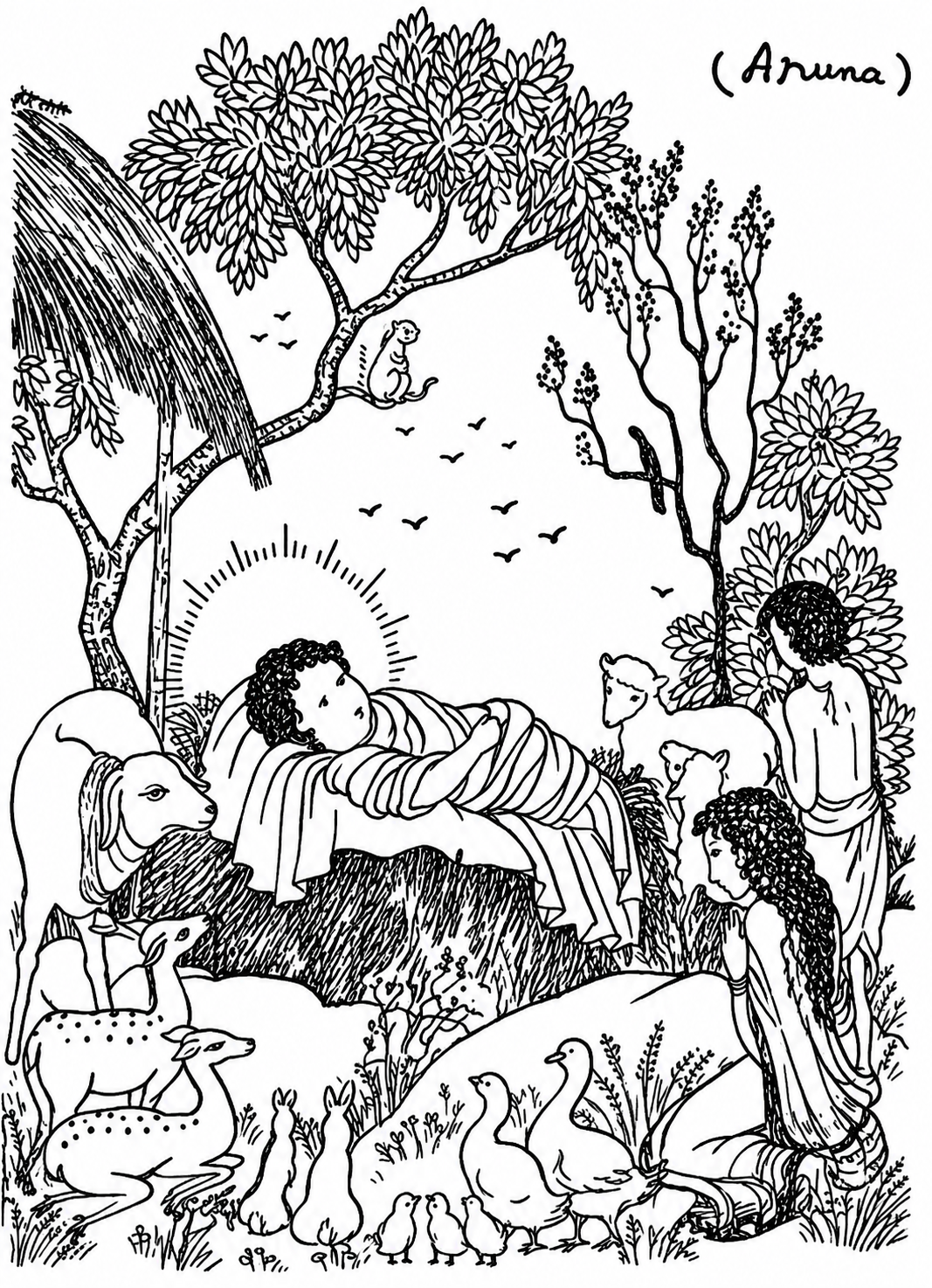
Greetings to Mother India. On the auspicious occasion of the first Christmas after declaration of independence, the Christian Bhaktas salute their fellow countrymen in the name of Tathagata that was born today and wish all Indians a year of peace and goodwill with which the angels heralded the Yesu-Jayanti.
Two events, one dark and the other bright, wove a strange, pattern round the cradle. Herod and court priests, afraid of the prophecy that the king of Jews will be born in Bethlehem conceived the diabolic plan of killing all children of the age of Jesus in the hope of destroying him. Have we not witnessed in our land in the first few months of freedom two major communities perpetrating slaughter of the innocents in pursuit of misguided revenge and retaliation? How events in Indian history have besmirched the fair name of India, fewer still wounded her spiritual pride as the insensate bath of blood with which we welcomed freedom. May the Infant in the cradle at Bethlehem stretch his living hand and bless us with peace, goodwill and brotherhood! Who is a Hindu ? Who is a Muslim? Who is a Christian? Are all not children of one father? Why forget this bond and soil our hands with blood? “Shanti Om Shanti” was the central and final benediction of Upanishad. Muslim - the very make and the greeting — salam — means peace. Angels in heaven spoke “peace on earth” on the Christmas day. Shall we not today round the cradle - Hindu, Muslim and Christian, clasp hands in love in joy at the face of the Lord of Love and Prince of Peace?
Somehow on the first Christmas day, while evil hung on the air, angels and providence were checkmating the evil. Herod failed in his plot and the salvation of the world could not be stopped by the Lords of the Earth - proud in the petty pride and pomp of the day. As against the Kings and their councillors stand the Shepherds and the wisemen. To the Shepherds suspecting of the heavenly splendour about to break on their peaceful slumbers and to the wisemen of the East, ever the stargazers of humanity straining their eyes in slumbering vigil into the future - God sent the angels and the star to guide them to the cradle. May we not hope that the same Providence brooding over India with the love of a mother bird for her chicks, direct great men of wisdom and little men of innocence to the cradle where lies the desire of the world and the hope thereof! May we not pray that during this Christmas God may initiate a new era of fulfilment that will realise in our land the Mahavakya - That art Thou - in all of us as Jesus realised it in his Sonship to God! May this year witness in India the advent of the “sons of God”, for which the whole creation have been groaning! May this year also see the fruition of our prayers — the establishment of the Kingdom of God! Where else could the Kingdom of God be so fittingly inaugurated us in the land of Gandhiji? Various nations have various ways of approaching the elucidation of mystery of existence. Some like the Jews see the riddle of life in the death and the solution thereof in resurrection. Others like the Greeks seek the meaning of existence in the life and would frame their deepest quest in the words “we would see Jesus”. We Indians read the enigma of life in ‘birth’ and its solution in ‘rebirth’ (punarbhavah). Christmas passed unnoticed among Semitic Jewish Christians was even proscribed by the early church. They gathered round the Cross. We in India will gather round the cradle of Jesus. Indian Christianity, theology and philosophy will revolve round the cradle. In the mystery of Rebirth that lies in the cradle in the form of infant Jesus shall we find the journey’s end of the great quest of India.
Let us then greet our leaders - Gandhiji, Nehru and Patel, our brethren of Pakistan - Jinnah Sahib and others; the great spiritual leaders - Aurobindo, Ramana Maharishi - with the blessings of the season and pray that their labours may be crowned with success by the blessings of Jesus.
Christians, gather round the cradle and sing ‘Yesu Ki Jai’ — Deva Suta Ki Jai.
— P. Chenchiah.
Report on Work Among Hindus
(1945-47)
United Provinces Christian Council.
A report from Rev. R.O. Jenkins of Fyzabad says that regular open air work is done with a small staff of preachers in the bazaars of the Cantonment area; a catechist is stationed at Ayodhya who makes contacts with Hindus there. A plan for Reading Room there, is in view. Most of the day scholars attending the Girls Boarding School are Hindus. Several large Melas at Ayodhya are attended by a band of workers, men and women, selling gospels and making individual contacts. The Bible Society’s Colporteur is out daily. The work has been occasionally hindered by the police who from political motives have not looked favourably upon large gatherings.
Principal Malvea of the Ewing Xian College, Allahabad, writes to say that though he has no special report he himself conducts:
- A Sunday class for non-Christian menial staff and their children
- The College has a scripture period. On demand for an alternative course studies in “Ethical Foundations” are being prepared
- There is a weekly prayer group - intercommunal and interreligious in character.
The Rev. A.C. Chakravarty writes from Brindaban that Christian books are lent to educated people - mostly officials, to whom in many cases personal testimony is given. About 1500 gospels have gone to other Hindu homes in the year. He remarks further that disillusionment is coming among Hindus who ask - what has religion done in so many years, what can save the people from destruction? They receive the good news about a loving and forgiving God from a Christian who can testify, in life and practice, to the love of a Christ-like God.
Miss Sarah Chakko, Principal, Isabella Thoburn College says that:
- A number of Hindu students attend their religious services and classes of religious and education
- Students go out to neighbouring Mohallas once a week to do social work and to give religious instruction. Off and on Arya Samajist groups have obstructed this work.
- Students are running a night school and at the beginning of the year they are given special instruction in adult Literacy programme.
I will now touch upon a few places from where I have no direct report but about these pieces of work I have some personal knowledge. In Haridwar and neighbouring Bhogpur area the Reformed Presbyterian Mission of Roorki contact pilgrims, visit Ashrams and attend Melas. In Allahabad City open air work especially at the Magh Melas is conducted under the guidance of Dr. Janvier. In the months of May and June a special session of the Khristkul Ashram at Almora was conducted under the leadership of Mr. Das. In Vindhyachal Melas are attended by workers of the B.C.M.S. Mission at Mirzapur. Not far from Benares at Bahatpur and in villages around the Bible School students of the Oriental Missionary Society have been camping for some time. In the City of Benares the Z.B.M. through its primary schools and Bible women penetrate somewhat into Hindu homes. They have also lately been touching some villages nearby with the help of a convert of the Benares United City Mission. There is open air preaching at the C.M.S. Church at Godhowlia opened daily by another young convert of B.U.C.M. Referring to my own work in Benares, which is well-known to many friends, I would only say that it has continued, with encouragement and hope, inspire of the closing of the United City Mission. In 1946 autumn the school of Hinduism was conducted as in the past. This year it was possible for me to make tuition and guidance available for some with the help of our local Hindu, Buddhist and Jain friends and scholars. Visitors included some missionaries, leaders of organisations and theological students. I was grateful for very faithful service and help of three Christian Sanyasis, one of whom stayed for ten months, another four months and the third for six weeks. In particular, pilgrims were met on bathing ghats and students were contacted in institutions and at the Dashashwamedh centre. In spite of many difficulties a considerable quantity of literature was sold and distributed free among thousands of religious Hindus.
After this rather sketchy report I would like to conclude with a few remarks based on my experience covering a total period of more than 20 years that I have spent in these provinces. The type of work done among Hindus clearly shows lack of grasp of a supreme end and objective. There is disagreement as to the fundamental purpose of evangelism. Again there is absence of that love of souls that characterised the pioneering workers of a century ago. There is a lack of love for the people among and for whom the work is done. This absence of love has produced a kind of officialism, spiritual inefficiency and idleness. Among workers, both Indian and non-Indian, there is a criminal neglect and surprising ignorance of Hindu life and faith. In places, I have met with defiant hatred of everything Hindu. It is significant that studies in Hindu culture and religion have been carried on in Benares for over 10 years and in other centres not far from these provinces but hardly a few workers of this area have availed themselves of this opportunity. Men and women have come from far down South, from the East and the West. It is also rather meaningful that the more established and organised churches have been very indifferent and neglectful. I hope and pray that Christianity in U.P., the home of Vedic Hinduism, will not develop an exclusiveness like that of Islam. Another disconcerting feature in preaching and teaching is undue emphasis on doctrine, and on Church and not on the simple gospel and kingdom of God. Yet again there is an instinctive desire for number through baptism and little thought of quality through conversion. Preaching has become so very professional. The pure and simple gospel truth is seldom presented to the conscience and heart of men in humility and love. There is too much beating about the bush, much too much of moralising and story telling and little of the core of the gospel - the saving grace of Christ, the Cross and the Resurrection.
Too often the appeal is to the intellect. With the Hindu the presentation to the heart should first be made attractive and dynamically and then the will, will be conquered resulting in discipleship. Enlightenment is often the very last thing. But my impression of Christian worship, instruction and preaching in the protestant churches is that the appeal is too overburdened with the intellectual emphasis. Hence, it results in fruitless controversy and even resentment and antagonism. In certain centres young girls and women actively join in open air preaching and public gatherings. This is objectionable from many standpoints and harmful to both parties concerned. There are many other things as regards methods of approach, but I think I have said enough to lead to searching of hearts among the more earnest and thoughtful. Evangelism among Hindus as a whole should be overhauled. As it is, it is disorganised, and not of a high order. The whole subject hinges on a deep and adequate understanding and realisation of Christianity itself and its purpose in the world and certain basic attitudes to Hinduism and to the country wherein it has flourished for several millenniums. On whether the churches and missions avowedly responsible for evangelising India will think hard, face facts and humans obey the call of the master, will largely depend on the future of Christianity in this land.
BENARES,
R.C. DAS,
Convenor,
Committee on work among Hindus.
Church - True and False
An esteemed Indian friend writes:
Dear Mr. Das,
“From the ‘Seeker’ it appears that your Ashram is run on a non-sectarian basis. In your Ashram there will be no unity of faith for the different sects of Christians differ from one another very much. What brand of Christianity will you preach to the Hindus of Benares? Our Lord preached one faith, established one church and this church is guarding the faith preached by him by the help of the Holy Spirit. Our Lord said”on this rock (Peter) I will build my church and the gates of hell shall not prevail against it.” He also said “the Holy Spirit will lead you into all truth”, and “who so heareth you, heareth me; rejecteth you rejecteth me”. This means that there must be a body of teachers who teach with Christ’s authority and teach all the doctrines of the church without mistake. Where is this body today? The difficulty with us, Indian Christians is that foreign missionaries came to India and preached different brands of Christianity. Shall we not find out the church which he founded? - the infallible church which cannot make any mistake in faith and morals according to his promise ? … Hence, your Ashram, if it is not attached to this church, will be another Tower of Babel … The Foreign missionaries, though sincere, created a mist on the face of our glorious Lord and Master … The Bible also must be interpreted by this infallible church. Private interpretation must not be permitted.”
For lack of space the letter had to be shortened. But the correspondent’s contention is clear. My answer is briefly this:
The church - the visible institution - militant here on earth - cannot be infallible as it is imperfect. This is tenable rationally and historically. The Kingdom of God, of which the church is the resultant of its earthly projection, which is in the church and beyond it, is infallible. The church is the training ground and instrument of the Kingdom, - the Kingdom in preparation. The church which the correspondent advocates by implication has not been infallible in history. It has committed grievous blunders like other sects.
The rock is not Peter but Peter believing. So Christ builds his church with believers. And all believers under the Holy Spirit have the privilege of interpreting and preaching the truth of the Bible. There is no question of private or individual interpretation. All true believers are wonderfully held together by the spirit of God in the unity of the one faith.
The correspondent is too much worried over the differences, between sects, in non-essentials. The full truth is not comprehended by any one group. Different sides of truth are grasped or emphasised by different groups as we are not perfect. St. Paul says “now we see in a mirror darkly”. Christ is the Truth. But who dares to say that he has known him fully? Even in a rational statement of Truth there is defect. But preaching or teaching is based on one’s experience. Correct theology, however important, does not touch the springs of life. Only life can communicate life.
Claim to official monopoly of truth and of its custody begets spiritual egotism and has historically resulted in violent exclusiveness. Greater knowledge truly means deeper humility. Truth is its own protector.
Indian Christians will be better guided by the true catholicity of the Gospel, the New Testament and the apostolic Church as also by India’s along belief in multifaceted truth and unity in diversity and diversity in unity than by a church that has been chewing dry bones of doctrine, suppressing men’s divine freedom of thought and even interfered seriously in the economic and political life of nations supporting capitalism and fascism. The children of God are free under the grace of Jesus Christ. They obey, and are loyal to, not the dictatorial fiats of a despotic God but the love of a Father. In the Father’s home they go in and out freely and yet are held together by the bond of peace and love.
— R.C. Das.
Church or Kingdom?
Are they different or distinct entities? Or are they the same? If distinct, which has the primacy?
This is a question very pertinent to the present world condition and need.
Our Lord in his last commission asked his apostles to “make disciples” (Matthew 28:19) and to “preach the gospel”. “He that believeth and is baptised shall be saved.” It leaves the responsibility on the hearer of the gospel (Mark 16:15-16). In Luke 24:47 the Lord said that repentance and remission of sins should be preached and that his disciples are “witnesses”. “Ye shall be baptised with the Holy Ghost”. “Ye shall be my witnesses” (Acts 1:5 and 1:8). “The Kingdom of God is at hand: repent believe in the gospel” (Mark 1:15).
Nowhere did Christ expressly ask his apostles and disciples to “establish the church.” That is not man’s work. God does it himself. When he does it, it resembles the Kingdom of God.
Faith, repentance, forgiveness, new birth and new life - these constitute the moral and spiritual fact and the rock upon which the church is automatically born i.e. founded by the Holy Spirit. Those who are saved by the Blood of Christ spontaneously, under the guidance of the spirit, associate with one another and form into a fellowship which is verily the Body of Christ - the true church.
It is misleading and dangerous for church dignitaries and divines to define conversion of non-Christians by saying that the missionary does it by establishing the church of Christ in the country where he works and by giving to individual conversion a secondary place by calling it only “Important”. This is serious confusion of vital issues. The evangelist is to have the primary motive of preaching the gospel and of baptising converted individuals when desired. Conversion and forming of the church is God’s work. If the missionary thinks the founding of the church as his primary duty he will succeed in creating a formal official church - an institution and organisation - scarcely resembling the pattern Christ had in mind.
Neglect of this distinction between the church and the Kingdom of God and giving of priority to the church in thinking and practice has resulted in the foundation of an institution which is a community and a caste rather than a church. Except in the first few centuries and for short periods during the later age and except for small groups here and there the church has historically acted as a community rather than a fellowship or “communion of saints”.
It does make a lot of difference whether the missionary gives priority in his mind and work to the Church or to the salvation of souls. The one attitude will produce formal Christianity the other love, joy and peace in Jesus Christ. There is only one absolute God, Christ, the Kingdom. Other entities are relatives - Church, institutions, sacraments. To over-emphasise the relative, the Church, is a harmful half-truth and a dangerous heresy. Emphasising the Kingdom will produce change of life — the very basis of the true church. Church emphasised creates oppressive and suppressive authoritarianism and Kingdom stressed inspires real authority which induces fruitful obedience. The missionary setting about establishing and building up the Church is apt to be adopting the authoritarian attitude which is unhelpful and embarrassing to the growth of a free self-respecting and serving Church especially when he is not free from the stain of racial prejudice, pride and snobbery. The evangelist, earnest about bringing souls to the Saviour and going about doing good and serving in humility and love will leave the consolidation of the Church to the converts themselves under the guidance of the Spirit. The missionary providing the ministry and perfecting its organisation is apt to leave a strong golden cage in which the weak soul of the church will be frustrated. Let the evangelist help men come to Christ and build strong souls with sincere faith and pure devotion and a witnessing self-propagating church worshipping and serving, will be the natural outcome. Otherwise, if his service is cluttered with other motives, it will only issue is an extension of his own national Church administration in the midst of an alien atmosphere which may be condemned as nothing better than religious imperialism to be finally crushed or side-tracked in perpetual conflict.
— R.C. Das
For Students of Hinduism
A. Challenge of Hinduism
- Religion in Transition
- Mahatma Gandhi
- The Hindu view of life
- Eastern Religions and Western Thought
- East and West in Religion and other books — Radha-Krishnan
- Mahatma Gandhi’s Ideas - Andrews
- Ramkrishna Paramahanasa — Romain Rolland
- Rethinking Christianity
- Ashramas - Past and Present - Christian Book Club, c/o The Guardian, Madras
- Personalities — Ramkrishna, Rammohan Maharishi Debendra, Keshub, Rabindranath, Gandhi, Malavya, Aurobindo, Ramana Maharishi, Dayananda, Shradhhanand
- Institutions - Brahma Samaj, Arya Samaj, Theosophy, Ashrams, Orders of Monks
B. Essential Features of Hinduism
- Dharma Dwipika - Book Depot, Benares Hindu University
- Sanatan Dharma — Elementary and Advanced - Bhagwan Das
- What is Hinduism — D.S. Sharma
- Scientific Socialism - ancient and modern - Bhagwan Das
- Rigvedic Hymns
- Gita
- Upanishads
- Manu Sanhita
- Ramayana
- Mahabharata
- Bhagwata Purana
- Shankara
- Ramanuja
- Crown of Hinduism and Modern Religions Movements and Outline of Religious Literature - Farquhar
- Soul of India - Howells
- Karma and Redemption - Hogg
C. Devotional Reading
- Mira Bai’s songs
- Kavir Bijaks
- Bhakta Mala
- Hymns of the Rigveda
- Bhagavad Gita
- Gitanjali
- Isha and Katha Upanishads
- Ramayana
- Temple bells - Appasamy
D. Apologetics
- Soul of India
- Books of Chakkarai, Chenchiah and Appasamy
- Karma and Redemption
- Hinduism or Christianity - Cave
- The Unique Christ and the Mystic Gandhi - George
- India in Dark Wood and Is Christianity Unique? - McNicol
- Ashramas - Past and Present
- The Missionary’s Job - Phillips
- The Goal of India and the Indian Outlook - Holland.
E. Publishing Houses and Libraries
- Calcutta University.
- Benares Hindu University.
- Visva Bharati — Bolpore
- Y.M.C.A. Publishing House
- Russell Street Calcutta
- Natesan and Company Madras
- Indian Bookshop, and Ramkrishna Mission - Benares
- Gita Press - Gorakhpur
- Arya Samaj, Ajmer
- Lucknow Publishing House
- Mahabodhi Society - Sarnath, Benares
- Kitab Mahal, Kitabistan and Tract Society — Allahabad
- Navajiban Press - Ahmedabad.
F. Journals and Magazines
- The Prabuddha Bharat - 4, Wellington Lane, Calcutta
- The Aryan - Pondicherry Ashram
- Kalyan - Gorakhpur
- Theosophy - Adyar, Madras
- The Indian Messenger c/o Brahmo Samaj, 210, Cornwallis Street Calcutta
- Viswa Bharati, Vishal Bharat - Bolpur
- The Suryoday - Sri Bharat Dharma Mahamandal, Benares
- The Mahabodhi Journal — College Square, Calcutta
Notes
Japan has been demilitarised so successfully and completely that there is no possibility of rearmament within a century. Germany has been emasculated thoroughly in the same way. The methods used have been violent - mass executions of all so-called war-criminals, gagging the press, muzzling the civil population, converting the soldiers into industrial and agricultural slaves, general terrorisation of the population, starvation, compulsory education in called democracy and now-violence - all done by compulsion. But there is rumour of a hidden government and the possibility of the emergence of a reactionary and virile movement.
On top of this many church leaders and pious statesmen have found the time ripe for converting them to Christianity. It seems, and history proves it, that for the most part the Christianity of the Churches does not appeal or spread until the subject becomes weak or neutralised in his personality.
The so-called Christian and democratic nations thus manoeuvres to keep under their thumb great nations and large sections of mankind for economic exploitation with the help of political religion. The true followers of the Nazarene, the world over must beware of, and fight, this masquerading or false Christianity of churches which cannot face and meet strong nations and individuals of personality and conviction.
Some of our governments and public leaders are in a hurry to banish English and impose Hindi as the national language. But hastiness in this matter will be harmful. Hindi ought to be encouraged and allowed to spread naturally. Meanwhile, English should not be forcibly ousted. In our great universities, in the all-India Councils and conferences, in cultural and religious institutions, the use of English will mean unity and publicity and intelligibility Prompt banning of English and compulsory introduction of Hindi in unwilling areas will create resentment, confusion and darkness. In the present condition of insecurity in the land, we must hold these matters in abeyance. For international (political and cultural) purposes English is the best medium, why even for all-India purposes disturb English so hastily? Men in the South and in the extreme east and large groups in all the provinces will not easily learn Hindi when they already have a medium in English. Let us haste slowly.
The public have the impression that our national government have been appeasing certain groups and interests far too much and far too long. The rule of justice ought to be strictly followed. Generosity or optimism or opportunism does not bear fruit under certain conditions and with certain me. Wickedness has to be firmly dealt with by a government in whom millions of law-abiding and innocent people have trusted. When will our government be free from the burden of keeping the peace, to eradicate corruption from all departments of life, feed and clothe and house the common people! Men’s patience seems to have almost reached the breaking point. There is no question of full support to the government in all measures for the amelioration people’s conditions on the basis of impartiality and equality.
“Conversion” has been a vexed question. For it has meant in most cases mere social transfer from one community to another. It has not been largely based on any fundamental change of spiritual, mental or other convictions. Men of all religious generally misunderstand and misapply conversion. Has the Christian a separate community or a separate nation anywhere in the world in a socio-political sense, as Indian Islam (only a part of it) has claimed and acted upon? Are not all Christians united in their loyalty to Jesus Christ and in the Fellowship of the life of the Church - an entirely religious organisation. Are not Christians one with their neighbours in all other matters? Is not conversion in the sense of a change of convictions the birth right of every man? Has not even Hinduism allowed this kind of conversion within its own fold sometimes with generosity, sometimes with persecution? That is more or less true of other great religions. But when large masses of people want to join another religion without, or very little, change of heart and outlook largely from other motives the state and neighbours have a right to question. In a democratically free country emphasis on spiritual and moral truths will naturally lead to a solution of the problem of conversion. But it is clear that in conversion there is no place for force or fraud. Such conversions, when they happen, should be regularised by the state. One regrets to note that the learned editor of the “Prabuddha Bharat” (Dec. 1947) lumps Christians and Mussulmans together when he discusses conversions by force and fraud. If he cares to study the subject and will investigate into the matter he will find out that there is a serious difference in motive, spirit and method between the Christian and the Muslim not that we hold the Christians entirely blameless and free from mistakes. But to judge both together in the same breath reveals a serious lack of knowledge and understanding. A religion like Christianity while claiming to be supreme and unique (and even exclusive) as regards truth can at the same time be tolerant of other faiths and cultures. In fact in history tolerance has generally characterised its attitude and approach to other religions, though there have been some temporary lapses. Hinduism too has not been altogether free from errors of intolerance and persecution. The basic question is do we preach only truths (i.e. doctrines, dogmas, creeds, rules and even principles) only in religions? Is not the deepest and fullest thing in religion the Love of God who is the father of all men? When we preach the truths of religion, our whole being and attitude ought to be saturated with divine love and grace with which in Jesus God saves and converts. Humility and tolerance are born of love on which basis alone we can present Christ to the world. Only in love can we preach and teach. Conversion is the work of the Holy Spirit of God in the human heart. Man’s part is only to witness to, and share in humility, his own experience of the truth of God with his fellowmen who are brethren. Where is the place for separatism or exclusiveness in this? Is not the separation from other men the very negation of the Gospel? In Christ God became man to save man. Can we do less than identify ourselves with our brothers and sisters of other faiths?
And I saw a new heaven and a new earth; for the first heaven and the first earth were passed away; and there was no more sea.
And I, John saw the holy city, new Jerusalem, coming down from God out of heaven, prepared as a bride adorned for her husband.
And I heard a great voice out of heaven saying, Behold, the tabernacle of God is with men, and he will dwell with them, and they shall be his people, and God himself shall be with them, and be their God.
And God shall wipe away all tears from their eyes; and there shall be no more death, neither sorrow, not crying, neither shall there be any more pain; for the former things are passed away.
Praise ye the Lord. Praise God in his sanctuary; praise him in the firmament of his power.
Praise him for his mighty acts: praise him according to his excellent greatness.
Praise him with the sound of the trumpet; praise him with the psaltery and harp.
Praise him with the timbrel and dance; praise him with stringed instruments and organs.
Praise him upon the loud cymbals; praise him with high-sounding cymbals.
Let every thing that hath breath praise the Load. Praise ye the Lord.
Chorus:
Jiwan men rakhua, Masih ka sahara, Bas rakhua, Masih ka sahara.
- Wohi papon se ham ko bachae, Wohi mukti hamare karae, Wohi naiya ka khewanhara.
- Jab sara jag thukrae, Jab pas na koi ae, Chhae charon taraf adhiara.
- Sab tut choke jab asha, Man dole prem ka pyasa, Par chhore na Yesu hamara.
- Nirasha man men dale phere, Jiwan naiya khae thapera, Dur pe jab ho kinara.
— Bare Bhaiya (J. Blythe) Prem Sabha, Lucknow