
The Pilgrim
The Quarterly Bulletin of the Christian Society for the Study of Hinduism
| Volume | Date | Issue |
|---|---|---|
| 12 | January 1953 | 1 |
Editor: Rev. Dr. R.D. IMMANUEL
Editorial Notes
If any man does His will, he shall know of the doctrine whether it be of God.— John 7:17
A happy New Year to all our readers of the Pilgrim. May the year 1953 be to all of us a year of God’s richest blessings. There is a fundamental relation between our expectations, and our attempting, on the one hand and our attempting and attaining on the other. William Carey’s motto, which guided him throughout his life was “Expect great things from God and attempt great things for God.”
We are planning to have some changes in this Magazine. Instead of twenty-four pages it is proposed to have at least thirty-two. There will be a section called “The story that has an appealed to me most”. Anyone who has a Hindu religious story that appeals to him can send it to the editor. If it is found suitable it will be published.
Similarly, there will be a section on prayer, wherein prayers of Hindu saints will be published. Prayer is a valuable radiation of the religious aspirations of the man who uses it. We will be very glad also to get articles and letters helpfully criticising our articles. The society’s funds do not permit us to give remuneration for articles, but we do hope that many interested in the study of Hinduism will come forward, to help us without expecting monetary, remunerations.
The “Book Review” section is the most important one from the point of view of the society. So we shall appreciate much if our readers will bring to the notice of the editor any book of outstanding merit, that helps us to see Hinduism in one or more of its various phases.
This issue ought to have been out at least a month earlier. But on account of unavoidable delays we are sending it to you now. Hope the next issue will be punctual.
Prayer of St. Francis of Assisi for Peace
Lord make me an instrument of Thy peace. Where there is hatred let me sow love; where there is injury, pardon; where there is doubt, faith; where there is despair, hope; where there is darkness, light; and where there is sickness, joy.
O Divine Master, grant that I may not so much seek to be consoled as to console; to be understood as to understand; to be loved as to love; for it is in giving that we receive; it is in pardoning that we are pardoned; and it is in dying that we are born to eternal life.
Makara Sankaranti
In the month of January, our Hindu friends observe the great Makara Sankaranti festival. Makara is the Zodiac sign corresponding to the Capricorn in the western almanac. The sun is said to begin his northward journey to bring comfort and light to the people of the Northern Hemisphere. On this day there are enormous gatherings of people to bathe at Sangam (that is the place of confluence) of Jumna and Ganges at Allahabad. Similarly, there is another large crowd of worshipful devotees at Ganga Sagar - that is the place where the sacred Ganges enters the ocean.
In South India a festival called Pongal takes place at this time. The word Pongal in Tamil means boiling. The Tamil new year begins with Pongal. This is in honour of the birth of ‘Surya’ and is actually the revival of the Solar Year. This is a time of intense excitement and merriment. Houses are whitewashed, and all furniture are well scrubbed and cleaned for the occasion. Old potteries are thrown away, and new ones are bought. New clothes also are made if the family budget can afford. A certain portion outside the house is chosen and out in the open rice is cooked. (The Brahmans do not cook outside the house. But they select a place inside the house where the rays of the sun fall.) Selection of this spot is made about a month earlier. Every morning the women sweep this place, besmear it with cowdung, and draw beautiful patterns by deftly sprinkling white soapstone powder with skilful hands and decorate artistically the small square. In the centre they put a small ball of cowdung and stick into it a nice large attractive coloured pumpkin flower.
On the day of Pongal this place is prepared and decorated with minute care by the women. The cooking of rice is the most important item. For this all the Sumanglies (that is women who are married, and whose husbands are alive) go and bathe and as soon as they come they worship the sun and begin the cooking of rice in milk. This is the time of intense excitement. They watch with keen interest the time milk begins to boil, bubble and overflow. But it is the senior sumangli lady that has to give the official verdict. An anxious band of overexcited maidens are at her side and soon joyous expressions of ‘it boils’, ‘it boils’ peals forth.
Pongal is a time of merriment. They make the festival colourful by the use of flowers, and they sweeten the day by chewing and sucking large sticks of raw sugar cane.
In Bengal, this is called the festival of cakes; and it is observed with great relish for three successive days. All take part in it - men, women, and children. Almost the whole time is occupied in rural pastimes or gastronomical enjoyments. The popular cry in Bengal is “apwni Bowni, tin din pitta bhat khawni”, which means “Sankranti has come; let three days be passed in eating cakes and rice.” Another curious custom of tying their boxes, bedding, bowls, barns, bales etc., with shreds of straw is found in Bengal.
In Gujarat, Sankranti is observed very much like it is observed in other parts of India, except for the fact that in many villages, this day is set apart for competitive sports - especially kite flying. Boys and even men take great delight in this competition.
Every festival is an important part of our Hindu friends religious activities. But in the total ensemble of a people’s culture every religious practice has a bearing on their social and economic welfare. As such it would be good to study sankranti under three different headings - religious, economic, and social.
1. Religious Aspect
Feasts, festivals, and fairs form part of the indigenous technique to produce a corporate religious experience in a community. These brighten the life of ordinary men and women. Because, to the average Hindu, festivals are times of joy and delight, or merriment and laughter, of good cheer and happy innocent abandonment of laddus and jilabhies, of milk and sugar, of sugar cane, and sweet puddings. Any institution that helps the people to be cheerful and bring joy and mirth to their lives has a rightful place in religion. A merry heart has a receptive mind, and large doses of Hindu theology are usually injected by these festivals.
Sankranti and Pongal are connected with sun worship, and whenever this festival of winter solstice is observed, lessons regarding the power of renovation of Living Nature are taught. The method employed is suggestion through ritualistic mysticism. The sun turns northward. Life in winter (especially in the north) symbolic of uncomfortable cold, gives way to pleasant spring. Long nights symbolic of the darkness of ignorance give way to long days of light, and bright sunshine.
Here the lesson is taught that the power that enables nature to pass from darkness to light, from hibernating winter to pleasant and lively spring, can also enable men, women and children to renew their lives. The discarding of old vessels, the cleaning of furniture, the whitewashing of houses are all religious rituals. To the thoughtful Hindu, these are really sacraments. The boiling of milk is another sacrament. Those who do not feel in their heart a peculiar feeling, call this boiling of milk a silly superstition and an instance of mimetic magic. But to others, this is a prayer to God, made through a ritual, expressing the yearnings of human heart for a fuller and richer life. In one of the popular Tamil folk songs composed by Kothamangalam Subbhu, this prayer aspect of the rice boiling ritual is beautifully expressed. So, the central lesson of Sankranti is every man must resolve to recreate himself and learn to recognise and appropriate by humble supplication, the great Power, that works in and through nature.
In other words, to the Hindu Sankranti ought to be what Christmas should be to every Christian - the birth of the Sun of Righteousness, the coming of the true Light that lights every man coming into the world.
2. Social Aspect
Popular Hindu religion has a large element of social thinking and social feeling, and feasts and festivals are only concrete expressions of this feature of Hinduism. Anything that involves group activity gets a ready response from the average Hindu. Not only is he ready to do his part in the group, but he enjoys doing it, and is delighted to see others doing their part.
Sankranti has many customs which encourage social activities. In South India, all houses, and front yards are beautifully decorated at Sankranti. Each man does his part, and so the whole village is swept and attractively and artistically decorated. Sports, specially those connected with the cow are part of the festivities. These cattle have their horns painted and decorated. All peasants stop work for at least three days. Such temporary cessations for social diversions are very wholesome. The good things they get to eat, adds some more zest to the innocent mirth and general hilarity of the masses. This is the time they quite often choose for weddings. Exchange of presents is another social feature commonly observed during Sankranti. Sweet meats, ghee, flour, oranges, coconuts, balls of concentrated milk, vegetables, spices, sugar, almonds, raisins, etc. are exchanged between relatives.
3. Economic Aspect
Many merchants especially in South India begin their yearly account on Sankranti. It is the duty of every parent to see that he sends something substantial to his married daughters this day. After Diwali, Sankranti is the day, before which people are asked to return all loans that had been taken from creditors or bankers. Any payment that has to be made according to Jajmani System - like paying the family doctor - should be made this day. When each village in India was a self-contained unit, the economic aspect of Sankruti was in the forefront. But even now it is not completely lost sight of.
Here is a stanza from a Christian poet Henry Van which we might quote as a fitting conclusion to our study of the Sankranti festival.
  Mortals join the mighty chorus
    Which the morning stars began,
  Father love is reigning over us,
    Brother love binds man to man.
  Ever singing march we onward
    Victors in the midst of strife,
  Joyful music leads us sunward,
    In the triumph song of life.
Hindu Culture Expressed in Household Vessels
Emil Brunner says that culture is the sum of productions and productive forces by which human life transcends the animal sphere of self-preservation and preservation of the species. Thus, in any culture (according to him) three types of factors are to be considered.
- Natural factors like formation of country, climate, possibilities of maintenance etc.
- The inherent spiritual and mental capacity of the people possessing this culture.
- The spiritual suppositions of the people having culture. These are of a religious and ethical nature.
Of these three types the first is purely external. The second is purely internal. The third one is in an altogether different realm - it is neither purely internal nor external. It is social and spiritual.
This grouping of factors gives us a convenient handle to examine the Hindu South Indian house-hold articles. At the Leonard Brass museum are kept over two hundred of these articles. Only a few of them are made use of for this study.
Natural factors help us to understand why brass, copper, and bronze vessels were used in abundance in South India till very recently. Brass and copper are cheap there. Bronze is not affected by lactic, citric, or tartaric acids. These three acids are to be found in a large measure in many forms of food in South India. So the bronze vessel was almost a necessity to people who would not use earthenware pots in that land.
The inherent spiritual and mental capacity of the people as a factor in South Indian culture is readily seen the moment one sees these vessels. “A thing of beauty is joy forever”. These people created and enjoyed beautiful forms and shapes. The graceful contours and artistic engraving and inlaying of these lovely vessels testify that these people were able to appreciate and enjoy grace, rhythm, proportion, in short beauty so much, that they must create it and have it with them for their daily use and constant enjoyment.
The most important factor in this study is the third one, the religious and ethical suppositions. Emil Brunner calls these ‘the culture transcendent pre-suppositions’. Let us see some of these.
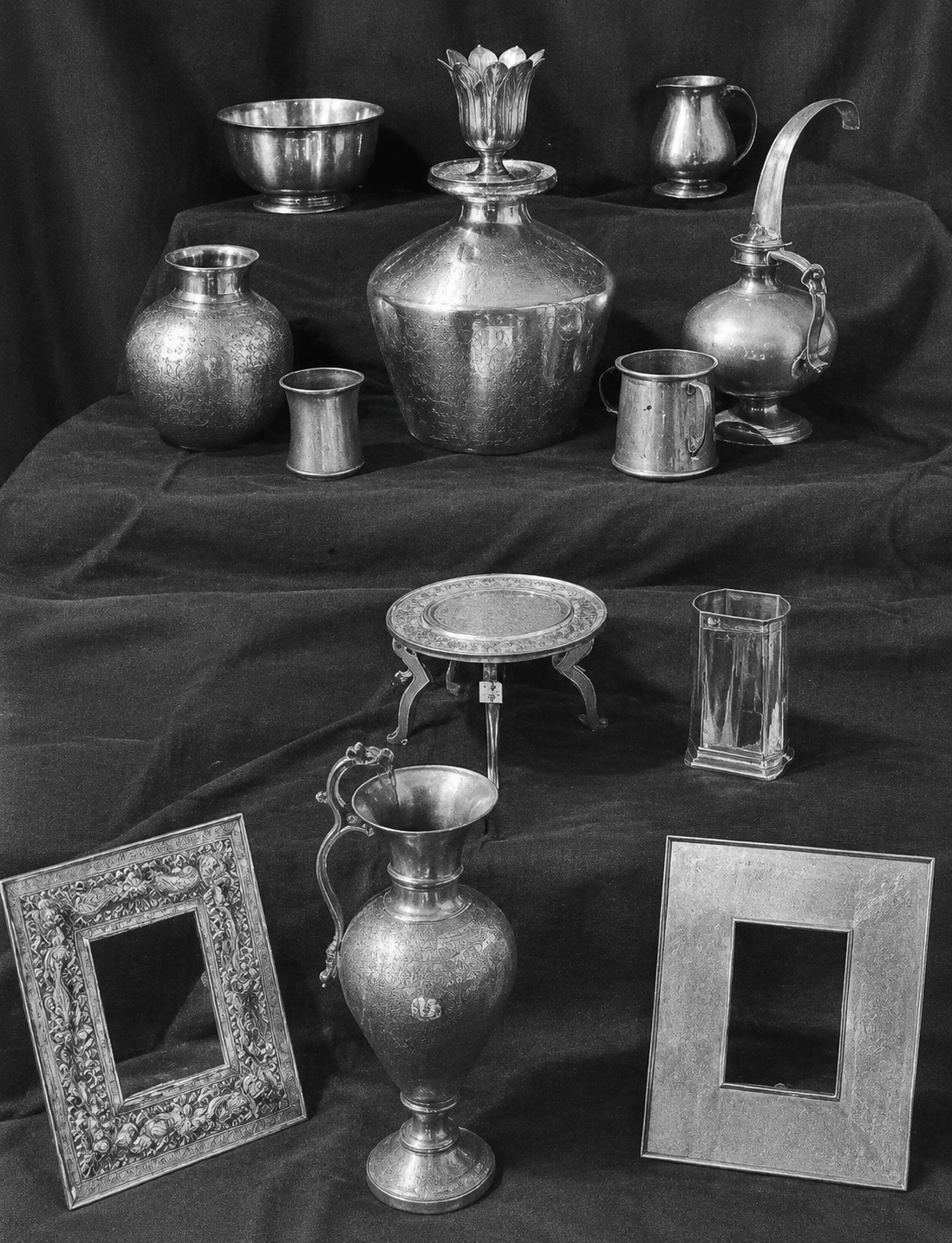
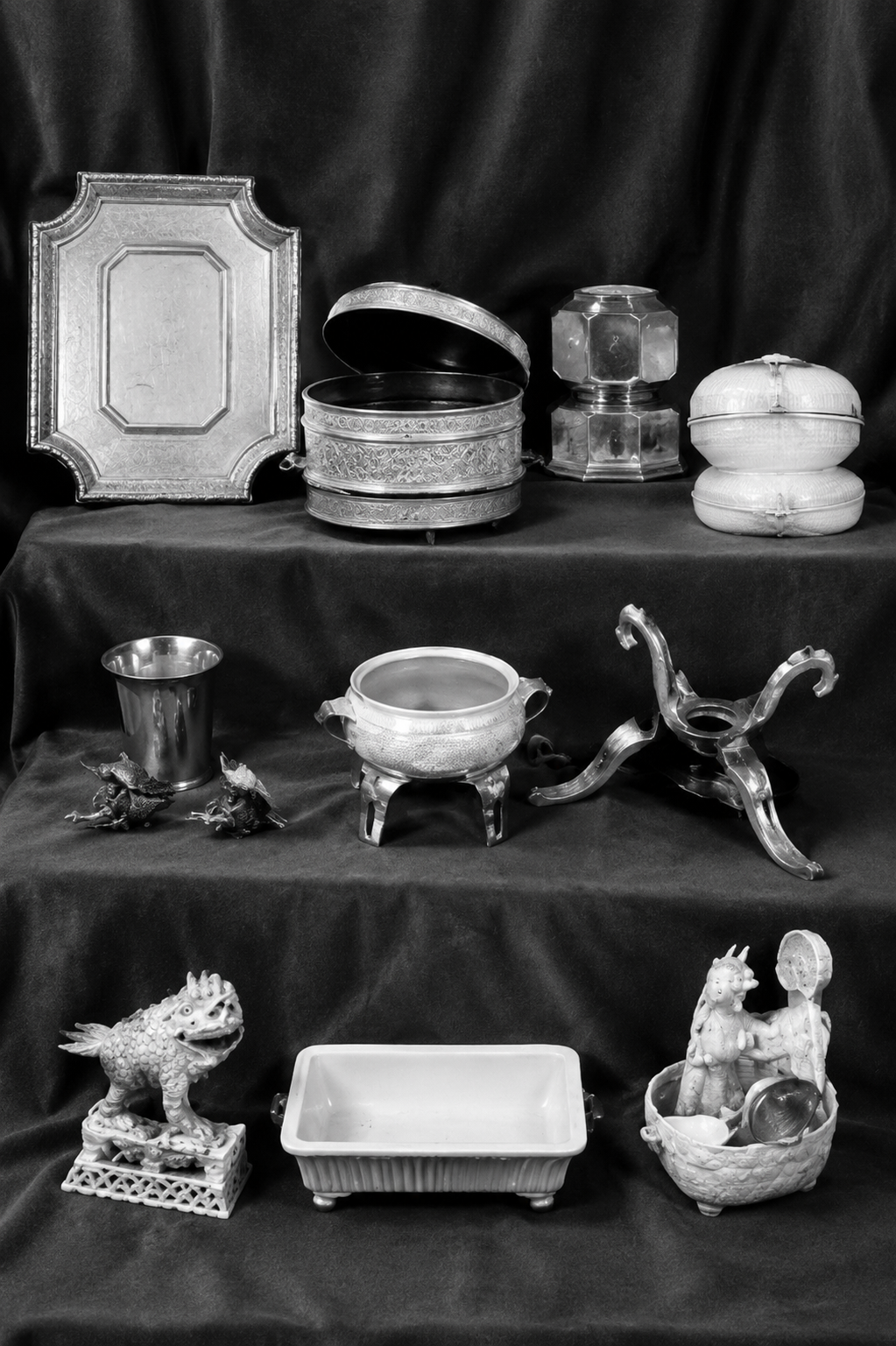
Figures 5, 6, and 7 in the picture might be taken first. These are called in Tamil Kumba. These have the form of a lotus flower. According to the cultural concept, the lotus is the meeting place of the Divine and the human, because the lotus flower grows in mud and filth, and yet keeps itself pure fragrant and fair. The feet of God are called the lotus feet in this sense - the pure touching this impure world. So when vessels are given the shape of a lotus flower, the culture transcendent pre-suppositions of the people direct the artisan who designs the shape, to give it a form that would not only be pleasing to the eye but also suggest that the food it contains is the grace of God - come down from heaven to meet the needs of man.
Lotus shaped vessels like the ones in Figures 6 and 7, are very often used to hold sandal wood paste, which is often used in welcoming people. The cultural idea involved here is the predominant concept of Hinduism, viz. pantheism. Every person is divine - a “Shiva or Parvati” - to the Shaivaite Hindu. That divinity must not be offended, but honoured.
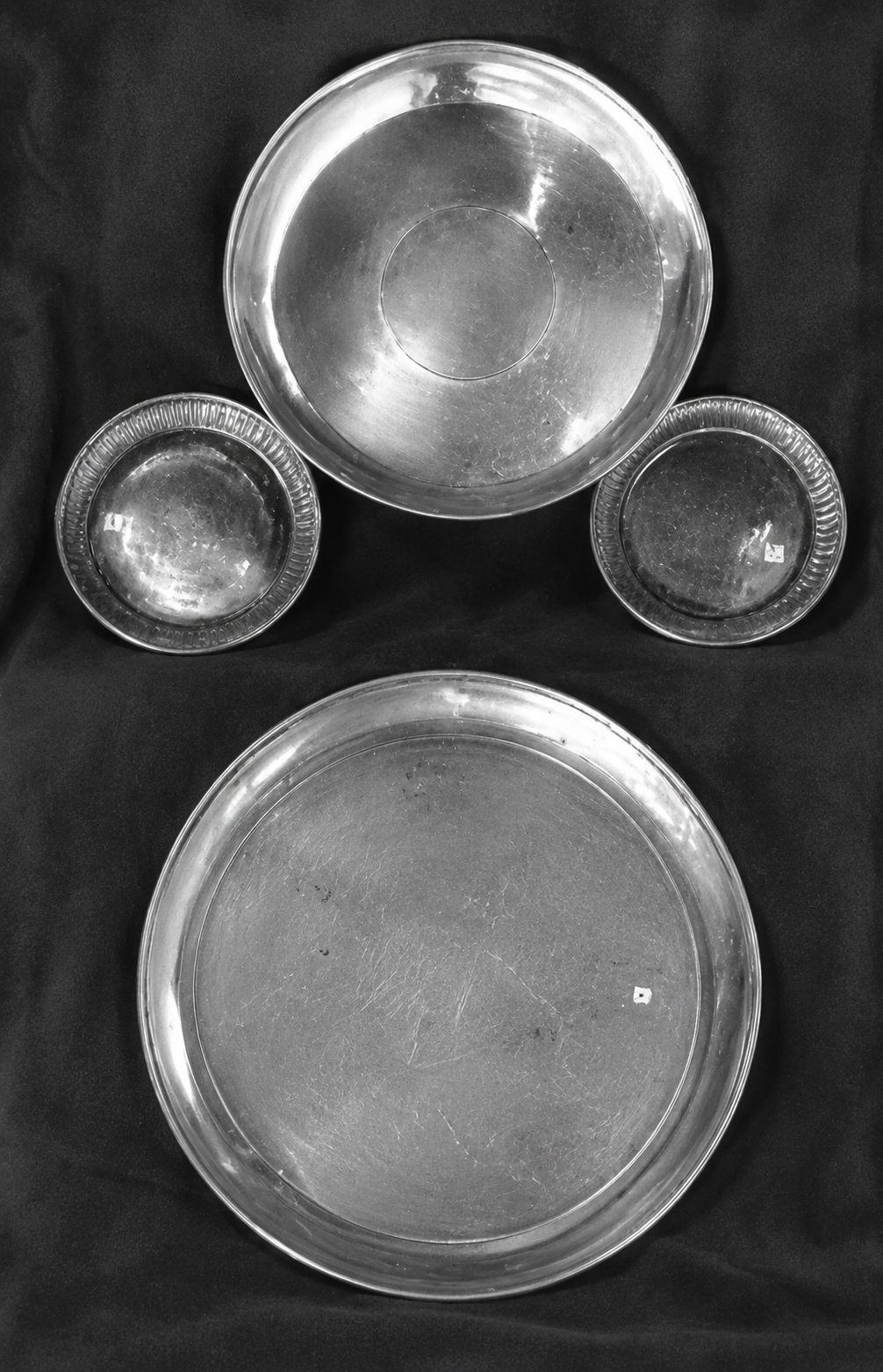
Figures 2 and 3 are presentation plates. When somebody is welcomed, or given a present these plates are used. Most of these have the picture of a bird like swan. This is the mythical Hamsa bird. According to the legends, if anyone places before this bird a cup of milk diluted with water, the bird would drink the milk and leave the water alone. So when this swan picture-embossed plate is offered by the host it means to indicate that the donor requests the receiver to choose the best and leave the rest as the Hansa bird does.
Another symbol very commonly found in these plates is the picture of a tree with flowers and fruits. This is the famous Kalpataru - a tree which is not only evergreen, but also brings forth any kind of fruits which any man who addresses it desires. Some other plates have the picture of a cow. This is the symbol of the famous “Kamadhenu of Indra Loka”; this cow not only gives milk but also grants the desires and petitions of those that address her. But the most commonly used symbol in plates is the circle. Numerous circles are embossed one on top of or by the side of another. Circle represents infinity. Infinity is unending. By these designs the donor desires that his gifts might be satisfying the receiver unendingly or always.
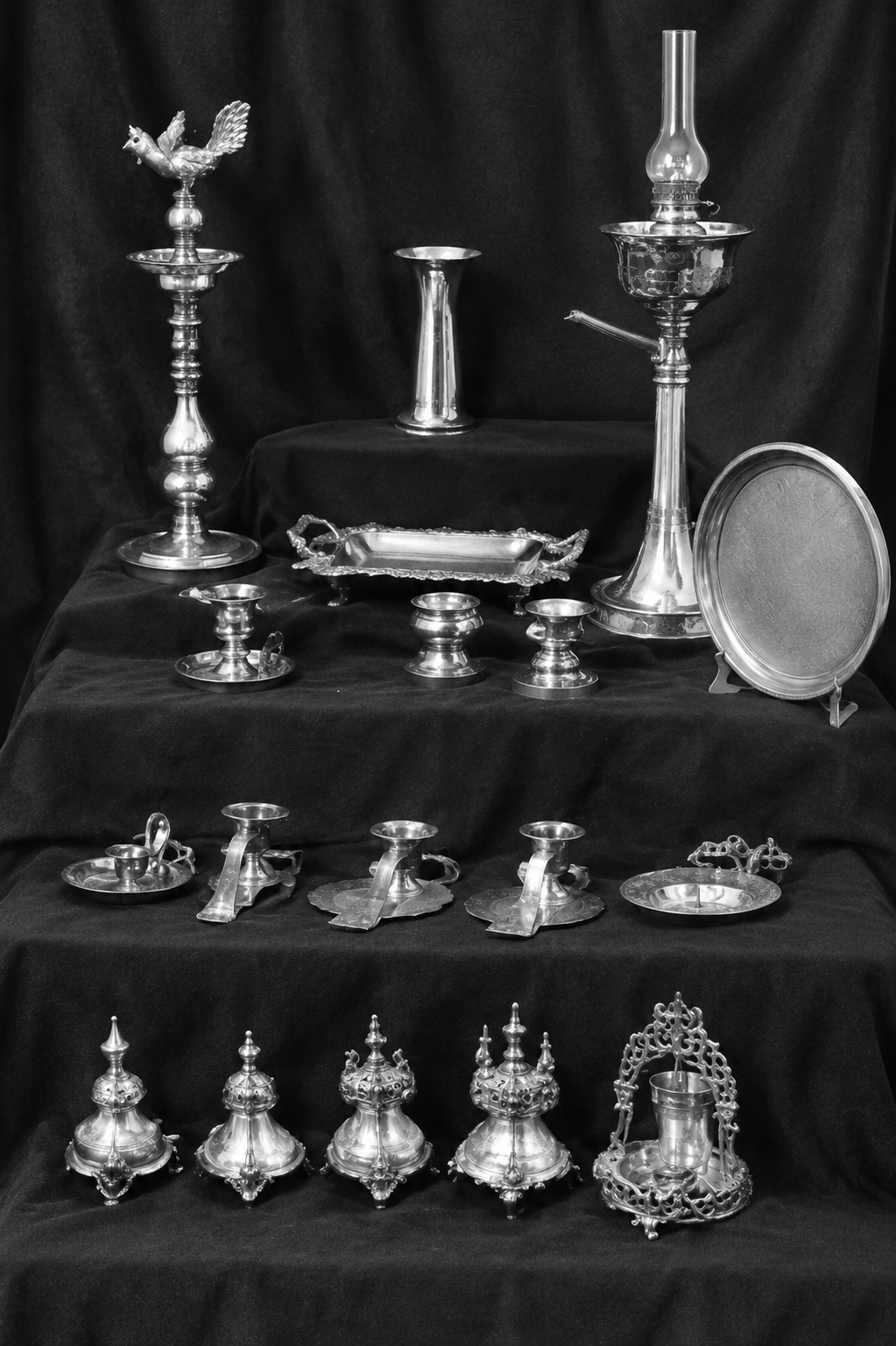
Snakes have a large place in the South Indian culture. There is the Adhi Seshan - which carries the whole world on its head. Only this story could explain the symbolism of the tripod (Figure 38). This tripod is made of one piece of wood and is an intricate piece of craftsmanship requiring delicate handling and consummate skill. The top part has three snakes, ensuring the secure support of three Adhiseshans. To the Shaivaite, snakes are precious because the God Shiva is usually depicted as having a snake curling round his matted locks. The very commonly known stories about snakes are the tales about “Rahu and Ketu,” how they try to devour the sun and the moon. The lamp in Figure 26 shows this. The flame signifies the sun - but the serpent though overshadowing it is not able to put it out. “The light shines in darkness and the darkness is not able to overcome it” says this little symbol.
Brass book-stands (Figure 15) usually have the famous mystic letter ‘OM’ inscribed on them. To the Hindu OM is the whole world, present, past and future. It transcends time too and is the ultimate reality that underlies the universe. To the Shaivaite this is the first syllable of the great mystic formula ‘Omnama Shivaya’. The lotus flower also is connected with anything educational. This is because it is the favourite flower of Saraswati the goddess of learning, and arts.
A few words might be said about the animals represented in these vessels (Figures 8, 16, 36, 39, 41 etc.). The first to be mentioned is Hanuman (36). This chieftain is the embodiment of loyalty and complete devotion. When he was asked to bring from a hill a small plant to be used as a medicine, he went there but could not recognise the plant. Anybody would have returned empty-handed. But Hanuman brought the whole hill by his super-Herculean strength. Tortoise (39) is an incarnation of Vishnu. So is Narasimha (41) the half man and half lion. Airavattam is the famous elephant of Indra, whose elephant-driver was called Vasavatta. The peacock was a favourite Vahana of Subramaniam the Shaivaite god of war. So in war-implements like swords, knives, we can see peacocks engraved. But Subramaniam is also the god of light. Thus, many Shaivaite lamps have Subramaniam with the peacock (Figure 19 and 25) embossed. Bulls are called - Nandi devars - because Shiva is a bull rider and his bull is Nandi. Garuda - the monstrous vulture is the Vahana of Vishnu when he appears with his terrific power.
Lights occupy a central place in the Hindu home life. The lamp is kept burning on all principal occasions - such as marriage, and daily worship. Lighting the lamp every day is a solemn sacrament to the Hindu. Lamps tell us the sect of Hinduism to which the user belongs. Thus, (Figure 19) the one with a peacock belongs to a Shaivaite. The Vaishnavaite who believes in the irresistibility of the divine grace uses a lamp with a figure like the letter ‘V’ inscribed on it (Figure 3). The Vaishnavaite who believes that the effort and co-operation of the human will with the Divine grace is necessary in salvation uses a lamp with a figure like the letter ‘Y’ (Figure 28). The Roman Catholic Church is not averse to the use of symbolism. Figure 32 shows a Roman Catholic lamp. In it one can see the doctrines (of trinity, of the centrality of the cross and of angelology) symbolised in a striking manner.
The number of spouts for these lamps is an interesting study. They are all odd numbers. Each of these numbers have symbolic meanings. The spout facing south is not lighted. If there is only one spout, and that has to face south in the room, they turn it to some other section when they light the lamp. This is because South is the place where the God of death dwells.
Next in importance to the lamp in the household comes the waterpot. There are many different shapes and forms of water pots. The Hindu culture would instil some theological thought or other in the case of each one of these. First is the Kudam. (Figure 9) The way water is carried depends on the caste of the women. The higher caste women carry Kudam on their hips, the middle class on their shoulders, and the lower classes on their heads. For a man to carry a Kudam on his head means that he is assuming the responsibility of the family and that his father has died. The imagery on these pots is very profuse. The main points of the Kudam in Figure 19 are very striking. The details are for experts only. There is the picture of Shiva Nataraja. The eternal dancer dancing shows that the universe is the expression of his zest. Beneath his feet is the Asura whom he has conquered. The garland of skulls, the snake, the trident held in one arm, the blazing fire in the other the tiger skin he wears, all show his terrific nature. The crescent moon on his locks, and the Ganges spurting from his hair show his grace. All these, inscribed on the water pot used daily, have a profound meaning and bring religion close and real to the user.
A few comments of a general nature might be now made. First, Hindus have made art a handmaid to religion, and they have pressed the universal human quest for beauty into the service of theology. People like beautiful things. So artistic engraving is made a vehicle to convey theological concepts. The engraving of these in common vessels that are used daily, breaks down the middle wall of partition between the sacred and the secular and makes every act of human life supremely worthwhile. This not only brings religion closer to everyday life - but makes the common task of life an uncommonly divine sacrament. These vessels silently suggest rather than loudly proclaim. Hence, they may not be like the sun in all its glory manifesting brightly all things that it shines upon. Rather they are like the pale flickering torch with its feeble light (compared to that of the sun.) However, the torch throws light on dark corners inaccessible to the rays of sunlight. Likewise, religion thus communicated, has its effects, in regions unreached by other methods.
A word about symbolism. Hinduism by its emphasis on symbols declares the ultimate truth to be unknowable and indefinable. We (Christians) do not say so. While we affirm the totality of the Godhead to be beyond our comprehension, we do say that the truths declared by the rich and profound personality of Jesus concerning God are absolutely true and dependable. But this does not mean that we have no place for symbolism. Symbols do set forth in visible form what cannot be fully realised.
Symbols also serve the purpose of providing in material form a convenient object of reverence. It is this latter trend that has been made use of in Hinduism which has developed into idolatry.
Transcript of a Sunday Gurdwara Service
BIHARILAL B.A.
Editor’s Note: Mr. Lal is a student of Leonard Theological College, working in the Department of Organised Research whose director is Dr. Henry H. Presler.
It was a beautiful morning as we stood before the Gurdwara. Before entering the temple we had to leave our shoes in the shed which they have made for the purpose. We saw a middle-aged man sitting there in front of the shed. We asked him whether he would receive our shoes and issue us shoe numbers. “The man who has the shoe numbers has not come yet, Sir, but I will relieve him. Please leave your shoes with me, but one of you come afterwards and take the numbers.” The man spoke in a very hospitable manner. So we left our shoes with him and went in and sat down.
An old man was fulfilling his morning religious duty and was adding to his good works for the next birth. He was reading the Banni. An old woman came and stood on his left side, with folded hands and trembling. She touched the books very reverently and then touched her eyes and thus sanctified herself. Then she requested the man, beseeching him to read for her some verses from the Holy Book. He read the Asa Mahala 4. As he was reading she sat at the back of the altar and kept her hands folded; as one sits near a king to ask his forgiveness.
Then people who wanted to sing came into the Gurdwara. They placed the musical instruments on the other side of the altar where the women sit. The party had come from G- to sing and to collect money for the Gurdwara to be built in G-. A blind man whom they said was a student in G- began to lead in singing.
They sang, “Houn wiegh aya, houn wich giya.” Man came into the world in fear, and he lives in this world in fear of birth and death, and he goes from the world in fear to be reborn again in any form, either of animal or human.
They sang this song also, “Parh part gadi ladhiye”. When we read the Banni we are adding to our good works. We should read the Banni and fill a train with good works, so that when we go to the other world those good works may release us.
They sang, “Kodn rajah, Koon parja.” False is the king of this world and false is the subject of that king. This world is false.”
A middle-aged woman going to her home from the Gurdwara, reached the door, suddenly sat down and began to shake the mat placed at the door. Then she gathered its dust. She gathered the dust in her left hand and with the right hand began to throw it in her mouth. She did it four or five times, and then she took the dust and went away. Nobody objected to her eating the dust.
Then the blind man sang, “Bal bal Tauri Shah Sundar he.” I sacrifice myself upon my beautiful king, who helped me find God. He has struck me with his arrow of love now I have become his lover.
Then he sang, “Har karta sab Kuchh Janda,”. God who is the doer of everything knows everything. “Jinhin Untar gurmukah pareethai.” Those who love the Guru from their hearts are ready to do every thing for him.
Then he sang another song, Moi Nam Tan hayo. “Pas rahyo ki hai sangi, Mowt Main - Dinrat avat ho piyare.” Those who have joined their hearts with the Name, or who have loved the Name, God lives with them, and they are not afraid of death, God lives with them like a relative and for them night becomes day.
Two very old ladies came with some flowers which they threw in front of the altar and bowed down and went away and sat among the women. A boy with something in a bag went to the priest who was sitting on the altar and fanning the Holy Book in a majestic way. He reached the priest and offered the bag; the priest put his hands in the bag, and becoming a bit angry asked him to throw the things in front of the altar. The boy went in front of the altar and threw some flowers from the bag.
Next they sang, “Jo Sharan Kare Sadhu ki So Par Karawe Naiya Dhan Santam KaMaan Santan Ka Diya Santan Sadh Har Nam Tihawe Santan Sawap tap divya. Santan Nam Amaratdata piya Kabir Sadhu ki Sangat raho Teerath Sanat Japawe Nam. Sanat Man Amarat data piya, kabir Sangat Kare Sadhu ki, Kirpal Swami mere santa sang biyawe. Sanat Sadhu ki Tahl mile, sadhu Sangat ko Mile Jo harhowe nihil.” The man who lives in the company of the gets his boat on the shore. The man who lives with the saint gets salvation. His heart and wealth belong to the saint and the saint gives some power to recite the name. The Sadhu is everlasting, he is not afraid of rebirth. Kabir says that he lives in the company of a saint, because at the pilgrimages also, the saint helps the people to recite the Name. The saints have drunk the Amrit, so they are everlasting. Live in the company of the Sadhu, says Kabir, and you will get rid of rebirth. By living in the company of the saints one solves his difficulties. If God becomes gracious and kind then he sends a Sadhu to meet the congregation.
“Sadhu Jin Amrat data piya. Ham Santan Ki Sarna Sanat homari ite; Sanat hamara Gahna, jo Sharan bhare Sadhu ki so par kara-we naiya, Samtan Jin Amvat data piya, keertan ra gawe”. Those are the saints who have tasted the Amrit or love of God. By drinking Amrit a man becomes everlasting. We are the slaves of their souls and the saints are our hope and defenders. The saints are our ornaments. It is necessary to serve the saints. That man is a saint who drinks Amrit of God. We should sing the advantages of the Keertan.
Then they sang, “Gur Sikhan Jin Pareet hai, Gur Sat Gur ditha.” The man who loves the Sikhs sees the true Guru. Because by serving our fellowmen we serve God.
“Papi pap Kamamdiyan, Nanak tera koi beli na koi Yar.” O Nanak! As long as you are a sinner and as long as you are committing sins and leading a sinful life, nobody will help you to get salvation, and nobody will become your friend.
“Uth chalna, Khasmi pavana; moorakh man ka-he kar si Namana, kahe ho si udas ab patar taram na Chare, beena te tiyon Charahown - Jin Nanak deve tar. Ho moorakh man kate no si udas.” After all you have to go from the world, O foolish heart! Why do you become sad? Nanak will get thy ship of life to the end of the sea or ocean (will give thee salvation).
Then they sang, “Jinni Gurmakh nam Tihaya …” Those who recited the name found the God.
“Nal iyane dost kade na awe ras.” The friendship of a foolish person never avails anything.
Next they sang, “Mere Lal Jiyo, tera Unat Majana. Rajan Raj, Jog men Jogi, tap men Tapase. Bhagat sukh paya, Nanak kise Unat Na Paiya. Rajan men to Wajah kahaye, Thakar pareet karai teri, Ape banda, ape te Wanayara, Ape te ap … ape hai Wanfara, Ji mere Lal Jiyo tea that na Paya, Lagi - Jag Pareet … Niya men val Jejawe, Aptan ki Sangat Nanak Wahnda, kay on Kar mol Udh Pawe, Jiyo mere Lal Jiyo tera Unat na Paiya, Jab Tak tera man Pansana, man Sarb Samana …” Long live my beloved (Guru Nanak). Nobody has found thy end or limit. There are kings among those who recite the name thou canst be counted first. Thy worshipper has found peace with thee, O Nanak; nobody can find thy end. We can say that thou art the king amongst the kings. Thou hast helped us to love God. Thou art the worshipper and the centre of worship.
Next they sang “Guru Untar Gurmukh pareet hai.” The Sikhs love the Guru from the innermost part of their hearts.
Then they sang Mahala 2.
After this the singer said, “You are of great fortune who are listening to the Keertan. You know that this group has come from a far place. If I have committed any mistake while singing the Keertan then I ask your forgiveness.
Then they began to sing this song, “Har Jag Jag bhagat upaya, pej nakhda aya Ram … Hunkariya nindika preeth de …” God loves his worshipper, and he does not allow him to be ashamed. But to the proud, he turns his back and never listens.
After this the Secretary stood up and began to say this, “You who are enjoying the delicious taste of the Keertan of God, you who are living in the court of Guru Nanak, you who are living in the true world, speak loudly,”Wonderful is the Khalsa and conquest be to the true Guru.” Then the congregation shouted with one voice. “Wonderful is the Khalsa and conquest be to the true Guru”. The Secretary continued “We are very happy that the group of singers have come from G_. This group has come to collect money for the Gurdwara which is going to be built there. I am very thankful to the gentlemen who are selflessly trying to do the work of the Guru. Before I ask Doctor R- to speak there are some announcements. It is the news of the morning and our grief that the son of Sardar S-. S-. who was studying in M.A. Philosophy has died. We are all one in sorrow with the relatives. The daughter of Sardar M-. S-. has also died, and he is going to hold an Akhand Path (I) to which all will be invited.
All of you know that G-. K-. S-. And his party are here for a few days. They sing the Keertan in the morning but not many people come here during the week to listen. So after singing the Keertan for a few days here, they went to O-. G-. They have been singing there, and the congregation is also sufficient on week days. But today at 7 p.m. they will sing the Keertan here. Your presence is requested at that time. Please come tonight and listen to the Keertan and solve the problem of your rebirth.
After this Doctor R-. S_. Who had come from G- began to speak, “Wonderful is the name of the Guru and conquest be to him”. The congregation again shouted in one voice the slogan, “Wahe Guru Ka Khalsa, Sin Wahe Guru Ki Fateh”.
“Wonderful is the truth of Guru, and he will be the Conqueror in the end. There is no need of any lecture after singing the Keertan of the Divine Banni. Because this Banni puts us in divine shape or form. By singing the Keertan of the Banni we fulfil all the conditions required to get salvation. As you know already, this group has come from G_. Those who have read”Itihas” (a book) know how Guru Gobind Singh came to G- and how he released the rajahs who were imprisoned. That place is lying desolate now, and only a wall is standing there. Many times the Sikh leaders decided to build a Gurdwara, but due to political hindrances offered by the Government, they could not succeed. Now the committee of G_ has met and decided to collect about fifty thousand rupees for a Gurdwara, The government is willing to contribute ten thousand rupees and the rest must come from the congregation. We decided to send a group of singers, but you know that good singers require a lot of money. So I suggested in the committee that we should not think of good singers. People who love the Guru will contribute to the good cause without good musicians. So we should send those who sing Keertan in the Gurdwara daily. The Committee saw eye to eye with my proposal, and decided to send this man who is blind as a missionary of the great cause. They appointed me as the head of the Group. But I told them my difficulties. I told them that I have left all my property in Pakistan and now the only source of income is my daily practice. But the committee told me that before this I was a physical doctor only, now they are making me a spiritual doctor. This cause of building the Gurdwara is much more important. So I have come out of my home for this great purpose and I hope that by the kindness of the Guru and by your prayers my efforts will be crowned with success. I went to one town where there was a lady whose husband was not at home. When she came to know that we were to leave soon she went to somebody and borrowed 101 rupees and gave them to me and said, ‘I was waiting for my husband to come, but you are going soon, so I have borrowed 101 rupees from somebody for you. This time of service will never come again.’”
“In ‘Itihas’ (books) it is written that once there was Rajah and a Rani. The queen was very much devoted to Guru, and she used to sing Keertan early in the morning and to read the Banni. But the Rajah was just the opposite. He was very cruel and irreligious. He was tired of his queen singing and reading the Banni. So he ordered that he did not want to hear any such sound in the palace any more. The Rani was very much worried about this. She was afraid of the Rajah, and used to recite the Name in her heart only. She used to pray, to the Guru for her husband. She ordered her servants to be on the lookout for a Sadhu. As soon as they happened to see a Sadhu, they were to inform her. One day her servants told her that they had seen a Sadhu sitting on the small hill top. She told the Rajah that she wanted to go for a walk with him. So they went both together. When they came near the hill she told him that she wanted to climb the hill by running. So she ran upward towards the top. When she came near the Sadhu, she knelt before him and salamed him. The Sadhu was making little palaces out of sand. She asked the Sadhu about the toys, and he said that those were palaces, and if she desired to buy one, she was welcome; the price was two annas. She bought one toy. By this time the Rajah had also arrived, and he was very angry, when he saw his beautiful wife kneeling before a naked Sadhu. He could not control himself and began to beat her. He took her into the palace and was very angry with her. At night when he was sleeping, he had a dream. He saw that he was dead and angels had come to him and began to beat him. They beat him mercilessly and the result was that there were wounds in his body. They took him with them, and as they were dragging him they were beating him also with lashes. At last, they came to a very beautiful garden. He felt the cool breezes blowing, and the fragrance was very sweet. He requested the angels with folded hands that they should allow him to go inside the garden. But they beat him more severely. They said that he was always cruel in his lifetime, and they would not show any mercy to him. But he requested them more earnestly, and at last they were taken in by his beseeching and crying. They dragged him into the garden. There he saw a very beautiful road. This road was clean and tidy, and shady trees were on both its sides. He came to his senses in that atmosphere and when he looked around he saw a palace. He proceeded towards that palace. When he came near the gate he saw to his astonishment that the name of his Rani was written there. He told the angels that was his queen’s palace, as it belonged to him. But they said that it was not his queen’s palace, but it was bought by a good lady. In the other world there are no wives nor husbands. At this the Rajah began to cry, and he woke up. He ran towards the queen and fell at her feet and asked her forgiveness. Then he asked her to take him to the same Sadhu. So they ran towards the Sadhu. The Rajah fell on his knees, but the Sadhu turned his face from him. Then the queen be sought the Sadhu to forgive her husband. The Rajah told the Sadhu that he wanted to buy a palace. But the Sadhu told him that there were no palaces to buy. He must do good and serve others, and in the next world he would have a palace.”
“But today I do not want to offer you here a palace, but if you will contribute to the great cause surely you will get a palace in the other world. If you give money and help the Guru’s building to be built you will find a great comfort.”
Then he sat down, and the Secretary stood up and said, “Khalsa Ji! Blessed is the work of these friends who have left their homes and are spending their precious time in serving the Guru. May the Guru grant a good reward for their work and grant them salvation. I do not ask you to give money for anybody’s help, but I request you to contribute for your own homes (future homes) and thus add to your good works.” After this he asked four men to stand up and called for money from the congregation, and they contributed Rs. 171/12/6. After this the priest read the Sholoka Mahala 9 from the Granth Sahib. Then he read Madhowni Mahala 5 and Sholoka Mahala 5 and Ragmala Mahala.
After this they sang Ram Kali Mahala 3.32. “Anand Piya meri Male sat Guru Main paya, He mana meriya Sada raho har nal.” I got peace of mind when I found the true Guru. Remain with the Guru, O my heart.
After this all of them stood up and recited the Ardas ki benit, “Utha kar tu pe Urdas, Jew-Pind sab Tewi das. Tum Mat Pita ham balak tere, teri kirpa men sukh ghanere. Koi na jane tera Untar Uche te Ucha bhag-vanter Sagal samagry tera sitar dharit tum to hoe so agiya kar. Timri gat mit tumri Jani, Nanakdass Sada gurbani.” Rise up and humble thy self before God. All the villages and living beings are thy slaves. You are our mother and father, and we are thy children. There are many comforts in thy being kind to us. Nobody knows thy end. Bhagwan is almighty and powerful to all. The whole universe receives orders from thee. All is thine and Nanak is always thy servant.
After this the priest stood in front of the altar and began to pray. “Blessed is Guru Nanak; blessed is the sword of Bhagavadi. Blessed are the Guru Ram Krishna, Guru Arjuna Deva and Guru Teg Bahadw, who are everywhere. Blessed are the five beloveds, and Guru Govinda Singh and his four sons who were sacrificed for the sake of Sikhism. O Guru Nanak! Remember them for their work which they have done. Be with all those, O Guru, who fought for the freedom of the Gurudwaras. Remember them for their work also. Be with those who jumped into wells, and who were killed for Sikhism. Be with those who fought during the riots for the sake of Sikhism. Be with those mothers and sisters who sacrificed their children for the sake of Sikhism. Be with those women who ate only one bread and drank only one glass of water, but were faithful to Sikhism; who even jumped into wells to save their respect. Remember them all. Be with all the Sikhs wherever they are. Grant them power and progress in their work. Grant them a visit to Amritsar. Thy congregation has sung thy Keertan since early morning. Be with these who have sung and with those who have listened to the divine Keertan. If we have mispronounced any word then forgive us and enable us to read thy Banni correctly in the future. Accept the Pasad which has been offered to thee by thy congregation. Bless them who eat this. Bless them who have contributed for Parsad. Be with them who are collecting money for thy Gurdwara, grant them success in their work. O Guru Nanak keep the panth in progress always!”
Then all of them bowed down to the ground and worshipped the Granth Sahib. Then again they stood up and recited “Agiya thai akal thhi tabi chalayo Panth, sab Sikham ko Kukam hai Guru manyo Granth, Guru Granth ji mayiyo Sab Gurnth ki deh. Jo be mil ko Chah knoj shabead men mile Raj Karaga khalsa aki rahe na ko, khanoar kowe sab mil inge, teache sharam jo howe.” With the permission of God the Guru started the panth. All the Sikhs are ordered to regard the Granth Sahib as the very body of ten Gurus and as the leader of the Sikh congregation. If you want to find God then search in the words of the Granth Sahib. The Khalsa will reign in the end and those who go after other things will be ashamed of themselves.
Then the priest read some verse from the Granth Sahib and after that he distributed the Parsad.
After this again the secretary stood up and said, “For worldly works we can give so much money but for the spiritual work we could contribute only a little money. When the case ot Master Tara Singh was to be fought in the court we contributed Rs. 1,500/- for that. But for the building of the Gurdwara we have contributed only Rs. 171/12/6. So we should give more.”
At this one man was offended and came to him and said that there was no respect in his heart for Master Tara Singh. So again he stood up and said “You, dear Congregation, who is in the form of Guru now, can forgive everybody his sins. So if I have committed any sin please forgive me. By relating the case of Master Tara Singh I did not mean that I had no respect for him in my heart. But I only meant that it was a worldly work.”
This ended the service.
Banaras Institute of Hinduism
(23rd September to 20th November 1952)
A brief report
This year the study was spread over a much longer period covering over eight weeks. This was advantageous both for teachers and students. They were able to choose their convenient periods - not less than a full week - as also their own topics and questions. To me, it meant much easier handling and less concentrated labour.
Altogether twelve came from outside centres such as Calcutta, West Bengal, East Bengal, Bombay, Madhya Pradesh besides three local workers, total 15. They were: 1 Missionary Pastor, 1 Missionary evangelist, 1 Teacher, 2 Sanyasis, 1 Unattached evangelist, 1 Doctor - a volunteer worker, 1 author, retired businessman and reformer, 1 College student, 1 Professor, 5 Theological students. In addition to these I had the pleasure of receiving, each for a day, a party of 11 and another of 5 - boys and girls who were doing extension work in the Agricultural Institute, Allahabad. Among these latter I discovered a budding writer, a Burmese girl and a South Indian youth keen on Church and evangelism. These represented nine denominations and three of them no denomination.
It was a privilege (incidentally a relief to me) to have for a week the Rev. Dr. R.D. Immanuel giving two courses of lectures. The one on Hindu Ethics was instructive and illuminating and the other on some Tamil, Saiva saints and poets was most inspiring. He deserves the Society’s sincere and hearty thanks. My own subjects were necessarily various as I tried to give individual attention and satisfy, personal needs. I touched on questions like these - God - and gods and goddesses; Idolatry; Varnashram and caste; Holy Waters; Pilgrimage; Rites and Ceremonies; Ashrams; Sanyas; essentials and differentia of Hinduism; the present religious situation in India; some saints, sages and Avatars; The Church’s evangelism and the Christian approach in the light and background of Hinduism.
The students were taken to almost all important shrines, Ashrams, centres of learning and culture - of devotion and religious practice of different types. One Jain and one Buddhist scholar provided some teaching on their respective faith and culture. This leisurely study enables us to know one another intimately. Situated in a noisy and congested area, strict observance of the 12-hour period of silence; Co-operation and helpfulness of one and all; and the daily meditation on the Word of God gave us peace, poise and power for which we are all thankful to our Heavenly Father.
“Khristpanthi Ashram” 329, Dasashwamedh. R.C. DAS.
Section on Prayer
[Here are a few specimens of prayer by Tirunavukarasu Swami - a Tamil poet of the Saivite sect. Probably he lived in the early years of the seventh century of our era. He was a convert from Jainism to Shaivaism which he had relinquished early in his life. After his re-conversion to Hinduism, he wandered from shrine to shrine singing his way through the Tamil land. He is one of the very few Hindu poets who feel and express their sense of sinfulness.]
“I have reserved a place for violence within my heart and have in vain nourished my body with care. I would like to drink gladly Thy grace; but my spoon has no handle. I am like a pitiable frog cruelly caught by the deadly snake and in my terror I imagine many things. Oh! God! Oh! King of Tiruvottiyur!1 Wilt thou not care for me and save me?”
“I do not understand the things that I should understand, and every day I am sunk in a world of sin. I do not find the way I should go, Oh! Thou of Athihaivirattanam2 I beseech Thee to grant me enough grace to see Thy gracious feet.”
Here is a consecration hymn:
    Oh! Head of mine worship thou the true Head, the head of one
that wears a garland of skulls Oh! Head of mine worship thou the true Head, of him who begs
with a skull as a begging bowl in his hand. Oh! My eyes! Won't you see the one Who drank poison of the sea,
One who dances with eight shoulders! Oh! My eyes won't you see Him?
Oh! My ears! Won't you hear praises of Siva red like the beautiful pearl?
Oh! My ears! Won't you hear praises of Siva?Here is another: short prayer that has inspired many generations of Sivaites:
    Oh! Stamp me with Thy imprimatur - the bull that
white as snow and accept me as thine own.A few words may be added here as an explanation of references which might be obscure to readers who are not acquainted with the religion of the poet. The saint was a worshipper of the God Siva and all allusions have reference to this god. The poet went from place to place wherever there were shrines to his god.
Jesus said: “If any man would come after me let him deny himself and take up his cross and follow me. For whosoever would save his life will lose it; and who ever loses his life for my sake, and the gospel’s will save it. For what does it profit a man, to gain the whole world and forfeit his life? For what can a man give in return for his life?
Story Section
The Story of Eight Lakshmis
Lakshmi, the spouse of Vishnu, is the goddess of prosperity. However, each sphere of prosperity in man’s life is attributed to a particular Lakshmi. The goddess of wealth is Dhana Lakshmi. The goddess of health is Sukha Lakshmi. The goddess of victory, is Jaya Lakshmi, and so on. All these Lakshmis are considered to be sisters and were eight in number.
Once upon a time there lived a beautiful young man who was a favourite of these eight goddesses. So he prospered in all walks of life. He was wealthy and healthy. He had a loving wife, and many bright children. Every body respected and honoured him. Success followed his footsteps and he was a happy man indeed.
But one day it so happened that he displeased one of these Lakshmis. This Lakshmi was very angry with him, and wanted to see him ruined. So, she called all her sisters and urged them to desert the man. They too, found that the man was guilty and desertion by the Lakshmis was all that he deserved. So, it was decided that these sisters abandoned him, not all together - but one by one. As a mark of courtesy, these goddesses agreed that they would bid farewell to the man before departing.
The first day the goddess of wealth bade goodbye. The man cheerfully let her go. With her all his wealth was gone and he became a very poor man. But he did not mind it. The second day the goddess of health took leave. He cheerfully bade her goodbye. He became very sick. But he did not mind his losses. The third day the goddess of friendship took leave. He cheerfully bade her goodbye. His friends forsook him. But he did not mind his loneliness. The fourth day Jaya Lakshmi the goddess of success went away. From that moment failure dogged his steps. But he was cheerful and did not mind his misfortune in any way. So, one by one, each goddess left him, and he very cheerfully bade them all goodbye. Finally on the eighth day, Veera Lakshmi, (the goddess of courage and heroism) came to bid him goodbye. But he said, “No! Even if you leave me I won’t leave you. I will kill you or be killed myself rather than be separated from you”. And as he would not allow her to go away, she stayed with him. The other Sisters waited a long time for Veera. But since she did not join them, they came to her for an explanation. She told them that she could not leave him because he was so stout of heart. Then they said, “If you won’t come with us what would be the use of our going out? We want our youngest sister, and we will be where she is”. So all the goddesses came back to him and his prosperity and happiness was permanently established.
Lily Immanuel
Book Reviews
I Follow After - An Autobiography by Lakshmibai Tilak
Translated into English by Josephine Inkster. Champak Library, Oxford University Press, 1950, pp. 353, Rs. 7/-.
This is a many facetted gem of dazzling colours; for here is, all at once, a brilliant biography, a valuable storehouse of anthropology, a gripping exposition of Tilak’s theology, an accurate and descriptive psychology of religious experience, a vivid presentation of the literary and national aspirations of the Maharashtrians at the beginning of this century, and many other interesting subjects.
Taken merely as a story it is, an exceedingly fascinating one, full of human interest. Bubbling with wit and humour this picturesque story is narrated in a way that carries conviction. It is appealing because it comes straight from a sincere heart and told with artless simplicity. Its literary merits are great but its value as a study of religious experience and the psychology of conversion is even greater. Here is drawn the beautiful picture of a great and noble Indian, who would not be a slave in any sphere, and so would give his Christian religion an indigenous expression.
In this matchless story we see the great personality of Lakshmibai at first confused and confounded, but afterwards completely transformed and raised to great heights of spiritual experience by the influence of the greater personality Narayan Vaman, her husband. He was a noble soul with a large heart, a born poet, a sincere lover of humanity, a self sacrificingly generous philanthropist. As a man he was an enigma to those among whom he lived - very exasperating and very loveable. He used to disappear from his home for months at a time - all the same, he was a gentleman who loved his wife dearly and cared for his children affectionately.
When this man became a Christian, Lakshmibai the intensely, conservative and exceedingly religious Brahman wife suffered terribly; “the chords of her heart were torn asunder between the devotion to her husband, and her unbounded faith in the religion of her forbears”. After five long torturing years of grief and separation, scorn and humiliation, she decided to FOLLOW AFTER him. So she became a Christian and they established a happy Christian home. The years that followed were the best years of their lives - full of religious blessings, philanthropic activities, and literary creations.
The original of this book was written in Marathi and “I Follow After” is the translation of the first three parts of that book. The translator has done a very commendable job because she has caught the spirit of the author. The vigour and simplicity of the original is not lost.
This delightful and inspiring autobiography should be read by every Indian, Hindu as well as Christian and those Western friends who are interested in India or Hinduism.
R.D. Immanuel
Rural Sweepers in the City
By Samuel Jayakar. (Jabalpur Leonard Theological College): 1952, p. 61.
This booklet is the first of the series of Student Research Monographs edited by Dr. Henry H. Presler, Head of the Department of Organised Research of Leonard Theological College, Jabalpur. These monographs are published says Dr. Presler in his preparatory note, with a view:
- To make available recent information pertaining to typical religious phenomena, for comparison with similar phenomena elsewhere in India.
- To show how students practise research theory and procedure after being exposed to departmental disciplines.
- To encourage independent study of Indians of their own cultures in relation to Christianity.
- To hint at the meaning and understanding science adds to what is already known about religious institutions, and to show how students of both religion and social science analyse a parish.
The author Jayakar says that his object is to examine objectively what effects the urban environment has had on some immigrant Christian sweepers. So, in this book he gives us the results of three aspects of the culture of these people, namely the economic, social and religious. The Community, Mr. Jayakar has examined, consists of Telugu-speaking sweepers, who live in a small mohulla called Rani Tal. Telugu is a foreign language in Jabalpur and the people here have come from Nellore and Vizianagaram Districts. The author worked among these people for about eighteen months, both as a research student and as a pastor. In one sense his observations were made from a very close and intimate associations with these people.
Chapter one gives us the conclusions. In doing this it follows the Nyaya Syllogism of Indian Philosophy and gives to the reader the goal and the direction of the arguments.
The succeeding seven chapters have plain facts, statistics and other concrete evidences. In the last chapter the author attempts to give an interpretation of his work and gives his suggestions for uplifting this backward community.
The book is not large. The conclusions are not astounding. Nothing spectacular can be found in this book. But it represents sound methods of procedure, and a wholesome caution in drawing conclusions.
There are several photographic pictures that help us to imagine vividly the conditions in which these people live.
Hindus, Mohammedans and Christians live in Rani Tal. But the author has very little to say about the Hindus and Mohammedans. So, when he makes a statement like “The religious and ethical standards of the people are strictly limited by economic and social standards,” we would like to know very much whether this is true of the Hindu and Mohammedan people of the same locality. However, he has made clear the fact that in Rani Tal, religion affects and is affected by the social and economic factors. The whole book emphasises the concept of the functional ensemble in which all aspects of a culture mutually affect one another.
The approach to the study of religion in this booklet is analytic and descriptive rather than speculative and theoretic. Culture in India is rapidly undergoing significant changes. Hence, this study is timely, and the methods employed wholesome.
We recommend this monograph to those who are interested in the study of culture especially that field called Cultural Anthropology, and congratulate the editor Dr. Presler for this first monograph. We hope that under his leadership many interesting and challenging monographs will follow. It is also hoped that the author Mr. Jayakar will continue to work along the lines charted by him and produce other interesting books.
Bhagavad Gita
By C. Rajagopalachari, Delhi, The Hindustan Times Limited, 1940, pp. 143.
The editor desires to review this book, not because it is a recent one for it was published first in 1936, but because it is a book that one can recommend to Christian readers who desire to get a clear and concise exposition of the Gita.
The book has undergone many editions since 1936 - the fourth one having a revision made by the author in 1941 with the assistance of a Gita study group of fellow - prisoners in the Trichinopoly Central Jail. The author says that this book has been written mainly to serve as a handbook for students. Says he, “This little book aims at a simplified presentation of the Gita - content and at bringing it within a small compass to enable the modern student to understand in the midst of his other studies the faith, discipline and ideals that lighted the path of life for our forefathers and to which is given the name Sanatana Dharma or Hinduism.”
The ‘Introductory’ chapter is a very stimulating one and tackles the problem of the study of Religion in general. The author says while scientists struggled hard to obtain a deeper knowledge of the physical sciences, there remains a residue of vast unknown which can neither be ignored nor brought under the sway of man’s intelligence. This elusive unknown is no less real even though science as it is now cannot probe it. They are like infinity, zero, and surds in mathematics. “Religion deals with this vast unknown, not as science deals with matter but in a different way which is the only possible way”. He points out that a reverent spirit is necessary to understand any religion, and that a detective-police mentality in studying religion incapacitates one even to understand it.
The author accepts the interpretation of Gandhijii and other modern Hindus, and holds that the historicity of the context of the Gita should not be emphasised “To take the battle of Kurukshetra literally and to interpret all that is said in the Gita in the light of the motive of the particular scene would not only not help the student to understand the Gita aright but may even lead him to error”. Such a statement would be a puzzle to the Christian reader. In Biblical scholarship, a liberal scholar emphasises the background, the context, and the historical and geographical environment. However, what the author does is the accepted interpretation of most of the advanced Hindus To them Kurukshetra is only a myth in which lies embedded the universal message of the Gita.
In his treatment of the subject the author deals only with the doctrines of the Gita. Each chapter deals only with one doctrine, and the following are some of the most important ones: The Soul, Karma, God and Nature, Right action, Mind Control, Meditation, Godlessness, Surrender and Grace. The oneness of existence. These doctrines are dealt within a masterly way. The author summarises these doctrines and explains them in a simple non-technical language and then substantiates his statements by actual quotations.
The last chapter is very important. If one finds that he is very much pressed for time, he can get quite an insight into the Gita by reading the last chapter alone.
However, this book, can serve only as an introduction. The author does not expect it to be much more.
The Christian society, for the study of Hinduism is trying to get Dr. Hill’s masterly work, Bhagavad Gita reprinted. We hope this could be done soon. But for a beginner, this book is very good and we recommend it.
Advertisements
NOW READY: Student Research Monograph I, entitled Rural Sweepers in the City, by Samuel Jayakar.
See review in this issue. Price Rs. 2|-. This 61-page booklet will be sent V.P.P. by Dr. Henry H. Presler, Department of Organised Research, Leonard Theological College, Jabalpur, M.P., on receipt of order.
The Influence of Hinduism on Indian Christians
By Rev. R.D. Immanuel, M.A., B.D., Th.D., Professor of New Testament Interpretation and Philosophy of Religion, Leonard Theological College, Jabalpur.
A Few Extracts From Reviews About This Book
Dr. E.D. Soper in the Indian Witness writes:
“A rich feast is prepared for the reader … we have here a truly Christian book which will not only clarify the mind but strengthen the faith of all those who read its pages … Dr. Immanuel has shown commendable independence of judgement in dealing with others who have discussed these subjects … The reader of these pages soon begins to realise that he is in the hands of a safe and faithful guide who looks forward to the time when the Universal Gospel of Jesus Christ shall have an Indian dress and be the better able to reach and transform the entire life of all the people of India.
The Guardian (Madras) Reviews
“Few books written in the last ten years by Indian Christians are likely to measure up in importance, latent possibilities of stimulating new thought as this unpretentious essay on the development of vital thought currents among Indian Christians … Dr. Immanuel deserves the thanks of this generation for beginning with his book a type of literature which gives to the world, the thinking of Indian Christians on basic issues of Christianity and for assessing their value and significance … We recommend this book to all foreign friends who should like to know in a concrete way, what one of the younger churches - the Church in India is thinking on Christ and His Salvation; to all Indian Christians who want to crystallise their own thoughts, know their own minds and perceive the drift of their own souls to all those who are called upon to represent India in World Councils of the Churches desire to be something more than yes men and under scorers and tell the world what India thinks and feels. The author has redeemed in this book the reproach that lies on all theological institutions in India that they know neither the agony of the West in its soul-shaking modern criticism nor the grandeur of the heritage they have received from the East, but carry on the burden of knowledge of Western theology as porters carry heavy loads on their heads etc.”
Price Rs. 4/- Postage Extra. Available from:
Dr. R.D. Immanuel,
Leonard, Theological College,
Jabalpur, M.P.
Printed by Dr. E.M. Moffatt, at the Lucknow Publishing House, Lucknow. - (200) - 602 -1-1953.
Patrons:
- The Metropolitan of India, Calcutta.
- Bishop Clement D. Rockey, Lucknow.
President:
The Rt. Rev, C.J.G. Robinson, M.A., Allahabad.
Vice-Presidents:
- The Rt. Rev. A.J. Appasamy, M.A., Ph.D., Coimbatore.
- The Rev. C.E. Abraham, M.A., B.D., D.D., Serampore.
- The Rev. C.S. Thoburn, M.A., S.T.B., Jabalpur.
Secretary of Society:
Dr. A. Ralla Ram, Jamna, Allahabad.
Convener of Institutes:
Rev. R.C. Das, M.A., 129 Dashashwamedh, Banaras, U.P.
Editor of the Pilgrim:
Dr. R.D. Immanuel, Leonard Theological College, Jabalpur, (from June).
Treasurer:
Prof. P.C. Addy, M.A., Bible House, Thornhill Road, Allahabad.
Committee:
- Prof. V.E. Devadut, M.A., B.D., Serampore.
- The Rev. Paul Das, B.A., Allahabad.
- The Rev. C.G. Diehl, Madura.
- The Principal, School of Islamics, Aligarh.
- Mr. S.J. Duraiswamy, B.A., N.M.S. Madras.
- The Rev. R.W. Scott, M.A., Christian Council, Nagpur.
Editorial Committee:
- Rt. Rev. Bishop A.J. Appasamy, Coimbatore.
- Rev. C.G. Diehl, Madura.
- Rev. R.C. Das, M.A., Benares.
Objects and Aims
The objects of the Christian Society for the Study of Hinduism are:
- To create and maintain adequate interest in the study of Hinduism by Christians
- To carry on the study in a sympathetic, constructive and critical way for the purpose of effective evangelism and
- To achieve the above objects in co-operation with Church and Mission bodies.
The activities of the Society are:
- An Institute of Hinduism in Benares,
- ‘The Pilgrim’, a quarterly bulletin bearing on Hinduism, its relation to Christianity and for work among Hindus and
- Organising a permanent School of Hinduism
Every member will receive THE PILGRIM free Membership fee Rs. 4 per year
Note
Donations may be sent to the Treasurer:
Prof. P.C. Addy, M.A.,
Bible House,
12, Thornhill Road,
Allahabad.
Enquiries about the Society and its work should be addressed to the Secretary:
Dr. A. Ralla Ram, Jamna, Allahabad
All communications and correspondence relating to the Pilgrim should be addressed:
Dr. R.D. Immanuel, Leonard Theological College, Jabalpur
Ottiyur is one such place.↩︎
Athihaivirattanam is in South Arcot District, Madras State. The poet’s religious experience seems to have been much deepened by his visit or visits to this shrine/↩︎
Siva is represented as wearing a garland of skulls. A skull indicates that something has gone out of existence and is dead. So, because God is eternal every age or aeon which is over becomes a dead thing or skull to Him. So the wearer of a skull simply means He who has seen and experienced infinite ages. Another explanation is Siva inspires the feeling of Mysterium tremendum or the feeling of reverence and awe. So He who wears the skulls is just the all terrible.↩︎
Paradoxical statements are not necessarily inconsistencies in religion. So Saivites claim that this all terrible god of power and awe condescends to be a beggar and begs from people for alms.↩︎
Siva is the god of grace. Once the gods attempt to get nectar by churning the ocean. The mountain Mantara was used as the churning stick and the rope was the snake Vasuki. But something went wrong and instead of nectar, the whole universe was deluged with a deadly poison. This threatened ruin and destruction to men and gods. So they called on Siva who came and drank the poison in order that others may not die.↩︎
Slaves in those days were branded on the body with the marks of their master. Siva’s mark was the bull. So the poet is asking here that God may make a slave of him and in order that people might know it that He brand His devotee with the mark of a bull. This is very much like the tradition concerning the stigmata of St. Francis of Assisi. According to Hindu traditions Tirunavukarasu Swami did receive a favorable answer to his prayer and on his shoulder was imprinted in a miraculous way the mark of a bull. Christians naturally think in this connection of St. Paul who calls himself a bond-slave of Christ Jesus and also writes that he bears on his body the brand marks of Jesus.↩︎