
The Seeker
| Volume | Date | Issue |
|---|---|---|
| 7 | Haimantee 1953 | 6 |
Printed by B.N. Dutt at THE EUREKA PRINTING WORKS Ltd, Godhowlia, Banaras.
Published by Rev. R.C. Das, 129, Dashashwamedh, Banaras.
    "Who being in the form of God ... emptied himself taking the form
    of a servant, being make in the likeness of men."
— Philippians 2:6-7
"A light to lighten the Gentiles."— Luke 2:32
"Until the day dawn and the daystar arise in your hearts."— 2 Peter 1:19
Happy Christmas and Bright new year to all!
World Dominion Publications
Christ’s Hope of the Kingdom
By Rev. Alexander McLeish
Preface by Dr. John A. MacKay,
Princeton University, U.S.A.
A fresh study of the Missionary Obligation of the Christian Church; divided into two parts:
- The Hope of the Kingdom in New Testament Times;
- … after two thousand years. A challenging re-statement of the major concern of the Church.
(Price Rs. 4/8)
Objective and Method in Christian Expansion
By Rev. Alexander McLeish
Being the Small Mission Lectures delivered at Princeton Theological Seminary, U.S.A., October 1952.
(Price Rs. -/8)
Missionary Methods - St. Paul’s or Ours?
By Roland Allen.
(Price Rs. 8/-)
Spontaneous Expansion of the Christian Church and the Causes Which Hindrances
By Roland Allen.
(Price Rs. 4/-)
All available at World Dominion Book Depot, Church House, Mhow, M.B., India.
What Can Asia Teach Us
By Rev. John Garrett, Secretary, Australian Council of Churches
Those of us who belong to the Western world think of Christianity as the religion of Europe. It is our special export.
This, of course, is quite wrong of us. Jesus of Nazareth was an Asian. It is possible that we westerners have been hard on the Jew because he reminds us that the most significant of all the progenitors of our civilisation was not a Greek philosopher, but an Asian nomad called Abraham. The spiritual life of Europeans is nourished at the source from outside Europe.
We all try to bury the childhood that made us what we are, because we want to feel fully adult and to stand on our own feet. And yet it is intriguing to drop these defences and go back to Asia to see what we can learn from the continent that gave us our faith.
Strangely enough we find the aristocratic culture little changed until today - and today it is changing fast. The village culture is much as it was in Biblical tines. But it cannot be so for many years more. Above all, in every port of Asia men are still fundamentally religious. We are not. Let us admit it. Our religious exercises are an artificial addition to our practical agnosticism. Very few of us radiate the quality of strangeness and holiness which is the hallmark of the religious man. Because the spirit of holiness has been shut out of our daily lives many of us think it hardly worthwhile assuming there are holy men, much less that all life is holy. Perhaps we had better go back to Asia to learn what Asia can teach. Perhaps all the European wise men, the atomic scientists, sociologists and psychoanalysts had better come with us. Shall we fall on our knees in a cattle-shed in an Asian village? This is what the Old Testament prophet, Isaiah, said: “Hearken to me, ye that follow after righteousness, ye that seek Lord; look unto the rock whence ye are hewn, and to the hole of the pit whence ye have dug. Look unto Abraham, your father”. The greatest modern Christian missionaries to Asia turned their faces eastward in the knowledge that they were going to a continent where they would not only pass on their faith, but find it renewed at the source.
What I’m proposing to do is to share with you three pictures of life in Asia now. I’m going to try to draw each of these pictures for you much as I saw it myself As you might expect I am going to draw moral eventually from each picture.
Here’s the first picture. The place is an Ashram, or resident religious community, not far from Jaffna, in the north of Ceylon. The time is evening.
The heart of the Ashram is the chapel. It was six in the evening. The large bell tolled to bring the men and boys into silence at the hour of sunset. We bowed our heads for a brief angelus. The sun began to go down. The senior member of the community continued to walk about with us, talking softly. Everything here is pervaded with a living, breathing silence. The boys began to move into the chapel for evening prayers. The stars became clearer with the descent of dark. A few men with burdens on their heads walked past the fence, singing monotonously. The never-extinguished lamps the chapel drew our eyes to the circle of warm light before the at actuary, where the boys were squatting or kneeling forward with heads on the pavement. We walked in softly, removing our shoes. The leader sang - a solemn eastern recitative. All the boys joined in. Under the plain columns, in the gathering night, we drew near to Jesus Christ. I do not think I ever understood before how close to Nazareth one may come to imagination in any country east of the Mediterranean. Insects fell from the large green glass oil lamps in there the of the building. They crawled on the floor and on the plaited mats. The lesson was the twenty-second chapter of St. Luke’s Gospel. Over the sarcophagus - like Holy Table is a small cross in olive wood fixed on the wall. What looks like the circlet of an Iona cross is revealed on more careful scrutiny as an olive wood crown of thorns. Vessels and lamps are of brass. Over the sanctuary doors, which may be closed, is an inscription in Tamil. It says: “God so loved” …
Here’s the second picture. The place is part of the Madras plain in South India.
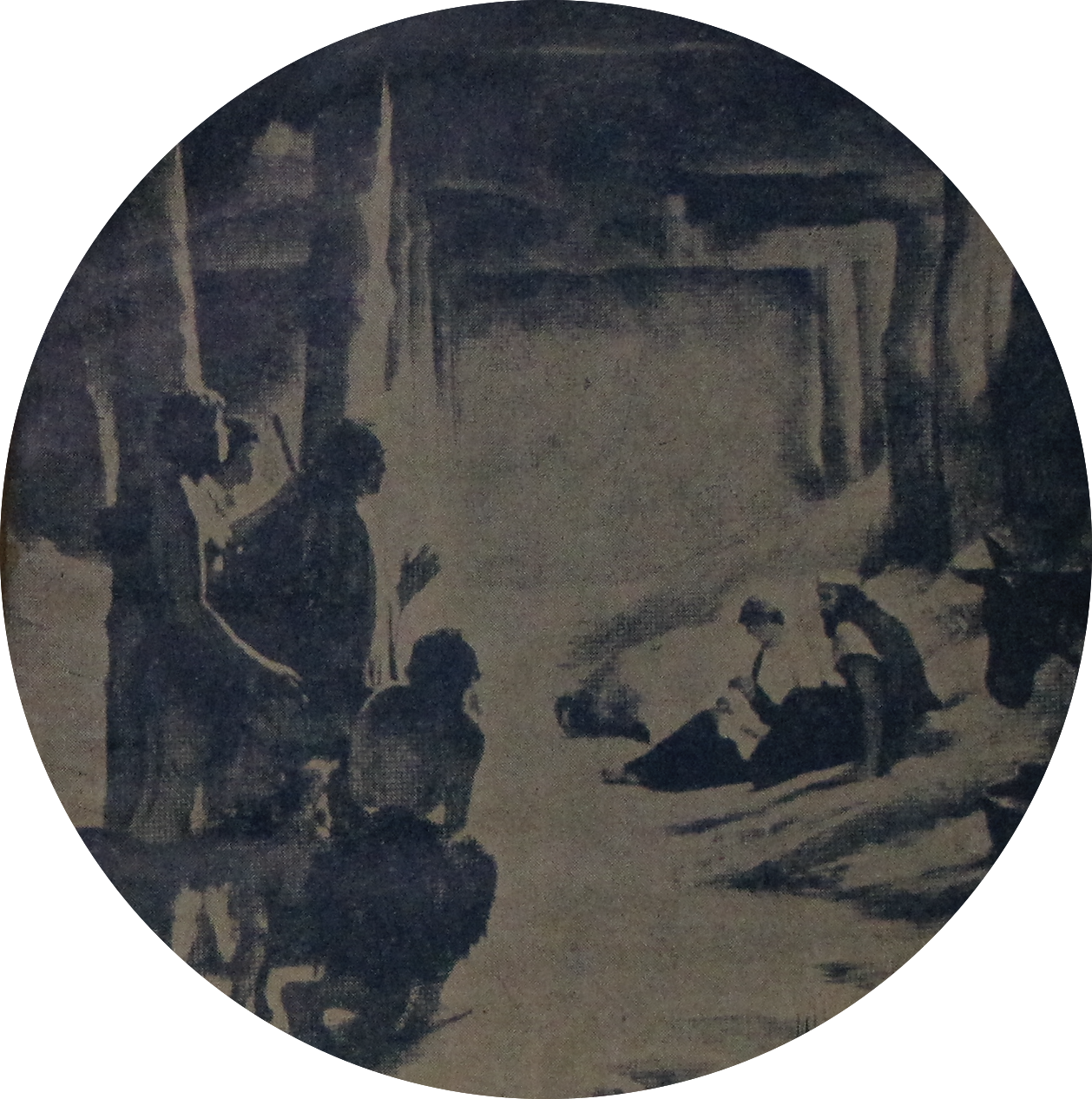
We went out by jeep with a volunteer band of evangelists. Our objective was a caste village named Parameesvaramangalam. The members of the party were nine volunteers, men and women. We took hurricane lanterns and food, because we knew the job would last three hours and finish in darkness. As we reached the village we were met by the Priest of the temple, a most distinguished looking Brahmin, wearing a dark thin beard and stripped to the waist, He led his little girl by one hand and held in the other the massive key of the temple, which he was about to open for the nightly ceremonies.
We paraded up and down the dusty streets, preceded by a fiddler, a drummer, crackers and people clanging little brass cymbals. As this is the hour in the village when boredom tends to creep on we soon gathered a procession. Two or three singers intoned at each halt. Then we moved on, rhythmically chanting the Tamil lyrics of the Church.
When night came we took up our stand on the steps of the dimly lighted temple. We could peer in through the iron gate and see the coloured idols in the glow of the lamps. The “swami”, still genuinely interested, stood just inside the gate and followed the proceedings. The large crowd stood or squatted on the dust, the children in front. The black darkness was gradually relieved by bluish moonlight.
Seven speakers told between them the story of what God has done. It began with the Creation and came right up to the present day. Between the short colloquial addresses lyrics were sung. The last speaker was a member of a robber tribe, who had been converted in goal. He gave a hair-raising account of the life he led before all this and bore witness to the power of Christ in his life.
When the show was over - and after all, the work of God in the world has been a drama - there was a brisk sale of literature. The priest shut his temple and bought Luke’s gospel. He wandered away to his house, gripping his little girl by the hand. There was something likeable about him. We said prayers together round the jeep. Then it was over.
That’s the second picture. Here’s the third.
The place is Djakarta, Indonesia. The time is nine o’clock night. We sat talking under the standard lamp in the garden of the house. This delightful pre-war custom of sitting in the garden at night is one of the mellow pleasures left as a heritage by the Dutch. There were eleven of us: a well-known preacher from the Church on Timor, two American Lutherans, a Dutch couple, a Japanese woman and her American husband, two Australians, a Eurasian woman, a Swiss. We talked about friends in Germany, about a Y.M.C.A. man in Hong Kong, about what might be happening now to others of our Chinese friends still on the mainland, about a woman from the Gold Coast and a Christian chief in South Africa who had thrown in his lot with the passive resistance to the Malayan government. One of the Dutchmen was about to take up difficult work in East Java as a mediator in industrial disputes. We began to talk about the borderland between theology and politics. We could assume that there would be a universe of discourse between us, different though we were. We were all keenly interested in the World Council of Churches. I suppose it was the agreement within the World Council that brought us to our common mind. I found myself asking, “Could we have met like this in Europe or America or Australia, or only here, under the standard lamp in an Asian garden?”
Now we come to the moral.
What can Asia teach? Here are three things at least; Silence before God. Uninhibited communication of religious trust. International community.
Now I want you to be quite clear that I’m not pleading a special case for Asian Christianity here. They belong to the Asian culture and the Asian soil.
The Christians in the chapel of the Ashram at sunset were worshipping in rapt stillness and in the traditional Indian attitudes of prayer. Their spirits were filled with the living God, who is in the silence. Like millions of other Asians they were seeking God intently with all their being. I’m afraid most Europeans have ceased.
The Christians in the village on the Madras plain were communicating the story of God’s coming into the world. And the remarkable thing is that those who heard them were glad they were there. The whole village listened. I don’t want to suggest that there is no religious intolerance in Asia. But it is true that in Asia men of all religions are more ready to share what they have. More than this, men of all religions are, on the whole, more ready to receive. I’m afraid most of us westerners are too indifferent to care or too shy to start,
The Christians under the standard lamp in the Djakarta garden were sharing in the life of a beautiful and cosmopolitan country, our neighbour Indonesia. Whereas Indonesia is racially speaking an open society, Australia is rather a closed society. Yes, I know we have hundreds of thousands of newcomers from Europe, but Europe is a small fragment of God’s wonderful humanity. Until we learn to share in the personality, crafts, music, food, homelike, of Indians and Chinese, Africans, South Americans, Israelis, any of God’s children and here, on our own soil, we are insular human beings. I know the risks of this. I think we should take them all; and I don’t see how any Christian who knows his Bible can say I am wrong.
So these are some of the lessons we can learn from Asia. Of course, there are many lessons we can teach. Asians know how true that is. But we must not think it is our Prerogative to introduce Jesus Christ into Asia, as though he were a European and might find the place unfamiliar. He is risen. He has been in Asia ever since he was born there as Son of Mary. We may expect to gather from Asian Christians more of His immeasurable wonder then we ever had. The Asian churches have everything to teach our churches about silence before God, true mission and true community.
You may remember certain words of Jesus. He said, “Ask, and your prayer shall be granted; search, and you shall And; knock, and the door shall be opened to you. For he that asks receives, he that searches finds, and to him that knocks on the door shall be opened.” These words are a promise to every sincere Asian man and woman who waits in the silence for God to speak. They are a promise to every sincere Asian who is receptive to the faith and message of others. They are a promise of a richer international community than the world has ever known; and I think it will be born on Asian soil. The true world has ever known; and I think it will be born on Asian soil. The true seeker in Asia will be found by Jesus Christ and bear his image.
Asia can teach you and me to learn to acknowledge our spiritual emptiness and need, to prepare ourselves to be filled with the fullness of the maker of the stars, the God of Abraham, the giver of joy. I’m closing at this point. The reason is that we “may be encouraged to strive for a perfect knowledge of God’s hidden truth, even Christ Himself, in whom all treasures of wisdom and knowledge lie hidden”.
Indigenous Worship
Some suggestions as to Forms and Methods
By R.C. Das
These are external features referring to postures, movements, actions - music, dress, ceremonies, buildings etc. Without an Indigenous mind and spirit - internal attitudes - it will be mere imitation far worse in effect than imitation of foreign methods. For a Christian not a convert from any Indian faith, it is necessary to be soaked in the religious literature of the country and its observances to derive any benefit from use of these methods or to see any value in them. Certain methods are peculiarly suited to Christians of Hindu origin and others to those with Muslim background. Some are common to both.
All these suggestions should not and need not be tried at once or in one place. They should be implemented naturally by consecrated men and not by way of amateurish experimentation. One should go into it with a sincere and deep conviction.
Common to Christians With Hindu and Muslim Backgrounds
Washing and bathing before prayers.
Squatting or standing or kneeling or prostrating for prayer with folded or open, outstretched hands.
Compulsory removal of shoes or sandals outside before entering a place of worship.
Sitting on the floor for prayer rather than on any high seat.
Teaching while sitting on a slightly high platform with a low desk in front. Prophetic preaching might appropriately be done standing or moving about slightly.
No distinction in seating arrangements between rich and high and low.
Clothes worn during worship should be simple and clean. Expensive and gaudy dresses and heavy ornaments should be avoided.
There should be a definite place in worship for Aradhana (adoration); and Stuti (praise), standing.
Silence and meditation, free or slightly directed, must have an assured place in public and congregational worship especially in group meetings. Individuals also should be encouraged to observe periods of silence in the house of prayer.
Music with Indian tunes but without the accompaniment of instruments - both solo and choral or congregational.
Among the various elements and features of worship - scriptures, sermons, prayers, intercessions and creeds will be common and universal.
A building or a place in the open air, in the shade of a tree or private house may be the place of worship. If in a building, any style except Hindu temple architecture, without pictures or images of any prophets or saints or sages.
Flowers, lights and incense may be used according to taste.
Whatever may be the place of worship, simple beauty, order and cleanliness must be there.
Everything to be carried on in Indian languages. A non-Indian preacher may be accommodated on occasions.
Different kinds of services in the church buildings - its cleaning, decoration and seating arrangements - should be done not by paid servants but performed in cooperation by different individuals or groups in the congregation especially by young men and woman who should learn to serve God and the church from their childhood.
Offerings should be laid at the altar by the congregation in any orderly manner and not collected in a bag in the middle of worship or in a box at the door. Offerings may be in kind or cash through vows or thank offerings.
Persons, objects or things related to the church or its worship services and activities should be signified by terms in the Indian languages, however imperfect some of them may be at present.
Normally, ordained ministers will use an approved type of special dress on public occasions.
The services through the month or a longer period should be varied. On one Sunday, emphasis should be on songs, on another Sunday upon Meditation again on admonition or interpretation of Scriptures and so on.
Along with worship there should be room for distribution of charity and for healing services.
Avoid having feasts or other secular meetings such as Committees inside the house of prayer.
To foster the spirit of sanctity, reverence and purity there should be no conversation allowed inside the church.
The church building should be open and accessible to devotees during the greater part of the twenty-four hours of the day.
I should encourage and teach the practice of tithing, Dakshina (voluntary gifts offered in gratitude), legacies through renunciation etc.
Let the church compound wherever possible, be a garden of flowers and fruits and even grain crops.
Our worship to be truly indigenous and vital, the economic position of the church must be sound and respectable. We cannot worship with joy and freedom in a house or on land belonging to others. For a permanent source of income we must acquire and attach to the church crop lands and gardens and in cities houses to let etc.
Festivals
- Anniversaries of Saints, noted sadhus and sanyasis and other great men of the world, especially of our country and church, can be observed as festivals,
- Marriages and birthdays,
- Musical performances and processions, illuminations, dramatic performances depicting incidents in the lives of Biblical heroes.
- Dedication of children, naming children, beginning of student life, Baptism, Confirmation.
- Harvest festival, erection of a new house and its first use, festivals of the seasons etc.
- Christmas, Epiphany, Palm Sunday, Easter, Whit Sunday (Pentecost). Laymen must be freely and fully associated with the Services and festivals of the church.
Peculiar to Christians With Hindu Background
Structure of the church may be after the pattern of a Hindu temple but with a Cross on top or at the gate for distinction.
The internal disposition of the church may be to an extent that of a temple with a “holy of holies” - the altar - in a semi dark cell to induce the sense of mystery and awe. Then it may have an expanding body or a chabutra or Angon - open or protected courtyard for the congregation.
Pictures, paintings, or other symbols helpful for inducing remembrance, respect and faith and as aids to worship may be kept according to taste.
Flowers, incense, lights, candles or small earthen lamps preferably and other artistic decorations may be freely used.
Consecrated Food and Drink symbolising the Body and Blood of our Lord Jesus may be preserved at the altar for devotees to receive freely at other than Communion time.
Kirtan or Kalakshepam (songs sung in union by a party) to induce Bhakti (loving devotion) to Christ.
Nama Sadhan - reciting the name or names of God many times to foster concentrated devotion and self-surrender to, and union with, Christ.
On special festive occasions, going round the church in a procession with lights or flowers or branches in hand singing praises, say 12 times (remembering the Apostles) or 7 times (after the seven Churches) or three times (meditating on the Holy Trinity) will be helpful to all, especially the young. This is Pradakshin - a typically Hindu practice.
Arati or service of lights, incense, flowers etc. Especially in the evening, worshippers may sing with flowers in hand and offer them on the altar or wave lamps or incense around the altar. This needs careful and detailed instruction. This will arouse and satisfy the religious emotions.
Prayers, praises, songs or benediction in Sanskrit will create a climate of mysticism, reverence and a sense of unity with the country’s past and present spiritual life. Women should have an honoured place in the Services and festivals of the Church.
Peculiar to Christians With Muslim Background
Some converts of the deeper mystical type will emphasise the contemplative aspects of life aiming at a loving union with God in Christ. They will be inevitably influenced by their Sufi heritage and will be anti-sacerdotal and anti-ritual. Their worship will partly rescue that of the Quakers. They will mainly draw from Johannine writings and the Psalms. They will hardly be interested in the ritualistic worship of the average church and will find affinities with similar groups of other Christians. They will have to be not only tolerated, but sympathised with in discovering modes of communion satisfying to their souls.
The average Muslim convert will be satisfied (like many Hindu converts) with the simple type of worship and prayer as are in vogue in modern denominations like the Baptists, Presbyterians and Methodists.
But a small number will find fellowship in an ornate festive type of worship and will develop a life like that of the Shias who form a large part of the Muslim community in India. Their respect for Pirs, Paigambars will express itself in their respect for Christian Saints and sages and sanyasis. They will have appropriate symbols and rites on festival occasions.
Muslim converts generally may, and in time will, build churches after the Saracenic style of architecture a valuable contribution.
They may keep features of Muslim life and culture as are not inconsistent with Christian principles in the matter of dress, language and name unless they take to Sanskritic and Hindu way of life.
Recitation of verses, or songs or praises in Urdu, Persian or Arabic will be quite in order unless they give up these in favour of other Indian languages - a trend which may be set in motion soon and effectively.
In brief, a Muslim convert has as much right and duty to express his Christian faith in his own way as a Hindu convert has. In Muslim dominated towns and village areas, at least in some congregations, Muslim culture must have a right of way-everything without impairing undivided loyalty to Christ.
The whole purpose of indigenous method of worship is to give freedom for full spiritual development and to make religious life easy and natural so that the innate powers of the soul may be brought our and utilised in the service of God and man. In foreign terms and through borrowed vehicles-through imitation-the hereditary resources of a people cannot be mobilised for worship.
Decomposition in the Church
The policy which prevails in the Christian Society of today is something like anti-Christ behaviour. These few lines are sent to the press not with the object of defaming the leaders, but to draw the attention of the administrators concerned to rectify the Church. The more we have tried to reform them privately and friendly the more they have turned deaf ears and become stubborn and reactionary. As a consequence of the Un-Christ like spirit which reveals through the Church decisions has appeared infidelity in the character of Christians in general. The following are a few of the many gateways of the evils:
The Gospel is interpreted through the action of the leaders and understood by the people in a reverse way.
The Church instead of being the spiritual Power House has become a political centre, where “Might is Right” policy is observed.
Members are more worldly than spiritual.
Violence is practised more than Love - (Force, Anger, Hatred etc. are considered to be violence).
The system of excommunication and cancellation of Church membership is anti-National. As a matter of fact no living person believing in the blood of Jesus can be without the Grace of God and hence should not be left alone. There is no denomination in the body of Him.
A small list of events happened in the Eastern Pakistan, is given below to show how mission policy deals with the independent thinkers. Although the reports will seem to be one-sided, still they are exactly the things which actually happened. Instead of exposing the actual names of persons concerned with the events only alphabets are used.
“A” is a secretary of a big Church, holding mission service, “B” his son, “C” is a lay Christian young man and member of the Church. A crowd of Christians assembled one evening in front of the Church on the Public Road. “A” spent out over four thousand rupees of the Church without the knowledge of the treasurer. Money came to the hands of “A” and he spent. “C” accused “A” for doing so. Crossing of words sarcastically went on for a long time. “B” in rage attacked “C” with fist, but the crowd stopped him. “C” brought forward the incident to the Church for justice and 37 other members of the same Church Joined in a petition against the behaviour of “B”. The Church forwarded (?) the matter to the District Superintendent of the mission who has finally asked both the parties to give up the fists to each other.
If “B” were a lay man he would surely have been excommunicated.
“A” is the pastor, “B” the secretary, “C” is a lay Christian grocer and member of the same Church. Both “A” and “B” are paid by the mission. A very hot discussion continued for a long time in a Church meeting, one evening. “C” and others demanded proper accounts of the Church. “A” said a remark to “C” and was - “You are a grocer of fifty rupees only and how dare you demand the Church accounts! Do you understand accounts?” “B” replied to another member thus - “Is this your father’s property that, you call us to account for the Church funds?”
These matters were brought to the notice of the (mission) Church Union of which nearly 80% workers are mission paid. The result was nothing.
The services of “A” and “B” long ago matured for retirement, but have further been extended the fourth time.
“A” is a mission worker “B” a lay Christian, X-Y supervising missionaries. “B” went to West Bengal some years back entrusting “A” to collect the house, rent of “B” which he let out. “B” has since returned to Pakistan and become a main factor of the “Christian Satyagraha Samity”. As a member of the Satyagraha Samity “B” has had to stand against the wrong doings of the mission workers. As a consequence of which “A” now refuses to pay the money he had collected in behalf of “B” as house rent during his absence, saying - “You are ungrateful”. “B” complained against “A” to X-Y who turned deaf ears.
“A” is a virgin (15), “B” a mission paid Pastor, “C” a mission school master, “S” is an unattached preacher (Grown up). A few families under the guidance of “S” detached themselves from the mission-church, with a view to forming them as the Church of Christ in Pakistan. Those families came out from 3 different mission denominations. At this the leaders of those missions started anti-propaganda to demolish the National cause. Their first step was to threaten and speak ill of each and all the men and women who called themselves the members of Pakistan Church of Christ. Secondly “B” raised a rumour against “A”. The rumour was rapidly spread that “A” had illicit connection with “S”. At this the tender heart of “A” was so shocked that, she made her widow mother to sue the rumour mongers. “B” and “C” then gathered the leaders of all three denominations and began beating the lot of the new congregation, looted their cattle and other things from the houses, seized “A” to the court to get the suit withdrawn and compelled them to give their signature upon blank white paper.
None of the 3 denominational missions has yet taken up the matter with the aggressors belonging to their folds.
“S” is an unattached preacher, “U” is a virgin. “S” used to hold prayer meetings at a certain village of Faridpur district every day which continued even until late hours of the night. “U” was one of the regular attendants. At this the mission-church men had malicious heart-burning and sought for the chance of dispersing the revivalists. The primary step they took was to announce in the village that “S” and “U” were in illicit connection. Finding that the assembly did not pay head to the rumour they engaged some hooligans to insult those brethren and chastised them inhumanly.
Mission authorities are taking no notice of this.
Bakargunj-Faridpur Baptist (Mission) Union has very lately adopted and circulated a strange resolution. The gist of it is as follows:
“Sadhus and independent preachers are good, and they preach excellently, but they must not be allowed to work in our midst lest our men leave us and follow them”.
It may in another way be read thus:
“Believing and spiritual Christians should never be allowed to enter our Church.”
There are ample proofs of there being scoundrels and ruffians who are deemed to be good by the so-called Church. Is this the church of Jesus of Paphos? Acts 13:1-6.
The same decision further adds:
“The word ‘ALLELUIA’ or any other synonym to express joy and Praise of the lord must not be allowed in any of our churches or in any mission houses, as our God is not the God of ‘Noise’.”
Should not the Baptist mission, and it’s Union to send a copy of their above decision to the residents of HEAVEN with a view to stop them singing the praise of God? (Revelations 4:8, 5:12, 19:1-6).
The missions (If they are based upon the Gospels) should make proper investigations to make my report either false or corroborated by impartial and a third party. Indifference to this may lead us to give it wider circulation.
— J.N. Hulder (Sanyasi)
Christian Evangelism in Southern Asia
The literature on expansion of Christianity through evangelism is growing apace and the earnest student requires a guide to thread through one complicate maze of ideologies, and techniques. Apart from individual studies, the investigation and pronouncements of world conferences are a valuable help in forming plans. The missionary bodies in the West review their work in their mission fields, their deliberations often severely restricted to means and methods are always worth studying if for no other reason, for getting an idea of new mission policies likely to emerge. The indigenous churches, who after a century of tutelage may be said to have outgrown their minority, have not yet become vocal because they have not begun to think for themselves. When they do, their deliberations will be determinative of policies is South Asia. It is time they begin to speak out their mind instead of repeating their master’s voice. The N.M.S. by its functions and vocations may be said to be best qualified for the task. Unfortunately it is either too busy with institutional work to think of larger issues or have not the capacity or means to enlist available talent for an investigation of the whole problem from the standpoint of the Indian Christian. American missionary Societies through their committee on Southern Asia of the Division of foreign Missions, have issued a Statement of agencies and the mission field, at a meeting in Denver, Colorado.
The foreign missions are evidently feeling not too much of their resources are ‘used up in the maintenance of established work and too little for aggressive outreach’. On principle this sounds good policy and common sense. However, if missions carry out this policy to the full extent they may find to their dismay that the so-called established work is so insecure that they will be creating problems behind the marching lines.
I see that the mission-mind still thinks of Education, hospitals, rural economic improvement as avenues of approach to the non-Christian mind. At one time it was. But the situation is rapidly changing. These activities are being taken over by the Government and very soon they will not be open for missionaries. They must think of new approaches of love to Asiatic hearts.
I find a reference is made to an early establishment in India of regional centres for study and research in the religious and cultural manifestations of Hinduism and of Buddhism. But I do not see much appreciation of institutions that have done this work so far or any keen sense of their tremendous and crucial importance in the Christian expansion. India for our old missionaries was a land of darkness, idolatry and barbarism. Now that it has obtained a seat and influence in the U. N., in spite of darkness and barbarism, the church has begun to talk of Hindu culture. We need a study of Hinduism different from that of Savant on the one side and partisan on the other. For this task only Indian Christians with an emancipated mind and unbiased intellect (which too few possess) are fit. It all depends on how these regional centres are constituted and worked, if they have to play their part in evangelism.
It would help missions if we present them with our views and plans. The task of evangelising India is the burden of the Indian Christian. I wish, if N.M.S. does not move, a body of independent laymen, qualified for the task by reason of their Indian inheritance and experience of Christ will study the whole problem of Evangelism of India taking into consideration the new situation in India and world forces that are emerging all over.
— P. Chenchiah
My dear Rajen Babu,
My statement ‘as a convinced Anglican’ needs some clarification, as I may be rightly accused of being a sectarian and lose the Gospel. What I really mean is that the Anglican heritage does possess certain things, just as much as any other denomination can claim, which are worth preserving and most helpful towards better understanding of the one Church to be in India. It is not at all necessary to raise this question - which of the denominations possess more of the Catholic truth and need to absorb the small ones in the name of our Lord, but the fact remains that the different denominations have also developed, apart from many good points, certain systems which foster rested interests and alienate the spirit and mind of our Lord. We all can repeat many painful stories from observation and experience. To get out of one denomination may mean, following another to the vilification of the former one or creating a new sect. Each denomination needs purification from within and needs to get back to the spirit of love and charity which pervade the whole Gospel. In my defence I can say that I can be a convinced Anglican, while I am most critical of our manifold moral and spiritual failures.
I think the term ‘goodbye’ to Hinduism which I used in connection with the conversion of my great-grand father is rather unhappy, and I agree with you that it may breed hatred, contempt, separation and clash. Perhaps, it is more true to say that Christianity is also the goal of all Hindu thinking and aspirations.
Regarding ‘the mystical union of love and fellowship’ I am also conscious, as much as you are, that the domination on the part of the Western Church (husband) over the Indian Church (wife) had been most detrimental to our spiritual growth, but we must avoid ‘Grievance’ phobia and carry on a struggle on the basis of absolute love. Surely we can speak the most unpleasant truth in utter love. That is why I used the term ‘falling in love.’
When I speak of indigenous leadership, I mean two things - all strategic positions in the Church are to be held by Indians, and secondly they must be well rooted not only in the Gospel but in the culture and thinking of the people. European missionaries who come to our country for a temporary period, though may be inspired men. Cannot possibly meet all our requirements. In the present set up of the Church, there is a very little room for vigorous and independent thinkers to assume the official positions leadership in the Church though their influence in shaping the destiny of the Indian Church cannot be ignored. At the moment only such Indians, who are considered as safe men and will perpetuate the old condemned order under an Indian name are found worthy to be successors of all those positions hitherto held by missionaries. The system is so unnatural to the soil that the Indian leader who sits on the ‘Gadi’ can play one of the three parts-to make a mess in his administration if he had never been trained in that line or play the part of a diplomat if hr lacks spirituality and depth of thinking or carry out a strong and consistent policy even at the risk of losing popularity. I strongly advocate Indian leadership, in spite of the fact that many such leaders are only poor imitations of the West. With the march of events, and greater crisis to face, patronised leadership will automatically disappear and be replaced by real leaders, but under no circumstances the Indian Church should depend on hired leadership and put the clock back. At present there are more progressive thinkers available among foreign missionaries than among Indians who are in the ministry and limited by various circumstances. The progressive thinkers among us have either become reactionary or so dejected that they have lost their heart for any kind of reformation. The only course of Christian action left before us is to speak and write plainly, which means paying heavy price that only a few can bear.
I entirely agree with you when you say that our Indian leaders are puppets and pale imitations of the westerners. What you say about Indian bishops is correct and can be corroborated by others. We are living in a vicious circle, one is replaced by another to perpetuate the condemned order. There is hardly a point with which I do not agree so far as diagnosis of our present day situation is concerned, but I do differ in the remedy you suggest - a revolution and parallel Church. Both the terms are misleading and untheological which reactionary thinkers may exploit as arguments against the most valuable and fundamental issues which we are raising. Christian revolution means self-purification from within by plain-speaking and firing. A parallel Church will mean adding to the number of denominations and making the Body of our Lord more sick.
I would very much appreciate criticisms from readers the Seeker” as that would stimulate me to write more articles, in defence of the issues I have raised.
Yours Sincerely,
SATYA K. MUNDLE
The reasons our correspondent gives for being a “convinced Anglican are not bad. But the question is why in these days and in India we should be convinced”Anglicans” or Baptists or “Methodists”? Why not Indian Catholics and why not press for an indigenous independent Church of Christ in India - a branch of the Holy Catholic Church? Whether others recognise you or not, is not the point. The most important thing is that we should be established in truth. The resources of God - the Holy Spirit - the Living Christ as well as of the Bible and of the apostolic church are open to all. Let us first be born gain men and other things will occupy their rightful place.
As regards “the mystical union of love and fellowship” it will always remain an ideal in this imperfect world. If we are really united to God our love and fellowship will break through barriers of communalism and caste and sectarianism. Unfortunately in this relationship of “husband and wife” money looms large and so the love cannot be genuine. Domination will continue. “Absolute love” does not and cannot work within a set pattern.
The indigenous Church cannot come through Indians without rots in the country and trained abroad. Such men will play only one role - that of a reactionary. They will preserve the status quo and weaken the Church so that it will fall a prey to some social, political or religious upheaval. A true Christian revolution starts within and breaks out, transforms the individual and changes society and system.
Secessions and parallel Churches are writ large on the entire history of Christianity and other religions. That is how truth finds an instrument to live. Revolutions are the strides of progress. Denominations tons have not made the Church sick. It is sin in the personal and collective life that has made it so. United undivided monolithic Churches are more sick.
— Editor
September 25th, 1953
Dear Mr. Das,
You spoke of the indigenous church. We believe in it, and our policy is to see such churches and Christian institutions formed. We may not feel as strongly as you do that there is no place for the missionary in the Indian church, but surely the Indian Christian should be given as much responsibility as he can bear, and the sooner, the better. Unfortunately, many of the Christians in India have never experienced the new birth (John 3) and are thus not true Christians. An indigenous church composed of and carried on by nominal Christians will never succeed. And it is just as much the responsibility of the Indian Christian, as it is of the missionary, to do “sincere evangelism among non-Christians”. I am sure that many mistakes have been made by missionaries in the past, and these should be corrected when brought to light. But it is equally dangerous to swing to the other extreme where the missionary is unwanted as a part of the visible church in India.
You asked some questions about our attitude toward Hinduism. In answering, let me do so as an individual, and not on behalf of the (although I think most members … will hold to my position). I have never made a detailed study of other religions, although I have studied them briefly. It is my firm conviction that Christianity is the true religion - there is one God and one Divine Revelation, the Bible. I believe truth is one. Therefore, other religions are basically false. Christianity has its roots in the Jewish religion. With this in mind Paul’s statement in 1 Corinthians 10, is most illuminating. But I say, that the things which the Gentiles (non-Jews) sacrifice, they sacrifice to devils, and not to God: and I would not that ye should have fellowship with devils. The Hindus and others may speak of worshipping God, but because they are not believing the truth of Christianity nor worshipping the God revealed in the Old Testament, they are worshipping devils. If this truth is accepted, then we must say that non-Christian religions are false and are of Satan. We as Christians must deal with non-Christians in the spirit of love, but we must always keep in mind that they are lost and bound for an eternal hell because they are without Christ. John 14:6 and Acts 4:12 makes it clear there is only one way of salvation. Because all men are descended from Adam and later through Noah, and since these men had the truth, there is a possibility of non-Christian religions having a semblance of truth, but even so it is only relative. The sincerest non-Christian will be lost, because Christ is the only way to God. I should say there is some value for the Christian to understand non-Christian religions. But in making such a study, there is the danger of losing our discernment of the truth, and of trying to find a lot of “common ground”. This can lead to the attempt at syncretism, and when you mix truth with anything, you lose the truth. Non-Christians and nominal Christians both need salvation through repentance and faith in Christ. The way to heaven is a narrow way. Let us not be deceived by all the talk of tolerance and brotherhood into thinking that the way is broader than God’s Word declares. This in brief is my position. I hope I have answered your questions. May the Spirit of God give us discerning hearts as well as tender, loving hearts, toward those who are in darkness.
Sincerely yours,
…
Our correspondent represents a large section of missionary opinion especially in the so-called Evangelical section in India. It is true that the churches with so many nominal Christians composing their membership will not benefit much by being indigenous. But can there be a visible church without some nominal Christians in it? After all who will judge? Some can judge and keep their opinion of men in their hearts and pray for the nominal ones. But who is there to judge the hearts of men and eliminate them from church membership? Even our Lord is patient until the judgement. He allows the tares to grow along with wheat until harvest time. What about the west where there are large numbers (probably larger) of nominals and counterfeits? Would you like the churches to be dominated by Indians and Chinese? Are they not autonomous and indigenous?
We have been hearing for half a century the pleading that indigenous leadership will be created and given charge of congregations. Modern Christianity in North India is about four centuries old. Yet in the sight of missionaries qualified Indians have not emerged, and so they keep the reins of church government directly and indirectly in their hands. The question of leadership is a local and indigenous question. The missionary has no part in it. His only business in India and everywhere is propagating the faith and leave believing converts to organise under the guidance of the Holy Spirit.
The opinion that Hinduism is basically false, and its goodness is only an appearance that it is the Devil’s workmanship is an assertion that deserves to be calmly laid aside. Let these so-called missionaries be honest and sincere and study the non-Christian religions. They will have to modify their opinion. It is a presided, unscriptural and irrational statement. Such missionaries wearing the guise of the Gospel are not only false friends of the Christ but constitute political dangers to this country disrupting its life through hatred. Let these missionaries ponder over the scriptures given below:
Romans 1:19-20
Romans 2:14-15
Hebrews 1:1-2
Matthew 5:17-19
Acts 17:16-34
Acts 15:17
Phillipians 4:8.
Editor
Notes
(20-23 November 1953)
The Uttar Pradesh Christian Council
The meetings were successful in the ordinary sense of doing business. In our view these should be more in the nature of a retreat than policymaking and discussion groups. Expenses in food and travelling and office (Printing, postage, clerical help) are huge. Most resolutions and decisions are shelved. Moreover, they are hackneyed going round from year to year. There are hardly any dynamic or creative decisions taken or implemented. There is show of big business. But where does it go? It goes round and round among a few mission church employees. Even after a quarter of a century these councils have hardly any members unconnected with mission church service from among the independent folks who form the backbone of the churches. This is why they are always in ruts and want to preserve the status quo for sheer self-existence and self-interest.
The Roman Urdu Common Hymn book even after Independence and the strides that the School of Islamics are making indicate which way the wind bloweth in the church in U.P. Nothing can more effectively block the church against the Hindus than Urdu - the official and domestic language of Christians - and the church being dominated by Islamic culture and thought. What right has a church (mainly of Hindu extraction) being influenced by Islam to evangelise Hindus, and why should Hindus join such a church, and why should the public and Government (dominantly Hindu) not oppose conversion of Hindus to Christianity? The experience of Hindu India in respect of Islam is painfully fresh. Is the church intending to repeat it? In that case it deserves to be smashed as an institution.
Kulamani Mahanty of the Baptist Church Puri and a Colporteur of the Bible Society for many years-has been known to us ever since he became a Christian as a very faithful and hard worker. He is now a middle-aged man with a fairly large family. We understand that from January next his services will no longer be required. We claim to know something of how he has been victimised by intrigues. We would ask the Bible Society of Calcutta to inquire and think ten times before they take such a drastic action in throwing this man on the street.
In this connection we have also heard from a reliable source that the Bible Society of India want to replace their paid system by volunteer church agency. Very sound policy. But why begin with the poor Colporteurs? Let them retire or die naturally. And why not begin at the top with the Secretaries most of whom are now Indians (!) but live in royal comforts-enjoying the position vacated by their missionary predecessors? We are quite sure that they can more easily and much less painfully be replaced by educated retired men in the churches without any charges on the Society. Let us understand and face the practical implications of our faith.
Bible Case in Meerut
We have observed in some papers and also heard from friends that a Christian or Christians of Meerut have instituted a suit against a Hindu who wrote a book against the Bible and circulated it. Some Christians think that not only Hindus but even Government are showing favouritism towards the accused which we cannot accept in the absence of any proofs.
Whatever it may be, our view is that the Christians have done an unwise and uncharitable thing. The Bible, Christianity and church have been unfairly criticised and abused-more so within the church and in called Christian countries. We Christians have to have lots of patience and love to bear with our enemies and evil speakers. If Christian preachers have condemned Hinduism and its gods and goddesses for so long and even to date cannot Christians show forbearance in a single case? The only successful Christian strategy is to disclose clearly the Christ - the Divine Saviour and all calamities will die down. The suit shows revenge and anger and should be withdrawn.
The Pattern of Christian Work
Under the above caption there appears an article in the N.C.C. Review of October 1943 from the pen of the Rev. S.K. Chatterjee, President of Bengal Christian Council and Moderator of the United Church of North India.
Speaking of “the Church and Mission” he identifies the two - which is in order provided the mission is the Church’s own and issues from its inner experience. The Church, if true and living, must have the Mission and become the mission. The Church’s foundation being Biblical and Apostolic it cannot but be missionary i.e. witness to the Christ crucified and risen-to the Hope that is in Christ. This is natural.
But the writer immediately speaks of integration of Mission into the Church. This implies that Church and Mission are extraneous to each other. Mission is a natural product and spontaneous activity of a living Church. Mission belongs to its inner life and then gets expressed in its outward conduct. This confusion, deliberate or unconscious, between the mission of the indigenous church in India and the Missions - the projections of other Churches outside India - is disastrous in its consequences. The Missions of the non. Indian churches witnessing in India are not, and cannot be, by any stretch of imagination, the missions of Churches planted in India by those external missions. The missions of Indian Churches will rise naturally when they are free from administrative and financial bonds with which they are at present bound. And this mission of the indigenous church will not necessarily be of the same pattern as set by foreign Churches though she will proclaim the same Gospel. The sense and conviction of mission of another Church (another in cultural and national set-up) cannot be foisted on an indigenous congregation. It is, of course, true that foreign missions should and can inspire the native Churches to a sense of mission by the example of their missionary enterprise in this country. Integration in the sense in which it is being effected in a number of cases for some years is an artificial operation which is bound to suppress the inner springs of the Church’s life here in India. This is the potent cause of the absence of the evangelistic spirit in Churches and of the general demoralisation that has taken place.
On the subject of “the missionary from overseas” Mr. Chatterjee is thinking in terms which, one thought, became obsolete long ago. He does not see qualified Indians to take over from missionaries. It is indeed a question of being able to see or not see. Some Indians like Mr. Chatterjee and some Missionaries may not find Indians qualified enough to undertake the responsibilities of foreign missions though in our humble judgment every missionary in India can be replaced (in some cases has been replaced) by an Indian equal or superior to the missionary. But that is not the question or the problem. The real question is how best and how soon the indigenous Church can be free enough to live its own life in the Indian climate and grow from within itself the missionary urge to evangelise India in her own way with her own humble means and according to her own lights. The question is emphatically not how the Indian can take the place of the missionary. Some Indians would not accept, even if pressed, the missionary positions tons with power, prestige and emoluments.
It has been clear for many years now, that the Indian Churches have neither the material resources nor the trained skill to undertake the responsibilities of institutions, instruments and organisations created by foreign missions. Why then foist these upon the native churches and then the missionaries remain within the churches to conduct them with their funds? How can the churches under these conditions ever attain self-support and autonomy? It is clear from their present conduct in quickly integrating missions into churches that missionaries never intended, or intend now, to give up their domination of Indian Christians and help them attain independence. No thinking man can ever believe that on the basis of simple logic.
Christian Workers Must Think Seriously and Act Bravely
According to the latest census figures there has been a fall in the number of Christians in U.P. by many thousands - 22000 if I remember right. It is real defection through loss of faith or frustration of any kind or due to manipulation of figures by Hindu enumerators. It is a serious matter if there is a voluntary return to Hinduism Islam. We are aware of cases of individuals forsaking the Church - quite numerous - in different parts of India. Incidentally this would indicate the importance of the study of the culture and faith of India.
Another serious matter is the acceptance by Christian Youth (along with non-Christians, of course) of Communism. You will find a few almost everywhere. This is a definite setback to Hindu younger considering the claims of Christianity. If Christianity can satisfy the all round need of man why should thinking youth turn to Communism?
Christian workers-especially missionaries-have been maligned, not only by interested parties among Hindus but by public leaders and even by highly placed Government representatives. The complaints are against conversion of Hindus (especially in the hills and villages) to Christianity. It is rather unfortunate (at least from the standpoint of reputation) that for the probable faults of a few the whole body of Christian evangelists have been condemned. Recently Government seems to have realised their mistake in whole-sale condemnation of evangelisation and conversion and modified their stand.
But there is no real security in a mere paper constitution unless we have the goodwill of the people and the rational (though reluctant) approval of the intelligentia and the leaders in particular. The goodwill of the Hindu common man can be earned easily by our sincerity and good deeds. The toleration of the intelligent can be maintained by suitable Christian apologetics. The hostility of the politically conscious can be neutralised by Christian humility and patience. Any way the panic and alarm that were noticeable among Christians in certain circles have been unwise. We must preserve our equanimity. The current of renascent and resurgent Hinduism, both popular and cultural-philosophical, must be allowed to pass. We must not be swept off our feet, and we must always be ready to suffer the consequences of our faith in a humble spirit. Hindu India respects and adores Christ and if his Church will follow his simple law and be wise and strong in loyalty she will march triumphant. If Christians will unreservedly and loyally leave Mother India through good report and evil report there will be no cause for any real year.
Christian Communalism and Its Cure
The called All India Conference of Indian Christians composed of a few odd individuals have on right to speak publicly for the entire church in matters political and national. One thought that this rather imbecile body had died a natural death since Independence. This and other similar little organisations such as the I.C.A. (especially Bengal and U.P.), the United Christian Association of Delhi and the Christian Union of U.P. are surviving symptoms of the communalistic spirit of some Indian Christians who had been pro-British and pro-western and never had any true patriotism; such organisations spasmodically give expressions to their sectarian and limited outlook. They also support in an alarmist way the whole foreign missionary enterprise in and through the Indian Church which foreign missionaries want and so have devised the system of “integration” into the church in order that they may perpetuate their domination in the guise and under the shadow of the native church. Dr. Lanka Sundaram (M.P.) have sounded the right note by declaring that missions are working against national interests and by asking Indians to establish national churches (New Delhi Session of the Christian Conference as reported in the A.B. Patrika of Allahabad on 20th October). Mr. Ralla Ram has acted a faithful reactionary by declaring that missionaries are working according to their lights - have realised that their days are numbered and so are going their best to Indianise their churches and missions. Mr. Ralla Ram’s statements are not based on facts. Is the light of the missionaries derived from the Bible - from Jesus Christ - from the apostolic church? Or does it emit from the politico-cultural emotions of there respective nationalism? The number of missionaries has actually increased since Independence, and they are more active today in establishing themselves in permanent positions within the churches through unification of different churches and by the merging of missions into churches and thus ensuring for themselves effective executive control in the combined set up. They have never had a mind to retire from or to give up church affairs or dear are like John the Baptist who said “I must decrease and he (Jesus) must increase”. Missionaries have in their own strong hands the effective leadership of the Indian church through theological schools and through the diocesan and other assemblies, synods and councils. They have indeed Indianised to some extent some positions to produce an illusion of independence of the church by giving some positions to Indians who by nature are slavish and have been carefully trained abroad so that they may preserve the missionary system inside the church through foreign personnel and funds on a large scale. So today the church is more dependent and helpless than they were a few years ago before this clever integration policy was applied. Mostly selfish Indians (like Chiang Kai-shek and Syngman Rhee) are being appointed in high positions with large emoluments, power and prestige that missionaries have enjoyed, and this brown missionary bureaucracy keeps up the western institutions in the western way with western spirit much better than missionaries can ever do. This is the kind of Indianisation which is much worse than the situation in which the church was sometime ago when western missions were separate from churches. Hence, we all need to recover the freedom of the church in the interests of true nationalism and peace of the world.
A public convention suggested by Dr. Sundaram under which minorities may have reservation of seats etc. is a back door method for securing communal rights. The idea of minority Board suggested by Mr. Ralla Ram is fraught with grave dangers. It will reawaken communal feeling and clash. Let all Indian Christians be genuine patriots and show their ability for and interest in public work shoulder to shoulder with others; then they will be naturally recognised not as Christians but as citizens of India. Let them also eschew foreign administration within the Churches maintained through foreign personnel and funds. This is a definite hindrance to the growth of nationalism or indignity in the Church. Let us not imitate either Muslims or Hindu communalists. For a time we may lose but integrity and sincerity are sure to be appreciated at last. Let the Churches be nationalised in the administrative and cultural sphere. That in no way hinder the fellowship (spiritual) of the Indian Church within the Church universal.
The Biblical Witness is the organ of the Evangelical missionaries in India. In its editorial of October 1953 it criticised our contemporary the “Indian witness” in its attitude to Communism with which we would agree. True Christianity does not, and will not, necessarily and always, lead to economic equality. Our Lord left us in no doubt that following truth would result in suffering. A social Utopia is not necessarily an earthly counterpart of the Kingdom of Heaven. So an over-emphasis on the reconstruction of society on communistic principles is misleading. Truth, righteousness, love, Kingdom of God - and not necessarily material happiness, is our goal.
But this is not the same thing as to say that we must not try to establish justice in society and state. It cannot mean that we give up the fight for a just social order. But it does mean that our struggle for freedom and higher living standards will be limited by the demands for truth and love and by the actual conditions of this imperfect world. So, as Christians we cannot accept the absoluteness of a social Utopia.
In this context we cannot understand the criticism of Dr. E. Stanley Jones’ position by this journal in its issue of September 1953. To say that the position of Dr. Jones “is aiding the Communist world revolution” is unfair and incorrect. In his view a just “social order embracing the entire world” is not the whole of the Kingdom but is material expression which is quite in keeping with the social teachings of our Lord. Dr. Jones does not equate the social order with the Kingdom. The society based on justice on earth is only the visible aspect (the Church militant) of the much larger Kingdom which is yet unseen and beyond. The principle (not thesis) “from each according to his need” is not Communistic (Marxian) but Christian. Vide Acts 2:44-45, Acts 4:32-35. The principle is of Christian origin. Because Christianity (rather the Church) down the centuries did not implement this ideal of community life Karl Marx and others in Russia have divested it of its spiritual content and quality and implemented its social and material aspects by compulsion. In a sense they have taken the winds out of the church’s sails. And communism may go on gaining victory all over the world unless evangelical Christians, and the church as a whole, combine “serving the living God” with “loving thy neighbour as thyself” and serve God “with all thy strength”.
It is true that Communism is the only political theory that really holds the Christian position of the absolute equality of every individual”. Christianity or the Church holds it theoretically, prays for it and expresses a pious wish. Dr. Jones’ concept of society, far from being in conflict, is in perfect consonance, with the teaching of the Bible. It will be a big volume, if all the socialistic teachings of the prophets and of our Lord are collected together. Christ no where says his Kingdom is only spiritual. Seek ye first the Kingdom of God and his righteousness and all these things shall be added unto you”. Remember his clear words when he describes how he will welcome those on the last day who have served the hungry, the thirsty, the naked, the prisoner etc.
Dr. Jones does not suffer from any theological error but holds a balanced view of truth and grace, this world and the next, the spiritual and the material, the inner and the outer, the invisible and the visible. The real heresy is to separate the two and to serve God leaving mantis child-high and dry-a serious theological error which vitiates the position of the Biblical Witness. It similarly attacks the great Japanese saint Toyohiko Kagawa. The criticism is ill-conceived and based on ignorance of the fullness of Biblical Truth, and need not be separately refuted.
The other and previous criticisms by the said journal of the World Council of Churches as being led by men of ultra liberal and modernistic views and as being a super-Church depending on man-conceived organisations and large sums of money - all leading to the domination and suppression of the local and national churches of the east - are somewhat correct and should be pondered over by its protagonists lest we should become a protestant counterpart of Roman dictatorship.
An anonymous letter charging a high ecclesiastical authority of malpractices and evil intrigues have been received in our office some time ago. We would like to say this to the authors of this letter and others that it is unworthy and wrong of Christians to lay charges against anyone in this secret way. It is a cowardly attempt to disgrace someone. The Christian way is to tell the person in private of his faults, if he does not listen tell it in the presence of a few believers. If he is still recalcitrant tell it before the whole, church publicly giving out the names and addresses of the accusers. After this, if the complaints are amenable to legal treatment the courts are open. After this Christians must suffer but not cease from revolutionary struggle in a non-violent way. Under no circumstances can Christians adopt underhand or violent means. Open bloodless sacrificial revolution is a potent weapon that will succeed and will be according to the mind and manner of the Master.
News, Notice, Comment
Ishananda Sudhir Kumar has been singing out the Gospel the Balasore district (Orissa). He hopes to visit Tatanagar a Sambalpur later. Sadhu A.N. Sircar finished his work of revival and healing in Agra peacefully in all the churches and then proceeded to Delhi where he has been carrying on the work in a garden under a Saminer which had not been very safe for him. We hear there has been some trouble. It is unfortunate that the church authorities there have not been willing to open their buildings for him as they have done in other places. We have contacted a high authority about this matter w said he had received unfavourable reports from other stations about the Sadhu’s work. It would be interesting to know who these reporters are. One understands the reactions of Pastors and superintendents who naturally get jealous of such simple and unpaid worker’s success. Authority is more anxious to protect its prestige than glorify God at a cost. If churches were free of missionary occupation Indian Christians would enthusiastically welcome these servants of God. The western scientific mind with a material outlook would naturally look askance at the mystical and supernatural expression of religion of which the Christianity is full. In this connection it is a significant revelation that recently the Sadhu has received not less than a thousand letters from Roman and Syrian Christians with requests for prayer and inviting him to the South. Sadhu Hulder has lived since the middle of October at the Ishapanthi Ashram, Puri, engaged in writing a new life of Jesus in song. Mosquitoes gave him some fever during his loneliness, but he is better. Both the Sadhus are contemplating a visit to Palestine.
In our eight-day trip to Kanpur and Lucknow we made fruitful contacts. In both the places the Ashram ideal and method were presented to groups and individual friends. It was a pleasure to see the growth of independent groups of disciples and worshippers. If it is the will of God we may visit Bolpur and Calcutta before Christmas.
The six weeks’ course of Hinduism in the Ashram brought in 15 students hailing from different parts of India and belonging to different churches such as Bengal, Orissa, U.P., M.P. and Travancore, Cochin and Baptist, Anglican, Methodist, Jacobite and Mar Thoma, Syrian, Lutheran. There were missionaries, Indian evangelists, teachers and theological students. This study is useful not only for the students but the Guru gains a lot of new experience Through the vital fellowship in prayer and thought.
The “Fellowship of Christian Ashrams” has been reorganised with some new office bearers and committed members and is in process of being incorporated in order that it can competently deal with legal matters.
Kind friends who have been helping the Ashram with their prayers, and material gifts will, it is hoped will continue and renew their interest for which the Sevak Pramukh will be sincerely grateful.
Subscribers to the “Seeker” will please renew their subscription after receipt of this issue. The first issue in the New Year (end of January) will be by V.P.P. unless an M.O. is received before that date.