
The Church of Christ
(Based on the Word of God; dedicated to the promotion of independence, Indianisation, unity, co-operation, and to the removal of corruption and evil in all forms and in all places.)
| Volume | Date | Issue |
|---|---|---|
| 10 | 1973 | 3 |

    To All Children Of God:
    May Christmas Bring Joy and Peace:
    And New Year a Fresh World Of Trust,
    Peace and Prosperity!
Seven Sins
LUCKNOW, July 28. (UNI)
Politics without principles, wealth without work, pleasure without conscience, knowledge without character, commerce without morality, science without humanity, and worship without sacrifice are the seven sins against which Mahatma Gandhi warned the nation as early as 1921.
Recollecting this, President V.V. Giri said here today that ‘these seven sins are present in our society today in a more virulent form, and unless and until we take immediate steps to remove them lock, stock and barrel from our miles, we cannot survive as a nation.’
The President was opening the Gandhi Bhavan here this morning.
— Northern India Patrika
What Can Be Done
Longfellow could take a worthless sheet of paper and write a poem on it, and make it worth six thousand dollars. That’s genius.
Rockefeller could sign his name to a piece of paper and make it worth millions. That’s capital.
Uncle Sam can take gold and stamp an eagle on it and make it worth twenty thousand dollars. That’s money.
A mechanic can take material worth five dollars and make an article worth fifty dollars. That’s skill.
An artist can take a fifty cent piece of canvas and paint a picture on it and make it worth a thousand dollars. That’s art.
God can take a worthless, sinful life, and wash it in the blood of Christ, put His Spirit in it, and make it a blessing to all. That’s salvation.
— The Crusader.
Astounding Event, but Why?
Dr. I. Ben Wati of the Evangelical Fellowship of India writing from Atlanta (Georgia), U.S.A. gives the following news item to his editorial note in the Aim of September 1973:
While visiting the home of Miss Margaret Haines, an AIM reader, in Philadelphia on Wednesday, June 17th we heard for the first time that the Kabul Christian Community Church in Afghanistan had been destroyed on June 15th. Over three years ago when I was writing my first News Report for the new magazine AIM it was from Kabul, Afghanistan (November 27, 1969) and this particular church building was mentioned.
The modern church structure was dedicated on May 17, 1970 and if cost over $250,000. Last year threats from hostile hands became visible and by March this year it was closed down for worship. And according do a news release the Afghan Government forcibly took over the only Christian church on Afghanistan soil on June 13, 1973 and on June 15 it was demolished by a bulldozer. A protest letter signed by prominent Christians from around the world was sent this week and prayer is requested so that there may be freedom of religion in that land.
The news is stupefying indeed! But nothing new. Even in India where there is freedom of religion legally extended and general religious tolerance issuing from Hindu background, churches and philanthropic institutions have been destroyed, anti-Christian laws in the States have been passed and even acted upon, poor Christian homes have been burnt, and individual Christians of good character with public reputation have been killed. There is no freedom of religion legally granted yet in Nepal, Tibet, Persia and some other Muslim States. Even in the West supposed to be the paradise of liberty in a permissive society, there is intolerance and hostility against group of people. What are the reasons? Are they always purely religious — not at all. A lot of politics and economics are mixed up with it.
Christianity (in the so-called Protestant and evangelical form) comes from the strong nationalistic and rich countries of the West to poor, degraded and downtrodden countries of the East and in a fully foreign garb thrust its powerful evangelical projection in an awesome material form of a huge building and frightens the simple bearded pop out of their wits. They become suddenly aware that their ancestral faith and indigenous culture are in danger! So they mobilise to fight the enemy.
The cost of the Church (nearly 2,000,000 Rupees) is painful to imagination and hurtful to one’s spiritual sensitivity, is out of all proportion to the understanding and need of the situation, and would be so even to the spiritual groups of western countries.
Afghanistan is trying to find her soul. In the midst of uncertain complex political developments, a spectacular show of foreign money and power under cover of a religions veneer, is naturally interpreted as political intrigue for infiltration and subversion.
These are the real causes of the hostility. There would be little opposition if modern Christian Missions come, as St. Thomas came, with humility, sacrifice, a lot of love in their hearts and well doing in their hands. But they are self condemned in their present pattern. They are only reproducing a diluted and perverted Christianity in countries where they need the magic touch of Christ - the Saviour and Leader.
— Editor.
Mother Teresa - A Sample of Sublime Silence
(IGNATIUS ABSALOM)
Indira Gandhi’s tribute of praise and thanksgiving to Mother Teresa in the following encomium — “Today we feel infinitely humbled in the presence of this person” — strikes a genuine note about the illustrious example of a true disciple of Christ on the sacred soil of India. Indeed, India needs a battalion of such devoted human individuals, imbued with the Love of Christ. As St. Paul, Mother Teresa also, confesses “The Love of Christ constraineth me.” She is the Messenger of Mercy. If Christ could say, as He walks on earth again, He would surely declare, “Here is one, who could say after Me, that she is meek and humble of heart - and her heart is made like unto Mine.”
The Nehru Award for International Understanding for 1969 goes to Mother Teresa. The Award is administered by the Indian Council of Cultural Relations, and carries one lakh of Rupees. Here is a rich reward for one, deeply involved in ministering to suffering humanity, epitomising the fundamental attributes of humanism, and standing out as a shining affirmation of the essential brotherhood of man. In her Universality of secular outlook, she emphasises the secular ethos, so well enshrined in her cosmopolitan background. About 25 years ago, she emerged from a Calcutta Convent in search of souls to serve the poorest of the poor in deep affliction, found in the slums of that city of palaces. She dispersed the gloomy desolation in the lives of lepers. For supreme self-denial, it is difficult to come across such another as Mother Teresa. For renunciation and sacrificial living, she comes very close to Indian outlook on life. No wonder today she is adored as another ‘Devatha’ by the people of this land! She is an incarnation of Christian Love, which she generously bestowed on a mass scale over the human race, considered as one and indivisible, specially for the four million lepers in unhappy India. It was her magnificent obsession.
Her movement has acquired the rare dimensions of a vast international circle, as she runs even in India twenty Poor Homes in Calcutta, Ranchi, Delhi, Jhansi, Bhagalpur, Madras, Bombay, Agra, Ambala and Amravathi with a faithful Band of ‘Sisters of Charity’ and ‘Brothers.’ Her Homes for the homeless are noted for an all-round service. Surely she has come from Albania to serve and not to be served! Today she is classed among the earlier recipients of the same Award as U. Thant, Dr. Martin Luther King, Abdul Ghaffar Khan and Mr. Yahudi Menuhin.
President Giri was profuse in his tribute of praise for Mother Teresa. He terrified, “We in India have a close connection with Christianity, almost since its inception! In this context, Mother Teresa’s works of Mercy will be an inspiration to all voluntary agencies working in this felt. And such work will help to overcome the crisis of character that we see all around.”
Here are so many elements found blended in her to form a glorious human amalgam, that Nature can surely point her finger and say unhesitatingly, ‘Here is a woman.’ When the four Absolutes of the Moral Rearmament are to be classified to find a sample of a human person who could full all the four Absolutes such as Absolute Purity, Absolute Love, Absolute Sincerity, and Absolute Unselfishness, Mother Teresa richly embodies all. As the Lady with the Lamp in the Hospital as Scutari, she goes about this Land of the living Lotus, up and down, in search of souls deeply afforded with a fell disease. If Florence Nightingale’s shadow was kissed by the soldiers in bed, Mother Teresa’s image is carried in the Heart of Bharat. “Let your light shine, so that they may see your good works, and glorify your Father in Heaven,” says the Lord; and Mother Teresa faithfully carries out this great Commandment. If Christianity has to spread this message on earth ‘to serve and not to be served,’ a vast horde of self-giving apostles of love, filled with the love of dedicated service, ought to spring out from Colleges and all avenues of public service. Our Youth in India languish today for want of fruitful works. The aged and the retired personnel throughout India can render unto the Lord rich and meritorious service, if only we take up seriously such works of Mercy and Universal good-will as Mother Teresa was nobly shouldered.
Labours of Love, not looking for rewards, have characterised great men and women of India and in India. The Christ’s Faithful Apostle (C.F. Andrews), Sadhu Sunder Singh, Bishop Pakenham Walsh and others (to name but a few) have left golden footprints on the sands of India. The Church of Christ in India has to infuse this spirit of service in the minds of all Christians, irrespective of Bo many Denominations! “Well done, thou humble and faithful servant,” shall call be our expected reward at the end. May we merit it some day!
— Arunodayam, December 1972 to January 1973.
Michael Madhusudan Dutt
[We print below an excerpt from the Calcutta Notebook of the Statesman of February 5, 1973 which appeared under the title ‘With Michael’, as it may be of some interest to our readers. We publish this with acknowledgement to the Statesman.]
January 25 and 26 of 1973 will always remain memorable for the sleepy and remote village of Sagardari - a tiny hamlet 29 miles south-west of Jessore — whose only claim to fame is its being the birthplace of Michael Madhusudan Dutt. To celebrate his 149th birth anniversary which fell on January 25 Sagardari woke up to for an array of VIP’s and “other things” which it had never expected to see in its life. There were Ministers of Bangladesh Government, who directly flew from Dacca in a helicopter landing almost in the courtyard of the dilapidated house of the poet to attend the celebration. There were the noted Indian literatures who came all the way by road from Calcutta. To attend the celebration also came intellectuals from Dacca in flashy limousines. Although the helicopter and the cars looked rather incongruous in the idyllic setting of Sagardari, with the meandering Kapataksha flowing by its side and mango, jack fruit and coconut groves predominating the scene.
After Partition the place had almost been reduced to anonymity With the Pakistani officials considering Madhusudan “an Indian rather than a Pakistani poet.” After Bangladesh came into being, the situation was reversed with the State taking upon itself the responsibility of reconstructing the 200-year-old house of the poet and preserving it as a national monument, building a secondary school in Sagardari and by publishing a collection of his poems and plays to popularise his works.
Sagardari has changed very little since the poet’s days. Except for a few commemoration tablets here and there, the same for almost a century and half. An enterprising Jessore banker has put up a marble plaque at Goalando ghat on the river where the poet and his wife Henriesta were not allowed to come ashore from the boat by his orthodox father. Inscribed on it is a sonnet that the poet dedicated to the Kapataksha. What surprised many, especially those from India, was that almost every child of Sagardari knows by heart this sonnet and the fluency with which they recited it at both work and play amazed them.
(A number of years ago a Gallop poll taken in united Bengal declared Michael the greatest Bengali poet. - Editor Church of Christ.)
A Letter of Keshab Chandra Sen
CALCUTTA
(From the New Dispensation)
To the Bishop of Calcutta
My Lord,
The prospect of a conference of the Bishops of India in the metropolis induces me to avail myself of the favourable opportunity to lay before your Lordship a few thoughts and suggestions which have been uppermost in my mind for sometime past. In the spread of Christian ideas and sentiments, of Christian devotion and purity in the land, I am as deeply interested as you are, though for obvious reasons your interest in the dissemination of Christian dogmas and doctrines must be far more intense. However widely I may differ from professed Christians in dogmatic theology, I yield to nose in my anxiety to see the spirit of Christ assimilated to Indian while and character, and an everlasting fellowship established between India and England, Asia and Europe through ‘him crucified’. And it is for this purpose that I now beg humbly to urge upon your Lordship the importance of raising the tone and standard of Christian piety and righteousness among the higher classes of Christian residents in India. Every European in this land is a responsible delegate of the church of Christ, a missionary, though unordained called to bear witness to the Son of God in his life and character. And the higher his position the greater his responsibility. My Lord, if you can by God’s grace help the servants of Christ in this land to be more devout and pious and more spiritually minded you will draw India’s heart nearer to Jesus. One thing especially do I ask of your Lordship, that you will are all Christian officials subject to your authority to attend Church regularly and profit by its weekly ministrations.
Secondly, — Unity in the Church of Christ. Sectarianism being a thing carnal is baneful at all times and in all places. But here in India it greatly hinders the acceptance of Christ by the people. When so many churches and sects offer themselves and demand allegiance, India, confounded and vexed, asks, — Which is the true Church of Christ? Is it not possible, my Lord, to introduce greater harmony into the Christian community in India? At least for India’s sake these sects ought to merge their differences in a common cause. If Liberals and Conservatives, however great their disagreement at home, harmoniously co-work here for our welfare, why should not Broad Church and Low Church agree and combine as friend for India’s regeneration? The Christian church in this country ought to be broad enough to include even Catholics and Protestants in loving fellowship and co-operation. This may seem to some impractical. But surely it is not too much to expect this of the followers of that great Master, who said, ‘By this shall all men know that ye are my disciples if ye have love one to another.’ I pray sincerely and earnestly that God Almighty may establish greater love and harmony among the many Christian sects working in this country, and put an end to their unseemly jealousies and wrangling. And may you, so far as lies in your power, be instrumental in reconciling this differences, and promoting friendly feelings among them.
Thirdly, — Respect due to India and her institutions. It is to be regretted that the attitude generally assumed by the Christian community toward India’s national faith is one of unmixed hatred and antagonism. Such an attitude is evidently incompatible, as well with the ancient greatness and acknowledged merits of Hinduism as with the Pauline maxim of being all things to all men. That there are grave errors and obnoxious doctrines and practices in our national faith few will deny, and none deplores them so sincerely, none so anxiously and prayerfully seeks their removal as the enlightened Hindu himself. The Christian missionary is quite welcome to denounce and attack all that is erroneous and harmful in the national scriptures of the Hindus, but in the interests of truth and of our great country we may fairly demand at the bands of our Christian brethren a more discriminating appreciation of the precious truth that are in Hinduism, more reverential regard for our national prophets, saints and devotees, and more scholarly study and treatment of the sacred books of the East. The late Bishop Cotton in opening the Cathedral Mission College read a hymn from the Rig Veda. My Lord, Christian preaching may be European to the men of Europe, but to the Indian it must be Indian. Such conciliation would not be compromise, but undoubtedly win non-Christian hearts, as did Paul’s preaching of old.
Lastly, — Greater sympathy with the natives of the soil. I do not understand why the honoured ambassadors of Christ should live in India in a state of estrangement, and not penetrate more deeply into the affections and sympathies of the people. Such isolation is disastrous both to the cause of Christianity and to India, and I believe that the time has come when systematic and persistent efforts should be made to draw into more friendly relations the ministers of the Gospel and the educated natives. Even those who minister to the European community ought to remember that their primary object is to prepare India for Christ. When I consider the large number of clergymen and missionaries employed in India, their capacities and opportunities of usefulness, their devotion and philanthropy, I thank God that He has sent unto us so large and powerful an army for the good of my country. And I humbly entreat you, my honoured and revered friend, to help my country by utilising their services in the best manner and to the fullest extent possible. They ought to identify themselves with every good work and every reform movement in the land, and lend their sympathy and co-operation to all classes of native reformers and philanthropists. They should be foremost in helping forward every useful undertaking conducive to the material and moral well-being of the people. Whether it be education or charity or the promotion of social reforms, they should evince their cordial and active interest and thus prove What they are the truest and best friends of India. Lectures to educated natives and social commingling with the leaders of native society will also materially further the object in view. Thus, by useful services and constant social and intellectual intercourse the servants of Christ will gradually win their way into the sympathy and love of the nation.
My Lord, I look forward to the reconciliation and union of the East and the West in Christ, and I sincerely trust and pray that the Holy Spirit may help you to use the high authority of your exalted office, and your great personal influence as the Metropolitan of India in this direction unto the glory of God and the redemption of India. Trusting you will forgive my presumption, and receive in a kindly spirit this hurried epistle written in the midst of numerous and pressing engagements, I remain,
My Lord Bishop,
Yours sincerely,
(Reproduced from the Epiphany)
K.C. Sen.
Is the Bible Society Removing Verses From the Bible?
Ralph R. Harter
Now and again we hear that the Bible Society is guilty of removing verses from the Bible. Let us sift out the truth on this subject and have a good look at it.
It is true that when we compare the Authorized “King James” version of the Bible with modern translations, we find that a number of verses have been omitted. Why is this?
Firstly, we must realise that the Ring James version was published in the year 1611. The last of the writers of the Bible, the Apostle John, had been dead for more than 1500 years. The King James Bible will not be 400 years old until the year 2011. Happily we have Bibles which are older than 400 years.
The first Bible ever printed on a printing press is more than 500 years old. Some handwritten copies of the Bible have been found which are as much as 1600 years old. Some portions of the Bible have been found which are even older than that.
How would you like to have a copy of a Bible that is 1875 years old? Well, that is what the Bible scholars and the Bible Society ate trying to produce for you.
When the 362-year-old King James Bible is compared with Bibles which are fifteen hundred years old, it is found that the King James Bible contains verses which are not found in the older Bibles. Why is this?
In the days before the invention of the printing press, when the Bible had to be copied out by hand, some of the copyists were very careful about their work, but others were not so careful. It is the occasional careless copyist who must be bed responsible for the added verses.
We should not, however, be harsh on these copyists. They only did what many preachers do every Sunday morning. They did nod add anything new to the Bible. They only inserted in one book what was found in another.
For example, take Luke 23:17. It reads, “(For of necessity he must release one unto them at the feast.)” This same information is found in Matthew 27:15, Mark 15:6 and John 18:39. The copyist though he was being helpful by adding to Luke what was already in the other three gospels. He thought he was doing a good job of editing. He did not add anything new to the Bible, but he did add something to Luke’s gospel which Luke himself did not write.
Some other examples of verges added by copyists are the following:
Matthew 17:21 (Compare Mark 9:89) Matthew 18:11 (Compare Luke 19:19) Matthew 23:14 (Compare Mark 18:40 and Luke 20:47) Mark 7:16 (Compare Mark 4:9,23) Mark 9:44, 46 (Compare Mark 9:48) Mark 11:26 (Compare Matthew 6:15 and Matthew 18:85) Mark 15:28 (Compare Luke 82:87).
In none of these instances did the copyist add anything NEW to the Bible, but they did add to the Bible.
The instances noted above involve entire verses of the Bible. There are many more examples where the copyists add parts of verses and extra words which were not penned by the original writers.
It would not be honest to keep verses in the Bible which we know were not in the original Bible.
You may complain that it is very confusing to have the numbering of verses jump from Luke 23:16 to 23:18 without knowing what happened to the 17th verse. Here we must remember that the oldest Bibles were not divided up into chapters and verses. Indeed, chapter and verse numbers were not added until the year 1236. Chapter and verse numbers are very convenient, but they are not sacrosanct. They are not always accurate either.
The scholars and the Bible Society, who are trying to produce a perfect Bible for you, are your friends. You should not be persecuting them and spreading all kind of false rumours about them. It is not a matter of taking verses out of the Bible. It is a matter of removing verses which were carelessly added by copyists many years after the apostles had died.
It would be wrong, however, to give the impression that the Bible Society deserves a lot of credit for the work which has been done in restoring the original text of the Bible. This work has been done and the expense borne by people not connected with the Bible Society. The Bible Society has only taken free advantage of the work which has been done by others.
It is also a mistake to think that these are all recent developments. The “missing verses” which I have listed earlier in this article were all taken from the American Standard Version which was published in 1901. If I am not mistaken, the same changes appeared in the Revised version published in England in 1881. As far as I can ascertain, no funds of the Bible Society were expended in producing either of best two translations, although the British edition has been circulated by the British and Foreign Bible Society. The American edition was never circulated by the Bible Society.
Letters
1. From Keithahn: Kodaikanal, 27-1-1978
Dear Brother in Christ,
Thanks always for your stimulating thought shared with us. In your recent number you commented at length on Peace - F.O.R. etc. I am sure you are always involved in the ministry of Reconciliation. But it seems to some of us that you are unfair to many peace workers - F.O.R. members, etc. For example, (1) Did not C.F.A. - M.K.G. etc. do much for peace in the field of “political disagreements”? I could give many other examples.
Military confrontation is more difficult. But at U.N. level the Quakers, I.F.O.R. etc. are doing a good deal. (2) I do not think your analysis of violence in nature is very helpful. However, facts are there, I agree. (3) Hearts of “tyrants and aggressors” have been touched by St. Francis, C.F.A., Gandhi and many there. But not enough, I agree. Strengthen us in the ministry. Criticise but constructively. Blessings.”
(Those desiring to see the comments on Peace - F.O.R. etc. should consult the “Church of Christ” — Occasional Paper No. 3, 1972, Notes No. 2).
Answer from R.C. Das, Varanasi.
Dear friend,
Yes, I am deeply involved in the ministry of reconciliation. It is of the essence of the Mission of Christianity and so of the Church. I could not have been a lifelong evangelist if I did not accept that truth and try to practice it in daily life and conduct. When I was a youth of 21 and had surrendered myself to Christ I came to know of the Alliance of Honour and the F.O.R. with Headquarters in London. I at once contacted them both. But my lifelong thinking, study of the Bible and other Scriptures as well as my practical experience in political and society convinced me finally some years ago that the position of the F.O.R. and similar other peace making bodies is not conceptually sound i.e., in doctrine and idea of peace and non-violence, love, and the use of force (as distinct from violence); and so when a crisis arises their ideas and methods do not apply. Your heart and spirit is right but reasoning and theological position is inadequate.
Yes, C.F.A. and M.K.G. did much for peace. I knew both of them very intimately. When in 1914 War broke out, Charlie Andrews (staying normally in Bolpur Shantiniketan with Gurudev Rabindranath Tagore, and with us in St. Paul’s when visiting Calcutta) went up to the Metropolitan of the (Anglican) church like an anxious child to ask him to request the Archbishop of Canterbury and the Prime Minister of England to surrender to the Germans all war weapons and be ready to be conquered. This was a suggestion of the highest application of pure non-violence. But the Metropolitan of India, and all of us in College, felt it would be no Christian love for England to be cowardly like that and allow men, women and children, their heart and homes and the whole country, very prosperous at the time, to be devastated, enslaved and exploited for, none knows, how many centuries! Mahatmaji once said that if be had “a choice between cowardice and violence” he would favour the latter. We knew through personal channels that during the fiery rebellion 1941-42-45 he did not disapprove of the countrywide violence of a terrible nature (not touching actual woman life so much as the paraphernalia of the whole British system) in which many good congressmen professing non-violence were involved.
We are facile in giving all the credit to the Mahatma for the liberation of India through a bloodless revolution and forget the role played by violence at the same time. Yes, we do conveniently forget that the real threat to the British came from the Terrorists who were devastating the British administration by their widespread secret murders of civilians and police. Then, during the second World War the British felt and feared the onslaught of Netaji Subhas Chandra Bose and ite future consequences.
In 1905, I as a High School boy became a member of the first group of fifteen young volunteers under Congress auspices to boycott British goods on the occasion of the artificial and forcible splitting of Bengal into East and West by the British Raj. Very soon this small organisation was invaded and sabotaged by the original terrorists in 1907-10, and they also forged separate secret groups almost immediately. From 1908 to 1947 it is a long thrilling and ominously consistent story of terrorist violence originating in Bengal but rapidly covering the whole country. The Naxals would be no match for them! They all aimed against the Governmental system in a ruthless manner. The British felt by 1947 that it would be the better part of their valour, wisdom, and prudence if they withdrew from India after two centuries of exploitation of the country. And they would incidentally earn a good name for moral idealism! They are a shrewd people! I wish America (particularly Nixon) were like that! The tough British imperialism and their trained I.C.S. and soldiery equipped with vast lethal weapons really smiled in their sleeves about the non-violence of Mahatmaji and some of his followers (not all congressmen, mind you) which was paraded a little too much at the cost of other leaders and thinkers. These views are directly derived from my close association and cooperation with the congress movement. I think the two greatest events of history so far are (1) the British withdrawal and (2) the liberation of Bangladesh. I appreciate the voluntary British withdrawal by taking advantage of the Indian situation more than the importance of Gandhiji’s non-violent struggle, and admire the significance of the violent struggle of Bangladesh. The British could have thwarted the non-violent movement and Bangladesh could have conceivably been destroyed by Pakistan with the help of America and China but Bangladesh and India played their role admirably to end further bloodshed and attain freedom. In matters like this we must realise the importance of the place of interrelated forces at work in the situation.
I am deeply sorry if I have, by my comments, hurt your feelings that I have been affair to you - workers of the F.O.R. I had no intention of doing so. I greatly admire the kind of work done by Forrester-Paton, Acharya Chandra, and your good self, whom I have personally known. But I must say that I disagree with you on the basis of your peace making being non-violence, humanism, and a shallow understanding of the Love of Christ — which goes much deeper in recognising the brutal reality of sin not only in individuals but sin entrenched in vested interests in the most complicated human systems — economic, social, political, legal and religious — on the national and international levels. This sin, like granite, cannot be eradicated by non-violence alone in the imperfect conditions of the World. Use of force is necessary under certain circumstances. The Christian lover not only takes suffering on himself, but of necessity sometimes, inflicts it on others in a certain emergency for the greater good of a greater number of innocent humans. The U.N.O. and its predecessor the League of Nations, peace making bodies, have totally failed in their essential objectives and functions. If the Governments and good people of the earth, national and international groups, empowered the U.N.O. with policing the world and punishing the culprits cooperatively and on an agreed basis then there would have been less aggression and exploitation.
Until a majority of men get their hearts cleansed of selfishness, brotherliness, and hatred and be filled with the Holy Spirit of love in a personal sense mere reduction (in a technical and political sense) of armaments, and so, of war is neither feasible nor possible. Therefore, F.O.R. workers like true Christian evangelists, should go forth with the message of the cross to save and convert individuals and groups, irrespective of their position in society, during peace time: and when a crisis arises they should be patient and not unwisely criticise or interfere with national policies of military confrontation and the use of force the restoration of law and order. Peacemaking is essentially the preparation of a moral climate in the state and among the people, in which contending parties may find it easier to come to mutual agreement with justice and airplay.
— R.C. Das.
2a. From Rev. S.K. Mundle
C/o Dr. John Arapura, Canada, 17th July 1973
My Dear Acharya,
I spent one full month at the General Theological Seminary, New York, from where I received my M.Div. degree and then came over to my sister and brother-in-law. As a private visitor without being a show boy of any missionary society or the recommendation of the hierarchy in India, it had not been very easy to make arrangements for my movements during these 120 days trip to U.S.A. and Canada except these which came on the way.
I do consider myself as a pilgrim and stranger as I have been moving from place to place with the minimum of previous arrangements, but thing are working well by divine planning. I have visited a number of Anglican monasteries and comparing them with our Ashrams in India. There is a good deal of interest shown in these two countries for Yoga as especially in the monasteries and certain Church circles. One of the top Church leaders told me that the youth of America are more interested in Maharishi Mahesh Yogi and his transcendental meditation than the sort of Gospel we are preaching. One English S.S.J.E. Father, who was in Poona, told me that Yoga exercises according to Patanjali should be made use of by Christian leaders for better understanding of the Gospel. One Anglican Monk gave a course of lectures on Yoga as an approach to prayer, I have been invited by the S.S.J.E. Father to England to spend a year with him in his Ashram in Sussex. There are ten members in his fellowship including Hindus and Muslims.
Tomorrow I am flying to California about 4000 miles from here and spend a fortnight with my niece Indira and her husband Dr. Barjit Singh. All my movement had been possible due to Dr. Arapara and Dr. Singh.
Dr. Arapure sends his regard to you. His one year’s stay in Varanasi Hindu University had been a very profitable one. He has made a real name as a professor of Oriental religion in Canada and U.S.A. His new book - Religion as anxiety and tranquillity — has just come out.
This September you will be completing your 86th year by the grace of God. I hope and pray that this letter will find you in good health.
Recently, I have been reading a lot of good books on Yoga written by Americans and Indian Swamis in U.S.A. I do not know to what extent the people of India are interested in Yoga. I am coming to the conclusion that we should make a real research on this subject as many in the west are doing.
With love and regards,
Yours affectionately,
Satya K. Mundle.
2b. From Rev. S.K. Mundle, Canada, 8-8-1978
Your long awaited and kind letter of 27th July reached me yesterday. From the 18th July to the 4th of August I was with Dr. Surjit Singh in California and thoroughly enjoyed my stay and saw life on the Pacific coasts. As I did not come as on official representative of the Church in India the official Church in this land could not do much to help me with regard to my travels or hospitality or speaking engagements except kind words. The bishop and Archdeacon of Niagara did make use of me in his diocese. I was even invited by the Southern Baptist Church to preach which I did. They are the largest Protestant group in U.S.A. I was invited by several Pentecostal groups to preach with an introduction from the Rev. Mark Buntane of the Assembly of God, Calcutta. The most Interesting man was an S.S.J.E. father of Poona who admitted that as Europeans they had no business to be in India to make cheap converts. On the other hand, he said, they had much to learn from Hindu Sadhus and Sanyasis and especially from Indian Yoga. I have invited one of the Holy Cross monks Fr. Roy Parker to be in Calcutta possibly from Sept. 17 to Oct. 7. I will not be breaking my journey on my way from Delhi to Calcutta but may be with you for a longer period in Oct. or Nov. for spiritual refreshments. Perhaps you could help me to get in touch with some Yoga school in Varanasi where I could learn some of the genuine Yoga exercises and literature which could be profitably used by Christians.
By the very fact that you have crossed 86, still keeping a healthy body and mind, you had been Christian Yogi. Dr. Arapura and my sister send their regard to you. I should be in Calcutta by the first week in September. Looking forward to your Paper No. 2.
Yours affectionately,
Satya K. Mundle.
2c. From Rev. S.K. Mundle, Canada, 25-8-1978
Let this be my last letter before my 120 days journeys in U.S.A. and Canada will end. I had always been akin to you as you are as much a stranger to the official hierarchy in India as I am. Though I rose as far as the Archdeacon level I had to discard it as an unwanted position in the prevailing set-up of the top hierarchy. It is better to be a pilgrim and an unemployed presbyter such as I am than to be in a job meant for a hireling only, you had been a critic of the foreign missions most systematically and for a long time, but I am more suspicions of the black leadership or so-called Indian leadership supported by dollars from abroad. They are worse enemies of the Church in India. They know how to captivate the imagination of hirelings who know well from where the better comes, and how to dabble in subtle church political to serve selfish ends. Though always the invocation is there to remind as of the true mission of the church. From this point of view I would like to remain a stranger like you and remain in fellowship with you and many others in spirit.
I do not wish to be rude, unkind and uncharitable towards the hirelings or so-called leaders, but I wish to be true to the mission of our Lord as I am able to understand it, being always conscious of my own shortcomings. If you think that in any of my expressions I have gone wrong or shown any other spirit except the spirit of the Lord, please ignore it.
The more I have been sojourning in the western countries, without any official backing but simply as a free man and presbyter of the Church of North India without any paid assignment; I become more and more convinced that some of our Theological thinking in India which we have inherited from the West (and are still imbibing brought the 3 or 4 odd dozens of Theological Seminaries — Editor) is no longer relevant to our situation in the East or even in the West. We do need to do a lot of independent thinking in the light of the Gospel and our ancestral cultural background as well.
Vast distances and limited time made it impossible to cover every thing one wanted to. I had to take things easy. Western society is a permissive society where one is free to become a saint or a hardened criminal with all the symptoms everywhere of murders, rapes, insanity and suicides. On the surface Mammon seems to have a good grip of the people.
The extreme cold here is very oppressive and killing. I would not care to live here permanently though life is much more easy and comfortable. But I would not mind making further trips as a sojourner as long as health would permit.
After Dr. Parker’s visit to Calcutta, I will, if convenient, take him round to see Varanasi and Sarnath sometime in October or November. I would like to visit you in Varanasi. Truly speaking I like your one room Ashram at Dashashwamedh.
My brother-in-law, Dr. Arapura, by his one-year stay at Varanasi in the University arranged for two-way traffic between the two universities concerned. I met a number of Hindu scholars from Varanasi who were invited here. The Vedanta schools of philosophy and Yoga in North America seem to be flourishing. I got more interested in Yoga here than in India. Even in church circles people expected me to speak about Yoga, its exercises and philosophy, but I pleaded my ignorance.
Yours affectionately,
S.K. Mundle.
3. From: Rev. Aksel J. Knudsen
Oct. 22, 1972.
From Rev. Aksel J. Knudsen, Thyrogadvez 47, Brande, Denmark
My dear friend,
My sojourn in India was only from 1923-1927. But it was years that influenced my life in the profoundest way in all its aspects of heart, mind, intellect, faith, and thought with experiences that formed my life and which with the continued study of the development of Indian thought and life during the past nearly 50 years still is forming it. In so many deep subtle ways Hindu spirituality has supplemented, intensified and deepened my Christian life and thought and formed my Christology. And when I consider your long life and Christ inspired living and thinking and testifying and strenuous witness for Hindus and Christians and your serious and deep endeavour to preach Christ using Hindu terms I get an unforgettable testimony and illustration there of in all the copies of “The Seeker and Pilgrim” and the “Church of Christ” and your “convictions of an Indian Disciple.” I was glad to read your deep analysis of Bengal Today and the other articles on Bangladesh as also your answers to Ralph Keithahn’s questions along with your statement of Khristpanthi Ashram. In No. 2, I enjoyed your fair objection and necessary critical valuation of Somaddar’s superficial form of evangelistic Christianity as also the article on the Evangelist situation in India.
One of my young friends, student of Theology in the university of … is very interested in the Hindu interpretations of Christ, and is now reading the two copies of the “Church of Christ.” He will be discussing the views and aspects profounder in your paper and in my letters to him a small study circle of the students. I have read in the “Indian Journal of Theology” Professor … review of Appasamy’s “The Theology of Hindu Bhakti.” I do think that my old friend Bishop Appasamy whose book “Christianity as Bhakti Marga” I translated into Danish in 1929 has not quite understood Hindu spirituality in its deeper aspects, and I also think it is not enough to cherish Christianity as Bhakti because it also as being with Christ immanent in the totality of the Christian individuality also has its Jnan and Karma aspects,
Yours ever in Christ,
Knudsen.
The Bible Society of India
BIBLE SUNDAY
December 9, 1978
On Bible Sunday we specially thank God for having the Bible in our language, a privilege which most of us have.
But where are languages in India which are yet to have the Bible translated into them. However, we may still thank God that during the last few years the Bible Society of India has been bringing out translations into these languages, at the rate of ONE NEW BIBLE PER YEAR, — a record not equalled by any other Society in the world. At this rate Bibles came out in Car Nicobarese, Angami, Kuki, Paite, Mara and Ao (new orthography).
In 1978 a new Bible is being brought out, and we request that special prayers of thanksgiving be made for this translation in MANIPURI which is ready to go to the press. In addition to being the mother-tongue of the Meeteis who are Vaishnavites, Manipuri is also the second language for all the tribals in Manipur. Even though there are few Christians among the Meeteis there are many Christians among the tribals, and it is impossible to get the Bible in many of their languages. Therefore, Manipuri is a language of great strategic significance in the life of the Church in Manipur. We appeal to all Congregations to remember the Manipuri Bible, and with prayer contribute their Bible Sunday offerings towards the cost of its printing. (If possible an announcement may be made about this special offering on the Sunday preceding Bible Sunday). Contributions may be sent to the Auxiliary Office in your area or to:
The Bible Society of India, 20 Mahatma Gandhi Road, Bangalore - 560001.
We invite you to join with us and with all God’s people throughout the world on this day in thanksgiving and prayer and in a new act of obedience.
Yours in fellowship,
ALEXANDER MAR THEOPHILUS, President.
A.E. INBANATEAN, General Secretary.
Benedictions
(1) Aksel J. Knudsen
Thyregodvej 47, 7330 Brande, Denmark, April 16th 1973.
My dear friend,
Thanks very much for your letter of 7th inst. I was indeed very sorry to know what severe illness you have had to go through, but I also did enjoy on your behalf that our Lord did give that unforgettable experience of a foretaste of the glory and blessedness, the beatitude, otherwise first graciously given us after departure from this world. I do deeply understand how you could feel that it had seemed so much the better to have joined Him immediately instead of have rejoined our workaday world with all what we have to experience. Still you also had the glorious experience to feel the love and understanding of near and dear friends and family as a taste of the community of saints. I am very thankful for your friendly letter to let me partake therein through your loving words.
Now, with regard to your so very short answers to some of my questions:
Transmigration can be neither proved nor disproved, but to my mind each of us was in God’s mind before our human birth and his thought included a certain pattern for our one life stretching from the transcendent thought of Him through our human birth our whole life on earth, through death and further where, how and when we do not know, but all of it is and remains that only god-given life, transmigration or not, as the intermediate state till His fullness with us has arrived in His time. It is peculiar to note that through the 60 years I remember about transmigration the idea and eventually truth of it has been spreading extremely quickly in the West. In my childhood none believed in it, now it seems to be very common among many people and accepted as an explanation of a sort of “karma”, the karma ideology being theoretically accepted as a sort of solution of the total problem, in one way as positive thing as far as an acknowledged responsibility and a willingness to bear the results of ones own life and its responsibilities for other lives, but at the same time a flight from the Christianity of our thousand years preaching of the Gospel of repentance and forgiveness through Christ. The Jesus Star movement among a number of young people throughout the Western world-is of various elements not all to the good.
Mahesh Yogi and Jyotir Math. It seems that this Yogi might be used as a sort of modern 9th incarnation Buddha! For helping heretics to run out their treachery to their own religion and tradition, and a sort of nemesis in revenge for ways in which we Christians have helped the people adhering to other religious foreigners in their own people. Perhaps I may write to his old Math and acquire the opinion of their guru how the view Mahesh Yogis endeavours in the Western world.
I thank you for your remarks on the political situation re Bangladesh, India and Pakistan.
With my best wishes for your work, your health, your friends and your family as for “The Church of Christ,”
Yours in Christ as ever,
Aksel J. Knudsen.
(2) S. Biswas
Dear Rev. Das,
Wish you a Happy and Peaceful life … through your coming days. We pray to our Lord for your good health and long life.
Sincerely Yours,
S. Biswas, 5 Avenue South, Calcutta-32.
(3) Rev. P.K. Adhicary
From the Rev. P.K. Adhicary, B.A.,
(Retired Pastor of Duff Church, Calcutta)
My dear most respected Venerable Rev. Das,
On the auspicious occasion of your 86th birthday let me pay my most cordial tributes, profound reverence, and best wishes for the still many happy returns of the day, so that you may continue beyond a century to pray for us, to bless us and to guide us in our service to God, to the Church in India and to the brother and sisters of our country. All these long years you struggled hard at great sacrifice to serve the cause of Christ in our mother country practising, and holding before us, your great ideal of witness for the Risen Lord among our people.
May God pour his richest blessings upon you on your 861h birthday and may you live long in His peace. Bless us on the occasion so that we may remember you with grateful hearts and follow your noble example of worship and service.
Affectionately,
(8d.) P.R. Adhicary,
177/1, Diamond Harbour Road, Calcutta-63.
(4) From Professor Banyopadhay
(Vanaprastbi, Varanasi).
Dada Bhai,
Though not well, the desire is there to join prayer at the Ashram on the 10th September your auspicious birthday.
“O ever living Acharya! May you obtain happiness, peace, and imperishable joy. May your ballad of eighty-six flowers be full of love, unnameable, deathless, and fall of Christ.” This is the prayer of your little brother.
Benode Bihari,
10-9-1973
(Rendered from Bengali)
In the Fellowship of Faith and Witness
Rev. D. Dutt of she India Evangelistic Crusade of Calcutta who had visited Germany for several weeks and held evangelistic meetings there now returned by the end of July.
“Shri Shri Jesus Antaheen Jiban” or the Endless Life of Jesus in Bengali has seen light recently. It has an impressive frontispiece detecting our Lord’s gracious call “Come unto Me.” Written in acceptable spoken language by the well-known Evangelist Mrs. Bina Dutt — author of “Raktajharapath” (The Path sprinkled with Blood). This strongly bound book of several hundred pages and priced at Rs. 7/- is a real contribution to the richness and quality of Christian Bengali literature. It is hoped that the book will be cherished by individuals, both Hindu and Christian for the development of their moral and spiritual life and also preserved in Libraries of Churches and educational institutions. To be had at: 60/0, Ritchie Road, Calcutta-19.
Another book written by the noted literateurs — Sri Achintya Kumar Sengupta entitled — “Aonritapurush Yisa” — The Immortal Jesus - has already been published or is about to come out has been advertised as a unique presentation of the life and teaching of Christ. The picture facing the book is challenging. We hope Christians in particular will read this book from a well-known literary man of Bengal. It goes without saying that the literary meanly and style of Bengali is of a high order and attractive.
Our respected and dear friend - Prof. B.B. Banerjee, M. A., - author of a big Bengali book on Jesus Christ published in 1959 has been ailing in recent months living as a Vanaprastbee in Varanasi. Let us pray for his recovery.
We are glad to notice that our young friend - Dr. Rajan T.D. Claudius was emerged as an Evangelist in recent years. His birthplace is Varanasi. His father a retired Railway man was zealots volunteer colleague of Acharya Das in preaching the Gospel to Hindus. Rajan spent a period of discipleship in the Ashram and followed Sadhu A.N. Sircar, the Divine Healer as his assistant when he worked in U.P. for two years a long while ago. After much struggle and difficulties and travel in India and abroad he has now founded an Evangelistic Association of which he is president. He is intending to visit Varanasi on a tour of preaching at this writing (29-9-1973). May God guide him with His wisdom.
The Rev. P.K. Adhicary, B.A., late Pastor of the Duff Church Calcutta, has now settled in Thakurpukur (177/1, Diamond Harbour Road, Calcutta-63) and along with a few other friends and assistants is carrying on voluntary evangelistic work both among Christians (5,000 in be area of many denominations) and non-Christians, under the name of “Peace and Goodwill Mission.” The work is done chiefly through literature and personal contacts and prayer. Miss Anu Roy, daughter of the late Baptist leader Rajani Roy is preaching the Gospel and praying for the sick in the area and is in touch with Rev. Adhicary. Sri Adhicary declares that his mission will in no way interfere with any Church - (which is a sound policy) - and will carry on the work in indigenous ways. He says he has “consulted veteran Ashramites like Acharya Das and others before launching his mission. We hope that the members of different Churches in Bengal will fully support Rev. Adhicary not only in prayer and with material gifts for the success of his noble mission. Evangelism is woefully neglected within the Church due primarily to lack of lively faith and dearth of suitable workers having the spirit of dedication and sacrifice.
Another point of importance is that in order to understand and employ indigenous ways Mr. Adhicary and his colleagues should meet, say, once a month in a leisurely way to discuss subjects like Hindu culture and faith, Ashram ideal of life, Renunciation and Sanyas, basis and motive of evangelism, mission of the Church - both from Hindu and Christian standpoints.
The famous preacher and divine healer — Sadhu A.N. Sircar (Swasthi Nilayam, P.O. Katpadi, N.A. District, Tamil Nadu) has been working in recent months in wide areas in A.P. under the auspices of bishops. Many Hindus and Christians have heard the Gospel and some have accepted the Lord through baptism and some are being prepared for reception.
He has expressed a desire to come to the North to renew his many friendships and revive the work. It was from the Khristpanthi Ashram and from the Varanasi Churches that he started his work publicly and spent two full years, touched all the principal Churches in the towns and cities and the hills of U.P., blessed thousands of sick people some of whom were healed, even instantaneously. Is will be possible for him to come here again if any friends in any centre will stand sponsors for him. Contacts may please be made to him directly.
Another outstanding Bengali book — which may be indeed called “An Anthology of Christ”- prayer, praise, meditation, song, poem, etc. culled from every corner of the earth, by the famous poet and writer Nachiketa Bharadwaj has appeared recently. His framework, contents and motivation are unique. The Hindu mind (or rather the true Indian mind) in its attitude and devotion to truth and spirituality, and so to Christ, bring out wonderful surprises so lacking in the Christian products of the logical and historical West. One feels sure this book - “Ek Mrityu O Ananta Jiban” - One Death and Eternal Life — will give satisfaction to many hungry and thirsty souls with a mystical inspiration.
Both the books (1) “Amrita Purush Yisu” by Achintya Sengupta and (2) “Ek Mritu O Ananta Jiban” by Nachiketa Bharadwaj — have been published by the Christian Literature Centre - 65A, Mahatma Gandhi Road, Calcutta-9.
Acharya Das has maintained fairly good health in the summer and rainy season. In May and June he had a round trip to Calcutta, Bhubaneshwar and Rourkela (both in Orissa), and Dum Dum. In Orissa, he was able to be in the family of his youngest daughter and child. Recently his body attained the age of 86. On the 10th September some friends gathered at the Ashram for a brief spell of praise and prayer.
The following visited the Ashram: Brother D.D. Mani - lawyer, recent convert to Christ, independent witness in Calcutta; Prof. B.B. Banerjee, M.A., author of a biography of Christ, Vanaprastha in Varanasi; M.P. Jacob — the independent worker among hippies; 3 Hippies - open to the Gospel message; Mr. Anil and Mrs. Bajpayee of Kanchrapara, W.B.; Mr. and Mrs. B.B. Bhattacharya and a member of Acharya Das old community.
Notes
A. Morality Touches All-Time Low
(A) Corruption: New Delhi, Sept. 19, (Uni)
Nearly seventy percent of the people interviewed in a recent survey had said that moral standards in India have touched an all-time low over the past few years.
The survey, conducted by the Indian Institute of Public Opinion here involved over 1250 interviews in five urban areas.
Three in four persons were of the view that the ranks of the corrupt among the Ministers and Government administration have filled in over the last three years.
This however is not confined to the Ministers and the Government administration alone. The elected representatives (M.P.’s and M.L.A.’s) also suffer from the stigma of corruption, the survey says.
Nearly the same proportion (three fourths) thinks that these politicians, supposed to represent the peoples interest, seldom miss a chance to make an extra buck.
The survey reveals that the loss of popular confidence is all along the line whether it is big business (80 percent) or retail traders (69) percent or civil servants (68 percent).
Thus, the entire establishment now suffers from a credibility gap.
— Northern India Patrika.
(B) Immorality - Sex Perversion
This confusion of morals and sex relations has been steadily on the increase since Independence. Universities, Colleges, Schools, Hostel rooms have been and are notorious centres of sex irregularities. Rapes of young girl students by male students and even by Professors and teachers have been fairly common. Girl students have been ravished by examining teachers for concessions in their favour. Love affairs between teachers and taught have ended in misery. In many of these cases of sex perversion death of the girls has been gate frequent. Consequences of these immoralities to the girls families can be imagined. Legal action in most cases has been barred by superior influence. Rapes in hospitals, medical colleges, clinic are very common. Female doctors, nurses, girl students, even female patients are the victims of male sex-greedy doctors. Rapes on women and young girls of Harijan classes — untouchable and backward poor communities especially in the villages practised by high caste males have been on the increase in recent times. The police are indifferent and inactive due to high caste pressure. Often they themselves are the perpetrators of these horrible crimes. In many cases the victims die. When a case is taken to the Court, the judge is overwhelmed by the wealthy criminals. Open immorality (rape, kidnapping, love making, abortion) among ministers, parliamentarians, administrators has been accelerating of late and often wives and daughters of officers, ministers and fellow-legislators are involved. Open sex perversion among the wealthy and powerful classes of landlords and big business is quite common. Even Sadhus, Sanyasis, Yogis, Babas and Gurus (Ashram leaders) are no exception. Can a sex demoralised people like this ever rise from slavery, decadence, obscurantism, degradation, disunity, etc. and be a strong nation? Never. Much of this sex immorality is due directly to the influence of Holly wood dirty pictures and obnoxious literature from the West in wide circulation in the country, as also to the adoption of the free living and thinking style of the West. Is our Law moral enough and Government censors upright enough?
(C) Economic Degradation, Misery and Atrocities
The Congress party and government have been loudly proclaiming ever since 1947 that they would halt and stabilise high prices of consumer goods including food grains. They have made promises, pledges, altered slogans like “Garibi Hatao,” but have actually done precious little to save the 80% of India’s poor. The value of the rupee actually is not more than 20p. Prices of essential goods and of grains are prohibitive even for the comparatively rich. Government never admits starvation deaths and says there can be no death from starvation except when a man fasts unto death. What a legal technical nicety in which responsible and educated members of Government indulge. Simple truth is inadequate diet, malnutrition (people eat adulterated food, grass and leaves, collection from dust bins etc. during the perennial famine seasons of the Indian calendar) and lack of nutrition cause diseases like Diarrhoea, Anemia, Dysentery, Cholera, Gastroenteritis, heart troubles paralysis and polio, and die. Is this not starvation death? Not according to the Government vocabulary. What a strange hypocrisy!
Neither in the Fair Price Shops nor in the Statutory Ration Shops has there ever been an adequate supply of food grain, Whatever is given is not enough for a week’s feed. So poor people have to pay double and triple prices to buy from the Black or White-Black Market. Many officers and junior workers of the supply department and shop-keepers have been found diverting large quantities of food grains to the Black Market. What happens to the guilty and arrested criminals? Nobody knows except that a few small fry sometimes are given some light punishment. Why, because, as many Congress leaders have divulged, the Party get huge same for political work from Black-marketeers and boarders of grains who are left quite free to carry on their nefarious professions which is responsible for the misery and death of millions of poor people.
We are firmly of the opinion that our country produces enough food to feed its own people and to export some surplus. But Government have been exporting large quantities of better quality of food grains to enlarge its Foreign Exchange needed for the unnecessarily costly upkeep of the inefficient dead wood staff in many of our embassies, as for the satisfaction of to squander manja of many of our ministers, legislators, and administrators enjoying foreign trips (often not urgent or necessary) sometimes with their families and relatives.
To fill up the gap on the food front Government have in the past have imported food grains from abroad — some of which has been detected to be tainted and poisoned. What a situation!
Only in the recent times they proclaimed fixing of the prices and the display of the price — list and stock. It is a shameful fizzle. For some week we have not been getting any wheat or rice in the F.P. Shops and their quantum has also been legally reduced. Under the circumstances what can hungry folks do except rising in revolt and commit violence? Our population explosion is certainly being halted by the rather rapid processes of starvation and semi-starvation of the poor! But let us remember that the poor are the producers (not of food and goods only but also of are and culture), the workers, labouring slaves of the upper community and bulk of our military forces and so the backbone of the nation. If they vanish, as they are doing, let us be warned, the fabric of the whole nation will fall into pieces, and we shall be slaves again inevitably of other powerful nations.
(D) Education and Religion
No discipline in schools and colleges. Even in Universities authorities are defied. Students no longer venerate their teachers. The traditional relationship of love, trust and reverence have altogether vanished. Trade unionism and party politics have replaced serious peasants of knowledge and character building. There are deceptions, thefts, and improper practices all examinations and even of violent treatment and murder of teachers by the caught, aimless destruction of properties - is common and on a vast scale throughout the country. Universities and allied institutions often remain closed for long periods. Police-students violent clashes often have fatal results on both sides. This is basically the long term consequence of absence of religious teaching and practice in educational institutions also due to widespread are by the young of western secular, agnostic and communistic literature and also to direct interference by political party leaders. It is also the result of the over emphasis on theoretical education, examinations, over production of graduates without avenues of employment or fruitful field of production. The whole of educational ideals, principles, aims and structure badly needs fundamental overhauling. Government have put in cold storage the reports and recommendations of numerous but important commissions on education. Inefficiency, corruption and confusion rule the day.
There is no religion in the average home, parents are secular, agnostic and indifferent. Children are never influenced by religious and moral standards and practices. Therefore, the whole of popular religion has become hypocritical, and kind of cheap sport with the young. They make a lot of noise and spend a lot of money and physical energy on occasions of festivals and worship. But it is all Tamasik and Rajasik (dark and fleshly), not Sattik (spiritual).
“Shradhwaban lavate Jnanam,” “Satyameva Jayate” (It is the reverent who attain knowledge, Truth alone triumphs) - such pregnant and creative principles have no sway over the minds and hearts of the young and the populace in general. Such unprincipled and corrupt people will never make any progress towards peace, prosperity or happiness but will rather go the way of ruin and destruction. In this situation of darkness suffering from masses of mankind, paralyses of a whole big people — the duty and mission of all true Christians and of the Church is to walk the way of Christ, love and serve the needy, and hold aloft moral and spiritual standards.
B. Transcendental Meditation
Perhaps what the world needs today, urgently and abundantly, is a process of acquiring creative intelligence by a simple effortless technique, that commands worldwide acceptance. And that is now available brought Transcendental Meditation. You are given a high-sounding Word; and that you keep revolving in your mind for precious twenty minutes, twice a day. The technique is not what matters most. What is thoroughly enjoyed is that you enjoy a deep rest to your body, mind and spiritual elements, which get energised. You are almost in contact with the Living Source of Energy and Supreme Intelligence, as a Lotus not getting soaked by waters surrounding it. You feel less irritable; and your fatigue is considerably reduced. Anxiety neurosis, if any, gets reduced too. The nervous system rejuvenates and works at a normal speed. Above all, where I reap the richest harvest is in the field of interpersonal relationships, and this leads to a greater sharing of my Faith, its principles and practices. Physiologically and psychologically the benefits of Transcendental Meditation are many and varied.
C. The Church Is Cold, but the Warm Spirit of the Christ Is Hovering and Throbbing
Abolish the sins of the invidious distinctions of wealth, education and social ostracism and race. Let the Holy Spirit sweep and burn the dross. Do the work of Jesus - of saving, reconciling, forgiving and rebuild his Body on Himself. Let the Church be Christ centric and drink deep at the springs of the water of Life flowing from the Cross and the Resurrection is certain. The world needs the triumphant Lord of Life and Death. All of us pray that the Baby of Bethlehem be born in our hearts.
Acharya Das (86) - Bids You Farewell
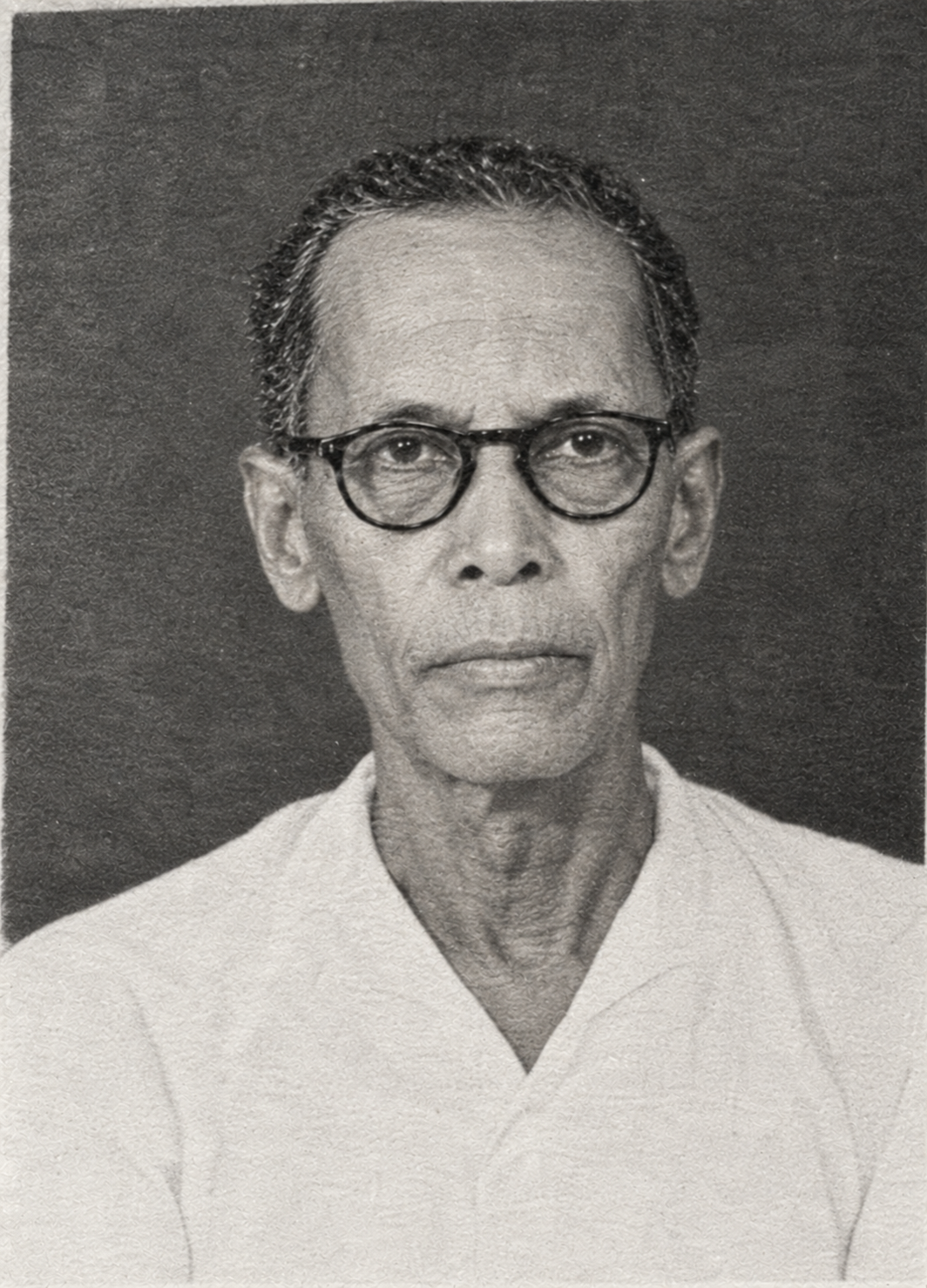
Mainly on grounds of my advanced age the publication of this small paper will come to an end after 1973. I wish to say goodbye and express my sincere gratitude to all Readers, Contributors, Patrons and to the Printers in particular for their friendship, cooperation and help.
The “Church of Christ” - an occasional paper since 1963 - originally started in 1947 as a regular quarterly Magazine entitled “Seeker, Jijnasu, Khoji” in three languages. In a few years it began to appear only in English and a little later incorporated into itself the functions of the “Christian Society for the Study of Hinduism” under the double name of “Seeker and Pilgrim” when the Society and their official organ “Pilgrim” were liquidated.
Through this humble publication as through the ministry of my life I have tried to hold up certain ideals and standards in the matter of Evangelism and interpretation of Christianity in the background of the Hindu faith and culture. I hope and believe this little paper has been able to stimulate rethinking in Christian circles for the building up of the Church in India in the light of original Christianity and make its humble contribution to the awakening of conscience for justice, freedom and brotherhood within the Church and outside it.
My prayer is that the Church and my beloved mother country may be guided in all their affairs by the Invisible but Living Christ Who is the Lord of life and destiny.
— R.C. Das.
Wanted
WANTED: Jesus Christ, Alias: The Messiah, the Son of God, King of Kings, Lord of Lords, etc. Notorious leader of an underground liberation movement.
Wanted for the following charges: Practicing medicine, wine-making, and distributing food without a licence. Interfering with business in the temple. Association with known criminals, radicals, subversives, prostitutes and street people. Claiming to have the authority to make people into God’s children.
APPEARANCE: Typical hippie type: long hair, beads, robe sandals.
BEWARE: This man is extremely dangerous. His insidiously inflammatory message is particularly dangerous to young people who have not been taught to ignore him yet. He changes men and claims to set them free.
WARNING: HE IS STILL AT LARGE!
— The Crusader - Poster from Jesus People Underground paper
Taxes
A tax assessor came one day to a poor minister of the Gospel to determine the amount of taxes the minister would have to pay.
“What property do you possess?” asked the assessor. “I am wealthy,” replied the minister. “List your possessions, please,” the assessor instructed.
“FIRST, I have everlasting life (John 8:16.) SECOND, I have a mansion in Heaven (John 14:2.) THIRD, I have a peace that passeth understanding (Philippians 4:7.) FOURTH, I have a joy unspeakable (1 Peter 1:8.) FIFTH, I have divine love that never faileth (1 Corinthians 18:8.) SIXTH, I have a faithful, pions wife (Proverbs 31:10.) SEVENTH, I have healthy, happy, obedient children (Exodus 20:12.) EIGHTH, I have true, loyal friends (Proverbs 18:83.) NINTH, I have songs in the night (Psalms 42:8.) TENTH, I have a crown of life (James 1:18.) ELEVENTH, I have a Saviour, Jesus Christ, who supplies all my needs (Philippians 4:15.)”
The tax assessor closed his book and said, “Truly you are a very rich man, but your property is not subject to taxation.”
— The Crusader, Baptist Challenge.
Available from:
Rev. R.C. Das, M.A.,
Khristpanthi Ashram,
129, Dashashwamedh, Varanasi, India
Printed at:
Evangelical Press,
“CHRIST NAGAR MISSION”,
Mijar Post, Mangalore Taluk, S. India