
The Seeker
| Volume | Date | Issue |
|---|---|---|
| 1 | Free India 1947 | 2 |
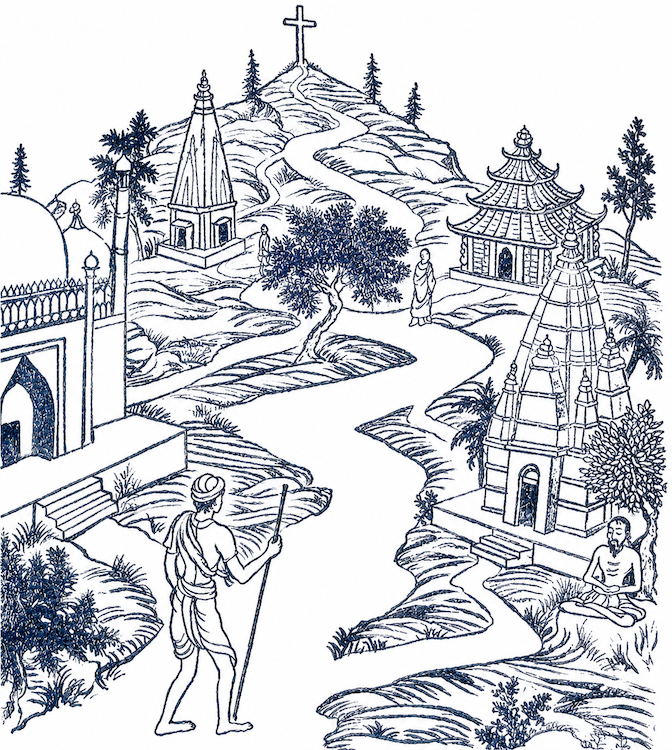
Ye shall know the Truth and the Truth shall make you Free— Jesus Christ (John 8:32)
This little occasional pamphlet will stand for:
Review and criticism of important events and opinions.
Advocacy of radical and independent thinking.
Encouragement of new experiments, progressive movements, ventures of faith and indigenous efforts such as:
- Christian Ashrams,
- Study of Hinduism,
- Indian form of Christian worship,
- An indigenous church in India,
- An Indian Christian Theology,
- Christian Literature etc.
Promotion of peace and concord among all men on the basis of truth.
Freedom and toleration.
Justice for the oppressed, neglected, deprived, weak and helpless.
Brief articles and concise opinions along the above lines will be welcome and published.
129, Dashashwamedh,
R.C. Das
Benares
India
Contributions will be gratefully acknowledged.
Love Thy Neighbour as Thyself
Prayers
For the Holy Catholic Church
Gracious Father, we humbly beseech Thee for thy church. Fill it with all Truth, and in all Truth with all peace; where it is corrupt, purge it: where it is in error, direct it; where it is superstitious, rectify it; where anything is amiss, reform it; where it is right, strengthen and confirm it; where it is in want, furnish it; where it is divided and rent asunder, heal the breaches thereof; for the sake of Jesus Christ, Thy son, our Redeemer
Amen.
For Racial and Communal Reconciliation
God of all nations, we pray thee for all the peoples of thy earth: for those who are consumed in mutual hatred and bitterness: for those who make bloody war upon their neighbours: for those who tyrannously oppress: for those who groan under cruelty and subjection. We pray thee for all those who bear rule and responsibility; For outcaste tribes, the backward and the down trodden: For the ignorant, the wretched, the enslaved. We beseech thee to teach mankind to live together in peace no man exploiting the weak, go man *hating the strong, each race working out its own destiny, unfettered, self-respecting, fearless. Teach us to be worthy of freedom, free from social wrong, individual oppression and contempt, pure of heart and hand, despising none, defrauding none, giving to all men in all the dealings of lifetime honour we owe to those who are thy children whatever their colour, their race or their caste. Amen.
— Hayland
Let US Pray
Oh, God who hast taught us that all our doings without love are nothing worth. Send thy Holy Spirit and pour into our hearts that most excellent gift of love, the very bond of peace and of all virtues, without which whosoever liveth is counted dead before thee,
    All our righteousness, if it be without love,
        Profiteth nothing.
    All our zeal in doing good, if it be without love.
        Profiteth nothing.
    We cannot get it by striving for it,
        Pour it into our hearts.
    We never can have too much of it,
        Pour it into our hearts.
    With this gift we possess all gifts,
        Lord, give it us.
    Love is the crown of all goodness
        Lord, give it us.
The Name
The name which thou hast given unto me. I have given unto these men, save them, for thy name’s sake, which thou hast given unto me.” This is an unfailing Prayer of the Lord Jesus to His and our heavenly father. The whole of the universe may be destroyed, in the twinkling of an eye but not a single word of His Promise and Prayer will be futile
The Power of the almighty name “Jesus” was not only active to the first disciples but to every one, from beginning to the end of the world, who take it, as an instrument of self guard. It is a shield for saving oneself as well as helping others to be saved. Saint Peter and his companion while entering into the temple by the beautiful gate, commanded the lame man to rise and walk in the same name “Jesus” which their master had given unto them. The vagabond Jew exorcists tried the name on some men possessed of evil spirits, and they were astonished to find the wonderful Power.
What is the modern world doing with the name? Instead of trying to save souls they are killing so many in various ways.
The name is not entirely given up by Christians. They use it only for sanctification of souls from sin. But how can one justify the idea that the name has power to save souls from sins only and not from all the troubles of life ?
During the last fourteen years of my Sanyasi life I have tried the name in several ways to see the Power of it in casting out evil spirits, healing sick persons without medicine, getting necessary food while helpless in the dense forests and hills, and by being saved from the _attack of wild animals, only by the name “Jesus.” It is known to all that the hills of Assam and Arakan are full of wild animals such as elephants, leopards, bears, Wild buffaloes, dogs, cows, tigers, snakes etc. My habit is to keep the word “Jesus” in my mind always, especially when raining in the hills and forests alone. It was in the autumn of 1937 I was coming down away from the Lushai hills. There were two very high hills on both of my sides. There was brushwood even at the joining feet of those hills leaving only a few inches without bush for any creature to walk along. Beyond a few yards of brushwood from the track between the hills, the dense forest commenced. I left in the morning a “Basty” (residence of hill people) to whom I had preached the Gospel in the previous night. And I arrived at the above spot at about 9-10 o.clock when a very big sound of some moving bodies reached me. It sounded like sudden cyclone blowing and twisting madly the big trees in the right-hand side hill not very far from me. I turned my head to see what was happening there, but neither any creature nor any tree moving could be seen, and the sound also subsided after a few minutes. I took that to be the sound of a large wild animal having fled away at my approach, and I went on my own way. But as I walked a few steps I noticed a huge buffalo approaching me running and jumping to butt and stick me to the ground. As I had decided not to try to escape by dint of my own effort in case I am attacked by any wild beast 1 halted and began to repeat the same name in my mind more earnestly the beast on Ms own way ran to approach me and instantly came within the reach of one single jump not farther than 7-8 yards from me. As a fast running horse is reigned to stop suddenly the beast halted and pointed its raging eyes upon me, as if it wanted to spear me to the ground by its sharp horns, but it seemed that somebody from behind prevented. It was not below five feet in height, it had the fullest health, its horns were like ever-sharpened spear, and eyes were like two sparkling marble balls. It was the only healthiest beast and the largest buffalo I had ever seen. It remained there for a few minutes standing and gazing to kill its prey, but was refrained by some invisible thing from behind. The beast then suddenly turned its back and ran away from my sight to the same direction from where it came. There is neither the slightest exaggeration nor falsehood in narrating this incident.
There are a few more instances of my life when I have observed the wonderful power of the name, to save people from such difficulties.
— Kumar Jitendra Nath Huldar Sanyasi.
N.B.
Mr. Huldar has been a Sanyasi for about fifteen years. He is Secretary of the Christian Ashram Sangha, Bengal.
Sadhu Huldar is undertaking a pilgrimage to Palestine. We commit him into the loving hands of our Common Master for safe keeping and pray that in God’s dispensation he may return with deeper faith and consecration to serve the church and the country with greater zeal and devotion. As a Sanyasi he has no means of his own and will be grateful for any help that the faithful will be able to give him. He will be glad to serve the brethren as he journeys along.
— R.C. Das, Benares.
An Appreciation
I have gone through the first number of the ‘Seeker’ and I believe it meets a distinct need in the Christian community. I like the title ‘Seeker’ for in place of supreme complacency that prevails by reason of imitation we need a mood of experiment, adventure, pioneering in Christianity in India as much as in politics and sociology. We have so far copied the western church. Only when the Upanishadic spirit of earnest fearless search come to us can we hope to make our contribution. Let us express freely our love to Jesus and our thoughts about him without being obsessed with the “fear whether it will accord with the doctrines of the historic church. We in India should not be mere products of history but should make history. It may be interesting to note that there were once a group of Christians who called themselves”Seekers” because they were dissatisfied with the churches and did not get what would satisfy. So they searched. Those “Seekers” gave place to Anabaptists and they in turn Quakers or Friends. I wish for this endeavour the blessings of Jesus.
— P. Chenchiah.
Short Studies in Theism (Hindu and Christian)
1. One God
Writers on primitive society differ in their opinion whether in early communities the worship of many spirits represents the initial stages of a process of ascent to one spirit or indicates a descent or a fall from monotheism to polytheism. The weight of authority favours the view that society started with many gods and evolved for itself in due course a monotheism. The view accords with the data that in practically every field of primitive life the movement was from many to one. The paterfamilias i.e. the heads of families - merge into chieftains when families merge into clans. When clans, each with a chieftain, unite we have king instead of many chieftains. We are witnessing the birth and growth of world society where this takes place the prophecy of a world-ruler, whether called emperor or president will be fulfilled. That religious development had been on lines similar to social or political is a reasonable inference unless facts to the contrary make, the position untenable. We may take it then as a sound generalisation that the line of development in religion has been from polytheism to monotheism.
We have however to remember that the passing away of many gods and the reinstatement of one in their place, is part of a larger picture of the movement of many into one. The one that was reached was not necessarily personal. In Hinduism, we know, the one was conceived as impersonal, supra-personal and personal. Monotheism is definitely not an inset in the picture but the central figure. Nevertheless, the frame holds other types of one than the person Brahma - the one is spelled in neuter as well as masculine — the one is not only a homogeneous one but ‘one’ in ‘many’.
The pathways of ascent from many to ‘one’ are various, and I have not seen a full treatment of the ways by which the one was reached. Hinduism in its prolific variety illustrates the manifold ways by which the ‘one’ was reached. The student of comparative religion is indebted to Hinduism more than to any other religion for a collection of various processes by which monotheism was attained. I shall therefore begin with the examination of Hinduism before passing of to Judaism and Christianity. The pathway from many gods to one may be enumerated thus.
- The survival of one among many
- The supersession of many by one
- Selection of one out of many
- The integration of many into one
- The coordination of many into one-leading to hyphenated one
- The differentiation of one into many.
The first three processes fall into one group and belong to the initial stages of development. The second three fall under another group belonging to the later and higher phases of religious development.
- The survival of one. In Rigveda we find the worship of many nature gods as practically co-equal deities. All of them were equally invited to the altar and all of them equally honoured. But the position could not be maintained long. Soon a self differentiation began and there can be no doubt that Indra who led the Aryan invaders into the land of the live rivers gained predominance though in ethical valuation Varuna as a just god was his superior. This supremacy was rendered possible by what Max Muller characterised as henotheism in a process in which one God was invoked at a time and in one invocation all the excellences of all other gods were attributed to him. In other words he becomes the one God and the sole God occupying the mind of the devotee. Thus, a sort of provisional monotheism arose without the many ceasing to be. Nevertheless, we have reason to believe that in the struggles of Vedic gods Indra survived and became the sole object of worship. Among the many fossilised survivals that present day Hinduism carries the memory of the cult of Indra is one. His worship was carried on in south India even in the Jain period as Manimalkhai … a Tamil classic testifies. Bhagavatam also shows that Indra cult was dominant in Sri Krishna’s days and that he led a crusade against Indra. From these indications the inference may be hazarded that Indra survived the other Vedic gods was the ‘one’ worshipped. Undoubtedly the main current of theistic movement passed by him. ‘Daksha Yagna’ preserves to us the history of struggle of gods for survival for Siva attained to his eminence only after struggle and success. Arya Samaj I am aware of beliefs that Rigveda embodies a monotheism basing its argument on the text “Reality is one, the sages call him by different names.” But critical study shows that the position was reached after a process of evolution, the starting point being many. While Indra represents a survival Brahma represents a super-cession.
— P. Chenchiah
Almora Ashram
(May to June 1947)
A Brief Report
Mr. E. Thomas Choudhury, a retired magistrate Lucknow is the proprietor and patron of the Isudasi Khristkul Ashram situated in his estate at Kalimat, 3 miles out of Almora town in the Himalayas. The fourth annual and special session of the Ashram was conducted for two months this last summer. Resident inmates including a Christian Sadhu were seven. Casual visitors numbered about ten. Then there were local friends, both Christian and Hindu, who paid frequent visits, It was a good thing to have Mr. Thomas and his younger daughter living on the estate all the time.
The centre at an altitude of six thousand feet with beautiful pine wood on the surrounding hills and villages and facing the entire range of the eternal snows provides wonderful opportunities for quiet study, prayer and meditation and observance of silence. The main theme of the Bible study was the teaching and practice of the apostolic church. There were classes on a comparative study of Hinduism and Christianity on a simple scale. Preaching and selling gospels on the main road to Pindari glacier, in the town and one or two villages was very encouraging. Nearly 700 scripture portions N.T. and Bibles were sold and at least 5000 hand bills were freely distributed. Visits were paid to and spiritual conversations were held at many local Hindu Ashrams and temples. Meetings of a devotional and evangelistic nature were held in some of the Christian institutions. Two series of nine lectures for the public of Almora town on religion and educational topics were arranged in the Mission High School and two addresses were given in the local Methodist Church. A social gathering of Christian leaders and a few Hindu Mussulman friends, and also a cultural day with a variety entertainment programme was made possible by the generosity of the Thomas family. The Ashram held a Commemoration Service with the Methodist Pastor Rev. U.S. Das in the Chair in which high tributes were paid to the Christian character and life of the late Mrs. Thomas in whose memory the Ashram has been started. With the next, and fifth experimental year of the Ashram its future will have to be decided. It is expected that a part of the estate will be dedicated to the Ashram purpose to be carried out in cooperation with the local church and the Fellowship of Christian Ashrams in North India.
Sincere thanks are due, for this successful session, to the N.C.C. for their kind contribution towards the expenses and to several friends for their personal service such as the Rer. U.S. Das, Dr. M.T. Titus, Dr. Goheen, Miss Chakko, Dr. Dharmendra, Mr. S.B. Tewarson, to the Thomas family and others
129, Dashashwamedh,
Benares
R.C. Das
(Organiser)
Peace and Truth: Unity and Love
The pairs are fundamentally related. Peace must be leased on truth and unity must flow from love. One cannot be separated from the other. Peace achieved at the cost of truth or on a compromise between truth and untruth will break down. Unity without love in the heart will be a mere appearance-a very little thing.
The proposition will apply equally truly both to church and state, Church Union without an adequate common basis in truth will collapse. It will be a ponderous show unless there is real heartfelt respect and spirit of fellowship among members of various communions. The union in the organisation and administrative machinery, if emphasised, will suppress and cover up real differences of thinking and feeling which will gather momentum and burst up one day One type organisation cannot be democratic. In true democratic unity diversity of administration, thought, emotion and action will not only be allowed but respected because they will be reasonably reconciled as far as possible. Autocratic union is oppressive and essentially divisive.
The Word of God for the Times
    Ye shall hear of wars and rumours of wars: see that
    Ye be not troubled. Nation shall rise against nation, and
    kingdom against kingdom and there shall be famines and
    earthquakes in diverse places and then many shall stumble
    and because iniquity shall be multiplied, the love of the
    many shall wax cold. But he that endure to the end the
    same shall be saved.
— St. Matthew chapter 24
    Hear the word of the Lord. There is no truth for
    mercy, nor knowledge of God in the land. There is nought
    but swearing and breaking faith, and killing, and stealing,
    and committing adultery; they break out; and blood touched
    blood. Therefore, shall the land mourn, and every one that
    dwelleth therein shall languish, with the beast of the field
    and the fowls of heaven; yea, the fishes of the sea also
    shall be taken away, and thou shalt stumble in the day,
    and the prophet also shall stumble with thee in the night.
    My people are destroyed for lack of knowledge; because
    thou hast rejected knowledge, I will also reject thee. Seeing
    that thou hast forgotten the law of thy God, I will also forget
    thy children. Thy shall eat, and not have enough,
    because they have left off to take heed to the Lord.
— Hosea chapter 4
    But in the latter days it shall come to pass, that the
    mountain of the Lord's house shall be established in the top
    of the mountains, and it shall be exalted above the hills;
    and peoples shall flow unto it. And he shall judge between
    many peoples, and shall reprove strong nation afar off; and
    they shall beat their swords into plough shares, and their
    spears into pruning hooks: nation shall not lift up sword
    against nation, neither shall they learn war any more.
— Micah chapter 4
Independence
The British have withdrawn their political control. There is room for grave doubt whether the act of transfer of power, unique in history apparently, has been truly voluntary out of a generous motive or compelled by external forces or impelled by internal weakness. That is for the future historian to probe and ankylose. It is good that India’s joy over this liberation after a thousand years was soberly expressed, It is particularly good for the Christian that his religion from henceforth will be gradually disentangled from inhibiting psychological and administrative connections with politics. It can now be presented and considered on its merits in a free atmosphere. Christians in India have all along stood on the side of all progressive political and social movements, avoiding sensational limelight: they have done quiet constructive work for the motherland. Their humble unassuming service will be more needed in new India.
The legacy of the British government is almost crushing to the infant national government. Abject poverty, dark illiteracy, miserable disunity, administrative inefficiency and corruption-are bailing problems. But that durable and worthy leaders will rise to the occasion is the faith of every true child of India. Unity, law and order must be preserved at all costs. Food and clothing must be adequately provided and that quickly, to the suffering people. Fear, insecurity, violence must be removed, and civil liberties must be re-established. Otherwise, bare political freedom will lack content and may even be lost.
India must forge ahead inspire of threats of internal commotions and even of wars, and all people including Christians, Muslims and other minorities must stand by the Government and the national flag. Whether some people like it or not India is on her path of destiny. She must sail on the high seas however boisterous the winds and threatening the waves in the dismal dark. Let us with heart and hop say Bon Voyage!
Notes
The view that the troubles in this country are communal has been assiduously spread by interested parties who have opposed Indian independence and democratic principles. The view is largely and essentially false. During seven centuries of Muslim rule and for the greater part of British rule these “communal” quarrels have been unknown. The root causes of the whole trouble lie deeper. Desire for political supremacy, economic gain, and mere ordinary human selfishness have been the dominant motives. Religion has been used as a suitable cover by many. The Muslims could not think of being ruled by Hindus, (being only one fourth among three fourths-mainly Hindu) not primarily because their religious faith is different but because of their inherited Semitic exclusiveness and imperialist pride. Other factors are also responsible for the murders, rapes and forcible conversions happening for some time now. The enemies of unity and independence want to fish in troubled waters for selfish gain. The racketeers, black-marketers, profiteers, the princes and zamindars, professional goods, believers in the two-nation theory and a theocratic state (Hindu and Muslim) and the last but not the least, the service men, the British Tories and Imperialists, Capitalists and Industrialists (both national and international) have all been playing their respective nefarious part in this grim and tragic drama. They think that they can retain and regain their prosperous position in the darkness of confusion and anarchy. In the circumstances the duty of every loyal citizen and true man is to help preserve law and order.
Can the Hindu and Mussulman live together? The Muslim says ‘no’, the Hindu ‘yes.’ The Muslim has always boasted of his ‘universal brotherhood’. The Hindu has been trained in the atmosphere of caste. This is strange! If We look deeper it is not unintelligible. The Mussulman’s idea of ‘brotherhood’ like other ideas has been fixed and exclusive. The caste within Hinduism has been mobile, adaptable and evolved. The Hindu has gladly welcome democratic principles from western history and constitutions. His forefathers have known them though in different forms and contexts. Muslim culture has been aggressive and dominating. Hindu culture is assimilative. The Muslim makes a wholesale imposition of alien elements of his culture upon a native culture that has always sifted and accepted with discrimination. So Hinduism feels hurt. It is not used to being thrust upon. Semitic culture with its logicality and exclusiveness-expressed in Muslim life in India — in its Arabian name and form and even dress and food and learning and architecture — its iconoclastic methods have not fitted in the Indian climate. Yet the Hindu has always thought that the essentials of Muslim culture and faith can be expressed in Indian terms of thought and life. At any rate his conviction is that it is possible for the Hindu and Mussulman to live together a unified economic and political life in a united country. Religion — is private personal affair. To the Christian it suggests the possibility of a reconciliation between two rival faiths on the basis of their essentials being disentangled from excretion Preserving its differentia Christianity has adapted itself different cultures in different nations.
Will Christians behave like Muslims, and when they grow a little larger, claim distinct nationality and culture? The possibility is there. Both Christianity and Islam have Semitic tendencies of exclusiveness - and they are both historically related to it. It will be a sad day not for the church and Hinduism, if ever that comes to pass Maintaining its essential uniqueness Christianity must inter-penetrate and mingle with the life and culture of the country and freely give and take. As far as I know. Hindu position mentality and history the Hindu will not interfere with the life and faith of the church when it is genuine and sincere. The quarrel is mostly over externals. Christian leaders have to be very thoughtful as to how they organise and developed the church life in this country. Over-organisation of life including theology that has come from the west will tend to stiffen the church against indigenous expression and may end in time in producing an exclusive social, cultural and political community or a caste like Islam. Lack of interest, if not opposition on the part of church-Mission authorities, in exploring, ways and means to make Christianity acclimatised is very ominous. Separatism will have disastrous results. It is high time for the Church to relate its life to its environment. Those who do not believe in it have a conception of religion analogous to that of Muslims, and they may well drive the Church to a similar position. Fortunately there are thoughtful men who realise this danger, and we should all forewarned and forearmed against development of external loyalties so often misconceived as internationalism or universalism.
SOUTH AFRICAN RACIALISM Why are the Churches in Africa, U.K. and the Empire silent about this wicked business? A European friend of mine has gone to prison along with Indians. Why do all clergymen and bishops and other Christians not protest and fight against this and fill up the union jails? Will the Indian issue resettled by Indian Ahimsa or the biological remedy of sheer brute force? What is the relevance and place of Christianity in all this affair? Is there any Christianity present in the so-called Churches? If Christianity fails so hopelessly in its own sphere of influence what right or inspiration has it to speak of God’s love and Christ’s salvation to millions in India?
VERY STRANGE! The two greatest wars of a global nature have been initiated and fought to the bitterest end by and among Christian peoples - not simply governments. The most horrible destructive weapons also have been both made by Christians and used by them against heathens. The clarion call of halt and the strident voice of protest against its wickedness has gone forth from India-from Mahatma Gandhi. Some few churches have pronounced feeble disapproval, others have supported. They are not agreed Strange indeed! It only shows how far away are the Churches from Jesus Christ. To be sure the God of Christ does not live in Churches alone and among Christians only. He has his own mysterious ways of fulfilling his purposes. Was not Christ rejected by the church of his own day and people ? Christians all over the world and particularly in this country ought to have openly and frankly advocated India’s cause for freedom for herself and others and her stand for world peace. It is good however that many of the world states has been compelled to support India at the U.N.O. But that again shows the utter bankruptcy of the official Christianity of churches. Many of the laymen and ever statesmen have a clearer apprehension of and better regard for Christian principles than ecclesiastical dignitaries.
Study of Hinduism in Benares
The usual course of study arranged every year around the Dusserah holidays will start from the 13th. October new and continue for a month or six weeks according to require went. Christian teachers as well as local Hindu, Buddhist Jain scholars are expected to lecture, students will have expert guidance in visiting the centres of religion and cul sure and important personalities. There is a special library of books on Hinduism on the spot and other local libraries can also be visited.
Expenses: Tuition fee Rs. 5/- for every Rs. 100/- of Salary or part. Entertainment Rs, 2/- daily Indian style, Rs. 3/, semi European. Local conveyance can be shared Correspond with.
Rev. R.C. DAS
Khristpanthi Ashram,
120, Dashashwamedh
Benares