
The Church of Christ
(Based on the Word of God; dedicated to the promotion of independence, Indianisation, unity, co-operation, and to the removal of corruption and evil in all forms and in all places.)
| Volume | Date | Issue |
|---|---|---|
| 4 | 1967 | 2 |
Dedication
Lord, make me an instrument of Thy peace:
    That where there is hatred - I may bring love,
    That where there is wrong- I may bring forgiveness,
    That where there is discord- I may bring harmony,
    That where there is error - I may bring truth,
    That where there is doubt - I may bring faith,
    That where there is despair - I may bring hope,
    That where there are shadows - I may bring light,
    That where there is sadness- I may bring joy.

Lord, grant that I may seek rather
    To comfort - than to be comforted;
    To understand - than to be understood;
    To love - than to be loved;
    For it is by giving - that one receives;

    It is by self-forgetting - that one finds;
    It is by forgiving - that one is forgiven;
    It is by dying - that one awakens to eternal life.
AMEN.
— Francis of Assisi, “Revival”
This Paper is Available from:
Acharya R.C. Das, M.A.,
Khristpanthi Ashram,
120, Dashashwamedh, Varanasi, India.
When the Spirit Comes
Rev. Paul S. Rees
Raymond Calkins somewhere suggests that all genuine Christian living has “three - not one or two, but three important and essential elements.” There is the mind - we must have a reasonable belief in God; there is the will - we must be obedient disciples of the will of God as revealed to us in the example of Jesus Christ; but also we must be possessed of the Spirit of God; our whole nature must be filled with the very life of God, which so possesses us and fills us with its inexhaustible abundance that it transforms us from weak and hesitating and questioning believers into bold, fearless, confident, conquering children of God.
It was precisely that which took place in the lives of the early Christians when, on that first Pentecost, they were brought so powerfully under the control and direction of the Spirit of God. Then it was that the Holy Spirit, wrote his own marks - which are, of course, the marks of Christ - upon them, not with ink, but with his own spiritual stamp. They became, “epistles of Christ” read and known of men.
What are the marks of the Holy Spirit in the life of the Christians?
Well, for one thing, He is known as the Spirit of Truth. John 15:26 Jesus says: “But when the Comforter is come, whom I will send unto you from the Father; even the Spirit of truth, who proceedeth from the Father, he shall testify of me.” And in the following chapter occurs the statement, “When He, the Spirit of Truth, is come, He will guide you into all truth” (John 16:13).
Andrew Murray, in his excellent book called “The Spirit of Christ,” has a chapter in which he reminds us of the two trees in the Garden of Eden - the Tree of Life and the Tree of Knowledge. Of the Tree of Life man was to eat, but not of the Tree of Knowledge. Now why Life before Knowledge? Because, as Murray puts it, “through life would come the knowledge and likeness of God.” But man, falling before the sin of pride, put knowledge ahead of life, and his troubles began. They began, and they have not ended. For today, after a long story of proud man’s effort to work out his own salvation, atomic man has the knowledge - the “know how,” as we say - to tap power that will blow him to smithereens; but he seems to have no secret that will enable him to live with himself.
One of the distinctive things about a man who is sensitively yielded to the Spirit of Truth is that he does not take his orders from, or pattern his life after, the stupid, shallow, and open pagan conventions and customs of the society in which he lives. He is open to truth.
Take the case of Peter in the early church. He had been preaching to Jews only. Came a day, however, when he was invited to conduct meetings among the Gentiles in Caesarea.
He was on the point of saying, No feeling that the gospel was not for them, when the Spirit of God spoke to him, “What God hath cleansed that call not thou common” (Acts 10:15), Whereupon, Peter flung his racial prejudice to the winds and began to fraternise with Gentiles in the ministry of Christ’s universal gospel!
The same Spirit of Truth is at work today. I sat at lunch with a businessman in a mid-western city and heard from his lips a story that, in some respects, duplicates the experience of Peter. This man, a deacon in a large church which is famous for its evangelical testimony, said that while the war was on a Japanese “Nisei” applied for membership in the church. No one doubted the young man’s conversion or the quality of his Christian life. Yet, when the application was presented to the Board of Deacons, that group of men was ready to turn it down. When the discussion revealed that the action, if taken that night, would be negative, the pastor moved to lay the matter on the table until the next meeting. Meanwhile, the pastor conferred with his deacons. “What Christian grounds have we for rejecting this man?” he asked. They could think of none. When the matter came up again, a month later, the Japanese brother was received into the church, with nothing but the happiest results for all parties concerned.
Said that deacon, who shared the incident with me, “I used to feel differently on this race question, but the Lord showed me where my thinking was wrong.”
That openness to truth is one of the marks of the Spirit of God. Upon our character and upon our behaviour the Divine Spirit writes the mind of Christ that we may thus become epistles of the living God to be read by all men.
Again, the Spirit of God is known as the “spirit of holiness.” That phrase occurs in Paul’s letter to the Romans where he speaks of Christ’s resurrection as having been wrought by the Holy Spirit. “Jesus Christ,” says Paul, “was declared to be the Son of God with power, according to the Spirit of holiness, by the resurrection from the dead.” (Romans 1:4).
For Christians there should be no serious problem over such blatant easily labelled sins as lying or stealing or drunkenness. Most of us are all keyed up to denounce these evil things and to stay away from them.
But the Spirit of holiness in the Christian believer is never content to keep us out of such mischief only. He searches and probes and convicts in those inner pockets of the soul where hidden evil lies. Take pride, for example. It is an infection of the carnal heart. If you want to detect it in yourself, catch yourself at the business of craving praise and flattery, while you become depressed and irritated over criticism and disapproval. That pride needs to die, else the full glory of your Lord will never be seen in you.
Or that peevish temper, or that pushy, stubborn self-will or that mean stinginess, or that smug complacency and lukewarmness of spirit - do you think that these are not sin in the eyes of God? And men?
The trouble with too many Christians is that they are more concerned about their doctrine of holiness than they are about being clothed with the beauty of Christ’s purity. Two Christian nurses fell into a heated argument on the doctrine of sanctification. One said that sin could be completely taken out of a person; the other denied it. Finally, both of them lost their tempers, and both of them demonstrated that what they needed was not a controversy but a cleansing. They needed to make a full surrender to the Spirit of holiness. By so doing the stamp and image of Christ-likeness would be written upon them and they, as epistles of God, would bear the message of His cleansing grace before the world.
The Spirit of God, moreover, is the Spirit of Power. Just before His ascension, Jesus spoke two remarkable sentences that carry with them the promise of power. Luke records them both, one in his gospel, one in Acts. In Luke 24:49 our Lord instructs the disciples, “Tarry ye in the city of Jerusalem until ye be endued with power from on high.” In Acts 1:8 he assures them: “Ye shall receive power after that the Holy Ghost is come upon you.”
The word “power” fascinates most of us. In fact ours is to an extraordinary degree, a power-conscious and power-hungry age. Yet our conception of power and our use of such power as we have is so selfish, whether in the home or in international relationships, that we tend to wreck our world rather than save it.
Now go back to those early Christians and see what magnificent things happened to them when “the power of the Holy Spirit” took possession of them.
Speaking of the vast needs that challenge us in contemporary life one writer observes: “Politics needs to be purified; our industrial worlds need to be pacified; our social life needs to be simplified; our whole world needs to be unified.” Granted! But how would it do to declare a holiday on all our grandiose schemes long enough to start something new. New, you say? O, yes, quite new! What is it? It is making Jesus Christ, actually and consistently, the central figure in our individual lives. If you don’t think that takes power, it is because you have not seriously tried it. It takes such power that only the Holy Spirit can furnish it. It is a major malady of our time that we want in the large what we are unwilling to adopt in the little. We want in the mass what we do not practice on the scale of the individual. We blame the United Nations for being so divided and futile when our homes are places of wrangling, of tension, and of discord.
Power to make Christ central! How immensely we need it! Nor will it come by blowing on our hands and declaring that we are ready to turn over a new leaf. It will come when we kneel humbly before God in prayer. It will come when we Christians pray with faith, “Take us, Lord, O take us truly.”
Then God will write the mark of power upon us and send us out as epistles of His grace to be read of all men.
— Revival.
Not for Sale
Simon, the Samaritan sorcerer was ready to offer hard cash for the power of the Holy Spirit (Acts 8:9 ff). While we cringe at his coarse commercialism, it is to his credit that he at least wanted power. A disturbing number of Christians nowadays are apparently content to not consider it a major issue. Speaking about the Christians in his day, Moody said, “You might say safely, that nineteen out of every twenty of professed Christians are of no account so far as building up Christ’s kingdom goes; but on the contrary they are standing right in the way, they have just got life and have settled down, and have not sought for power. The Holy Ghost with power is distinct and separate from conversion.”
This diagnosis cannot be far from dead centre today. Long unmoved and unmoving, preserving a fine outward form of religion but actually strangers to power, many believers are themselves, but that sign of the end times predicted in 2 Timothy 3:5.
Power! How are we going to obtain it? The Apostles put Simon straight. The Holy Spirit was not for sale. He was, Peter said, “the gift of God.” Money could not buy His power then, nor can it now. Plans, programmes, and personnel are all of vital importance. But they do not in themselves make certain the presence and power of the Holy Spirit. He is to be obtained on God’s terms alone.
The Holy Spirit is available to those who wait for Him. “Tarry ye in the city until ye be clothed with power from on high” (Luke 24:49) was the Lord’s command to the disciples. In obedience, they retired to the Upper Room to pray and to wait. It was not long before the Spirit descended upon them, and they gave daily demonstration that they were in constant touch with divine power. The record in Acts of God’s Spirit at work is surely intended for more than just preservation of the historicity of the events. It must also be intended to make us hungry for a personal experience of power in our own lives and service.
We need to wait for Him. The length of time is not the crucial matter, but the manner of our waiting. We must search our hearts deeply. We must confess our sins of un-Christ-like actions and attitudes (A slow, prayerful reading of Colossians 5:10 in the New English Bible or in the Phillips’ translation will reveal many of the sins we have learned to live with.) We must come to sincerely see our helplessness and hopelessness apart from His enabling, and so surrender ourselves completely to Him. ‘Blessed are all they that wait for Him’ (Isaiah 30:18).
Waiting for Him, however, is not an interminable process. Waiting must lead to asking. The Holy Spirit is available to those who ask for Him. This, too, is the word from the Lord, “… how much more shall your heavenly Father give the Holy Spirit to them that ask Him” (Luke 11:13). Waiting for Him will reveal our deep need and inspire a longing for His fullness in our entirely surrendered heart. This is faith, and faith has its sure reward; “Ask and ye shall receive.” As an earthly father would never mock his son by giving stones when he requested bread, so the Father is certain to grant the Spirit to those who hunger and ask for Him.
Waiting and asking. And then? Remember the Holy Spirit is given to those who obey Him (Acts 5:32). An obedient Christian cannot help but be a powerful Christian. The Apostles had power because they were in the place where God wanted them, and doing the work which He appointed. Simon was impressed when he saw the miracles. But the “miracle phase” of power was only part of the picture, and apparently a short-lived part at that. Those in touch with the Spirit went forth preaching, witnessing, planting churches, leading believers into deeper experiences, and travelling on and on with the gospel which proved to be the power of God unto everyone who believed.
Power is not for sale, but it is obtainable to all who wait and ask and obey.
— R.M.R. - Editorial, The Revival.
Letters
Amsterdam, Oranje Nassaulaan 10, Dated March 3, 1967.
My most reverend brother,
You will be wondering to receive a letter from me from this distance in reply to your kind post card addressed to Madras. I fear my letter written to you from Switzerland might have been mislaid - for I was expecting a reply to that all these days. I have also written to our brother in Calcutta thanking him for his best wishes for my travel to Europe. He is also planning to visit the West if he can find an opportunity. People of our type who have a different approach to our Lord should visit the Christian world and present to our brethren here, how we dream, think and live in the world of Christ with our approach, an approach which is different from what the missionaries think and speak of here. What an amount of ignorance one can see even among the great scholars of Christian Thought here. The great question that is asked here. Why should the Indians who have been drawn to the feet of Christ, should think of their ancestral culture, heritage and things of that kind, and put in all efforts to lead their life as Christians in harmony with their past life. It is their wish, if I understand the missionary type of people here aright, that we cut ourselves off entirely from our past connections with India and Indian heritage. I am enlightening the public here in my own way but the forces - mostly emanating from our kith and kin - who come to the West at the invitation of the missionary bodies - work otherwise. This you know. I want brothers like you should help to present the right approach of ours through their writings. For this purpose, you are the right one and your writings - however small they might be - should contribute their might in this direction. I am sure you have seen the writings of Manilal C. Parekh which have now been translated into German by a German professor of Theology who adores Parekh and his approach to our Lord. You should guide us also with your rich experience. So also our Appasamy should come forward with his writings.
My thirty-three years experience as a humble and devoted follower of Christ has made me peep into the mysteries of Hindu world - even though we as Christians prefer to utilise the vehicle of Bharat or Indian World as our guidance - and through that enabled me to look at the present day Hindu world with a Himalayan vision. So long the Indian Christian world misses this eternal link, we will be “Pariahs” in our own country as the second rate mouthpieces of the missionary world. This truth we should bring home to our own people, if we really want to work among the Hindus and make them understand what Christ means to us. Either from the present day converts or from the converts from the past generations, a Martin Luther must be born and lead us from the Unreal to the Real - We need first unity of thought and approach among ourselves - and with this unity we must live and work among the Hindus - considering them as our brethren - This is a Himalayan task. I thought and dreamt so much the Converts Conference in which we took so much interest at Bangalore would guide us in this but, it has let us down. You are our Mantri, and I am confident you will devote all your energy in this rich and mature age of yours. Please permit me to join you in this great mission of yours. Our “Bharat Khrist Sangh” should be a pioneer to lead us to the future. I want your blessing for my work here.
I will be in Europe till the middle of August. My address until then will be c/o Ecole D’Humanite, 6082 Goldern/Hasliberg, Switzerland. With all my loyal greetings,
Yours John Narayan
(A.N. Sharma).
A Quiz
187 Roberts Road, Trimulgherry, Secunderabad-15, (Deccan)
Dear Sir,
Can any of your readers kindly answer the following questions which are puzzling me a great deal: -
What is really responsible for splitting the Church of Christ into so many denominational sections of rivalry and intolerance, thus creating a traffic jam on the straight and narrow way?
Is it the Life of Jesus Christ?
Is it the Sermon on the Mount?
Is it the Lord's Prayer?
Is it His Parables?
Is it His Miracles?
Is it His Supreme Sacrifice on the Cross?
If NOT, what else is causing the disintegration?
May I be enlightened?
Thank you.
C.D. Airan.
(Copy of letter dated 22-9-65 from Rao Sahib K. Subba Rao, Munipalli, to Mr. C.D. Airan, Trimulgherry, A.P.)
My dear Brother Airan,
The truth is that you are not this visible body. You are more than that. You are the Spirit-undying spirit - beginningless and endless, for the moment residing in the body called Airan. Forgetfulness of this fact makes you to be the servant of the body - a dry leaf in the whirlwind of dusty desires. That is the Fall and the fallen state in Sin. It is not stealing that is the mark of this Fall - Sin. It is the desire. It is not debauchery that is the sign of the Fall - Sin. It is lust, passion, that is sin.
“Of course these limits (commandments) set to the Fall are good for the society. That is all. Do not you see that a person who lives with his wife alone in mind, word and deed; who does not steal; and is satisfied with counting his own money, etc., is not a perfect man. He may be a good man, but he is not perfect. This is social morality which does not put you on the spiritual path. This morality changes according to the times and circumstances. Once it was moral to marry many women - to beget children by means which we call sin nowadays.” This man made morality leads us not to the path of Christ. This man-made morality belongs to man-made religions, called Christianity, Hinduism, etc. But these do not at all qualify you to follow Jesus Christ. At least this was His advice to the righteous rich man who asked him. He straightly told us that he who hopes for heaven and reserves a place there, etc., does not marry nor is given in marriage.
Complete conquest of the self - complete self-denial - complete renunciation_ (mind, it is not simple; it is renunciation in thought, word and deed) is the beginning of real life. Jesus lived like that, and said it is the Way of Life. So one can be baptised into the religion called Christianity; one can be made to go to a building called Church; one can be made to do all kinds of things, calling it worship, prayer, etc. But that leads us nowhere.
Rather it leads humanity astray. There are only two alternatives: (1) Living like Jesus to become Christ; or (2) worshipping, praying, and do all the rest of things expected by religion. It is the latter that transformed all that Jesus did and said into a Religion; and made Him a God subject to the torture of worship and prayers. Do not put your trust in prayer and worship. Let Christ save you. Let Him live in you. Let Him save humanity through you. Let Him use your body completely. Let His Will prevail over your body. Let your self die so that you may live a selfless life. This is the only problem. Do it, or do not do it. If you do it, it is Airan becoming Christ. This is everlasting life. But for Truth’s sake do not cover up your inability to live like that, by some pretence called religion, worship, prayer, etc.
May the Lord Jesus serve you so that you too may become one with Him - Christ. Explain this to the world in its own language which I do not know.
Yours affectionately,
Sd/- K. Subba Rao.
Comments
If a man’s spirit is “beginningless and endless,” it is eternal and absolute - equal to God. This is absurd Hindu thinking. There cannot be more than one eternal or absolute. According to the teaching of the Bible man is created and relative.
Even Hinduism accepts morality as a necessary preparation to Yoga and Samadhi in order to have the beatific vision of Brahma. Jesus accepted the validity of the commandments followed by the young rich man and even appreciated him. But the Guru wanted him to go further - to Jyag (renunciation) and to self-surrender discipleship.
There is a hopeless mixing up of this story with the controversy Jesus had with the Jews (Sadducees) who asked him whose wife a woman would be in heaven who married seven husbands one after another on earth. The Bible should be read with care
Mere self-denial or renunciation is negative and unfruitful or just selfish in fact. It must lead on to positive dedication to God’s will. Meaningful worship and prayer in the church has always inspired consecration to the service of God and man. Worship, if considered an end in itself, is a barren hindrance but as a growing process and means, is fruitful, issues in compassion for sinful humanity and abiding in God (Brahmasthiti). Superficial denial of the efficacy and power of prayer, worship and instruction within the church is a thoughtless flying in the face of facts.
We can become like Christ and like God - never equal Christ or God. It is lopsided Hindu thinking that equates Divine and human personalities.
It is altogether careless reading of the N.T., especially Gospels, that makes one think that his disciples made Christ into a God. Contrary is the truth. It was not easy for them to recognise God in Christ. Christ’s life and words made such an impact upon their souls that they were forced to find Christ to be God. Apart from that, on many occasions and in many ways Christ declared His own Godhood. It is hoped that Hindu friends will study the character of Jesus with more discrimination and not be biased by Hindu ideas - not only with Bhakti in their heart but with some light of Knowledge and Conscience and reason.
— Editor. Church of Christ.
My Spiritual Pilgrimage
By R.C. Das.
(continued from No. 1)
I became attached to Brahmoism and to Christianity almost simultaneously though during the earlier part of my residence in Dacca I was inclined more to Brahmoism than to Christianity. Had I not kept up this connection with Christianity (for which I thank God) perhaps I could not have become what I am today. There was sufficient reason for my partiality to Brahmoism at that time. First, it is indigenous in every way, and so naturally appealed to my heart. Secondly, it possesses a most excellent literature in the vernacular which, I believe, is the most effective instrument to change men’s opinions. Thirdly, it offers a reconciliation of all the conflicting religions of the world though I discovered the fallacy of its eclecticism before long. Lastly, the Brahmo community is highly developed in point of education, morals and religion, and is a pleasant half-way house between Hinduism and Christianity. All these drew my attention to it. I hardly found any good Christian literature, and scarcely frequented the Christian chapel. I remember having gone to the Bengali service once or twice, but it gave me little satisfaction. Everything, even the very atmosphere, seemed to me foreign and alien to my taste. But it must be noted that I never broke my connection with Mr. Morris. I had made considerable progress in the study of the Bible. We used to have prayers together after reading the Word of God. All this was exerting a secret influence upon my soul. Brahmoism stirred my whole being, but it was more critical than constructive. While I found a sure and lasting consolation whenever I read of the gentle Jesus. I noticed there was something real and living behind the simple words of the Gospels. Gradually the personality and character of Christ began to capture my imagination. I found that the words of the Gospels were not merely dead letters, but full of inspiration and power - above all soothing and life-giving. As days went on a dignified, sedate but yet most glorious and dazzling ideal appeared above my mental horizon. I was experiencing the power and winning influence of the personality of Jesus. The Gospel message gave me hope and gladness, and supplied me with an ideal. But if it had ceased there, I could not have been what I am.
The living word of God warned me of a serious fact in my life. The life and death of Jesus convinced me of the fact that God is not only loving, beautiful and almighty, but that above all He is holy and righteous. The character that has been revealed through the Gospel pages brought out my own character in its true colouring; it told me plainly that I was a miserable sinner, unworthy of the Heavenly Father’s love and affection. My whole life became gloomy. At this time I was most unhappy not knowing how to relieve my pain. I had not yet understood the meaning of the death of Christ, and so resorted to Brahmoism to seek for relief of my anguish I thought that through sorrow and repentance I would be able to wash away the stain on my soul and secure God’s forgiveness. So I decided to accept Brahmoism not knowing definitely why, only thinking that thereby I would be able to quell the storm that had arisen in my moral life. This period of my life - about a year - was a most unhappy time for me. I tried, but could not become a Brahmo. Not that any human force kept me back, but I felt a supernatural power always working within my soul, heart and spirit. It was somewhat later that I became clearly conscious that it was the ever living Jesus of Nazareth that was inwardly controlling my life.
All through this stormy period I felt that I must be honest and sincere with myself. True to conviction, I must try my best to follow the light and the truth as far as I knew it. All through my inquiry after religious truth, I used to pray and meditate for light and truth. True to the rationalistic principles of Brahmoism I could not take Christ or any other great man as my sole spiritual guide and ideal. But I was now finding myself unable to resist the influence of the Son of God. Often did I utter unintentionally and unwillingly the simple name “Jesus” when in despair and sorrow, often did I lisp the expression “in Jesus name” silently after a solemn and earnest prayer. Mr. Morris often spoke about Jesus, about His love and my sin, but he never persuaded me to become a Christian. He often advised me in his letters to follow the right and shun the false when I knew it. Often did I write to him almost unwillingly about my faith, in and love for Jesus. Very soon I came to find in Jesus my personal Saviour. My Friend, My Guide and Ideal. I believed because I could not help believing. In this conviction and experience I was helped by Dr. Frank Lenwood of the L.N.S. who at that time was on a lecture tour in India, and visited us in Dacca. His main theme was Man’s sin and God’e redemption.
Now came another conflict in my soul between Brahmoism and Christianity. Brahmoism taught me to be critical; I felt I must not take Christ so easily. My faith in Jesus might be the product of a charm and just an emotion not necessarily an intelligent response to truth. I must question Him and test Him. If He could stand the test, I would accept Him or else not. This was a period of intellectual doubt, conflict and struggle. The supernatural element in Christianity was for a long time a great stumbling block to me until through the agency of both human and Divine help. I was led to see that all true religion as such, and especially Biblical revelation, is inseparable from supernaturalism. The possibility of a special revelation was a knotty problem, but soon I was convinced that for a perfect, adequate and vital religion revelation was absolutely necessary. I believed quite sincerely that truth must triumph in the long run. So I applied this rational criticism against Christianity and Brahmoism alike. Under the pressure of this criticism my faith in Brahmoism came to pieces. I found that Brahmoism was a mental abstraction and a philosophic speculation having little reality behind all its teachings, and no organic unity amongst its principles. I discovered the unsoundness of its eclecticism. I found that Brahmoism was largely Christianity divorced from the living personality of Jesus Christ, and my surprise knew no bounds. It taught me that God is loving, but it overlooked that He is also holy and righteous which I learned at the feet of Jesus. It talked loudly of the fatherhood of God and brotherhood of man. But all this is meaningless without the Son-ship of Jesus. Brahmoism stirred the depths of my soul, created a restless spirit in me, but gave no adequate consolation and peace. It told me to repent and turn to God, but I was unable to work true repentance. I often shed tears but found no peace, no assurance of God’s love and forgiveness. It increased my restlessness and dryness of heart. I chased the shadowy ghost of the God of Brahmoism in vain. It eluded my grasp, and I could not worship unless I created a God in my heart. But I was not to be satisfied with imagination. I wanted reality which would at once satisfy my conscience and intellect. Brahmoism hardly told me anything of the stain and impurity which blackened my soul and heart, and dimmed my vision of God and defiled His image in me. Brahmoism scarcely offered me an adequate means of salvation except a false repentance which has to be worked out. It told man to go to God, but did not undertake to remove the barrier between. Reason and intuition are the ultimate criteria of truth according to Brahmoism. Revelation is an absurd impossibility. Well did my whole nature revolt against such a system when I arrived at the age of discretion and maturity. Christianity I found to be the most rational faith which satisfied the intellect as well as the deepest needs of the human soul. I tested Christ and found Him true and strong. In Him, I found my highest moral ideal, and the perfect assurance of a Divine Reality as our loving and just Heavenly Father. The purpose and necessity of Christ’s death on the cross of Calvary became clear to me, and as I linked myself to Him through faith and trust and surrendered my will to His, I found myself electrified with His spirit, my sense of guilt removed, the black stain washed away by the sacred blood of the lamb of God. The heavens were opened as it were, and a new vision of life crossed my mind. I decided to accept Christ as my Saviour and Lord publicly through baptism. I told my father of my conversion and decision. He wept bitterly and apparently did not oppose. My friends and people also became alarmed, and all combined to prevent me from becoming a Christian. They offered me many strong temptations. To some of them I yielded. But Christ would not let me go astray; He raised me as soon as I fell because I looked up to Him even when I was falling. At last, through the weeping and sorrowing of my parents and friends, I was led nearest to my Saviour and was baptised in 1908 by Rev. P. Noble, Superintendent of Baptist Mission, Dacca.
“Come unto me, all ye that labour and are heavy laden, and I will give you rest. Take my yoke upon you, and learn of me, for I am meek and lowly in heart and ye shall find rest unto your souls. For my yoke is easy, and my burden is light.” Matthew 11:28-30. That gracious tender call of Jesus, the like of which I had not heard anywhere else, arrested my attention. The whole process of my conversion was completed when I became convinced of the legitimacy, authority and force of the unique claim of Christ when He says, “I am the Way, the Truth and the Life; no man cometh to the Father by me.” John 14:6.
Before I became a Christian I had no definite idea as to what work I should do in my life. My only anxiety then was to find out a moral ideal and a spiritual standpoint and when once I found that, I thought it would be all right with me. And I thought rightly. It was after my baptism, in lonely prayer before the throne of God, that I found out His will and purpose for my life. It was after cool deliberation and through God’s guidance that I arrived at the final decision with regard to my lifework. I felt my humble life, all my energy and ability, must be used in the service of my Master to whom I owed all that I was.
(concluded)
(I am now engaged in writing my subsequent experiences in the church).
A Review
Convictions of an Indian Disciple
(Indian Christian Thought Series No. 6) C.I.S.R.S., Bangalore, 1966; pp. 33, Rs. 2/-
By R.C. Das, Varanasi.
The author is a well-known evangelist and ashram leader at Varanasi, whose thoughts on the Church have often been criticised by missionaries and pastors. He also touches upon these issues here, but (unfortunately) only to a small extent. One wonders whether the C.I.S.R.S. editors have omitted the controversial passages.
The booklet consists mostly of extracts from R.C. Das’ earlier publications and has four chapters, (1) The Unique Christ (2) Presenting Christ to the Hindu (3) Experience of a Sanatani Christian (4) By Ones and Twos.
Following the Farquharian method the author tries to present Christ as the fulfilment of all religious aspirations in the various forms of Hinduism. “He is the goal to which all spiritual movements lead - the Gauri Shankar (Mt. Everest) of the Himalayan heights in mankind’s spiritual upsurges … He sums them up in his unique personality.” Thus, Christ’s uniqueness is not unrelated (“as Barth and Kraemer have claimed”) but “inclusive, comprehensive and synthetic.”
There is much truth in Das’ criticism of Barth and Kraemer, but Das himself seems to overlook that also man’s religiosity, perhaps especially man’s religiosity bears the mark of sin. Jesus was crucified by very religious minded people, because He - while accepting the necessity of religious forms - condemned man’s way of using religion to separate himself from and elevate himself above others. There is an acceptance, but there is certainly also judgement of religion in the Gospel of Christ, but in Das’ writings there is very little of the latter aspect. The more religiosity and the more spirituality, the closer to Christianity seems to be the idea.
But when that is said, there is indeed much to learn from this book. Exactly because the author is a Christian is he able to see the great values and the deeper meanings in Hinduism, not so much the philosophical as the religious Hinduism with its sacrificial system. A Christian visiting Varanasi is often disgusted with what he sees; he should read this booklet, or even better visit the author in his Ashram so that the author may open his eyes to the deeper motives of the bathing in the Ganges, or the sacrifices in the temples.
Last, but not least, in our age of Communalism, also Christian Communalism, it is good to have it said plainly and straight forward that the task of the Christian evangelist is not to enrol members in the religious organisation called the Church, but bring men to God in Christ.
— Dr. K. Baago, Bangalore.
(I did not know Farquhar - far from “following” him - when I discovered Christ as the natural culmination, and even as a logical consequence, of Hindu Jnana, Bhakti and Karma.
Surely, “man’s religiosity bears the mark of sin” and the “judgement of religion” (especially as a system) “in the Gospel of Christ.” But my aim in the booklet is to show that the moral and spiritual truths of Hinduism, as distinct from mere forms, are of a piece with Gospel and lead to a final surrender and shelter in Christ. Hinduism is deeply sacramental. Idolatry, Holy water, Sacrifice, Varna, Incarnation etc., are not mere religious forms or thoughts but truths however imperfect and hazy. Christ’s judgement applies equally to historical Christianity as a religion.
R.C.D.)
Pope Sounds Like Marx
Vatican City, March 28 (Reuter) - Pope Paul VI today criticised certain aspects of the capitalist system as he made a strong plea for rich nations to help under-developed countries.
He said it was unfortunate that a system had been constructed which considered profit as the key motive for economic progress, competition as the supreme law of economics and private ownership of the means of production as an absolute right that had no social obligation.
In his Papal Encyclical - a letter to the world’s 550 million Roman Catholics - the Pontiff attacked the rich for keeping what they did not need, landowners who misused their vast properties and men who drained money from a country and transferred it abroad.
The superfluous wealth of rich countries must be placed at service of poor nations, he said and repeated a call he made in Bombay in 1964 for a world fund taken from arms expenditures to be used to relieve men’s misery. The arms expenditure, he said, was “an intolerable scandal.” The peace of the world and the future of civilisation were at stake, he warned. To underline the urgency he said: “We must make haste, too many men are suffering.”
In his 20,000-word letter, the Pope called for the establishment of a world authority capable of acting effectively in juridical and political matters. He also suggested regional agreements among weak nations for mutual support. - The Indian Express: New Delhi 29/3/67.
(What about his vast wealth and authority in his own church? - Editor)
Printed by: Evangelical Press, Christnagar Mission, Badagayedapadavu Post, Mangalore Tq. S. India
Notes
Supplement to “The Church of Christ.”
1. Zakir Husain
We hail our new President and offer him our warm and sincere felicitations. The choice has been politically sound and wise, and socially good. Zakir Husain is an erudite scholar, a servant of the nation and a veteran Congressman imbued with Gandhian principles. His installation to the high office is certainly a proof and a bulwark of the secularism of India. It proves that the core of Indian political life is still sound. Those who have any misgivings and have suggested that Rastra Bhavan might be used as a centre of Pakistani politics must be suffering from a perverted mind affected with the virus of communalism. We wish Dr. Hussin good health, courage of conviction, and every success in his responsible and difficult position.
2. The Economic, Social and Political Life of the Country
In one word we are heading toward chaos, to misery and ruin. The United Front Leftist Governments in half of the States are essentially unstable. It is a hotchpot of conflicting ideologies and a source of internal clash. But if they can evolve and work on a large enough common ground programme, and concentrate on that, such as the questions of food and prices; bettering the conditions of workers, housing and accommodation, black-marketing and profiteering and a few other subjects, they would strengthen and stabilise the government and would do a lot to make the people happy. Then the law and order problem will look after itself. But one fears that they are also behaving more or less as the Congress government has done for nearly 20 years. Words, sermons, pledges, promises, equivocation, hypocrisies, without implementation have made the poor masses sick in heart and rebellious in mind. They are really unhappy and miserable. No amount of sermonising will help the situation. They are angry and violent and the consequences will soon be very serious. Unless strong and just government is exercised and corruption in different departments of administration and among the public is eradicated, at least to a larger extent, it would not be possible to save democracy, secularism and non-alignment - the three great pillars of our national life.
3. Reasons Why Church Life Is Not Happy and Why the Mission of the Church Is Not Being Fulfilled
In north India for two centuries in the building up of the church too much money, too much organisational power, too much domination and control, foreign initiative and talent and the motive of numbers rather than quality - have been used. The church extended rather than deepened in its moral and spiritual life. National genius and culture were not only hated but rejected. Original converts - some of them spiritual giants - who had enough cultural creative energy and patriotic fervour were not given any scope to utilise their talents in developing church life according to their lights. Instead, they were distracted and shunned and foreign patterns of church government and worship were firmly established. So the church is, after two centuries, an exotic plant - glass house. Even today missionary rule, direct and indirect is strong. How can you expect such a church to bear any fruit?
SECTISM has been equated with the apostolic principle of moral and spiritual separation from untruth, error, evil, superstition, apostasy and sinful conditions in church and society. A particular doctrine, may be essential, has been over-emphasised at the cost of other doctrines equally important, and a peculiar exclusive narrowness has resulted. A church has been called by the name of such a doctrine or in the name of a living person not yet convincingly proved to be a saint, and a sectarian intolerant church has risen much to the pain and hostility of other Christians. e.g., over emphasis on truth and holiness has produced spiritual egotism-pharisaism - and love and fellowship have fled, over emphasis on salvation - the cross of Christ, Blood of Jesus at the comparative neglect of the Incarnation identification, cultivation of moral and spiritual life, neglect of the moral teachings of Christ and of putting them into practice - has produced a temporary soul satisfaction of having been saved and hence a certain shallowness in Christian life appeared and depth and power is lacking. Over emphasis on the prophetic ministry and open air shouting evangelism at the cost of silence, meditation, quiet prayer, physical health has produced a shallow ministry with no impact on the Hindus. This has produced a canalised Christianity and a divided exclusive church with external means touching only the superficial and marginal life of society. All doctrines and truths of Christ should be harmonised and equally stressed and cultivated as the divergent expressions of the One Word of God and of the one church life.
Some individualistic and independent itinerant preachers of the Gospel are too free, non-co-operative, and personal and succeed in gathering round themselves small but numerous congregations who compete and conflict with one another. These otherwise good workers and servants of God woefully lack general education, common sense, fellowship and love, and a sense of the Catholic and apostolic church, at the present time they are creating a lot of harm to the cause of the Kingdom in India. All these independent enterprises are vital, creative and lively as far as the Gospel preaching and conversions are concerned. But they lack the very spirit of unity and its basis, they think unity is achieved by conformity to a set of a few doctrines at the cost of vital truths of Christianity. They should all come together on a broad basis of common essential doctrines and a practical programme within one constitution. This is amply provided by the “Bharat Khrist Sangh” with its indigenous and apostolic outlook which is liberal enough to include different types of individual Christians and church congregations and orthodox enough to exclude real error and heresy. But it is regrettable that these brethren - leaders of small groups - in spite of their spiritual zeal - are too selfish and greedy of power and money. In fact, they are self-seeking and opportunists church leaders ought to contact them and sympathetically pray for them, many of them can be weaned to usefulness and a larger life.
INVIDIOUS DISTINCTIONS between one Christian and another, between one group and another, poison social and ecclesiastical life everywhere. The teachings of Christ about wealth, property and social fellowship and the example of His own life and that of His disciples and apostles for over two centuries have not affected Christian life since then. At the present time social exclusiveness and economic differences - all artificial - are to be found in the church as much as, if not more than, in the heathen society. The reason is that the average Christian does not know the Word of God nor those few who know ever seriously think of the implications and practice of the biblical teachings and commands. Practically to all Christians both in the west and in the east, Christianity has become a traditional religion based on human wisdom and many local unchristian ideas and customs. Christians have forgotten that Christ has given us a Gospel and a Way of new life and not a religion unrelated to ethics - not a system of beliefs to be professed without any obligation to practice or without any bearing upon our moral conduct and social relationships. Hence, high and low, touchable and untouchable, uneducated and educated - and consequent sins like snobbery, pride, contempt and hatred on the part of the rich and jealousy, greed, enmity and frustration on the part of the poor are to be found among Christians as much as among the non-Christians.
The only remedy is to come to the cross in penitence and think and act freely under the leadership of the Holy Spirit and walk, in the footsteps of Jesus. Otherwise, the causes of the unhappiness, partially enumerated above, will not be removed and life will never be joyous or fruitful.
4. Christians Have Forgotten
That goodness quality or excellence is the child essentially of genius but also of hard labour, self-control, utter devotion, even of suffering and poverty. Ease, comfort, money, organisation, limelight, publicity and propaganda partially or completely spoil the quality or substantiality of a thing pursued or produced. The basic truth of this statement should be learnt by our missionary and Indian Christian friends who run to the hills for work of Bible translations. Many editions of the Bible have been printed in each of the languages of India. How many of them have been acceptable or made any impact upon the public? When the Ramayana, the Mahabharata and the Gita and the Puranas were published, they soon became established in the hearts of people and have been honoured and read widely to the happiness and benefit of the people. All the literary, spiritual, philosophical cultural wealth of India has been forged in the crucible of Ashram life in the midst of discipline, poverty, and utter devotion to truth. Read Church history carefully. Spiritual depth, intellectual height, evangelistic success, extensive humanitarian service have all been achieved under similar conditions of hard and devoted life and not where money, comfort, men and committees have had controlling influence. Beware, learn the lesson, and mend your ways. You are wasting huge funds of good money mainly upon yourselves and spoiling the lives of many. Your policy of selecting ‘yes’ men for this holy function is discredited. You have always shunned creative men simply because they were not your paid servants. Mercenary motive will never succeed in achieving anything great or important. Even after two centuries there has not been an Indian Bible because you have occupied the field with money and well run councils and committees and with your artificial productions. Only when western intervention through money and personal service of missionaries will cease, the Indian church, uninhibited and creative, will show forth its power and talent. The path for Indian Christians to follow is quite clear if they want a bright future for themselves and their children - the way of freedom and national initiative - the way of truth and sacrifice.
5. The City of Palaces and Wealth - Calcutta / Greater Calcutta
There is no joy nor happiness here among the majority of its eight million people. It is a city of great contrasts. It is a wonder how palaces and slums can coexist - how, with what conscience or heart, millionaires can live with thousands of miserable beggars, refugees, starving destitute and diseased men, women and children at their very doors. Those unfortunates are found all over and also in other great cities. In the rural areas too big farmers who mostly own the land, congressmen and ministers who have made a pile, businessmen who monopolise all trade and commerce and money, factory and mill owners who have usurped paddy lands - are on one side, on the other are the poor small farmers who cannot get enough crops to support them through the year, labour cultivators, small traders and craftsmen, and other day-labourers who have no rice and cannot purchase it at Rs. 3/- per Kg. So they slowly die of starvation effects. Government have never admitted death from starvation under shelter of a technical definition of starvation. Besides these classes, there are lakhs of clerks of various grades whose salaries are always inadequate to support their families. They work hard in mills, factories, offices, and shops where the proprietors and managers and directors enjoy fabulous profits.
Except rich areas in Calcutta and Greater Calcutta, the whole of W. Bengal, as other parts of India, is practically in famine condition. The rich people can take care of the poor and increase their prosperity, and efficiency and usefulness for society without much discomfort to themselves. But have they the concern, love and passion for their underprivileged countrymen? Indian history does not show an example of the high and rich thinking of the low and the poor. Otherwise, there would not have been an accumulation of seven crores of untouchables and depressed, millions of hill tribes and aboriginals (Adivasis) and many crores of other poor caste people. And there could not be these conflicting contrasts and gaps between the ‘haves’ and the ‘have-nots’. The only alternative to voluntary surrender and equitable distribution of wealth and prosperity is compulsory communism. The hesitant look to socialism and rosy promises to the ignorant masses will not work any more. Democratic Socialism is a delicate experiment too idealistic and precarious. It is better to go on one side and be creative and progressive. Government must be stronger and yielding results to the common man.
Christnagar Mission - Children’s Home
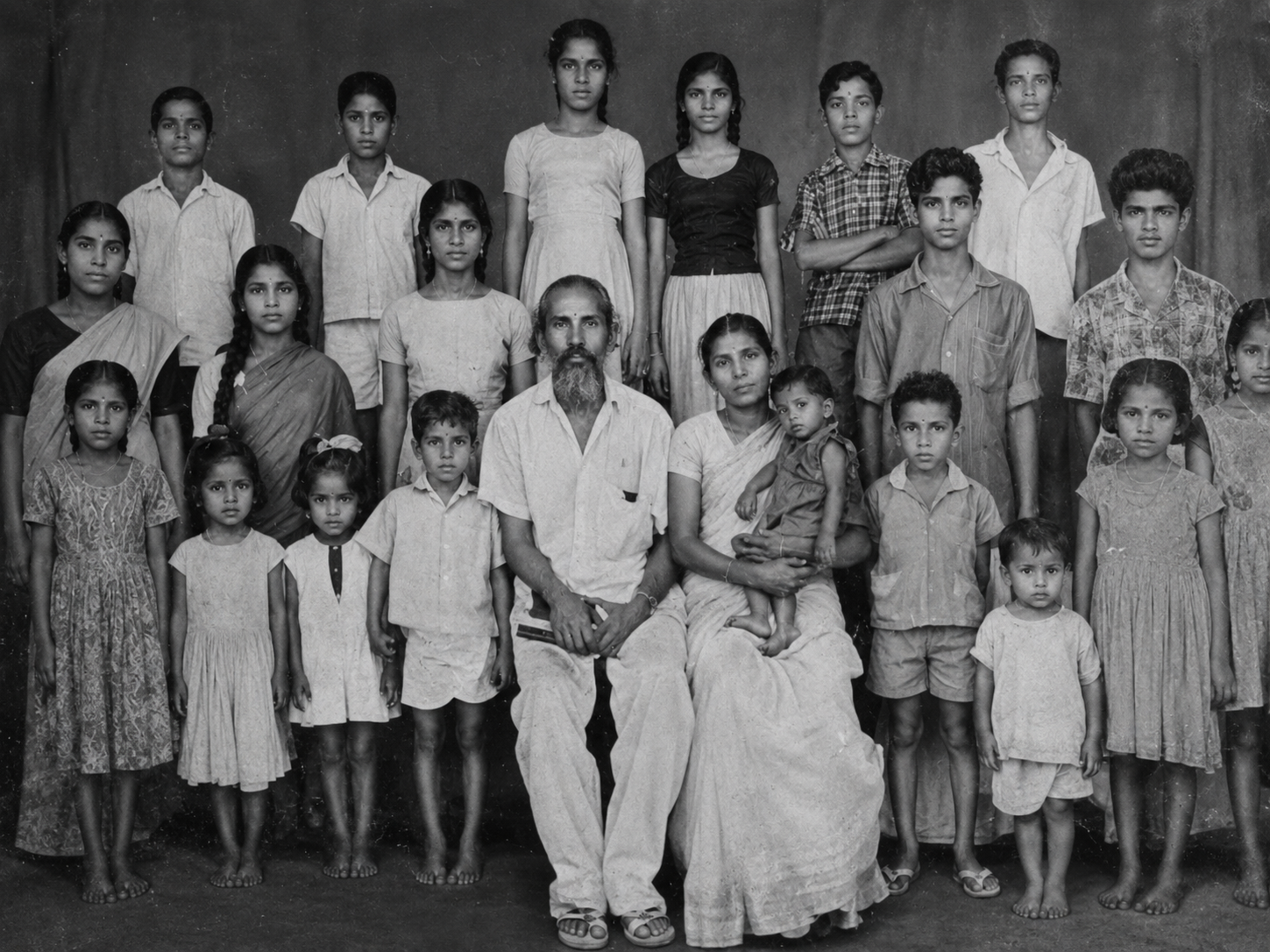
Dear Friend, Please love the children who are standing in the above photo and be an immediate Sponsor to one of them at least. They are our Mission seeking Sponsors. We want to educate most of them. Those who are not brilliant in studies we train for home industries.
They are all poor, but God’s children. Our Mission keeps them happy with the spiritual food. They are trained in the Bible. Director of Christnagar Mission is seated in the above photo with his wife who is the Sunday School Teacher for these children.
Their names and ages are mentioned here below:-
First row: Left to Right
| Name | Age | Status |
|---|---|---|
| Evelyn | 9 | Schooling |
| Iris | 8 | Schooling - (Sponsored) |
| Veera | 7 | Schooling |
| Thomas | 7 | Schooling |
| Prakash | 1 ½ | Held by Director’s wife |
| Dewlyn | 6 | Schooling (Director’s son) |
| Goldin | 3 | Children’s Home |
| Mary | 12 | Schooling |
| Kechha | 11 | Schooling - (Sponsored) |
Second row: Left to Right
| Name | Age | Status |
|---|---|---|
| Christabel | 17 | Schooling |
| Apoline | 17 | Home industry - (Sponsored) |
| Leelavathi | 16 | Schooling |
| Somanath | 17 | Training in the Press |
| John | 18 | Press Line |
Third row: Left to Right
| Name | Age | Status |
|---|---|---|
| Samuel | 12 | Schooling |
| Victor | 14 | Schooling |
| Evangeline | 11 | Schooling (Director’s daughter) |
| Jessy | 16 | Office Training |
| Joseph | 14 | Training in the Press |
| Vincent | 18 | Carpentry Training |
You can bring a smile to their faces by becoming their sponsors. It costs Rs. 60/- ($10, £3) a month to provide food, shelter, clothing, education and medical care for a boy or a girl. But knowing that they have someone like YOU, who really CARES, makes all the difference in the world.
You will be furnished with an individual photograph of your selected children, personal history and the exchange of letters will make this relationship real and truly rewarding.
Please do not throw your old clothes, stationery, blankets and bedsheets. Send them to us to be used by these children. We want anything and everything, from a pin to a piano, to keep these children happy. Through your support these children will have their living, their education, and particularly the spiritual life - Salvation.
All Gifts are most welcome. God loveth a cheerful giver. Charity never faileth. Deuteronomy 15:7-9; 21:19-22.
P.S. Please ask the support of your friends and relatives on behalf of these poor Children. Deuteronomy 16:15,16,17.
Please cut here and return to us,
To:
CHRIST NAGAR MISSION,
Children’s Home,
Badagayedapadavu Post,
Mangalore Taluk, S. India.
Edited and Published by:
Rev. R.C. Das, M.A.,
Khristpanthi Ashram,
129, Dashashwamedh, Varanasi, India
Printed at:
Evangelical Press,
“CHRIST NAGAR MISSION”,
Badagayedapadavu Post, Mangalore Taluk, S. India