
The Pilgrim
The Quarterly Bulletin of the Christian Society for the Study of Hinduism
| Volume | Date | Issue |
|---|---|---|
| 12 | August 1953 | 3 |
Editor: Rev. Dr. R.D. IMMANUEL
Editorial
God who commanded the light to shine out of darkness, hath shined in our hearts, to give the light of the knowledge of the glory of God, in the face of Jesus Christ. 2 Corinthians 4:6.
The National Christian Council Review in a very significant article (June-July 1953 issue) entitled “Missionary Societies Name Priorities” has given the substance of the findings of the meeting held at Denver, Colorado, U.S.A. of the American Missionary Societies regarding the reshaping of their program in Southern Asia. This as well as the two earlier conferences viz The Strategy Conference of the Methodist Church, and the International Missionary Conference at Willingen (Germany) 1952 July, have brought to the immediate attention of the leaders of the Church, the urgency felt by the missionaries as well as laymen of the field, for the need to readjust their program of evangelisation. We welcome heartily these recommendations, which are summarised in the above-mentioned article. One of these is of vital interest to the readers of the Pilgrim in general and particularly to the members of the Christian Society for the study of Hinduism. For the sake of the few non-Christian readers of the Pilgrim we would like to make a remark or two about these recommendations.
There is no spirit of defeatism at all in these suggestions. A missionary, (and every true Christian is a real missionary) is never enfeebled by any sense that he is “under some external and hostile compulsion to rethink his missionary enterprise.” Neither the purpose nor the method of missionary activity can be changed. Neither could there be any doubt of the final success of this great enterprise in obedience to the will of God. The only purpose the Christian has is to communicate to every human being the transforming power of the love of God working in and through Jesus Christ. The only method possible is to mediate God by a Christ-filled life of love, truthfulness and service. Any other method is either unchristian or unethical or both. So, the idea “that the missionary enterprise has failed in India, and so they are trying to seek new methods”, is wrong and should never be entertained.
These suggestions, therefore, should be taken to mean only a deeper consecration to God and His work and not an abandoning of old ideals and loyalties.
With these remarks, we would like to deal with only one or two of the recommendations made; these are the ones that affect our society for the study of Hinduism. Section 3 (G) runs as follows: - “By promoting the early establishment in India of a regional centre for study and research in the religious and cultural manifestation of Hinduism …”
This seems to us a matter of vital importance. Thus far only sporadic efforts by individuals or missions have been made with varying degrees of success. Rev. R.C. Das of the Christa Panthi Ashram at Banaras is trying to do in a way this sort of work. He is an able man and an ardent worker. However, this work needs the support and backing of all Christians, missions as well as Churches. It is not a one-man-job. Mr. Das has neither the money nor the material resources, and we are sure he will be glad to get such a centre at Banaras or elsewhere by missionary bodies. Dr. H.H. Presler has been carrying on research work at Jabalpur as head of the Department of Organised Research at Leonard Theological College, Jabalpur. Research of the type Dr. Presler is engaged in, is a long and difficult process needing not only enormous money, labour and persistence, but also the goodwill, esteem and friendship of the people. All these Dr. Presler has, and we hope to get from him a mine of valuable information in due course. Probably, there are many others like these good workers, whom we do not know. But the point we are making is, a united centre will not be a competition to these individual efforts - but a reliable source of help to such workers who are often misunderstood and who do not get the help and encouragement they need.
India is so big a country, and the Southern part of India is so very different in culture, language, religious habits etc. from the rest of the country that it would be best to have at least two centres one in the North and another in the South.
Probably Banaras is one of the best places in the North to study Hinduism and naturally the centre might be started there. On the other hand, there are others who think that this centre should be connected with a Theological institution and so, would prefer Serampore or Jabalpur. But the selection of the place is an item that could be investigated later on.
The motive of this article is only to stress the necessity of starting such a union institution soon. Not only missionaries do not understand the Hindu, but it is a crying shame, that Indian Christians also do not have any clear ideas concerning Hinduism. This centre for the study of Hinduism is all the more necessary because Indian Christians are profoundly affected by the ancient Hindu culture which now is undergoing a rapid transformation on account of the nascent political independence. The religious and cultural elements of Hinduism must be studied carefully because not all of them are obstacles to be overcome, for there are many gems of thoughts, concepts, and practices that would be a store house of the finest treasures that the Hindu has amassed in his long and arduous struggle for self-fulfilment. “In the intricate plan of life in the East, God has spoken and built,” says Merle Davis. Therefore, the church must seriously study the foundation of our work.
Another important point is there is no organised attempt to bring the educated Hindu to the influence of Christ. Most of our Christians have been won from the lower strata of society. The transforming power of, Christ has raised these not only spiritually but also socially and economically. But the educated Brahman needs Christ as much as the uneducated Pariah. This new regional centre could give its full attention to this exceedingly important phase of Christian ministry.
So the recommendation of the conference is well-timed, and we hope the church and the mission authorities will take immediate steps to put it into action and start the proposed centre soon.
Prayer Section
What do people ask for in prayer, is a question worth our serious study? Here are two prayers - the first one is from the Bhagavad Gita and the second from Devaram - where the supplication is not for any worldly benefit but for the vision of God. The desire to see God, and the belief that the sight of God leads to the highest experience of bliss is common to all religions that believe in a personal God.
Prayer of Arjuna
    Oh! Thou whose eyes are like broad lotus leaves, oh!
    Thou who art the beginning and end of all born beings, I
    desire very much, Oh! Great Lord, to look upon thy excellent
    form, Oh! Excellent person (Purushottamaa). If thou deemest,
    Lord, that thy form may be seen by me grant unto me the sight
    of thy immutable self, Oh! Thou King of Yoga.
— Gita 9, 2 and 3
Prayer of Appar
    Oh! Greatly loved One! Our King, our Lord, from all
    eternity. Oh! Thou the great mystical Yogi, I sing praises
    of Thee daily and my prayer is that I may see the shining
    blossom of Thy feet, Oh! Golden Lord, the most precious.

    I have no right to live if justice is enforced, I am stained
    dark with sin. I read but cannot understand, and I am not
    keeping Thee in my innermost thoughts. Grant unto me
    this one boon - that I might see Thy flower-like feet of holiness.
Articles
The Idea of God in the Six Systems of Hindu Philosophy
In the last issue we studied the relation between theology and life. There we found that the idea of God was basic to all human thinking and living, and that culture, ethics, and even economic conditions of living were affected profoundly by our belief in and concepts of the existence (or non-existence) of God and His nature. So, we shall try to follow our study by an examination of the idea of God in the six orthodox systems of Hindu Philosophy.
It is very strange, but true, that in the Hindu philosophy systems, one need not profess to believe in the existence of God. Thus, the classical Sankhya is considered to be orthodox, even though it is plainly atheistic in its outlook. The only criterion by which a system is considered to be orthodox is, its attitude towards the Vedas. If a system accepts the Vedas to be authoritative, then it is orthodox. Judged by this standard, only the philosophies of Jainism, Carvaka or materialism and the four schools of Buddhism, are condemned as being unorthodox. In this issue, we shall try to examine the concept of God in the Nyaya and Vaishesika systems.
The sage Gotama (or Gautama) is the reputed founder of the Nyaya system. The meaning of the word “Nyaya” is argumentation and one finds this to be a discipline in analytical and logical reasoning. This system is predominantly a science of epistemology. We can understand the Nyaya system better when we see that Gautama was an atomistic pluralist in metaphysics, and a realist in his theory of knowledge.
Kanada is the reputed founder of Vaishesika system. Both the systems are usually classified together as “Samanatantras” that is as similar philosophies. However, Vaishesika deals with the nature of existence or being (ontology) and its main contention is that the heart of reality consists in difference. Since these two systems imply and supplement each other they are taken together for this study.
As was observed previously, Vaishesika attempts to deal with the concept of God from the point of existence. All that is real comes under the object of knowledge and is called Padartha or category. There are seven Padarthas viz. dravya or substance, Guna or quality, karma or action, universality or Shamanya, particularity or Vishesa, inherence or Samanaya, and non-being or abhava. Of these, dravya (the first padartha) consists of substances, which are self-subsistent, and absolute. These nine dravyas are earth, water, fire, air, ether, time, space, spirit, and mind. So God is classified under the eighth dravya soul (spirit or Mind).
Dr. Chandradhar Sharma of the Banaras Hindu University in his book Indian Philosophy (p. 263) uses pretty strong words criticising the Vaishesika concept of the spirit (atman) in general, and God in particular. Says he, “Barring the Charvaka position which reduces the soul to a product of matter, the conception of the soul in Nyaya Vaishesika is the most absurd and degrading in the whole field of Indian Philosophy. The fate of God is no better. He is not the creator of this universe. Innumerable atoms, and innumerable souls are co-eternal and co-present with Him to limit Him and to distort His Glory and greatness. He has been reduced to the status of a supervisor. And even as a supervisor, His hands and feet are chained by the shackles of the law of Karma, unfolding itself as the adrsa”.
By the very nature of its postulates. Vaishesika has to postulate that God is related to man and the world only externally. The Vaishesika simply does not maintain any internal relation. Consequently, the concept of God in this system is very shallow. Indeed, Kanada the founder of the system, has not specifically mentioned the word “God” in his philosophic teachings. But the later Vaishesika and specially Nyaya writers have - probably as a sort of concession, to popular opinion - given to God an important place in their system. However, such ideas do not fit in very well with the postulates of the founder.
Thus, they say, that God is the Creator, maintainer and destroyer of this world, and that it is very essential for man to obtain His grace to get a true understanding of the real facts which alone saves man by helping him to get release from the bonds of Karma. Since the realm of the Nyaya writers is logic and epistemology, they attempt to prove by logical reasoning the existence of God. In this they have had success to a considerable extent and some of their arguments have become classical.
The following seven are some of the most famous:
The causal argument. The world is an effect. This effect needs an efficient cause which must be God because the order, adaptation, co-ordination etc., can only come from an intelligent designer.
A ‘word’ has meaning and significance. How could a word get this power unless some sentient power does this. This source of power is God.
The Vedas tell there is God. So there must be God.
Vedas are wonderfully inspiring and are authoritative. Such infallible statements must have an author. That author is God.
The world of atoms is in motion. The atoms are essentially inactive. So the “first kick” to the atoms must have been given by someone. That one is God.
Moral laws pervade through the whole universe. So, there must be one moral agent who upholds this moral law who is God.
Men reap the fruit of their actions. These actions gain for each man merit or demerit. The sum total of these for each man is his adrista - the unseen power. This, being unintelligent, cannot operate except by the guidance of a supremely intelligent God. So there must be God.
Another argument used by the Nyaya writers extensively, is the one called the negative argument. By this argument they mean that it is not possible to prove the non-existence of God. So they say: - “You are not able to prove by arguments that God does not exist. Then how dare you say that it is wrong to believe that God exists?”
The Christian Evaluation
Many Christian writers will not use the strong words of criticism that Dr. Chandradhar has for these two systems. There is much to be said in favour of their position of regarding God as wholly other than each and every human soul. That is the logical ultimate of their realistic standpoint. They stand for the individuality and separate existence of each soul, and their absolute distinction from one another and from God. This is all very good and Christian theologians will accept these.
However, these two systems do not have much to say about a personal God known by personal experience. If God is a person, (and these two systems more or less are agreed on this point) the only way to know Him is by personal experience. To understand a person by pure reason or philosophical argumentation does not help much. Elements of love, trust, co-operation etc., contribute largely to the understanding of a person. The utmost Nyaya could do is to prove the rationality of God’s existence if we are to conceive this universe rationally.
But there is a world of difference between the cold abstract product of reason and the warm, tender loving godhead that Jesus revealed.
Tulsi’s Way of Salvation
The Hindi-speaking people of India, hold in great respect Tulsi. H.H. Wilson (in Encyclopaedia Brittanica) says, that the works of this man exercise “more influence upon the great body of Hindu population than the whole voluminous series of Sanskrit composition”.1
But Tulsi is not the founder of a sect. Rather he chose to draw from the traditional material the best elements and make use of them in the form of a story, to teach his convictions and beliefs.
His Ram Charitramanas is a real work of art, a masterpiece in world’s literature. With consummate skill he has produced this charming composition of rare beauty. Dr. McDougal says, “Today, among Hindi-speaking peoples in India scores and scores of charming word pictures of indigenous scenes in town and country, its flashes of rare wit, its homely words of wisdom, and its many notes of deep pity, are in the daily repertoire of the speech of the peasant and rajah alike, and of the ignorant as well as of the learned”.2
Tulsi’s passionate cry was “the worship of the Impersonal laid no hold of my heart”. So, he worked out a systematic theology wherein he clearly describes the way of salvation. Rama the hero of the epic is the saviour of the world. All that one has to do is to call upon his name and surrender himself in utter devotion.
This Bhaktimarg, standing in sharp contrast with Jnanamarg is not new by any means. Krishna with the various Vaishnava cults had existed before the time of Tulsi. But though he had not much originality in framing his theological concepts, he is to be considered as a successful theologian, because of the tremendous influence he had and continues to have over the people. In this article, let us try to see:
- What was the teaching of Tulsi regarding the technique of the way of Salvation?
- Why has this method proved to be so popular?
First, one notes that in Tulsi’s Ramayana there is not one way of Salvation. There are several ways - though Tulsi would say that there is one paramount way of salvation - that is complete or single devotion to Ram, Here is a passage that shows this: - “In the First or Golden age, Salvation came by means of contemplation. In the second it came by means of sacrifice, while in the third Temple Worship was the appointed propitiation. But in the fourth this wild and impure - Age, where the soul of man floats like a fish in an ocean of sin - the name (i.e. the name of Rama) is the only tree of life. In these evil days neither good deeds nor piety, nor spiritual wisdom is of any avail, but only the name of Rama”.3
Secondly it might be stated that the Bhakti advocated by Tulsi is on a higher level than most of the other types. These later ones make religion a channel for letting out the emotional and erotic impulses of people. Says Dr. McDougal: “It is hard to over-estimate the particular phase which this Tulsi phase of the Bhakti development rendered in saving large areas of India’s Hindus from the debauching influences of the widely prevalent features of the Krishna development”.4
Tulsi was a Brahman and a dyed in the wool conservative. So, it is no wonder that the very first essential for this Bhaktimarg, he says, is unquestioningly absolute devotion to the feet of Brahmans. Everybody has access to Rama no doubt - but devotion to Rama begins with implicit obedience to the Brahmans.
Another equally important injunction is the reverence of scriptures and strict adherence to them. However, the word scripture is a vague term. It might mean the four vedas only, or it may be broad enough to include books like the Gita. However, there seems to be enough reason to believe that Tulsi had in mind specially the Rama legend when he referred to the scriptures. His heart was filled with Ram and there was no place for anything else.
Service to saints is the third step in the ladder of Tulsi’s technique of salvation. ‘The lotus feet of saints’ is the commonly used term. Parents, and spiritual teachers come under the category of saints. Not only are these saints to be respected and revered - but their physical comforts should be carefully attended to.
The fourth element helpful in getting salvation is the habit of singing Bhajans and Kirtans. Singing to Tulsi does not mean merely movements of the lips and tongue producing melody - it is something that affects the whole being of a person something that causes him to be lost in wonder praise, and love.
The fifth element is very closely allied to the last mentioned one. It is repeating again and again the sacred and sweet name of Rama. His name has a charm, a magical power, which helps people to win victories. It enables the weak to get strong, the coward to become brave, the sinner to be transformed to a saint. So when one hears the miraculous powers of the name of Ram, he begins to wonder if the name of the person is more powerful than the person himself.
The sixth element is more an attitude or set of attitudes. Self-restraint, detachment from the world, gentleness etc. are the most important of them. One noteworthy thing to be mentioned here is the importance attached to love. Every act of the Bhakta must be full of love and tenderness. This love must extend to men and beasts, to trees and plants.
The seventh helpful element is to honour the servants of Rama more than Rama himself. This is not strange. A bird in hand is worth two in the bush. A servant of God who can be seen is often honoured more than the God who is not seen.
The eighth element is an attitude of contentment. This is an ease of body and peace of mind under very difficult circumstances.
The ninth and the last one is the possession of a Stoic mind, which is neither moved by joy, nor affected by sorrow.
Dr. McDougal points out that the last mentioned element does not fit in very well with many Bhakti ideas and that it savours of the Vedantic school of thought. But since there are many signs of eclecticism, in Tulsi’s Ramayana, this is nothing strange.
When one reflects upon these nine elements or stages in the Bhakti technique of Tulsi, he notes that there is neither logical unity, nor a systematic, progress leading to a climax in these. Nor is any one of these an original contribution of Tulsi. He took the material offered to him by his religion and has used them without altering them much. So we have to look for the success of his efforts somewhere else. The following points might throw some light.
First the political and religious condition of the country was a very great factor contributing to the success of Tulsidas. The Mohammedan invasions, and Moghul rule of emperors up to Akbar were very devastating to the Hindu religion. Idols were smashed, temples were plundered, Brahmans were made to bow down at their feet. Apart from the ravages of the Mohammedan wars, there were frequent devastation of famines and outbursts of epidemics. These and other factors made gross materialism rampant; they had no God to worship. The concrete stone idols had been vanquished - but the people needed an idol to worship. So Tulsi offered an idol - Ram, not sculptured in stone but in unforgettable human language, in matchless beautiful, sonorous, rhythmic poetry, the hero of the national epic, unselfish, merciful, kind and mighty. So, in spite of all his conservatism, Tulsi was a practical revolutionist. For this is what it amounts to. The traditional religion had failed or had deteriorated. The times needed a living God, and Tulsi supplied it. So instead of Gods like Brahma and Indra to the latter of whom Tulsi applies the epithets a “crafty thieving Crow” and a “snarling, village Pariah”, he creates the new God Ram. The old gods were selfish - but Ram is absolutely unselfish - the traditional deities were impotent - but this new God is Almighty. However, whenever he found a god popular, or worshipped sincerely Tulsi did not attack that God. The case of Shiva might be taken as an example. He praised and honoured Shiva.
The conflict with demons in Ramayana has a functional value. The demon world has been and is even now very real to most of the village and to a small extent the urban Hindu. For to many people it is the demons that cause famine, and epidemic, burn their homes, destroy their crops, break up their domestic harmony, waylay them at night and trouble them everywhere and always. To such people overridden with fear and despair the story of this great demon conquerer with his offering of mercy and grace to all is like cool water to people dying with thirst. The name of Ram as a magical spell to exorcise demons is a great boon.
The fact that the salvation offered is to all, irrespective of caste, learning, social status, or sex is another important factor contributing to the success of the movement.
We shall close this article with some of the leading Theological ideas of Tulsi Das: - Being a thorough Vaishnava, Tulsi Das approaches in his concepts a position very close to Christianity. Thus, he taught that God is one, a person of infinite power and mercy. On account of the latter He became incarnate and lived the life of a normal human being to relieve the world from sin because man by nature is sinful and unworthy of Salvation. This incarnate Rama has gone to heaven - but he is there still as Rama. So, he is a god who knows by actual experience the weaknesses of men, and the temptations that beset them. His definition of sin is that which is contrary to the will of Rama. The corollary of these, is the doctrine of the universal brotherhood of man and the fatherhood of God.
It is on account of these strong resemblances that scholars suspect the influence of Christianity in the theology of Tulsi Das. This study shows, however, the right procedure we ought to adopt in presenting our Master Jesus Christ to the Hindu. For, Lord Jesus, not only had all the ideal characteristics and virtues attributed to Ram - but also He actually lived and was crucified under Pontus Pilate and rose again.
A Subrahmanya Image
By V.M. NARASIMHAN.
.JPG)
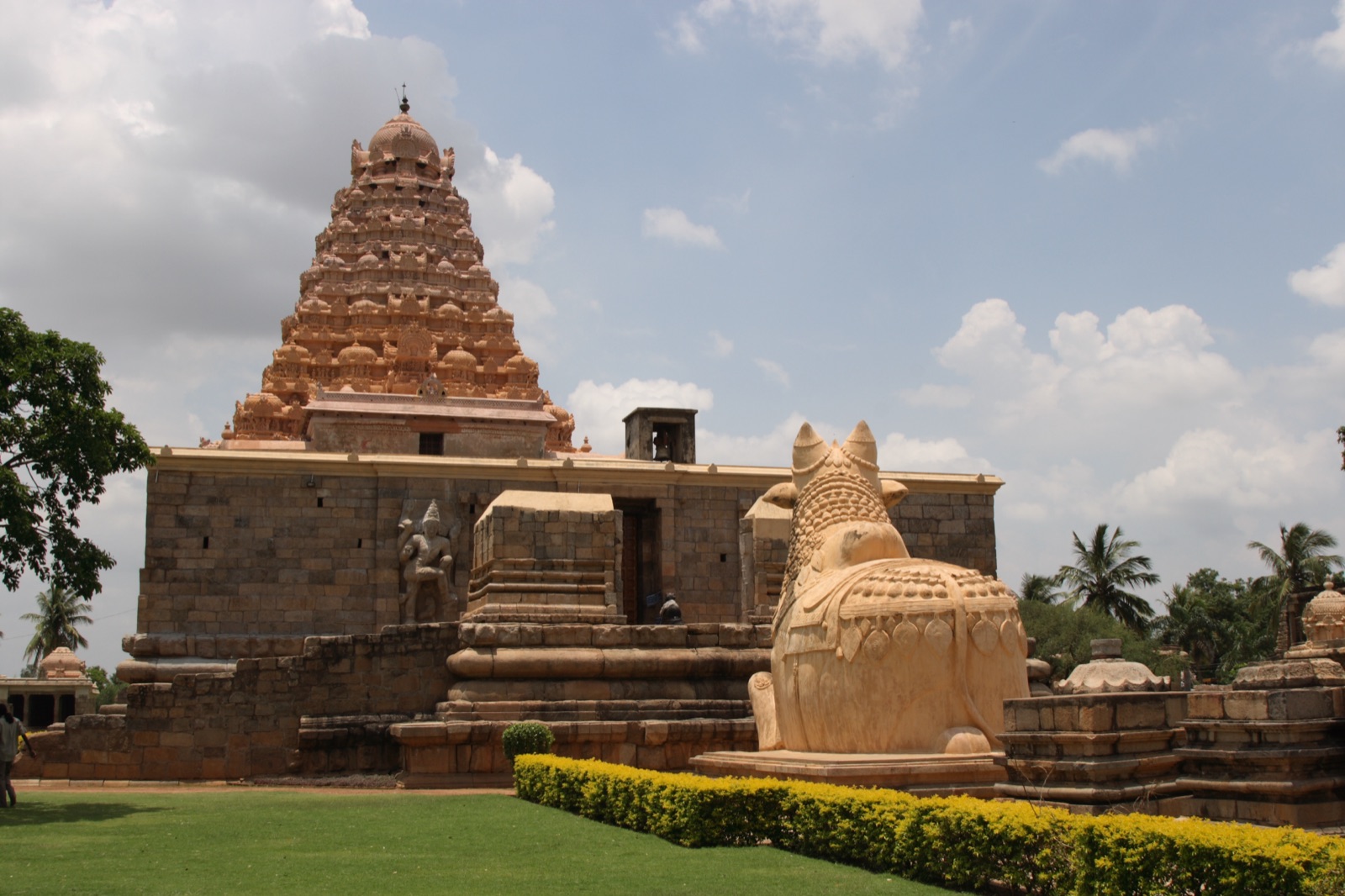
The Chola temple at Gangai Kondacholapuram, Tiruchirapalli District, is widely known both for its architectural beauty and sad state of dilapidation. But it is less known for possessing many early Chola bronzes. All of them except two - a superb Virshavahana and the unique Subrahmanya icon reproduced here - are in puja. The latter image is more attractive and very rare. Hence, I am describing it below.
This bronze is one of the few early Chola pieces still left in our temples defying the vandalism of art treasure hunters. It is very interesting both from the iconographic and artistic view points. It is, as far as I know, the only icon of Kumara, one form of Subrahmanya. Any person who sees it cannot but admire it for its workmanship. Its imposing appearance and well-proportioned limbs are bound to arrest the attention of all.
The most common variety of Subrahmanya is Shadananda or Shanmukha, Subrahmanya with six faces and twelve hands. Probably just the opposite of it, the least represented form, is “Kumara”. In the Kumara-tantra Agama, second canto, it is said that Subrahmanya in this form should hold in his right hands the Sakti and the Khadga (Sword) and in his left hands the Kukkuta (cock) and the Khetaka (Shield). But the Sritavanidhi prescribes Abhaya and Varada hastas in the place of sword and shield. It also states that he should be represented as a red youth, with lotus garland and Karanda Mukta. Our image is cast true to the former agama while at Kumbhakonam we have a sculpture, a little later than the icon under review, fashioned out as laid down in the other agama. But in one of the rock-cut temples at Ellora there is a Kumara sculpture. He is shown slightly different from the description: in the other he holds a cock. He is depicted as a youth with a Yagnopavita, Karanda Makuta and a very few ornaments.
The Chola image is nearly three feet in height. It is pretty heavy. At least two persons are needed to handle it. Like many early Chola images, it is cast in pancha-loha with high percentage of gold which keeps it free from the usual rust. Being an early Chola bronze, some of the features noticed on Pallava sculptures are noticed on it - the protuberant ushnisha at the bottom of the Makuta, the proportion of the lower limbs longer than usual, the peculiarly fashioned Keyura (hand ornament), and the upper pair of hands branching off from the lower abruptly. Like all known South Indian metal images of the Chola period, this also has a broad, flat series of necklaces all more or less circular, none hanging down between the breast, the girdle with the conventional loop and lion’s face and with bows descending from it on the sides of both the legs, round face and transparent lower cloth.
Many interesting features are noticed on the image. The Yagnopavita is in six strings of pearls. It has two knots, one in the front, on the chest, and the other on the back. The lowest strand of it branches off from the front knot and joins with the udarabandha. The first top strand branches off from the front knot, travels separately and joins the back knot. The upper half of the holy thread is left undisturbed. Another noteworthy feature is that the emblems are firmly held in hands. In the upper right hand, the Sakti is held in the reverse direction. Its top portion is broken. In the lower right hand, the sword held is missing. Probably due to these two breakages, the icon is not in worship. Besides, nothing is known about its Devis. It wears Makara Kundalas with strings of pearls dangling and rolling on its shoulders. Its hair is shown as falling on the neck in curly jatos arranged in a semicircular manner.
The icon has four emblems. The two in the upper pair of hands, the Sakti and the Cock, are said to indicate his association with Sun God. The two weapons in the lower pair of hands, sword and shield, remind us that he cuts the root of all troubles and protects his devotees and stands to stress his Vira aspect as the young ‘Devasenapati’, or ‘Kumara’.
Reprinted by kind permission from The Hindu, Sunday, July 19, 1953.
Story Section
Two Temple Stories
By BEATRICE IMMANUEL
‘Silly superstition’ is a word of contempt in our conversation. We often label with this mark many so-called religious acts that have brought pain and suffering to humanity. But not all superstitious acts are of this kind. There are some which while condemned at the bar of reason as being ridiculously absurd, yet contain some strange elements of fascinating beauty that appeals to us powerfully. A thing of beauty is a joy forever even if the stuff of that beautiful thing be composed of gross ignorance, and a glaring lack of what is called common sense. Here is one such story.
Palar is a river in South India whose bed is a vast wide expanse of pure white sand through which for the most part of the year trickles a narrow shallow stream. Large crowds of people used to gather at the river banks, some for fetching water and others for bathing or just to while away their leisure hours. But there were a few who came there to worship an idol which they believed earnestly was a manifestation of God Himself. One of these was a lady of wealth, who used to pay her homage to this idol by kneeling before it. She poured out her whole self as it were in this act of worship daily.
She was not satisfied because the idol was there bare, out in the open. So she made a small mound, and with great devotion and care set the idol on it. Every, day she used to bring fresh flowers and beautify the place. Very often it was her custom to take out her bright pearl necklace and adorn the idol with it.
While other people used to worship this idol a minute or two asking in their prayers for many gifts of money or children, or some other fulfilment’s of their hearts desire, this woman used to stay there for hours and hours singing and praising and literally losing herself. The idea of asking a boon in prayer seemed strange to her.
One day it so happened that it began to rain and pour as the monsoon usually does. All the worshippers ran away leaving the poor idol to its fate. Not this devotee. She was there protecting her object of worship. The water was increasing every minute. Some people were shouting from a distance asking her to come out. In her devotion, (which seemed to others, foolish) she would never think of going away leaving her God in the lurch. Down came the floods dashing and splashing. People heard a joyous hymn of praise which merged into the roaring of the foaming current. And nothing was left.
The second story stands in a marked contrast to the first, and brings out in bold relief the fact that common sense and devotion to God are not two incompatible elements that do not mix like oil and water.
This story comes from Madhya Pradesh and here also the principal actor was a woman. Near the present city of Jabalpur there flourished the ancient city of Garha, famous for the rule of Gond kings and queens, where lived a very happy couple whom we shall call Uma Chand and Leelavati. They were not rich, but the husband was prosperous in his trade as a mason and his one dream was to build a temple. But he had no money at his disposal; nor could he find anyone to help him. One sad day, when the epidemic of bubonic plague started, thousands of people fell victims and the heart of Leelavati was pierced to the quick when her husband, who was hale and healthy the previous day, was groaning with excruciating pain from this fatal sickness. However, his greatest grief was that he could not build the temple. He died that very day.
Leelavati could not bear to be separated from her husband. She wanted to be burnt along with him on the funeral pyre. The world was nothing to her after her dear husband was gone. Moreover, it was the custom of every devoted wife to practise this ‘sati’. Her relations also urged her to do so. It was very difficult for her to decide, but finally she made up her mind to live and fulfil the work which her husband had attempted but failed.
At first, it was very hard for her because people scoffed at her and pointed at her with accusing fingers. She was shunned and ostracised by the people of her caste. The odds indeed were very much against her. How could she, without any position in society, attempt to do what her husband who was well esteemed in society could not do. But she did not lose confidence in her cause. With a face set like flint, she refused to speak to anyone, and she was completely oblivious to the scandalous critics, mischievous talk.
In course of time people found that she was not a woman who sought worldly pleasures, but that she was an incarnation of purity and that she was praying intensely and earnestly for an extraordinary gift - which they could not understand. They only saw her praying.
To a widow in those days, very few avenues of work were left open. So, Leelavati chose the dull, hard, monotonous work, of a flour grinder. Whatever she earned by this hard work was not spent on her meals even if it should mean that she would go half starving after such a strenuous labour. But a portion of it she set apart for the building of a temple.
When people heard that, she had a great ambition, many came to patronise her trade and got their wheat ground by her. However, it was a very hard pull. Soon a fairly good amount was saved and Leelavati started to find for the temple a place. No place could she find or get except a plot of ground at the top of a hill. With a brave heart she bought it. Toiling alone, toiling hard, she continued to work and pray. Some days were dark and dreary. Labourers had no confidence in a poor woman who eked out her livelihood by grinding flour. But she did not lose heart in prayer. Finally, one day saw the completion of the grand temple on the hill by the side of the forking road. To this day it stands a silent but imposing witness of a woman who prayed, with devotion and worked with a determination. The name of the temple attests to her modesty. It is called pisnahari temple - the temple of the woman who grinds. Many people from far and wide come to this temple and are thrilled to see this beautiful edifice.
Book Reviews
Necessity for Sanyas
By Swami Sivananda (Rishikesh, Sivananda Publication League, 1947) pp. 111, Price Rs. 2-8.
This is a burning passionate appeal written in simple English. The author practises what he preaches, and the whole message comes from his heart and is rooted and grounded in his personal experience.
There are four chapters only. The first is the introductory one in which the author shows that Sanyasa and Vedanta complement and supplement each other. His claim is that Vedanta without Sanyasa is mere intellectualism and Sanyasa without Vedanta is an empty discipline which does not serve any useful purpose. Vedanta makes (according to him) faith rational, and Sanyas turns this faith into experience.
The second chapter is Sankaracharya’s Slokas on hammering delusions in thirty-one couplets. Both the Sanskrit texts (in Devanagari Script) and their English translations are given. This is followed by a series of small articles like the glory of Sanyasa, History of Sanyasa, Arguments for Sanyasa, Modern Sanyasa, Sanyasinis (women ascetics) etc. This chapter gives the whole message of the book and is the most important chapter.
The third chapter gives instructions to those who have taken the vow of asceticism. So, it deals with regulations like: Nivritti Niyamas, vows, moral character requirements, the relation between Sanyasa and society.
Chapter four is a sort of appendix. There are many illustrating stories of renunciation like the story of Ramdas, of Sivaji, of Bhartrihari, of Patinathu, Pillayar etc.
The book is very easy reading and the subject is presented in a very challenging way, to the Hindu. It does not appeal to the Christian quite as much because the basic postulate of Christianity is so very different. To the Christian the body is not evil and the ideal Christian Home is a miniature of the Kingdom of God. Such ideas are very foreign to this book. The following quotation taken at random is a good example.
“Thinking that they are educating their children they (the parents) allow their children to rot in delusion, worldliness and passion. If there are five sons, the parents want all their sons to become barristers and judges! There is vanity at the root of all this. If at least one of your sons has the glorious fortune to open his inward eye to realise the futility of the earthly life, to renounce all his attachments and to take the wise path of self realisation, that son has done his greatest duty to his parents, that son has opened the doors of Salvation to his parents and family people.”
The author does not have in mind the Karma Sanyas praised so much by the Gita but rather the Sanyas advocated by Sankara - the complete renunciation of work. The author says, the dictum Ahimsa Paramo Dharma cannot be strictly practised by house-holders and that only Sanyasins can tread this nivrittimarg. In a similar strain he says that a “woman’s duty is not family, her duty is to transcend family.”
Nor does the author believe in a person who claims that he has renounced in his heart every evil desire but does not wear the orange coloured robe, “If there is real internal change the external change is bound to come, you cannot be a rogue inside and a sage outside.”
The value of the book lies in the fact that it gives an accurate idea of what a very large number of our Hindu friends hold regarding asceticism. In this connection it might be stated that the book gives a summary of the Narada Parivrajaka Upanishad and deals with matters like Sannyasa Diksha, (initiation) Sannyasa Sadhana, Viraja Homa (i.e.) Sacrifice of the body. For a beginner who wants to study Hindu ascetic ideals this is an excellent book.
Vethanyaga Sastriar the Tamil Christian Poet of Tanjore
By D.W. Devanesan (Madras, Christian Literature Society, 1947) pp. 200; Price Rs. 1-8-0.
This biography of the great Tamil poet and lyrical writer is a welcome addition to the South Indian Vernacular Literature. The book is more than a biography - it is a scholarly research and a source book of documents that will be of great help to future writers, concerning the life of the poet. In several ways the author is well-fitted to write a biography of the poet. First, he has a Boswellian spirit of appreciation of Vedanayagashastriar. Then being a member of the family of the poet’s descendants, he has been brought up in the traditions of the family and has access to facts, sayings and incidents of the poet treasured with peculiar affection by his children and grand children. At the same time he is accurate in recording facts of history. Thus, he does not blink over some of the shortcomings of the poet-like his caste prejudices-but just describes them with the impartial spirit of historic accuracy.
This book contains many documents of great value-and some of these are in English. There are also several lithograph plate pictures and portraits that make the book attractive.
But the greatest value of the book lies in the fact that the author tries and succeeds to a very commendable extent in interpreting the theology of the poet. The poet was not a sponge to receive wholesale and without any change the Theology of the West. He was a strong personality and every idea that he received from others was sharply criticised, and tested before it was received or accepted. So. in a spontaneous way an indigenous Theology was framed by the poet.
Thanks to the Christian Literature Society of Madras - the book is very moderately priced. We commend this book to every Tamil knowing reader, and hope the author will write many more books.
Gita Rahasya Vols. 1 and 2
Bala Gangadhar Tilak (Poona, Tilak Bros. 568 - Narayanpeth, Poona City)
Shri Bala Gangadhar Tilak, a leading Lawyer of Bombay, an outstanding politician and a gifted literary writer wrote this two volume expository commentary on the Bhagavad Gita while he underwent imprisonment for political reasons. The first publication of this came out in 1915 in Marathi, the author’s mother-tongue. This has undergone translations into all the major languages of India as Tamil, Hindi, Gujarati, Bengali, Kanarese, Telugu and also into English. The first English translation was published in 1935.
The first volume deals with various topics contained in the Gita such as Karmasannyasa, Karma Yoga, Bhakti Marga Sukha-Duhkha Viveka (consideration of happiness and unhappiness) and so on. The second volume deals with the concluding Chapters of the series of topics dealt with in the first volume. In addition to this, in the second volume he gives the English Text of Gita and a detailed commentary on the text of Gita verse by verse. Without going into the source criticisms he plunges directly into the contents of the Gita. The author’s primary aim is to reveal to the public the secrets hidden in Bhagavad Gita and especially the doctrine of Karma Yoga which the Gita is, advocating. He argues that every Jivan Mukta even after attaining self realisation by knowledge and works, should devote himself to works without taking into consideration the results or (Phala).
The author exhibits his wide and intimate knowledge of the Hindu philosophical and religious books and is equally at home among the philosophers of the Western countries. He compares the ethics of Gita with the ethics of Western philosophers and is of opinion that in the West the ethics formulated by philosophers like Kant and Green could favourably compare with Gita.
He asserts the superiority of the ethics of Gita over all other views on account of its metaphysical implications. His main desire is to make known to the world especially to the West, what he believed, that is that the Gita is a profound ethical and philosophical treatise, and not in any way second to the moral philosophical systems of the West.
Reviewed by Rev. Thangayya B.D., United Church of South India.
A Synopsis of to Christ Through the Vedanta
By P. Johannes, S.J., Parts I to IV (Ranchi, Catholic Press) as 8 each part.
This is only a synopsis of the series of articles contributed by the author to the Light of the East, under the heading “To Christ through the Vedanta”. “A synopsis” says the author “would have the advantage of being short and thus cheap. It would enable also the student of the Vedanta to contemplate the wood before being absorbed in the particulars of the trees”.
The author does not want to be destructive by any means - as the title shows. It is a “constructive in gathering of the extremely valuable philosophical materials embedded in what still remains the greatest and the most accepted of the Indian Philosophical systems”.
The author’s purpose is to show that a Roman Catholic “can construct” his “Catholic philosophy with materials borrowed from the various vedantic systems”.
Each of the parts deals with the system of one particular Acharya, and the four great teachers thus selected are, Shri Sankara, Ramanuja, Vallabha and Chitanya. Of course the first three of these are integrally connected, and so they must be read together. One can see the development of thought in the argument of the author namely rebuilding a Roman Catholic Philosophy on Indian soil. He shows clearly that the greatest contribution of Sankara is the concept of the absoluteness of God which is the basic foundation. Ramanuja’s contribution is summarised in his own words “with Ramanuja we reached the ideal world, or the world which reclines, so to say, on this absoluteness”. But the author’s highest praise goes to Vallabha, and it is especially in his practical philosophy that the author finds the most valuable contributions. The following quotation speaks for itself. “It is even in his school that we meet with the perfect definition of the love of God, for it states that we must love God for His own sake, and ourselves and everything else for the sake of God. A better definition is impossible. Moreover, Vallabha has brought divine love as close as possible to another theological virtue, that of divine trust or hope. For, despising all the self trust, which is so conspicuous in the Karma and Jnana ways, he invites us to build on trust in God alone. We must expect our salvation from the fact that it is more, infinitely more, the concern of God, than our own”. The author discovers in Vallabha true union with God, by faith hope and charity, which leads to the goal of life, viz. beatific vision.
The author’s style is forceful and clear and his arguments are well framed. So, we commend these books, to those who would like to begin a study of Hinduism.
Printed by Dr. E.M. Moffatt at the Lucknow Publishing House, Lucknow - (250) - 95 - 8-1953.
Patrons:
- The Metropolitan of India, Calcutta.
- Bishop Clement D. Rockey, Lucknow.
President:
The Rt. Rev, C.J.G. Robinson, M.A., Allahabad.
Vice-Presidents:
- The Rt. Rev. A.J. Appasamy, M.A., Ph.D., Coimbatore.
- The Rev. C.E. Abraham, M.A., B.D., D.D., Serampore.
- The Rev. C.S. Thoburn, M.A., S.T.B., Jabalpur.
Secretary of Society:
Dr. A. Ralla Ram, Jamna, Allahabad.
Convener of Institutes:
Rev. R.C. Das, M.A., 129 Dashashwamedh, Banaras, U.P.
Editor of the Pilgrim:
Dr. R.D. Immanuel, Leonard Theological College, Jabalpur, M.P.
Treasurer:
Prof. P.C. Addy, M.A., Bible House, Thornhill Road, Allahabad.
Committee:
- Prof. V.E. Devadut, M.A., B.D., Ph.D., Serampore
- The Rev. Paul Das, B.A., Allahabad.
- The Rev. C.G. Diehl, Madura.
- The Principal, School of Islamics, Aligarh.
- Mr. S.J. Duraiswamy, B.A., N.M.S. Madras.
- The Rev. R.W. Scott, M.A., Christian Council, Nagpur.
Editorial Committee:
- Rt. Rev. Bishop A.J. Appasamy, Coimbatore.
- Rev. C.G. Diehl, Madura.
- Rev. R.C. Das, M.A., Benares.
Objects and Aims
The objects of the Christian Society for the Study of Hinduism are:
- To create and maintain adequate interest in the study of Hinduism by Christians
- To carry on the study in a sympathetic, constructive and critical way for the purpose of effective evangelism and
- To achieve the above objects in co-operation with Church and Mission bodies.
The activities of the Society are:
- An Institute of Hinduism in Benares,
- ‘The Pilgrim’, a quarterly bulletin bearing on Hinduism, its relation to Christianity and for work among Hindus and
- Organising a permanent School Hinduism
Every member will receive THE PILGRIM free Membership fee Rs. 4 per year
Note
Donations may be sent to the Treasurer:
Prof. P.C. Addy, M.A.,
Bible House,
12, Thornhill Road,
Allahabad.
Enquiries about the Society and its work should be addressed to the Secretary:
Dr. A. Ralla Ram, Jamna, Allahabad
All communications and correspondence relating to the Pilgrim should be addressed:
Dr. R.D. Immanuel, Leonard Theological College, Jabalpur