
The Church of Christ
(Based on the Word of God; dedicated to the promotion of independence, Indianisation, unity, co-operation, and to the removal of corruption and evil in all forms and in all places.)
| Volume | Date | Issue |
|---|---|---|
| 9 | 1972 | 2 |
The Sadhu Ideal
Natural Approach to Hinduism
By Brahmanand
(continued from previous issue)
The Influence of Sadhu - Ideal in the Life of Sundar Singh?
One of the greatest influences in Sundar Singh’s early days was the spiritual nourishment he received from his mother through the study of the Grantha Sahib of the Sikhs, the sacred Scriptures of the Hindus and especially when he was handed over to a Hindu pundit and to an old Sikh Sadhu for discipline and instruction. Besides his study of the sacred Scriptures he learnt to practice Yoga as a preparation for meditation. His fine tribute to his mother was put in these words: “Her bosom was for me my best theological school, and she prepared me as much as she was able to work for the Lord as a Sadhu.” About Sundar Singh’s desire to lead a Sadhu life his schoolmate John W. Chauhan wrote like this: “From the very beginning his purpose was to become a Sadhu, but at that time he hardly knew that he was to become a Christian Sadhu and a living witness for Christ our Saviour.”
It was this determination of Sundar Singh to become a Sadhu enabled him to pass through all kinds of hardships in his later life. His family cast him off completely on a night when he cut off his long hair, and he had to spend a whole night in cold weather under a tree. This he described as an experience of the living presence of the Saviour.
On October 6, 1905, at the age of sixteen, thirty-three days after his baptism, he began the life of a Sadhu. Here too his deeply spiritual mother installed in him to be so as she kept on pleading to him not to become a worldly man like his brothers but to become a Sadhu - a holy man, a man of God. Subsequently, he himself expressed this desire to his friends in the school.
Sundar Singh was baptised on the third of September 1905, on his birthday, in the St. Thomas Church, Simla and instantaneously he felt strong impulse to separate himself from the things of the world. So be left the Church behind and set off to Sabathu, which later on became his permanent dwelling place during the rest of his life. As he walked away, leaving behind the most alluring world, Satan often pulled him with all enticements to go back - to his father or home at Raipur. But he felt his beloved mother’s words ringing in his ears” “It may be that one day you too will become a Sadhu.” He felt as he did this, most convincingly, that he is an ordinary village Indian and that be had no place in the sophisticated and Westernised Indian Church.
Against this background Sundar Singh emerged, with a yellow turban on his head and a long saffron robe on his body. But for Sundar Singh it was following a way, a way opened by the Master. Sundar Singh accepted for himself the self-discipline and the self-denial of India and the apostolic ideal of the preaching friar. His was not a clumsy appearance of some of the wandering mendicants but be was clean, tidy, vigorous, radiant and vivacious.
Fr. Nehemiah Goreh
Fr. Nehemiah Goreh was one of those outstanding converts from Hinduism in the last century, of whose life add work the Indian Church is rightly proud. By his evangelistic zeal and preaching, his scholarship and writing he has made a unique contribution to the Church in India, in defence of be faith, which is an inspiration to all Indian Christians. As Fr. R.M. Benson, the founder of the Society of St. John the Evangelist, says in one of his letters: “He was a good deal like J.H. Newman in making his religion a matter of the intellect.” He had become a Christian after much reasoning and arguments, followed of course by conviction, and he, therefore wanted to prove to other what he believed himself, although sometimes trying to prove what was beyond the reach of human reason. His deep knowledge of the Hindu religion and its philosophical systems was a great asset in his work of effective witness before the educated non-Christians. His active life covered a period of over forty-five years, during which time his evangelistic tours took him to most of the important cities of Northern and Western India between Calcutta and Bombay. Men of the intellectual calibre and evangelistic zeal of Fr. Goreh are much needed by the Indian Church today in her mission to the educated non-Christians of our country.
Early Life
Nilakanth Goreb was born on the 8th February 1825 in Benares in a Mahratta Brahman family which had moved there. His ancestors had taken up employment under the Raja of Benares. His father was Sivaram Goreh. Seven sons and a daughter were born to Sivaram Goreh, but all except Nilakanth the eldest and Govinda youngest had died young. Nilakanth received his early education through private tutors. His father taught him Sanskrit, and placed him under the care of some of the distinguished pundits in Benares in those days. Nilakanth was an intelligent student with great retentive powers of memory. He soon became well versed in the Vedas and Indian philosophy. Later he was to acquire the title of Pandit. It is interesting to note that even when quite young, he gave up the family deity, who was Shiva, and adopted Vishnu in his stead as his ishtar devata (favourite deity), much to the disappointment and annoyance of his family. As was custom in those days, Nilakanth was married at the early age of twelve, but the girl died soon afterwards. A second marriage was forced upon him in 1844 when he was nineteen to Lakshmibai Jogalekar, daughter of a well-known Konkanasth Brahmin of Benares. Soon after this marriage he lost his mother, which event brought about great changes in the household. After his wife’s death Sivaram Goreh decided to retire from the world and lead a solitary life. In fact, he lived like a Sanyasi till the end of his life, going on pilgrimages to all the holy places in the country.
Missionary work had started in the city of Benares during the early decades of the last century. In 1818 the Church Missionary Society had taken over the Jay Narain School, and it flourished under the management of the missionaries. The Rev. William Smith and the Rev. C.B. Leupolt were two of the best known missionaries of Benares, who laboured there during the years 1882-72. It was the bazaar-preaching of William Smith which drew the attention of Nilakanth and led him finally to Christianity. Nilakanth was a man of keen and subtle intellect, a Sanskrit scholar and one who was fond of discussion. His intention was to relate the Christian religion and silence the missionaries by his intellect. After hearing the missionary speak in the bazaar, he started visiting him in his house. He wanted to show the missionary the great beauty of the Hindu religion. During his visits he found he could not draw Mr. Smith into argument. While disputing with the missionary the good Providence of God led him to look into the Bible, and then it was, by the power of the Word of God, that the light of truth entered his soul. He was struck by the beauty of Christ’s teaching in the ‘Sermon on the Mount.’ Still for three years he was vacillating, his mind full of doubts and difficulties. His family and friend who came to know of his inclinations to Christianity tried their best to lead him back to Hinduism. His growing faith in Christianity constrained him to speak more openly of it to his friends and acquaintances. Apprehending further trouble from his relations and friends if he were baptised in Benares, he went to Jaunpur a short distance away, was baptised there on the 14th March 1848, in his twenty-third year, and was given the Christian name Nehemiah. He always traced his conversion entirely to his own reading of the Scriptures and to the grace of God.
His Conversion and After
It is never an easy thing for a Brahmin to become a Christian, The immediate effect was his excommunication from cast. As Fr. Goreh later said in one of his lectures, “It was a great sacrifice for me to be separated from and cast out by my relatives and to become the object of the greatest ignominy and reproach among all. But it was the force of conviction and the voice of conscience which showed that I ought to embrace Christianity and compelled me to embrace it, God by His grace giving strength and courage to do so.” His wife returned to her father’s house, and it was after nearly five years that she was brought back to him. A year after her return their only daughter was born, Ellen Lakshmi Goreh, who later became a Deaconess in the Church. Nehemiah slowly began to instruct his wife in the Christian religion, not against her will, and she was baptised on the 1st December 1853 along with their baby daughter. Unfortunately his wife died two days after her baptism. By this time he had also become reconciled with his father. Although his father blamed him for becoming a Christian, he used to implore him not to give it up and become an atheist. He used to tell him, “Without religion man cannot exist. You have changed yours; but still Christianity is a religion, therefore keep to it.”
First Visit to England
In 1854 Nehemiah had an opportunity to visit England in the company of Maharajah Duleep Singh. The Maharajah, who became a Christian in March 1853, had come across Pandit Nehemiah in Benares and chose him as his tutor and companion on his visit to England. Nehemiah was then 29 and the Maharajah 16. In the company of the Maharajah, Nehemiah was introduced to the fashionable life of English society, which however was not his liking. He was welcomed in London, Oxford and Cambridge. At Oxford, he visited Prof. Max Muller. He attended some theological lectures at the C.M.S. Institution in Islington. This visit gave him many opportunities to meet many important people in public life in that country including a private audience with Her Majesty the Queen. After about sixteen months stay in England, he thought he had enough of if, and longed to be back in India. He got back to Bombay in November 1855, by the same boat which brought Dr. Alexander Duff back from his furlough.
Lay Missionary (1856-67)
The ten years following his visit to England were an important phase in his active life. After landing in Bombay be proceeded to Poona, where he addressed public meetings for educated Hindus, along with another well-known Brahmin convert, the Rev. Hari Ramchandra Khiste, who was a pastor of the American Marathi Mission. The fame of the pandit, who had a private audience with the Queen, had preceded him and that in itself was sufficient to attract many young men to his meetings. As a result of his public addresses and private conversations several young men from Poona became Christians. Among them were the Rev. Kasem Sahib Dawed of Sastra, the Rev. Ruttonji Novroji of Aurangabad and Shaha Daji Kukade. After this successful visit to Poona he returned to Benares to resume his humble work as a catechist under his friend the Rev. William Smith. On a visit to Calcutta in 1857 he got in touch with Dr. Kay, the then Principal of Bishop’s College, whose saintly character and ascetic life made a profound impression on him. It was about this time that he was working on his book, ‘Hindu Philosophy examined by a Benares Pandit’, which was published in 1860. He wrote it in Hindi, but it was translated into English by Dr. Fitz-Edward Hall, a former professor of Queens College, Benares, and published in 1862 under the little ‘Hindu Philosophical Systems, a Rational Refutation’. In order to help Dr. Hall in this work of translation, Pandit Nehemiah was with him for nearly three years in Central Provinces. During this time he had opportunities of visiting Jabalpur. It was there he first met Moulvi Safdar Ali, a Deputy Inspector of Schools in the service of the Government. Safar Ali was just then in a state of indecision, wavering whether he should accept the Christian religion. It was Pandit Nehemiah who helped him to take the final decision to be baptised, which took place in 1864.
In 1866, he went to Cawnpore and worked with the Rev. J.R. Hill. Several years later Dr. Hill wrote about his first meeting Nehemiah: “Our dear brother Nehemiah was shy and reserved, diffident and humble in an extreme degree. His mind and gentle manners, his profound and lustrous eyes, seemed to reflect the invisible world rather than the faint gleam of this world’s lights. His very presence seemed to speak of the things of the Spirit, to breathe forth faith, hope and charity. It was impossible not to feel that you had seen a saint.” It was during his stay in Cawnpore that Keshab Chunder Sen visited that city and called on Dr. Hill. Pandit Goreh was introduced to Keshab Sen, and he came to know all about the Brahmo Samaj. Almost immediately after the departure of Keshab, Fr. Goreh started writing the first of his tracts to the Brahmos. This took him to Calcutta in 1867, where he stayed in Bishop’s College, and within four months published his first work on Brahmoism, ‘Letter to the Brahmos from a converted Brahmin of Benares.’
— Epiphany 14-9-1968.
Heaven? Or Earth?
By MANORAMA R. MODAK
We know almost nothing about life after death, therefore why are we so much concerned about it? We guess what it is. We guess that it may be another life, but we have no knowledge of it. We only know that this body in which we live while on this earth, vanishes, either into ashes - or into fertiliser for the soil. The body which we know can never exist again - it is gone. We may have some kind of celestial body in the sky, perhaps where the latest American rocket has gone, beyond Jupiter, and that rocket may even reach that place which Christians call heaven, and discover all the “saved” people playing harp and singing! Or, as the Hindus claim, our soul may be re-born in this world in other physical bodies until it is perfected, and, when perfected, is will be absorbed into the Universal Spirit. These are some of our beliefs and guesses; they are not facts.
This being our vagueness as to what may happen after death, why do we spend so much thought considering it? Why do we not leave it to God? If we trust him, we must leave it to him. Our guesses will have no effect on what really happened to us after we die.
We do know about this life here on earth. We know about the air we breathe and fly in; about vegetation, the animal, and about human life - our relatives, our neighbours, near and far. There is no guessing about this life. We likewise know that we must relate ourselves to these indisputable facts, and that our happiness here is a result of the way we relate ourselves to this world. To solve this problem correctly is quite enough for ns. Why should we spend our some and strength considering the next life about which we know little. Leave it to God, if we trust him.
Relating ourselves to this life, to our relatives and neighbours, we find quite difficult; it absorbs all our powers. We find it so difficult that we blame others when we fail in life. Or, we turn to guessing about the next life, and creating in our minds the satisfactions and joys we will have there because we have failed to attain them were. In the days of slavery in the United States, the Negroes (Blacks, they are called now found their only satisfaction in considering the next life? One of their songs expressed it: “We are going to put on shoes and walk all over God’s heaven.” No slave had shoes, but his owner had them; no slave except the special household slaves could step into his owner’s house - so, in heaven all slaves would have shoes and walk all over the owner’s house. This was the slave’s satisfaction.
Life here is difficult. Who will deny it? Many of us find no way to cope with it. We suffer here. Those people without employment, with so little income that they cannot obtain adequate food or educate their children even up to literacy, those with incurable diseases - we suffer. Others of us suffer mentally. We must live with family members or neighbours with whom we quarrel. This is not suffering because it can be remedied. We are not obliged to quarrel or be unhappy. Why do we antagonise one another? Because we have not learned that confrontation only brings more unhappiness that we must cooperate with one another and not confront. We must refuse to be moved by the confrontation of others, refusing to confront in return, understanding the reasons the other person acts as he does.
Also in examining our own behaviour, our own attitudes, and correcting them where they are not in line with Jesus’ way. Companionship in suffering is to be given by everyone to everyone; it costs nothing. If a wife cannot support her husband in his problems, she is no wife, merely a housekeeper; if a husband cannot support his wife in her problems he is not a husband but a mere money-earner. And a neighbour who can only discredit us is not a neighbour but merely the occupant of the next house. Even God suffers when we suffer because our suffering is a spot on his universe. This thing called understanding is a gift of God; it costs nothing. It is our reason for adoration of our mothers, Jesus, Mahatma Gandhi and so on. Because they, too, suffered for us. It is a gift which we can give to one another, if we choose to do so. And it has its reward. If I smile, your frown will go away. You cannot keep from responding. It is our nature. If not today, tomorrow. Believing it, is the meaning of faith in God.
It is entirely possible for us to conduct ourselves in such a way that people love us. Some people quarrel because their pride forces them to win. Is that the sort of pride we want to be known for? Our pride should be in the fact that we are loved, not in winning. In the Bible is a sentence, “We love him because he first loved us.” This is a fact of life, the key to happiness. It is nature, and we should live according to our nature. What does the “green thumb” of the gardener mean? That he so loves the vegetation that it responds to him. If we smile at a dog he comes close to us, wagging his tail with pleasure; if we frown, be runs away and if we beat him, he retaliates with biting. It is nature.
I hear people say, it is such a relief to think about heaven instead of this world. Thus, the heaven-idea becomes an escape from a life here will which we have failed to cope. Because we refused to understand and love. We have enough to consider when we look at ourselves and change our ways into understanding. We need to be saved in this life from failing to understand other people and not in order to get to a heaven we have imagined and about which we know nothing. This is the meaning of faith in God.
Everyone at some time in his life wonders what will happen to him, to his self, to his personality, after be dies. This is also natural. Many people have even withdrawn from society and devoted themselves to meditation on this subject, and made prophecies about it. Whether their prophecies are correct or no, no one knows. We accept those which appeal to us. When Jesus was asked his opinion about what would happen after death, he said very little about it, merely that the activities of this life would not continue after death. But he had much to say about this life; his relations with his fellowmen were extolled during his lifetime and remembered by his followers. If we are sincere followers of Jesus we should balance our thinking as he did. Our emphasis should be similar to his; on this life, not on guessing about our future. I have met clergy and laity who go about asking people if they are “saved.” Saved from what? For What? Saved after death? Or, saved in this life from our selfish ways of living?
If we conduct ourselves in this life as he did, with faith in God’s goodness and power, we have no need to give much thought to post-death; we will leave it in God’s hands. Salvation in Jesus mind and heart was for this life. We need to be saved, liberated from our lesser impulses, our selfish concerns, our unneighbourly behaviour, so that we can be happy by living on a higher plane instead of a lower one. Heaven may not even be a place, but a condition of being free from our present physical limitations.
U.K. Church Meditates on Yoga
By Francis Elmsford
LONDON: The art of Yoga which has invaded many unlikely quarters in Britain looks like reducing another fastness - the Church of England.
The 64-year-old Bishop of Hereford has asked his younger clergy to help him investigate Yoga to see if it might help with prayer and meditation.
But, at the start, it will be confined to those who are both fit and can claim to be young. “From what I have seen Yoga positions, some people of my age might not be able to achieve much,” said the Bishop. Many people in the Church, he added, knew a great deal about the art and while he was asking them only to study it, it would be all to the good if they practised what they learnt.
“If it is a way of learning to pray because of the attitude of one’s body, then I think it is good. If there are good report we might get a group of clergy together to study it in depth.”
No one in the diocese claims to have an expert knowledge of the subject, but the response to the Bishop’s request has been favourable. One curate, the Reverend Brian Ruddock, admits to being able to achieve a half-lotus position and says: “There are many methods of meditation which are non-Christian but not anti-Christian and there is no reason why we should not hold them in common with other religions.” (ASIA - F)
Comments: - Different systems of Yoga have been followed in India for well-nigh four thousand years. Yoga is both a science and an art. Its essential purpose is to control and harmonise the physical functions and mental faculties so that a Yogi may arrive at a mental poise and a spiritual tranquillity to enable him to grasp the ultimate Reality. Most novices fail, a few attain and arrive. Its ultimate recall is a sort of secular spiritualism as the Reality is conceived as a spiritual substance rather than as a personal God of grace and love, morality and truth. What good is it if a few persons arrive at the experience of sachchidananda (Reality, Intelligence and Bliss)? It cannot percolate down to the huge mass of humanity. In the process many injure their organs and faculties.
Christian prayer and meditation properly guided, by the light of the New Testament illumines and heals and help the average person. Christ was right in asking us to pray to God as a little child speaks to its mother - how natural, easy and fruitful! - Editor.
Indecent and Immoral Dress
Our papers are filled with mystery orders. Women and girl being forced into automobiles and later found in a field or ditch, raped, beaten and murdered. Immediately the cry goes out; “get the sex killer.” Let me stop a minute and consider. Who is to blame? - Who is guilty of arousing the beast nature in the murderer? Why did he do it? The majority of womanhood has by their seminude appearance in public aroused this beast nature and invited this lust demon to demand its passion satisfied.
Womanhood is inviting this thing upon themselves by this indecent and immoral dress. No woman or girl can parade about exposing their bodies to the opposite sex without inviting an insult. When a man is brought before a court in this day for insulting a woman is would be well to investigate as to just how decently dressed the woman was at the time of the crime and if she were dressed in these so-called sun-suits or some other immoral garb. Let her be charged by the court for solicitation as a prostitute, or for indecent exposure, and sent to jail with the man for she is as guilty if not more so for dressing to invite such a crime.
If a woman is not selling her body on the altar of lust let her take it off the display counter. People who have something to sell usually show is and advertise it to the public.
If women do not want the insults and attacks of lust-filled libertines let them cover up. If mothers do not want their daughters attacked, let them see to it that they dress modestly.
Read Ephesians 6:6, Colossians 3:23; and 1 Peter 3:3.
— The Crusader, Christ Nagar Mission.
All One in Christ Church Fellowship
(Headquarters in W.B.)
(Founder-Leader: Mr. H.R. Somaddar, B.A.)
ANTECEDENTS AND BACKGROUND: Born early in the century in a Christian family of Eastern Bengal Brother Somaddar, after graduation, took up work in a Calcutta, Office. While in work he showed signs of religious life and devotion. He came from a specially religious family and in Calcutta gave himself up to a devout study of the Bible. He got new light and especially felt the desirableness of the denominational differences among Christians and the barrenness of the Church. Is this any wonder to student of the Bible of Church History?
He claims to have found new life in one of these days with Christ as his Saviour and Lord. To fight denominationalism and emphasise some Christian truths neglected by the Churches of the day, he founded in the forties of the century a fellowship of like-minded Christians on the basis of Apostolic teaching and practices. He has remained a celebrated and required his main workers and Assistants to follow celibacy also. Through many vicissitudes the movement has rapidly grown to thousands of followers mainly in East Bengal but also in West Bengal, Assam, Orissa and few other centres. His teachings and the various evangelical activities in different places have been regularly published in his Bengali organ “Prahari” (watchman) and in recent years in an English version called End-Time Evangel. They have just celebrated the Silver Jubilee of the foundation of the Fellowship.
I will now consider some of the more important Statements and claims made by the leader over the years especially in recent months and published in the Prahari of April, May and June 1972.
ALL ONE IN CHRIST CHURCH. “This Fellowship is God’s right hand” - his preconceived idea. “It is working in the whole world. All those who cannot love it are falling under a curse. And upon those who oppose it falls the punishment of the Lord. Long before the organisation of the Fellowship God gave me the vision of”all one in Christ.” “God cannot go against Himself nor can He raise another spiritual group nor another devotee (except myself). Even if a man of God arises, he must choose the Fellowship (for his ministry). The Lord’s final plan (of salvation and preparation for meeting him on his coming) is being worked out and revealed through this Fellowship. Heaven or hell depends on election (or choice or acceptance). You may not see Jesus. Many do not. But you are certainly seeing the chosen ones of the Lord (members of the Fellowship). The coming of Christ shall happen through the mediation of this Fellowship. Unless those that have acted against this Fellowship repent and confess their sins, their destruction is inevitable. In the living hope of His coming the Lord has united and integrated us in an unprecedented way - the like of which has never happened in the world before. Without entering into the truth of the Fellowship no denominational Christian can be saved in the long run.”
COMMENTS: Now these are some of the statements of the leader taken from his own writings. They could be multiplied. But no need. It is obvious that they are similar to, and often stronger than the claims allegedly attributed to the Roman Pope and his Church. The same kind of authoritarianism and divine powers attributed to the Fellowship. And yet he has not concealed his strong opposition to the Catholic doctrines and practices. This is inconsistent. The claim that the Fellowship is working in the whole world can be made only to ignorant gullible folks. He represents God as under strange obligations and pressures of the Fellowship. Even if a servant of God arises in another church he will have to come under the mediation of the Somaddar sect to receive validation and recognition. Is this true to facts? Has not God blessed the ministries of millions of his servants through the ages and even now in India? Is not the mediation of Jesus sufficient? This is simple Romanism and sheer humbug.
“Great prayer of the Fellowship was the secret of the liberation of Bangladesh. Certainly the people of Bangladesh have realised that there is no other way except Jesus. During the fierce trial all lost their faith in their respective religions, as the mouthpiece of God and in great faith I declared that Bangladesh and Sheik Mujibur Rahman were free. Be it known to all our countrymen and to all the world that it was for the sake and in the interests of the Fellowship that God saved Bangladesh. This Fellowship is that ship (like the arc of Noah) into which all men will have to enter in order to be saved. God, for his own glory and witness, was brought about the freedom of Bangladesh. Otherwise, the Silver Jubilee would have remained unfulfilled. The Lord has said that this country will not be cleansed without the shedding of the blood of those who shed blood. Because the Fellowship was (also) in Bangladesh, its liberation was necessary so that the members there may make real and deep contacts with the centre (Davagram) in West Bengal, India. The terrible sufferings (of Bangladesh) happened in order that we may with greater firmness preach the fine judgment of God. It is through our prayer only that the Lord has freed and saved this country. By these happenings the Lord has crashed the orthodoxies of all religions and has brought about a new atmosphere.
COMMENTS: These remarks about Bangladesh vis a vis the Fellowship can at best be described as childish. God had no other purpose (say the liberation itself of 75 million people) than the salvation of a few souls through the Fellowship. God is not so partisan or narrow in his love and justice. Silver jubilee is not the only glory of God. The salvation of a people from unprecedented atrocity, giving them an opportunity for democratic, secular and socialistic existence in close friendly relations with India redounds no less to God’s glory. Other groups (even non-Christians), a million times larger than the Fellowship, have prayed and worked for the liberation of Bangladesh. The Fellowship or its leader was not the only mouthpiece of God. Many others (including non-Christians and even politicians) believed and declared the salvation of Bangladesh. Let Somaddar not monopolise the credit and the spiritual pride. God in Jesus does not cleanse a whole country or an individual by shedding the blood of the oppressor or take any revenge except through the forgiving shed blood of Jesus on the Cross.
We would and must preach the judgment of God even when there are no terrible events with consistent earnestness. That only the prayer of the Fellowship or its leader has caused the liberation of Bangladesh indicates spiritual egotism and fanaticism. Even after terrible happenings, men will remain orthodox and show undue zeal in their respective ideologies.
FANTASTIC PERSONAL CLAIMS. Somaddar has made these claims publicly in all his magazine and papers over the last quarter of century. The following excerpts will make it plain.
“The end-time apostle. The only last one. There can be no other anywhere else or at any time. God finishes his plan through him. This is like Mahommad claiming to be the final prophet.”
“This the last word that is being preached, and this is the last period of spiritual nurture that is being given.” This exclusive absolute claim is so naive and ignorant. He thinks God is bound by Him. God is working wonders through other men and building up and preparing his children elsewhere and even in India will do so as long as the world lasts.
“The full and final truth of the Fellowship and the imperfection, frustration and the apostate condition of the other churches and missions were declared with such power as was never done before.” This is sheer ignorance of church and mission history. Thousands of other prophets throughout the world have done so and are doing so besides the self-appointed last apostle.
“That all will have to become one in Christ by accepting the second coming of the Lord and the full truth and the Fellowship was thundered out.” This is sheer braggart of a bigoted zealot.
“In spite of the Holy Spirit, the Pentecostal Mission is divided into different groups who are confused. They are deluded. Because among them there is no God-sent apostle.” By implication, he is the only apostle appointed by God. During all these years he has claimed too often that God and nature have obeyed him by stopping rain or drought and doing many other miracles for the convenience and benefit of the Fellowship. Yes, God does hear the prayer of his righteous and believing children. But let us remember that even of our Lord did not display his wonders and miracles but rather asked the people to be quiet about them. Does not the leader of the Fellowship want limelight and seek a unique position for himself? In a certain meeting the leader spoke on choice, (selection and election) and referring to himself he claimed that among all devotees he may be used of God in the supreme way, that God will have to make him the best of all men, of course, on the condition that he will go through supreme trials also. This is subtle spiritual ambition. That is why our Lore warned his disciples not to seek positions but regard themselves as unworthy servants and the least among the brethren.
LOPSIDEDNESS, OVEREMPEASIS AND ERRORS OF SOME OF HIS TEACHING8. He has over-emphasised the importance of the Church as the Virgin of the Lord (preparation to meet the Lord on the last day), the final coming of the Lord, the baptism of the Holy Spirit. He was done so forgetting that other Christians also accept and teach these truths soberly and in proper perspective relating them to other and more vital truths. There is almost no reference to Christ’s ethical teachings (the Sermon on the Mount), his socialistic teachings on justice and practical love - his emphasis on devotional saintly life of quest and meditation, his constant insistence that from true life of faith must proceed two parallel ways of life (or one way with two sides) - the prophetic witness to the total truth of Christ - to the Person of Christ rather than to doctrines and the other loving selfless service of fallen and suffering humanity:
He has, associated in his work especially at meetings, a young prophetess whom he calls “daughter of the Lord.” She often has a vision or word from God which she passes on either herself or through the “Servant of the Lord” (Mr. Somaddar). In the history of religions, such association was always created a glamour and a mystery around the leader. In some cases it has produced undesirable consequences. In any case, there is no doubt that it produces a curiosity and interest among some people and adds, to the influence of the leader upon men. The identity of teaching and technique of delivery have been noted by thinking observers and may have drawn their conclusions.
Very often it is reported in his papers that distinguished Hindus and Muslims visit him in many places and also that he flies in planes from one place to another. It is expressed in such a way as if he wants fame and glamour. Sometimes it is said that after one meeting these non-Christian friends get convinced of the truth of Christianity and accept baptism. This seems to be an indigenous version of the later proselytism for the practice of which (for more than half a century with disastrous results) some foreign missionaries have been condemned by Indian Christian leaders and by some missionaries too. Moreover, it is claimed that Mr. Somaddar proved to them in one meeting the futility of their religions. One wonders what claim our friend can make to a sound knowledge of even a fraction of the two great religions. Further, be opines that due to the horrible sufferings in Bangladesh the faith of the Hindus has disappeared altogether. This is only wishful thinking. Even this wish is neither healthy nor correct. Because a man who loses faith itself is not likely to develop a fruitful Christian life, if baptised, nor to understand the vital truths of Christ who says “He that hath to him shall be given etc.”
“At present, the spiritual Israel (and not the Israeli nation) will have to elect to join the Fellowship.” Only a few years ago Mr. Somaddar on more than one occasion identified the political nation of Israel with the true Israel (genuine followers of Christ) and declared that the Israeli nation would be entitled to the privileges and blessings prophesied in Scriptures. The writer of this article publicly criticised his position as scripturally wrong to which there has been no answer so far. But one is glad that now he recognises the spiritual Israel. But to our painful surprise he says even now (most inconsistently) that behind the great victories of Israel (Jewish) there was the great prayer of the Fellowship!
“In the present world crores of Christians and even the leader do not believe that salvation is through the blood of Jesus. The missionaries preach salvation but are not themselves saved?” In order to-magnify his party he indulges in unfair exaggeration. The remark against missionaries is too sweeping and false. There have been missionaries like Carey, Duff, Judson, Miller, Morris (Dacca), Jewson, Brown, Douglas Urgubart, Mrs. Porter, Farquhar etc. Were they not saved? Among the converts they and other missionaries gathered stand out the names of Kristadas Pal, Neelkanth Shastri, Sundar Singh, Narayan Vaman Tilak, Chakkrai, Chenchiah, Sushil Rudra, Mathuranath Bose, Allauddin Khan, Atul Chakravarty, Bimalananda Nag. Are these not some of the finest specimens of conversion and salvation and were they not baptised with the Holy Spirit who mightily led them in their fruitful ministry? Ignorant prejudice and blind hatred lead to spiritual ruin?
“In other missions and churches there is no confession of sin nor any remedy for it.” This is part of Pentecostal prejudice and complaint based on ignorance. This is also a sweeping remark.
“This is why we have no ‘Fellowship’ with them.” Is Fellowship based on confession of sin and salvation or on love which is redeeming and covered all sins and distinctions? Love cannot thrive in such exclusiveness, bias and hostility. The fellowship has set itself against truth, fairness, love - against the entire universal church - to its own are peril.
“The only proof of your being with the Lord is whether you are in unity and agreement with the people of the Lord (the chosen Fellowship). Otherwise, it is all bogus. Because at the present time Christians of the different denominations cannot see this truth, there is confusion and factionalism among them.” Again another expression of sectist pride. Denominational differences have existed before the coming into being of the “All one in Christ” sect. These differences are not all due to sin or lack of truth. There are valid reasons too. Fault is not with legitimate differences or varieties but with natural human failings - lack of love, selfishness, prejudice, narrowness of mind etc.
Referring to the terrible happenings of Bangladesh, Mr. Somaddar says that “the Lord has given a shaking to each in order to declare and prove whose religion or whose God is true.” A very childish and unhealthy thought since dawn of history men have been familiar with natural catastrophes, political upheavals and military oppressions on vast scales among Hindus, Buddhists, Christians and Muslims. Did they happen to determine whose religion war true?
LINKING HUMANITARIAN HELP WITH GOSPEL PREACHING. In the past this has been one of the serious errors in evangelistic policy which has produced ingratitude weakness and barrenness in the entire church. In reference to Bangladesh conditions Somaddar considers that proper help (material) given will bring evangelistic gains. Some of his assistants will bring evangelistic gains. Some of his assistant workers have taken mounds of Gospels and tracts to starving and suffering poor people who need food, shelter, medicine etc. and not religion at the moment except in the sense consolation, encouragement, and inspiration. The cry of the people is “eave us, we are dying (of starvation).” The cruel answer is mounds of literature and volumes of empty preaching!
Obsession with Tithe and a ‘Badge’. Instructions on the day of tithe giving based on Scriptures is helpful and in order but any implied or explicit emphasis on it will mean practical compulsion - which is unhealthy. For the Silver Jubilee the leader prepared a badge for delegates which he sanctified. It was priced at Rs. 5/- each. He emphasised its importance, even for Holy Communion Service so much that it amounts to superstition and magic. But what I regard as more objectionable is an implied monetary motive.
Finally: Daring these 25 years he has often declared even the date of the Coming of the Lord especially in the earlier period when the expectation is not fulfilled according to prophecy (as in the case of the Primary Church) frustration is the result. Undue emphasis on the preparation on the part of believers for the coming of the Lord - has led to the theoretical religion of prayer and scripture to the neglect moral duties of the normal avocations of life like agriculture, studies, household duties etc. and the meaningless waiting for the final Return. Artificial efforts to inspire the receipt of the Holy Spirit and continued long prayers and meetings as a stress up to, and sometimes beyond, midnight has led to the mental breakdown of many a woman. Somaddar bitterly complains against the divisions and quarrels in other churches and rightly. He emphasises the unity, faith and fellowship of his own followers conveniently ignoring the face that disagreement, and quarrels in his own party during the years have led to secession by his assistant workers who have gone out and formed other small groups or remained independent individuals. Many ordinary followers have joined other churches. Church history clearly shows that even those was boast of unity and denounce others for disunity themselves fall a prey to division. Claiming oneness in Christ does not help then. Why? Because their claim to oneness in Christ is hypocritical, they lack love, they do not live nor understand a full Christian life their faith and knowledge is narrow and inadequate. And because they bring to the fore secondary doctrines.
Together with many others I had much expectation from Brother Somaddar. He has lacked patience, love, temperance. He ought to have remained within the Holy Catholic Church in one of its branches that were increasing being united. He might have made a great contribution to a much wider circle by preaching on the new life through the Cross, repentance, faith, forgiveness, new birth and the need of the Holy Spirit instead of organising a raw sect with over-emphasis on lesser doctrines a sect which is doomed to failure and dispersion, as soon as the leadership is withdrawn, as has happened to many similar movements in the ecumenical church down the centuries beginning with the Judaising Christians in the early church, the AnaBaptists up to the period of myriads of sects after Luther even to the present times in India - the miserable failure of the Church of God Movement in Bengal, Assam, Orissa, Kerala, Punjab etc. under the able and very spiritual leader - Allauddin Khan, Father Mondol and Nicols - Roy or more useless similar reasons. So beware!
— R.C. Das.
Evangelistic Situation in India
In the first period of Mission History in modern India, pioneering missionaries of simple but great faith and prayer preached the unalloyed Gospel, converted men and planted churches. In the middle age came Stalwart missionaries of conviction and learning - many from great families of Europe - men who had a large heart and mind and sympathy with Indian aristocracy of letter and wealth. They made great converts from high and rich castes - who were educated and patriotic. But to give the Indian church more autonomy and greater leadership and for nationalist reasons and on political grounds, many of these worthy and effective missionaries left India and the bigger missions were dwindling in personnel and money support until today when we see hardly any missionary of latent or vision or hope engaged in prophetic ministry or work of reconciliation with an understanding approach in free India of great changes and events.
The places and functions of these two classes of missionaries, who have done great service for India and for man, have been steadily occupied by scores of small so-called evangelical missionaries especially from U.S.A. and Germany which, for some decades, has been the breeding ground for hundreds of grotesque sects with peculiar doctrines and practices, normally they developed dictatorial leadership, are well-organised with a strong money basis. Some of these in N. India are the different schools of Pentecostals, a splinter group of the Reformed Presbyterians (known in India under the name of Bible Christian Council of India). Every Home Crusade, Ambassadors of Christ, Seventh Day Adventists, Operation Mobilization, All India Evangelical Association, etc., all pose to be evangelical, some are full Gospel preachers, others teach Bible Christianity. Most of these modern foreign mission groups and their Indian congregations and workers have in recent years been organised under the name of Evangelical Fellowship of India. Some of the missions have established in different centres Bible schools where the teaching is of a fundamentalist type.
Some of these groups produce and distribute literature on a vast scale that most of it goes to waste. Most of it is in the form of leaflets and tracts, but they also sell or give away a considerable number of books. They are practically all in English, America-made or their bad translation. The contents are not at all suitable or Indian readers.
Their doctrines are exclusive and condemnatory - they preach the hell and fire Gospel in absolute terms claiming utter difference and separation of Christianity from all other religions and cultures. They over-emphasise in a narrow way the role of truth (formal abstract truth) cutting, piercing and judging conveniently forgetting that the New Testament and our Lord Himself put a strong stress on the spirit of love, peace, humility and identification with those whom we want to bring into the saving knowledge of Christ.
Reflect on the following comments and form your own attitudes and convictions.
These missions are foreign originated, led and supported by foreign men and many Indians are just slaves on their pay-role. The latter join these parties for filthy lucre, position and comfort. For they hardly have a loving concern for the people.
From the manner of their operations their evangelical or missionary motives are not clear. They appear like officers or director of manoeuvres, or political Reporters.
They do not come into vital contact with Hindus or Muslims. Though they claim isolated and dubious conversions they keep aloof from people and cast their so-called Gospel before them from a distance.
They are exploiting unemployed young boys and girls especially from the south of India.
Their leaders live in high style drawing fabulous, salaries. They build big houses of their own with all modern facilities and an amount of corruption has been suspected.
In the name of religion they pursue the ways of the world - name and fame and limelight.
Simple hard life of sacrifice in the service of the needy and suppressed in hardly known or understood by them.
They encourage young Indians to go abroad and get trained there for work in the East.
Some of the leaders of these foreign groups have one foot in Now York or London and another in Hong Kong or Tokyo.
They hate India and Indians - especially the Hindus though some of there have a soft corner for Pakistan.
They exhibit in their dealings with men blind bigotry, conceit and braggart claiming that Christ is the only Saviour and except Christians there are lost. Hinduism is all darkness. No truth in other religions.
They themselves enjoy and encourage their eastern workers and students to adopt Western style and standards with immaculate American dress and rooms filled with modern gadgets.
Compare these pitiable and unfortunate Christians (as distinct from believers and followers) with the simple Galilean - the Nazarene - the “man of sorrows acquainted with grief” who loved the people especially the fallen, the poor, and the oppressed; quietly went about doing good, and gave his life for us and our salvation, with the Apostles and prophets of the early Church who suffered, living among the people, ignominy, atrocity and even death, with the Hindus who are normally humble seekers of truth, peace, love. What place have these foreign missions and churches divided into a hundred factions disconnected from the ecumenic church and the main streams of Christian life and faith) and what role can they play in helping and raising India with the lever of the Cross of Christ” They are like weeds and thorns vitiating and cluttering the religious field in this country.
— R.C. Das.
News and Report
Sadhu A.N. Sircar in recent months has been preaching the Gospel and healing the sick in different parts of Andhra Pradesh under the auspices of the bishops in the area. Thousands of men and women of all communities, tormented by various ills confused and dissatisfied in their religious life, have thronged to hear and see the Sadhu as in the days of old large crowds surged round our Lord and his Apostles in far off Galilee.
Rev. D. Dutt of Calcutta was a leading speaker in a Convention at Orissa. His mother - Mrs. Bina Dutt - is still ailing and weak for whose batter health prayers of the faithful are requested.
Ishananda S.E. Paul has been working in different districts of Orissa holding meetings and treating the sick. He is handicapped for lack of funds in proceeding with his Ashram work.
Smt. Manorama R. Modak of Ahmednagar (Maharashtra) has been spending the summer in Mahableshwar.
In the postwar reconstruction in Bangladesh the contribution of many Christian agencies, both Indian and foreign, has been important and significant and much appreciated. The maternity work of Mother Teresa has been frankly recognised. Many friends may not be aware that Mujibur Rahman was educated in a Christian School at Gopalganj in East Bengal which was founded by the famous Mathuranath Basu of the independent Evangelical Mission. Thus, Mujibur received as least the rudiments of Christian truth and no wonder that he is what he is and what he stands for. Unfortunately this good Christian service for the devastated men and women and children is being spoilt by some overzealous freelance preachers who are exploiting human suffering for cheap conversions.
Two young colporteurs sent by the All India Fellowship of Delhi have been resident at the Ashram since January. Acharya Das avoided the extreme heat of U.P. by staying away in Dum Dum for three months and is soon joining Varanasi early in July.
— Executive Secretary - B.K.S.
Good News
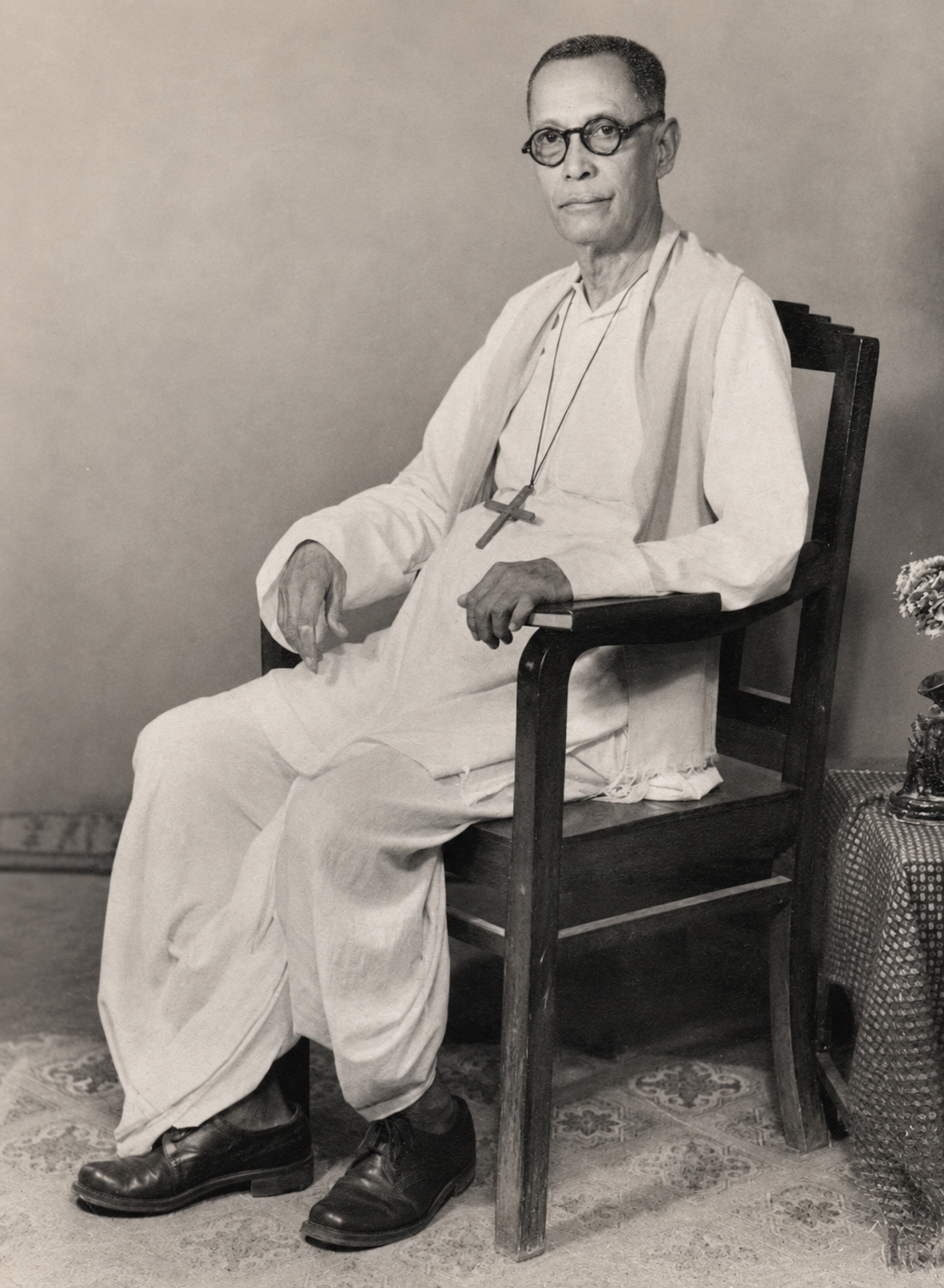
Subject to God’s will and grace Acharya Das will be 85 on the 20 September 1972. He will be thankful and happy for friends praying for him on this occasion. It would give him much pleasure if any outside friends and old associates could conveniently visit Varanasi at the time. We could then have a season of good, fellowship in some creative thinking and prayer.
— Father Ishwarprasad
Edited and Published by:
Rev. R.C. Das, M.A.,
Khristpanthi Ashram,
129, Dashashwamedh, Varanasi, India
Printed at:
Evangelical Press,
“CHRIST NAGAR MISSION”,
Badagayedapadavu Post, Mangalore Taluk, S. India