
My Spiritual Pilgrimage
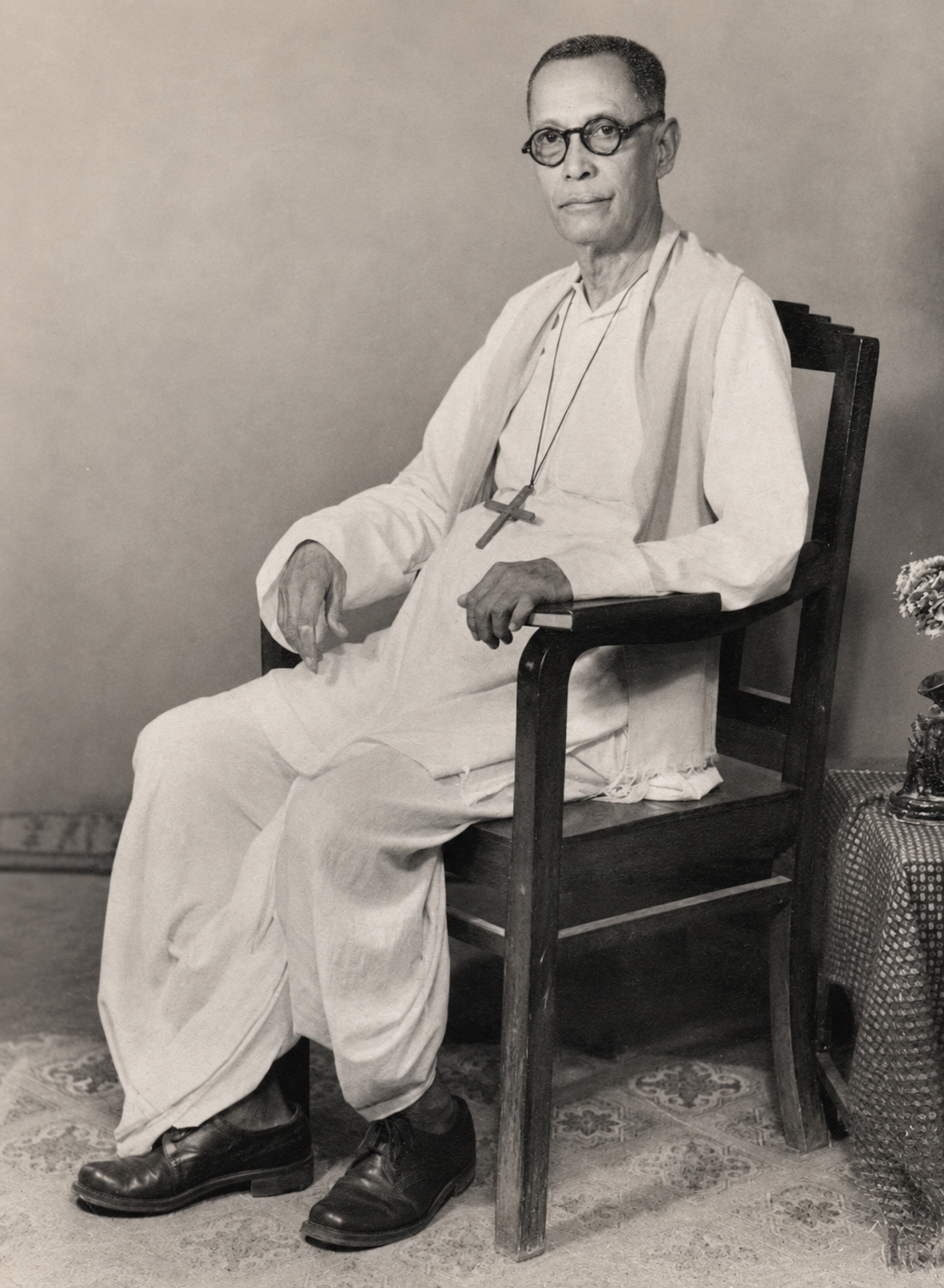
(By the Rev. R.C. Das, M.A., of the Khristpanthi Ashram, 129, Dashashwamedh, Varanasi; written in 1911 at the suggestion of the Rev. Peter Noble, English B.M.S. who baptised me in 1908; published in the National Christian Council Review in March 1949, and presented to the conference of Hindu converts in Bangalore in May 1963, under the Christian Institute for the Study of Religion and Society. The following is from the version published in The Church of Christ in 1967, vol. 4 no. 1, pp 6-9 and vol. 4 no. 2, pp. 11-14.)
I was born of humble parents in the year 1887 in a tiny village near Sabhar, a commercial centre 16 miles away from the city of Dacca, second capital of the Bengal Presidency (now chief city of East Pakistan). All the influences of society and environment were practically against my getting any education worth the name. But my father had a noble heart and a good intention. Against all traditions and to the surprise of all his fellow villagers, he made arrangements for my education which would at least enable me to live a respectable life among an agricultural people. So, early in my boyhood I passed through about half a dozen small pathshalas and village gurumahasayas (original and primitive schools and teachers) and at last entered the government aided middle English school at Sabhar where, after the usual period of study, I passed my middle vernacular examination and secured a government scholarship. My father was at once glad and sorry because in order to enjoy the scholarship, I was to continue my studies in English in some H. E. school away from home. He did not like the idea very much. However, being persuaded by my teachers who loved me sincerely and wished my welfare and progress, he became reconciled to the idea of sending me to Dacca for secondary education. I was perhaps 13 years old when I was admitted to the B.I. Jubilee H. School, Dacca, and took up lodgings in a students mess.
In my boyhood days I was a little too gentle and shy, and had a religious turn of mind, all of which combined to give my parents and friends the false impression that I was going to be a fool in the world. However, they did not disturb my studies and did not cross my wishes because my pundits and the educated people of the neighbourhood spoke well of me, and assured my father of my future prospects. Early in these days being disgusted with unsatisfactory surroundings, I discovered within my breast a craving for a higher ideal in life. It was rather inarticulate. I always used to seek good company, loved religious meetings and conferences, and had a great passion for jatras and rammangals - semi-theatrical performances representing the lives and deeds of great kings and religious heroes of ancient India such as Ram and Krishna. My father as a Vaishnava (follower of Vishnu, God of grace and love) had some reputation of being a devout man and used to have fellowship with other Vaishnavas of the locality. According to the wishes of my father, I read the Ramayana and the Mahabharata from beginning to end. Sri Krishna, Sri Ram and Sri Chaitanya, the central personalities of Vaishnava faith in N. India were the objects of my devotion and worship. As I had a somewhat strong imagination, the other gods of Hinduism except for Saraswati (goddess of learning) had a second place in my heart because of their unsatisfactory character. Though I had a passionate love for and a deep faith in Krishna, doubts often arose in my mind whether the Hindus were justified in worshipping the physical image of Krishna. Krishna to me was rather an ideal, and with that I was for the time being satisfied. I remember having heard from time to time Christian preachers, but no definite impression was made upon me. I remember having bought a few books from them most probably the Psalms and the story of Joseph and his brothers. These books appealed to my impressionable heart. But I am not sure whether I heard or read anything about Jesus at that time when I was in the village.
In the students mess where I was living in Dacca, there was a young man who had acquaintance with the local Baptist missionaries, and also with the ministers of the Brahmo Samaj (worshippers of Brahmathe supreme personal God). He frequented both the Christian and Brahmo places of worship, attended their lectures and had conversations on religious topics. I liked his company, and he began to take me with him wherever he went. By and by I became acquainted with the Rev. J.D. Morris and Rev. W.S. Page of the Baptist mission, and with the Rev. Gurudas Chakravarty, Amrita Lal Gupta and Bhai Banga Chandra Ray three Brahmo ministers. Mr. :Morris came to love me and began to take special interest in me. His pious life and noble character led me to revere him, and I became a regular visitor to his place. He arranged a Bible class for both of us. My friend and I used to read the simple story of Jesus life and death in wonderful words of life. I found them so real, consoling and life-giving that these simple words began to take root in my heart. Simultaneously I joined a Bible class in the Mission House conducted in a scholarly way by the Rev. J.N. Rawson, Rev. C.B. Young and together with Dr. Meghnath Saha (famous scientist), my class friend, carried off the first and second prizes of the All Bengal Bible Examination.
However, I used to visit regularly the Brahmo Samaj also, attend their Sunday services, their lectures and had religious conversation with their ministers. Above all Bhai Banga Chandra Ray, minister of the New Dispensation Church, an old saintly man, produced a deep impression upon me; I liked his sermons and prayers very much and devoured them eagerly. I was surprised to see that though a Brahmo he used to speak of Jesus more than Buddha or Mohammed and drew his texts from the New Testament more than from any other scripture. But what is most notable in my connection with the Brahmo Samaj is the fact that as a regular active member of the East Bengal Student Association (of Brahmo Samaj) I had the opportunity of studying a good deal of valuable literature on biography, religion, criticism, history, morals, poetry and so forth. I was a passionate lover of books, especially books on morals and religion, and read as many as I could from the Brahmo Samaj library. I remember on one of the first occasions when I attended the Brahmo Samaj Sunday Service, I actually shed tears on hearing a most touching hymn. Their form of worship, hymns and sermons appealed to me most strongly. Study of Brahmo literature, constant attendance at their services and meetings, and private personal inquiry as to what Brahmoism was resulted in a gradual and total collapse of my faith in Hinduism. Idolatry was now abominable to me. Sri Krishna became an inglorious personality enveloped in mythical mist. Nevertheless, Brahmoism had not given me anything tangible on which I could lay a firm hold. It gave me a vague ideal of a Spiritual Being, loving, beautiful and sublime. To Him, I was taught, every human being was individually responsible for right living, and from Him alone one was to draw all inspiration and guidance in life. Buddha, Chaitanya, Christ, Mohammed and others were great prophets having a greater knowledge of divine things than ordinary mortals. They were our ideals and guides in so far as their teachings and actions tallied with reason and intuition. I tried to realise the presence of this God, and tried to pray and worship in spirit and in truth. But to remove the uneasiness which destructive Brahmoism had created in me, I resorted to other means. I had heard about the Ram Krishna Mission, and the Arya Samajists, since my friend had already acquaintance with some people of these missions. To pacify my restless spirit I began to inquire of their faith by reading and by personal interviews. Thus, I read a good deal of most fascinating, but unsound literature, on Neo-Hinduism. The Satyarth Prakash of Swami Dayanand Saraswati (like Brahmoism) successfully shook my faith in popular Hinduism altogether. But later experience showed it was not an unmixed evil. But their new ways of interpretation of Hinduism did not seem to me very conclusive and justifiable, especially when I judged them in the light of Brahmoism. However, these contacts left some permanent impressions which were later useful in my understanding of some of the deeper aspects of Christianity.
Gradually I discovered that my friend who was almost always my companion was somewhat shallow and of a trifling nature. He sought information regarding religion just to satisfy his intellectual curiosity. He tried to know only for the sake of knowing, not for applying his knowledge in life. Simple knowledge and not sincere action was his principle in the inquiry into religious truth. So gradually I came to dislike him and tried to avoid him whenever I could. I felt that as a man I must act according to the light that I was receiving. My friend also became somewhat suspicious of me, and henceforth our mutual intimacy became loosened, and we remained friends only in appearance. This man gradually took the role of a social reformer and finally became a member of the Legislative Assembly of East Bengal.
My student friends noticed my movements and tested my attitude towards religion. It became known to all very soon that I had no longer any real faith in Hinduism though I conformed to some of its rules and regulations such as bowing before idols, observance of the rules of caste, etc. But I did all these only to avoid social disturbance. I broke caste secretly long before and could no longer believe in it. My relatives and friends devised means to prevent me from breaking away from Hinduism. But secretly and carefully I got on well though I often met with opposition and various troubles. Both my Christian and Brahmo friends encouraged me and gave me timely advice. My father tried to get me married several times but was not successful due to my flat refusals. All through this restlessness of spirit and heart I was getting on well with my studies and became almost independent of all financial help from my father by securing government scholarships, stipends at school, and help from other sources, such as subscriptions from classmates who were attached to me for my brains and good conduct. This independence of means enabled me to get on without any serious disturbance.
I became attached to Brahmoism and to Christianity almost simultaneously though during the earlier part of my residence in Dacca I was inclined more to Brahmoism than to Christianity. Had I not kept up this connection with Christianity (for which I thank God) perhaps I could not have become what I am today. There was sufficient reason for my partiality to Brahmoism at that time. First, it is indigenous in every way, and so naturally appealed to my heart. Secondly, it possesses a most excellent literature in the vernacular which, I believe, is the most effective instrument to change men’s opinions. Thirdly, it offers a reconciliation of all the conflicting religions of the world though I discovered the fallacy of its eclecticism before long. Lastly, the Brahmo community is highly developed in point of education, morals and religion, and is a pleasant half-way house between Hinduism and Christianity. All these drew my attention to it. I hardly found any good Christian literature and scarcely frequented the Christian chapel. I remember having gone to the Bengali service once or twice, but it gave me little satisfaction. Everything, even the very atmosphere, seemed to me foreign and alien to my taste. But it must be noted that I never broke my connection with Mr. Morris. I had made considerable progress in the study of the Bible. We used to have prayers together after reading the Word of God. All this was exerting a secret influence upon my soul. Brahmoism stirred my whole being, but it was more critical than constructive; while I found a sure and lasting consolation whenever I read of the gentle Jesus. I noticed there was something real and living behind the simple words of the Gospels. Gradually the personality and character of Christ began to capture my imagination. I found that the words of the Gospels were not merely dead letters, but full of inspiration and power above all soothing and life-giving. As days went on a dignified, sedate but yet most glorious and dazzling ideal appeared above my mental horizon. I was experiencing the power and winning influence of the personality of Jesus. The gospel message gave me hope and gladness, and supplied me with an ideal. But if it had ceased there, I could not have been what I am.
The living word of God warned me of a serious fact in my life. The life and death of Jesus convinced me of the fact that God is not only loving, beautiful and almighty, but that above all He is holy and righteous. The character that has been revealed through the Gospel pages brought out my own character in its true colouring: it told me plainly that I was a miserable sinner, unworthy of the Heavenly Fathers love and affection. My whole life became gloomy. At this time I was most unhappy not knowing how to relieve my pain. I had not yet understood the meaning of the death of Christ and so resorted to Brahmoism to seek for relief of my anguish. I thought that through sorrow and repentance I would be able to wash away the stain on my soul and secure Gods forgiveness. So I decided to accept Brahmoism not knowing definitely why, only thinking that thereby I would be able to quell the storm that had arisen in my moral life. This period of my life about a year was a most unhappy time for me. I tried but could not become a Brahmo. Not that any human force kept me back, but I felt a supernatural power always working within my soul, heart and spirit. It was somewhat later that I became clearly conscious that it was the ever living Jesus of Nazareth that was inwardly controlling my life.
All through this stormy period I felt that I must be honest and sincere with myself. True to conviction, I must try my best to follow the light and the truth as far as I knew it. All through my inquiry after religious truth, I used to pray and meditate for light and truth. True to the rationalistic principles of Brahmoism I could not take Christ or any other great man as my sole spiritual guide and ideal. But I was now finding myself unable to resist the influence of the Son of God. Often did I utter unintentionally and unwillingly the simple name Jesus when in despair and sorrow; often did I lisp the expression in Jesus name silently after a solemn and earnest prayer. Mr. Morris often spoke about Jesus, about His love and my sin, but he never persuaded me to become a Christian. He often advised me in his letters to follow the right and shun the false when I knew it. Often did I write to him almost unwillingly about my faith in and love for Jesus. Very soon I came to find in Jesus my personal saviour, my friend, my guide and ideal. I believed because I could not help believing. In this conviction and experience I was helped by Dr. Frank Lenwood of the L.M.S. who at that time was on a lecture tour in India, and visited us in Dacca. His main theme was man’s sin and Gods redemption.
Now came another conflict in my soul between Brahmoism and Christianity. Brahmoism taught me to be critical; I felt I must not take Christ so easily. My faith in Jesus might be the product of a charm and just an emotion not necessarily an intelligent response to truth. I must question Him and test Him. If He could stand the test, I would accept Him or else not. This was a period of intellectual doubt, conflict and struggle. The supernatural element in Christianity was for a long time a great stumbling block to me until through the agency of both human and divine help, I was led to see that all true religion as such, and especially Biblical revelation, is inseparable from supernaturalism. The possibility of a special revelation was a knotty problem, but soon I was convinced that for a perfect, adequate and vital religion revelation was absolutely necessary. I believed quite sincerely that truth must triumph in the long run. So I applied this rational criticism against Christianity and Brahmoism alike. Under the pressure of this criticism my faith in Brahmoism came to pieces. I found that Brahmoism was a mental abstraction and a philosophic speculation having little reality behind all its teachings, and no organic unity amongst its principles. I discovered the unsoundness of its eclecticism. I found that Brahmoism was largely Christianity divorced from the living personality of Jesus Christ, and my surprise knew no bounds. It taught me that God is loving, but it overlooked that He is also holy and righteous which I learned at the feet of Jesus. It talked loudly of the fatherhood of God and brotherhood of man. But all this is meaningless without the Son-ship of Jesus. Brahmoism stirred the depths of my soul, created a restless spirit in me, but gave no adequate consolation and peace. It told me to repent and turn to God, but I was unable to work true repentance. I often shed tears but found no peace, no assurance of Gods love and forgiveness. It increased my restlessness and dryness of heart. I chased the shadowy ghost of the God of Brahmoism in vain. It eluded my grasp, and I could not worship unless I created a God in my heart. But I was not to be satisfied with imagination. I wanted reality which would at once satisfy my conscience and intellect. Brahmoism hardly told me anything of the stain and impurity which blackened my soul and heart and dimmed my vision of God and defiled His image in me. Brahmoism scarcely offered me an adequate means of salvation except a false repentance which has to be worked out. It told man to go to God but did not undertake to remove the barrier between. Reason and intuition are the ultimate criteria of truth according to Brahmoism. Revelation is an absurd impossibility. Well did my whole nature revolt against such a system when I arrived at the age of discretion and maturity. Christianity I found to be the most rational faith which satisfied the intellect as well as the deepest needs of the human soul. I tested Christ and found Him true and strong. In Him, I found my highest moral ideal, and the perfect assurance of a Divine Reality who is our loving and just Heavenly Father. The purpose and necessity of Christs death on the cross of Calvary became clear to me, and as I linked myself to Him through faith and trust and surrendered my will to His, I found myself electrified with His Spirit, my sense of guilt removed, the black stain washed away by the sacred blood of the lamb of God. The heavens were opened as it were, and a new vision of life crossed my mind. I decided to accept Christ as my Saviour and Lord publicly through baptism. I told my father of my conversion and decision. He wept bitterly and apparently did not oppose. My friends and people also became alarmed, and all combined to prevent me from becoming a Christian. They offered me many strong temptations. To some of them I yielded. But Christ would not let me go astray; He raised me as soon as I fell because I looked up to Him even when I was falling. At last, through the weeping and sorrowing of my parents and friends, I was led nearest to my Saviour and was baptised in 1908 by Rev. P. Noble, Superintendent of Baptist Mission, Dacca.
Come unto me, all ye that labour and are heavy laden, and I will give you rest. Take my yoke upon you, and learn of me, for I am meek and lowly in heart and ye shall find rest unto your souls. For my yoke is easy, and my burden is light (Matthew 11:28-30). That gracious tender call of Jesus, the like of which I had not heard anywhere else, arrested my attention. The whole process of my conversion was completed when I became convinced of the legitimacy, authority and force of the unique claim of Christ when He says, I am the way, the truth and the life; no man cometh to the Father but by me (John 14:6).
Before I became a Christian, I had no definite idea as to what work I should do in my life. My only anxiety then was to find out a moral ideal and a spiritual standpoint and when once I found that, I thought it would be all right with me. And I thought rightly. It was after my baptism, in lonely prayer before the throne of God, that I found out His will and purpose for my life. It was after cool deliberation and through God’s guidance that I arrived at the final decision with regard to my lifework. I felt my humble life, all my energy and ability, must be used in the service of my Master to whom I owed all that I was.